Best AI email marketing tools in 2026
Jul 08, 2026
/
Bruno S.
/
13 min Read

The best AI email marketing tools are platforms that use artificial intelligence to help you create, personalize, automate, segment, send, and analyze email campaigns. The right one depends entirely on what you’re trying to do.
Some platforms are built for beginners and simple campaign creation. Others focus on CRM-powered automation, ecommerce personalization, or predictive analytics.
Cold outreach, AI content generation, email design, and copywriting each have dedicated tools built for them. Free plans vary widely in what they actually include.
Each tool is compared based on AI features, best use case, pricing, availability of a free plan, and limitations.
Best AI email marketing tools at a glance
Tool | Best for | Key AI features | Free plan or starting price | Main limitation |
Hostinger Reach | Beginners and small businesses | AI email generation, subject line suggestions, AI audience segmentation | Free plan: 100 subscribers, 200 emails/month. Paid from $2.49/month | Limited third-party integrations |
HubSpot AI | CRM-powered automation | AI email drafting, Breeze AI content assistant, predictive lead scoring | Free plan available (2,000 emails/month, HubSpot branding). Starter from $9/month/seat (annual) | Can be expensive and complex for small teams |
Omnisend | Ecommerce stores | AI product recommendations, customer segmentation, email copy | Free plan: 250 contacts, 500 emails/month. Paid from $16/month | Less relevant for non-ecommerce businesses |
Instantly.ai | Cold email outreach | Deliverability optimization, AI-personalized sequences, inbox warm-up | No free plan. Outreach from $47.60/month (annual) | Not suitable for newsletter or ecommerce marketing |
GetResponse | AI content generation | AI email writer, subject line generator, landing page builder | 14-day free trial. Paid from $15.58/month | Broader feature set may be unnecessary for simple senders |
Klaviyo | Predictive analytics | Predictive segmentation, purchase likelihood, CLV scoring | Free plan: 250 profiles, 500 emails/month. Paid from $20/month | Expensive for small or low-activity lists |
MailerLite | Simple newsletters | AI writing assistant (paid plans), smart sending, automation | Free plan: 500 subscribers, 12,000 emails/month (AI assistant locked to paid). Paid from $9/month | No AI writing or templates on the free plan |
Brevo | Free plan with CRM features | AI email generation, segmentation, multi-channel automation | Free plan: unlimited contacts, 9,000 emails/month (300/day cap). Starter from $8.08/month | Automation is limited to 2,000 contacts on free and Starter plans; branding removal costs extra |
Loops | SaaS lifecycle emails | Audience branching, event-triggered flows, transactional email | Free plan available. Paid from $49/month | Too specialized for ecommerce or general newsletter use |
Sender | Free plan for automation | Email automation, segmentation, newsletter sending | Free plan: 2,500 subscribers, 15,000 emails/month. Paid from $7/month (annual) | Fewer third-party integrations than major platforms |
Stripo | AI email design | AI template builder, drag-and-drop editor, AMP email support | Free plan: 4 exports/month. Basic from $16.67/month (billed yearly) | Requires a separate platform to send campaigns |
Copy.ai | Email copywriting | AI email copy, subject lines, nurture sequences, cold email drafts | No free plan. Chat plan from $24/month (annual) | Does not replace a full email marketing platform |
Snov.io | Lead generation and outreach | Email finder, AI outreach sequences, drip campaigns | Free trial: 50 credits, 100 recipients. Starter from $29.25/month (annual) | Not ideal for permission-based newsletters |
1. Hostinger Reach
- Best for: Beginners, small businesses, creators, and Hostinger users
- Main features: AI email generation, AI campaign ideas, subject line suggestions, AI segmentation, automation templates, contact syncing from Hostinger Website Builder and WordPress, open/click/delivery and subscriber growth tracking
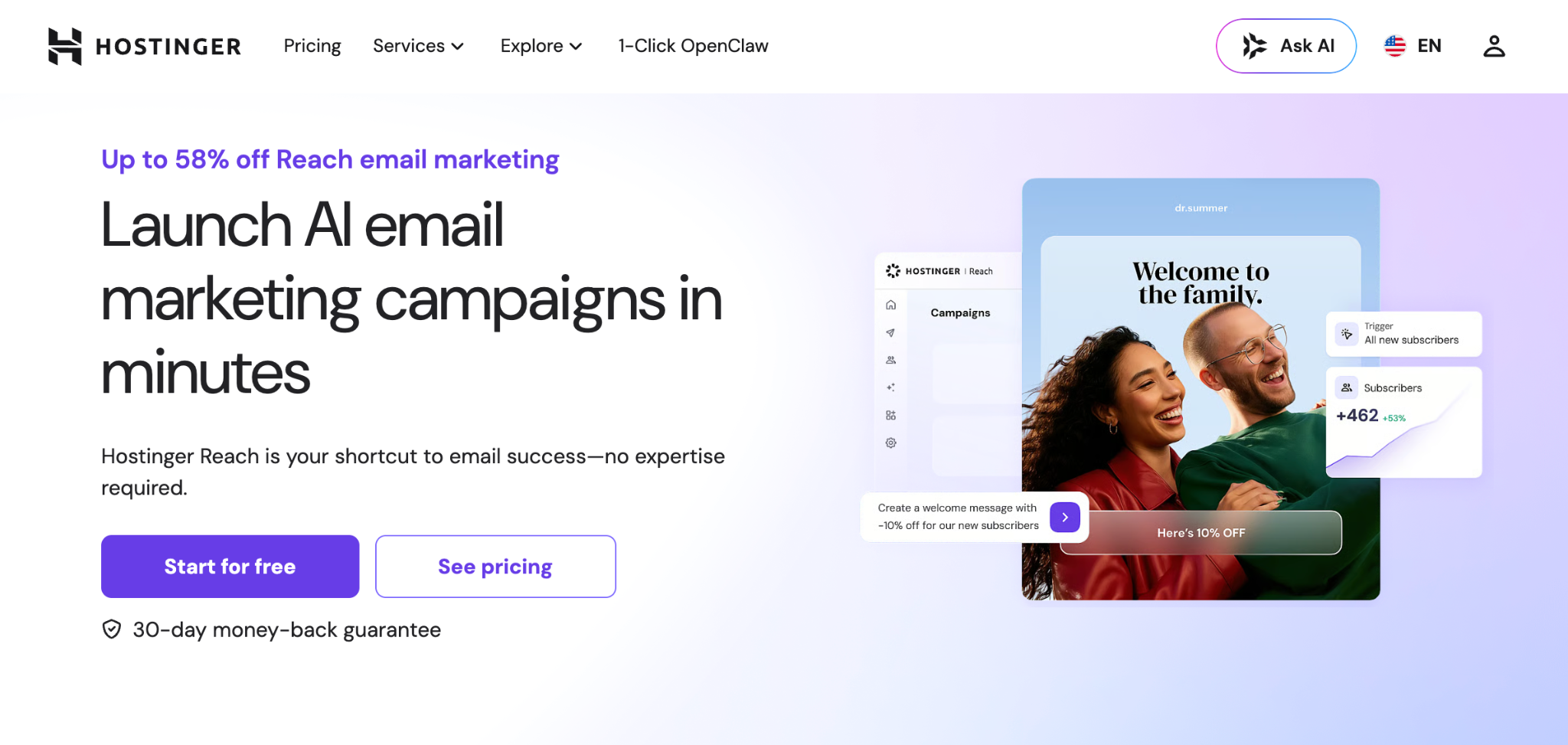
Hostinger Reach is an AI email marketing platform built for users who want to create and send AI-powered email campaigns without a complex setup.
The tool generates complete, mobile-friendly emails from a prompt, suggests campaign ideas to start from, and produces subject lines that match your content and tone. You can edit every element in the visual builder or ask the AI for quick revisions.
The AI segmentation feature lets you describe the contacts you want to reach in plain language, and Reach automatically builds the segment. Pre-made automation templates cover the most common use cases, and contacts sync directly from Hostinger Website Builder and WordPress.
Hostinger Reach automatically configures SPF, DKIM, and DMARC for Hostinger domains, removing a step that trips up many beginners. Every campaign includes unsubscribe links and follows CAN-SPAM and GDPR requirements by default.
The main limitation is third-party integrations – the platform currently supports fewer than most competitors.
Pricing: The free plan allows for 100 subscribers and 200 emails/month, no credit card required. Paid plans start at $1.99/month (billed annually) for 500 contacts and 3,500 emails.
2. HubSpot AI
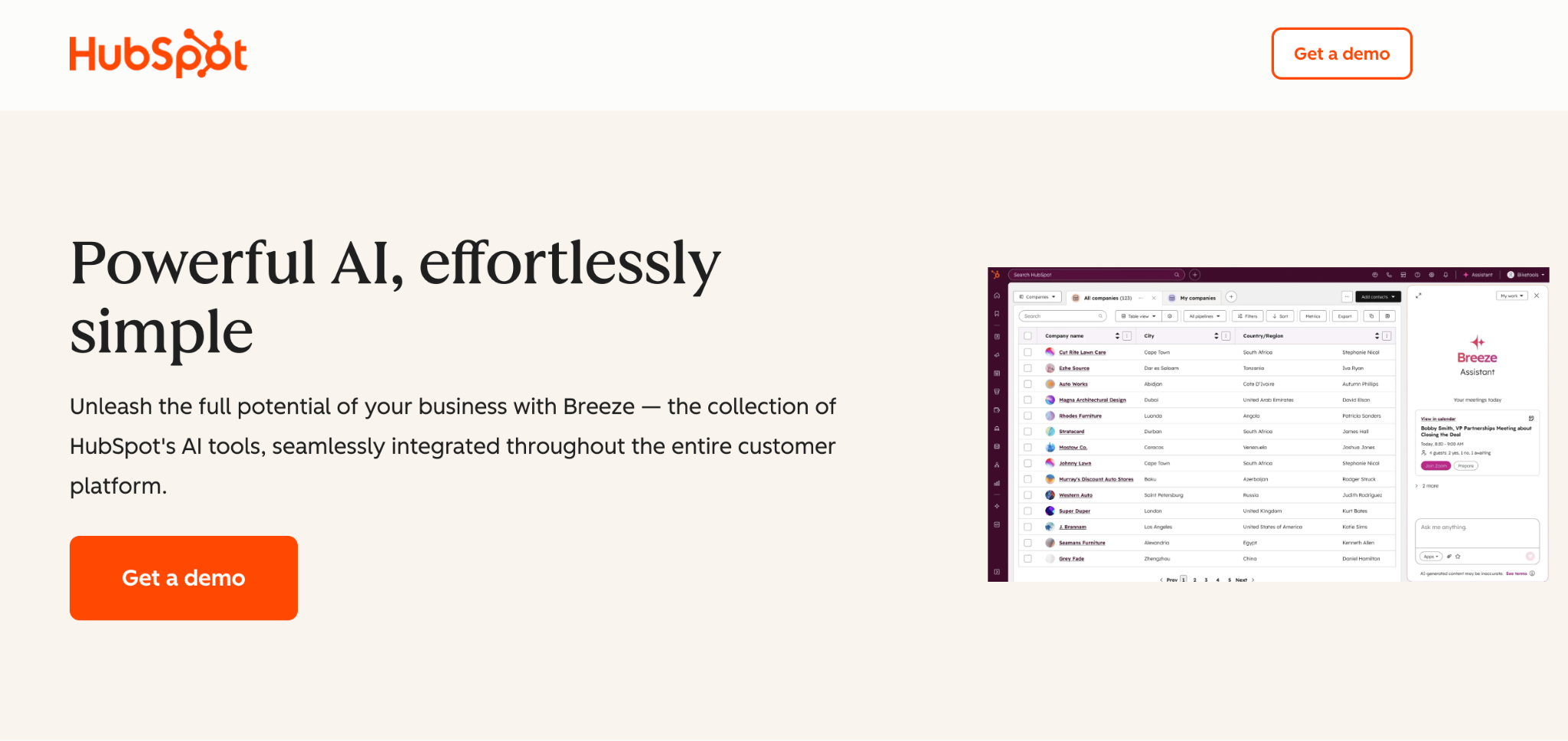
- Best for: Mid-market teams, CRM-heavy organizations, and sales and marketing teams on the same platform
- Main features: Breeze AI content assistant, AI email drafting, subject line suggestions, CRM-triggered automation, predictive lead scoring, revenue-linked reporting
HubSpot is a full marketing and sales platform, and its email marketing sits inside the Marketing Hub alongside CRM, landing pages, forms, and pipeline management.
That integration is what sets it apart: campaigns draw directly from unified contact records, so a form submission can start a nurture sequence and a sales rep’s activity can trigger a marketing email, all without switching tools.
The AI layer, called Breeze, includes a content assistant for drafting emails and subject lines, smart automation that triggers based on contact activity or deal stage, and AI agents on Professional and Enterprise plans that can generate campaign briefs, suggest segments, and draft full email sequences.
Reporting ties email performance back to pipeline revenue, so you can see which campaigns actually convert. However, that power comes at a cost: HubSpot can be more complex and expensive than beginner-focused email tools.
Pricing: The free plan includes email marketing with HubSpot branding and up to 2,000 sends per month. Marketing Hub Starter starts at $9/month per seat, billed annually.
3. Omnisend
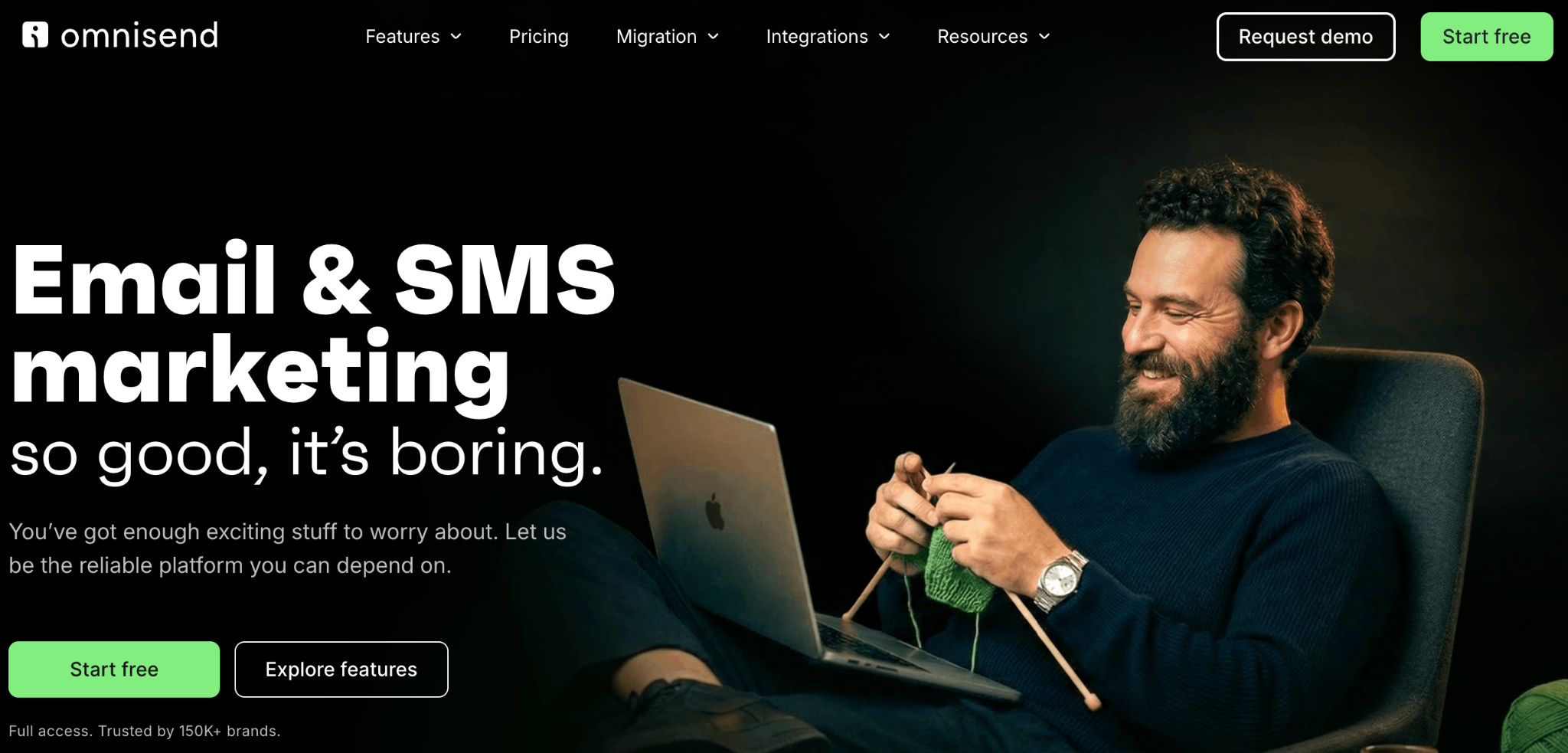
- Best for: Ecommerce stores running email and SMS campaigns
- Main features: AI product recommendations, behavior-based segmentation, email copy generation, pre-built ecommerce automation workflows, SMS, and push notification support
The platform’s pre-built automation workflows cover the 27 most common ecommerce scenarios, including abandoned cart, back-in-stock, browse abandonment, and post-purchase follow-up, so you don’t have to build flows from scratch.
Contact segmentation pulls real purchase and behavioral data, so messages reach the right customer at the right stage of the buying cycle.
Omnisend also connects natively with Shopify, WooCommerce, and BigCommerce, pulling real purchase and behavioral data directly into its automation engine. That data is what makes the automations work: instead of sending generic follow-ups on a fixed schedule, Omnisend triggers emails based on exactly what a customer did – viewed a product, abandoned a cart, or completed an order.
The result is significant: according to Omnisend’s 2026 ecommerce marketing report, automated emails generated 30% of email-attributed revenue from just 2% of sends.
The ecommerce focus is also Omnisend’s main limitation: if you’re running a SaaS product, a service business, or a general newsletter, you’ll end up paying for ecommerce capabilities you won’t use.
Pricing: The free plan covers 250 contacts and 500 emails/month. The Standard plan starts at $16/month for 500 contacts and 6,000 emails/month.
4. Instantly.ai
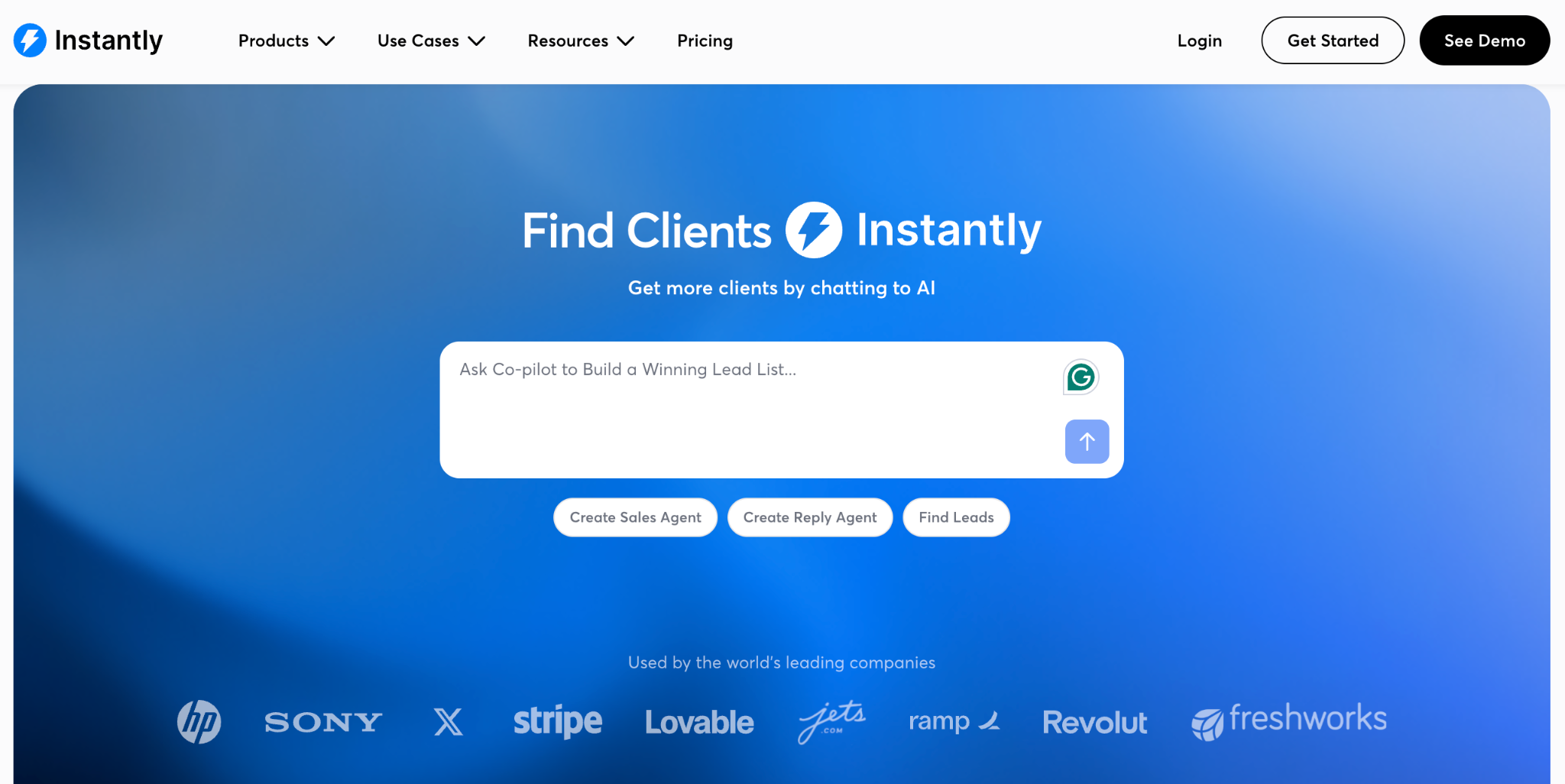
- Best for: Sales teams, agencies, and outbound teams running cold email at scale
- Main features: Unlimited sending accounts, AI-personalized sequences, inbox warm-up, sender reputation monitoring, lead database, built-in CRM
Instantly.ai is built for cold email outreach, not permission-based newsletter marketing. The platform supports unlimited email sending across all plans, which sets it apart from standard outreach tools.
AI-powered personalization lets you customize opening lines and sequences based on prospect data, and built-in deliverability tools rotate mailboxes to protect sender reputation and run warm-up automatically.
The lead database (Instantly Credits) and CRM are available as separate paid modules, so the full outbound stack is available in one place.
Keep in mind that Instantly.ai is not designed for ecommerce newsletters, subscriber list management, or general marketing automation. If you need permission-based email marketing, look for a different tool on this list.
Pricing: There is no free plan. The Outreach Growth plan, with 1,000 contacts and 5,000 emails/month, starts at $37.60/month billed annually. Real-world costs are higher once you add the lead database and CRM modules, typically $130–$200/month for the full stack.
5. GetResponse
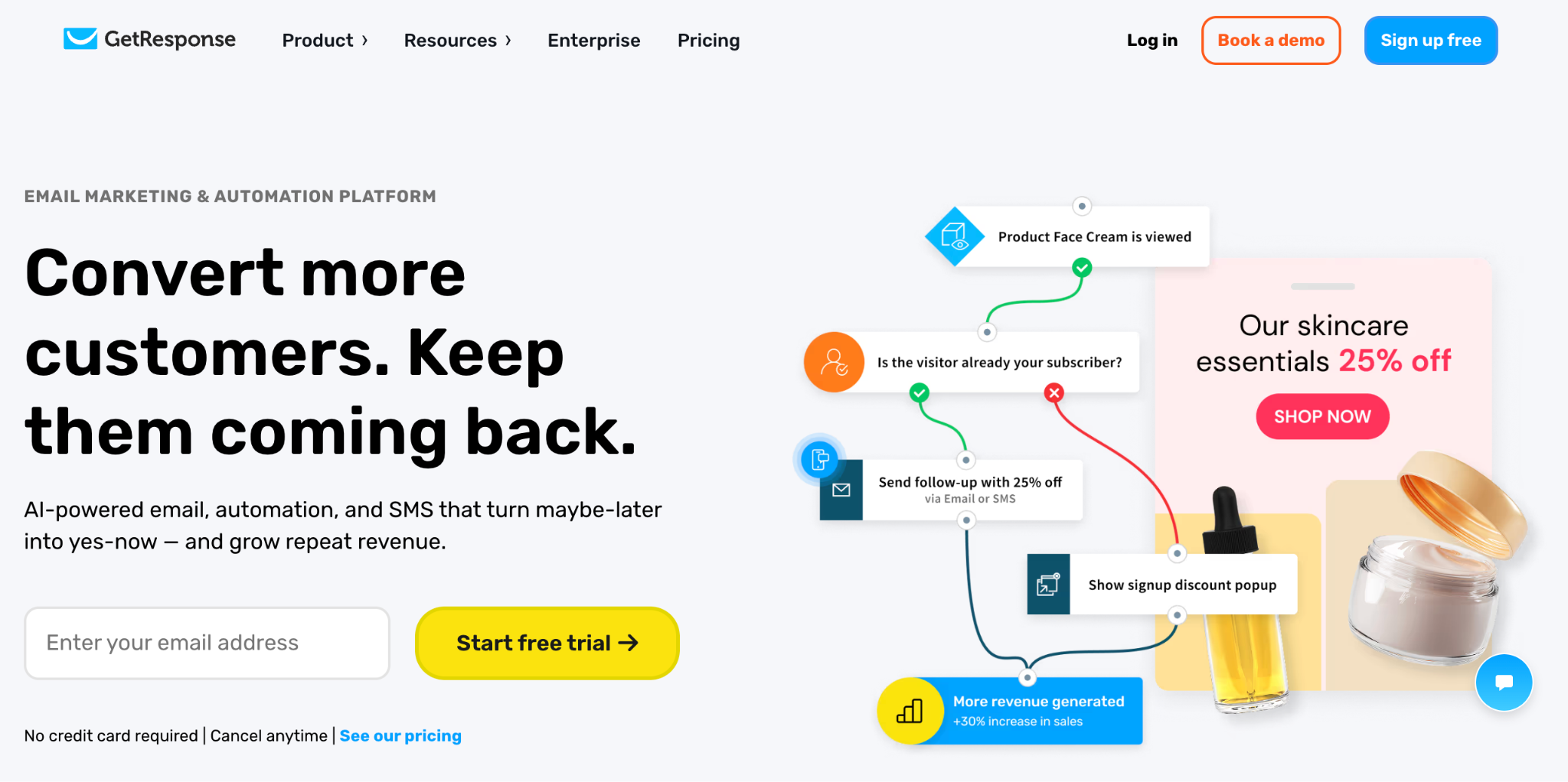
- Best for: Coaches, course creators, and businesses that need AI-assisted campaign creation across email, landing pages, and forms
- Main features: AI email generator, subject line suggestions, landing page builder, sign-up form builder, automation, A/B testing, webinar hosting
The AI email generator produces complete campaigns from a prompt, including subject lines, body copy, and CTAs. You can also generate landing pages and sign-up forms using the same workflow, which makes GetResponse useful for anyone building multiple campaign assets at once.
The platform covers the full campaign creation cycle: AI writing, list management, automation, A/B testing, and analytics. Webinar hosting and a website builder are included in higher plans.
If you only need email, though, the broader feature set may feel like more than you require.
Pricing: GetResponse offers a 14-day free trial. The Starter plan begins at $15.58/month (annual billing) for 1,000 contacts with unlimited emails, basic automation, landing pages, and the AI email generator.
6. Klaviyo
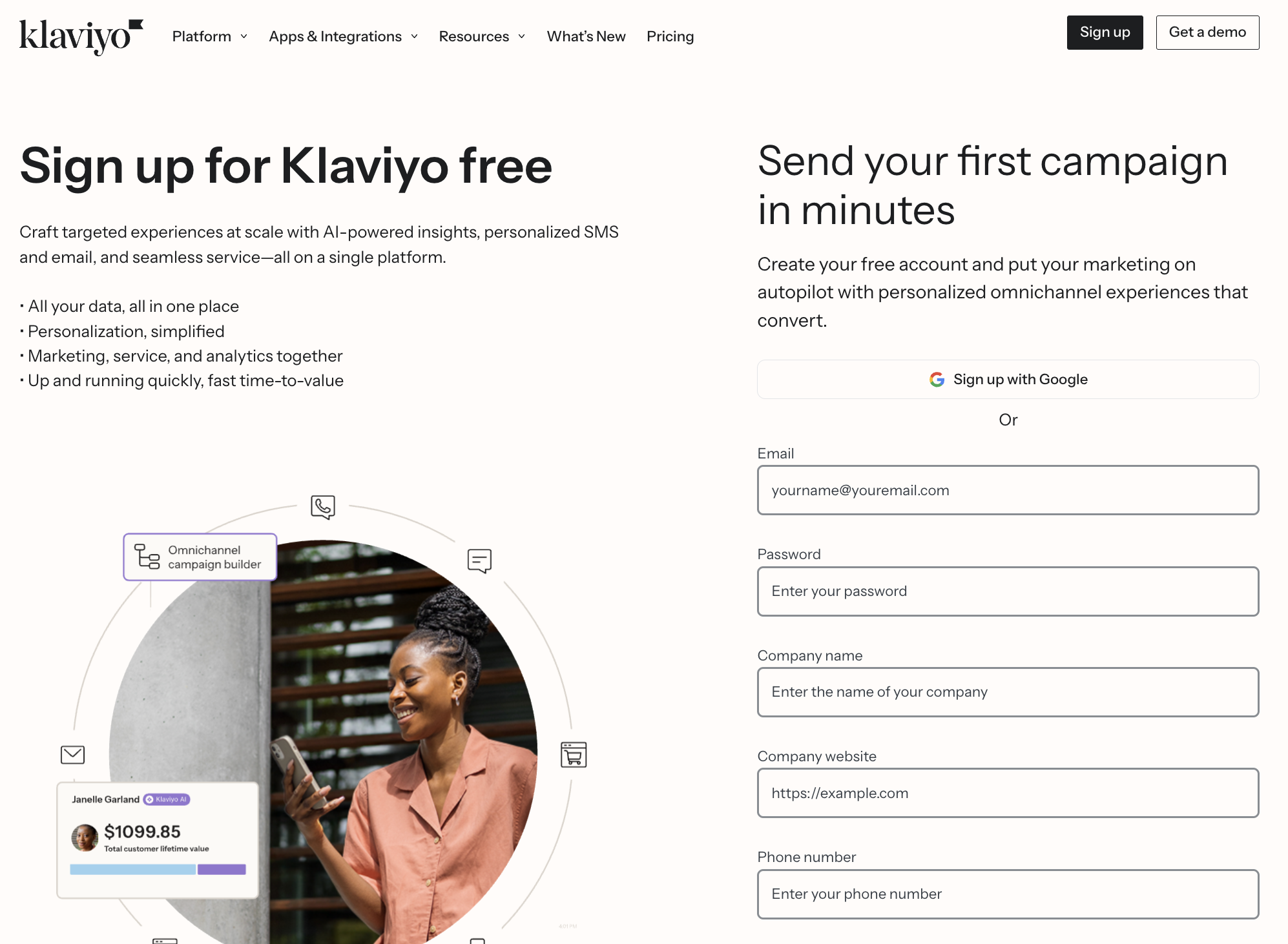
- Best for: Growing ecommerce brands that need predictive analytics and revenue-focused automation
- Main features: Predictive segmentation, purchase likelihood scoring, CLV prediction, AI-generated segments and content, Marketing Agent for flow building, 350+ integrations
Klaviyo builds unified customer profiles from purchase history, browsing behavior, and engagement data, then uses that data to predict what a contact is likely to buy next, their estimated customer lifetime value (CLV), and the probability of churn.
These predictions power segmentation: you can target customers likely to convert in the next 30 days, suppress contacts unlikely to engage, or trigger post-purchase flows based on what someone bought.
The AI feature set, including the Marketing Agent for building flows, is available on all plans. Feature access doesn’t change as you scale; pricing increases only because the number of active profiles increases.
Klaviyo’s profile-based pricing scales steeply, though. For small lists with low engagement, or for businesses outside ecommerce, the cost can outpace the value.
Pricing: The free plan covers 250 profiles and 500 emails/month. Email plans start at $20/month for 251–500 active profiles.
7. MailerLite
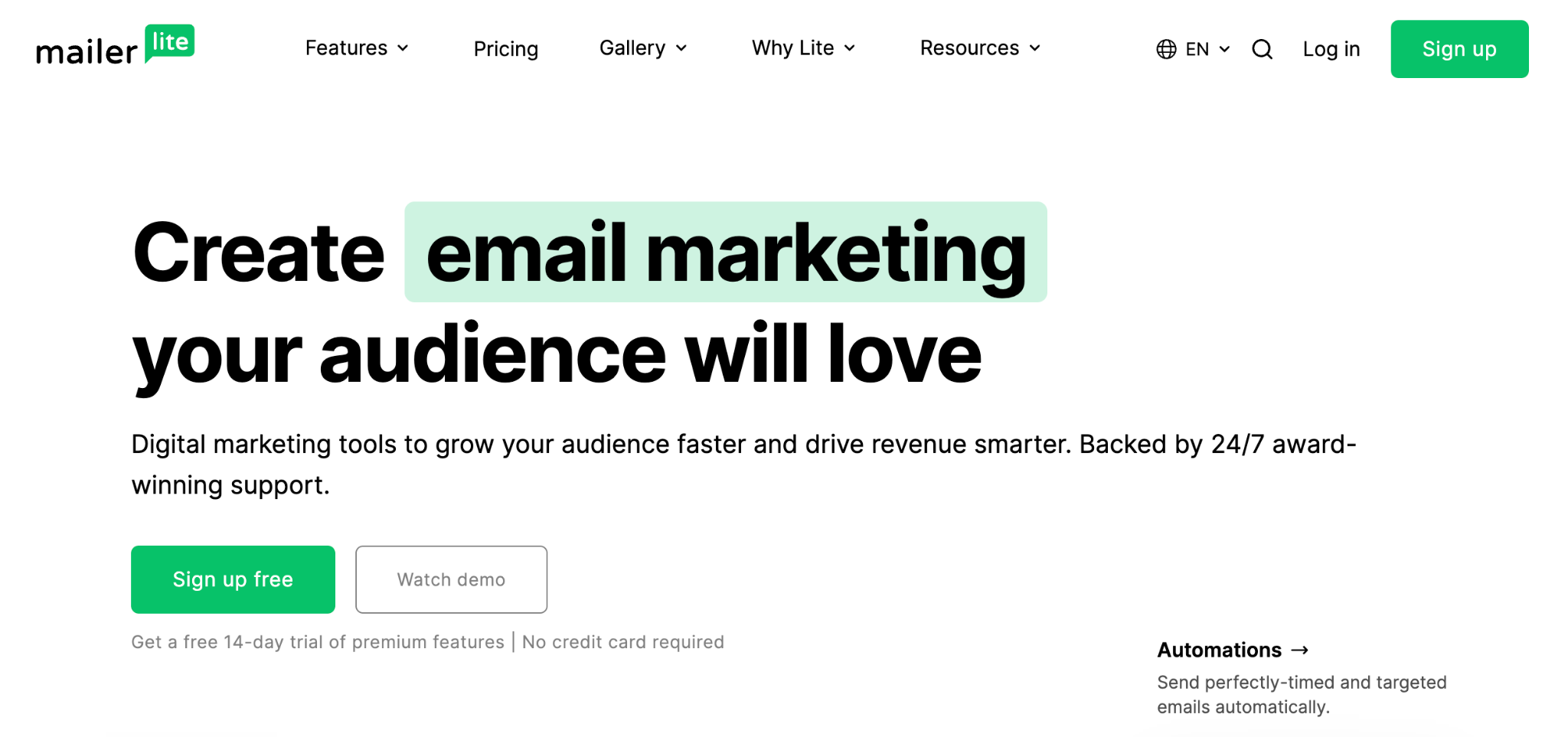
- Best for: Small businesses, creators, and newsletter senders who want a clean, simple platform
- Main features: AI writing assistant (paid plans), smart sending, automation, A/B testing, landing pages, paid newsletter subscriptions, and digital product sales
The drag-and-drop editor is one of the most intuitive in this category. Smart sending optimizes delivery timing based on past open behavior. For creators who sell digital products, MailerLite also supports paid newsletter subscriptions and digital downloads at 0% commission.
The AI writing assistant, which drafts email copy and subject lines, is available only on paid plans. The free plan includes automation and A/B testing but excludes templates, the AI assistant, and customer support after the first 14 days.
Where it falls short is depth: MailerLite doesn’t offer the CRM or predictive analytics available in HubSpot or Klaviyo, and the free plan’s subscriber limit dropped from 1,000 to 500 in September 2025.
Pricing: The free plan allows for 500 subscribers and 12,000 emails/month. The Growing Business plan, with unlimited emails, starts at $9/month (yearly billing) and also supports 500 subscribers, but doesn’t cap the monthly emails.
8. Brevo
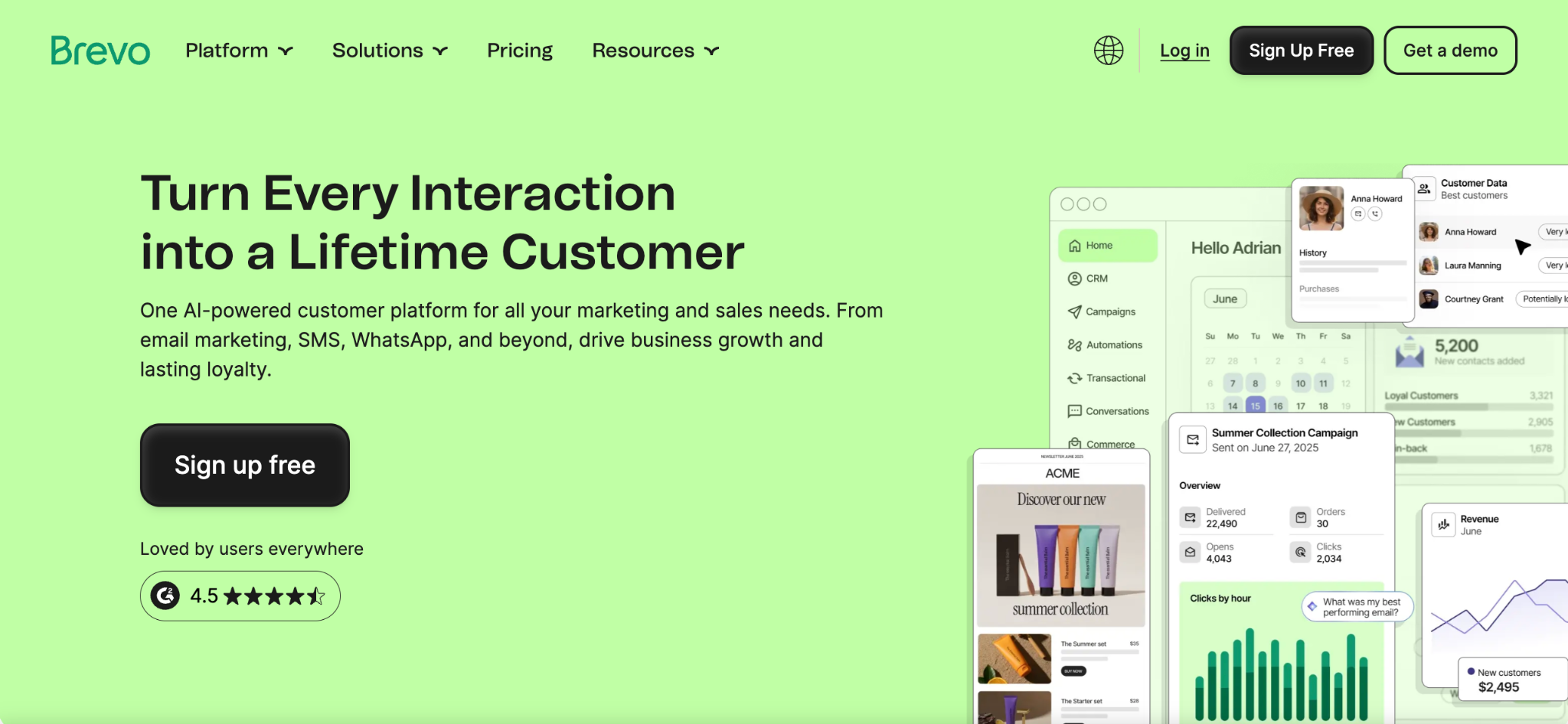
- Best for: Small teams that need email marketing and CRM features on a tight budget
- Main features: AI email generation, multi-channel automation (email, SMS, WhatsApp), built-in CRM, segmentation, volume-based pricing
Brevo is a multi-channel marketing platform that combines email, SMS, and WhatsApp campaigns on a single automation canvas. The built-in CRM tracks contact interactions, deals, and pipeline stages without a separate subscription, which makes it more capable than a pure email tool at a similar price point.
Paid plans scale by email volume rather than subscriber count, which keeps costs predictable for businesses with large lists that send infrequently. AI features include email generation and segmentation across all plans.
A few caveats: advanced AI and automation features are tied to higher plan tiers, and the daily sending cap on the free plan limits its usefulness for large single sends. Plus, removing Brevo branding from emails costs an additional $10.80/month on the Starter plan.
Pricing: The free plan includes unlimited contacts and 9,000 emails/month, with a daily cap of 300 and automation limited to 2,000 contacts. The Starter plan starts at $8.08/month (annual) for up to 100,000 emails/month and removes the daily cap.
9. Loops
- Best for: SaaS and product-led teams running lifecycle email campaigns
- Main features: Event-triggered flows, audience branching, onboarding sequences, transactional email, behavior-based segmentation
Loops is built specifically for onboarding sequences, product activation emails, feature announcement flows, and re-engagement campaigns. The platform uses events and audience filters instead of traditional list-based segmentation: you define who enters a loop based on the action they took, the plan they’re on, or their position in the onboarding flow.
Transactional email is also built in, so product notifications and receipts share the same infrastructure as marketing campaigns.
That specialization works against it outside SaaS: Loops is not built for ecommerce purchase flows, general newsletters, or traditional list-based campaigns.
Pricing: The free plan covers 1,000 contacts and 4,000 emails/month, with Loops branding in the footer. Paid plans remove those limits, add unlimited transactional emails, and start at $49/month.
10. Sender
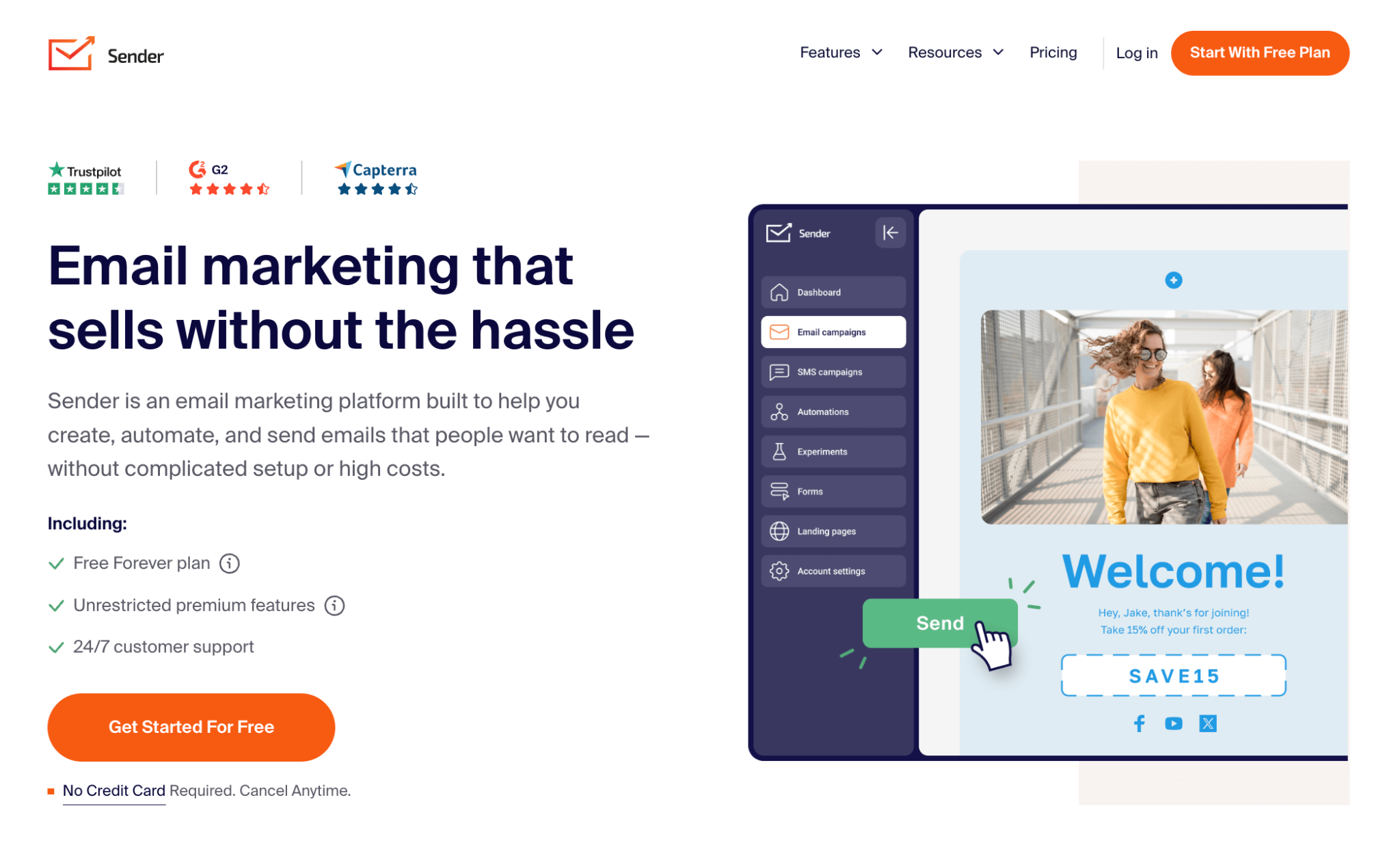
- Best for: Small businesses and early-stage teams that need a generous free plan with automation included
- Main features: Email automation, segmentation, drag-and-drop editor, templates, landing pages, WooCommerce integration, 24/7 support
Sender is a straightforward email marketing platform built around giving small businesses and early-stage teams access to core features without a paywall.
The drag-and-drop editor produces clean, responsive emails, and automation workflows cover welcome sequences, abandoned cart emails, and behavioral triggers. WooCommerce integration is included, and 24/7 support is available on all plans, including the free tier.
Sender handles the fundamentals of list building, campaign sending, and automation without restricting core features behind a paywall. It doesn’t offer a built-in AI email generator on par with Hostinger Reach or GetResponse, but for teams that need reliable sending and automation at low or no cost, it covers the essentials.
The trade-off is depth: Sender’s automation is functional but shallow for complex workflows, it has fewer direct third-party integrations than larger platforms, and there is no built-in CRM.
Pricing: The Free Forever plan covers 2,500 subscribers and 15,000 emails/month. The Standard plan starts at $7/month (billed annually) for up to 1,000 subscribers.
11. Stripo
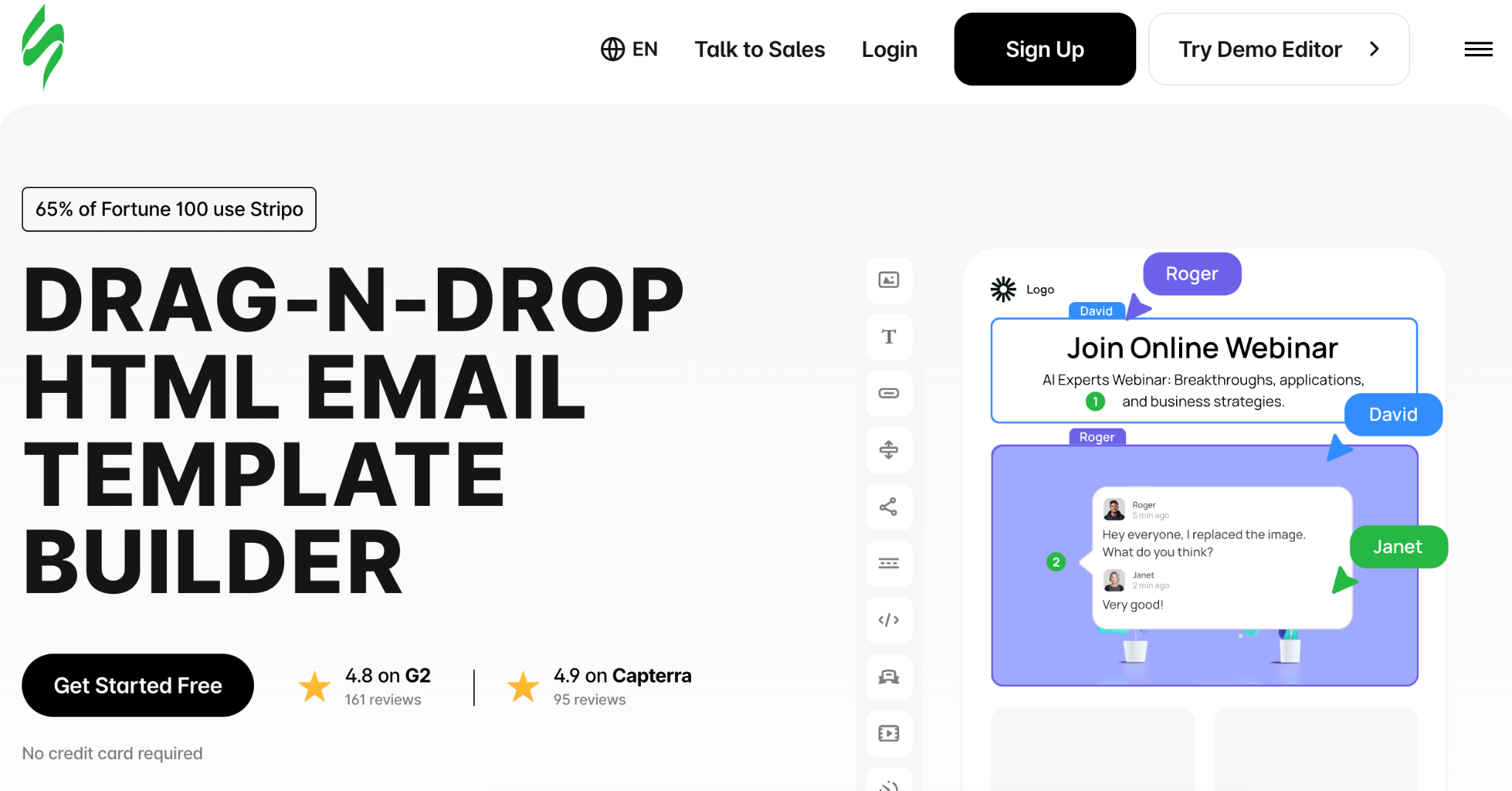
- Best for: Marketing teams and agencies that need polished email templates before sending through another platform
- Main features: AI template builder, drag-and-drop editor, AMP email support, export to 80+ email service providers
Stripo is an AI email design tool, not a full email marketing platform – the AI template builder generates email layouts from a prompt. The drag-and-drop editor offers granular control over structure, typography, and modules, including AMP email support for interactive elements like carousels and live polls.
Stripo exports directly to 80+ email service providers, including Mailchimp, HubSpot, Klaviyo, and Brevo, so your design lands in your sending platform with one click.
The key limitation: Stripo does not send emails, manage subscriber lists, or run automations. You still need a separate platform for everything except design.
Pricing: The free plan includes 4 exports/month, 5 test emails/day, and 10 stored emails. The Basic plan costs $16.67/month (billed yearly) and raises those limits to 50 exports, 50 test emails/day, and 50 stored emails, and adds premium templates.
12. Copy.ai
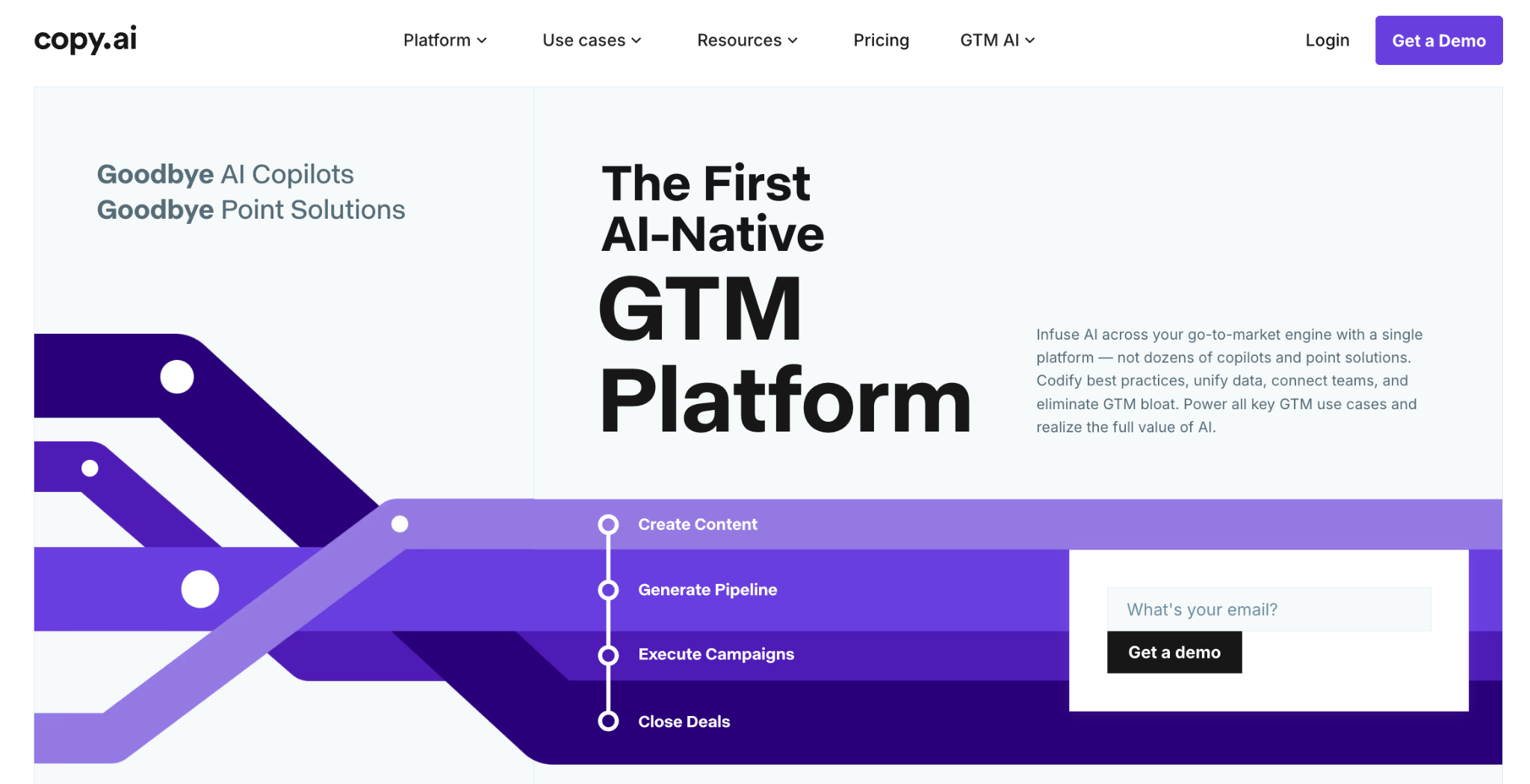
- Best for: Marketers who already have a sending platform and need faster email copywriting
- Main features: AI email copy, subject lines, preview text, nurture sequences, cold email drafts, multi-step workflows, brand voice settings
Copy.ai generates subject lines, body copy, promotional emails, and full nurture sequences from prompts. The platform supports multi-step workflows, so you can build a 5-email sequence in a single session.
It’s a writing assistant, not a campaign platform — it doesn’t manage subscriber lists, send campaigns, track deliverability, or run automations.
Pricing: Copy.ai doesn’t offer a free plan. The Chat plan costs $24/month (billed yearly) and includes 5 seats, unlimited words, unlimited projects, and access to OpenAI, Anthropic, and Gemini models. Enterprise pricing is available on request.
13. Snov.io
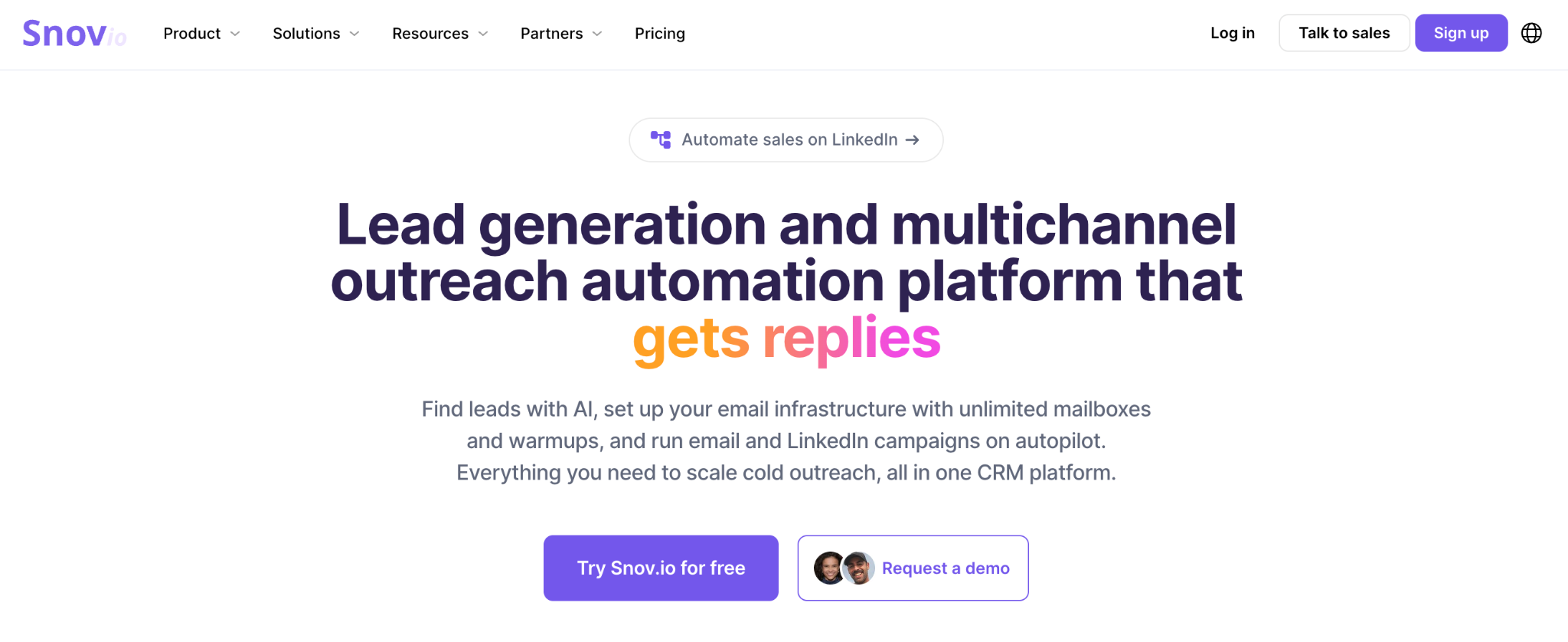
- Best for: Sales teams and agencies running lead generation and outbound email workflows
- Main features: Email finder, prospect database, AI drip sequences, email verification, lightweight CRM
Snov.io combines an email finder, a prospect database, drip campaign automation, and a lightweight CRM into a single outbound stack. The email finder identifies and verifies prospect addresses from LinkedIn profiles, company domains, and databases.
AI-powered drip sequences trigger follow-ups based on whether a prospect opened, clicked, or ignored the previous message, and email verification runs automatically to reduce bounces before you send.
It’s purpose-built for outbound, so Snov.io is not the right fit for permission-based newsletter marketing, ecommerce lifecycle campaigns, or subscriber list management.
Pricing: The free trial plan includes 50 credits, 100 recipients, and one email warm-up slot. The Starter plan costs $29.25/month (annual) and includes 1,000 credits, 5,000 recipients, unlimited monthly emails, and unlimited senders, follow-ups, and campaigns.
Which AI email marketing tool should you choose?
The right tool depends on your campaign type first, your AI feature needs second, and your budget third.
Use case | Recommended tool |
Beginner-friendly campaigns | Hostinger Reach |
Hostinger website or WordPress contact syncing | Hostinger Reach |
CRM-based email marketing | HubSpot AI or Brevo |
Ecommerce personalization | Omnisend or Klaviyo |
Cold outreach | Instantly.ai or Snov.io |
Simple newsletters | MailerLite or Sender |
SaaS lifecycle emails | Loops |
Email design | Stripo |
Email copywriting only | Copy.ai |
For most beginners and small businesses, Hostinger Reach offers the clearest path to AI-powered campaigns without the learning curve of a full CRM or the cost of enterprise tools.
If your campaign type doesn’t fit that profile, use the table above to match your use case to the right platform before comparing pricing. For a broader look at sending options, the email marketing platforms guide covers both AI and non-AI tools side by side.
What AI features matter most in email marketing tools?
The most impactful AI workflows in email marketing are the ones that reduce manual work without removing control: email generation, subject line suggestions, audience segmentation, automation workflows, deliverability tools, and campaign analytics.
AI email generation
AI email generation creates complete newsletters, promotions, product updates, and automated emails from a single prompt, including content, layout, and design.
Hostinger Reach, GetResponse, and MailerLite (on paid plans) generate full emails directly inside the platform. Copy.ai generates copy only; you still need a platform to design and send it.
A full email platform generates, sends, and tracks in one place. A writing tool produces email copywriting assets you paste into your sending platform, so if you’re choosing between the two, decide whether you need a complete sending workflow or just faster copy.
AI subject line writing
AI subject line generators suggest openers that match your campaign topic, target audience, and tone.
Hostinger Reach generates subject lines alongside the email body, so you don’t have to switch between tools. GetResponse and MailerLite offer the same inside their builders.
Subject lines generated by AI should still be reviewed before sending. Check that the phrasing matches your brand voice, avoids spam trigger words, and accurately reflects the email content – basic email subject line best practices that apply regardless of which tool you use.
Audience segmentation
Email list segmentation splits your subscriber list into groups based on behavior, contact details, purchase history, or engagement level, and therefore consistently improves message relevance. Sending the same email to your entire list is the fastest way to depress open rates and accumulate unsubscribes.
For example, Hostinger Reach lets you describe a segment in plain language and automatically builds the group, while Klaviyo segments based on active profile data, including purchase likelihood, CLV, and churn risk, making it the strongest option for data-heavy ecommerce stores.
HubSpot, on the other hand, segments using CRM fields, deal stages, and sales activity, giving marketing and sales teams a shared view of the contact.
Email automation workflows
Automation workflows send emails based on triggers rather than manual sends. Any sequence that combines a trigger with a time delay is a form of drip campaign. The most common workflows include:
- Welcome emails triggered by a new sign-up
- Abandoned cart emails triggered by a product being left in the cart
- Post-purchase emails triggered by a completed order
- Onboarding emails triggered by a new user completing a sign-up step
- Re-engagement emails triggered by a set period of inactivity
Hostinger Reach provides pre-made automation templates for the most common use cases, so you can set up a welcome sequence without building a workflow from scratch.
Loops structures automation around product events, making it the better fit for SaaS onboarding; Omnisend and Klaviyo build their automation around ecommerce purchase and browsing events.
Deliverability and spam checking
Deliverability determines whether your emails reach the inbox or the spam folder. It depends on three layers: technical authentication, sender reputation, and email content.
Technical authentication means your domain has correctly configured SPF, DKIM, and DMARC records.
Hostinger Reach handles this automatically for Hostinger domains; for external domains, the setup process is guided. Every campaign includes unsubscribe links and follows email compliance requirements – CAN-SPAM, GDPR, and unsubscribe handling – by default.
Cold outreach tools like Instantly.ai and Snov.io handle deliverability differently: cold email operates outside permission-based frameworks, so deliverability depends on inbox warm-up, mailbox rotation, and bounce management rather than authentication alone.
Reporting and campaign analytics
Analytics show how your email marketing performance stacks up over time. The standard metrics, including opens, clicks, deliveries, unsubscribes, and bounce rate, are available across most tools on this list.
Hostinger Reach tracks opens, clicks, deliveries, and subscriber growth in a single dashboard, while Klaviyo layers predictive data on top of campaign metrics: predicted next order date, CLV, and churn likelihood sit alongside open rate and click rate. HubSpot connects email performance to pipeline revenue, so you can trace a click through to a closed deal.
Choose a tool that connects AI-generated suggestions to measurable outcomes. A subject line recommendation that doesn’t correlate with open rate improvement is noise.
Are free AI email marketing tools enough?
Free AI email marketing tools are enough for testing small campaigns, building an email list, and learning basic automation. They stop being enough when your list grows, your send volume increases, or your campaigns need features that only paid plans unlock.
Most free plans cap out at 500-2,500 subscribers and 9,000-15,000 emails per month. Beyond those limits, you’ll typically need a paid plan for advanced segmentation, behavioral targeting, predictive analytics, multi-step automation, ecommerce or CRM integrations, and removing platform branding from your emails.
Among the free tiers on this list, Sender is the most generous at 2,500 subscribers and 15,000 emails per month.
Brevo covers unlimited contacts with 9,000 emails per month and includes a built-in CRM, though automation on the free plan is limited to 2,000 contacts; MailerLite allows 500 subscribers and 12,000 emails per month, but the AI writing assistant is locked behind paid plans.
Hostinger Reach’s free plan is smaller at 100 subscribers and 200 emails per month, but it’s the only free tier that includes AI email generation. Loops is free for up to 1,000 contacts and is best suited to SaaS teams testing lifecycle email before committing to a paid tier.
The right free plan depends on what you prioritize. If email marketing cost is the main deciding factor, compare the total cost at your target list size rather than just the entry price, because pricing models differ significantly between platforms.
All of the tutorial content on this website is subject to Hostinger's rigorous editorial standards and values.

Bruno is a Content Writer at Hostinger, focused on creating and optimizing helpful, engaging articles about web development and marketing. With a background in journalism, he combines storytelling with practical insights to make complex topics easier to understand. He has also contributed to publications like MacMagazine and Jornal A Tarde. Outside of work, Bruno enjoys exploring art, cooking, and technology.