The Kodee MCP shift: What 914,000 conversations reveal about AI-managed VPS
Owning a VPS feels great until something breaks. Then it’s just you, a terminal, and a problem you need to solve yourself.
Hostinger offers self-managed VPS hosting, and self-managed is the key part. You get the freedom, but you’re also responsible for managing and troubleshooting your server.
To make that easier, Hostinger built Kodee, an AI assistant that helps you run your VPS. At first, it could only offer guidance, telling you what to do while you handled the work yourself.
Then it started doing the work. That shift, from an assistant that advises to one that takes action, is what AI-managed VPS is all about.
Over six months and more than 914,000 VPS conversations, Kodee resolved 91% of cases with a clear outcome on its own. Only 7% required help from a human.
Your server is still yours, and you still decide what happens to it. The difference is that keeping it running no longer has to be a solo job.
A VPS has always been yours to manage, for better or worse
A VPS is self-managed, so the server is yours to run, and anything that breaks is yours to fix. That’s the trade you make for root access and full control.
For years, that trade kept self-managed VPS hosting out of reach for a lot of people. If you couldn’t configure a firewall over SSH or read your logs to find out why a service kept failing, you were on your own. No support team would log in and fix the server for you.
At first, an AI assistant didn’t change that. Before MCP, Kodee lived in Hostinger dashboard as a chat assistant. It could answer questions, walk you through troubleshooting, and point you to the right help article, but it couldn’t see your server or touch it.
You can see how that felt in the numbers from before Kodee could take action.
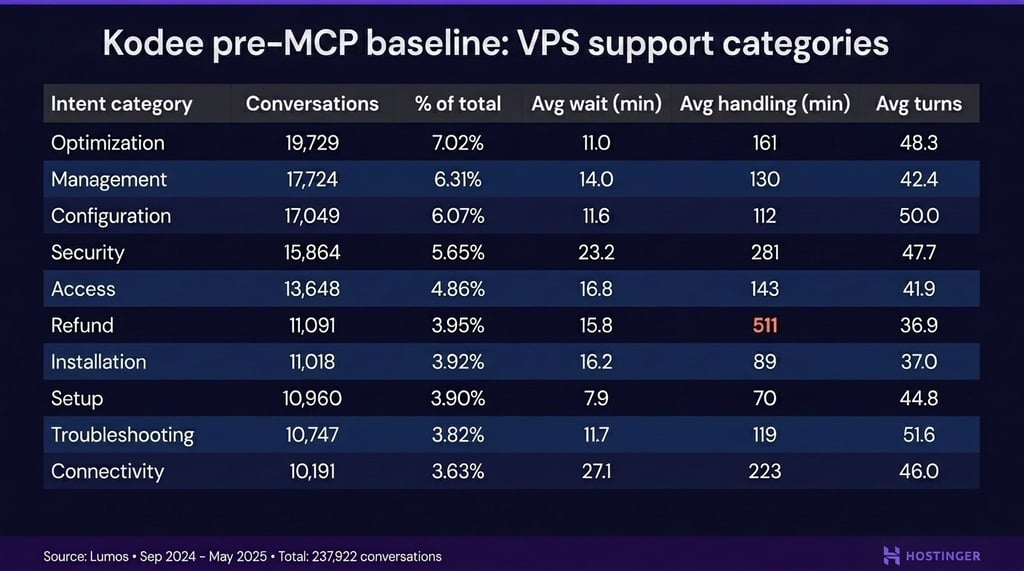
Across those 237,922 early conversations, the hard ones ran long. A single security question, for example, could take dozens of messages and almost five hours before you solve it. That’s most of a workday spent in a chat window, just to reach an answer you still had to run yourself.
If you’ve run a server, you’ve been there. A locked SSH key or a config typo that takes down your site is rarely complicated to fix once you spot it. What wears you down is doing it alone at 2am with the site offline.
What changed: From an AI that advises to an AI that acts
What changed was the connection. Kodee didn’t get smarter as much as it got plugged into your server. MCP, or Model Context Protocol, is the open standard behind that.
It lets Kodee see the live state of your server, including running processes, services, and logs, then act on what it finds.
That second part is the real leap. Reading the server helps Kodee give specific answers instead of generic ones. Acting on that information lets Kodee solve the problem instead of handing you instructions.
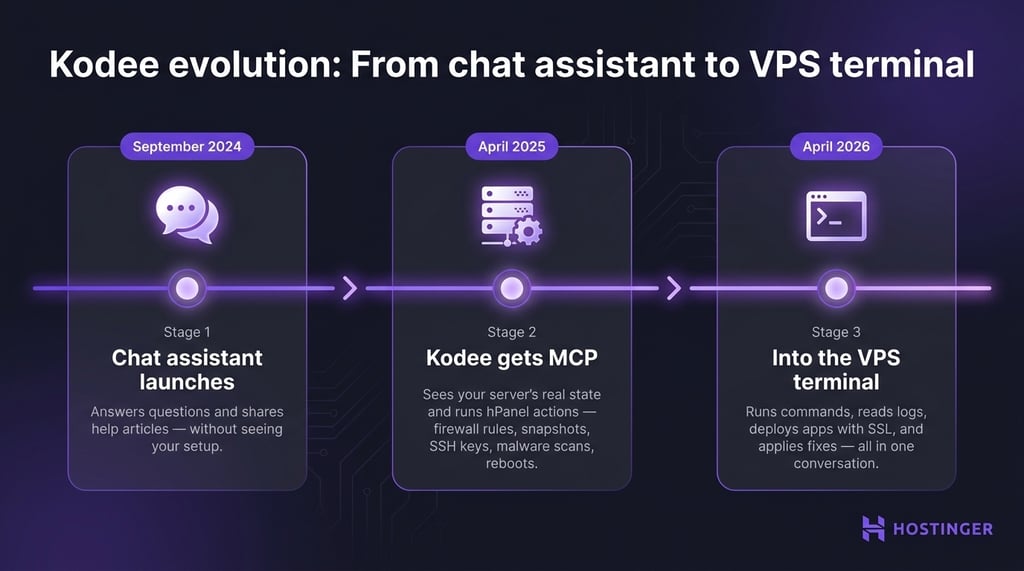
Kodee got there in stages. Its first version, launched in September 2024, was a chat assistant in Hostinger dashboard that could answer questions and share help articles, like a knowledgeable friend who hasn’t seen your setup.
In April 2025, Kodee got MCP, which changed what it could do. It could now see the server’s real state and carry out Hostinger dashboard actions itself, such as creating firewall rules, taking snapshots, rotating SSH keys, running malware scans, and rebooting the server.
That adds up to around 75 Hostinger dashboard actions Kodee can take for you, roughly the same set you could perform yourself.
In April 2026, Kodee moved into the VPS terminal itself. Inside the server, it can run commands, read logs, deploy an app with SSL in one conversation, and apply fixes directly.
All of that gets heavy use. The command tool Kodee uses to run tasks directly on the server fired more than 41,000 times on one randomly picked recent day we looked at.
Kodee went from telling you what to run, to running it in Hostinger dashboard, to working inside the server next to you.
What Kodee resolves on its own now
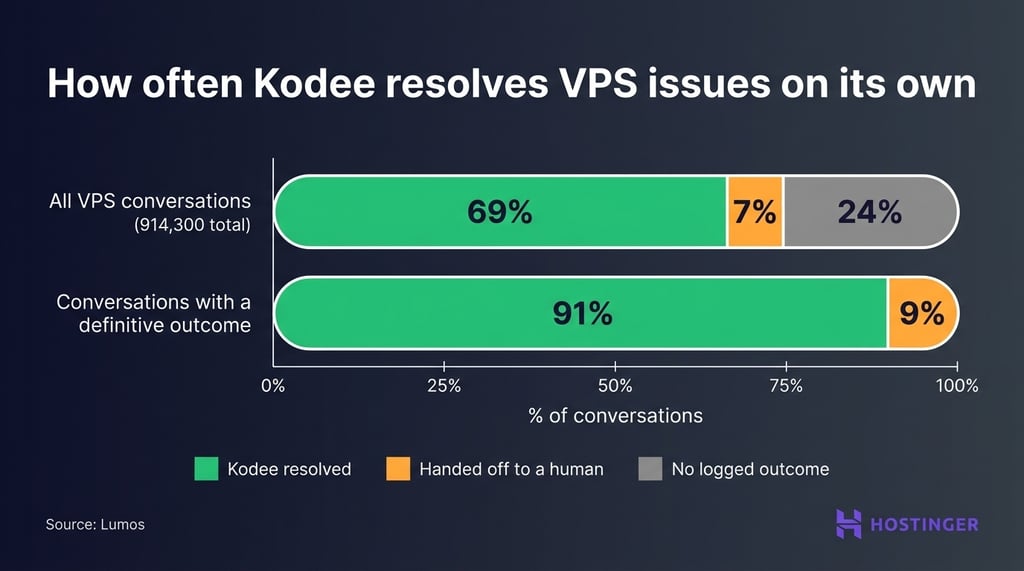
Among VPS conversations with a recorded outcome, Kodee resolves 91% on its own. That’s the figure that matters because it counts the problems Kodee solved, not the messages it answered.
There are two honest ways to read that number. Across all 914,300 conversations in the period, Kodee resolved 69% if we count those without a logged outcome as unresolved. Among conversations with a definitive outcome, the resolution rate rises to 91%.
Either way, the handoff rate remains low. Only 7% of all VPS conversations reach a human agent, increasing to 9% among those with a definitive outcome.
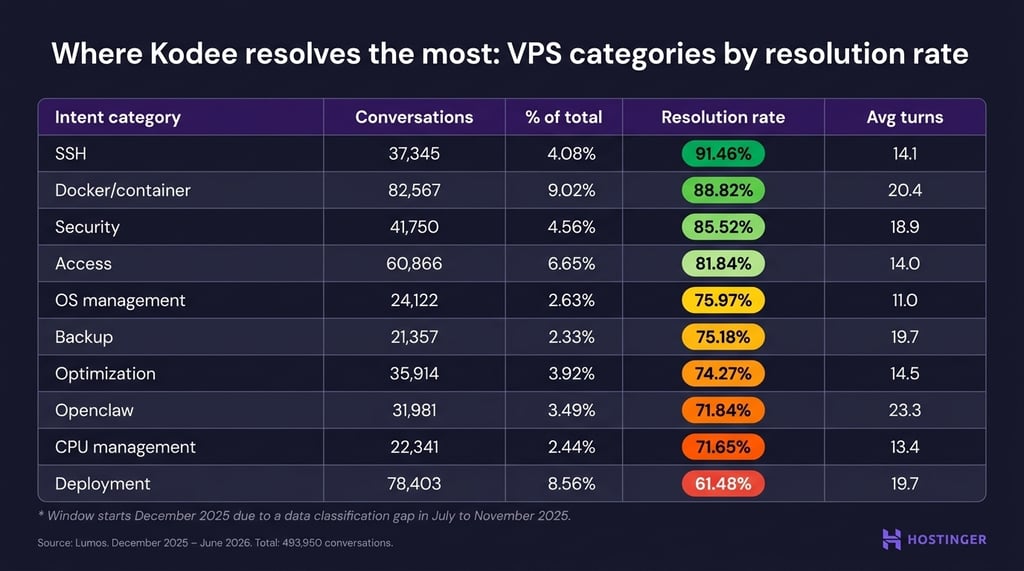
Kodee is strongest at hands-on technical work. It clears SSH problems 91% of the time and Docker issues 89%, with security and access both in the low-to-mid 80s.
The rate is uneven across the full set of categories, dropping much lower in higher-volume areas like pricing and initial setup. That split lines up with the type of question.
A broken SSH key has a clear fix, while pricing is a decision, and setup or deployment is open-ended. Not every conversation reaches a clear point where it’s done.
Even with those uneven spots, this changes what Kodee is. Once it handles most VPS questions for you, it stops feeling like an add-on and becomes the reason running a server feels doable.
How much less work it takes to run a VPS now
Once Kodee could act instead of only advise, getting something fixed took much less effort. The clearest way to see that is in conversation length.
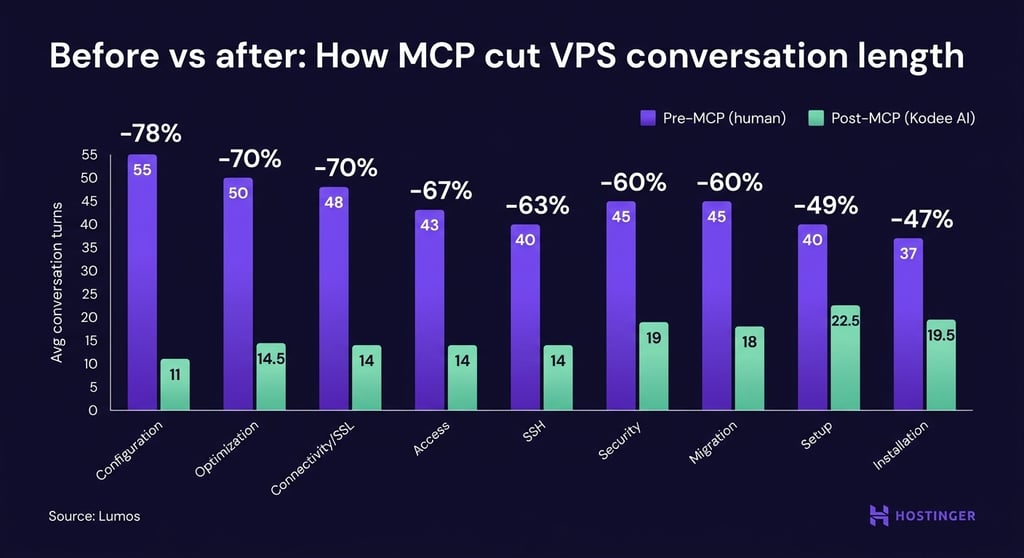
Server optimization questions used to take 48 messages back and forth. After MCP, they average around 15, a drop of roughly two-thirds.
That’s the difference between a multi-hour chase and a short exchange. The same pattern appears across categories that used to drag, with server configuration down 78% and connectivity and SSL down nearly 70%.
The chat logs make that change concrete. A customer locked out over SSH got back in during a single conversation, with Kodee pulling their keys, testing the connection, and repairing the server directly.
A firewall that would normally require a careful run of commands was set up in three messages. Kodee created the rules, switched them on, and synced them to the server.
The most involved case, a full app deployment, took 55 separate actions across 13 tools. Kodee inspected the existing Docker setup, rewrote the compose file, pointed the DNS, and confirmed everything worked.
The reduction was broad rather than selective. Even the smallest improvements, in setup and fresh installs, cut conversations roughly in half, while the trickiest categories fell by 70% or more.
What it did to retention and signups
As Kodee handled more of the work, the product numbers moved with it. Retention tells the clearest story.
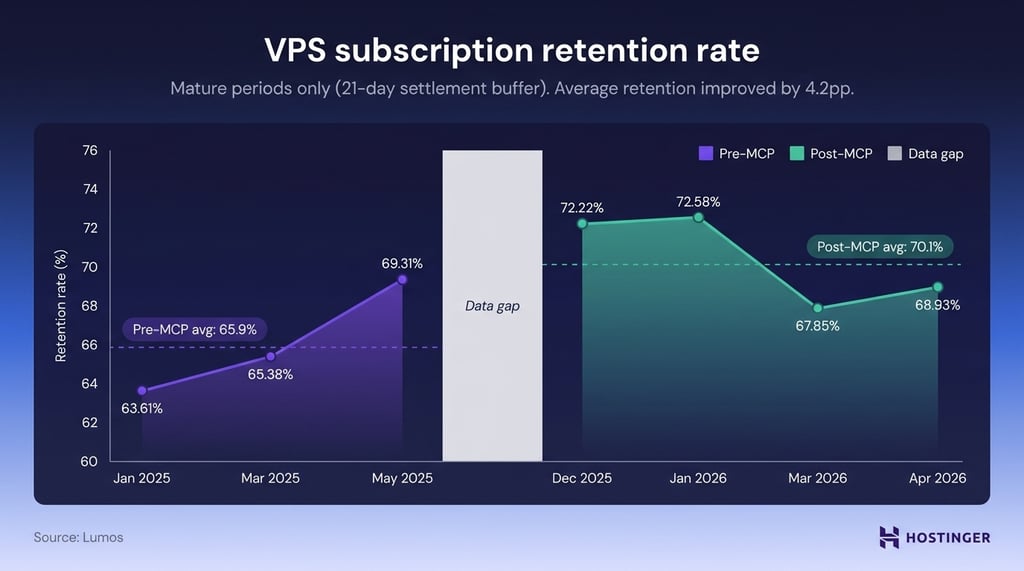
Before MCP, VPS retention sat around 66%. Afterward, it averaged 70%, even as the user base grew several times over and skewed less technical.
That four-point gain is the quiet headline. New VPS users have always been most likely to leave in the first month, usually after running into a server problem they couldn’t solve. That early drop-off now appears to be easing.
The trend holds even when the monthly numbers wobble. A dip in spring 2026 came from the large February signup cohort reaching its first renewal, which usually churns harder than older cohorts.
Signups rose too. VPS new orders grew roughly fourfold in the post-MCP era, though that jump is harder to pin on Kodee alone because pricing, marketing, and other launches all happened in the same window.
The retention number is the one to trust here because it’s far less sensitive to marketing spend than raw signups. A larger, less technical user base that stays longer is exactly what you’d expect if the problems that used to make people quit got easier to solve.
Where Kodee still can’t help, and why it makes sense
The categories where Kodee struggles are the ones that should involve a human anyway. That’s the most reassuring thing the data shows.
Resolution rates drop into the 60s and low 70s for a specific set of issues. Account suspensions resolve just 64% of the time, while DDoS attacks, server stability, and downtime sit closer to 70%.
Grouped together, these issues fall into three areas: policy-gated actions like suspensions and billing, infrastructure emergencies like DDoS attacks and downtime, and cases where the user simply wants a person.
None of those are AI limitations. Suspending an account requires policy authority, stopping a live attack requires real-time infrastructure access, and helping an upset customer requires human judgment.
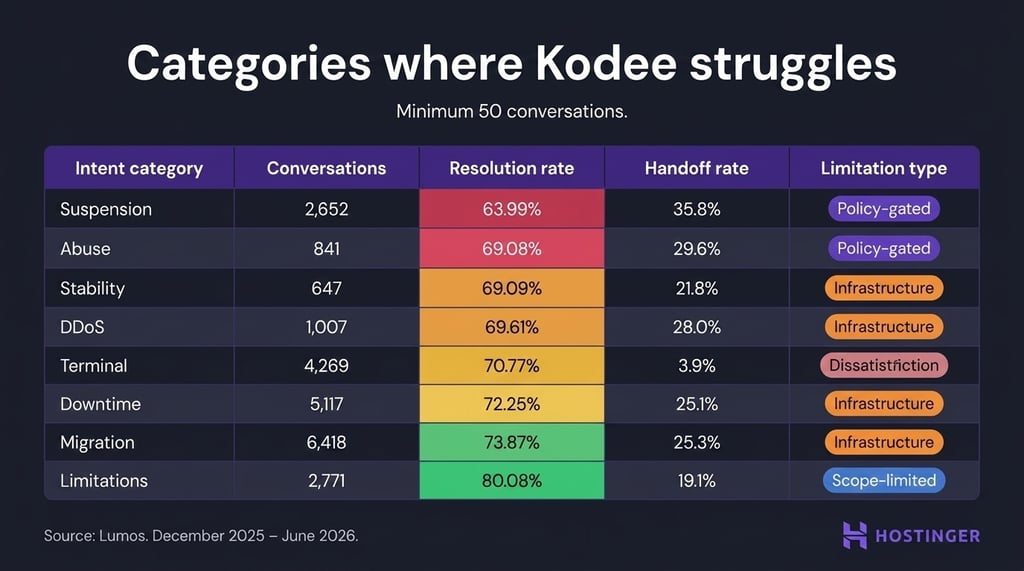
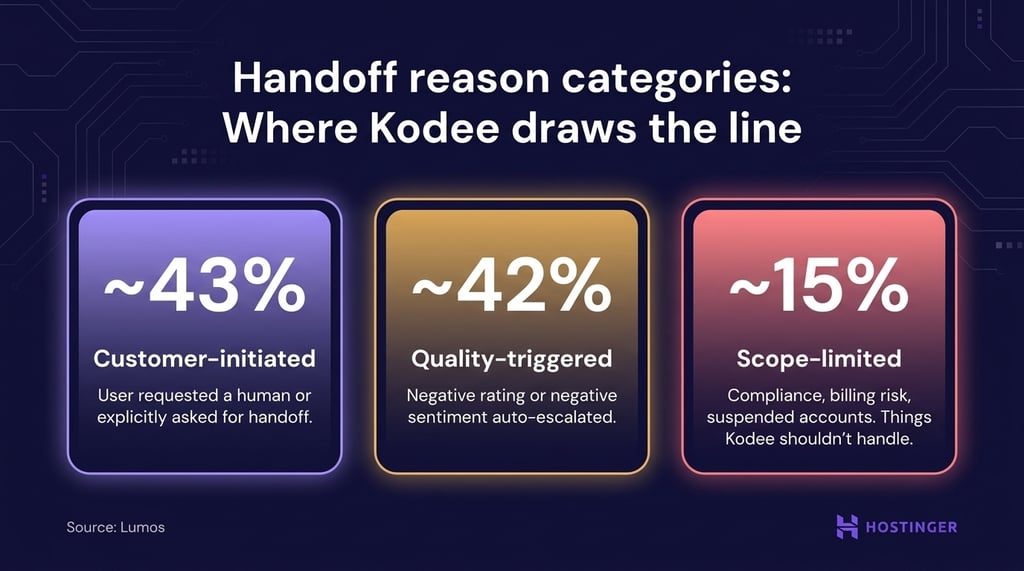
Kodee is built to step aside in exactly those cases, and the way its handoffs get triggered says the same thing.
Most don’t have a recorded reason, but among the ones that do, about 43% come from customers asking for a person, 42% from automatic escalation when someone sounds frustrated, and the rest from scope limits, like billing or compliance.
Read that way, those low resolution rates are exactly what you’d want: the system drawing a clear line where a human belongs.
Where AI-managed VPS goes from here
Put all of this together, and a VPS becomes a different kind of product. It’s shifting from something that requires technical knowledge upfront to something where an AI assistant carries a large part of the load.
In under two years, Kodee went from answering questions in Hostinger dashboard, to taking actions there itself, to working inside the terminal with full root access, just like you.
That raises the real question this data points to: if Kodee can already act at every layer, what does a fully AI-managed VPS look like, and how much of server management remains a human skill?
The honest answer today is that the barrier has shrunk, but it hasn’t disappeared. Migrations, real incidents, and anything touching policy still need a person, and the data is clear that Kodee knows when to call one.
If you’ve been holding off on a VPS because the management side felt out of reach, that calculation is changing. The work that used to require a sysadmin’s reflexes now increasingly starts with a sentence to an assistant that can act on it.
The next time something breaks, it’s still your server and your call. You just won’t be at the terminal alone.

Ariffud is a Technical Content Writer with an educational background in Informatics. He has extensive expertise in Linux and VPS, authoring over 200 articles on server management and web development. Follow him on LinkedIn.