Most popular domain extensions in 2026: Statistics and complete guide
Picking the wrong domain extension means you’re fighting a trust battle before a visitor reads a single word. A top-level domain (TLD) is the suffix at the end of a web address, the part that comes after the final dot, such as .com, .org, or .de. It shapes how audiences perceive your site, which regions you can reach, and even how easily people trust it.
The latest 2026 data makes the landscape clearer than it’s ever been. The .com extension still leads with 163.6 million registrations and no real challenger in sight, but country-code ones like .ai, now widely adopted by AI companies, are growing faster than anything the industry has seen in years.
The right choice still comes down to who you’re building for and what trust signals your audience actually responds to.
Top domain extension statistics for 2026
Domain extensions shape how people find, trust, and remember websites online. These statistics capture the state of the domain industry in 2026.
- The .com extension holds 163.6 million registrations worldwide, more than any other and nearly eight times more than its closest gTLD competitor.
- China’s country code extension, .cn, leads all country-specific domains with 20.9 million registrations.
- Legacy generic top-level domains (gTLDs) account for 50.1% of all domain registrations globally, totaling 196.6 million domains.
- New generic top-level domains (ngTLDs) grew 31.3% year-over-year, adding 11.8 million new registrations.
- There are now 1,265 domain extensions delegated in the DNS root zone, giving registrants more choice than at any point in internet history.
- .org carries a 79.6% renewal rate, the highest of any top-10 gTLD, reflecting strong long-term commitment from nonprofit and community organizations.
- The .ai extension crossed 1 million registrations in January 2026, growing at approximately 1% per week, driven by AI startup demand.
- 68% of online donors say they most trust websites and email addresses that use the .org domain.
- Country code TLDs (ccTLDs) represent 37.3% of all domain registrations, covering 316 country-specific extensions globally.
- Despite rapid growth, .shop carries only a 14.3% renewal rate, the lowest of any top 10 gTLD, suggesting most registrations are short-term or promotional.
The 10 most popular domain extensions
The popularity of a domain extension is measured by total registrations, which is a strong indicator of trust, adoption, and practical utility. The list below represents both the most recognized extensions and the fastest-growing, drawn from the Domain Name Industry Brief (DNIB) Q1 2026 report.
- .com: 163.6 million registrations, the most widely recognized and trusted extension, originally created for commercial entities but now open to everyone globally. Its decades of dominance make it the default choice for businesses, personal brands, and creators worldwide.
- .cn: 20.9 million registrations, China’s country code top-level domain and the largest ccTLD by registration volume. It is the primary extension for businesses and individuals targeting Chinese-speaking audiences, with strict eligibility requirements for non-Chinese entities.
- .de: 17.9 million registrations, Germany’s ccTLD and the second-largest country-specific extension in the world. Primarily used by German businesses and websites, though some Austrian and Swiss businesses also register it to reach broader German-speaking audiences alongside their own .at and .ch domains.
- .net: 12.4 million registrations, originally intended for network-related businesses but now used broadly across industries. Most people treat it as a credible fallback when their preferred .com name is taken.
- .org: 11.7 million registrations, originally intended for nonprofit organizations and still strongly associated with charities, communities, and informational websites. It holds the highest renewal rate of any top 10 gTLD at 79.6%, signaling genuine long-term commitment.
- .uk: 10.4 million registrations, the United Kingdom’s ccTLD, widely used for businesses and services targeting British audiences. It offers a direct signal of UK presence and is available for most website types.
- .xyz: 8.1 million registrations, the largest new generic top-level domain by registration count, popular among tech startups and creative industries. Its broad, unspecific meaning gives registrants flexibility in how they use it.
- .ru: 6.9 million registrations, Russia’s ccTLD, among the top 10 most registered extensions globally, used primarily by Russian-language websites and businesses.
- .top: 6.1 million registrations, a newer generic extension that has grown rapidly, particularly in Asian markets. Its growth reflects broader adoption of alternative gTLDs as .com availability narrows.
- .nl: 6.1 million registrations, the Netherlands’ ccTLD and one of the most active European country-code registries, used by Dutch businesses and organizations targeting local audiences.
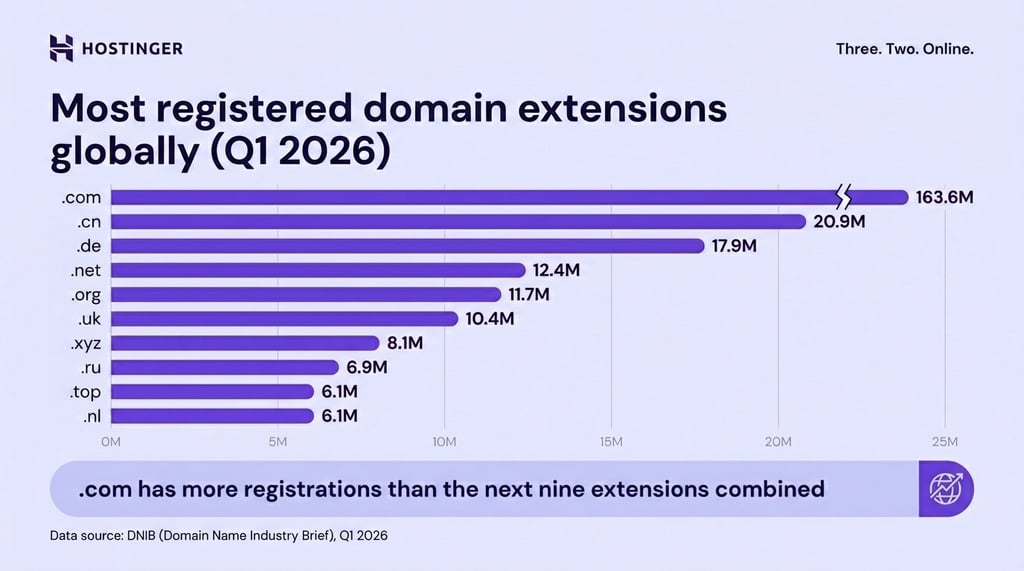
The gap between .com and every other extension underscores its unmatched position in the domain market. Even the second-largest extension, .cn, has about eight times as few registrations. That gap reflects decades of brand trust, user familiarity, and commercial infrastructure built around the .com standard.
Understanding domain extension categories
Not all domain extensions are created equal. They fall into distinct categories, each with different purposes, audiences, and registration requirements. Understanding which TLD suits your needs is a useful first step before registering.
- Legacy generic top-level domains (gTLDs): 196.6 million total registrations, accounting for 50.1% of all domain registrations. This category includes the most established extensions, .com, .net, and .org, and is open to anyone globally without restriction (DNIB).
- Country code top-level domains (ccTLDs): 146.3 million total registrations, representing 37.3% of all registrations, with 2.4% year-over-year growth and 3.4 million new registrations. There are 316 ccTLD extensions globally, each assigned to a specific country or territory (DNIB).
- New generic top-level domains (ngTLDs): 49.6 million total registrations, accounting for 12.6% of registrations, with rapid 31.3% year-over-year growth and 11.8 million new registrations. They include industry and purpose-specific extensions like .tech, .store, and .blog (DNIB).
- Total extensions available: 1,265, covering all extensions delegated in the DNS root zone, including more than 1,200 new gTLDs introduced since 2013 (DNIB; Hostinger domain name statistics).
- Sponsored top-level domains (sTLDs), a restricted category including .edu (accredited educational institutions), .gov (US government agencies), and .mil (US military). Registration requires meeting specific eligibility criteria verified by the sponsoring organization (ICANN).
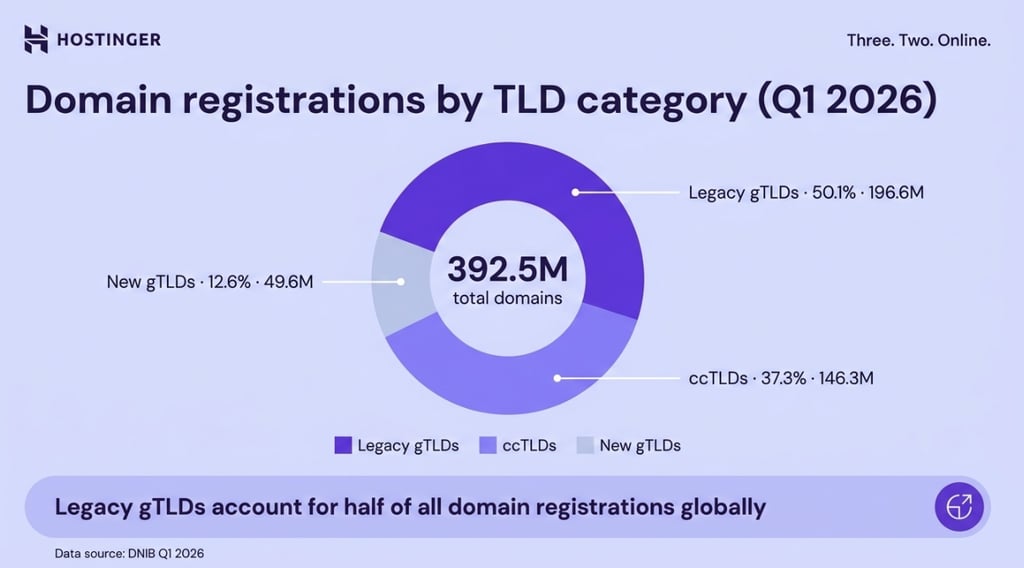
The contrast between legacy gTLDs and ngTLDs is striking: legacy extensions hold four times more registrations, but ngTLDs are growing eight times faster.
That gap reflects the tension between established brand trust and the appeal of fresh, available naming options. For most registrants, the right category depends on whether you’re building for long-term credibility or immediate relevance.
Most common domain extensions
Each extension type carries specific characteristics and ideal use cases. Here’s a breakdown of the leading extensions within each category.
Generic top-level domains (gTLDs)
Legacy gTLDs remain the most widely registered category. Their open eligibility and decades of recognition make them the default starting point for most website owners.
| Extension | Registrations | Primary use |
|---|---|---|
| .com | 163.6M | Commercial, general |
| .net | 12.4M | Networks, tech, general |
| .org | 11.7M | Nonprofits, communities |
| .info | 4.2M | Informational sites |
| .biz | 1.9M | Business sites |
Source: DNIB Q1 2026
The renewal rate difference between .org (79.6%) and extensions like .shop (14.3%) reveals how differently registrants treat each extension.
High renewal rates signal genuine, long-term use. Low rates often indicate bulk speculative registrations or short promotional campaigns.
Country code top-level domains (ccTLDs)
ccTLDs are assigned to specific countries or territories and serve as strong signals of local presence. They are often favored by businesses targeting regional audiences.
Europe dominates the top 10, holding six of the ten spots, while the growth of .in and .br reflects expanding internet infrastructure in India and Brazil. The full registration breakdown by country is covered in the local businesses section below.
New generic top-level domains (ngTLDs)
Since ICANN introduced new gTLDs from 2013 onward, more than 1,200 new extensions have launched. The fastest-growing ones serve specific industries or use cases.
| Extension | Registrations | Year-over-year growth | Primary use |
|---|---|---|---|
| .xyz | 8.1M | Stable | Tech, creative |
| .top | 6.1M | +12% | General use, Asia |
| .online | 3.8M | +18% | General web presence |
| .site | 2.7M | +9% | General web presence |
| .shop | 2.0M | +41% | E-commerce |
| .store | 1.4M | +36% | Retail |
| .app | 1.2M | +22% | Mobile apps |
| .ai | 1.0M+ | +~52% (annualized) | AI products, tech |
| .dev | 0.8M | +19% | Developer tools |
| .blog | 0.6M | +14% | Content publishing |
Source: DNIB Q1 2026
The .ai extension stands out as the fastest-growing ngTLD in absolute terms. It surpassed one million registrations in January 2026 and has been growing at roughly 1% per week since, driven by the global boom in AI startup activity.
For comparison, .shop and .store are growing quickly but struggle to retain registrants, with renewal rates well below most legacy gTLDs.
Choosing the best domain extension for your goals
The right domain extension depends on your website’s purpose, audience, and industry. Different extensions carry different trust signals, audience expectations, and practical considerations.
Getting the extension right is only part of the equation. Choosing the right domain name that’s short, memorable, and available takes just as much thought.
Best domain extensions for local businesses
ccTLDs signal local presence and build regional trust. For businesses serving a specific country or city, a matching country extension communicates geographic relevance far more effectively than a generic alternative.
The top 10 ccTLDs by registration volume reflect where local web presence is most active:
| Rank | ccTLD | Country | Registrations |
|---|---|---|---|
| 1 | .cn | China | 20.9M |
| 2 | .de | Germany | 17.9M |
| 3 | .uk | United Kingdom | 10.4M |
| 4 | .ru | Russia | 6.9M |
| 5 | .nl | Netherlands | 6.1M |
| 6 | .br | Brazil | 5.6M |
| 7 | .fr | France | 4.4M |
| 8 | .au | Australia | 4.3M |
| 9 | .in | India | 4.0M |
| 10 | .eu | European Union | 3.7M |
Source: DNIB Q1 2026
ccTLD availability and eligibility requirements vary by country, and some require local presence or a registered entity to qualify. If you’re targeting a specific region, it’s worth checking whether you meet the requirements before committing to one. Hostinger offers major ccTLDs alongside the global options.
Best domain extensions for ecommerce
For online stores, .com remains the default trust signal. It is by far the most recognized extension globally and the one most customers associate with legitimate business operations.
- .com leads all extensions with 163.6 million registrations as of Q1 2026, making it the most recognized and trusted extension for online businesses (DNIB).
- Despite rapid growth, .shop carries the lowest renewal rate of any top-10 gTLD at just 14.3%, while .store renews at 21.3%, suggesting most registrations are short-term or promotional rather than committed business identities (DNIB).
The renewal data tells an honest story: .shop and .store attract registrations but struggle to retain them. For a long-term store, a .com domain remains the most reliable foundation. A .shop domain can work well for campaign-specific or secondary use.
Expert tip
When your preferred .com is unavailable, it’s worth taking a moment to think strategically rather than just grabbing the first available alternative. A shorter or more creative .com might still be out there, but extensions like .shop or .store can work really well when they match your brand and audience. The key is pairing whichever extension you choose with a clear brand strategy so customers remember it.

Best domain extensions for nonprofits
The .org extension is the de facto standard for mission-driven organizations. Its association with nonprofits, charities, and public-interest projects runs deep, and donor trust data supports it.
- .org has surpassed 11.7 million registrations globally, reflecting widespread adoption among nonprofits, charities, and community organizations (DNIB).
- 68% of online donors say they most trust websites and email addresses that use .org, making it the strongest trust signal for fundraising and donor engagement (Nonprofit Tech for Good / Global Trends in Giving Report).
- .org carries a 79.6% renewal rate, the highest of any top-10 gTLD, reflecting strong long-term commitment from nonprofit organizations (DNIB).
For any organization raising funds or building community trust online, a .org domain is the most straightforward way to signal credibility and intent.
Best domain extensions for tech startups
Tech and AI-focused startups have more purpose-built options than ever. The right extension can communicate your product category before anyone reads a word of your site.
- .ai crossed 1 million registrations in January 2026, growing at approximately 1% per week, driven by demand from AI startups and tech companies worldwide (Government of Anguilla via Anguilla Focus).
- 28% of new Y Combinator and Techstars startups in H1 2025 chose a .ai domain, reflecting its rapid adoption as the standard extension for AI-native products (Identity Digital).
- .app and .dev, both operated by Google Registry, enforce HTTPS at the browser level through HSTS preloading, a built-in security advantage that .io does not offer (Google Registry).
One nuance for startups considering the .io domain: while it remains popular in tech communities, .io is technically the ccTLD for the British Indian Ocean Territory, which means its long-term governance could be subject to changes outside the startup world’s control. For teams prioritizing stability, an .ai domain, .app, or .dev are cleaner choices.
Expert tip
The domain extension you choose sends a signal before anyone reads a word of your site. .ai is now synonymous with the AI category, and that’s a real advantage if you’re building an AI product. But if your startup is broader than AI, don’t force it just for the trend. A clean .com or a .dev for developer tools will serve you better long-term. Pick the extension that fits your audience, not just the one that sounds current.

The future of domain extensions
The domain industry is expanding on two fronts simultaneously. Established extensions like .com continue to grow steadily and hold the dominant share, while newer extensions are growing at rates that would have seemed impossible a decade ago.
The 31.3% year-over-year growth of ngTLDs reflects genuine demand for purpose-built naming options, not just speculative registrations.
The clearest signal of what’s next is the rise of .ai. Crossing one million registrations in January 2026 and growing at roughly 1% per week, it has become the defining extension of the current technology moment in a way no extension has since .com became the default.
Other industry-specific extensions, such as .app, .dev, and .store, are following a similar trajectory, each building identity around a specific category of online presence.
Looking further ahead, ICANN’s 2026 Round of new gTLDs opened on April 30, 2026, with applications accepted until August 12, 2026. This round allows organizations to apply for completely custom extensions, such as .brand, .city, or .industry.
The first new TLDs from this round are unlikely to go live before 2027 or 2028, as applications must pass through evaluation, objection, and delegation processes after the window closes.
For most website owners, the decision remains practical: .com for reach and trust, ccTLDs for local presence, and purpose-built ngTLDs when your domain name itself can communicate what you do.
As availability in preferred categories narrows, having a clear strategy matters more than ever. Use Hostinger’s domain name search to check what’s still available across all major extensions.

Daniela is an Off-Site SEO Specialist with extensive expertise in link building, digital PR, and content optimization. She has led international outreach campaigns across the U.S., Brazil, France, and Spain, securing high-quality backlinks. Follow her on LinkedIn.