Trending products: Top 40 picks to sell online in 2026
Aug 21, 2026
/
By Justina B.
/
31 min Read
Trending products in 2026 span home essentials, beauty staples, health and wellness picks, tech accessories, and comfort items. Candles, LED strip lights, and portable power stations are notable home picks, while matcha, mushroom coffee, massage guns, and air purifiers stand out in the health and wellness category.
Fashion favorites like athleisure and wide-leg pants sit alongside gadgets like smartwatches, Bluetooth trackers, and power banks. Hair oils, press-on nails, pimple patches, and pet products like dog harnesses also show notable search interest.
These products were selected using Google Trends, keyword research, and market context. Selling prices, target audiences, and supplier options vary by category, and the right marketing approach depends on your store’s niche.
Most searched products on Google
Based on Google Trends data and keyword research, these product categories show notable search interest in 2026, indicating a high potential to sell online:
- Health and wellness – Matcha, gluten-free pasta, mushroom coffee, massage guns, air purifiers.
- Gadgets and tech – Smartwatches, power banks, Bluetooth trackers, phone stands, laptop stands, car chargers.
- Beauty and accessories – Makeup, hair oils, pimple patches, press-on nails.
- Fashion: Athleisure, wide-leg pants, cargo pants, mini dresses.
- Home and living – Candles, sleeping bags, fake plants, lint rollers, spin mops, power stations, LED strip lights.
- Hobby and lifestyle – Reusable water bottles, water shoes, and custom keyboard kits.
- Comfort – Wedge pillows, neck pillows, sofa beds.
- Baby and child care – Baby carriers, baby swings, baby monitors.
- Pet care – Dog harnesses, cat beds, cat litter.
- Kitchen appliances – Portable blenders, wine fridges.
Top trending home and living products
Home products improve daily life by making spaces more comfortable and convenient. According to Fortune Business Insights, the global home decor market was valued at $802.26 billion in 2025 and is projected to reach $1.3 trillion by 2034.
Outdoor products create ecommerce opportunities for stores serving camping, travel, and recreation audiences. Alongside home-comfort items, they give sellers niches to test across seasonal and year-round demand.
1. Candles
- Average selling price – $10-45 for mass-to-mid market; premium and luxury candles can exceed $100.
- Estimated monthly Google searches – 210,000+ for “candles”.
- Top countries – United States, United Kingdom, Australia.
- Target audience – Home decor lovers and gift shoppers.
- Supplier suggestions – Alibaba, Faire, Aussie Candle Supplies.
Candles have grown from basic light sources into popular home decor accents. People buy them for ambiance, relaxation, and gift-giving. Unique scents, eye-catching designs, and handcrafted touches make them appealing. Soy- and beeswax-based options can also appeal to shoppers looking for alternatives to conventional paraffin candles.
Google Trends shows that searches for “candles” remain steady throughout the year, with reliable spikes around the holidays.
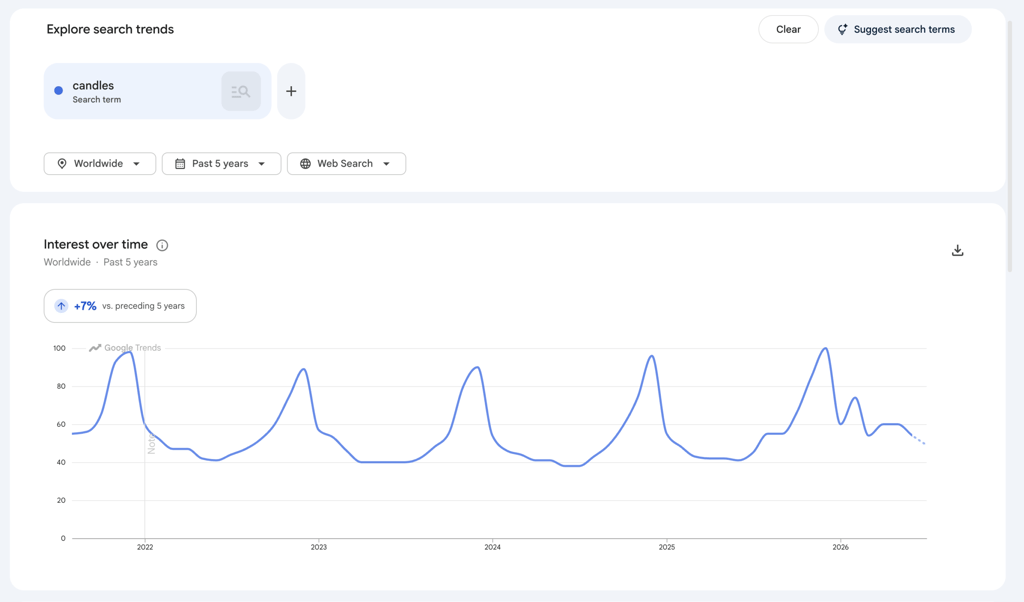
To market candles effectively, focus on lifestyle photos that showcase them in beautiful home settings. Create seasonal collections and bundle candles with complementary products, such as matches or holders. Partner with home decor influencers to feature your candles in styled spaces.
Standing out means offering something specific, like unusual scents, bold packaging, or eco-friendly materials.
Themed collections and personalized options also help differentiate your store. If this niche fits, you can start a candle business with relatively low upfront costs.
2. Sleeping bags
- Average selling price – $20-200 for entry-to-mid range; expedition-grade bags from brands like Western Mountaineering can run $300-$700+.
- Estimated monthly Google searches – 186,000+ for “sleeping bag”.
- Top countries – United States, United Kingdom, Indonesia.
- Target audience – Outdoor and camping enthusiasts.
- Supplier suggestions – Bags in Bulk, Alibaba, Global Sources.
Sleeping bags are a camping staple, essential for staying warm, dry, and comfortable on outdoor trips. They come in a variety of styles and insulation types designed to suit different climates and camping needs.
Google Trends shows that searches for sleeping bags follow predictable seasonal patterns, peaking in spring and early summer when people start planning their camping trips.
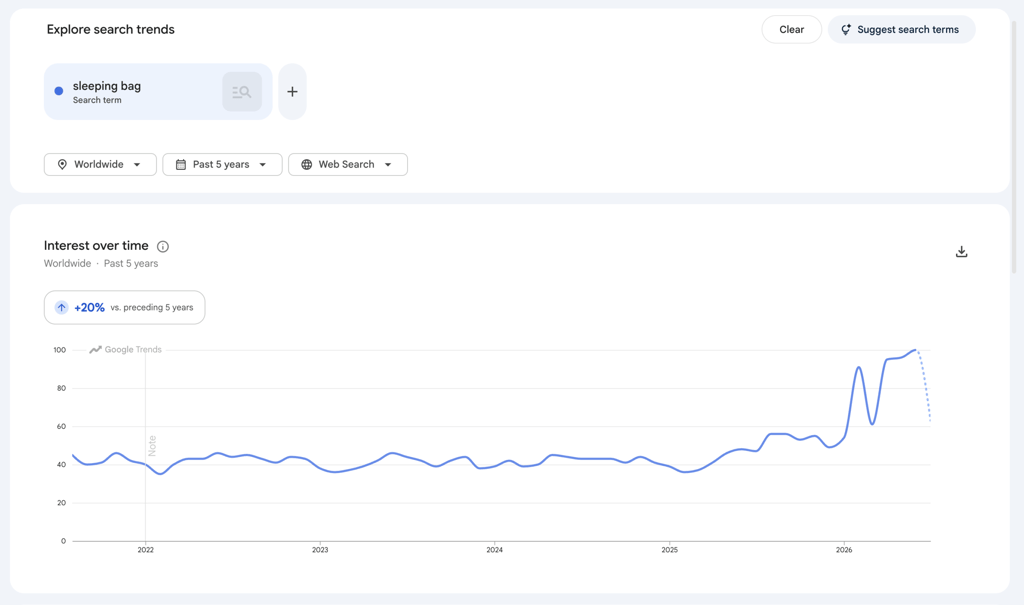
When marketing sleeping bags, focus on creating helpful content that guides customers through their buying decisions. Blog posts and videos explaining key features like temperature ratings, shape differences, and sizing tips are especially valuable.
During stronger seasonal periods, test Google Shopping ads and high-intent queries such as “best sleeping bag for beginners” or “lightweight sleeping bag.” These searches indicate a more specific product need than a broad query like “sleeping bag.”
3. Fake plants
- Average selling price – $10-100 for small-to-mid items; large premium artificial trees regularly exceed $200.
- Estimated monthly Google searches – 38,000+ for “fake plants”.
- Top countries – United States, United Kingdom, Australia.
- Target audience – Homeowners and office workers.
- Supplier suggestions – Nearly Natural, Geko Products, Artificial Plants Online.
Artificial plants suit shoppers who want greenery in their home without regular watering or pruning. They can also work in low-light rooms and offices where maintaining live plants is less practical.
Google Trends shows that search interest for fake plants stays relatively steady year-round, with modest peaks in spring during home refresh season and again around the holidays.
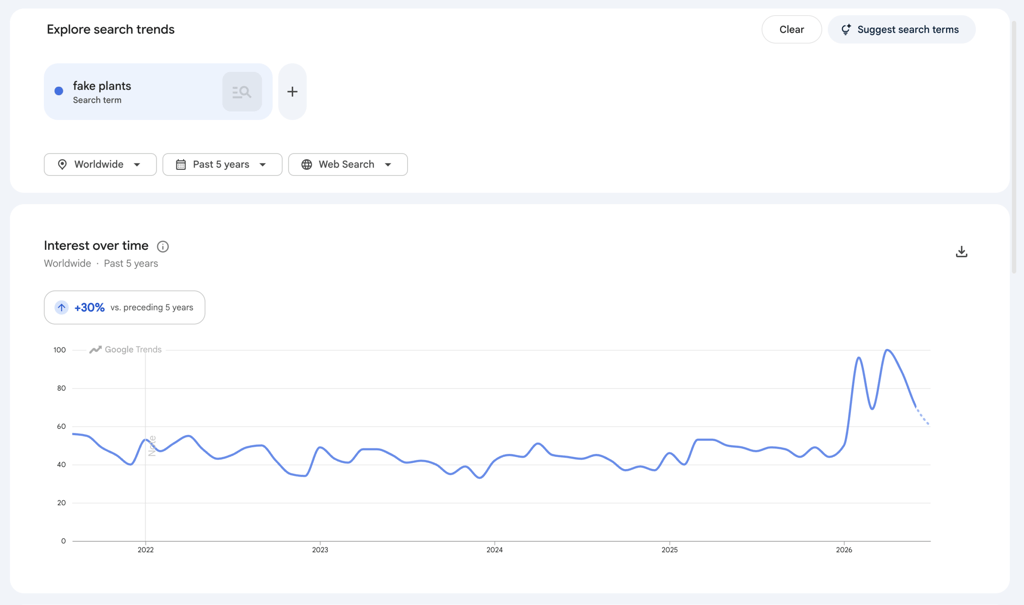
Artificial plants come in a wide range of sizes from small desk succulents to large fiddle-leaf fig trees. Smaller options can suit offices and apartments where space is limited.
To market artificial plants effectively, focus on home styling content. Write blog posts like “5 Fake Plants That Look Real” or “Best Artificial Plants for Dark Rooms” and share before-and-after photos showcasing how fake plants transform spaces: target busy parents, office workers, and frequent travelers.
Use social media to highlight different plant arrangements and styling tips for various rooms. Seasonal campaigns can focus on spring refreshers and holiday decor, while year-round content can target shoppers looking for low-maintenance greenery.
4. Lint roller
- Average selling price – $5-30 for traditional sticky rollers; electric lint shavers and rechargeable fabric removers range from $20-60+.
- Estimated monthly Google searches – 65,000+ for “lint roller”.
- Top countries – United States, United Kingdom, India.
- Target audience – Homeowners and pet owners.
- Supplier suggestions – Pepin Manufacturing, Inc., IndiaMART, Alibaba.
A lint roller is a simple yet essential tool made with sticky paper wrapped around a tube. You roll it over clothing, furniture, or fabric surfaces to pick up lint, pet hair, dust, and other debris that regular washing often misses.
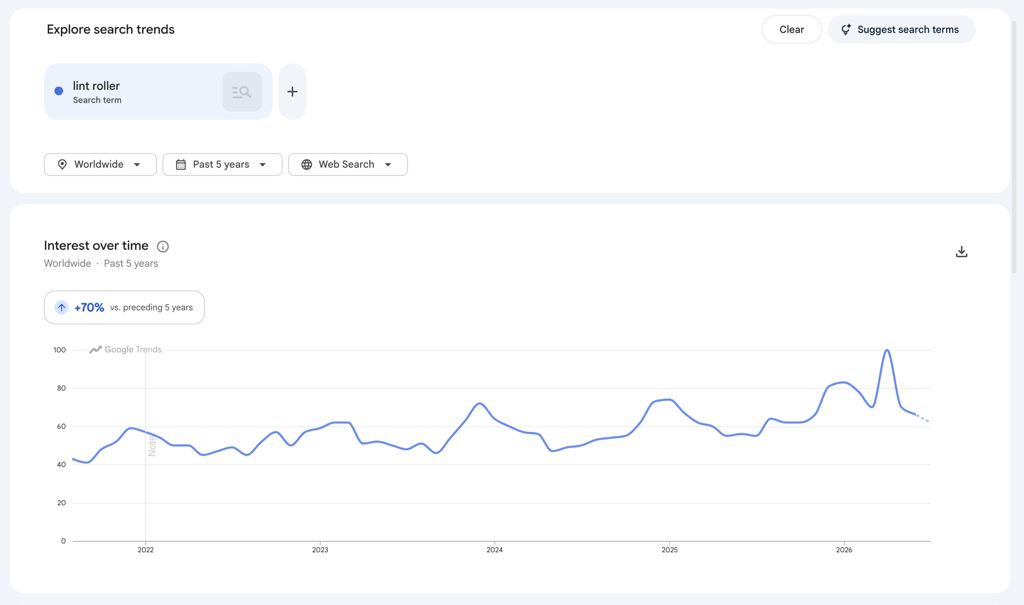
Google Trends shows that search intent for “lint roller” has generally risen over the past five years, with recurring fluctuations rather than a straight upward line.
To market lint rollers effectively, focus on visual content that demonstrates their satisfying before-and-after results on different fabrics. Short videos showing a roller picking up pet hair from a couch or removing lint from a black sweater make for easy, shareable social media content.
You can bundle lint rollers with refill sheets or offer travel-sized and full-sized versions. Bundles can increase order value when the combined price still makes sense for the buyer.
5. Spin mops
- Average selling price – $20-70 for manual and semi-automatic models; electric spin mops range from $150-400+.
- Estimated monthly Google searches – 44,000+ for “spin mop”.
- Top countries – United States, United Kingdom, India.
- Target audience – Homeowners, busy parents, and commercial buyers in hospitality, healthcare, and office cleaning.
- Supplier suggestions – Alibaba, Global Sources, Made-in-China.
A spin mop uses a spinning mechanism that lets you control the moisture level in the mop head, keeping it wet enough to clean effectively but not so soaked that it leaves puddles.
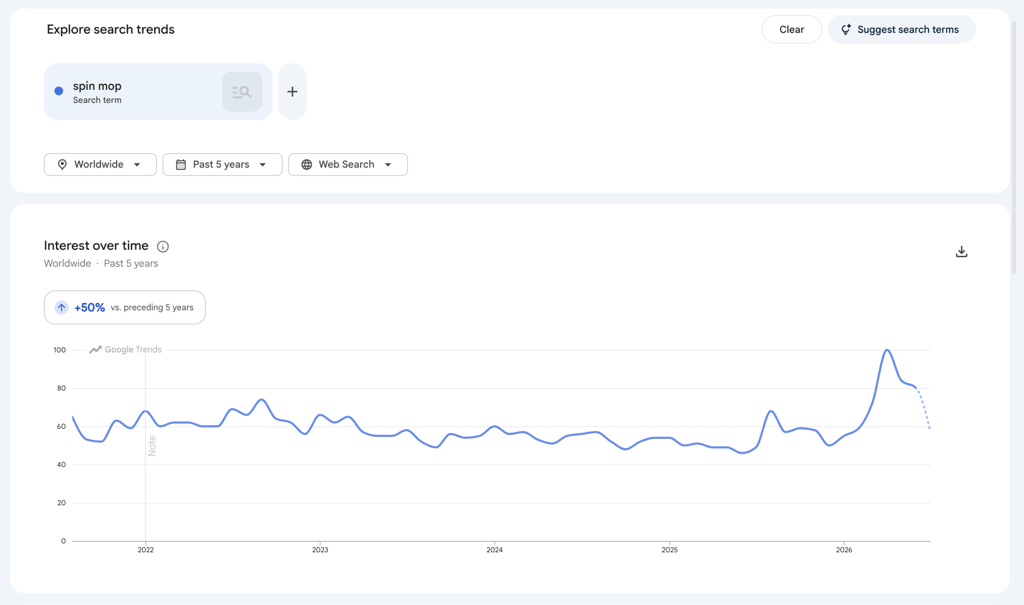
Google Trends shows that searches for spin mops have remained steady over the past few years, indicating consistent demand. The product can be marketed to households as well as commercial buyers that need reusable floor-cleaning equipment.
To market spin mops effectively, focus on the everyday problems they solve. Create comparison videos for YouTube and TikTok that demonstrate differences in wringing, moisture control, maneuverability, and cleanup.
Target busy parents and larger households for residential sales, and highlight durability and time savings for commercial buyers. Bundling spin mops with extra mop heads or cleaning solutions helps boost average order value.
6. Portable power stations
- Average selling price – $150-1,500 for the most popular consumer range; entry-level units start around $150, while high-capacity home backup systems can exceed $3,000.
- Estimated monthly Google searches – 101,000+ for “power station”.
- Top countries – United States, United Kingdom, South Africa.
- Target audience – Emergency preparedness buyers, outdoor enthusiasts, RV owners, and homeowners in areas prone to power outages.
- Supplier suggestions – Made-in-China, Alibaba, Global Sources.
Portable power stations are gaining popularity as more people look for reliable backup electricity. According to Grand View Research, emergency power is the largest application segment, making up nearly half of market revenue; camping, RV travel, and off-grid events round out the demand.
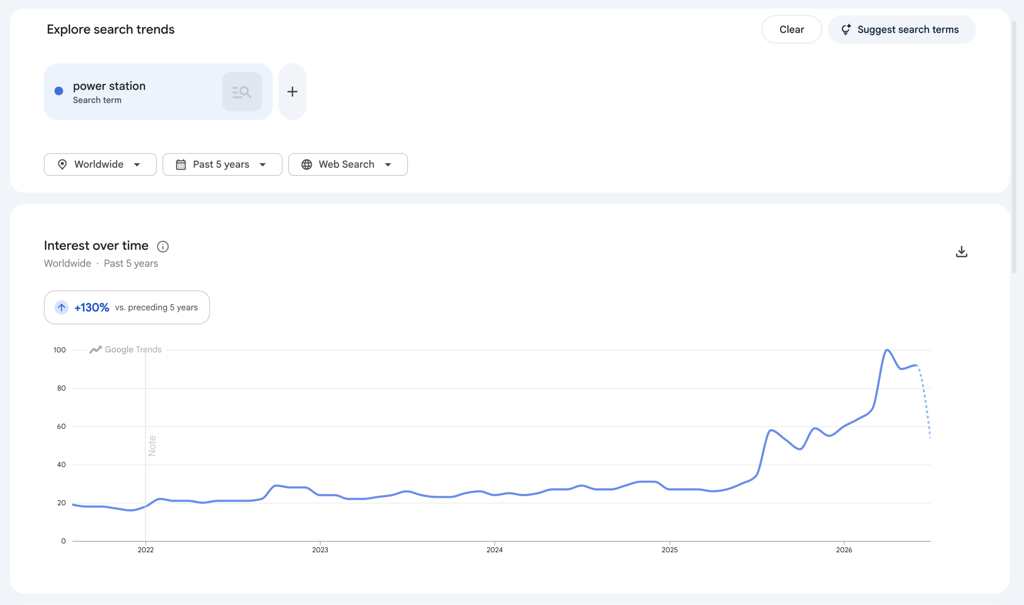
Google Trends shows steady growth in searches for portable power stations, reflecting rising demand for flexible power solutions both at home and outdoors.
Emergency-preparedness buyers, campers, RV owners, and households affected by outages are clear audiences for portable power stations. Match the product’s capacity, output, ports, and charging options to the use case you are marketing.
Build trust through detailed product demonstrations showing real-world use, like running a mini-fridge on a camping trip or keeping devices charged during a blackout. Partnering with camping, RV, and emergency-preparedness influencers adds authenticity.
7. LED strip lights
- Average selling price – $10-50.
- Estimated monthly Google searches – 180,000+ for “LED strip lights”.
- Top countries – United States, United Kingdom, India.
- Target audience – Homeowners, renters, content creators, gamers.
- Supplier suggestions – Alibaba, Global Sources, DHgate.
LED strip lights are flexible, adhesive-backed strips of small LEDs that you can attach to clean, smooth surfaces. They’re used for accent lighting behind TVs, under kitchen cabinets, around desks, and along ceiling edges. Some RGB models let users change colors and sync lights to music.
The global LED strip market was valued at $5.8 billion in 2025 and is projected to reach $13.2 billion by 2034, according to Dataintelo, growing at a compound annual growth rate of 9.6%.
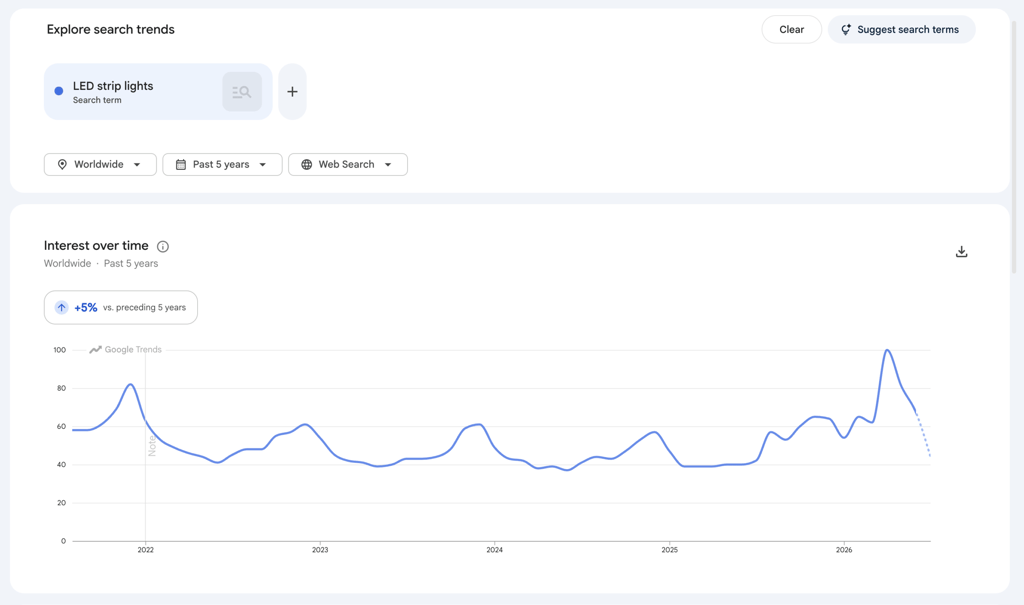
That growth isn’t spread evenly throughout the year. Consumer interest follows clear patterns tied to holidays, home improvement seasons, and gift-giving periods.
Google Trends data show recurring seasonal peaks for “LED strip” and “LED strip lights”, including a strong rise around the end of the year.
Target renters looking for non-permanent decor, gamers building RGB setups, and content creators who want better background lighting for videos. Homeowners upgrading their kitchens or bedrooms are another strong audience.
Create short TikTok and Instagram Reels showing before-and-after room transformations. You can also bundle LED strips with remote controls, connectors, or corner clips to increase average order value.
Focus your ad spend on the holiday season, when demand spikes. Year-round, position LED strip lights as an affordable, quick way to refresh any room.
Top trending beauty products and accessories
Beauty and personal care is a large ecommerce market. According to Statista’s Market Insights, the global beauty and personal care market is projected to generate $698 billion in revenue by 2026.
Makeup, hair oils, pimple patches, and press-on nails all show meaningful search interest and give sellers several distinct beauty niches to evaluate.
8. Makeup
- Average selling price – $8-60 for mass and mid-tier brands; prestige lines from brands like Charlotte Tilbury or NARS regularly reach $40-80+.
- Estimated monthly Google searches – 614,000.
- Top countries – United States, India, United Kingdom.
- Target audience – Beauty enthusiasts, teenagers, working professionals.
- Supplier suggestions – Alibaba, IndiaMART, Wholesale Makeup.
Staples like foundations, concealers, and lip products remained established makeup categories even as new trends regularly emerge in the makeup market.
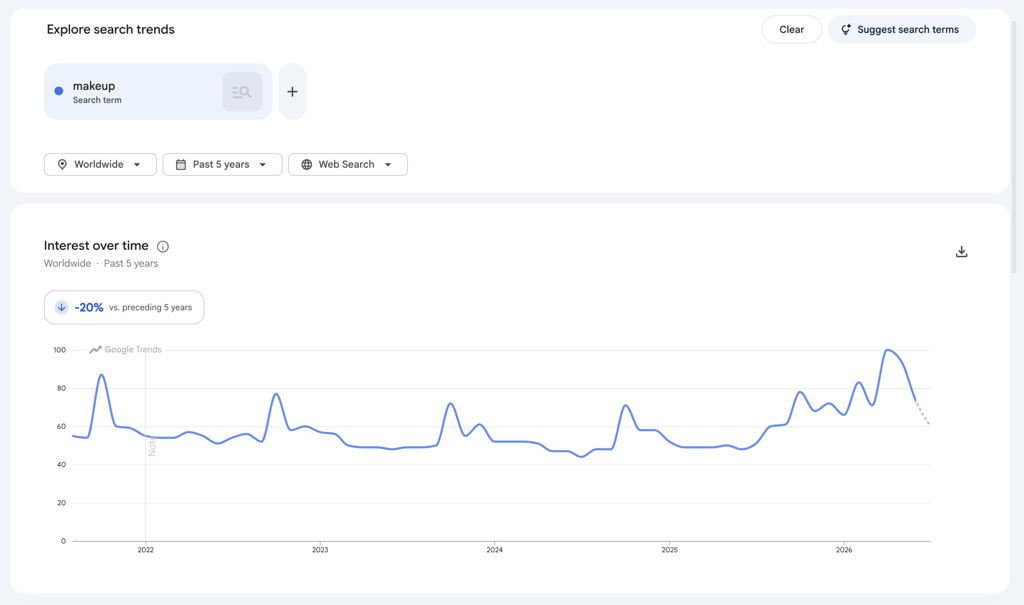
Google Trends shows that searches for “makeup” remain relatively steady year-round, with notable spikes during end-of-year sales events.
To market trending makeup products effectively, focus on user-generated content and tutorials that showcase your products in action. Collaborate with beauty influencers and makeup artists to demonstrate application techniques.
Offering shade ranges that cater to diverse skin tones helps you reach a wider audience. Consider targeting niches like clean beauty, long-wear formulas, or products tailored to specific cosmetic concerns. You can also create tutorials and beauty tips to help shoppers understand application and benefits.
9. Hair oils
- Average selling price – $10-50 for mass and mid-tier products; premium oils from brands like Moroccanoil or Olaplex range from $30-70, and professional-grade salon oils can exceed $80.
- Estimated monthly Google searches – 124,000.
- Top countries – United States, India, United Kingdom.
- Target audience – People dealing with hair damage, scalp issues, or heat styling wear; also popular among South Asian communities, where hair oiling is a long-standing cultural practice.
- Supplier suggestions – Alibaba, IndiaMART, Apollo Wholesale.
Hair oils are commonly used to condition dry hair, reduce friction and add softness or shine. The effect depends on the oil, formulation, hair type, and how the product is used.
People who use heat-styling tools may shop for hair oils marketed for smoothing, shine, or reducing the appearance of dryness.
The wording you use matters here. There’s a difference between describing what a product feels like and claiming it fixes structural damage. Avoid promising that an oil will repair heat damage or prevent breakage unless the specific formula has evidence for those claims.
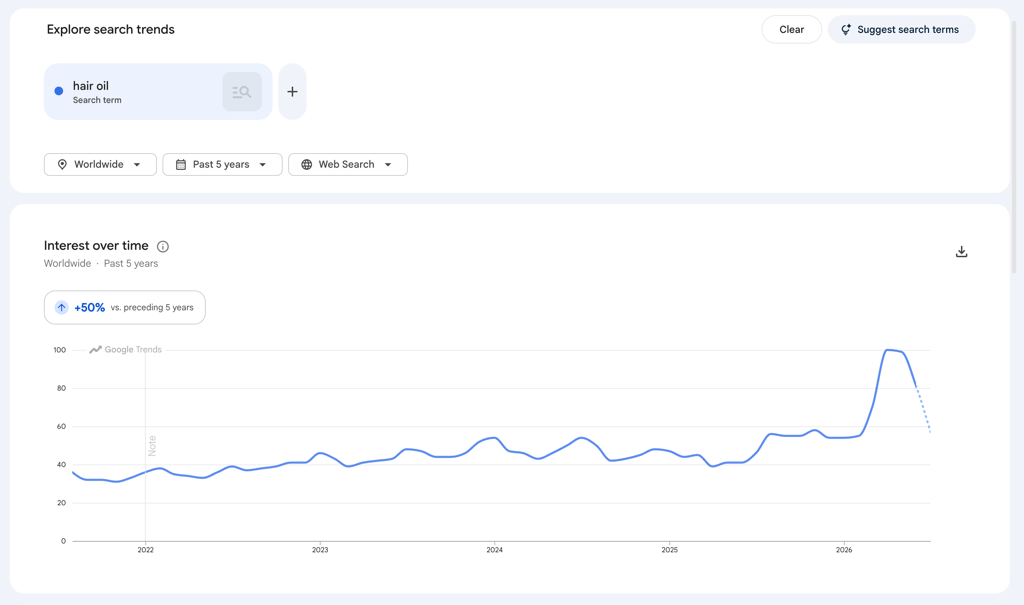
Search interest for hair oil has stayed consistently strong over the past five years, according to Google Trends.
To market hair oil effectively, collaborate with beauty influencers who can showcase clear before-and-after results. Target creators who focus on hair care routines, especially those with dry, damaged, or textured hair.
Develop educational content explaining different types of hair oils and their unique benefits. For example, argan and coconut oils are often marketed for conditioning and shine.
Offering sample sizes or trial sets is also smart, since many customers want to test hair products before committing to full-size bottles. Sellers targeting South Asian diaspora communities in the US and UK can tap into strong existing demand, since hair oil is already a staple in many of these households.
10. Pimple patches
- Average selling price – $5-25 for standard hydrocolloid patches; advanced microneedle patches from brands like ZitSticka or Peace Out can reach $30-40+.
- Estimated monthly Google searches – 175,000.
- Top countries – United States, India, Australia.
- Target audience – Teenagers, young adults aged 18-34, and adults with occasional breakouts.
- Supplier suggestions – Faire, IndiaMART, Alibaba.
Pimple patches are small stickers that you apply directly to blemishes. Many use hydrocolloid material, which can absorb fluid, protect the area from picking, and support healing.
While standard hydrocolloid patches mainly create a protective barrier and absorb fluid, some products also contain active ingredients to improve healing.
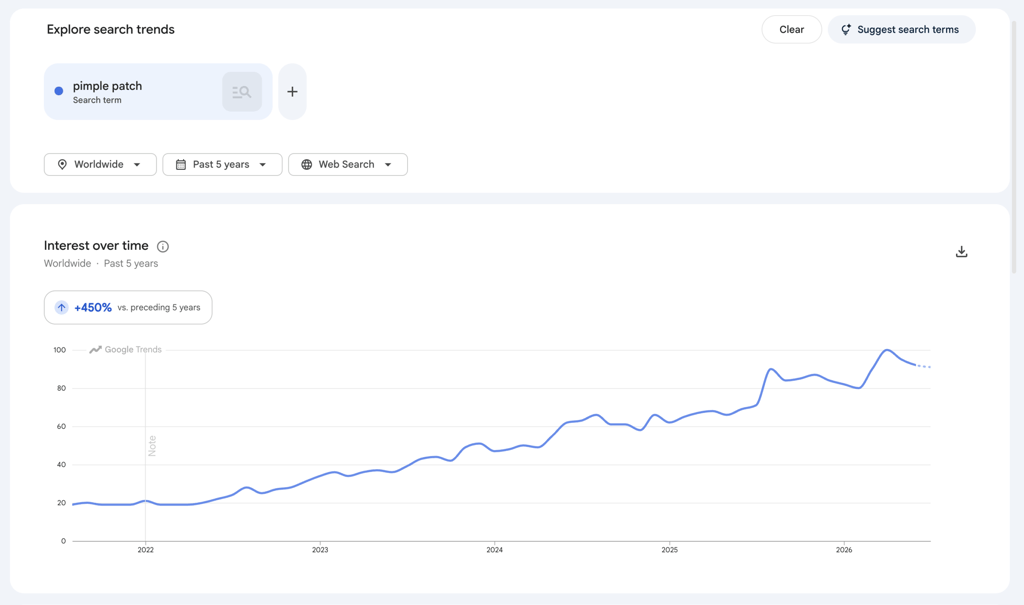
Search interest for pimple patches has grown steadily over the past five years.
To market pimple patches effectively, create educational content that explains how they work. Before-and-after photos showing real results perform especially well on social media.
Focus on teenagers, college students, and adults who deal with occasional breakouts. Acne is one of the most common skin conditions across all age groups, so the audience goes well beyond skincare hobbyists. Partner with skincare influencers who can showcase real results and demonstrate proper application.
11. Press-on nails
- Average selling price – $5-30; budget drugstore sets start around $5-12, while mid-range and handmade sets from brands like Olive & June, Glamnetic, or custom Etsy sellers run $15-50+.
- Estimated monthly Google searches – 257,000.
- Top countries – United States, India, United Kingdom.
- Target audience – Beauty enthusiasts, budget-conscious consumers, busy professionals.
- Supplier suggestions – Etsy, Alibaba, Faire.
Press-on nails offer a convenient way to change nail styles at home without a salon appointment. They’re simple to apply and remove, but improper application or removal can damage natural nails.
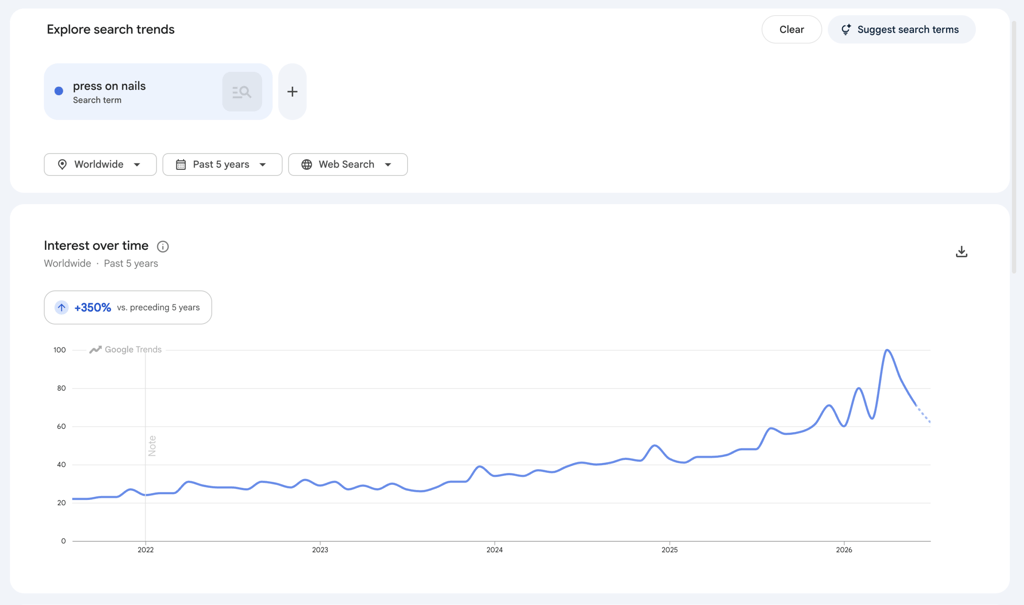
Google Trends shows that search interest in press-on nails has risen markedly over recent years.
To succeed with press-on nails, focus on unique designs that stand out from basic options. Launch seasonal collections, feature trending patterns, or team up with nail artists for exclusive styles.
Target busy professionals who want polished nails without salon visits, students on a budget, and anyone who loves switching up their look often. Share application tutorials and styling videos on TikTok and Instagram, where nail content thrives.
Offer a variety of nail shapes and sizes to suit different preferences. Custom, handmade or limited-edition designs can support higher price points when the quality and differentiation justify them.
Pro tip
Conducting thorough research to identify the best products to sell is important when starting an online store, but finding the right ecommerce hosting is equally important.

Top trending health and wellness products
People are increasingly prioritizing both mental wellness and physical fitness. According to Precedence Research, the global health and wellness market was valued at $4.79 trillion in 2025 and is projected to reach $7.76 trillion by 2035, growing at a 4.94% compound annual growth rate.
Health and wellness products need careful positioning because benefit claims can cross into regulated health or medical claims. Focus on accurate product information and everyday use cases, and work with creators who can demonstrate the product without exaggerating its benefits.
12. Matcha
- Average selling price – $10-50 for culinary and everyday-grade matcha; premium ceremonial-grade tins from brands like Ippodo or Marukyu Koyamaen can reach $80-100+.
- Estimated monthly Google searches – 1,500,000.
- Top countries – United States, United Kingdom, Germany.
- Target audience – Health-conscious consumers, tea drinkers, caffeine enthusiasts.
- Supplier suggestions – Keicha Tea World, Alibaba, Alveus.
Matcha is a powdered green tea that appeals to tea drinkers and people looking for an alternative to coffee.
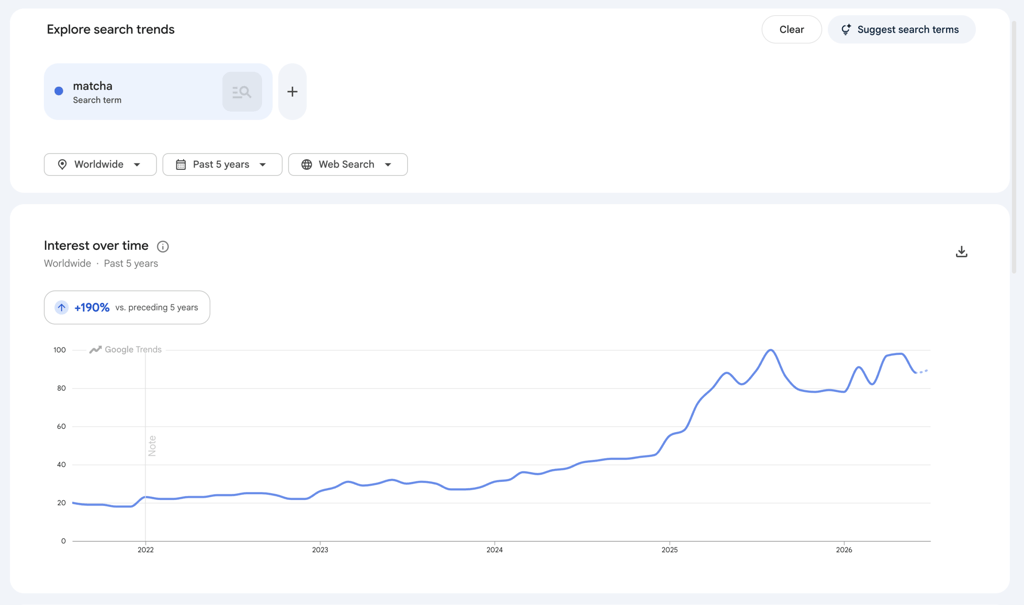
Google Trends data show consistent upward momentum, with a noticeable rise in recent years, indicating sustained consumer interest.
Market matcha around its flavor, preparation ritual, caffeine content, and recipe versatility. Avoid guaranteeing effects such as “no jitters” or afternoon crashes, which vary by serving size and individual response.
Focus on health-conscious shoppers, coffee drinkers exploring new options, and anyone interested in wellness routines. Share content about how to prepare matcha, what different grades mean, and easy recipes like matcha lattes or smoothies.
Bundle matcha with tools used for making it to increase your average order value. Offer starter kits that include matcha powder, a bamboo whisk, and a ceramic bowl at a discounted package price.
Pro tip
Matcha has a loyal repeat-buyer base, so your store needs to handle returning traffic and subscription-style purchases smoothly. Hostinger's WooCommerce hosting can support stores that need WooCommerce-focused performance and scaling features.
13. Gluten-free pasta
- Average selling price – $3-20 per unit; budget brands like Barilla start around $3-5, mid-range options like Banza or Jovial run $5-12, and premium artisan pasta reaches $10-18.
- Estimated monthly Google searches – 46,000.
- Top countries – United States, United Kingdom, Australia.
- Target audience – People with gluten-related medical conditions, health enthusiasts.
- Supplier suggestions – Manicaretti, Infinity Foods Wholesale, Explore Cuisine.
Gluten-free pasta is made from alternative flours like rice, corn, or potato instead of wheat. It comes in familiar pasta shapes, but taste and texture vary by formulation.
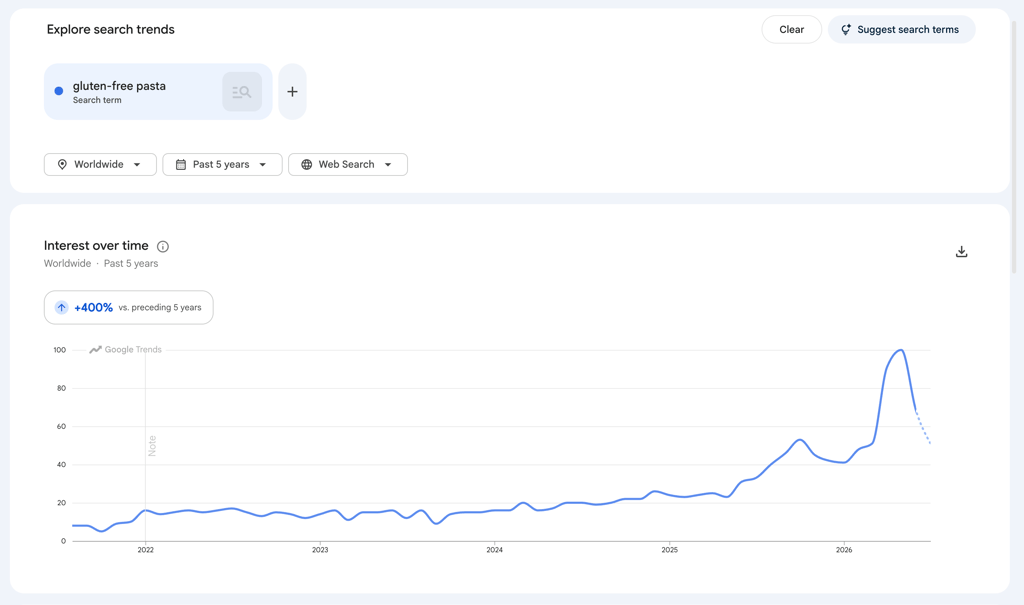
Google Trends shows steady, high search volume for gluten-free pasta, reflecting ongoing demand. People with celiac disease or gluten sensitivity rely on these options as dietary staples, not just occasional purchases.
Target people with gluten-related conditions like celiac disease and wheat allergies, but don’t overlook health-conscious consumers who choose gluten-free by preference.
Try offering variety packs with different pasta shapes to encourage sampling. Team up with gluten-free food bloggers and influencers who already have loyal, engaged followings.
Create educational content to build trust and position yourself as an expert. You can start a food blog filled with gluten-free pasta recipes, cooking tips, and brand comparisons helps attract organic traffic and build authority.
14. Mushroom coffee
- Average selling price – $10-50 for ground blends and instant packets; premium ready-to-drink formats and subscription bundles can exceed $50-80.
- Estimated monthly Google searches – 205,000.
- Top countries – United States, United Kingdom, Canada.
- Target audience – Health-conscious coffee drinkers, caffeine-sensitive consumers, wellness enthusiasts, urban professionals seeking functional alternatives.
- Supplier suggestions – Faire, Real Mushrooms, Dodjivi.
Mushroom coffee typically combines coffee with mushroom extracts or powders such as lion’s mane, reishi, or cordyceps. Caffeine content and ingredient amounts vary substantially between brands.
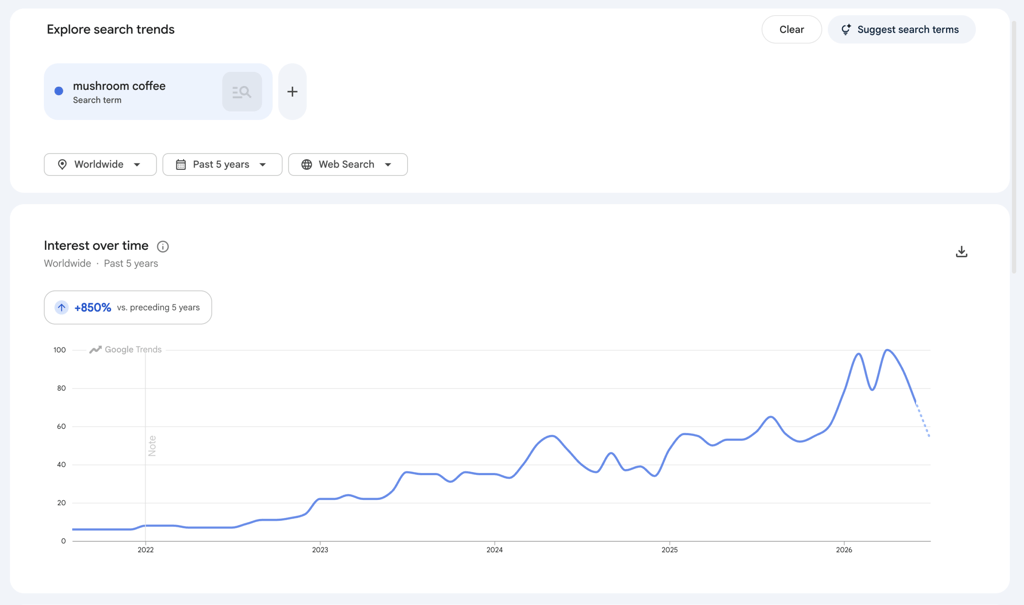
Search interest for mushroom coffee has climbed steadily over the past few years, reflecting strong and sustained demand.
To market mushroom coffee effectively, create educational content that explains what it is and why it’s worth trying. Avoid unqualified claims about immunity, focus, or “smoother energy” unless the specific formulation and wording are adequately substantiated.
The core audience is people looking to reduce caffeine without giving up the coffee ritual. Target health-conscious drinkers and caffeine-sensitive consumers, and consider offering sample sizes or variety packs so buyers can try before committing.
15. Massage guns
- Average selling price – $30-200 for consumer models; professional-grade devices from brands like Theragun and Hyperice range from $300-600+.
- Estimated monthly Google searches – 350,000+.
- Top countries – United States, United Kingdom, Germany.
- Target audience – Fitness enthusiasts, athletes, office workers, wellness-focused consumers.
- Supplier suggestions – Alibaba, Made-in-China, IndiaMART.
Massage guns are handheld devices that deliver rapid percussive massage to soft tissue. When used appropriately, they may temporarily reduce muscle tightness and post-exercise soreness.
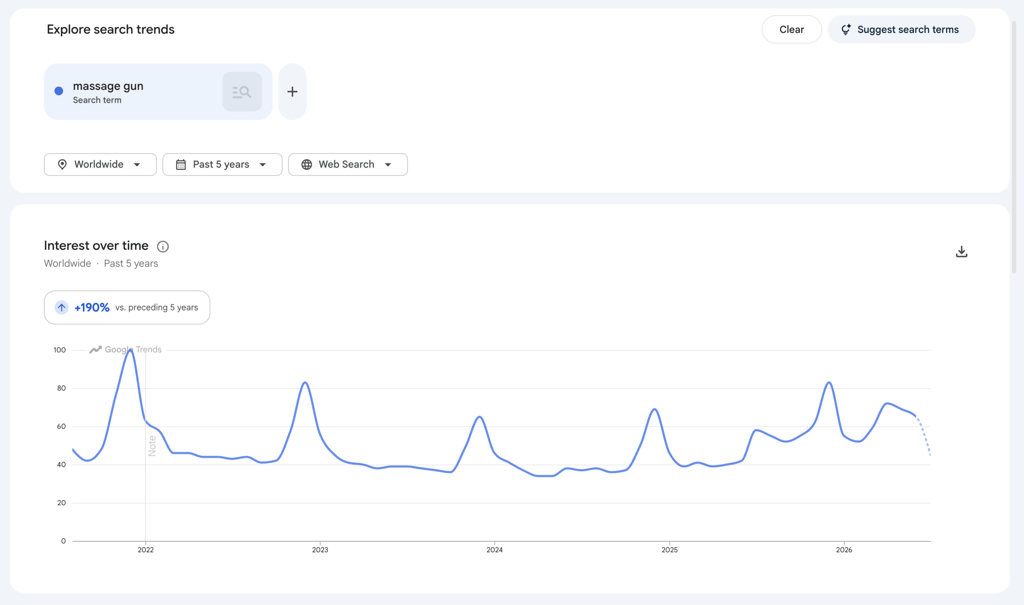
According to Grand View Research, the global massage gun market was valued at $491.6 million in 2025 and is projected to grow at 8.2% annually through 2033. Google Trends shows year-round interest with seasonal peaks around December and January.
Target fitness enthusiasts, athletes, office workers, and gift shoppers based on the product’s features and intended use. Avoid marketing a consumer massage gun as treatment for injuries or physiotherapy needs unless the product is specifically cleared and supported for those claims.
Create content comparing features like motor power, noise level, and battery life. Demo videos showing how to target specific muscle groups perform well on YouTube and TikTok. Bundling with extra attachments or carrying cases can increase average order value.
16. Air purifiers
- Average selling price – $30-200 for consumer models; premium smart purifiers from brands like Dyson and IQAir range from $400-1,100+.
- Estimated monthly Google searches – 485,000.
- Top countries – United States, India, United Kingdom.
- Target audience – Allergy and asthma sufferers, pet owners, parents of young children, urban dwellers in high-pollution areas, and residents in wildfire-prone regions.
- Supplier suggestions – Smart Air, Ausclimate, Alibaba.
Air purifiers can improve indoor air quality by filtering certain airborne particles, and some models can also reduce specific gases or odors depending on their filter media. They do not remove every pollutant, and health benefits should not be guaranteed.
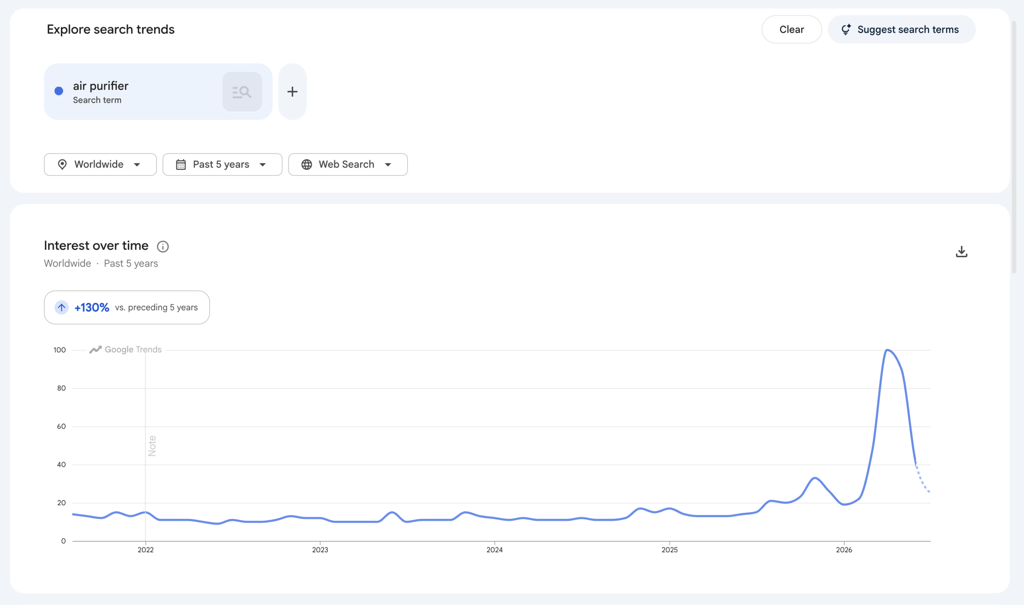
Google Trends shows higher search intent in air purifiers in 2026 after several years of fluctuation.
Target audiences based on room size and the air-quality problem they want to address. Small desktop units suit compact spaces, while larger models are designed for bigger rooms.
Create content that addresses common air quality issues such as pet dander, cooking odors, wildfire smoke, and seasonal allergies. Focus your marketing around peak allergy seasons in spring and fall.
Offer room-size calculators or buying guides to help customers choose the right purifier, and bundle them with replacement filters to boost order value.
Top trending fashion items
According to Statista, the global apparel market was valued at $1.92 trillion in 2026, making it one of the biggest consumer markets worldwide.
This year’s fashion trends emphasize versatile pieces that blend comfort with style. Wide-leg pants and athleisure continue to gain search volume, while cargo pants and mini dresses remain popular throughout 2026.
17. Athleisure
- Average selling price – $20-100 for mass and mid-tier brands; premium athleisure from Lululemon, Alo Yoga, or Vuori regularly runs $80-200+ per item.
- Estimated monthly Google searches – 67,000.
- Top countries – United States, India, United Kingdom.
- Target audience – Fashion and active lifestyle enthusiasts.
- Supplier suggestions – BELLA+CANVAS, IndiaMART, Fire Label.
Athleisure blends comfort with style, offering outfits comfortable enough for workouts but fashionable enough for daily activities. Major brands like Lululemon have transformed sportswear into everyday fashion, and the trend continues to grow.
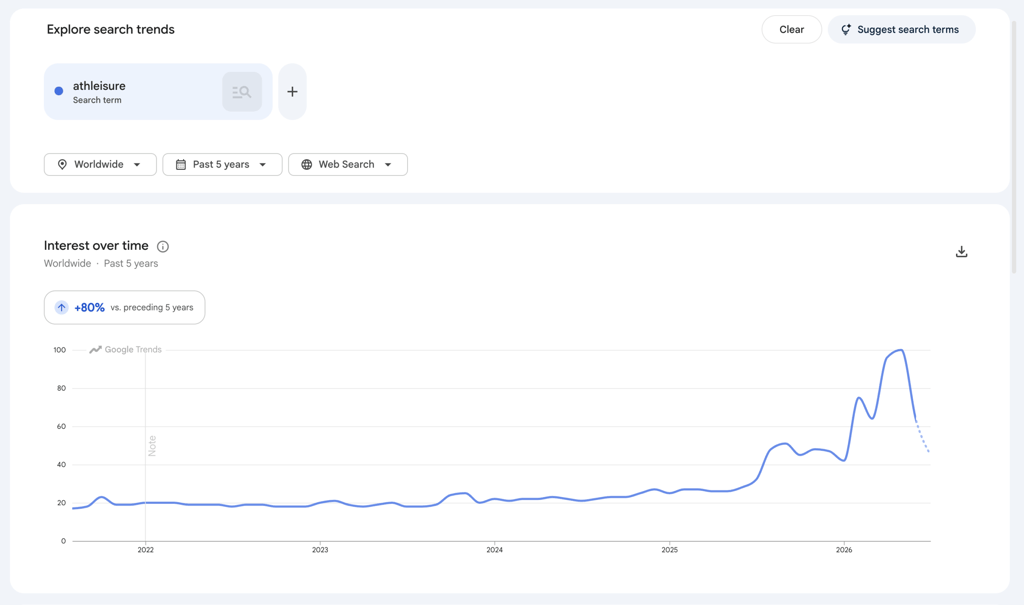
Search interest for athleisure has risen this year, showing continued interest in the category.
Athleisure includes plenty of product options for online sellers: leggings, sports bras, joggers, hoodies, and athletic t-shirts. Focus on versatile pieces that easily transition from workouts to everyday wear.
You can promote your website for free by focusing on social media platforms like Instagram and TikTok, where athleisure content performs well.
Explore partnering with fitness influencers who can authentically showcase your products in everyday settings.
18. Wide-leg pants
- Average selling price – $15-50 for mass and mid-tier; premium and designer wide-leg trousers in tailored linen or silk can reach $80-200+.
- Estimated monthly Google searches – 82,000.
- Top countries – United States, United Kingdom, Australia.
- Target audience – Fashion enthusiasts.
- Supplier suggestions – Wholesale Fashion Square, Faire, Alibaba.
Wide-leg pants have returned to mainstream fashion after years of slimmer silhouettes dominating many collections; their loose cut works across casual, denim, workwear and tailored styles.
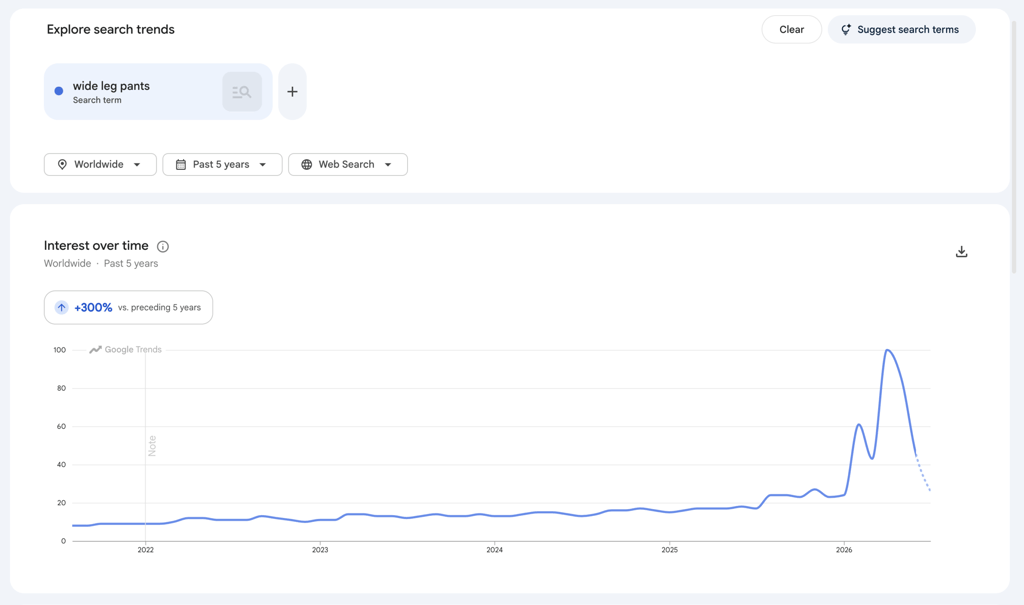
Google Trends shows that searches for wide-leg pants continue to reach new peaks, reflecting strong and growing interest.
Formal wide-leg trousers appeal to professionals looking for polished workwear. Casual wide-leg jeans appeal to younger shoppers, while high-waisted cuts appeal to fashion-conscious buyers who like vintage looks.
Create styling content that shows how to pair wide-leg pants for different occasions, whether it’s a work meeting, weekend brunch, or night out. Partner with fashion influencers who can demonstrate fabrics, rises, footwear combinations and styling options.
19. Cargo pants
- Average selling price – $15-80; budget and mass-market pairs start around $15-45, while mid-range workwear brands like Dickies and Carhartt run $40-80, and premium labels exceed $100.
- Estimated monthly Google searches – 657,000.
- Top countries – United States, India, United Kingdom.
- Target audience – Fashion-conscious casual consumers, workwear buyers, outdoor enthusiasts, and tactical/military gear shoppers.
- Supplier suggestions – Faire, IndiaMART, Alibaba.
Cargo pants are making a strong comeback, thanks to their mix of utility and style. They’re great for outdoor work, casual wear, or everyday use.
Google Trends shows that search interest in cargo pants has fluctuated over the past five years, with several pronounced spikes in recent years.
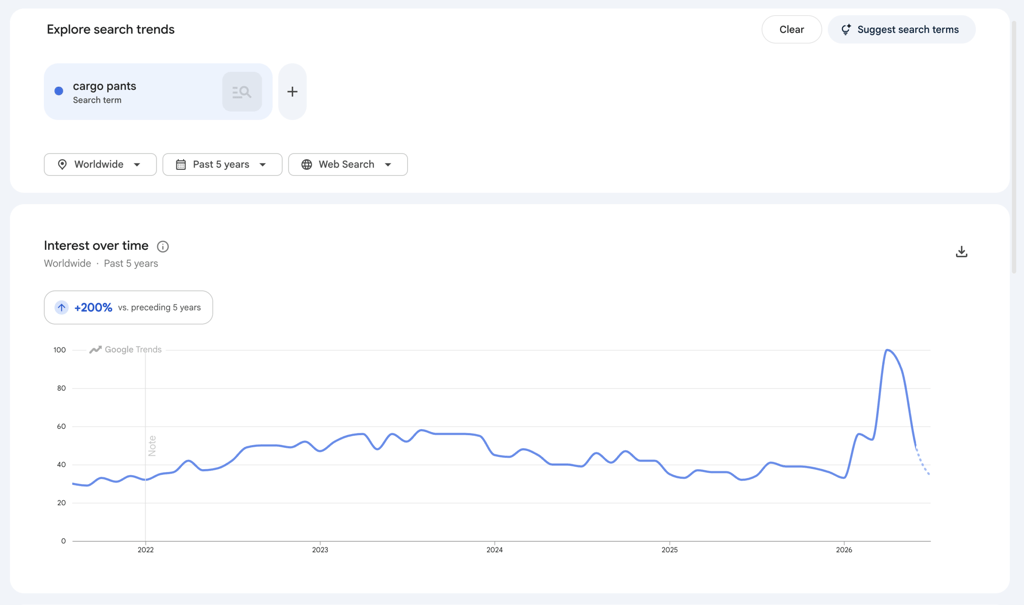
Market cargo pants by highlighting the features of the specific product, such as fabric weight, fit, pocket layout, reinforced stitching, or weather resistance where applicable.
Workwear and tactical segments are worth targeting alongside fashion buyers. Shoppers in these niches prioritize durability and function over trends, so highlighting materials, reinforced stitching, and practical features can set your store apart.
Create content showing cargo pants in action, whether that’s someone using all the pockets on a job site, hiking a trail, or styling them for a casual night out.
20. Mini dresses
- Average selling price – $20-100; budget brands start around $20-40, mid-range labels like Free People and Revolve run $40-120, and premium designers can exceed $150.
- Estimated monthly Google searches – 129,000.
- Top countries – United States, United Kingdom, Australia.
- Target audience – Young adults aged 18–34, teenagers, party and occasion shoppers, and vacation/resort wear buyers.
- Supplier suggestions – Corner 123, City Goddess, Style State.
A mini dress is a short dress with a hemline that typically falls above the knee. Styles include fitted, relaxed, tailored and flowy for casual, party and occasion wear.
Search data confirms growth in interest for mini dresses in 2026.
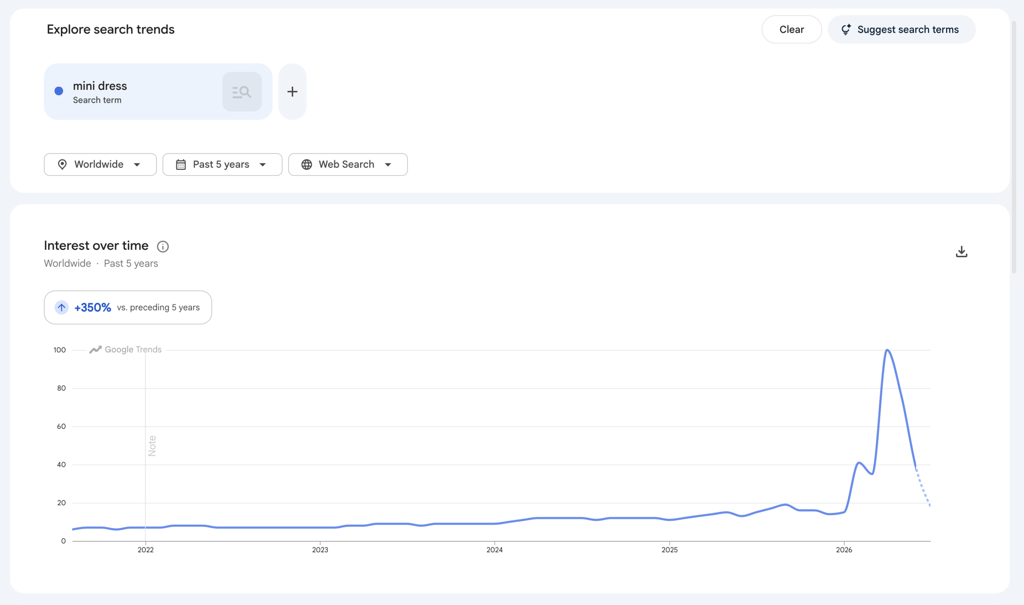
Help customers match mini dress styles to different occasions, like a sleek option for date night, a flowy version for vacations, or a tailored mini for casual office wear.
Showing these pairings works best when people can actually see the outfits in action. Short videos and styled photos do more for this category than product descriptions alone.
Visual platforms like Instagram and TikTok are useful for this category, so focus your marketing on styling content and outfit inspiration.
Work with fashion influencers to show styling ideas, from dressing minis up with heels and accessories to dressing them down with sneakers and denim jackets. Tackle common concerns like comfort, fit, and where it’s appropriate to wear a mini dress.
You can sell clothes online in 9 simple steps, from researching your market and finding clothing sources to setting up your store.
Top trending gadget items
Tech accessories are a broad range of ecommerce categories. Smaller accessories can be relatively easy to store and ship. However, profit margins vary widely by supplier, product quality, return rates, and competition.
Items that solve everyday problems can perform well: power banks for extended battery life, phone stands for hands-free viewing, and laptop stands for ergonomic setups. These products appeal to remote workers, students, and heavy device users.
21. Smartwatches
- Average selling price – $30-200 for budget and mid-tier models; premium devices like Apple Watch Ultra and Garmin Fenix run $400-1,000+ (the premium segment accounts for nearly half of total market revenue).
- Estimated monthly Google searches – 1,400,000.
- Top countries – United States, Germany, India.
- Target audience – General population, fitness, and tech enthusiasts.
- Supplier suggestions – Alibaba, Made-in-China, BigBuy.
Smartwatch features vary by model, but most can sync with your smartphone to track health metrics like steps, heart rate, sleep patterns, and calories burned. It may also let you receive notifications, respond to messages, make calls, and control music directly from your wrist.
Google Trends shows steady year-round interest, with noticeable spikes during holidays as gift-buying ramps up.
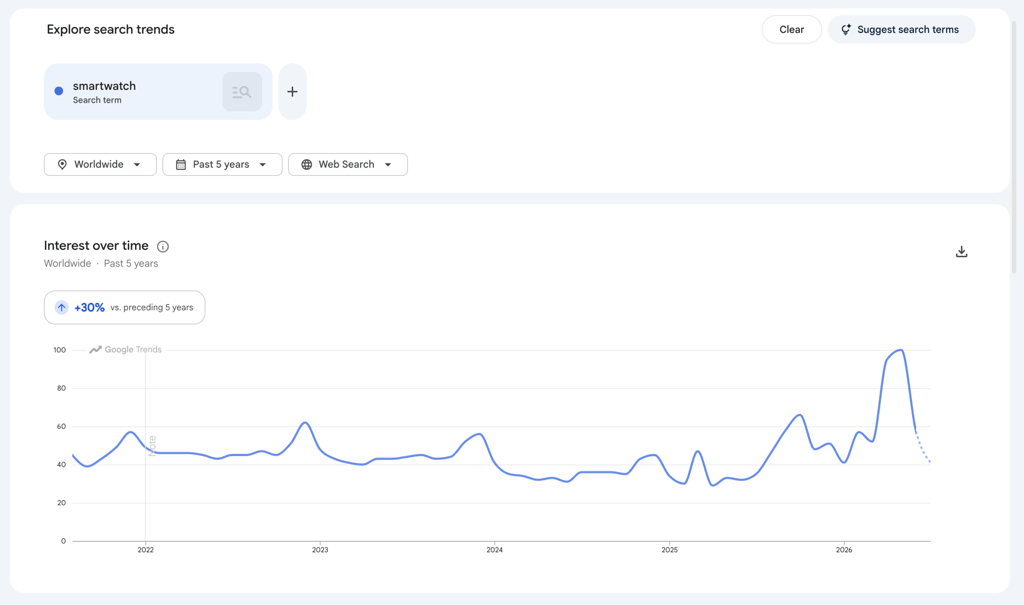
To market smartwatches effectively, use high-quality product photos showcasing the device from multiple angles. Include lifestyle shots of people using the watch during workouts, at work, and while out and about.
Target fitness enthusiasts, busy professionals, and tech-savvy consumers. Create comparison charts showing different smartwatch models and their features to help customers choose the right one.
22. Power banks
- Average selling price – $15-100; basic models start around $15-30, mid-range options with fast charging and 20,000+ mAh capacity run $40-80, and premium laptop-compatible or MagSafe units reach $80-150+.
- Estimated monthly Google searches – 653,000.
- Top countries – India, Brazil, Germany.
- Target audience – Travelers, remote workers, students, outdoor and festival enthusiasts, and tech-savvy consumers.
- Supplier suggestions – IndiaMART, Alibaba, Made-in-China.
Power banks are portable chargers that keep devices running during trips, outdoor activities, or busy days on the go. Compact and lightweight, they easily fit into bags or even pockets. Many models support fast charging and include multiple USB ports to power several devices at once.
Search volume for power banks stays consistently high, with spikes around holidays when people buy them as gifts or prepare for trips.
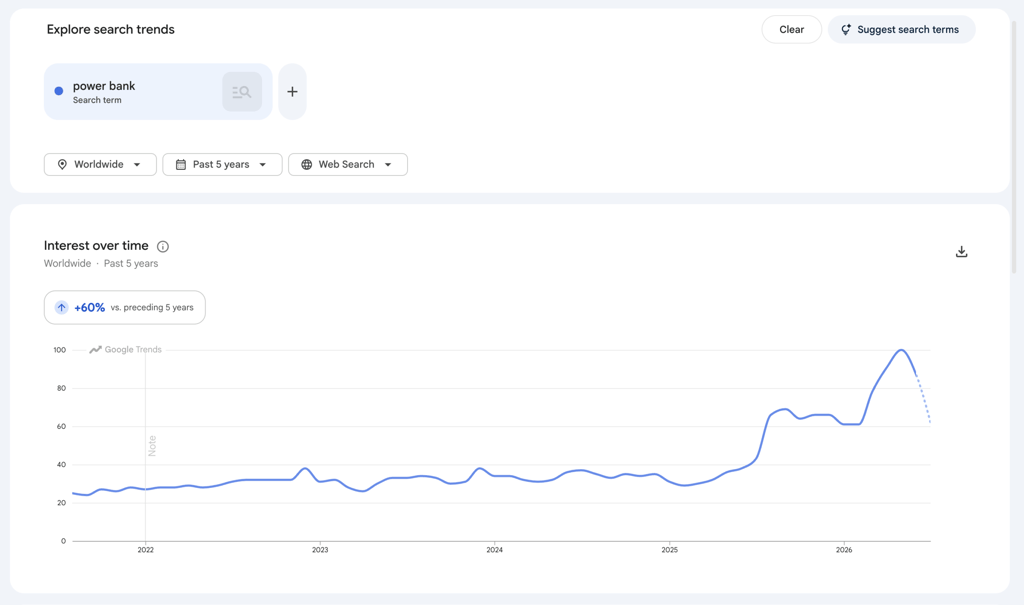
Create content that shows how different power banks perform in everyday situations. Highlight charging times for popular phone models, the number of full charges each provides, and how reliably they perform during travel or outdoor adventures.
Collaborate with travel bloggers, outdoor influencers, and tech reviewers who can showcase your power banks in action.
Alongside that creator content, your own product pages and blog posts need to answer the practical questions shoppers ask before buying.
Focus comparisons and buying guides around capacity differences, since shoppers often struggle to choose between compact low-capacity models and bulkier high-capacity ones.
23. Bluetooth trackers
- Average selling price – $15-40 for standard Bluetooth-only trackers; GPS and cellular hybrid trackers for pets or enterprise use range from $50-200+.
- Estimated monthly Google searches – 120,000+.
- Top countries – United States, United Kingdom, Germany.
- Target audience – Tech enthusiasts, frequent travelers, people who want to track their personal belongings.
- Supplier suggestions – Alibaba, DHgate, Made-in-China.
Bluetooth trackers are small devices that attach to keys, bags, wallets, or luggage so you can locate them through a smartphone app. Apple’s AirTag and Google’s Find Hub network have expanded the category, and brands like Chipolo and Pebblebee offer cross-platform alternatives.
The market keeps expanding. Apple launched its second-generation AirTag in early 2026 with improved range and Precision Finding. Google renamed Find My Device to Find Hub in 2025 and expanded Find Hub features in 2026, including item-location sharing with participating airlines. Google Trends shows steady search interest, with a spike in 2026.
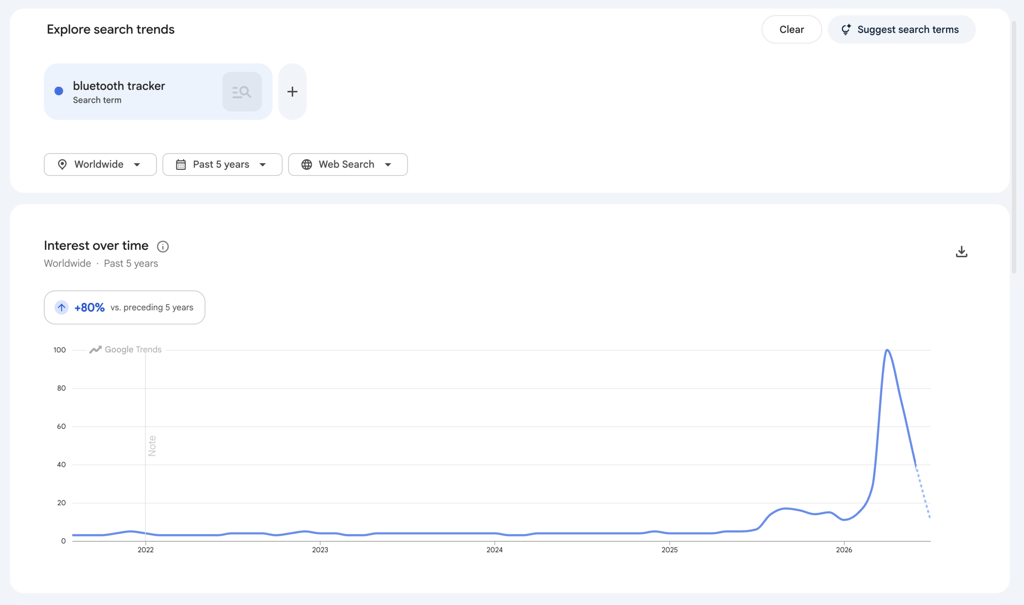
Target frequent travelers worried about lost luggage, or anyone who regularly misplaces keys or wallets. These are practical, problem-solving products with strong gifting appeal.
Create comparison content that breaks down Apple vs. Google vs. third-party trackers, including range, volume, battery life, and compatibility. Unboxing and real-world test videos can help shoppers better compare models.
24. Phone stands
- Average selling price – $5-60; basic plastic and acrylic stands start around $5-15, adjustable mid-range stands run $15-35, and premium models with wireless charging reach $30-80+.
- Estimated monthly Google searches – 53,000.
- Top countries – United States, India, United Kingdom.
- Target audience – Remote workers, content creators, home cooks, students, and general productivity users.
- Supplier suggestions – Alibaba, IndiaMART, Aulola.
Phone stands let users prop up their phones on desks, countertops, or nightstands for hands-free use. They’re especially handy for video calls, streaming content, following recipes, or using a phone as a bedside clock.
Interest in phone stands has remained consistent on Google Trends, with a rising interest in 2026.
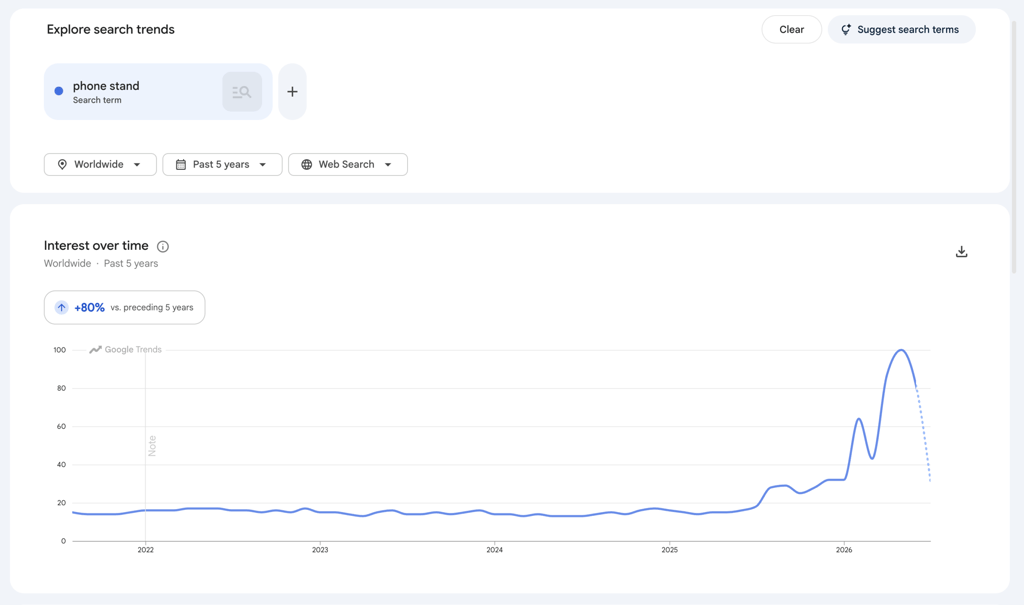
Target remote workers who need better setups for video calls, content creators who film with their phones, home cooks who follow recipes, and anyone who uses their phone for entertainment or productivity at a desk.
Position phone stands around hands-free viewing, stable framing for video calls, and adjustable viewing angles. Models with built-in wireless charging can also appeal to shoppers who want charging and positioning in one accessory.
25. Laptop stands
- Average selling price – $10-50 for basic and mid-range adjustable stands; premium ergonomic models from brands like Rain Design or Twelve South run $50-100+.
- Estimated monthly Google searches – 180,000.
- Top countries – United States, India, United Kingdom.
- Target audience – Remote workers, students, freelancers, and professionals.
- Supplier suggestions – Alibaba, IndiaMART, Made-in-China.
A laptop stand raises your device to eye level, making it easier to build an ergonomic desk setup. It also improves airflow around the laptop, preventing overheating during extended use.
Searches for laptop stands surged with the rise of remote work, according to Google Trends.
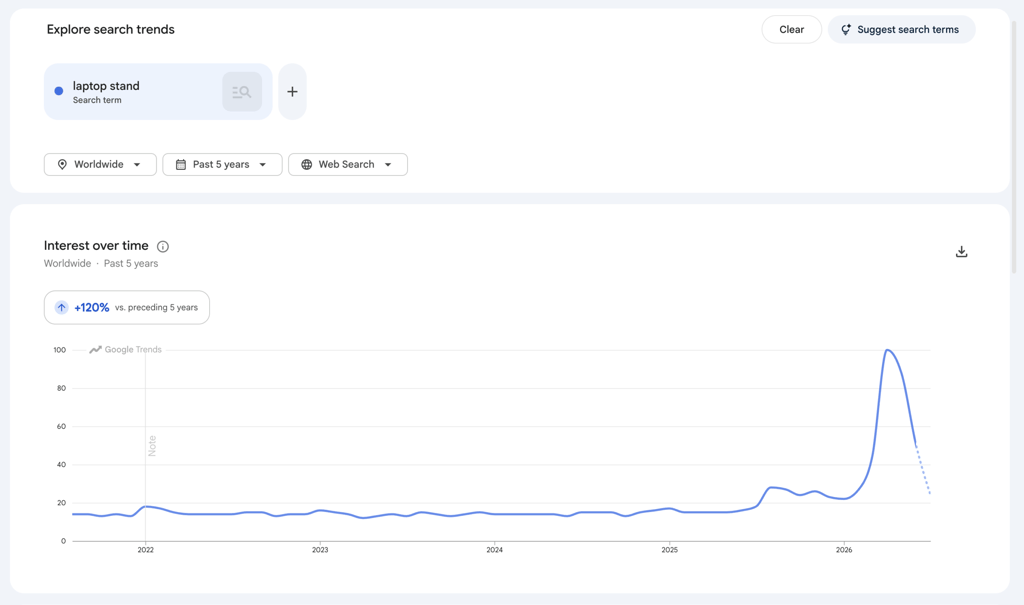
Target remote workers, students, freelancers, and anyone spending long hours on their laptops. Create content showcasing screen-height adjustments and how a stand works alongside an external keyboard or mouse.
An affiliate marketing campaign with productivity influencers, ergonomic experts, and remote work advocates can help promote your product.
Beyond partnerships, how you package your offer can also drive higher order values and give customers more reasons to buy from you instead of a competitor. Consider bundling laptop stands with other ergonomic accessories, such as external keyboards or laptop sleeves.
26. Car chargers
- Average selling price – $8-50; basic dual-port chargers start around $8-15, mid-range fast chargers run $15-30, and premium multi-port GaN models from brands like Anker or Satechi reach $30-60+.
- Estimated monthly Google searches – 46,000.
- Top countries – United States, India, United Kingdom.
- Target audience – Commuters, travelers, rideshare drivers, and parents.
- Supplier suggestions – Wholesale Phone Accessories, IndiaMART, Alibaba.
Car chargers plug into a vehicle’s power outlet to keep devices charged while on the road. Compact and easy to use, they often feature multiple USB ports and fast-charging capabilities.
Search for car chargers remains high and steady year-round.
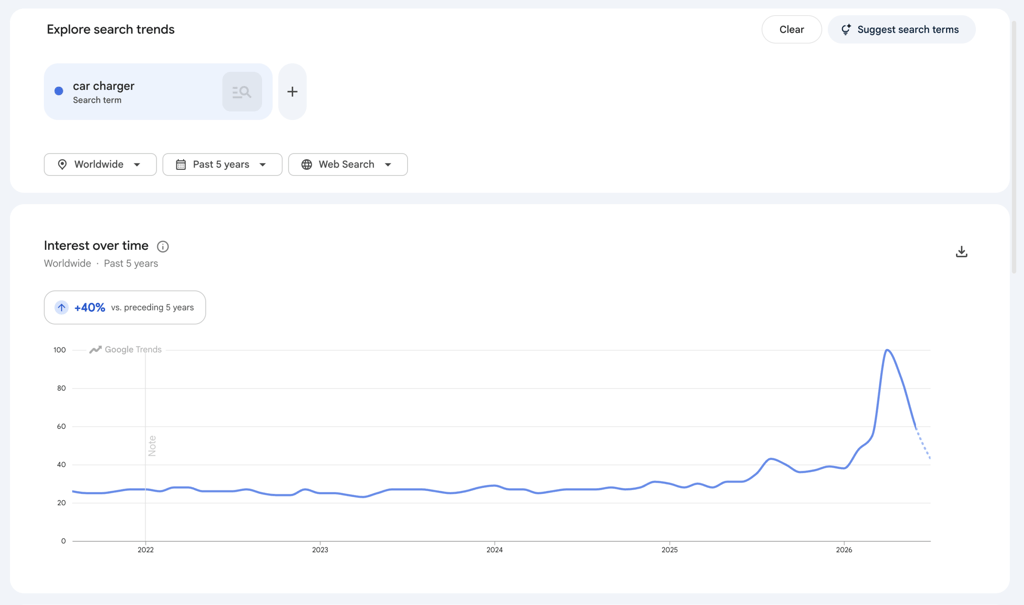
Car chargers are a strong product for dropshipping since they’re lightweight and compact to ship. If you’re new to that model, the steps for starting a dropshipping business apply well to tech accessories like these.
Your marketing should emphasize practical benefits such as staying connected in emergencies, keeping navigation apps active, and keeping phones charged for important calls. Highlight features customers value most: fast charging, broad compatibility, multiple ports, and durability.
Top trending baby and child care products
According to Precedence Research, the global baby care products market was valued at $110.69 billion in 2025 and is projected to reach $188.76 billion by 2035, growing at a 5.48% compound annual growth rate.
Baby and child care products cover recurring parenting needs across feeding, transport, sleep, monitoring, and everyday care.
27. Baby carriers
- Average selling price – $15-200; the mass-market tier at $50-80 accounts for the majority of sales, with premium carriers from Ergobaby and BabyBjörn at the upper end.
- Estimated monthly Google searches – 169,000.
- Top countries – United States, United Kingdom, India.
- Target audience – Parents and caretakers.
- Supplier suggestions – Baby K’tan, Amawrap, Faire.
Baby carriers let parents and caregivers carry infants hands-free while going about their daily activities. They’re useful for travel, public transportation, and crowded spaces since they fold up small and don’t require extra storage.
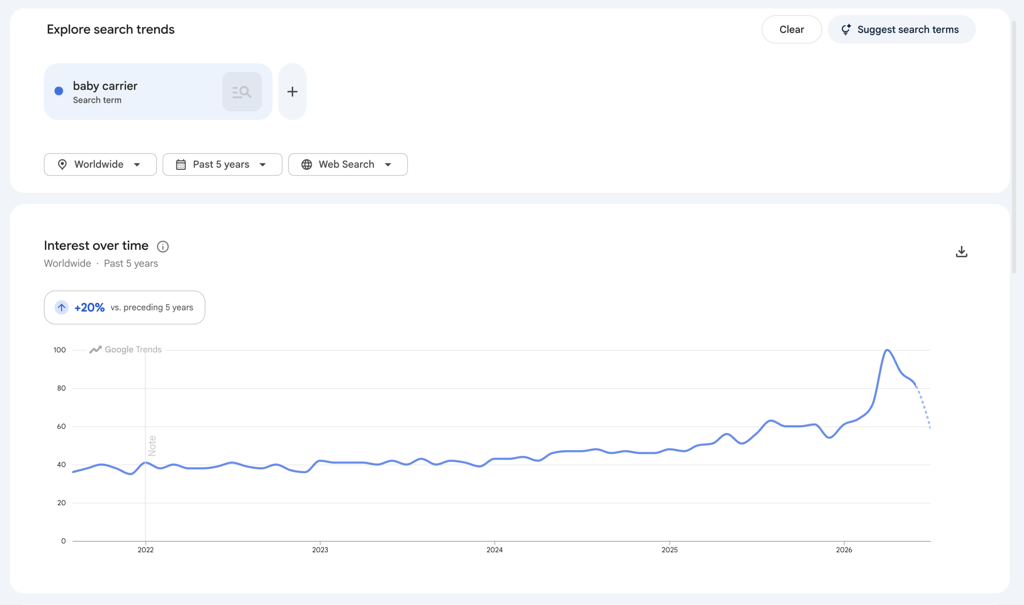
According to Google Trends, searches for baby carriers have grown consistently over the past five years.
Target parents and caregivers looking for hands-free carrying options. Focus on verified features such as supported age/weight ranges, adjustability, carrying positions, and ease of putting the carrier on.
Show parents using carriers in everyday life, from grocery shopping and hiking to doing chores and working from home. Offer a range of carrier styles:
- Soft wraps for newborns.
- Structured carriers for growing babies.
- Hiking carriers for active, outdoorsy families.
28. Baby swings
- Average selling price – $50-300; budget models with basic rocking start around $50-100, and premium app-connected swings like the 4moms MamaRoo reach the upper end.
- Estimated monthly Google searches – 103,000.
- Top countries – United States, United Kingdom, India.
- Target audience – Parents and caretakers.
- Supplier suggestions – Faire, Alibaba, IndiaMART.
Baby swings provide a seated, rocking space for awake infants while a caregiver is nearby. They should not be marketed as a sleep product; a baby who falls asleep in a swing should be moved to a firm, flat surface designed for infant sleep.
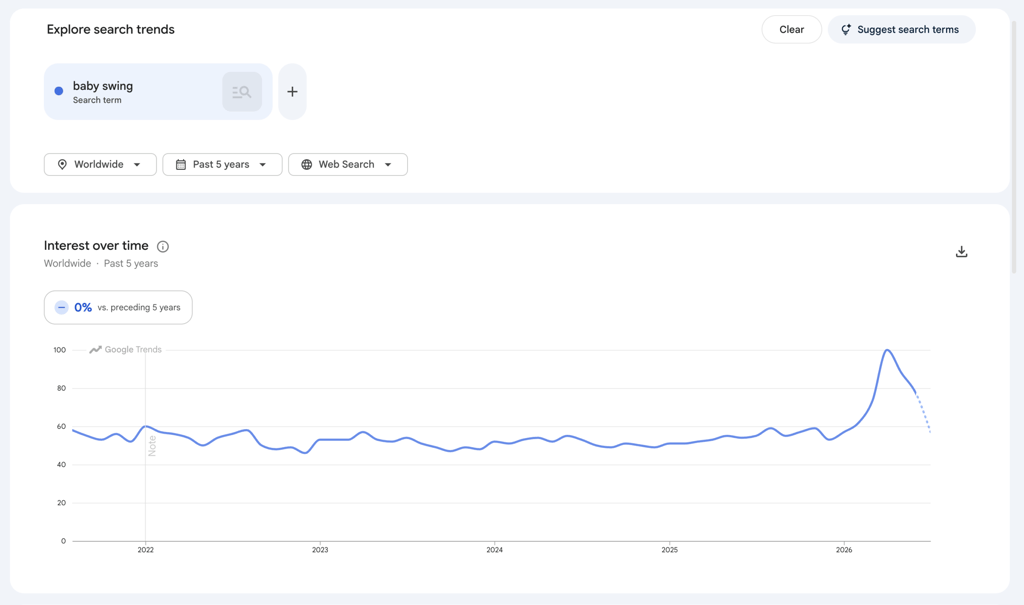
Baby swing searches remain consistently steady year-round on Google Trends, indicating reliable demand.
Baby swings range from basic models with simple rocking to smart versions with multiple speeds, built-in music, and hanging toys. Premium models connect to smartphone apps for remote control.
Consider offering swings at different price points. Bundle with other soothing products, such as white noise machines or swaddles. Create content that shows swings in action and includes testimonials from parents.
29. Baby monitors
- Average selling price – $30-350; basic audio monitors start around $30-60, mid-range video monitors run $100-200, and premium smart models reach $250-350+.
- Estimated monthly Google searches – 107,000.
- Top countries – United States, United Kingdom, Australia.
- Target audience – Parents and caretakers.
- Supplier suggestions – Alibaba, DHgate, Made-in-China.
Baby monitors let caregivers hear, view, or receive alerts from another room within the product’s stated range. Modern monitors offer features like smartphone apps, temperature alerts, two-way audio, and night vision.
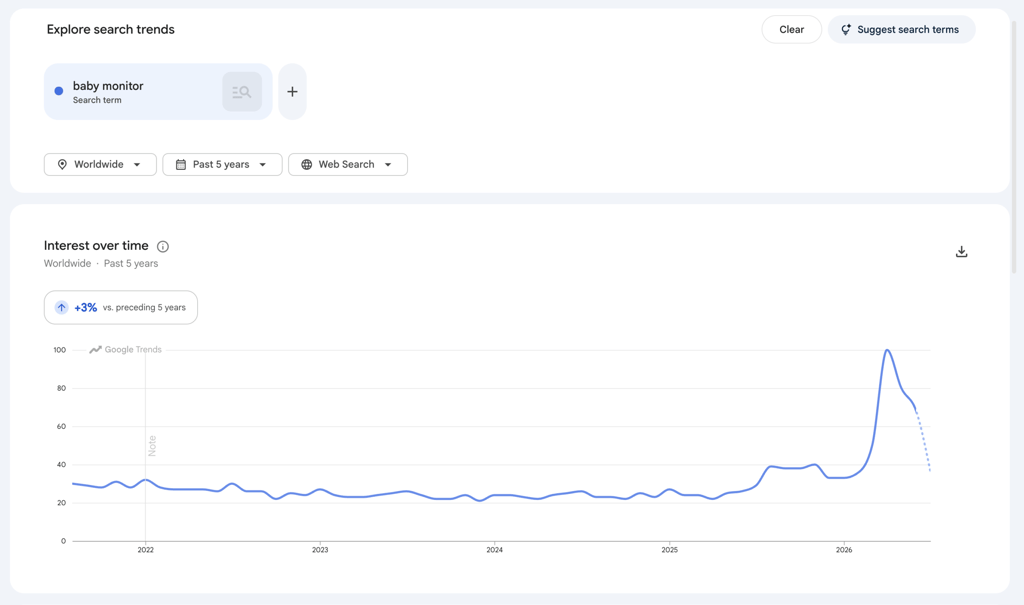
Interest in baby monitors stays consistently high year-round, with interest rising in 2026, making this a stable product category.
Highlight the key benefits: safety and convenience. Address common concerns like setup complexity, Wi-Fi reliability, and battery life. Clear guides, troubleshooting tips, and honest product details build trust.
Parents shopping for connected monitors often weigh privacy and security alongside features. If you sell Wi-Fi models, highlight security features like encryption and firmware updates. Non-Wi-Fi monitors are gaining appeal as a simpler option because they avoid direct internet connectivity.
Partner with parenting bloggers and family influencers who can share real-life reviews. Once you’ve decided which baby products to sell, you can create an online store with Hostinger Ecommerce Website Builder.
Top trending pet products
Pet care is a large consumer category. According to Global Market Insights, the global pet care market was valued at $304.4 billion in 2023 and is projected to grow at 6.8% annually through 2032.
30. Dog harnesses
- Average selling price – $10-100; budget nylon harnesses start around $10-20, mid-range options from brands like Ruffwear run $40-80, and premium ergonomic or tactical harnesses can exceed $100.
- Estimated monthly Google searches – 95,000.
- Top countries – United States, United Kingdom, Australia.
- Target audience – Dog owners.
- Supplier suggestions – Faire, Alibaba, Friendly Dog Collars.
A dog harness is a body-worn strap system that distributes pressure from walking across a dog’s chest and torso. Unlike traditional collars, harnesses, when properly fitted, avoid straining the neck, giving owners better control and dogs a more comfortable walking experience.
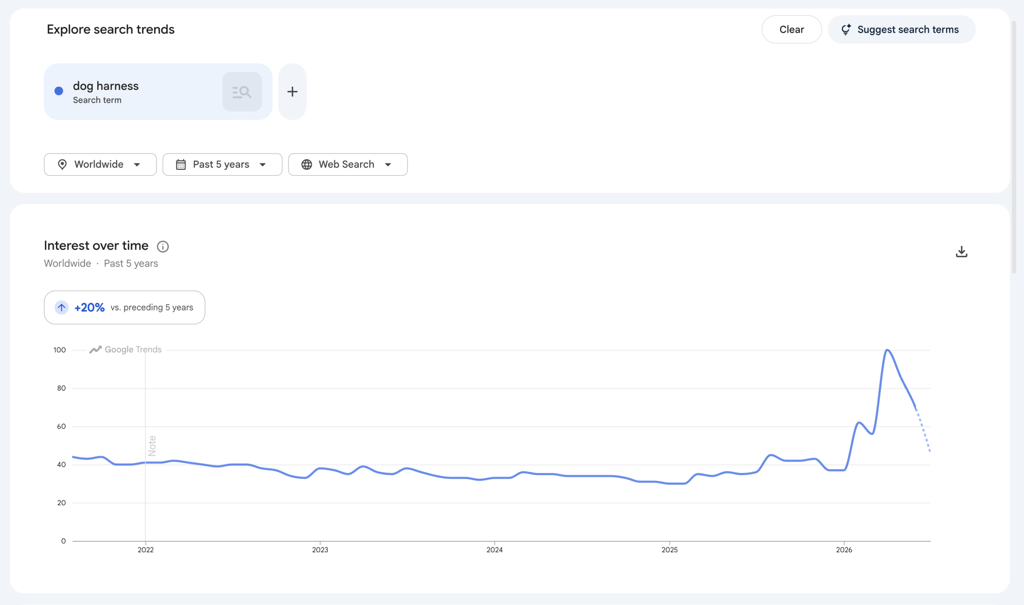
Google Trends shows searches for dog harnesses have remained consistently high over recent years.
Create educational content covering how to fit harnesses properly, the benefits over collars, and tips for training dogs to wear them. Produce clear demonstration videos and address common questions about sizing and escape-proof features.
Offer a range of harness styles to suit different breeds and activities, and consider bundling them with matching leashes.
31. Cat beds
- Average selling price – $10-100; basic cushion-style beds start around $10-20, mid-range enclosed and orthopedic beds run $25-55, and premium heated, designer, or handmade artisan beds reach $60-200+.
- Estimated monthly Google searches – 55,000.
- Top countries – United States, United Kingdom, Australia.
- Target audience – Cat owners.
- Supplier suggestions – Faire, Pet Beds Direct, Alibaba.
Cats spend much of the day resting, making beds a common pet accessory for owners who want a dedicated sleeping spot.
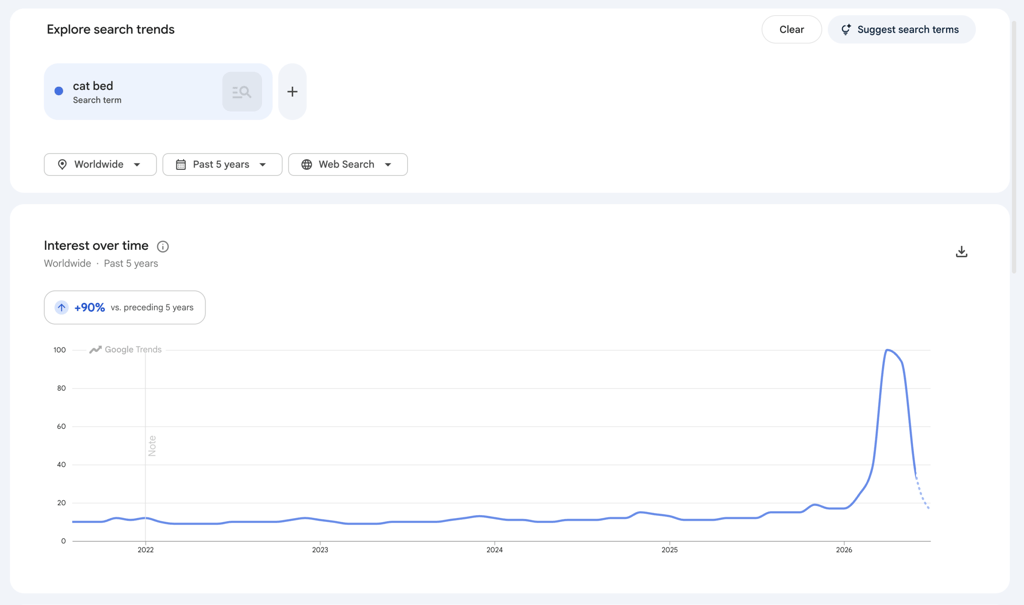
Searches for cat beds remain consistent, with a noticeable spike in 2026.
Offer a variety to suit different household preferences, such as enclosed beds, open cushions, washable covers, or raised beds. For heated products, prioritize models with appropriate safety controls and clear manufacturer instructions.
Create content featuring real cats enjoying the beds. Handmade or distinctive designs can help a store differentiate its catalog from mass-market options.
32. Cat litter
- Average selling price – $8-50; budget clay litter starts around $8-15, mid-range clumping options run $15-30, and premium natural or plant-based litters reach $30-50+ for large-format bags.
- Estimated monthly Google searches – 125,000.
- Top countries – United States, United Kingdom, Germany.
- Target audience – Cat owners.
- Supplier suggestions – Alibaba, AR Wholesale, Rufus & Coco.
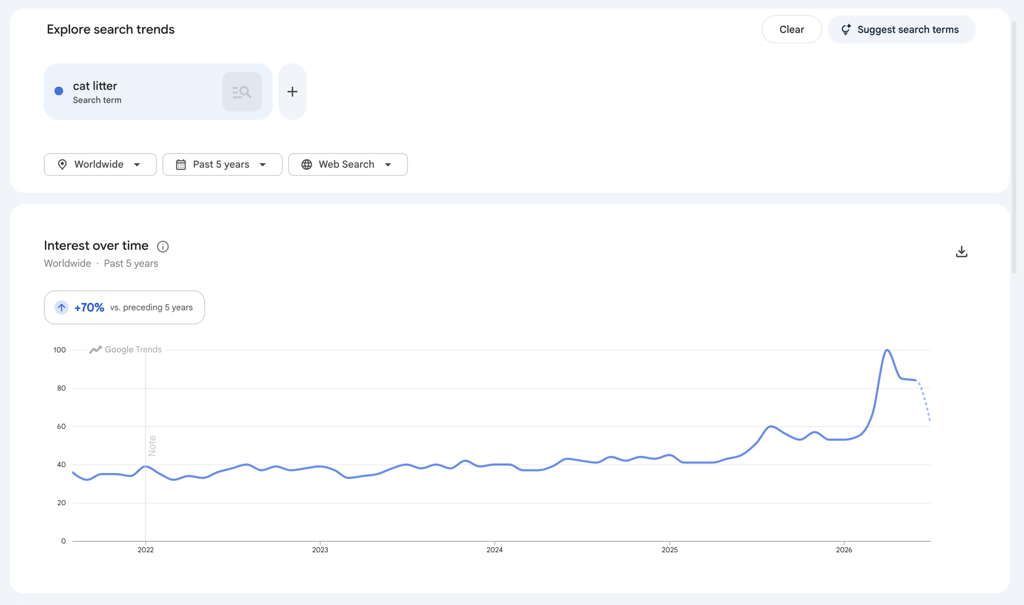
Cat litter is essential for indoor cats, giving them a comfortable and hygienic place to do their business. Search interest for cat litter has stayed consistently high, with steady growth over recent years.
Focus on practical benefits when marketing different litter types. Clumping litter forms solid clumps that are easy to scoop, ideal for busy owners. Non-clumping litter absorbs moisture and works well for owners who prefer to change the entire box weekly.
Natural or biodegradable materials appeal to environmentally conscious buyers. Lightweight options make scooping easier for elderly owners, and unscented litter works for cats with sensitivities.
If you sell flushable litter, keep in mind that flushable isn’t a regulated certification, and some municipalities prohibit flushing pet waste entirely. Check local guidelines in your target markets before making flushability a selling point.
Selling online through litter subscriptions is a smart move since cat litter is a product that owners repurchase regularly. The model can make replenishment more convenient when shipping costs and order frequency remain viable.
Top trending comfort items
Comfort products cover needs ranging from travel and reading support to space-saving furniture and sleep positioning. Demand varies widely by item, price, shipping cost and whether the product is bought for everyday use or a specific need.
From large pieces like sofa beds to targeted accessories like wedge pillows, comfort products span a wide range of product sizes and price points.
33. Wedge pillows
- Average selling price – $25-150; basic foam wedges start around $25-40, mid-range options run $50-80, and premium multi-piece options reach $100-200+.
- Estimated monthly Google searches – 71,000.
- Top countries – United States, United Kingdom, Germany.
- Target audience – People looking for sleep-positioning, reading, lounging or general comfort support.
- Supplier suggestions – Alibaba, DHgate, Made-in-China.
A wedge pillow raises your head, legs, or torso to create an elevated sleeping or resting position. Shoppers may look for them for comfort or because a doctor has recommended elevation for a specific situation.
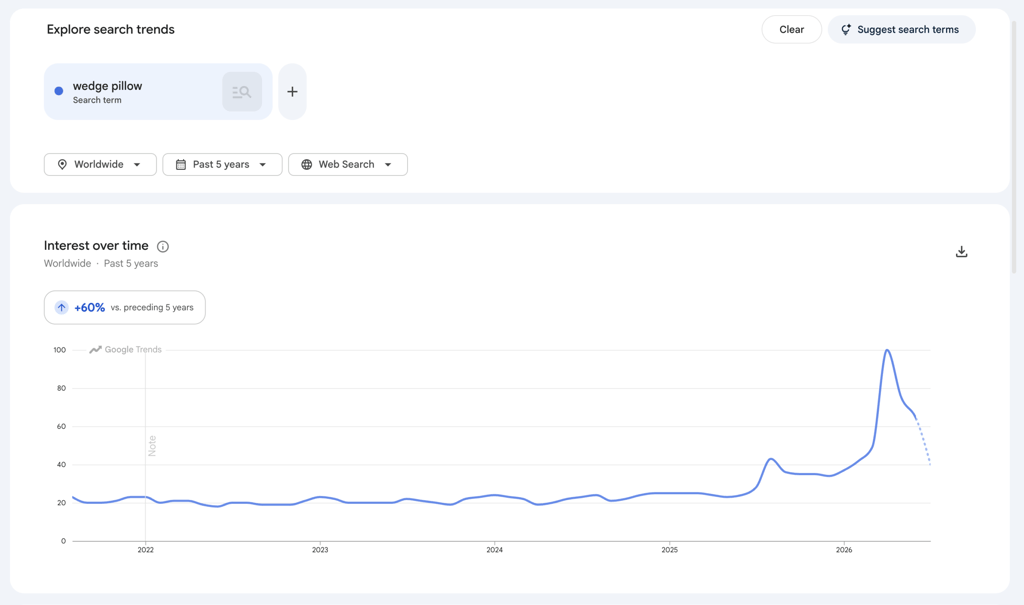
Searches for wedge pillows have steadily increased over recent years, reflecting growing awareness of sleep health.
Target by use case, such as reading in bed, elevated lounging, or buyers who have been advised to sleep with their upper body elevated. Product content should avoid diagnosing conditions or promising symptom relief.
Explain measurable features such as wedge angle, dimensions, firmness, cover material, washability, and whether the pillow folds for storage or travel.
34. Neck pillows
- Average selling price – $8-80; basic polystyrene models start around $8-15, mid-range memory foam options run $25-50, and premium models with features like Bluetooth or massage reach $50-120+.
- Estimated monthly Google searches – 104,000.
- Top countries – United States, United Kingdom, Germany.
- Target audience – Frequent travelers, office workers, remote employees, commuters, and people with neck pain.
- Supplier suggestions – Alibaba, IndiaMART, A&K Hosiery.
Neck pillows are designed mainly for travel or positional support, with shapes and firmness levels that suit different preferences. Some products also target desk or home use, but comfort claims depend on the design and user.
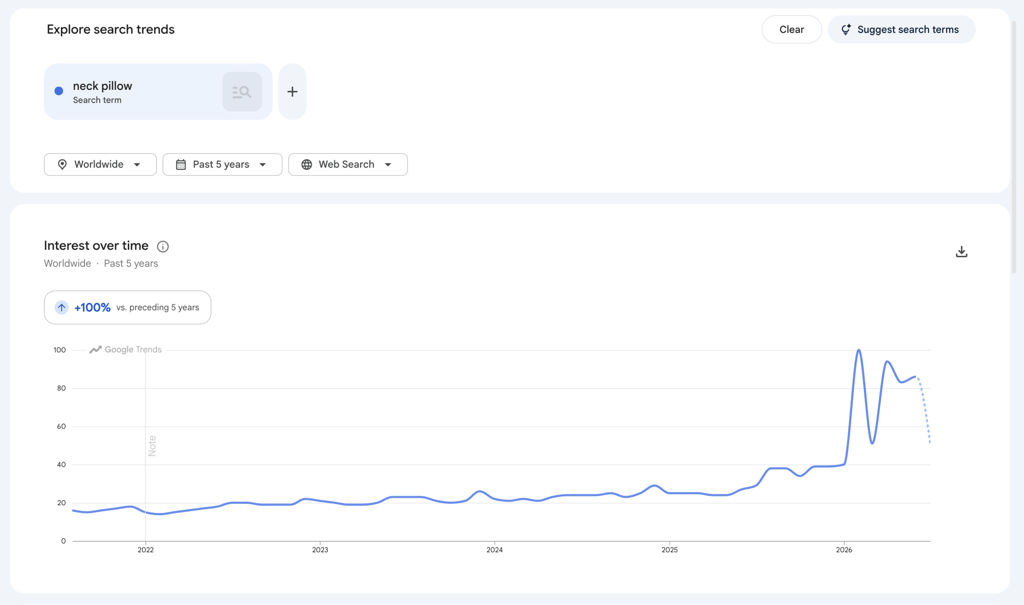
Google Trends reveals that searches for neck pillows have increased in 2026.
Target frequent travelers, remote workers and daily commuters. Create content to compare shape, firmness, packability, cover material, and cleaning instructions.
35. Sofa beds
- Average selling price – $100-700; budget click-clack and futon-style models start around $100-200, mid-range options run $200-500, and premium or designer sofa beds reach $700-2,000+.
- Estimated monthly Google searches – 393,000.
- Top countries – United Kingdom, United States, Australia.
- Target audience – Apartment renters, college students, first-time homeowners, and frequent hosts.
- Supplier suggestions – Birlea, Alibaba, Charming Living.
Sofa beds solve the common challenge of needing both seating and sleeping space without extra room for separate furniture. They’re popular among apartment dwellers, college students, and anyone who frequently hosts overnight guests.
Search interest for sofa beds has stayed consistently high in recent years, reflecting ongoing demand for space-saving furniture.
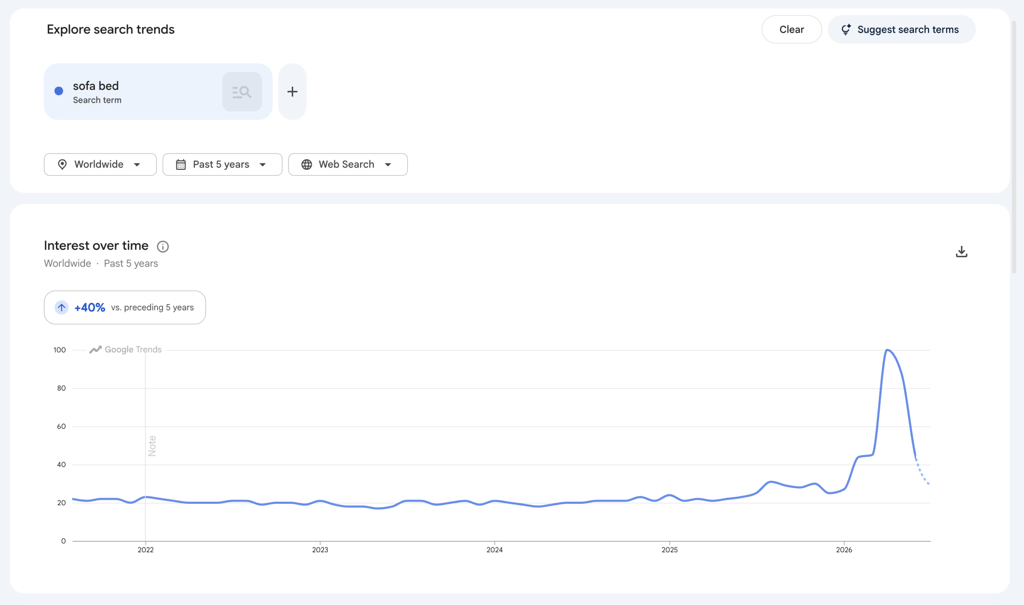
Target small-space dwellers like apartment renters, college students, first-time homeowners, and people setting up guest rooms. Focus on the functionality and space-saving benefits of sofa beds.
Comfort and durability are top concerns, with roughly 29% of buyers worrying about how well convertible designs hold up. Address this directly in product descriptions by highlighting mattress thickness, frame materials, and the conversion mechanism.
Use Pinterest to create boards focused on small-space living and guest room inspiration. Showcase your sofa beds styled in real, inviting room settings.
Top trending kitchen appliances
According to Polaris Market Research, the global kitchen appliances market was valued at $256.07 billion in 2025 and is projected to reach $428.23 billion by 2034, growing at a 5.9% compound annual growth rate.
Beyond basic appliances, specialty items like wine fridges, portable blenders, and cooking gadgets are gaining popularity.
36. Portable blenders
- Average selling price – $10-100; basic USB-rechargeable models start around $10-20, while mid-range and higher-capacity portable blenders commonly sell at higher price points
- Estimated monthly Google searches – 53,000.
- Top countries – United States, United Kingdom, India.
- Target audience – Home cooks, fitness enthusiasts, health-conscious consumers, travelers.
- Supplier suggestions – Faire, Alibaba, IndiaMART.
Portable blenders let people make smoothies, protein shakes, and juices at home and easily take them to work, the gym, or anywhere else. Most models double as drinking cups, so you can blend and drink from the same container.
Google Trends shows searches for portable blenders have remained relatively steady, with a spike in 2026.
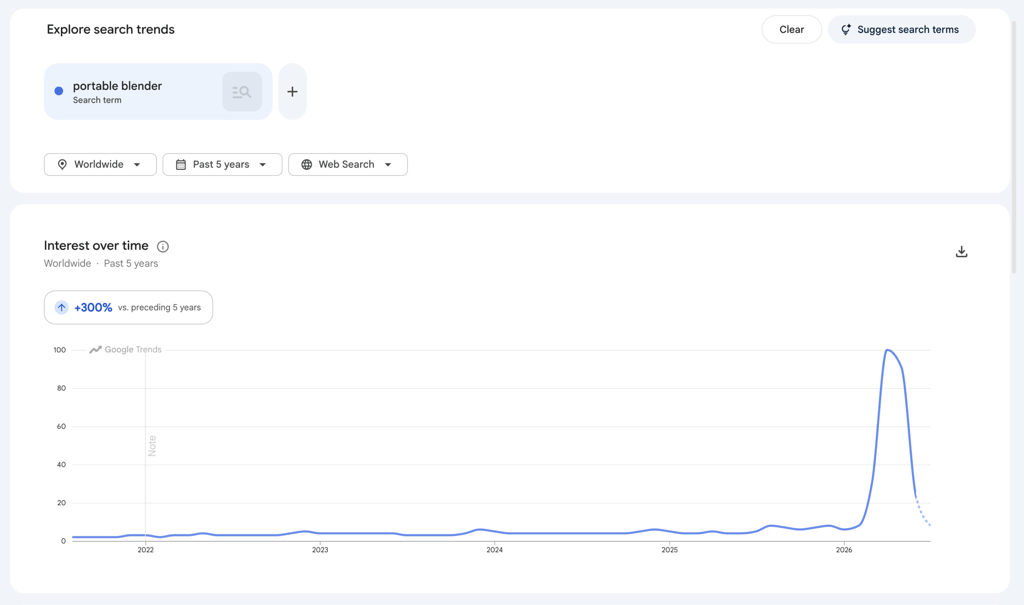
Target health-conscious consumers, busy professionals, fitness enthusiasts, students, and frequent travelers. Create content showing real use cases, like making a protein shake on the way to the gym.
Add extra value with recipe guides or ingredient starter packs. Boost order value by bundling blenders with travel cases or additional cups.
37. Wine fridges
- Average selling price – $80-2,000+; budget 8-16 bottle thermoelectric models start around $80-150, mid-range units run $150-500, and premium brands like EuroCave or Liebherr reach $1,000-5,000+.
- Estimated monthly Google searches – 57,000.
- Top countries – United States, United Kingdom, Australia.
- Target audience – Wine enthusiasts, people who entertain frequently, homeowners upgrading kitchen or bar areas, and hospitality businesses like restaurants and wine bars.
- Supplier suggestions – Alibaba, Made-in-China.
Wine fridges are designed to store wine within temperature ranges more suitable for wine than a typical food refrigerator. Features such as dual temperature zones, vibration reduction, and humidity management vary by model.
Google Trends shows searches for wine fridges stay consistently high, with spikes during holiday seasons.
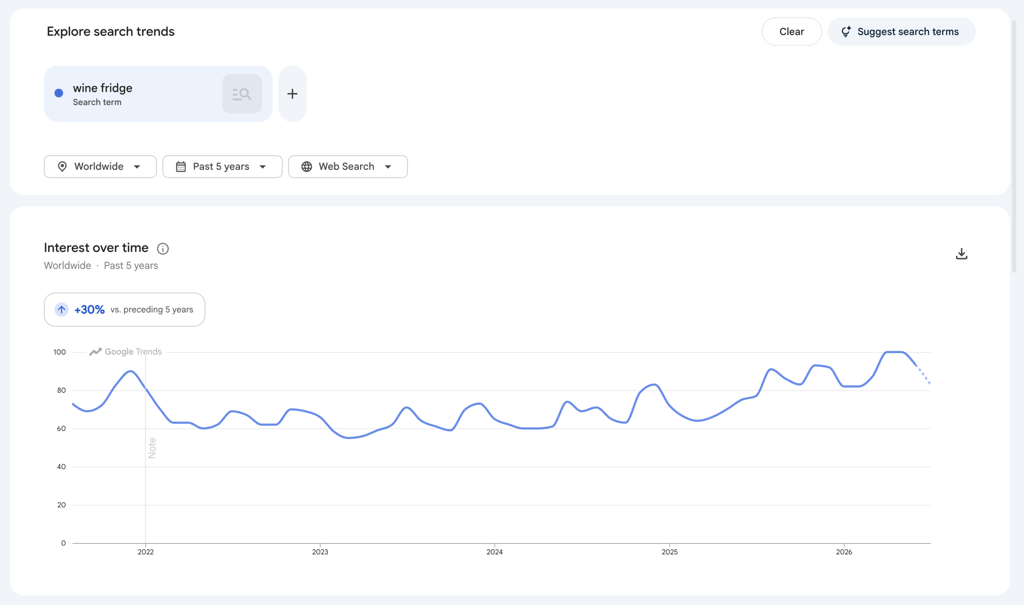
Target wine enthusiasts, people who entertain frequently, homeowners building wine collections, and anyone upgrading their kitchen or bar area. Restaurants, wine bars, and hotels are also strong buyers, especially for mid-range and commercial units.
Market the key advantages over regular refrigerators: precise temperature control, vibration-free storage, and humidity control that prevents corks from drying out. Partner with wine bloggers or sommelier content creators.
Top trending hobby and lifestyle products
With more people dedicating time to hobbies and activities both at home and outdoors, demand for certain products has surged.
38. Reusable water bottles
- Average selling price – $8-70; basic plastic bottles start around $8-15, mid-range insulated options from brands like CamelBak or Nalgene run $20-50, and premium smart or insulated bottles from Stanley or HidrateSpark reach $35-80+.
- Estimated monthly Google searches – 537,000.
- Top countries – United States, India, United Kingdom.
- Target audience – General population, sustainability enthusiasts.
- Supplier suggestions – Faire, IndiaMART, Pound Wholesale.
Reusable water bottles are great products to sell online because they address both environmental concerns and practical needs.
Google Trends shows that searches for water bottles have steadily increased.
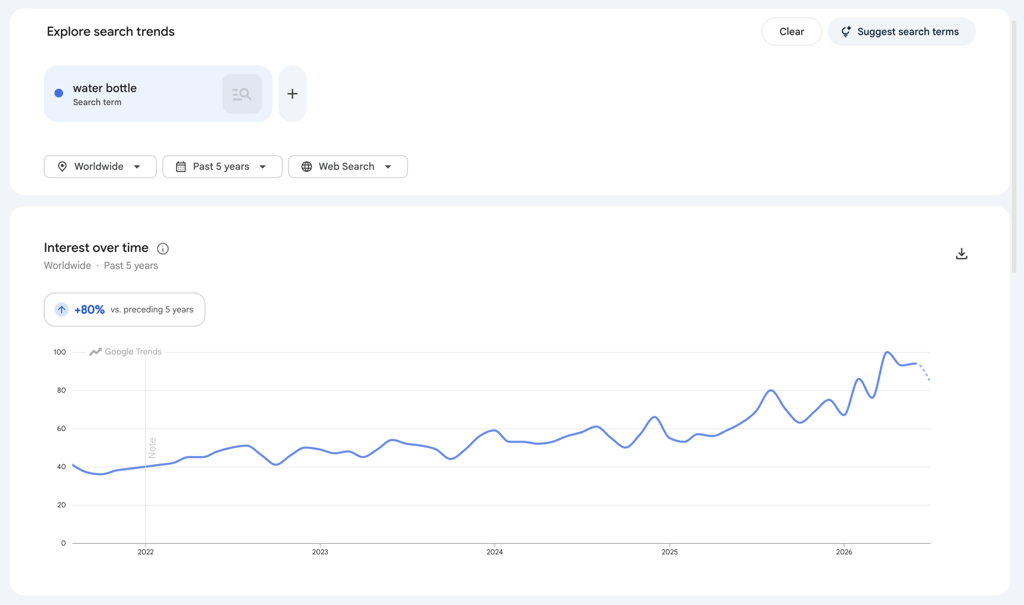
Target environmentally conscious consumers, office workers, and outdoor adventurers. Highlight product-specific benefits such as reusability, leak resistance, size, insulation, weight, and ease of cleaning.
Create educational content about plastic waste, hydration benefits, and product comparisons. Include real-life use cases, such as insulated bottles that keep drinks cold during workouts or collapsible bottles that save space while traveling.
39. Water shoes
- Average selling price – $8-60; basic neoprene models start around $8-15, mid-range options from Speedo or Crocs run $20-40, and performance shoes from Merrell or Keen reach $50-120+.
- Estimated monthly Google searches – 101,000.
- Top countries – United States, United Kingdom, Australia.
- Target audience – Water sports enthusiasts.
- Supplier suggestions – Eros Wholesale, Faire.
Water shoes protect feet during water activities like kayaking, snorkeling, surfing, and beach walking. They’re designed to get wet while providing grip on slippery surfaces and protection from sharp rocks, shells, or rough pool decks.
Google Trends shows that searches for water shoes follow seasonal patterns, peaking from April through August.
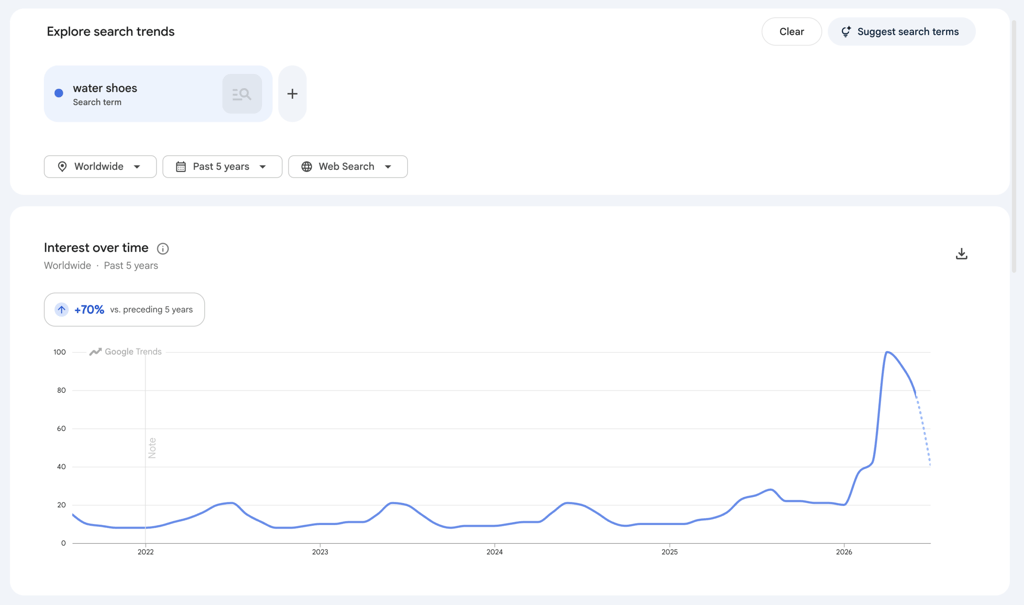
Target active families, water sports enthusiasts, beach vacationers, and pool owners. Highlight the advantages of water shoes over going barefoot: protection from cuts, superior grip on wet surfaces, and comfort on hot sand.
Create content showing water shoes in action, from walking on wet rocks to family beach outings. Include comparisons with regular shoes and flip-flops.
40. Custom keyboard kits
- Average selling price – $50-500+; budget barebones kits start around $50-80, mid-range options like the Keychron Q series run $100-200, and premium enthusiast builds from group-buy platforms or brands like Keycult reach $300-2,000+.
- Estimated monthly Google searches – 31,000.
- Top countries – United States, United Kingdom, Germany.
- Target audience – Gamers, programmers, remote workers, content creators, and mechanical keyboard hobbyists.
- Supplier suggestions – Alibaba, Global Sources, DHgate.
Custom keyboard kits let users build their own mechanical keyboards by choosing specific switches, keycaps, and layouts. The hobby has grown alongside a large enthusiast community, with dedicated forums, YouTube channels, and group buys driving steady demand.
Google Trends shows searches for custom keyboards remain consistently strong, with a notable spike in 2026.
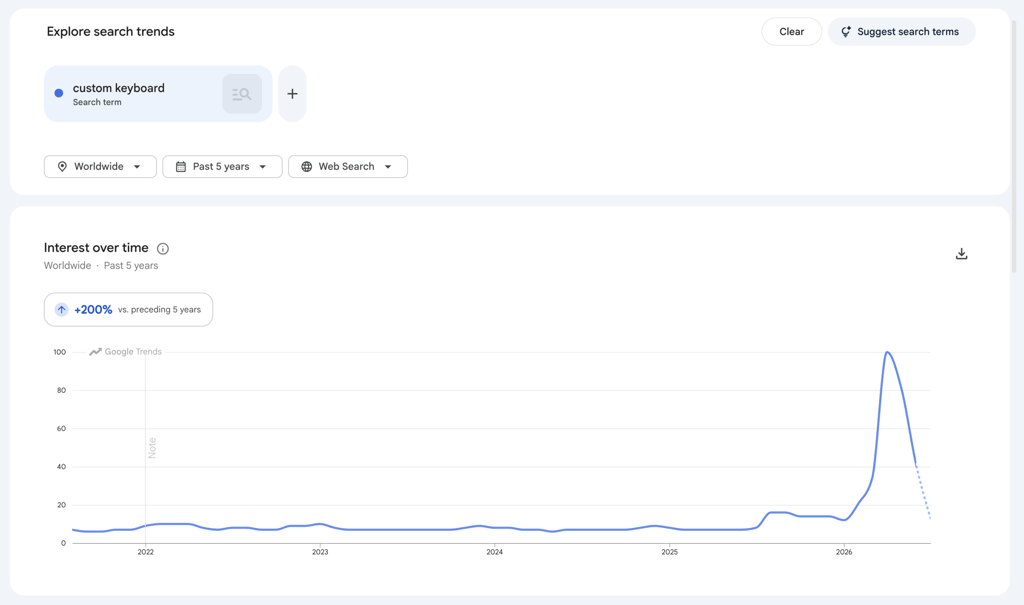
Custom keyboards appeal to gamers who want responsive switches, programmers who prefer ergonomic layouts, remote workers building comfortable home office setups, and content creators who want visually striking desk aesthetics for streams and videos.
What all these buyers have in common is that they know what they’re looking for. This audience researches specs before purchasing and can tell the difference between a budget build and a quality one.
Focus on high-quality components, as keyboard enthusiasts care deeply about switch types, keycap materials, and build quality.
Create engaging content showcasing the building process and final results. “Typing test” videos that highlight different switch sounds and time-lapse assembly clips resonate well with this community.
Where to find new trending products to sell online
Useful places to discover potential trending products include sources that show what people are buying, searching for, and discussing. Some of these include ecommerce marketplaces, social media, and trend post sites. Use them together when researching product ideas and business ideas for your online store.
Ecommerce marketplaces
Many online selling sites offer valuable insights into current product trends, often featuring dedicated pages for trending items.
Amazon’s Movers and Shakers page highlights top sellers over the last 24 hours, while the Most Wished For section shows what people are saving for later. On Etsy, the Popular Right Now page shows which products are currently trending.
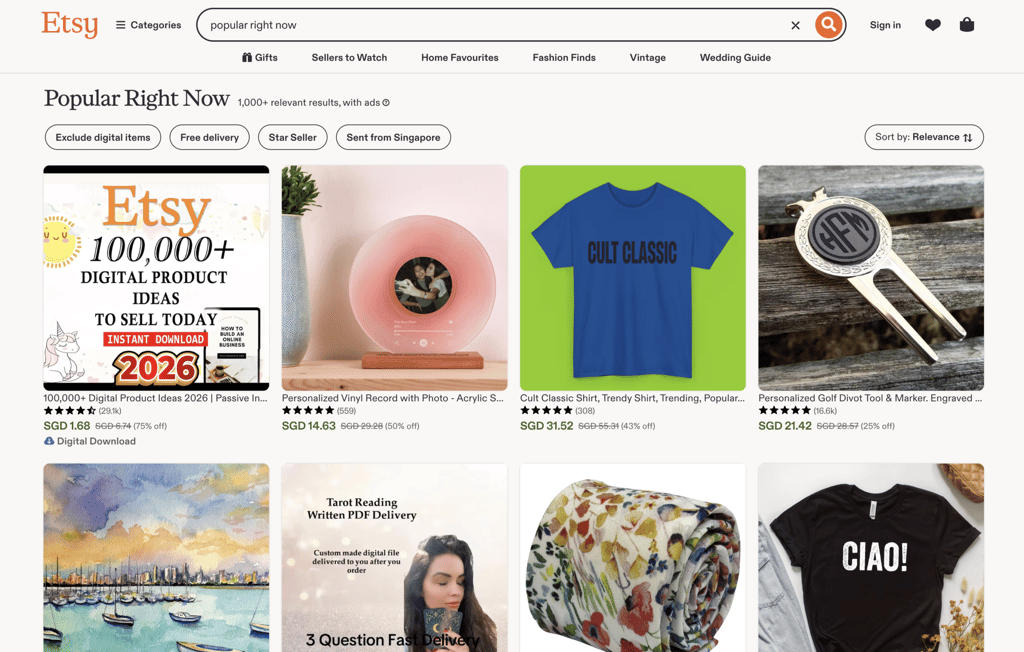
Use eRank to explore Etsy’s trending products. This Etsy SEO tool helps you discover high-performing keywords by showing search volume trends, competition levels, and related search terms.
Social media
According to Hostinger’s latest social commerce statistics, 82% of surveyed consumers use social media for product discovery and research. It also found that 40% of Gen Z respondents had purchased through TikTok Shop.
Look for Facebook and Reddit communities focused on trending niches. Research popular hashtags on X and Instagram to spot rising product trends. On Pinterest, use the search bar to uncover trending keywords and get inspiration for what to sell next.
Trend report sites
These platforms show what topics and products internet users are interested in:
- Google Trends shows relative search interest over time. You can filter by region, time frame, category, and search type.
- Ecomhunt highlights top-selling items with daily product updates, costs, suggested selling prices, profit margin data, Facebook ad examples, and market saturation insights.
- Trend Hunter tracks emerging consumer and product trends across many categories, updated daily. Premium users can access in-depth trend reports, track niche topics, and get personalized trend updates.
Staying informed about the latest ecommerce statistics and trends helps you make smarter, data-driven decisions that support long-term growth.
What are the best trending products for dropshipping?
The best trending products for dropshipping are compact items with steady demand. Phone stands, pimple patches, hair oils, Bluetooth trackers, and portable blenders are all strong options. They’re easy to ship and appeal to a broad audience.
Prioritize items with consistent Google search volumes over short-lived viral fads. Categories like health and wellness, tech accessories, and beauty deliver reliable performance for dropshipping businesses.
What is easy to make and sell?
Products that are easy to make and sell include handmade items such as candles, soaps, and jewelry, which require minimal equipment and can be crafted at home.
Starting a print-on-demand business to sell custom t-shirts, mugs, and phone cases are also straightforward since you handle the designs while a third party manages production and shipping. Selling digital products like printables, templates, and online courses is especially easy because there’s no physical inventory to manage.
These DIY options let you start small, test different products to make and sell, and scale based on what sells best.
What makes a good trending product?
A strong trending product has steady search demand, healthy profit margins, and appeals to a broad audience you can reach online. Items like phone accessories, beauty products, and home essentials solve real problems and maintain consistent demand.
Choose products with a well-defined target audience so you can tailor your marketing effectively. Products that are easy to demonstrate in photos or video can also be easier to explain on visual channels.
Important considerations when choosing trending products
Finding a hot product is just the first step. Here are the key factors to weigh before committing.
Search volume vs. competition
Pick products with meaningful search interest, then compare that demand with the number and strength of competing sellers. A lower-volume niche can still be attractive if competition and customer-acquisition costs are manageable.
Profit margins
Account for product cost, shipping, platform fees, and advertising expenses. Use a markup that fits the category and your actual costs.
Seasonality
Some products experience spikes during specific times. Sleeping bags peak in summer, while candles and LED strip lights surge in Q4. Plan your inventory and marketing campaigns accordingly, or opt for evergreen products that generate consistent sales year-round.
Supplier reliability
Your business relies heavily on dependable suppliers. Always order samples, read reviews, and have backup suppliers lined up.
Target audience match
Know who your ideal customers are and how to connect with them. If you sell gaming accessories, understand where gamers spend time online and craft messaging that speaks directly to them.
Social proof potential
Products that are easy to demonstrate visually can be easier to explain in short-form content. Think about how easily customers can share and showcase your items online to boost visibility and trust.
The right trending items for your business aren’t always the most searched products. They’re the ones that fit your budget, skills, and market knowledge. Focus on one product, test it thoroughly, and scale up once you find what works.
How to start selling trending products
Once you’ve picked the right products, the next step is to start selling online. Start by taking clear, well-lit photos from multiple angles, since buyers can’t physically inspect what they’re purchasing.
Then choose your sales platform. Marketplaces like Amazon and Etsy give you a built-in audience, while your own online store gives you more control over branding and customer relationships.
Write honest product descriptions, set competitive prices based on real market data, and ship quickly with tracking information. Following up after the sale and asking for reviews helps build the reputation you need for repeat business.
Hostinger Ecommerce lets you create a professional online store without coding. You get a drag-and-drop editor, built-in AI tools for product descriptions and SEO, and no platform transaction fees. Start with one or two products from this list, test which ones resonate with your audience, and expand from there.
All of the tutorial content on this website is subject to Hostinger's rigorous editorial standards and values.

Justina is a Content Writer passionate about marketing, with a background in social media and customer success management. She also loves reading books, traveling and exploring new places as well as cooking, and trying out new recipes. Follow her on LinkedIn.


