Best VPS hosting providers in India: Top 12 picks compared
Mar 10, 2026
/
By Aris S.
/
17 min Read
A Virtual Private Server (VPS) offers greater control and customization than shared hosting, making it the go-to choice for websites that need more power and flexibility. When selecting the best VPS hosting provider, it’s essential to focus on key factors such as performance, reliability, scalability, and support.
In this article, we’ll explore the top VPS hosting providers available and provide an in-depth analysis of their features, pricing, and performance. By the end, you’ll have a clear understanding of which provider best aligns with your specific needs, whether you’re running a growing ecommerce site or a resource-intensive application.
Here are our top picks:
- Hostinger – Best overall VPS hosting in India for budget-friendly pricing, NVMe performance, and full root access.
- MilesWeb – Ideal for businesses that prefer managed VPS hosting with Indian data centers.
- BigRock – A reliable Indian VPS provider with strong local brand recognition and SMB-friendly plans.
- E2E Networks – Best for enterprises and AI startups in India that need GPU-enabled, high-performance cloud infrastructure.
- Vyom Cloud – A performance-focused Indian VPS provider suitable for growing online businesses.
- LiquidWeb – Ideal for large enterprises seeking fully managed VPS hosting with optimized resource allocation.
- Ultahost – Great for users transitioning from shared hosting to VPS with affordable managed options.
- Cloudzy – A budget-friendly cloud VPS provider offering scalable global infrastructure.
- MonoVM – Suitable for users who need pre-configured VPS environments for quick deployment.
- RoseHosting – Best for businesses looking for premium fully managed VPS hosting solutions.
- Hostwinds – A flexible VPS option for developers who require customizable hosting environments.
- Contabo – Great for developers hosting resource-intensive applications with high hardware allocations at competitive prices.
1. Hostinger

Best for: Users in India looking for an affordable, high-performance VPS with full control, NVMe storage, and low-latency Asia data centers.
Pros: High hardware resources, NVMe SSD storage, full root access, built-in security, strong value for money in ₹ pricing.
Price: Starts at ₹599.00/month.
Hostinger offers four KVM VPS hosting plans optimized for developers, startups, agencies, and growing online businesses in India. Each plan includes a free snapshot, weekly backups, full root access, a dedicated IP address, and support for unlimited websites, delivering strong value compared to managed VPS providers in India that often start above ₹1,500/month.
All plans use NVMe SSD storage, which delivers significantly faster read/write speeds than traditional SSDs. With up to 8 vCPU cores and 32 GB of RAM, Hostinger VPS supports high-demand workloads such as eCommerce platforms, SaaS applications, AI tools, and custom web apps serving thousands of daily visitors across India.
Hostinger VPS provides full root access, allowing developers to configure environments freely using SSH commands. Our hPanel management dashboard also comes with extensive features that simplify system administration tasks, like OS templates, the browser terminal, and Kodee, an AI-powered assistant.
You can use our OS templates to install various Linux distributions, such as Debian, CentOS, and AlmaLinux, on your server with one click. We also offer templates with pre-installed VPS control panels or applications like Docker.
For optimal performance in India, choosing a nearby Asia data center reduces latency significantly compared to US-only providers. Lower latency improves page load times for Indian visitors, especially for applications serving users in metro cities such as Mumbai, Delhi, Bangalore, Chennai, and Hyderabad. You can also incorporate a content delivery network (CDN) service to ensure optimal website performance regardless of visitors’ locations.
Although Hostinger VPS is self-managed, 24/7 live chat support is available for general guidance. All plans include a 30-day money-back guarantee and a 99.9% uptime commitment, making it a low-risk option for Indian businesses upgrading from shared hosting.
Key features:
- Kodee. You can chat with our AI assistant, Kodee, and ask it for guidance, to write commands, or to manage various aspects of your VPS, like setting up a firewall rule. This feature makes hosting simpler and more efficient, especially for non-technical users.
- Browser terminal. This feature lets you connect and run commands on your VPS without using an SSH client like PuTTY or Terminal. You can remotely manage the server as root directly via a web browser.
- Built-in security features. Hostinger integrates BitNinja protection, DDoS mitigation, a built-in firewall, weekly backups, and snapshot management directly inside hPanel. These tools help Indian businesses protect customer data and comply with India’s Digital Personal Data Protection (DPDP) Act requirements.
- Scalable infrastructure. Users can vertically upgrade VPS resources in minutes without complex migration processes. This makes it suitable for Indian startups expecting seasonal traffic spikes during sales campaigns, festival promotions, or product launches.

2. MilesWeb
Best for: Businesses in India looking for managed VPS hosting with local data centers and hands-off server management.
Pros: Indian data centers, fully managed plans, 24/7 support, strong local brand recognition.
Cons: Higher pricing compared to unmanaged VPS options and limited flexibility for advanced configurations.
Price: Starts at approximately ₹1,299/month (managed VPS plans).
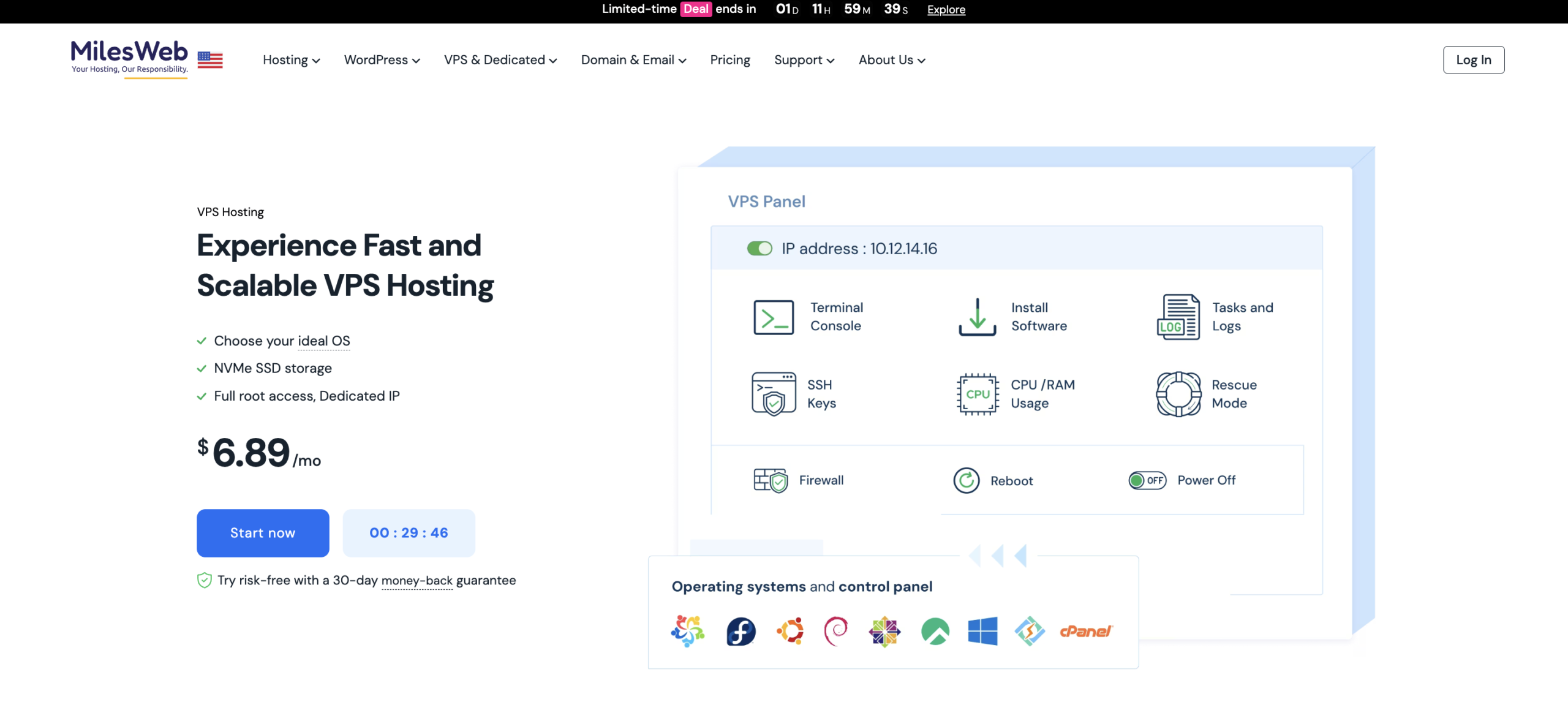
MilesWeb is an India-based hosting provider offering managed VPS hosting with data centers located in Mumbai. Its infrastructure is optimized for Indian businesses that prioritize low latency and local technical support.
Unlike unmanaged VPS providers, MilesWeb handles server setup, maintenance, security patching, and monitoring. This makes it suitable for small businesses, agencies, and entrepreneurs who lack in-house technical expertise.
MilesWeb’s VPS plans include SSD storage, dedicated resources, root access, and optional control panels such as cPanel or Plesk. However, managed services increase overall cost compared to self-managed VPS alternatives, especially for startups operating on tighter budgets.
Since the servers are located in India, websites targeting users in cities like Mumbai, Delhi, Bangalore, Pune, and Hyderabad benefit from lower latency compared to providers that only operate US or Europe-based data centers.
Key features:
- Managed infrastructure. MilesWeb handles operating system updates, security patches, and performance monitoring. This reduces technical overhead for businesses that prefer not to manage servers manually.
- Indian data center presence. Local hosting infrastructure helps maintain stable speeds for Indian visitors and supports compliance requirements for businesses handling domestic customer data.
- Control panel options. Users can add commercial control panels like cPanel, making it easier to manage multiple websites without relying entirely on command-line access.
- Scalable VPS plans. Plans can be upgraded as traffic increases, although scaling flexibility is more limited compared to global cloud VPS providers.
3. BigRock

Best for: Small and medium-sized businesses in India looking for a locally recognized VPS hosting provider with straightforward plans.
Pros: Indian brand presence, local customer support, SSD storage, familiarity among Indian SMBs.
Cons: Fewer advanced configuration options and less scalability compared to global cloud VPS providers.
Price: Starts at approximately ₹1,199–₹1,499/month, depending on configuration.
BigRock is an established Indian hosting provider offering VPS hosting solutions tailored to small businesses and website owners in India. It is widely recognized in the Indian domain and hosting market, making it a familiar choice for first-time entrepreneurs and growing companies.
BigRock’s VPS plans include dedicated CPU cores, SSD storage, full root access, and optional managed services. The platform supports common Linux distributions and allows users to install custom software as needed.
For businesses targeting customers in India, local infrastructure helps maintain stable performance and reduced latency compared to providers that rely solely on overseas data centers. This makes BigRock suitable for regional eCommerce stores, service-based businesses, and agency websites serving Indian audiences.
However, compared to more flexible cloud VPS providers, BigRock offers fewer advanced customization options and scaling features. Businesses expecting rapid traffic growth or complex application deployments may require a more scalable cloud-based solution.
Key features:
- Local market familiarity. BigRock has operated in India for years and is commonly used by small business owners launching their first website or upgrading from shared hosting.
- Dedicated resources. VPS plans provide isolated CPU, RAM, and SSD storage, ensuring more stable performance than shared hosting environments.
- Optional managed services. Users can choose managed support for server maintenance, which helps businesses without dedicated IT teams.
- Integrated hosting ecosystem. BigRock also offers domain registration, email hosting, and website services, allowing businesses to manage multiple services under one provider.
4. E2E Networks
Best for: Enterprises, AI startups, and developers in India needing high-performance VPS with GPU capabilities and local infrastructure.
Pros: India-based cloud infrastructure, GPU-enabled VPS options, strong performance for AI and compute-heavy workloads.
Cons: Higher pricing compared to standard VPS hosting and more complex setup for non-technical users.
Price: Starts at approximately ₹2,000–₹3,000/month for standard cloud VPS, with GPU instances priced significantly higher depending on configuration.
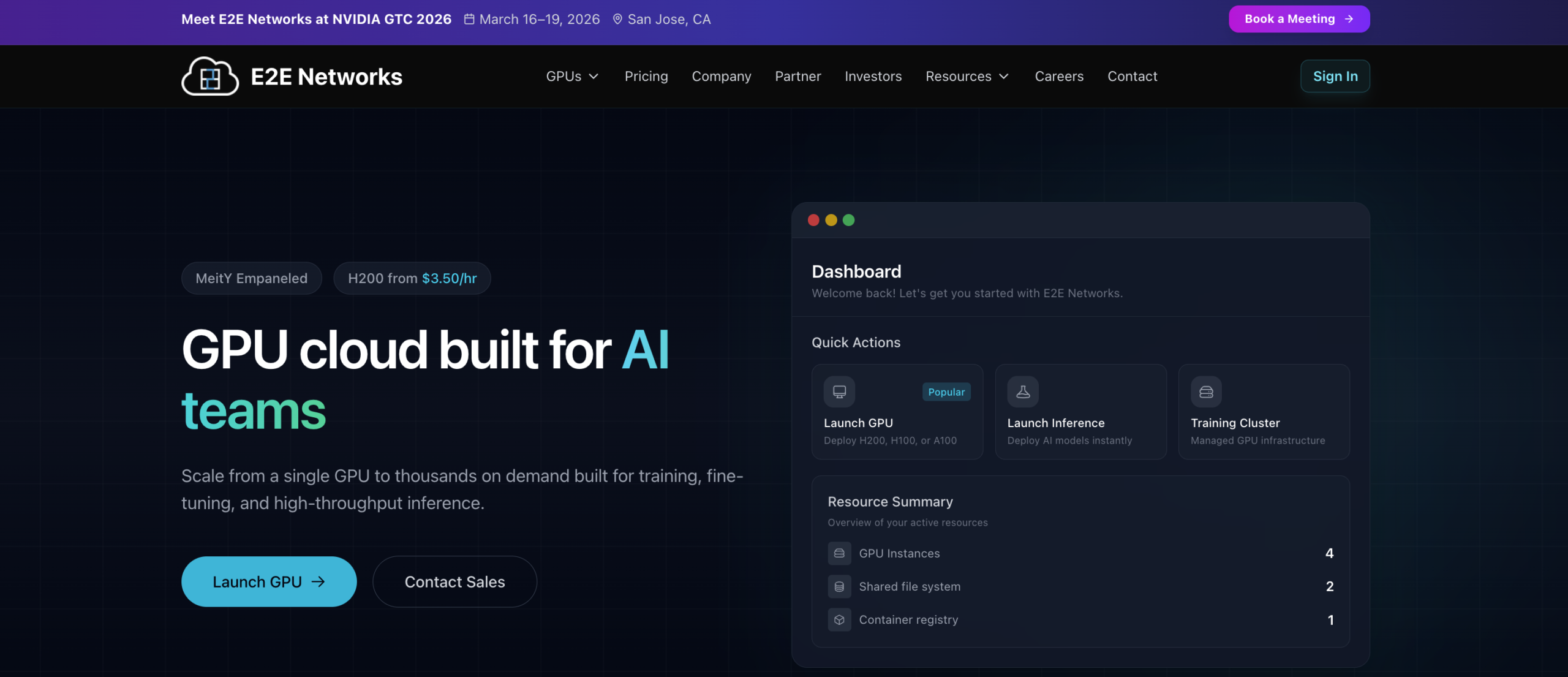
E2E Networks is an Indian cloud infrastructure provider focused on high-performance computing and enterprise workloads. Unlike traditional VPS hosting providers targeting small websites, E2E specializes in compute-intensive applications such as artificial intelligence (AI), machine learning (ML), data analytics, and large-scale SaaS platforms.
With data centers located in India, E2E Networks offers reduced latency for domestic users and supports businesses that require local infrastructure for compliance and performance reasons. This makes it particularly relevant for Indian fintech platforms, edtech applications, AI startups, and enterprise software providers.
E2E provides both CPU-based cloud VPS and GPU-backed virtual machines designed for model training, rendering, and large data processing tasks. However, these enterprise-grade capabilities come at a higher cost compared to entry-level VPS plans typically used for small business websites.
Key features:
- GPU-enabled virtual machines. E2E offers NVIDIA GPU instances suitable for AI model training, video processing, and high-performance workloads. This makes it one of the few India-based providers supporting GPU VPS infrastructure.
- India-located data centers. Hosting within India reduces latency for domestic traffic and supports businesses that prefer local data processing environments.
- Enterprise-grade cloud architecture. The infrastructure is designed for scalable compute performance rather than entry-level website hosting, making it suitable for advanced technical use cases.
- API-based cloud control. Developers can manage instances programmatically, enabling automation and integration into DevOps workflows.
5. Vyom Cloud
Best for: Businesses in India seeking performance-focused VPS hosting with locally optimized infrastructure.
Pros: India-based data centers, scalable cloud VPS plans, strong performance for mid-sized applications.
Cons: Higher starting price compared to unmanaged VPS options and fewer beginner-friendly management tools.
Price: Starts at approximately ₹1,500–₹2,000/month, depending on configuration.
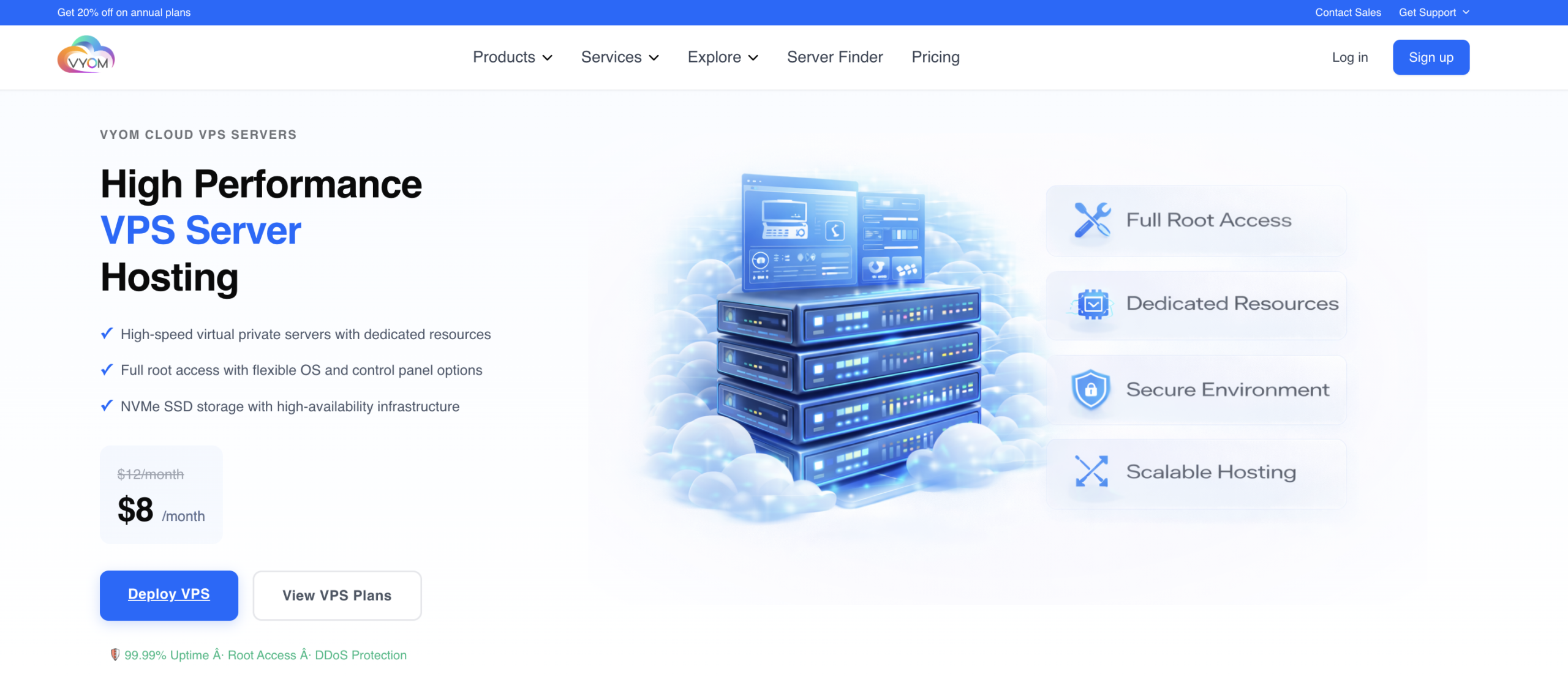
Vyom Cloud is an Indian cloud hosting provider offering VPS solutions built for performance and reliability. Its infrastructure is designed to support businesses that require consistent computing power for production websites, SaaS platforms, and enterprise applications.
With data centers located in India, Vyom Cloud helps reduce latency for domestic traffic. Websites and applications serving users in cities such as Mumbai, Delhi, Bangalore, Chennai, and Hyderabad benefit from faster response times compared to overseas hosting providers.
Vyom Cloud focuses on scalable virtual machines with dedicated resources, including SSD storage, configurable CPU cores, and flexible RAM allocations. This makes it suitable for businesses experiencing steady traffic growth or running data-intensive web applications.
However, compared to more beginner-friendly VPS providers, Vyom Cloud is more performance-oriented and may require stronger technical expertise for optimal server configuration.
Key features:
- India-optimized infrastructure. Local data centers improve load times for Indian users and reduce dependency on international routing.
- Dedicated virtual resources. Each VPS includes isolated CPU, RAM, and storage, ensuring stable performance for applications and business websites.
- Scalable cloud architecture. Resources can be adjusted as traffic grows, supporting expanding SaaS products and online platforms.
- Enterprise-oriented configurations. Vyom Cloud offers advanced server setups tailored to performance-sensitive workloads rather than entry-level website hosting.
6. LiquidWeb
Best for: Large enterprises wanting a fully managed VPS solution with resource allocation optimized for specific use cases.
Pros: Fully managed, excellent customer support, and varied plans optimized for different needs.
Cons: Some essential features, like cloud backup and extra security tools, are only available as premium add-ons.
Price: Starts at approximately ₹415/month (entry cloud VPS plan), with fully managed VPS plans typically starting above ₹2,000–₹3,000/month, depending on configuration.
LiquidWeb provides reliable, secure, and feature-rich VPS hosting services, making it an excellent option for large enterprises. It offers three plan categories optimized for different purposes and user needs.
The Compute plans balance the CPU core counts, RAM capacity, and storage space, making them ideal for all-around usage like hosting websites on a VPS. The memory-optimized plan is excellent for databases, while the CPU-focused one is suitable for traffic-intensive applications like file hosting.
In addition to 99.99% uptime, LiquidWeb offers a 30-day money-back guarantee and round-the-clock customer support. It also includes a free Cloudflare CDN for DDoS protection and the Standard ServerSecure Advanced Security feature.
LiquidWeb’s VPS hosting supports various operating systems and control panels, but its compatibility is limited. Moreover, it only offers data centers in North America and Europe.
Key features:
- High-performance network. All LiquidWeb VPS plans provide a 10 Gb/s redundant network with unmetered inbound data transfers and terabytes of outbound bandwidth.
- Adjustable plan. In addition to different plan categories optimized for different use cases, LiquidWeb provides various add-ons, including extra IP addresses, to further tailor your VPS solution to your needs.
- Fully managed service. At an extra cost, users can offload server administration tasks like migration and control panel management to LiquidWeb, allowing them to focus on their business.
7. Ultahost
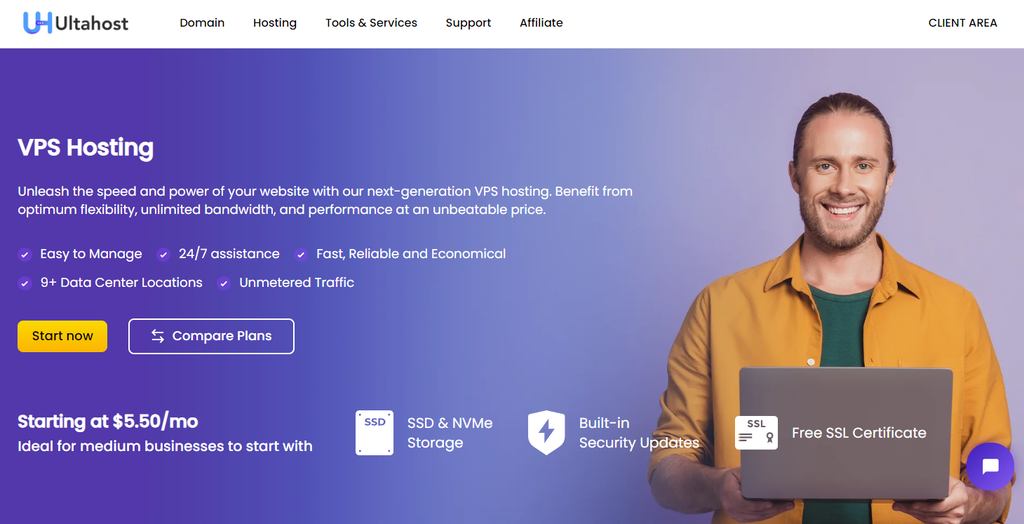
Best for: Users transitioning from shared hosting to VPS who prioritize features and affordability.
Pros: Fully managed, competitive pricing, and customizable operating system.
Cons: Ultahost VPS plans are not the most powerful, so they aren’t suitable for resource-intensive applications.
Price: Starts at approximately ₹400/month, with higher-tier managed VPS plans increasing based on storage and RAM upgrades.
Ultahost offers affordable managed VPS hosting plans suitable for new users. Its technical team takes care of all aspects of installation, configuration, updates, and monitoring of your server, all for free.
Ultahost’s VPS plans offer robust security features, including BitNinja protection, dedicated firewalls, and a free one-year SSL certificate. They also provide multiple data center locations, a CDN add-on, and advanced caching to improve server performance.
Despite the unmetered bandwidth, this web host doesn’t have the most powerful hardware, with only up to 4 vCPU cores and 100 GB of storage. Moreover, the starting VPS hosting plan only has 1 GB of RAM and supports up to seven websites.
While you can increase the storage and domain limits using add-ons, they are expensive. For example, Ultahost charges $10.49/month for an additional 100 GB of storage, while an extra IP address costs $4.00/month.
Key features:
- Robust security. All Ultahost VPS plans offer comprehensive security features, including free SSL certificates, auto-healing infrastructure, regular security patching, automated updates, and BitNinja protection.
- Free backup and unlimited snapshots. Ultahost VPS plans provide free cloud-based backup and unlimited snapshots to maintain optimal data security.
- Custom ISO support. Users can install the Windows Server operating system and any Linux distribution on Ultahost VPS by uploading an ISO image file through its dedicated interface.
8. Cloudzy
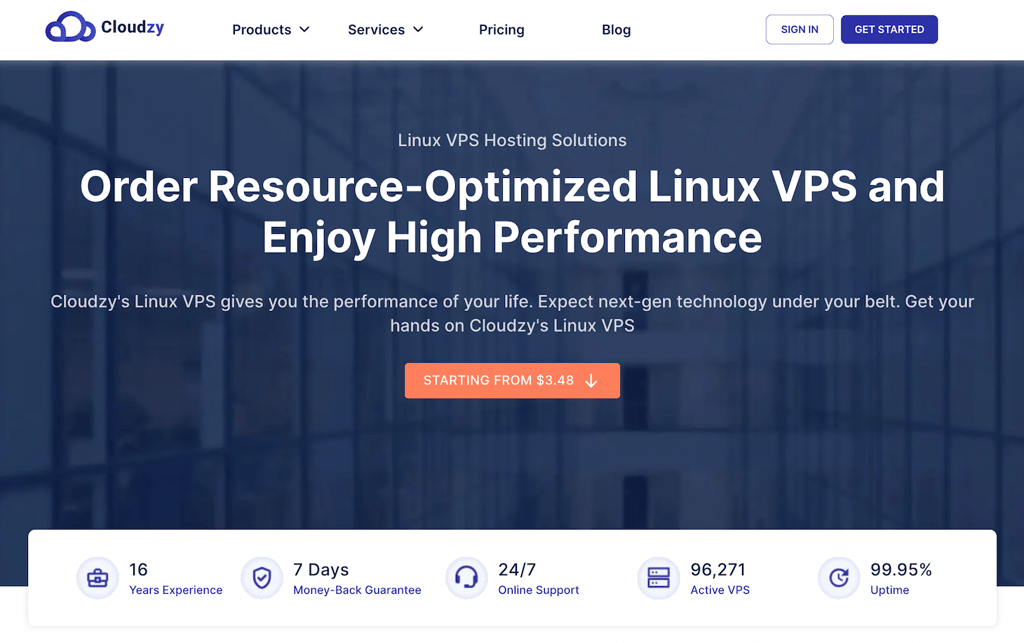
Best for: New businesses and individuals prioritizing scalability and affordability.
Pros: Global data center, pay-as-you-go pricing scheme, and reliable infrastructure.
Cons: The entry-level plans’ resources are very limited and suitable only for hosting small projects.
Price: Starts at approximately ₹415/month (introductory pricing may be lower for new users), with performance-focused plans starting around ₹3,000/month.
True to its name, Cloudzy offers cloud-based virtual private servers, ensuring resource flexibility and scalability, service reliability, and high uptime.
These servers come with enterprise-grade hardware resources like NVMe SSD and DDR5 RAM. Users also benefit from network speeds of up to 40 Gb/s across 15 global locations.
If you need more resources than your current plan provides, you can purchase additional bandwidth packages. Cloudzy also offers a 24/7 support team of technical experts, ready to assist with any issues or questions.
When it comes to pricing, Cloudzy is a budget-friendly option, starting at $4.95/month, or $2.48/month for new users. However, its most popular plan, which includes 5 TB bandwidth and six vCPUs, is priced higher, starting at $36.95/month.
Key features:
- Add-on services. Users can purchase various add-ons, like floating IP addresses, server snapshots, and bandwidth packages, directly from the Cloudzy panel.
- One-click apps. Cloudzy’s one-click app installer lets you configure popular operating systems and programs, such as WordPress or MetaTrader 5.
- PAYG billing method. You pay only for the services you choose to purchase, like new servers, floating IPs, or bandwidth packages.
9. MonoVM
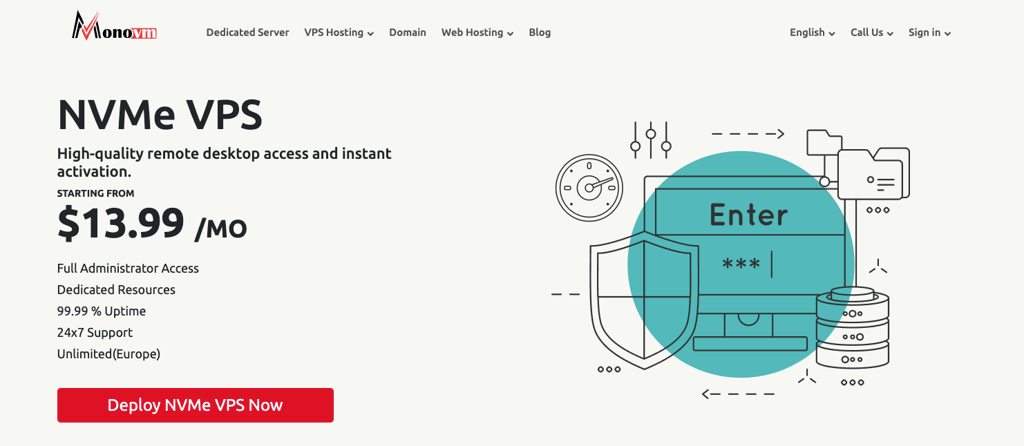
Best for: Businesses or individuals looking for ready-to-use VPS solutions for specific purposes.
Pros: Excellent support, easy to use, and seamlessly scalable.
Cons: The 7-day money-back guarantee is significantly shorter than what other providers offer.
Price: approximately ₹500/month, while Windows VPS plans start at around ₹1,750/month.
MonoVM offers pre-configured VPS plans with various applications, making it a convenient one-stop solution for your project. For example, you can purchase plans pre-installed with V2ray, VPN software, and other tools.
You can also install a wide variety of Linux distributions and Windows, including the desktop version. While MonoVM’s VPS solution comes pre-configured, it still offers full root access for complete control and customization.
With servers located worldwide, you can choose the closest one to your customers and provide them with the fastest speeds. You can also contact MonoVM 24/7 via live chat and support tickets.
The Linux VPS plans start at $5.99/month, while the Windows VPS plans start at $20.99/month. MonoVM offers a 7-day money-back guarantee on these plans.
Key features:
- Scale on demand. Users can easily scale their VPS up or down to meet their changing needs, ensuring optimal performance while minimizing wasted resources.
- Custom hosting dashboard. MonoVM’s custom web-based dashboard serves as a centralized platform for managing your server, making the process efficient and beginner-friendly.
- Instant provisioning. After payment, your VPS will be ready in seconds and pre-configured with your chosen program.
10. RoseHosting
Best for: Businesses or enterprises wanting fully managed VPS hosting solutions.
Price: Starts at approximately ₹3,300/month, positioning it among the more expensive fully managed VPS providers.
Cons: Expensive starting price and subpar server resources compared to more affordable alternatives.
Price: Starts at $39.55/month.
RoseHosting’s fully managed hosting services are excellent if you’re not comfortable manually configuring and tweaking your server. They’re especially useful for businesses that are transitioning to VPS but prefer to avoid handling the technical side.
The provider handles all server management tasks, including the hosting transfer, server setup, software installation, and monitoring. The customer support team is also available 24/7 via live chat, email, and tickets to help you resolve issues quickly.
RoseHosting’s managed VPS hosting offers powerful hardware with unlimited bandwidth and website support. It also provides free Secure Sockets Layer (SSL) certificates and weekly backups.
However, this managed VPS hosting provider is significantly more expensive than other web hosts. It also has only one data center, located in the US, so you’ll likely need a CDN to maintain consistent performance for global visitors.
Key features:
- Fully managed hosting. All RoseHosting VPS plans include free managed services, handling tasks like website migration, server setup and configuration, optimization, and error troubleshooting.
- Unlimited support. You can open unlimited support tickets for any server issues, and the hosting provider will fix them for free.
- Custom VPS resource. RoseHosting offers a custom-configured VPS plan. Users can select their preferred CPU cores, RAM capacity, storage, and bandwidth limit.
11. Hostwinds
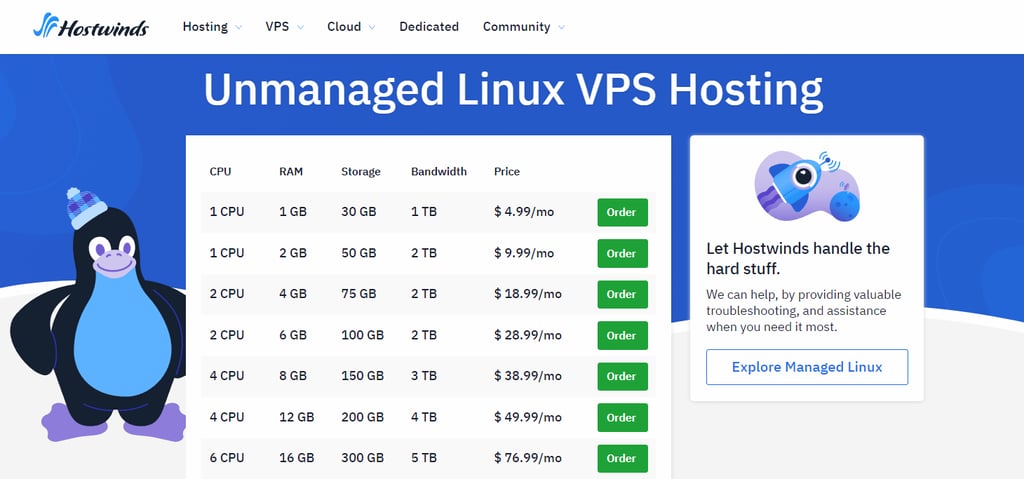
Best for: Developers looking for control and flexibility in configuring their VPS hosting environments.
Pros: Extensive features, highly customizable, managed and self-managed options.
Cons: Subpar hardware resources for the price and limited data center locations.
Price: Starts at approximately ₹420/month, with managed plans costing significantly more depending on resources.
Hostwinds offers flexible VPS hosting plans. Besides Linux, users can install various operating systems using custom images and .iso files. You can also configure the backup system to your needs by adjusting backup frequency, setting the storage duration, and selecting which files to archive or restore.
Moreover, you can choose a managed or self-managed VPS hosting service depending on whether you value complete control or convenience. These plans have identical hardware and built-in features.
Hostwinds’ VPS plans include an enterprise-grade firewall, snapshots, and multiple data center locations. They also provide a monitoring system that automatically opens support tickets when you encounter an issue.
However, self-managed VPS users don’t get any support, making this option unsuitable for beginners. Hostwinds’ data centers are also only located in the US and the Netherlands.
Key features:
- Custom images. This web hosting provider lets users install any operating system on their VPS plans, including Windows, by uploading custom .iso files or disk images.
- Load balancer support. Users can set up a load balancer on their VPS to distribute traffic among multiple instances and boost performance. This feature also improves uptime by redirecting traffic to a healthy server.
- Volume. Hostwinds’ Volume feature lets you add more storage to your servers. You can also move Volumes between different servers.
12. Contabo
Best for: Developers looking to host resource-intensive applications.
Pros: Flexible, great value-to-performance ratio, and highly scalable.
Cons: Some features that are free with other providers, like automatic backups and NVMe storage, are only available as premium add-ons here.
Price: Starts at approximately ₹415/month, though additional features such as NVMe storage, backups, or specific data center locations may increase the final cost.
Contabo provides cloud VPS hosting services with high-performance hardware at reasonable prices. It’s suitable for developers working with resource-intensive web apps.
Contabo also offers dedicated hosting plans that users can integrate with their virtual private servers to create a robust infrastructure. This makes the provider excellent for anyone looking for easily scalable solutions.
Moreover, Contabo has various features that simplify server management and development, including a WebUI control panel, RESTful API support, and cloud-init.
This web hosting provider has multiple data centers in the US, Europe, Australia, and Asia, which users can choose from for an extra fee. While phone support is available, 24/7 customer support is limited to ticketing.
Contabo’s main drawback is its hidden and additional fees, which increase the total cost. For example, you need to pay an extra fee to choose a particular data center location. There’s also a setup fee for the six-month and shorter subscriptions.
Key features:
- Private networking. This feature lets users connect their VPS with dedicated servers within a secure and private network. As a result, you can easily scale your infrastructure for a more advanced workload.
- Cloud-init. This software contains metadata describing your system configuration, including which packages to install and services to start at initialization. It makes setting up a new virtual instance more efficient and less prone to errors.
- Contabo CLI. The cntb command-line interface lets users manage Contabo VPS products via Terminal or Command Prompt. For example, you can create a new instance or upload a custom image.
How to choose the best VPS hosting?
Ensuring optimal website performance, security, and uptime depends heavily on choosing the right hosting provider. While all VPS hosts featured in this guide are solid options, there are several factors to consider when making your choice.
When selecting the best hosting plan for your needs, be sure to review its pricing and the resources it offers.
Compare resources to your needs
Evaluating VPS resources against your projected requirements ensures you have enough hardware to run your project smoothly.
While most VPS hosts use high-quality server hardware and reliable network infrastructures, some may not offer plans powerful enough for your specific needs.
For example, a VPS provider offering several Mb/s of network speed is sufficient for hosting a small blog. However, deploying a high-quality video streaming platform might require Hostinger VPS’s 1 Gb/s network and up to 8 TB of bandwidth.
Important! VPS hosting service providers that advertise unmetered or unlimited bandwidth commonly cap usage at an undisclosed number. Similar to limited-bandwidth plans, network speeds decrease once you exceed the fair usage policy.
Consider the upgrade path
Considering your VPS upgrade path ensures you can scale your hosting environment to meet your project’s future needs. Scaling enhances server performance, enabling it to handle increased traffic and process more data efficiently.
There are two methods of scaling: vertical and horizontal. Vertical scaling increases server resources, including RAM, CPU cores, and storage space. Meanwhile, horizontal scaling adds a new VPS instance or dedicated server to your infrastructure to distribute the load.
Ensure scalability by choosing a web host that offers plans with different resource capacities and load balancer support. Some companies also provide add-on resources, allowing you to upgrade particular server capacities based on your needs.
In addition, consider the ease of upgrading. At Hostinger, users can seamlessly upgrade their VPS with a single click via the VPS Dashboard without any downtime. The process takes around 10 minutes and preserves all files and configurations.
Determine your security requirements
Determining your security requirements ensures that the VPS hosting provider you choose supports handling and storing data according to your standards.
While Linux VPS providers commonly implement robust security setups today, it’s important to consider how much you can customize these settings and whether you can install new security tools. Providers should also offer free automatic backups and snapshots to ensure data integrity.
Hostinger implements robust VPS security measures out of the box, including Suhosin-hardened PHP, BitNinja protection, snapshots, and free weekly backups.
You can also install the optional Monarx malware scanner for free and customize your server’s firewall rules to fit your project’s needs. For added security, you have full root access to install any Linux-compatible software.
Beyond features, consider the web host’s compliance with data protection regulations. If your business collects customer information, your VPS provider should support compliance with India’s Digital Personal Data Protection (DPDP) Act, 2023. Businesses serving international users may also need to comply with global regulations such as the European Union’s General Data Protection Regulation (GDPR).
Consider your software stack
Choose a web hosting service provider that supports your preferred operating system (OS) and control panel. Otherwise, your sites or web applications may not run properly due to incompatibility issues.
If the provider doesn’t offer your chosen OS, it should support custom image installation. Also, choose one with a one-click installer – installing software via SSH or Terminal can be tricky, especially for beginners.
Most VPS hosting providers, including Hostinger, support popular control panels like cPanel, Plesk, Coolify, or Dokploy. For paid panels, you can purchase the license directly through our hPanel.
Hostinger also offers various Linux distributions bundled with control panels and applications. Instead of installing the OS and software separately, you can configure them simultaneously with a single click using templates via the VPS dashboard.
Pick a provider with a global data center
Choosing a VPS hosting provider with multiple data center locations worldwide lets you select the one closest to you or your target audience, improving website loading speed.
A nearby data center also improves management efficiency, as a greater distance increases network latency. This can lead to an unresponsive server and noticeable input delays when you connect remotely via SSH or VNC.
Hostinger’s VPS hosting service offers data centers in Asia, North America, South America, and Europe. You can choose any location for free and switch to another at any time.
Our VPS also supports CDN services like Cloudflare, ensuring optimal website performance for visitors around the world, no matter where they’re located.
Set your budget
Setting a clear budget helps narrow down your options and makes it easier to choose the best VPS provider for your needs. It also allows you to plan long-term hosting costs and avoid overspending.
To get the most value, look for VPS providers that include a variety of free features, like Hostinger. Along with free snapshots and backups, all our plans come with a built-in malware scanner and Kodee, our AI assistant.
While tempting, it’s best to avoid VPS hosting providers with extremely low prices. They often lack essential features like backups that might hinder you from implementing web hosting security best practices. Although the plans may seem affordable, the overall value is low if you have to purchase additional services separately just to keep your server running properly.
Also, be sure to check the final price carefully – some providers may include hidden fees, such as setup charges. To get the most value for your money, choose a company that offers a trial period or a money-back guarantee, like Hostinger.
Read user reviews
Reading user reviews is essential for evaluating whether a web hosting provider is reliable and trustworthy. Low-rated companies may fail to meet their service level agreements (SLA) or offer unresponsive customer support.
To assess a web hosting provider’s reputation, search for reviews on trustworthy websites and check the company’s track record on review platforms like TrustPilot or G2. We recommend looking for companies with at least four-star ratings and over 100 reviews.
Be cautious of VPS hosting reviews or awards displayed on a provider’s own website, as they may be self-promotional or even fabricated. To verify their legitimacy, check whether the reviews are cited from independent websites or trusted review platforms.
For example, Hostinger’s review page features user testimonials from over 20,000 Trustpilot reviews, along with awards from renowned websites like TechRadar and PCMAG.
Suggested reading
Still unsure? Visit our Customer Spotlight section to explore real success stories from clients who used Hostinger’s products to kick-start their online journeys.
What’s next?
Now that you’ve explored our top 12 VPS hosting providers for 2026 and learned how to choose the right one, you should be better equipped to narrow down your options.
To make the decision easier, consider starting with a provider that offers an extended money-back guarantee, like Hostinger. This gives you a risk-free opportunity to test the service and see if it meets your needs, all without long-term commitment.
When testing VPS services, be sure to evaluate non-performance factors like customer service, ease of use, and additional features. These elements help you manage your server more efficiently and contribute to a smoother development process or business operations over time.
With reliable hardware and plenty of time-saving features, Hostinger is a great place to start. To explore more about our services or VPS hosting in general, check out our other VPS tutorials.
This article is a localized version of 14 best VPS hosting providers for 2026, originally published in English.
All of the tutorial content on this website is subject to Hostinger's rigorous editorial standards and values.

Aris is a Content Writer specializing in Linux and WordPress development. He has a passion for networking, front-end web development, and server administration. By combining his IT and writing experience, Aris creates content that helps people easily understand complex technical topics to start their online journey. Follow him on LinkedIn.


Comments
0 responses