Will AI agents take my job as a writer? My honest take
My team leader recently sent us a lovely essay by Mariana Fernandes at Animalz, titled “For the Love of Content.”
As someone who spends most of my working days writing, I found it painfully relatable.
Fernandes’ argument, in a nutshell, is that content marketing had already optimized itself into emptiness long before AI arrived. We had turned content into something that could be scaled, measured, repurposed, distributed, and optimized. And then AI showed up and exposed just how hollow some of that work had already become.
Her invitation was to come back to something else: meaning, craft, and our own voices. To care about the work again.
I love her essay. And I don’t think her argument has become less relevant, even though a year has passed since the article was published, because AI has continued to evolve.
If anything, it might have become more relevant because AI-generated content is everywhere, and more content marketers are adopting it to stay in the game.
It would be easy to read all this as if we need to hold on to the craft or surrender to the bots, but perhaps the answer isn’t to pick a side.
We don’t have to abandon meaning in the name of efficiency. And we don’t have to be reluctant to AI or automation to prove that we care about meaningful work.
Maybe the more interesting challenge is learning how to do both.
To use AI where speed and efficiency genuinely create value, while protecting – and investing more deeply in – the parts of the work where human experience, judgment, and perspective matter most.
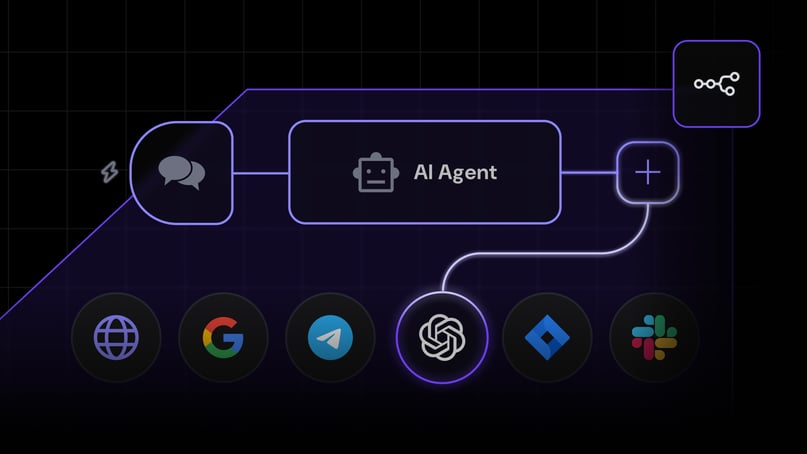
That’s where agentic AI became particularly interesting to me. Because, unlike generative AI, which is often used to help us create something directly, AI agents can take on broader parts of the process surrounding that creation. They can actively take action, such as researching, monitoring, analyzing, reviewing, and taking multiple steps toward a goal.
My job involves creating things that AI can also create, at least superficially. So, I’ve spent a lot of time wondering what exactly that means for me.
Partnering with the bots
I’ve tried automating my writing process with an AI agent, and sometimes the results turned out impressive. But I still felt the distance, like something was missing.
As writers and creators, we have more than just information to work with. We have experiences, context, instincts, opinions, memories, references, doubts, and all the associations that make one person tell a story differently from another.
I can tell AI what happened. I can give it a structure. I can even tell it what tone I want.
But deciding why a story matters, which details deserve to be included, where the tension lies, and what I want someone to feel after reading it – those are the territories I wouldn’t hand to any AI agent.
I eventually realized that AI agents could be much more useful for the other parts of my job.
I use them to fact-check and analyze information, and to notify me of the newest topics to write about, so I don’t run out of ideas – work that would otherwise require me to repeat a tedious process over and over again.
This also helped me understand what makes AI agents different from the AI tools I had been using before.
With a chatbot, I ask a question, get an answer, and decide what happens next. An agent can be given a broader objective or process and, depending on how it is built and what tools it can access, work through multiple steps before returning a result.
So, I’m not just asking for an answer. I’m delegating part of the work.
The agents aren’t competing with me for the writing. They’re taking on much of the work surrounding it: the repetitive checks, the reviews, the research, and other processes that need to happen before, during, or after the creative work.
I deliberately choose this route so that it gives me more time and mental space to focus on what I actually want to pay attention to. Sometimes, that means working on my personal blog. Other times, it’s reading newly released books, exploring what other writers and publications are doing, or simply spending time with the writing community in my hometown.
Those things might not always look like “work.” But they’re also part of what gives meaning to the work I do. They give me new ideas, perspectives, references, and experiences that eventually find their way back into what I create.
Adapting without losing the craft
At Hostinger, we have a value in our company culture called ambidexterity: optimizing what’s already here while preparing for what’s next.
As a writer, that means caring about the quality of the work I’m doing today while also learning how new technologies could change the way I do it tomorrow.
Not one at the expense of the other.
Fortunately, I have plenty of room to experiment with AI agents. The company has an internal agentic AI chatbot called DEX, which has already become an integral part of our everyday work.
And in June, I enrolled in an internal AI agents hackathon, which prompted us to consider other specific bottlenecks within our team that we could hand off to an AI agent.
I wanted to see what would happen if I stopped thinking about AI as something that occasionally helped me with individual tasks and started thinking about which parts of my work I could actually delegate.
Since then, I’ve become increasingly interested in building agents for the parts of my workflow I find tedious but still important.
Turns out, I could build an AI agent
I set up my own AI agents to meet my needs by navigating Hostinger’s internal tools, and it worked for me. Now, customers can also experience working with AI agents through Hostinger Agent, where they can simply choose a specialized AI agent for a particular task and start working with it.
That plug-and-play approach is one way to get started. If you want specific agentic functionality, there are open-source platforms such as OpenClaw and Hermes Agent that let you customize agents to meet your needs. And if you’re looking to add a specific agentic capability to an existing workflow or tech stack, you can turn to AI agent builders designed for creating agents for particular tasks and connecting them with other tools.
The more complex the agent, the more technical knowledge you might need. But my experience made me realize that an agent doesn’t need to look like sophisticated technology to be useful.
It can be as simple as the answer to “What is something I keep doing that I shouldn’t have to do manually every single time?”
The work I chose to delegate
One of the agents I created is a fact-checking agent.
Fact-checking is something I can do myself. But depending on the content, it can also mean going through dozens of sources, searching for specific claims, and checking whether the information I’m using is still accurate.
Sometimes the answer is buried in a report. Sometimes several sources contradict each other. And sometimes you spend 20 minutes looking for one piece of information, only to realize it isn’t available anywhere reliable.
An AI agent can help me do some of that groundwork much faster.
I’ve set mine up to scrape the web for information, flag potentially inaccurate or outdated claims in a draft, and bring back the sources it used. I’d still review those sources and make the call on whether the information should stay in the article.
The agent doesn’t get the final say. I do. But instead of manually sifting through page after page of search results to find a starting point, I can spend more time reviewing the information and making sharper creative decisions.
Another example came from the same hackathon. The other team of my colleagues, also writers like me, built an internal linking assistant to help us find relevant linking opportunities across our content library.
When you’re working with thousands of articles, manually going through the entire database to find the right internal links isn’t exactly the most inspiring part of being a writer. You can do it, but it takes an enormous amount of time.
So we handed that part of the process to an agent.
The agent can analyze the content and identify potential linking opportunities. A writer can then review those suggestions and decide which ones actually make sense.
That’s what has made AI agents increasingly useful to me as a writer. And for other roles, I’m sure it can also be useful, as long as we understand the process well enough to know where an AI agent creates the most value.
Preparing for what’s next
If you ask me whether I’m scared about where AI development will take us in the next 10 or 20 years, the honest answer is yes. Sometimes. It’s hard to prepare for a destination when nobody is entirely sure where the road leads.
I wonder if this is how people felt during the Industrial Revolution. Their world was changing too. Some established ways of working were becoming outdated. Skilled craftspeople, from hand weavers to other textile workers, suddenly found themselves competing with machines that could produce goods faster and on a much larger scale.
Just like us now, they didn’t know exactly what the future would look like then. They could only adapt to the changes unfolding before them. And yet, here we are today, living in the world that came after, where so much of what once felt disruptive has become completely ordinary.
I don’t think preparing for what’s next means blindly embracing every new AI tool or handing over everything to an agent. But I also don’t think pretending that this change isn’t happening is going to make it go away.
As a writer, I still want to care about the words. I still want to have spirited debates with my editor over headings and find the angle that turns a collection of information into a story worth reading.
But I don’t think I need to personally perform every task surrounding that work to prove that I am still a writer.
I can delegate without disappearing.

Larassatti Dharma is a content writer with 5+ years of experience in the web hosting industry. She has populated the internet with over 100 YouTube scripts and articles around web hosting, digital marketing, and email marketing. When she's not writing, Laras enjoys solo traveling around the globe or trying new recipes in her kitchen. Follow her on LinkedIn