More than 1 in 4 AI users say writing the right prompt takes longer than doing the task themselves
AI was supposed to make work faster, yet nearly 2 in 5 AI users hesitate before prompting at least once a week.
We surveyed 1,002 American AI users in October 2026 about their AI use over the last three months, divided into Web Beginners (everyday users of websites and online tools with limited technical knowledge) and Web Professionals (people with advanced technical knowledge who use digital tools extensively, often for work).
We wanted to measure how often that prompting hesitation happens and what it costs in time, money, and unfinished work. The answer has little to do with the technology itself and more to do with the pressure people feel to word things perfectly. For anyone leaning on AI at work, the friction sits in the asking.
Key takeaways
- Two-thirds of AI users (67%) experience prompt anxiety, feeling unsure or anxious about how to word a prompt.
- Nearly 2 in 5 AI users (38%) hesitate before prompting at least once a week because they aren’t sure how to ask.
- AI users who rewrite prompts lose about 16 hours a year to rewrites, costing working users an average of $529.
- 27% of AI users say writing the right prompt has taken longer than doing the task themselves.
- 1 in 4 AI users turn to AI to help them write better prompts.
- 45% of AI users would use AI more often if it understood what they meant without needing perfectly worded prompts.
Prompt anxiety is the quiet tax on everyday AI use
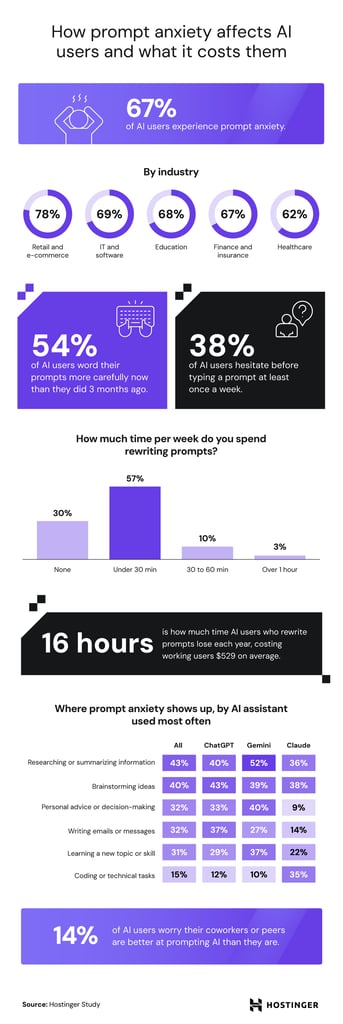
Two-thirds of AI users (67%) feel unsure or anxious about how to word a prompt, and for many it’s a regular occurrence: 38% hesitate before prompting at least once a week. At the same time, 54% say they word their prompts more carefully now than they did three months ago.
When the result falls short, most people look inward first. More than half of AI users (55%) blame the way they worded the prompt, 30% blame the tool’s limits, and 14% blame the task itself.
That instinct shows up in the way people work: 63% of AI users rewrite a prompt at least once before they get a usable answer. For those who rewrite, the extra attempts add up to about 16 hours a year, costing working users an average of $529.
Retail and e-commerce workers experience prompt anxiety most often (78%, compared with 66% of all other AI users). Healthcare workers who rewrite prompts lose the least time of the main industries, about 10 hours a year compared with 17 hours for AI users in other industries who rewrite prompts.
When wording a prompt costs more than the task
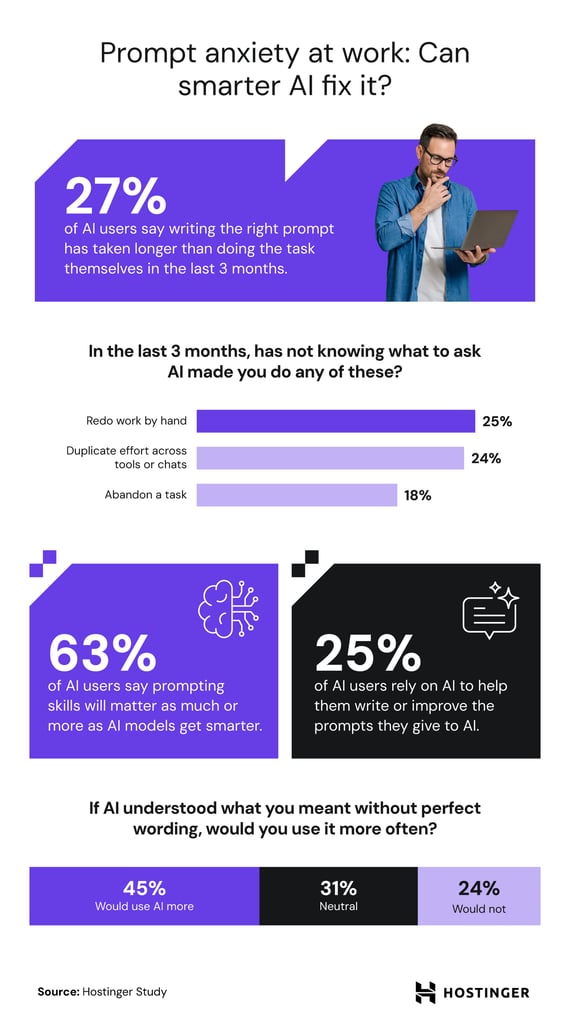
In the last three months, 27% of AI users say writing the right prompt took longer than doing the task themselves.
About 8% missed a deadline or delayed a project because AI couldn’t give them the result they wanted. Gen Z was hit hardest among all generations, more than twice as likely as Gen X to report this (12% vs. 5%).
People are finding workarounds, but they aren’t paying for them. A quarter of AI users (25%) rely on AI to help write or improve their prompts, and 28% have looked for free prompt help. Less than 1% have paid for prompt courses, templates, or guides.
What they want is simpler: 45% say they would use AI more often if it understood what they meant without needing perfect wording. Still, most don’t expect the skill to disappear. 70% of Web Professionals say prompting skills will matter as much as or more than they do now as AI gets smarter, and so do 60% of Web Beginners.
Easing the pressure to prompt
Prompt anxiety is widespread. It costs real hours, and most people blame their own wording for a weak result rather than the tool’s limitations. The potential fix isn’t enrolling in courses, but having tools that meet people in ordinary language, which is the direction AI is moving as models get better at reading intent.
Task-based AI agents are one example of that shift, as they start from what people want to get done. With agentic AI platforms, users can pick a ready-made skill, such as writing a blog post or researching keywords, and the AI agent asks a few questions about their goal before delivering the result. Many of these platforms also remember context across conversations, so users don’t have to explain everything again.
The question worth sitting with is how much more people would build if they stopped editing themselves before they ever hit enter.
Methodology
This survey was conducted in October 2026 and involved 1,002 American AI users who had used AI tools in the last three months. Its main goal was to find out how common prompt anxiety is and what it costs.
Prompt anxiety is defined in this study as feeling unsure or anxious about how to word a prompt. Respondents were grouped by technical skill: 72% were Web Beginners, who use digital tools for everyday tasks but have limited technical knowledge, and 28% were Web Professionals, who have advanced technical knowledge and use digital or technical tools extensively, often for work.
The average age of respondents was 40. Of those surveyed, 56% were women, 42% were men, and 2% identified as non-binary or preferred not to say. By generation, 19% were Gen Z (ages 18 to 29), 50% were millennials (ages 30 to 45), 26% were Gen X (ages 46 to 61), and 6% were baby boomers (ages 62 and older).
Methodology percentages that do not total 100% are due to rounding. The margin of error for the full sample is approximately ±3 percentage points at a 95% confidence level. All findings are self-reported.
Fair use statement
The data and images in this report are free to share for noncommercial purposes. If you use any of it, please credit Hostinger with a link back to this page so readers can see the full methodology.

Larassatti Dharma is a content writer with 5+ years of experience in the web hosting industry. She has populated the internet with over 100 YouTube scripts and articles around web hosting, digital marketing, and email marketing. When she's not writing, Laras enjoys solo traveling around the globe or trying new recipes in her kitchen. Follow her on LinkedIn