What the AI trust gap looks like with our AI support agent
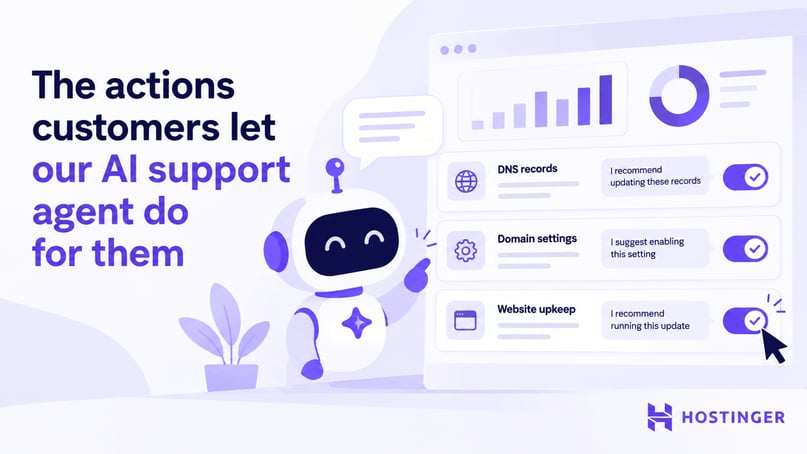
In case something broke on your website, would you let an AI agent fix it?
If your first instinct is to hesitate, you’re not alone. In surveys, only a small share of people say they’d let AI make changes on their behalf, even with their approval.
But surveys ask about AI in general and about situations that haven’t happened yet. We wanted to see what people do in actual real-life situations. So we looked at how our customers worked with Hostinger’s AI support agent.
The agent is built into the Hostinger dashboard, so customers didn’t have to seek it out, opt in, or set anything up. It’s simply how support works. That means the people in our data aren’t early adopters who sought out AI. They’re everyday customers who needed help with something.
Whenever customers asked for help with their hosting, domains, or email, it could check their accounts and identify issues. If fixing a problem required the agent to perform a change, it would always ask for the customer’s approval first.
Our data shows that customers said yes about 9 in 10 times (93%) when the agent asked to make a change. This demonstrates a different picture from the one surveys paint of the AI trust gap, the distance between using AI and trusting it to act.
What surveys say about the AI trust gap
Most of what we know about trust in AI comes from surveys, and they show a clear tension. A global study by the University of Melbourne and KPMG found that 66% of people use AI regularly, but only 46% are willing to trust it.
Trust drops further when AI moves from helping to acting. Capgemini found that the share of executives who trust fully autonomous AI agents dropped from 43% to 27% in a single year. In Ping Identity’s 2026 survey of 11,000 consumers, just 5% would go so far as to let AI act on their behalf with their approval, and only 3% would let it act without asking.
These surveys measure something different from what our data do. They ask how people feel about AI in general. Our AI support agent asked about one specific fix for a problem the customer had just described.
That difference is the point: our data shows what trust looks like when the request is real and specific.
Our AI support agent’s task delegation funnel
Most support questions didn’t need any changes. But when one did, our AI support agent went through three steps:
- Looked – In more than 1 in 4 conversations (29%), our AI support agent checked the customer’s account to see what was going on.
- Asked – In about 1 in 5 of those conversations (20%), our AI support agent found something worth changing and asked for permission to take action.
- Approved – Customers said yes to 93% of those confirmation requests.
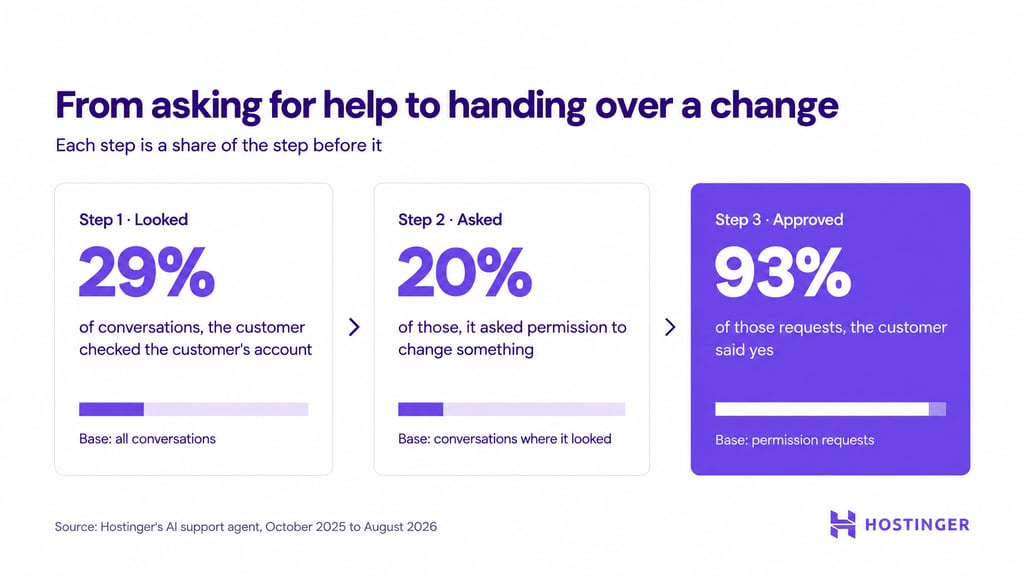
Month by month, customers approved between 89% and 95% of the changes the AI support agent requested from October 2025 to August 2026. If a customer didn’t confirm a change within 30 minutes, we counted it as not approved, regardless of the reason.
There’s a parallel in a very different product. Anthropic reports that developers using its coding tool, Claude Code, accept 93% of manual permission prompts. The matching number is a coincidence, and the settings are different, but the pattern is similar: when an agent asks before acting, people mostly say yes.
What are the tasks customers hand over to our AI support agent?
Customers mostly hand over the behind-the-scenes setup and upkeep that keeps a website online. DNS and domains came out on top, at 34% of all change requests. These settings decide where your website and email go, and one wrong entry can take both offline.
Here’s how the top five areas compare:
- DNS and domains – 34%
- WordPress – 14%
- Servers – 14%
- Security and SSL – 10%
- Speed and caching – 9%
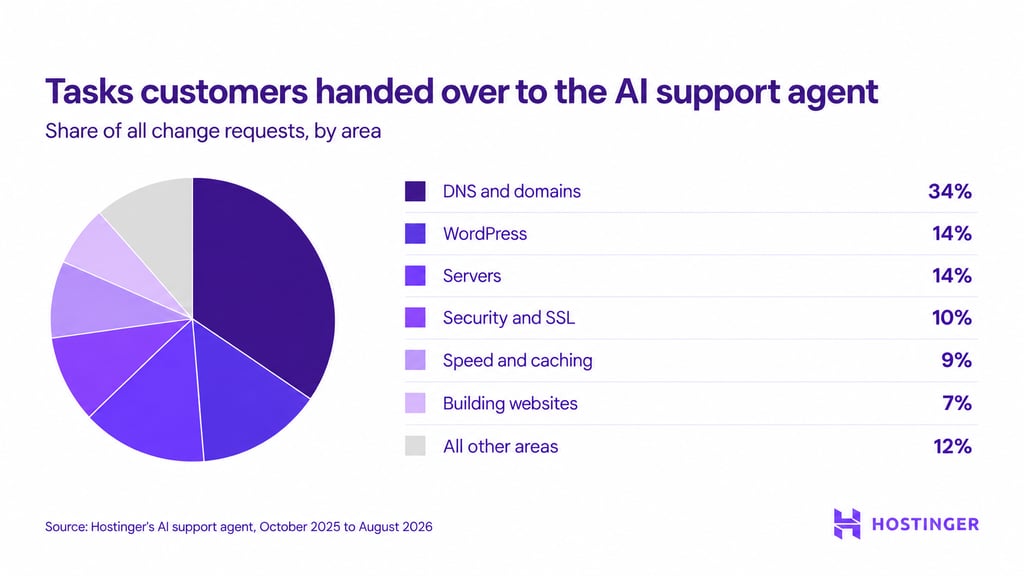
Approval stayed high across the board, from 94% for DNS and domains down to 90% for speed and caching. Even the lowest area still got a yes 9 times out of 10.
Updating DNS records, clearing WordPress cache, restoring backups, installing SSL certificates, and deploying apps on a server are the actions most delegated to our AI assistant.
Approval barely changed by type of action
Among the tasks handed over to our AI support agent, deletions were approved as often as creating or updating something.
From the riskiest-sounding action to the safest, the whole range is just three percentage points. Whether the assistant wanted to delete, create, reset, or turn something off, customers said yes at almost the same rate.
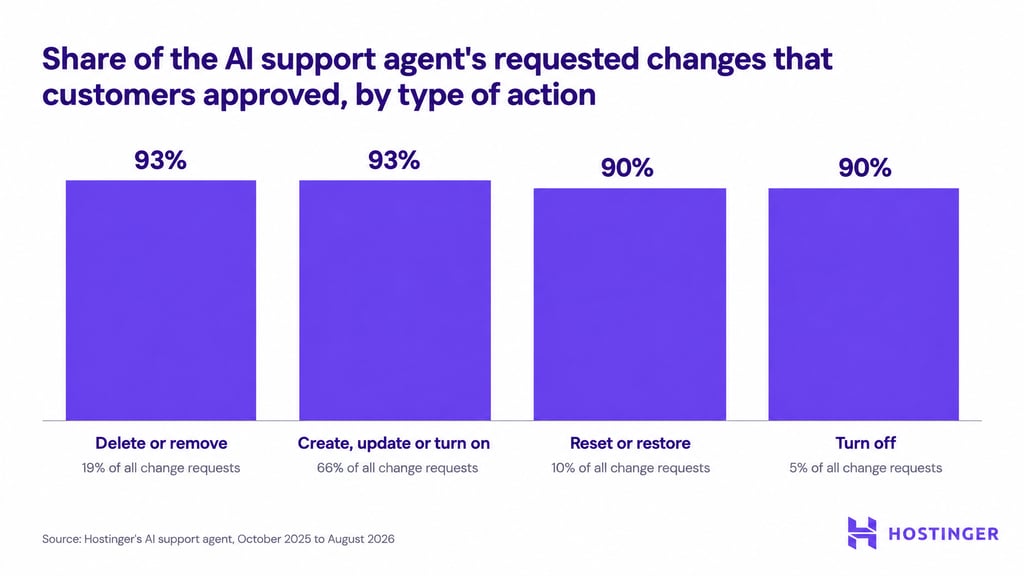
That’s not how trust looks in general AI agent usage surveys, where it drops as the stakes go up. In the agentic AI statistics we’ve gathered, for example, only 20% of executives trust agents with financial transactions, compared with 38% for data analysis.
Our data doesn’t cover money-related decisions, though. Billing, refunds, and payments weren’t part of this study, so these results are only about technical fixes.
When an agent handles payments or business decisions, the stakes and the risks look different. Our guide to AI agent risks covers what can go wrong and how to stay in control.
How fast did change requests grow?
Faster than conversations did. Between the first five months of the study (October 2025 – February 2026) and the last five (April – August 2026), conversations grew about 1.7x, and change requests outpaced that in six of the eight areas.
Routine website upkeep led the way: speed and caching changes grew about 2.5x, and WordPress changes about 2.4x.
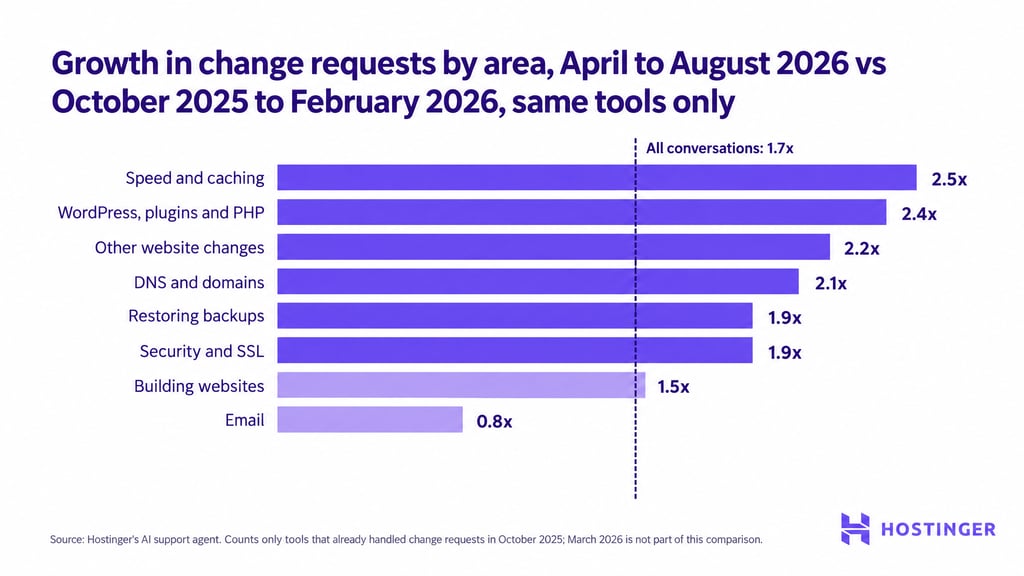
To keep the comparison fair, we counted only tools that already handled change requests in October 2025 and excluded March 2026 to prevent the two periods from overlapping.
A quick word of caution: the data shows growth, not the decisions behind it. Customers may have been handing over more, or the agent may have been suggesting changes more often as it improved.
What we can say for sure is that more requests didn’t bring more hesitation. Approval held between about 89% and 95% the whole way through.
The new AI agent skills tell a similar story
The comparison above omits the new skills the agent gained in 2026, and customers began using them as soon as they were launched. In AI agents, a skill is a specific task the agent can perform on its own. Each new skill expands what the agent can do for our customers. Installing WordPress, available from April, is one example.
In April – August 2026, new skills made up more than 40% of website-building and email requests. That also explains why website building and email were the two areas that didn’t outpace conversations on the original tools: much of that work had moved to the new ones.
Once people delegate, they keep going
A first yes isn’t always the last. Between June and August 2026, in 1 in 4 conversations (25%) where customers approved a change, they went on to hand over more tasks in the same conversation.
That fits a broader trend: trust in AI tends to grow the more people use it. In Ping Identity’s 2026 survey, 43% of consumers said they trust AI more today than a year ago. Our data shows a smaller version of the same pattern, playing out inside a single conversation.
How asking permission closes the AI trust gap
Hostinger’s AI support agent always asked for confirmation before making any change to a customer’s account, and it only needed to ask in about 1 in 18 conversations. When it did, customers said yes 9 out of 10 times.
Unlike the surveys, which asked about AI in general, our customers were deciding on specific tasks, and without their yes, the change didn’t happen.
That’s what human in the loop looks like in practice: the assistant does the legwork, and the customer makes the call.
Surveys point the same way when the question gets specific. In Accenture’s study of 25,590 consumers across 16 countries, 74% would let an AI agent handle routine tasks such as resolving complaints, as long as it strictly followed their instructions.
Gartner also predicts that agentic AI will resolve 80% of common customer service issues without human help by 2029. If that’s where things are heading, our data suggests success will depend on involving customers in decisions at the right moment.
Our AI support agent has now merged into a single tool with Hostinger Agent, an agentic product that handles business tasks like marketing planning, content writing, and SEO. Help with hosting, domains, and email is included with every hosting plan, while the paid Agent Plus plan lets users hand over more of the work of running their business.
The two tools covered a lot of the same ground, so we brought them together to make running a website even easier. Ričardas Kudirka, Hostinger Agent’s Product Manager, explains what connects them: “Trust doesn’t come from the AI acting on its own. It comes from the AI being clear and the customer making the decision. That’s the principle we’re building Hostinger Agent on.”
Methodology
This study is based on anonymized, aggregated usage records from Hostinger’s AI support agent, covering October 2025 to August 2026, prior to its integration into Hostinger Agent on September 2, 2026.
We excluded September 2025 because we were still building out the agent’s tools. We also excluded conversations about billing, refunds, and payments.
The records show which tools the assistant used, whether a tool changes something, permission requests, confirmations, and timestamps. They contain no message content, names, domains, or account IDs. No chat content or prompts were analyzed.
Key definitions:
- Looked: the assistant checked the customer’s account at least once in a conversation.
- Asked: the assistant proposed a change that needed the customer’s permission. Every such change required confirmation.
- Approved: the customer confirmed the change within 30 minutes. A request that wasn’t confirmed in that window didn’t go ahead and is counted as not approved, so approval rates are conservative.
Growth figures compare April–August 2026 with October 2025 – February 2026 and include only tools that already handled change requests in October 2025.
These statistics do not relate to customers’ use of Hostinger Agent, as no Hostinger Agent conversations were analyzed for this study.
What the data can’t tell us
These figures come from customers who had already asked for help, not from the general public. They show what customers approved, but not why. Some of the growth in change requests may reflect the assistant’s improving tools rather than changes in customer habits. People may trust an agent differently with a support fix than with a purchase or a business decision.

Larassatti Dharma is a content writer with 5+ years of experience in the web hosting industry. She has populated the internet with over 100 YouTube scripts and articles around web hosting, digital marketing, and email marketing. When she's not writing, Laras enjoys solo traveling around the globe or trying new recipes in her kitchen. Follow her on LinkedIn