Bitten Tech: 400,000 subscribers, one person, and an operation that runs itself

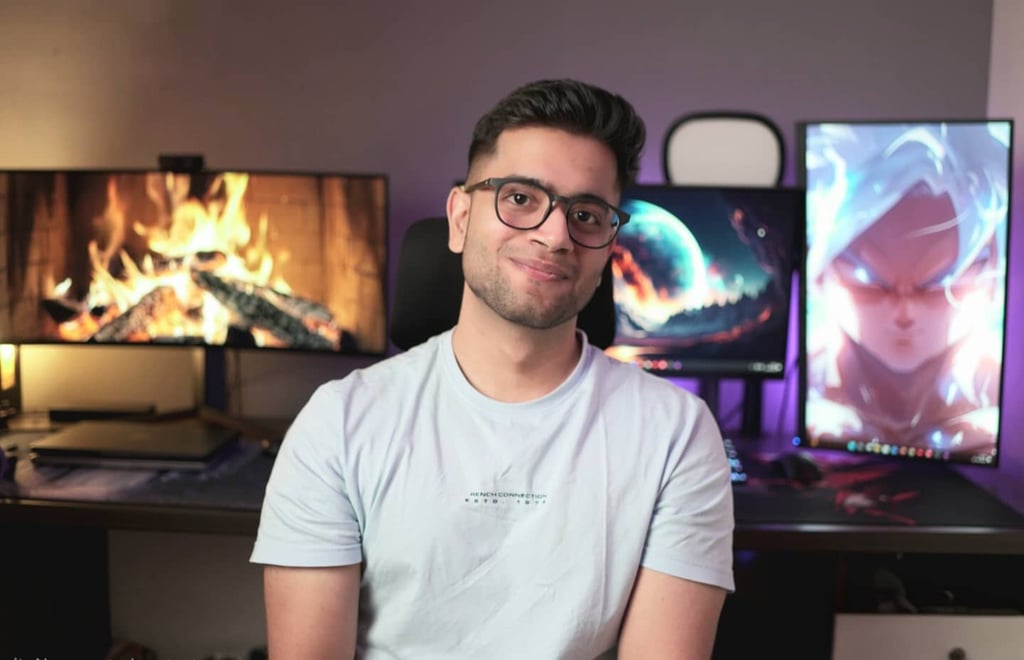
Some careers start with a big plan. Ansh Bhawnani‘s started with a friend who refused to share a cheat code.
Back in ninth grade, Ansh watched a classmate bypass restrictions in Need for Speed and asked how he’d done it. The answer was “go search yourself.” So he did, digging through forums on a limited mobile data pack until he cracked the game himself.
“I took it personally,” he said.
That determination has led to Bitten Tech and a following of more than 400,000 subscribers on YouTube, where Ansh teaches ethical hacking and cybersecurity.
The channel is the most visible part, but Bitten Tech is more than that now: a website he built himself, his own courses, and a Discord where an AI trained on his teaching answers followers when he isn’t there.
It took the better part of a decade to get there, though, and grew out of something a lot smaller.
How a cheat code became a career
That first game was just the start. Cracking games became his hobby, and from there he moved to rooting his phone, installing Linux, and collecting tools.
“I didn’t have many hobbies, so I made it my hobby,” he said.
Along the way, it clicked that all of this had a name – cybersecurity – and that a career could be built around it.
He was learning mostly from other people’s videos on YouTube, but with a coding background going back to Python in 11th grade, he understood the material better than most beginners.
He carried that head start into an engineering degree in computer science, where classmates kept coming to him when a topic didn’t land.
“People acknowledged and respected the fact that I can teach,” he said.
That respect was the nudge he needed. If teaching worked on the people around him, it would work on a far bigger audience online, so he started making his own videos.
Three years of talking to almost nobody
Ansh started posting on YouTube in 2016, small beginner tutorials at first: how to install Linux alongside Windows, how firewalls work, the basics of wifi cracking.
He half-expected one video to break through on its own, and posted about one a month, waiting for it to happen. He’d upload something, refresh the analytics, and watch ten or twenty views trickle in.
It didn’t take long to see there was no single video that would do it. “It’s not a cakewalk,” he said. “I need to be consistently posting and improving myself.”
What kept him going was the handful of people behind the numbers. His classmates were the first sign, telling him a year on, “We used to watch your videos and pass the exams.”
It was never really about the big numbers, anyway. “If I can help a few people, maybe five to six people, that’s a big thing,” he said, and what he holds onto now is the people who write to say they’ve cleared a certification or landed a job.
He’d started out in English, like the creators already doing well. But his community in India kept asking him to teach in Hindi because the people already doing it weren’t covering the material that helps a career. “The ones teaching locally were not teaching the real content that actually helps,” he said. So he made the switch.
His engineering degree gave him the raw material. He turned his coursework into full courses, eight to ten hours each, on Python, PHP, JavaScript, and networking. It was the first time he’d built something at that scale for the channel, whole courses instead of single videos.
That push toward hands-on teaching produced a practical cybersecurity workshop video, and it did what nothing before had: it pulled in around 20,000 subscribers on its own. That was the turning point, and the channel kept climbing from there.
Why he keeps the day job
Plenty of creators dream of going full-time on YouTube. Ansh deliberately hasn’t.
He works in application security by day as a senior analyst at HackerOne, and he treats that day job as part of the teaching itself.
“I want to know what is happening in the industry firsthand,” he explained. Shipping real security work, reviewing real code, and reproducing real vulnerabilities keeps his teaching grounded in how things actually work – a reality check for his audience.
The title helps too. Coming from someone doing the job at a serious company, what he teaches carries weight. “If it’s coming from me, then it’s actually true, and they will eventually follow.”
The channel, by contrast, is pure passion. His test for what deserves that word is simple: whether he disappears into it.
When he’s building something, hacking a machine, or teaching a topic, the clock stops and the world outside goes quiet. “It’s just me and the machine, everything else just fades out,” he said. “If I’m in the flow state, then I know that it’s my passion. I can keep doing it for years.”
Why the channel wasn’t enough
For all the reach of his channel, Ansh kept bumping into the limits of video. Part of it was personal. “I wanted to have a website where I can post blogs as well,” he said, “because I liked to write.”
Part of it was the audience. “Many people don’t watch videos, they read books, they have a reading habit. So I wanted to cater to that audience.”
He pictured a written home for the deeper material, technical deep dives, resources, a knowledge base, each article linking back to the video he’d made on it.
That’s what first brought him to Hostinger in 2017. He’d tried a handful of providers on their free tiers, experimenting on temporary domains to see what stuck, and Hostinger won on two things.
“The biggest thing that attracted me was the budget,” he said, “and the interface, it was very intuitive, very easy to use.” He registered a domain, built his first real site on WordPress, and grew it alongside the channel.
For years the site stayed a WordPress build he’d assembled by hand, page by page, designs and all, the last big pass done manually back in 2020.

Building without touching code
When he finally decided to redo it, he was ready to code the whole thing from scratch. Then he tried Hostinger AI Builder, and realized he didn’t have to.
“I was already with Hostinger, and if I just build it, it will be published right away. It’s the same workflow,” he said. Nothing new to wire together.
So instead of writing code, he described the site he wanted in plain language and fed the tool with his existing content. “The first day itself I was able to get a rough design,” he said, and about 25 days later he had the site he runs now.
His usual frustration with AI tools is repetition, going in circles on the same prompt. “I haven’t had this problem,” he said, because it held the context of what he’d built before and the design direction he liked.
That mattered to someone who, in his own words, is “a content creator and security person,” not a developer.
He set the vision himself. “I had my own idea of what should be the hero section, what the integrations should be, and how the flow should work,” he said. The execution was AI Builder’s.
The performance jump was the part he hadn’t expected. “It’s a very big change,” he said. The new site loads fast and cleanly, the kind of professional result he’d normally have had to code himself or pay a developer for.
His trainings had been stuck on third-party platforms that gave him no say over design, so he made his own course landing pages and training pages with filters.
When his audience asked for a way to find the right course, he built that too: a course finder where visitors enter their background, target, and goals, and it suggests which courses to take.
An operation that runs while he sleeps
The most recent chapter is where the whole story converges. Ansh is a security researcher, and security researchers automate. Building is also something he loses himself in, so he set up a VPS on Hostinger and used it to run automations around the clock, on the same account as his site.
“These automations are the next big thing for my brand and the backbone is Hostinger VPS,” he said.
There are 20 to 30 of them now, each one wired to handle a job he used to do himself.
Some handle the business. Weekly and monthly agents comb his YouTube and Instagram analytics for patterns: “what content is working, what is not working, and where could I improve.” Others research brand collaborations that fit his audience and his niche.
The one he’s proudest of is the teaching itself, automated: an AI cybersecurity mentor on his Discord server that he calls his “brain.” It exists to cover for him. “Anybody who messages me on Discord, I make sure that if I’m not available, my AI answers to them,” he said.
He’s poured everything into it, his notes, his teaching philosophy, the whole back catalogue of his videos. “Every bit of knowledge that I have, I’m trying to give it to the brain product, and it’s answering to the people.”
It’s the same job he set himself in those early years, guiding the beginner who doesn’t know where to start.
Next on the list is an agent that researches and audits vulnerabilities overnight and hands him the intel by morning.
The appeal was simple. “To build when I’m not there, and it’s still working for me,” he said.
One person, the capacity of a team

Bitten Tech is, on paper, one person, but it doesn’t run like one. He signed up for Hostinger in 2017 just to put a site online. Years later, he rebuilt that site with AI Builder, created community tools, and now runs a bunch of automations.
Same platform the whole way with nothing to switch between.
And he isn’t done. “I’m thinking of many more things that I can build,” he said. “I’m just doing it prompt by prompt.”
It’s the same drive it always was. The kid who dug through forums until he cracked that first game, just to know how it worked, never really stopped.
He’s still chasing down how things work and passing on what he finds, only now it’s to a few hundred thousand people, and some of it keeps going while he sleeps.

Simon is a dynamic Content Writer who loves helping people transform their creative ideas into thriving businesses. With extensive marketing experience, he constantly strives to connect the right message with the right audience. In his spare time, Simon enjoys long runs, nurturing his chilli plants, and hiking through forests. Follow him on LinkedIn.