Arts by Trinity: An architect’s side project that outgrew her day job
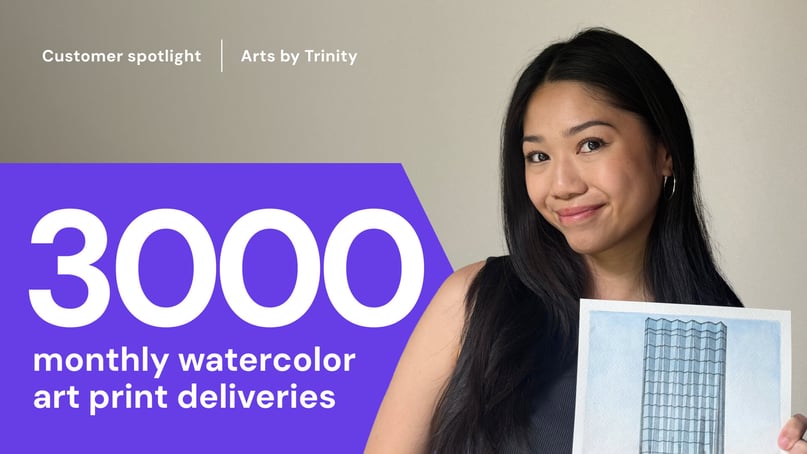
Trinity Shiroma started Arts by Trinity as a side venture while working full-time as an architectural designer. Today, it’s a full-blown art business with an online shop and a subscription mail club with customers in 22 countries.
She didn’t have the business mapped out from the start. Each new opportunity shaped what Arts by Trinity would become.
When architecture meets art
Growing up with a father who was both an art teacher and a practicing artist, Trinity had been painting for as long as she could remember. So when she enrolled in architecture school, she didn’t feel like she had to choose between the two. They naturally came together.
Watercolor classes were part of the curriculum, and Trinity quickly gravitated toward them. Her favorite course, though, was architectural history.
She was always fascinated by how buildings were designed and the stories behind them: why they were built, what they represented, and the people who created them.
After earning a master’s degree in architecture, she worked as a designer in an architectural firm. On paper, her career seemed set. But after two years behind a desk, she began to wonder if this was really her dream job.
While she searched for the answer, she never stopped creating art. She painted watercolors, crocheted Taylor Swift-inspired cardigans, and, somehow, always found people willing to buy what she made.

Then she realized the career she wanted would bring her art and her architectural expertise together.
The courage to just begin
As 2024 came to a close, Trinity set herself a New Year’s resolution: turn her art into a real business. She didn’t have everything figured out yet, but she knew the first step was building a website.
“I needed a website at least to take on commissions, so I can put in a commission form. Just a homepage, talking about who I am – that I’m a legit person you can trust and give your money to,” she explained.
Before she had settled on what the business would become, she registered artsbytrinity.com on Hostinger. The name was intentionally broad because she didn’t want to box herself into architecture paintings, watercolor, or any one artistic style.
That brand name ended up taking on a life of its own. “Everyone kind of calls me that,” she laughed. “I don’t even think they know my real name. They just call me Arts by Trinity.”
In January 2025, Trinity launched her website. She built it herself using Hostinger’s website builder, working on it in the evenings after her full-time job.
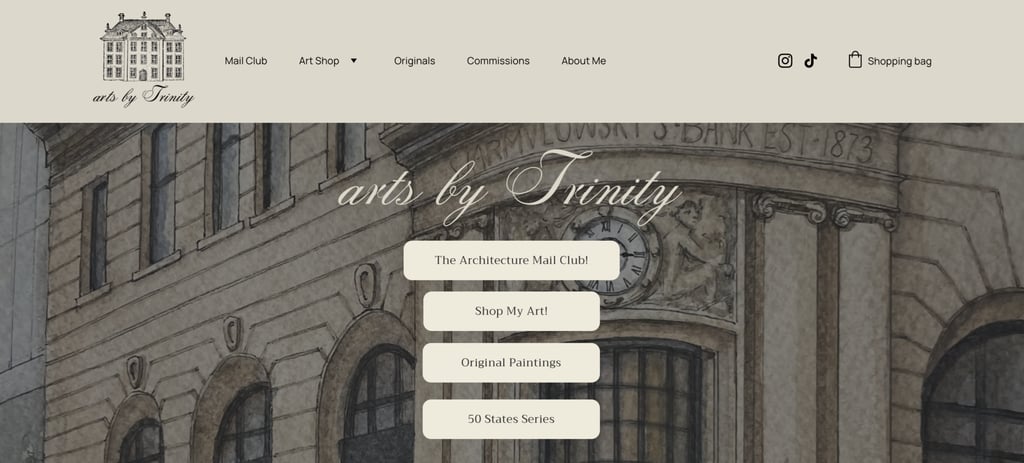
Rather than relying on the builder’s AI-powered onboarding, Trinity chose to build the site manually using the drag-and-drop editor. Over two weeks, she carefully refined every detail to match her vision and showcase her artwork exactly as she wanted.
“Hostinger is super easy to build on. It was more the other stuff, like how I wanted it to look, or even deciding the color palette. That was the hardest thing,” she recounted.
Commissions take off – and the numbers follow
With the website live, Trinity started sharing her work with an audience of about 70 Instagram followers. It didn’t take long for people to find her online.
Her first two commissioned clients discovered her through Instagram and, after visiting her website, reached out to place an order.
As more commissions came in, so did the volume of inquiries. Trinity soon realized she needed a better way to keep people updated than replying to every message in her Instagram inbox.
So she used Hostinger Reach, the AI-powered email marketing tool that integrates with the website builder. Rather than juggling another service, she could create email campaigns and manage subscribers from the same ecosystem as her website.
“Sometimes people look at social media, sometimes they don’t – so it’s just an easy way for me to make announcements and make a waitlist if I need to,” she said.
She organized her mailing list into separate audiences: commission openings, international customers, and people waiting for a spot in her Architecture Mail Club.
Just as with the website, Trinity wanted her first newsletter to meet her highest standards.
She used Reach’s prompt-to-newsletter feature to generate an initial template, then customized it to match her brand.
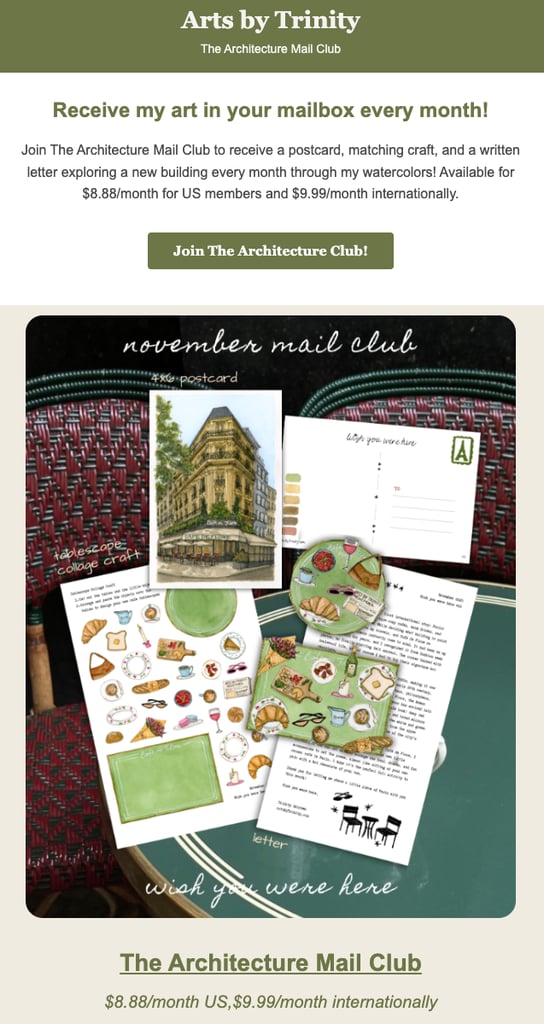
“It definitely made it easy – because again, I just don’t have time as an artist. When I could just say, ‘Hi, can you do this?’ it made it a lot easier the first time,” she explained.
It took her a couple of hours to perfect the wording, layout, and every last typo on the newsletter template. Once the template was in place, sending future newsletters was much easier.
The systems she put in place gave her more time to focus on her creative work. By May 2025, just four months after launching her website, she was earning more from her art business than from her role at the architecture firm, so she decided to resign.
Everything she loved, in one envelope
In September 2025, Trinity launched The Architecture Mail Club. While commissions had helped her build an audience, the mail club became the heart of her business. It was also the first project that brought together everything she loved: painting, storytelling, and architecture.
By joining the mail club, subscribers receive a themed envelope every month, each centered around a different iconic building. Inside is a postcard featuring a print of Trinity’s watercolor painting, a matching handmade craft, and a letter explaining the building’s history and architectural significance.
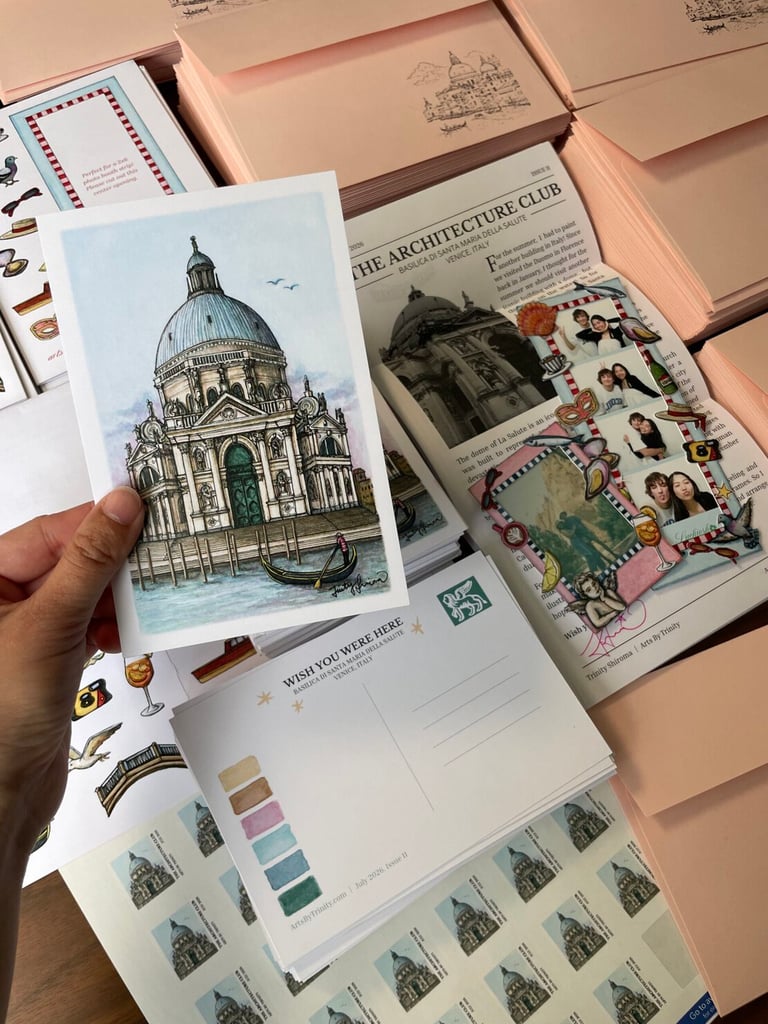
This mail subscription idea had been taking shape long before she officially launched it.
Growing up, she watched her father run a small art magazine that he mailed to subscribers. Years later, she saw creators building sustainable businesses through subscription models.
Taking inspiration from those, she finally created her own. Membership costs $8.88 a month in the US and $9.99 internationally – prices Trinity intentionally kept close to the cost of a cup of coffee so more people could join.
The response was immediate. The club launched with 117 subscribers in its first month. The following month, that number doubled. Then it doubled again.
Once the club surpassed 800 subscribers, Trinity’s home printer could no longer keep up with the load, so she switched to a professional print shop.
Apart from how she prints the postcard, the hand-stamped envelopes, handmade crafts, and the architectural stories that accompany every collection remain as personal as they were on day one.
And when the workload became too much to manage alone, Trinity turned to her family for help. “My parents are retired, so they’re pretty much free all month,” she said with a laugh.
Today, Trinity still packs and ships nearly 3,000 Architecture Mail Club subscription envelopes every month, with help from her husband and parents.

Still painting buildings, still telling their stories
Arts by Trinity has grown into a business with multiple revenue streams. Everything runs through the same website she built at the beginning of 2025, with Stripe integrated for payments.
Despite the enormous growth, Trinity still manages the website herself. A couple of times a week, she’ll spend 15 to 30 minutes updating a page, fixing a typo, or opening and closing a waitlist. “I kind of like the customization,” she said. “I have a vision, and I just like to do it myself.”
Looking back, Trinity believes one decision made the biggest difference in turning her art into a business.
“Artists need a website. That’s what I always tell people – your first step is that you really need a website. It makes you look legit. It makes you look like someone people can trust to buy art from.”
Last year, Trinity built a website for that exact reason. At the time, it was simply a creative side project to share her love for art while she continued building her career in an architectural firm.
Today, her watercolor prints travel to multiple countries every month, and she’s doing business without having to choose between the two things she loves the most, but by bringing them together.

Larassatti Dharma is a content writer with 5+ years of experience in the web hosting industry. She has populated the internet with over 100 YouTube scripts and articles around web hosting, digital marketing, and email marketing. When she's not writing, Laras enjoys solo traveling around the globe or trying new recipes in her kitchen. Follow her on LinkedIn