What is agentic AI and how does it work?
Sep 10, 2026
/
By Ksenija & Aris S.
/
10 min Read
Agentic AI is an advanced form of artificial intelligence that can independently set goals, plan, reason, and take action to achieve a specific objective with minimal human oversight.
Unlike generative AI, which primarily creates content in response to user prompts, agentic AI can decide what steps to take, use tools, and adapt its approach as it works toward a goal.
Its key characteristics include autonomy, goal orientation, reasoning, adaptability, and the ability to collaborate with other agents or people.
This goal-driven approach allows agentic AI to handle tasks across areas such as business, finance, and healthcare. How these systems plan, reason, and act also helps distinguish agentic AI from generative AI and determine when each is most useful.
For in-depth analysis, check out our YouTube video on agentic AI.
Key characteristics of agentic AI
The key characteristics of agentic AI are autonomy, goal-oriented behavior, reasoning, planning, tool use, memory, and adaptability.
Together, these capabilities enable AI agents and other agentic systems to pursue objectives, make decisions, take actions, retain useful context, and respond to changing conditions with limited human oversight.
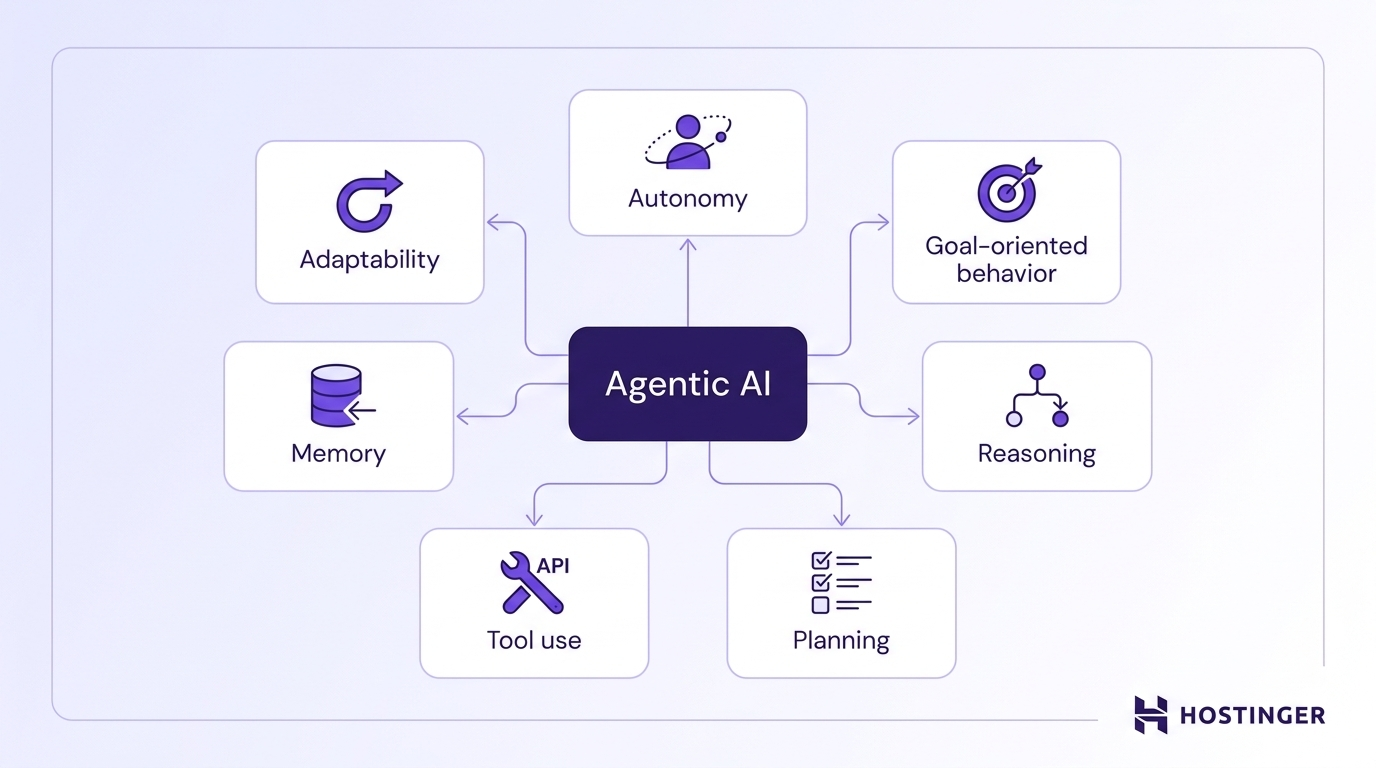
Here’s what each characteristic allows an agentic AI system to do:
- Autonomy. Autonomy refers to operating with limited human intervention. Agentic AI can make decisions and take permitted actions without requiring instructions or approval at every step. How independently it operates depends on its permissions, guardrails, and requirements for human oversight. Systems with a higher degree of autonomy, such as autonomous AI agents, can independently plan and perform more of the actions required to complete a task.
- Goal-oriented behavior. Goal-oriented behavior keeps the system focused on achieving a defined outcome rather than simply responding to individual commands. This allows agentic AI to pursue an objective across multiple tasks. A customer support agent, for instance, can work toward resolving an issue even when doing so requires several different actions.
- Reasoning. Through reasoning, agentic AI analyzes available information, considers different options, and decides what to do based on the context. This allows it to make decisions when the appropriate action varies depending on the situation.
- Planning. Planning determines which steps are needed to reach a goal and how they should be organized. Agentic AI can break larger objectives into smaller tasks, account for dependencies between them, and establish an appropriate order for completing them.
- Tool use. Tool use gives agentic AI access to external systems and resources needed to complete tasks. Depending on its permissions, it can search the web, query databases, read files, call APIs, update records, or send messages rather than being limited to generating responses.
- Memory. Memory lets agentic AI retain and retrieve information beyond the immediate interaction. Previous conversations, decisions, completed actions, and user preferences can provide context for later tasks and help the system maintain continuity over time.
- Adaptability. An adaptable agentic AI system can change its approach as new information becomes available or circumstances change. If a tool returns an error, required information becomes unavailable, or the original approach no longer works, it can account for the new situation and choose another course of action.
How does agentic AI work?
Agentic AI works through a continuous loop of perceiving, reasoning, planning, using tools, acting, reflecting, and adapting until it achieves its goal or reaches a point where human input is required.
To carry out this loop, an agentic system can combine AI models with AI agent memory, tools, APIs, and workflows or orchestration that coordinate how tasks are completed.
These components work together through agentic workflows, where information and results from one step can inform what happens next.
A missing-order request shows how an AI agent can move through each stage of the process:
- Perceive. The agent interprets the objective and gathers the information and context needed to understand the situation. For a missing order, this could include the customer’s message, the order number, the delivery status, the account details, and previous support interactions.
- Reason. It evaluates the available information and decides what needs to happen. If the tracking data shows that the package is overdue, the agent might determine that it needs to check the carrier’s latest status and the company’s replacement or refund policy.
- Plan. The agent breaks the goal into smaller tasks and decides the order in which to complete them. It might first verify the delivery status, then check the relevant policy, establish which resolution the customer qualifies for, and prepare the appropriate response.
- Use tools. It selects the APIs, software, databases, or other external systems needed to complete those tasks. In this case, the agent might use an order database, a shipping carrier API, a customer support platform, and a company knowledge base.
- Act. The agent executes the planned actions using the tools and permissions available to it. Depending on the situation, it could update the support ticket, initiate a replacement order, or send the customer a message explaining the resolution.
- Reflect. It evaluates the outcome to determine whether its actions produced the expected result. If the replacement order was created successfully and the customer received confirmation, the goal may be complete. If an action failed or the issue remains unresolved, the agent needs to continue working toward the goal.
- Adapt. The agent adjusts its plan or next action based on the result or any new information. If the replacement cannot be processed because the item is out of stock, for example, it could evaluate another permitted resolution, such as issuing a refund.
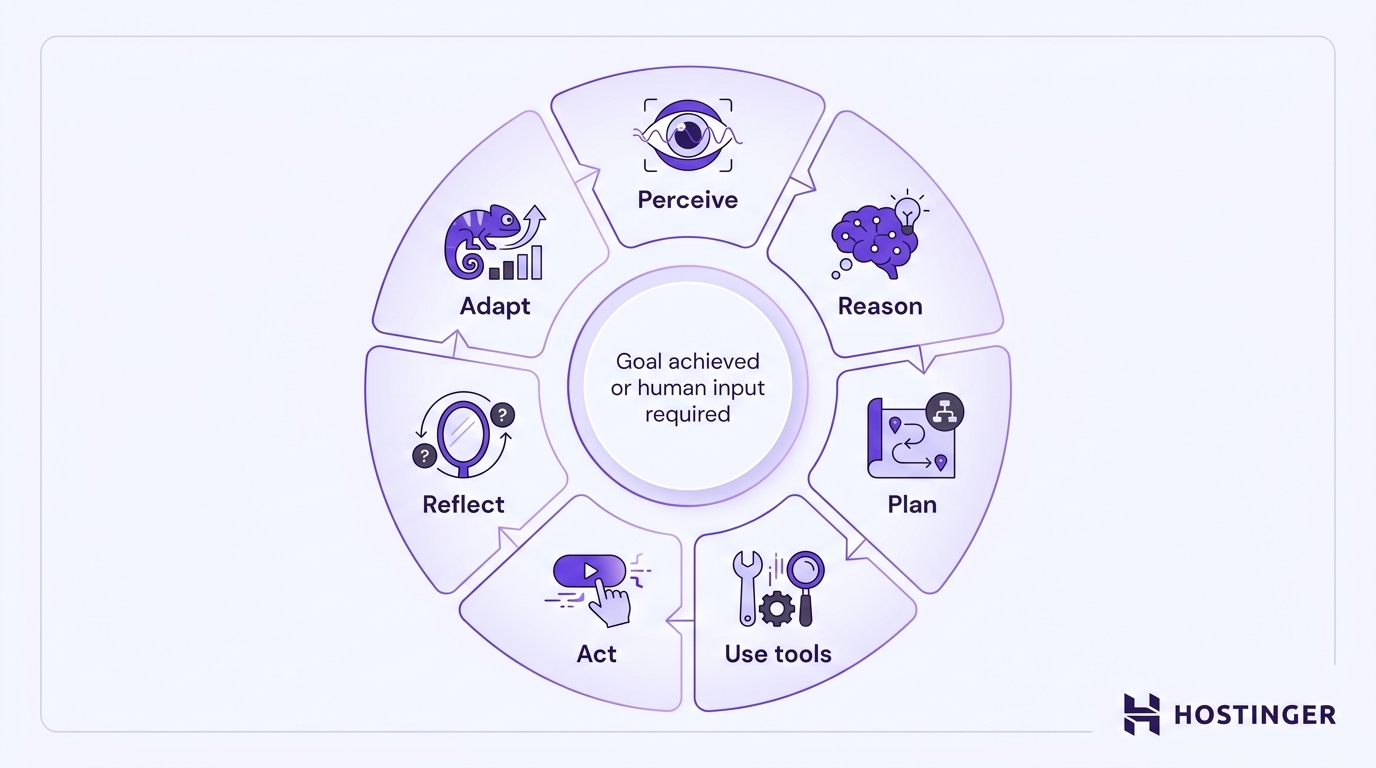
This loop can repeat as the agent receives new information or encounters unexpected results. It ends when the goal is achieved, the system reaches the limits of its permissions or capabilities, or the task requires human review or approval.
How is agentic AI different from generative AI?
The main difference between agentic AI and generative AI is that generative AI creates content in response to prompts, while agentic AI takes actions to achieve a goal.
For example, a generative AI tool can draft a customer support reply based on a prompt. An agentic AI system can go further by checking the customer’s order, reviewing the delivery status, deciding on an appropriate resolution, issuing a refund or replacement when permitted, and notifying the customer.
Similarly, generative AI can create a marketing email from your instructions, while agentic AI can use campaign data to decide which audience to target, generate the email, schedule the campaign, and adjust subsequent actions based on the results.
Here are the main agentic AI vs generative AI differences:
Aspect | Generative AI | Agentic AI |
Primary purpose | Create content in response to prompts | Achieve a defined goal through actions |
How it works | Processes input and generates an output | Plans tasks, makes decisions, uses tools, and takes actions |
Human involvement | Typically requires a prompt to generate each output | Can complete multiple steps with limited human input |
Tool use | Primarily generates content, though some applications can use tools | Uses tools, APIs, databases, and other systems to complete tasks |
Examples | Generating text, images, audio, or code | Resolving support requests, managing workflows, or completing multi-step tasks |
Generative and agentic AI are complementary rather than mutually exclusive. Agentic systems often use generative models, including large language models (LLMs), to understand instructions, reason about information, or generate responses, while other components handle capabilities such as memory, tool use, and task execution.
How does agentic AI relate to AI agents?
Agentic AI describes the broader approach of using AI to autonomously pursue goals, while an AI agent is an individual software entity that can perceive context, reason, use tools, and take actions toward a goal.
An agentic AI system can consist of a single AI agent or coordinate multiple agents, tools, and workflows to complete more complex tasks.
For example, a single marketing agent could analyze campaign performance and adjust its next actions based on the results.
A more complex agentic system could coordinate separate agents to research an audience, create campaign content, manage distribution, and analyze performance as part of the same campaign.
AI agents can also vary in how they make decisions and how independently they operate. Some types of AI agents follow relatively simple rules, while others can plan, use memory and external tools, evaluate results, and adapt their next actions.
In short, AI agents are individual actors, while agentic AI refers to the broader autonomous, goal-oriented behavior and systems they can enable.
Examples of agentic AI
Agentic AI can support multi-step tasks across marketing, customer support, software development, business operations, and research.
The specific process varies by application, but typically involves planning what needs to happen, using external tools or data, taking actions, checking the results, and adapting when necessary.
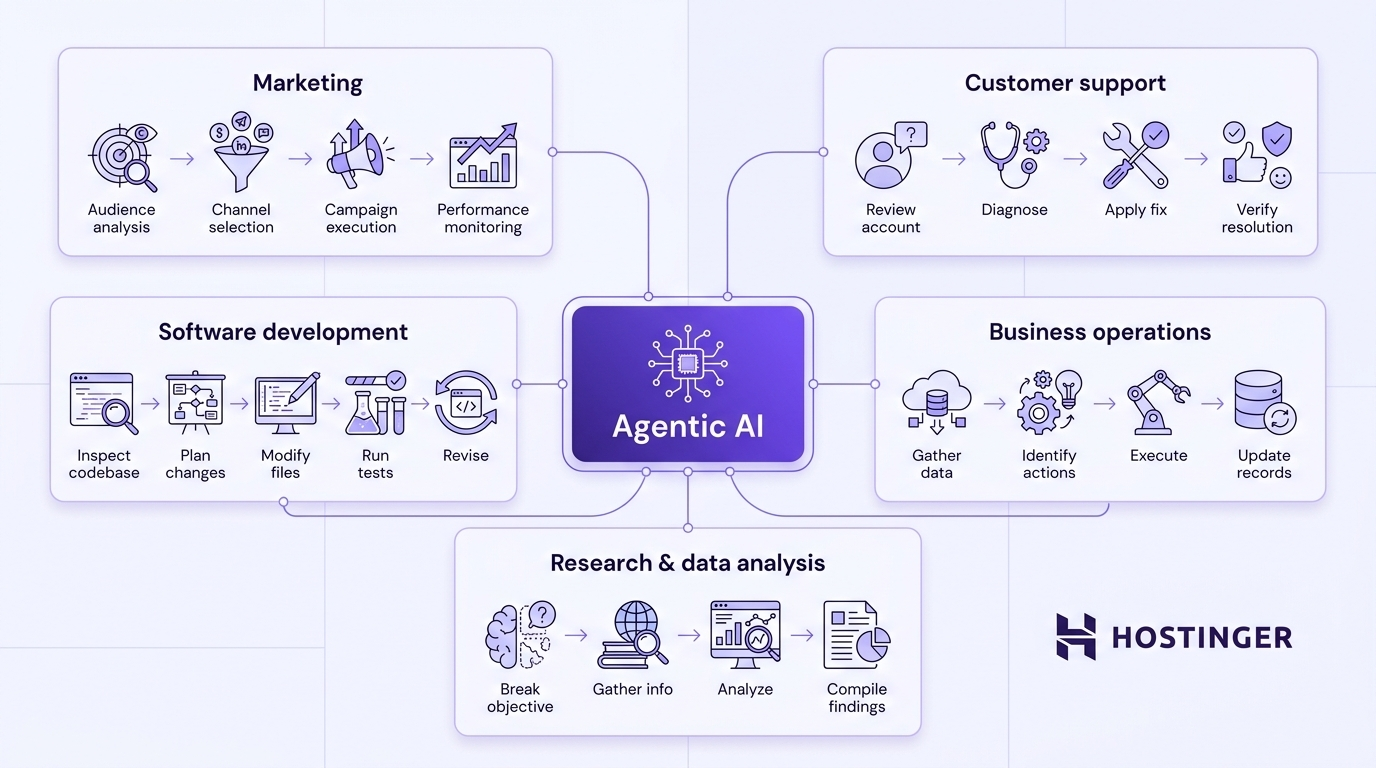
Marketing. Agentic AI in marketing can manage multi-step campaigns by analyzing audience and performance data, deciding which channels and messages to use, and executing actions through connected marketing tools.
It can then monitor campaign results and adjust targeting, messaging, or budget allocation based on performance.
Customer support. Instead of simply generating a reply, an agentic system can work through each step required to resolve a customer issue.
If a customer cannot access a service, for instance, it can review account information and technical data, identify possible causes, run permitted diagnostic checks, and apply an appropriate fix.
It can then verify whether access has been restored, try another solution, or escalate the issue if necessary.
Software development. Multi-step development tasks can include implementing features, fixing bugs, refactoring code, and resolving test failures.
An AI agent can inspect the codebase, plan the required changes, modify relevant files, and run tests to validate its work.
If it encounters errors or failed tests, it can analyze the results, revise its implementation, and test again until the task is completed or developer input is required.
Business operations. Tasks such as inventory management, invoice processing, scheduling, procurement, and reporting can involve several tools, data sources, and decisions.
An agentic system can gather the necessary data, identify what needs attention, plan and carry out actions, and update records as work progresses.
If conditions change, such as a supplier becoming unavailable or an invoice failing validation, it can adjust the next steps accordingly.
Hostinger Agent shows how this can work in practice. It can handle multi-step business tasks involving research, planning, content, SEO, troubleshooting, and other workflows, while connected apps such as Google Sheets, Gmail, Slack, Notion, and HubSpot let it pull information, send messages, and update records. For higher-impact actions, it pauses for approval before continuing.
Research and data analysis. A research agent can turn a broader objective into smaller questions, gather relevant information from connected sources or databases, and analyze the collected data.
If it identifies gaps or conflicting information, it can conduct additional research before compiling and presenting its findings.
Benefits of agentic AI
The main benefit of agentic AI is its ability to take on work that would otherwise require people to manually coordinate multiple steps, tools, and decisions.
In practice, agentic AI can help businesses in several ways:
- Automate complex workflows. Multi-step processes such as gathering information, making decisions, using external tools, taking actions, and checking outcomes can run with less human intervention. This allows businesses to automate processes that would otherwise require employees to manage each stage manually.
- Reduce repetitive manual work. Routine coordination, such as moving information between systems, monitoring progress, updating records, and triggering follow-ups, can be handled automatically, saving employees time and reducing administrative workload.
- Improve productivity. By taking over routine decisions, actions, and follow-ups, agentic systems can help teams complete processes faster and handle more work without a corresponding increase in manual effort.
- Make cross-system processes more efficient. Information can be retrieved from one tool, used to make a decision, and acted on in another. This reduces the manual handoffs required when business processes span multiple platforms.
- Respond faster to changing conditions. When new information or unexpected results affect a workflow, the system can adjust its plan and choose the next appropriate action. Businesses can keep processes moving without waiting for someone to identify the issue and manually redirect the workflow.
- Give employees more time for higher-value work. With routine execution and coordination handled automatically, employees can spend more time on strategic decisions, creative problem-solving, relationship building, and other work that requires human judgment and expertise.
What are the challenges of agentic AI?
Agentic AI introduces risks around reliability, control, and security because it can make decisions and take actions with limited human involvement.
The main challenges of agentic AI include:
- Incorrect or unreliable results. Agentic AI can misinterpret information, make flawed decisions, or take inappropriate actions. In a multi-step workflow, an error at one stage can also affect the decisions and actions that follow.
- Unpredictable behavior. Agentic systems can choose different paths toward the same goal depending on the information and circumstances they encounter. This makes their actions less predictable than fixed, rule-based automation, and can produce outcomes that businesses did not anticipate.
- Privacy and data security risks. Completing tasks may require access to customer information, internal documents, databases, or third-party applications. Poorly scoped access can expose sensitive information or allow an agent to interact with data and systems beyond what it needs for the task.
- Accountability concerns. Clear ownership is needed when an agent makes decisions or takes actions autonomously. Someone must be responsible for monitoring its activity, reviewing problems, and intervening when its actions could affect customers, finances, data, or critical operations.
- Monitoring and governance requirements. Businesses need visibility into what agents are doing, which tools and data they access, and whether their actions remain within established rules. Logging, testing, access controls, and escalation procedures help identify problems and keep agent activity within its intended scope.
- Need for human oversight. Sensitive, high-impact, or irreversible actions may require human approval before execution. Approval checkpoints can prevent an agent from making consequential changes independently, such as deleting important data or modifying critical system configurations.
Greater autonomy requires stronger safeguards. Scoped permissions, clear guardrails, activity monitoring, approval controls, and defined escalation procedures can limit what agentic systems can do and provide a way to intervene when necessary.
How can businesses start using agentic AI?
Businesses can enter agentic AI by introducing it into a low-risk process, giving it a clearly defined role, and expanding its responsibilities only after it has performed reliably under controlled conditions.
Here is a practical approach you can take:
- Choose a suitable workflow. Look for repetitive or multi-step work that requires people to gather information, make routine decisions, move between tools, or coordinate follow-up actions. Good starting points could include compiling weekly reports from several data sources, researching and qualifying sales leads, monitoring inventory levels, or preparing and scheduling marketing content.
- Define the goal and boundaries. Specify the outcome you want the agent to achieve, which decisions it can make independently, and which actions require your approval. If you’re setting up an agent to qualify leads, you might allow it to research prospects, check them against your criteria, and add qualified leads to your CRM. You could then require approval before it sends outreach or changes existing customer records.
- Choose how you will use agentic AI. You can adopt an existing agent for tasks such as research or marketing, use one of the AI agent builders to configure an agent around your existing tools, or create a custom solution when you need specialized logic and integrations. Building an AI agent gives you greater control over its behavior, tools, and workflows.
- Connect only the necessary tools and data. Give the agent access to the applications, APIs, files, or databases required for its task. If you’re setting up an agent to prepare reports, you could give it read access to Google Analytics and your sales database, plus permission to update a Google Sheet. Keep unrelated systems, such as billing settings or employee records, outside its access.
- Test with a limited scope. Begin with a small number of tasks, users, or workflows, and review how the agent behaves before expanding its responsibilities. You could have a marketing agent prepare one campaign for review before allowing it to work across several campaigns, or test a reporting agent with one weekly report before adding more data sources and reports.
- Monitor results and keep people in control. Track whether the agent completes tasks correctly, follows its instructions, and stays within its permissions. For example, an inventory agent could automatically flag low-stock products and prepare a reorder, while a person approves the purchase before it is submitted. Financial transactions, deleting data, changing critical settings, and other sensitive or irreversible actions should similarly require human approval.
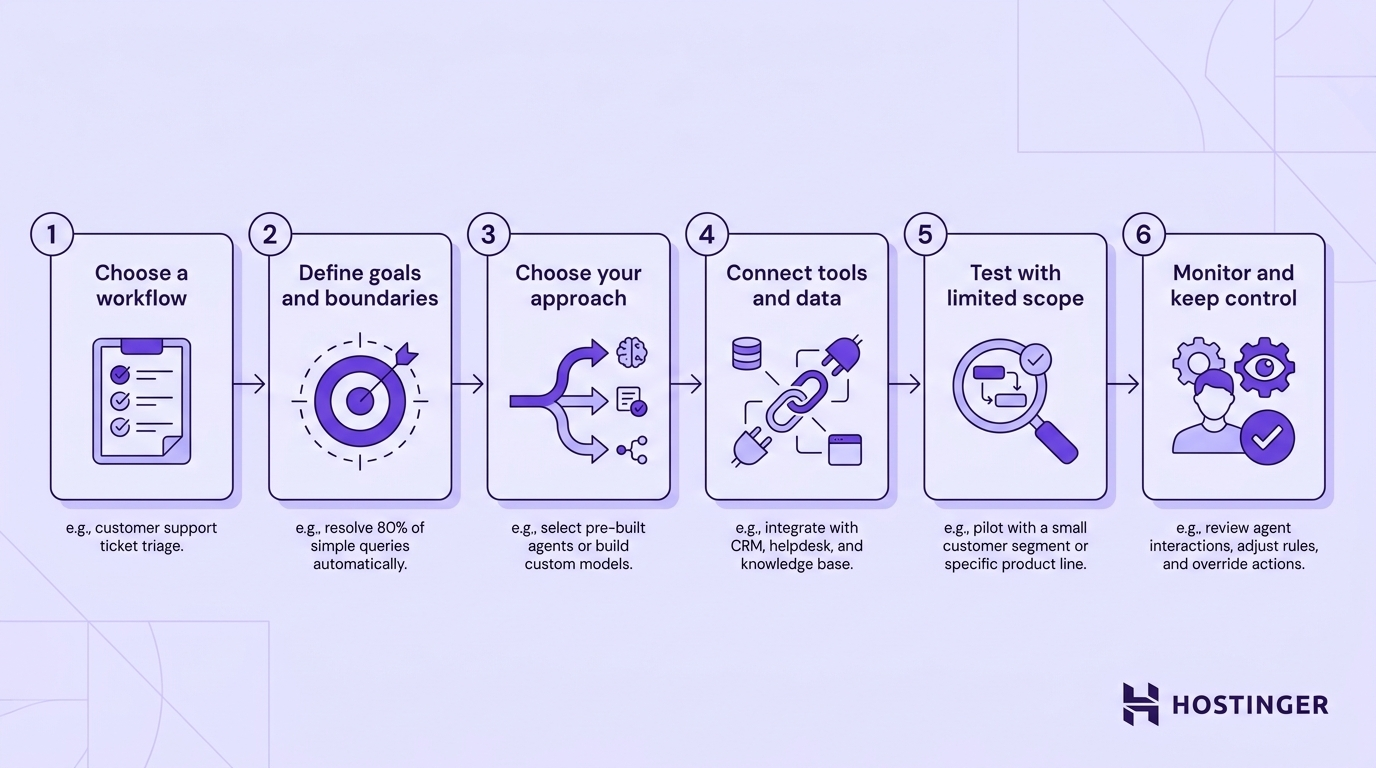
If you want to put these steps into practice, Hostinger Agentic AI provides several approaches depending on how much control and customization you need.
You can use Hostinger Agent for everyday business tasks such as responding to customers, following up on leads, creating content, and improving SEO.
If you want your own private AI agent, you can run OpenClaw or Hermes Agent on Hostinger without managing the underlying server yourself.
Whichever approach you choose, keep the same controls in place as you expand your agent’s capabilities. Grant access only to the systems it needs, review its permissions regularly, and require approval for important or irreversible actions.
Agentic AI trends and statistics
Agentic AI is growing quickly, but adoption is moving faster than production readiness. Current data show strong market growth and enterprise interest, alongside persistent challenges in deployment, governance, and risk.
A few agentic AI statistics for 2026 illustrate the trend:
- The global agentic AI market is projected to grow from $9.14 billion in 2026 to $139.19 billion by 2034, representing a 40.5% compound annual growth rate.
- 40% of enterprise applications are expected to include task-specific AI agents by the end of 2026, up from less than 5% in 2025.
- Only 23% of organizations report having scaled an agentic AI system into production, while another 39% are still experimenting.
- 82% of organizations already use AI agents, but only 44% have security policies in place to govern them.
These figures show that agentic AI is moving from experimentation toward wider enterprise use, but successful deployment still depends on strong governance, security controls, data readiness, and clear business value.
All of the tutorial content on this website is subject to Hostinger's rigorous editorial standards and values.

Ksenija is a digital marketing enthusiast with extensive expertise in content creation and website optimization. Specializing in WordPress, she enjoys writing about the platform’s nuances, from design to functionality, and sharing her insights with others. When she’s not perfecting her trade, you’ll find her on the local basketball court or at home enjoying a crime story. Follow her on LinkedIn.

Aris is a Content Writer specializing in Linux and WordPress development. He has a passion for networking, front-end web development, and server administration. By combining his IT and writing experience, Aris creates content that helps people easily understand complex technical topics to start their online journey. Follow him on LinkedIn.