How to start a fitness blog in 9 steps
Sep 22, 2026
/
By Ksenija & Miglė C.
/
14 min Read
To start a fitness blog, choose a focused niche, be clear about the topics you’re qualified to cover, set up the site, plan and publish useful fitness content, and build an audience around it.
Readers may use that content to guide their workouts and training decisions, so fitness blogging comes with an added responsibility to provide information they can understand and use safely.
That means drawing on relevant expertise and first-hand experience, supporting health-related claims with reliable sources, and making it clear when you’re sharing personal experience rather than professional or medical advice.
Workout content also needs practical clarity, with instructions that readers can follow correctly and original photos or videos that demonstrate the movement.
From there, choose the right platform, set up your blog, and plan a sustainable content strategy. Then, focus on creating trustworthy fitness posts, improving search visibility, promoting your blog, and introducing monetization as your audience grows.
1. Choose your fitness blog niche
Choose a fitness niche that matches what you know, serves a specific audience, and gives you enough relevant topics to cover over time.
This provides clearer direction for your blog and makes it easier to decide what content belongs there.
To narrow down your niche, answer four questions:
- What area of fitness will you cover? Focus on an area you know well and can create useful content about, such as strength training, running, calisthenics, mobility, or yoga.
- Who are you trying to help? Define your audience more precisely than people interested in fitness. You might focus on busy professionals who exercise at home, older adults working on mobility, or people training for their first marathon.
- What goals or problems will your content address? Identify what your audience wants to achieve, such as learning strength-training fundamentals, progressing from shorter runs to a marathon, or building an effective home workout routine.
- Can the niche support enough useful content? Think beyond your first few article ideas. A sustainable niche should give you room to answer different questions, cover related topics, and continue publishing without drifting away from your main focus.
Combining these elements can turn a broad subject into a more focused niche. Strength training, for example, could become strength training for beginners, while home workouts could focus specifically on home workouts for busy professionals.
Other options include calisthenics, mobility training, fitness for older adults, beginner yoga, or running for first-time marathoners.
Before committing to a niche, look at existing fitness blogs and the questions your intended audience is asking.
This type of research is useful when starting a blog because it can help you confirm there is enough interest in the topic and identify areas where your experience or approach can offer something useful.
Keep the scope centered on fitness if exercise and training are your main subjects. If you want to regularly cover nutrition, sleep, general health, and other areas of wellness alongside exercise, a broader health blog may be a better fit.
Pro tip
Use tools like Google Trends, Reddit communities (e.g., r/fitness or r/running), and the "People also ask" section in Google Search to see which fitness topics people search for and discuss. These sources can reveal recurring questions and content gaps, but treat them as interest signals rather than proof that a niche will attract a sustainable audience.
2. Establish your expertise and content boundaries
Start by identifying the basis of your expertise. This might include personal training or coaching certifications, formal education, experience in a particular sport, or years spent practicing a specific training method.
Be clear about these credentials or experiences on your author profile and where they are relevant to the content.
Then, distinguish between the types of information you publish:
- Personal experience. Describe what you tried and what you observed without assuming others will get the same results. You might share how your running pace changed while following a particular training plan.
- Professional recommendations. Give recommendations based on your relevant professional training or qualifications. If you’re a certified personal trainer, for instance, you could explain how beginners can structure a strength-training routine.
- Scientific or medical claims. Support statements about health, performance, or physical effects with reliable, current sources, such as research on how resistance training affects bone density.
Avoid diagnosing conditions or recommending treatments when you aren’t qualified to do so. For content that goes beyond your expertise, involve an appropriately qualified professional.
Avoid diagnosing conditions or recommending individualized treatment unless you are appropriately qualified. Unqualified medical guidance can mislead readers or create safety risks, so refer readers to a licensed professional when a question goes beyond your expertise.
Finally, tell readers who created or reviewed the content and what relevant qualifications they have.
Use disclaimers when needed to clarify that general fitness information isn’t individualized medical advice, and disclose commercial relationships when products, brands, or services are involved.
3. Choose a blogging platform
Choose a blogging platform based on how much control you want and how comfortable you are managing your site.
A website builder is a better fit if you want a simpler setup with hosting, design tools, and site management in one place. WordPress gives you more control over your site’s design and functionality, but requires more hands-on management.
When comparing the two methods, consider ease of use, customization, blogging features, SEO tools, mobile responsiveness, and ongoing cost.
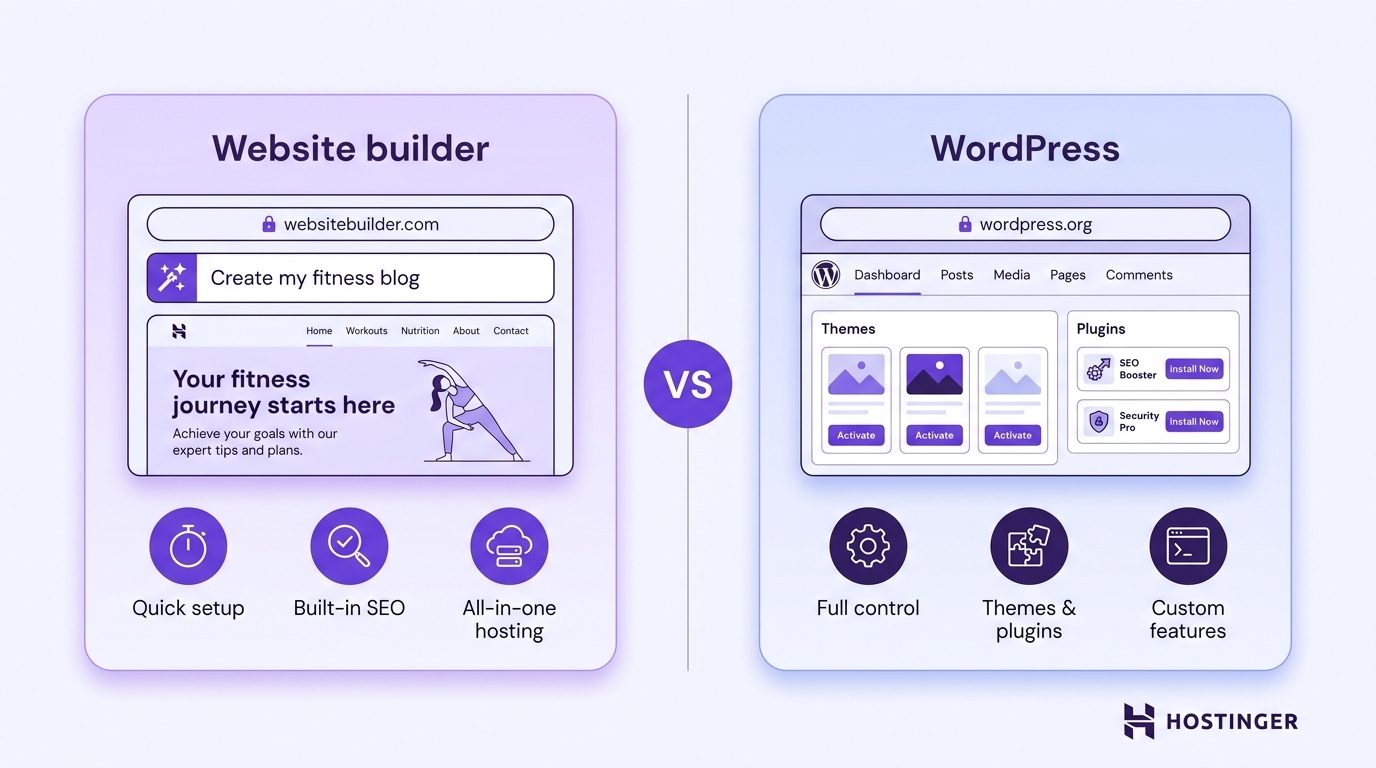
A website builder is a good fit if you want to get the blog online quickly and spend more time creating fitness content than managing the website itself.
With Hostinger AI Builder, you can create the first version of your fitness blog from a written prompt.
You can then adjust the layout, text, images, and functionality with AI or manual editing. Hosting, a custom domain, email, and built-in SEO tools are available in a single setup, reducing the number of separate services you need to configure before you can start publishing.
WordPress gives you more flexibility through its themes and plugins. This can be useful if you expect to customize your content structure or add specialized features as the blog grows, though you’ll have more decisions to make about setup and ongoing site management.
Browse some of the best blogging platforms for inspiration, then compare the options that fit the type of fitness blog you want to build.
4. Set up your fitness blog
Set up your fitness blog by choosing a name and domain, connecting your hosting or platform, creating the essential pages, and preparing the site for visitors.
Your blog name should be easy to remember and spell, and give readers some idea of your brand or fitness focus. Names like Beginner Strength Lab, The Home Workout Club, or First 5K Fitness immediately suggest what kind of content readers can expect.
Once you’ve settled on a name, look for a domain that closely matches it and is easy to type, pronounce, and share.
Keep it short where possible, avoid unnecessary numbers or hyphens, and check that it can’t easily be confused with an existing fitness brand.
Pro tip
Before committing to a domain name, search your country’s trademark database (such as USPTO in the US or EUIPO in the EU) for potentially conflicting marks in related fitness or wellness services. Treat this as an initial screen rather than legal clearance: a database search alone cannot confirm that a name is safe to use or register.
There are a few other factors to consider when choosing the right domain name, including the domain extension, availability, and how well the name will work as your blog grows.
.com is the most familiar option, but a fitness blog can also use an extension that fits its purpose.
Hostinger offers the .blog domain extension, for instance, which can be a good alternative when the .com version of your preferred name isn’t available.
Next, connect your domain and get the site online. If you’re using Hostinger AI Builder, hosting and a custom domain are available within the same setup.
With WordPress, you’ll need to choose a web hosting plan separately, so consider factors like performance, storage, security features, support, and the resources you’ll need for images and videos.
Keep your initial design simple and make the fitness content easy to use. Clear navigation should help readers move between related workouts and guides, while readable text and enough space for images or videos can make exercise instructions easier to follow.
Check these elements on mobile as well, particularly if readers are likely to view workouts on their phones while exercising.
Before publishing, create the pages that explain who is behind the blog and provide important information to readers:
- About – introduce yourself, your fitness focus, and what readers can expect from the blog.
- Contact – provide a way for readers, potential collaborators, and brands to reach you.
- Author or profile – show the experience, qualifications, and credentials relevant to the fitness topics you cover.
- Privacy policy – explain how the site collects and uses visitor data.
- Affiliate or sponsorship disclosure – disclose affiliate links, sponsorships, or gifted products when applicable.
- Fitness or health disclaimer – clarify the limits of your fitness content and that it isn’t individualized medical advice where appropriate.
Finally, enable basic analytics before launch so you can measure performance from the beginning.
You don’t need to analyze everything immediately, but having the data available will help you identify which content attracts and retains readers as you grow the blog.
5. Plan your fitness blog content
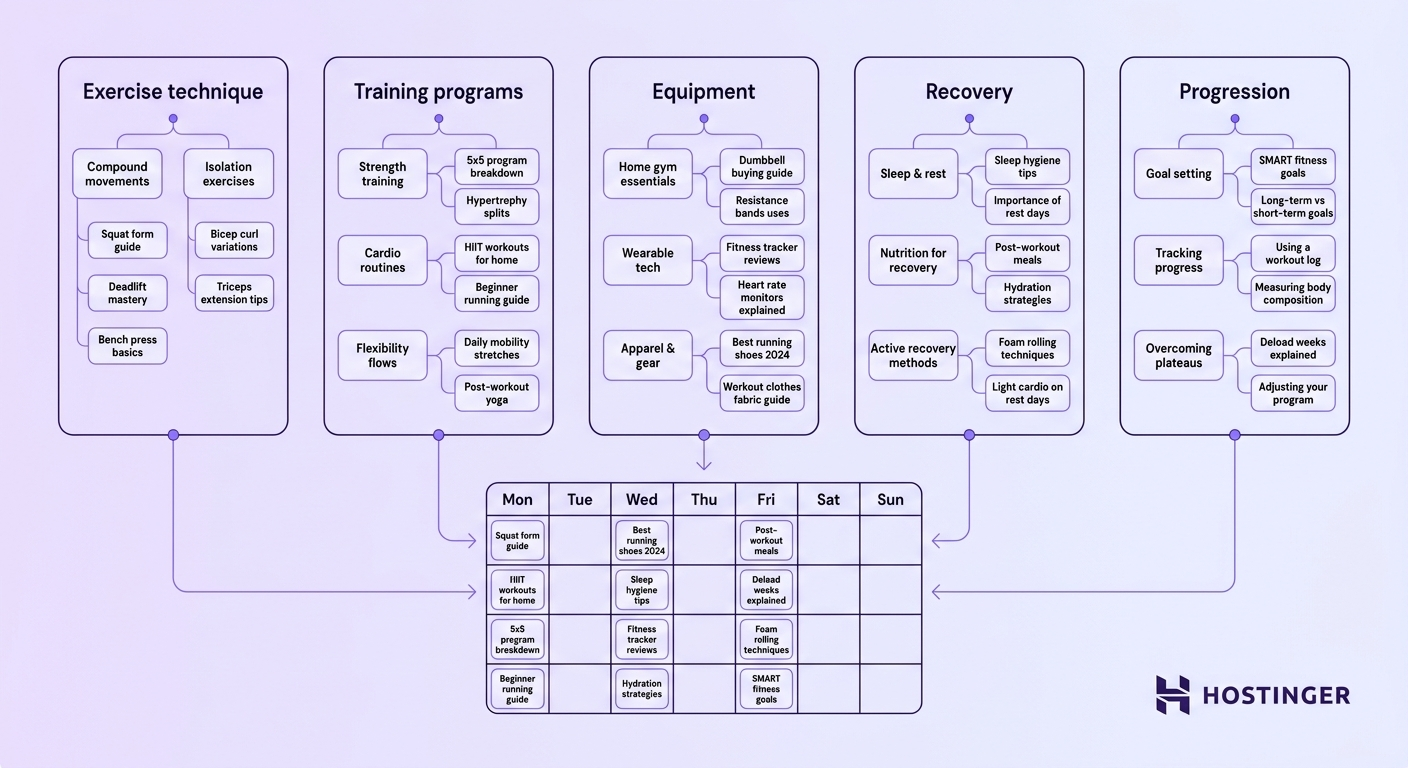
Start with three to five content pillars that are broad enough to support multiple related articles.
For a beginner strength-training blog, your pillars could include exercise technique, beginner training programs, equipment, recovery, and progression.
You can then build related articles around each one. An exercise technique pillar, for instance, might cover squat form, common deadlift mistakes, push-up variations, and how to perform a bench press safely.
Research the questions your audience asks about each pillar and use them to plan your first articles.
Search results, fitness communities, social media discussions, and questions from clients or training partners can reveal where beginners need more guidance. Prioritize questions that fit both your niche and the expertise boundaries you established.
Group related articles into content clusters so readers can explore a subject in more depth. If you cover running, you might create a beginner 5K training guide supported by articles on choosing a running pace, structuring weekly runs, warming up, and preparing for race day.
This gives you a more coherent content plan than publishing unrelated fitness topics whenever an idea comes up.
Balance evergreen topics with relevant developments in your niche. Exercise tutorials, beginner guides, and training fundamentals can remain useful for a long time, while new equipment, training methods, or fitness trends can give you timely subjects to cover.
Only pursue trends that fit your blog’s focus and that you have enough knowledge or reliable sources to cover responsibly.
Finally, turn your ideas into a realistic content calendar that records what you plan to publish and when.
Choose a publishing frequency you can maintain while leaving enough time to research claims, create workout demonstrations, and review fitness content for accuracy.
6. Create trustworthy fitness content
Base your fitness content on reliable sources, explain exercises and techniques clearly, and include the details readers need to follow your advice safely.
Support health or performance claims with credible evidence, distinguish general fitness guidance from medical advice, and avoid promising results you can’t guarantee.
Common fitness blog content formats include:
- Exercise tutorials – demonstrate how to perform individual movements correctly.
- Workout routines – combine exercises into sessions that readers can follow.
- Training plans – organize workouts over several weeks around a specific goal.
- Equipment reviews – share first-hand testing and help readers evaluate fitness products.
- Sport-specific guides – cover techniques, preparation, or training for a particular activity.
- Progress logs and first-hand experiments – document your own training process, observations, and results.
- Expert interviews – bring in qualified professionals to provide insight on topics within their expertise.
Match the format to the topic you’re covering. If you’re creating an exercise tutorial, use step-by-step instructions and consider adding a video demonstration to make the movement easier to follow.
For an equipment review, include original photos, explain how you tested the product, and share observations from actually using it.
Be equally clear about where the information comes from. Share personal results as your own experience, base professional recommendations on relevant qualifications, and support scientific or health-related claims with reliable, current sources.
If you’re explaining how a training method affected your own performance, include details such as how long you followed it and what you observed without presenting your results as something every reader should expect.
Workout instructions should give readers enough information to perform the exercises correctly. Explain the movement, the equipment needed, the sets, and the repetitions where relevant.
Original photos or videos can make movements easier to understand when written instructions alone aren’t enough.
You can use AI to help brainstorm, organize, or draft content, but don’t publish AI-generated fitness advice without reviewing it for accuracy and context.
AI tools can generate plausible-sounding fitness advice that contains factual errors, outdated guidance, or unsafe exercise recommendations. Review AI-assisted fitness content for accuracy, context, and safety before publishing, and involve an appropriately qualified professional when the topic goes beyond your expertise.
7. Optimize your fitness blog for search
Start with keyword research to find the fitness topics and questions people search for. Use tools like Google Keyword Planner or Ahrefs to identify relevant search terms, then check the top-ranking results to understand what information searchers expect to find.
Someone searching for “beginner dumbbell workout”, for instance, likely wants a routine they can follow, so the page should provide the exercises, equipment needed, sets, reps, and clear instructions for each movement.
From there, apply blog SEO strategies to help search engines understand the page and its relationship to the rest of your fitness content.
Use descriptive titles and headings that reflect the topics you cover, and write meta titles and descriptions that accurately represent the page in search results.
Connect related posts with internal links so readers can move naturally from a broader guide to more specific workouts or exercise tutorials. These connections also help search engines discover your pages and understand how your fitness topics relate to one another.
Compress large files to keep pages loading quickly, use descriptive file names, and add relevant alt text to images.
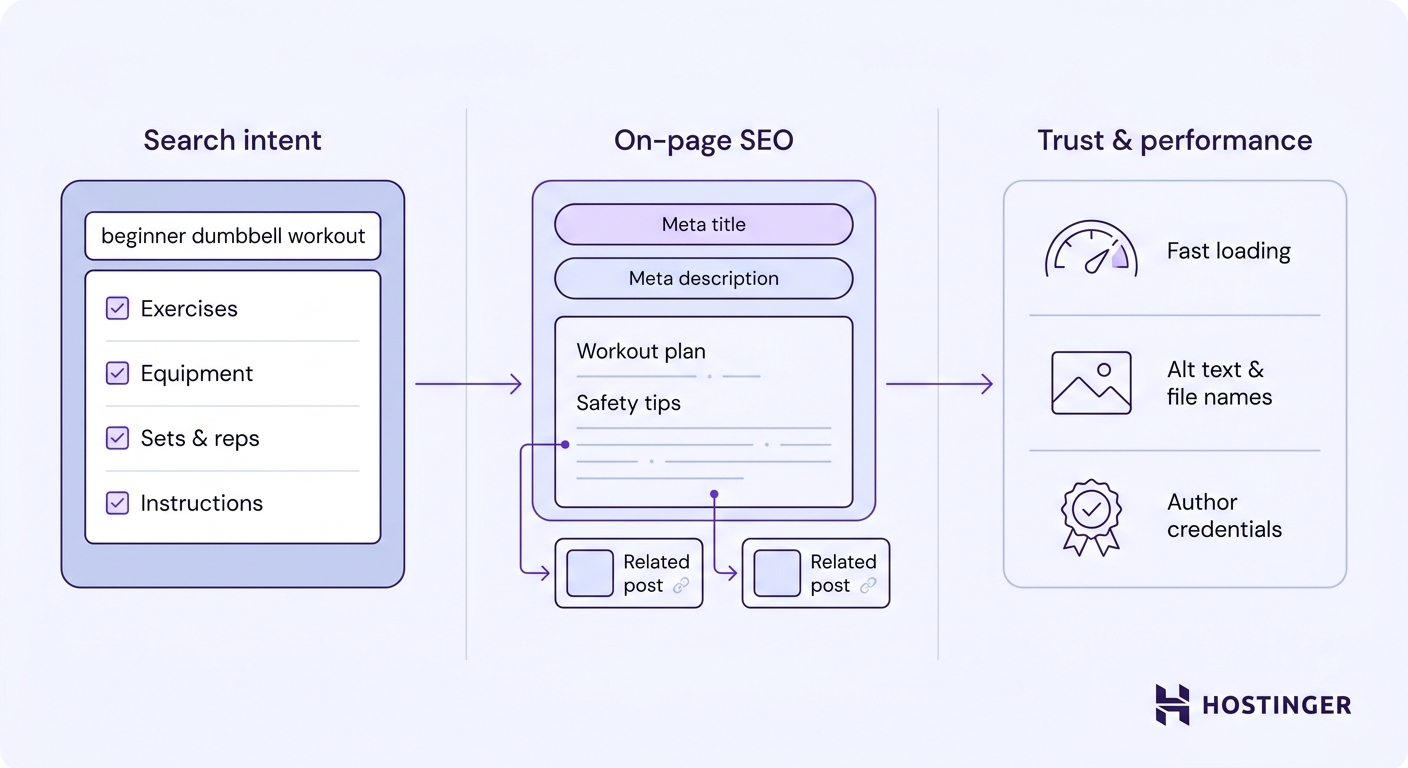
Accompany exercise demonstrations with written instructions as well, giving readers another way to understand the movement while making the information available as crawlable text.
As your content starts appearing in search, keep it useful and trustworthy. Make your relevant experience and credentials easy to find, cite reliable, up-to-date sources for health-related claims, and revisit older posts when research, fitness recommendations, or product information changes.
8. Promote your fitness blog
Promote your fitness blog by turning each new post into several opportunities to reach the people it was written for.
You don’t need to be active everywhere. Start with one or two channels your target audience uses, publish consistently, and direct interested people back to relevant content on your blog.
Here are practical ways to build your audience:
- Repurpose blog posts for social media. Pull one useful idea from a post and adapt it to the platform. Turn an exercise tutorial into a short demonstration video, a five-exercise workout into a carousel, or a marathon training guide into a series of weekly tips. Include a link to the full post when readers would benefit from the complete instructions or context.
- Collaborate with people in your niche. Contact trainers, athletes, coaches, or fitness creators whose expertise overlaps with your content. You could interview a running coach for a marathon guide, ask a trainer to demonstrate an exercise, contribute to each other’s content, or create a joint Q&A.
- Participate in fitness communities. Find groups, forums, and online communities built around your niche and answer questions you genuinely know how to help with. If someone asks how to prepare for their first 5K and you’ve published a detailed beginner plan, answer the question directly and share the article when it provides useful additional guidance.
- Build an email list from the beginning. Add a signup form to prominent areas of your blog and give readers a clear reason to subscribe. A strength-training blog might offer a four-week beginner plan, while a running blog could provide a race-day checklist. Then email subscribers when you publish content relevant to what they signed up for.
- Give readers reasons to participate. Ask for questions at the end of posts, respond to comments and emails, run Q&As, or create a training challenge readers can follow. Their questions can also show you what they need help with and give you ideas for future posts.
Dropping links in communities without contributing first can get you flagged as spam or banned. Always lead with a genuine, helpful answer. Share your article only when it directly adds value to the specific question being asked.
You can use Hostinger Reach, an email marketing platform, to implement the email component of this strategy.
Create a subscription form and add it to your blog, then use Reach to collect contacts and send newsletters, welcome emails, or automated sequences.
Reach’s AI tools can generate a complete email draft with copy, layout, and a subject line, while campaign and automation reports track opens, clicks, click-to-open rate, bounces, unsubscribes, and recipient-level activity.
As you experiment with these channels, try different blog promotion strategies and concentrate your effort on the ones that consistently reach the audience your fitness content is intended for.
9. Monetize your fitness blog
To monetize your fitness blog, start with one or two income streams that fit your niche and the type of value you already provide, then expand as you learn what your readers are willing to pay for.
Here are practical ways to make money blogging in the fitness niche:
- Affiliate marketing. Recommend products you have genuinely used or can evaluate properly, such as resistance bands, running shoes, fitness trackers, or home gym equipment. Add affiliate links to relevant reviews, comparisons, and training guides, and disclose that you may earn a commission if someone purchases through them.
- Sponsored content. Partner with fitness brands to create paid reviews, tutorials, or other content when their products are relevant to your audience. Agree on the scope and compensation beforehand, clearly label sponsored content, and keep your assessment independent even when you’re being paid.
- Digital products. Package useful resources into products that readers can buy and use independently. Depending on your expertise, this could include training guides, workout trackers, exercise libraries, or printable planning templates.
- Memberships and premium content. Offer paying members additional resources, such as an exercise library, members-only articles, training templates, or regular Q&A sessions. This model makes more sense once you have returning readers who already find your free content useful.
- Coaching or other services. If you have the appropriate qualifications, use your blog to attract clients for personal training, coaching, consultations, or related services. Create a dedicated service page that explains who the service is for, what it includes, how much it costs, and how someone can book or contact you.
- Display advertising. Add ad placements to high-traffic articles to earn revenue when readers view or interact with them. Start with a small number of placements that don’t interrupt workout instructions or make the page difficult to navigate, especially on mobile. As your traffic grows, compare revenue across different pages and placements to see where ads perform well without hurting the reading experience.
- Physical products. If you have an established brand or community, you could sell branded merchandise or fitness pr oducts that are relevant to your audience. Make sure the additional work involved in sourcing, fulfillment, and customer service makes sense for the demand you have.
Whatever you monetize, clearly disclose affiliate links, sponsorships, gifted products, and other commercial relationships.
Apply the same standards for evidence and accuracy to paid content that you use elsewhere on your blog, especially when discussing products or services that could affect a reader’s health or training decisions.
Disclosure rules vary by country. In the US, the FTC says that material connections, such as payment, free products, or discounts, should be disclosed clearly and conspicuously. In the UK, CAP/ASA guidance expects influencer ads to be obviously identifiable and generally recommends a prominent upfront “Ad” label; vague labels such as “gifted” or “in partnership with” may not be clear enough. Check the rules that apply where you publish and where your audience is located.
Tips for growing a successful fitness blog
Grow your fitness blog by looking at what brings readers back, improving successful topics, and using what you learn from your audience to decide what to publish next.
As your blog gains traction, use these practical strategies to keep that growth going:
- Update older fitness content. Revisit posts that continue to attract readers and check that workout instructions, sources, product recommendations, images, and links are still accurate. If you published a home gym guide two years ago, for example, replace discontinued equipment and update recommendations based on what you’ve tested since.
- Turn successful topics into recurring series. When readers respond well to a subject, give them a reason to return for the next installment. If you write about running, you could guide readers through their first 5K to 10K training. If you focus on mobility, you could publish a monthly routine that targets a different movement or body area.
- Add more first-hand experience as you gain it. Document workouts you’ve completed, equipment you’ve tested, events you’ve trained for, or techniques you’ve practiced. Include original photos, videos, testing notes, and observations where they help readers understand what you did and what you learned.
- Pay attention to returning readers, not only traffic. Track which posts bring people back, generate email signups, receive comments, or lead to product and service conversions. Even if one of your posts gets fewer visits, pay attention to whether those readers subscribe to your email list or continue to other articles.
- Use reader questions to plan new content. Keep a running list of questions from comments, emails, social media, and fitness communities. If several readers ask how to modify one of your workouts for limited equipment, that can become a new article or an update to the original post.
- Develop your fitness expertise. Keep building your knowledge as your blog grows by taking courses, gaining hands-on experience, or earning relevant certifications. If you want to expand into areas such as injury rehabilitation, working with specific populations, or specialized nutrition, pursue appropriate training or qualifications before giving professional recommendations on those topics.
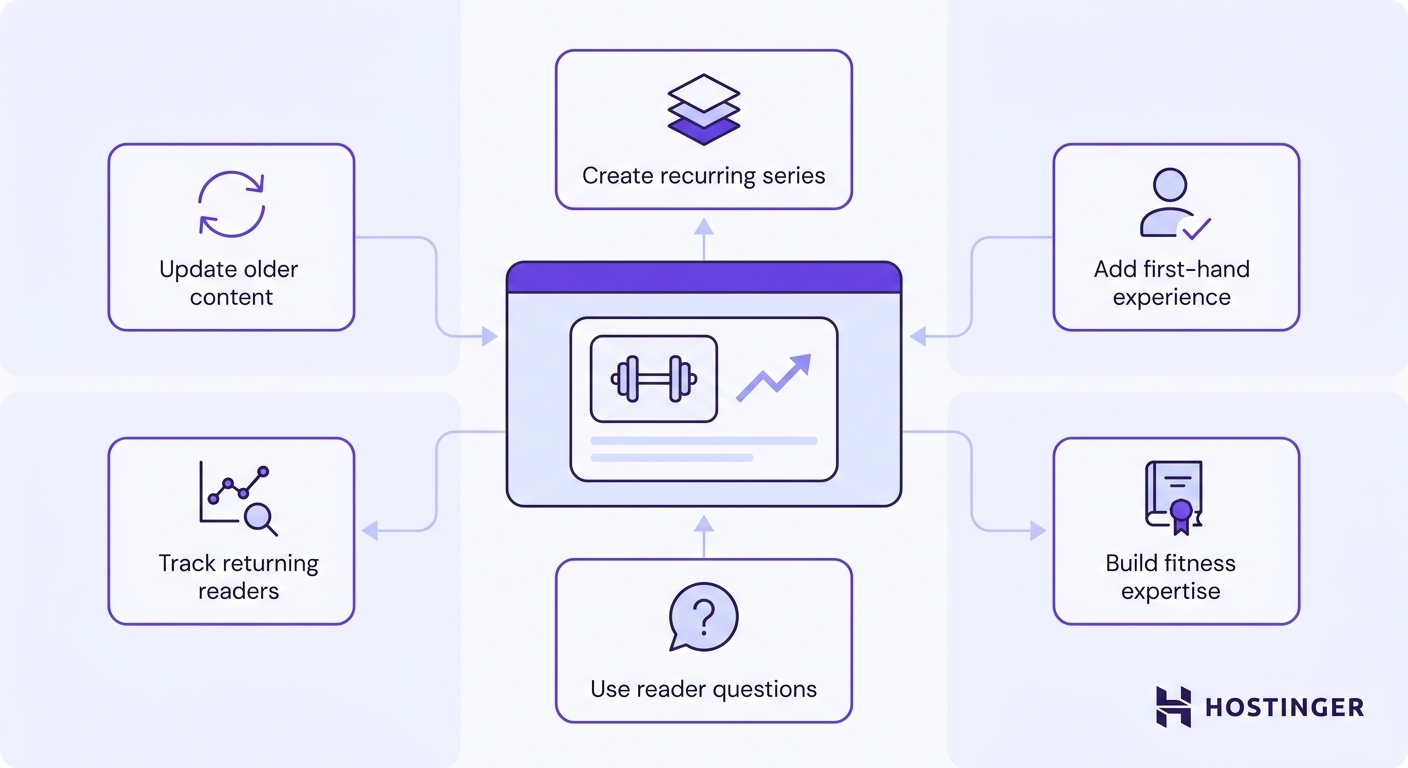
Review these areas regularly and use what you learn to decide where to invest your time. You don’t need to publish across more and more fitness topics to grow.
Strengthening the content that already works and creating useful follow-ups gives existing readers more reasons to return while gradually expanding the resources available to new ones.
What to focus on after launching your fitness blog
Once your fitness blog is live, focus on establishing trust and building a content system you can maintain, not publishing as many articles as possible.
As you grow:
- Monitor which fitness topics attract your intended audience and bring readers back.
- Expand successful topic clusters with related workouts, tutorials, and guides.
- Update older posts when research, recommendations, products, or your own knowledge changes.
- Use recurring reader questions to decide what to cover next.
- Build your email list and community alongside your search presence.
- Introduce monetization gradually as demand grows, without compromising the quality of your recommendations.
All of the tutorial content on this website is subject to Hostinger's rigorous editorial standards and values.

Ksenija is a digital marketing enthusiast with extensive expertise in content creation and website optimization. Specializing in WordPress, she enjoys writing about the platform’s nuances, from design to functionality, and sharing her insights with others. When she’s not perfecting her trade, you’ll find her on the local basketball court or at home enjoying a crime story. Follow her on LinkedIn.

Miglė Cicėnaitė-Jocė is a Product Manager for Hostinger's Website Builder. She is on a mission to redefine website creation, focusing on the AI flow and its features, and is always eager for product feedback and market insights to improve the user experience. Follow her on LinkedIn.