Ecommerce trends 2026: AI agents, payments, and shopper data
Sep 01, 2026
/
By Daniela C.
/
11 min Read
Ecommerce is being reshaped by a single force showing up in almost every trend: AI agents are becoming the first point of contact between shoppers and stores, not just another feature retailers add on. AI could drive up to $5 trillion in global retail spend by 2030, and traffic from AI sources to US retail sites already converts better than traffic from traditional search.
At the same time, a second gap keeps showing up in the data: a widening gap between what shoppers expect and what businesses actually deliver across payments, cross-border trust, delivery, and sustainability.
Top ecommerce trends for 2026
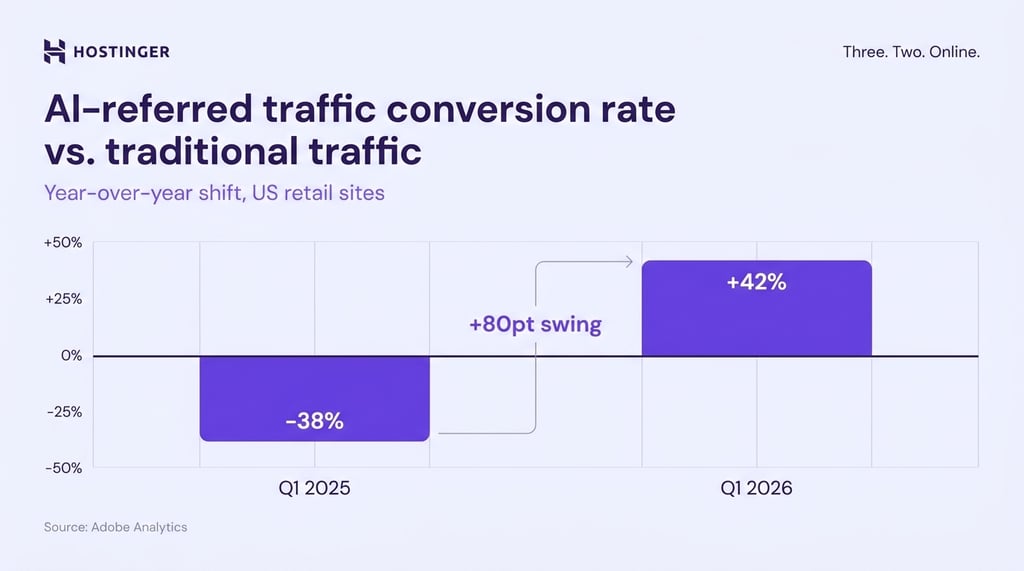
- AI agents are becoming a new front door for ecommerce. AI agents could influence or complete $3 trillion to $5 trillion in global retail spend by 2030, and AI-referred traffic to US retail sites is already converting 42% better than traditional channels.
- Global ecommerce revenue keeps climbing toward $8 trillion. Worldwide retail ecommerce is on pace for $6.88 trillion in 2026, growing to $7.89 trillion by 2028.
- Payment preferences are shifting faster than checkout can keep up. Digital wallets now account for 56% of global ecommerce transaction value, more than credit and debit cards combined.
- Cross-border shopping is accelerating faster than businesses can localize. International shopping is up ten percentage points year-over-year, yet a fifth of US, UK, and Canadian businesses still don’t localize their stores.
- Social commerce is set to cross $100 billion in the US for the first time. TikTok Shop leads the way, which is projected to hit $23.41 billion in US sales in 2026 alone.
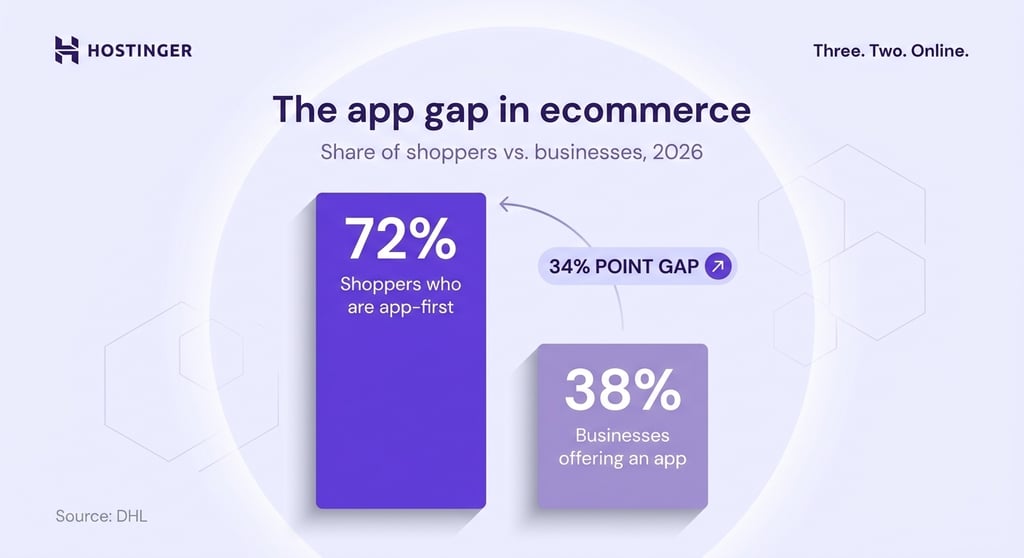
- The gap between what shoppers want and what businesses offer is widening. 72% of shoppers are app-first, but only 38% of businesses offer their own app to browse and buy from.
- Free delivery has overtaken fast delivery as the top purchase driver. Shoppers increasingly say they’d rather wait a few extra days than pay for shipping.
- Delivery and returns subscriptions are becoming a standard offer, not a perk. 40% of shoppers already pay a premium for one, and 53% of businesses now offer it.
- Sustainability expectations are outpacing what most stores deliver. Shoppers are willing to pay 9.7% more for sustainably sourced goods, but over a third have abandoned a cart over missing sustainability credentials.
- Retail media is becoming a core revenue line, not an experiment. US retail media ad spend is forecast to reach $71.09 billion, with Amazon and Walmart capturing most of the growth.
AI agents are becoming a new front door for ecommerce
Shopping is starting to happen inside AI conversations instead of on a retailer’s own site, and that shift is moving from “coming soon” to “already changing where sales happen.” An AI agent might compare prices across five retailers, apply loyalty benefits, and complete checkout, all without the shopper ever opening a traditional search bar.
In the US, that could mean $300 billion to $500 billion in agentic commerce spend by 2030, or 15 to 25% of all US online retail.
That shift is already visible in the traffic numbers:
- AI-referred traffic to US retail sites grew 393% year over year in Q1 2026. By March it converted 42% better than traditional traffic, a full reversal from 38% worse a year earlier (Adobe Analytics).
- AI agents influenced 20% of global online sales during the 2025 holiday season, worth $262 billion., Salesforce forecasts that AI chat agents will account for the same 20% share of holiday ecommerce traffic in 2026 (Salesforce).
- AI-referred traffic now converts eight times more often than traffic from social media. Retailers that deployed their own shopper agents grew sales 59% faster than those that didn’t (Salesforce).
- 60% of Gen Z shoppers regularly use AI overviews in search, compared with 29% of baby boomers. AI is reshaping the earliest stage of the shopping journey, before a purchase decision even starts (McKinsey).
Much of that spend traces back to personalization. Product recommendations alone can drive up to 31% of revenue when shoppers engage with them, a return that’s pushing AI tools into product discovery, fraud detection, and dynamic pricing.
Brands are also having to rethink where they show up. When large language models answer shopping questions, McKinsey finds that brand-owned websites drive just one to two percent of the sources cited, and even among the ten most-cited sources overall, brand sites make up only three to 10%.
Expert tip
AI agents are forcing every retailer to answer a harder question than “how do I rank on Google.” Now it’s “how do I get recommended by an AI that’s never seen my store.” Structured product data and genuine third-party reviews matter more than ever, because that’s what these models actually read.

Tomas Rasymas
Head of AI at Hostinger
What this means for sellers: visibility is shifting away from search rankings and toward whichever retailers, review sites, and product data an AI agent already trusts. Keeping product information structured and machine-readable, through tools like Hostinger’s agentic AI, matters more now than optimizing for a search results page that an agent may never show a human.
Global ecommerce revenue keeps climbing toward $8 trillion
Ecommerce growth is compounding rather than slowing after its post-pandemic normalization. According to EMARKETER, worldwide retail ecommerce sales are forecast to reach $6.88 trillion in 2026, up 7.2% from $6.42 trillion the year before, and 21.1% of all retail sales globally. That climb continues: $7.375 trillion by 2027, then $7.886 trillion by 2028, when online sales are expected to make up 22.5% of all retail spending worldwide.
The growth is also shifting geographically. The US, UK, and Western Europe remain the largest ecommerce markets by value, but they’re no longer where the fastest growth is happening. Asia-Pacific’s overall retail market is holding at a steady 4.9% growth in 2026, with China’s ecommerce penetration nearing 50% of all retail sales and regional livestream commerce expected to top $1 trillion for the first time, with India and Southeast Asia named as the next wave of growth.
For a broader look at where global ecommerce revenue is headed, Hostinger’s ecommerce statistics puts the market on pace to reach $4.91 trillion by 2030, growing at a 6.20% annual rate. The lower figure reflects a narrower market definition than EMARKETER’s, not a conflicting forecast.
What this means for sellers: the biggest markets are maturing, while the sharpest growth is now in regions where mobile-first design and payment localization matter most. Businesses that still treat international expansion as a US/UK/EU-first decision missing the fastest-growing demand.
Payments and checkout are where trust gets tested
Digital wallets have overtaken cards as the primary way people pay online, and the shift is accelerating. Digital wallets now account for 56% of global ecommerce transaction value, compared to 31% for cards. Buy now, pay later (BNPL) has grown 130-fold since 2014, from $2.3 billion in transaction value that year to an estimated $300 billion in 2025, and is on pace to reach $500 billion by 2030, per the same report.
That expanding menu of payment options is colliding with a checkout experience that hasn’t caught up:
- 62% of shoppers say they’ll abandon a purchase if their preferred payment method isn’t offered. Just 45% of businesses see this as a driver of lost sales (DHL).
- The average documented cart abandonment rate sits at 70.22% across 50 published studies. The two most common causes, unexpected costs and forced account creation, are both fixable (Baymard Institute).
That gap between what shoppers expect at checkout and what businesses credit as the problem shows up directly in the numbers above: shoppers are walking away over a missing payment method or a surprise cost. Businesses are consistently underestimating how much that costs them.
What this means for sellers: offering more payment methods matters less than removing the one that’s actually costing you sales. A checkout built for conversion starts with knowing exactly where shoppers drop off, and for many stores, accepting the payment method customers already expect fixes more than a full redesign would.
Platforms like Hostinger Ecommerce, which support 100+ payment methods at no added transaction fee, remove that specific point of friction without requiring a bigger platform migration.
Cross-border shopping is outpacing business localization
International shopping is growing faster than most retailers can adapt. According to DHL, shoppers who buy from another country climbed ten percentage points year-over-year, now sitting at 70%, and nearly half of them do it more than once a month, a habit rather than an occasional splurge. Over three in ten orders placed with online retailers are now shipped internationally.
What pulls shoppers across borders, and what holds them back, comes down to a short, consistent list:
- 60% buy internationally for lower prices. 44% because the product isn’t available in their own country.
- 45% avoid buying internationally over high delivery costs or long delivery times. An identical 45% cite fear of fraud or lack of trust in the seller.
Many businesses haven’t closed that trust gap, even where they already have customers. 22% of Canadian, 21% of US, and 18% of UK B2C businesses still don’t offer their store in local languages or currencies for international shoppers.
What this means for sellers: shoppers are already looking abroad for better prices and products that don’t exist locally, so the barrier to cross-border sales usually comes down to trust and friction at checkout. A store that shows local currency, accepts familiar payment methods, and sets clear delivery expectations upfront closes more of that gap than one that simply ships internationally and hopes for the best.
Social commerce is set to cross $100 billion in the US
US social commerce is entering a different scale of the market entirely. Sales are projected to surpass $100 billion for the first time in 2026, an 18% jump from the year before. TikTok Shop alone is expected to generate $23.41 billion in US sales, a 48% year-over-year increase.
That growth is happening despite a real trust problem that businesses haven’t caught up to. According to DHL, 63% of businesses now sell on social platforms, but only 45% of shoppers actually buy through them. Businesses are chasing reach on channels that shoppers still hesitate to trust with a purchase.
It’s a gap that shows up clearly in what actually drives a sale on social media: shoppers consistently say reviews, user content, and honest opinions carry more weight than paid promotion, even as brands keep investing in ads and influencer partnerships. According to Hostinger’s social commerce statistics, 82% of consumers already use social media to research products before buying, meaning discovery has usually already happened by the time a paid ad appears.
Live commerce is still growing in the US. The number of consumers using it is projected to climb from around 49 million in 2025 to more than 60 million within three years.
Globally, the live commerce market is set to grow from $172.9 billion in 2025 to $230.3 billion in 2026, with Asia-Pacific driving two-thirds of that volume.
What this means for sellers: treating social platforms as an ad channel first misses where the actual conversions come from. Investing in genuine customer content, reviews, and live product demonstrations closes the trust gap faster than a bigger ad budget does, especially on channels where shoppers are still deciding whether to buy at all.
Omnichannel expectations are outpacing what businesses actually offer
Shoppers have decided how they want to browse and buy, and most businesses haven’t kept up. 72% of shoppers say they’re app-first, meaning they shop mainly through a retailer’s own app or a marketplace app, but only 38% of businesses actually offer one – a gap DHL calls “the app gap”. Businesses sell across an average of three platforms already, own website, social media, and marketplaces being the most common. That spread still misses the channel shoppers name first.
Marketplaces are the one channel where expectations line up on both sides, and that alignment is already showing up in the numbers:
- 82% of shoppers expect to use marketplaces the same amount or more over the next five years. 90% of businesses anticipate the same growth or stability (DHL).
- US buy online, pick up in-store (BOPIS) sales are projected to hit $177.9 billion in 2026. That’s up 15.3% year-over-year and climbing to $291.9 billion by 2030 (Capital One Shopping).
- 85% of BOPIS shoppers buy something extra at pickup. Collection isn’t just fulfillment – it puts shoppers back in the store (Capital One Shopping).
- 42% of consumers research online, then buy in person. The pattern peaks around Black Friday and Cyber Monday (Hostinger’s Black Friday Statistics).
Personalization is doing much of that work. Product recommendations alone can account for up to 31% of ecommerce revenue when shoppers engage with them. That’s part of why businesses keep investing in AI in ecommerce for product discovery, even as they lag on channels like apps.
What this means for sellers: mobile and app experience is the biggest gap. Marketplace strategy matters less right now, since most businesses already sell on them. A store that’s easy to browse and buy from on a phone closes more of the app gap than another sales channel does.
Free delivery has overtaken fast delivery as the top purchase driver
The two-day shipping era is giving way to a cheaper one. Free shipping is now the top factor in purchase decisions for 76% of US shoppers, up from 64% just two years ago, while fast shipping in two days or less has fallen to just 15%, down from 20% the year before. Shoppers have shifted from prioritizing speed to prioritizing cost.
Businesses are already adjusting around that shift:
- 88% of businesses say offering free delivery and returns improves sales. Free shipping remains the single biggest motivator for completing a purchase (DHL).
- 70% of shoppers won’t buy from a brand they don’t trust with delivery and returns. The same share will abandon a cart outright if their preferred delivery or returns option isn’t offered at checkout (DHL).
- Nearly 30% of shoppers now send deliveries to parcel lockers or pickup points. More than 60% of returns already happen outside the home (DHL).
What this means for sellers: charging for delivery, or missing the delivery and returns option a shopper expects, now loses more sales than slow shipping does. Out-of-home pickup and flexible returns are no longer extras – they’re what shoppers assume, especially as more returns happen away from the front door.
Delivery and returns subscriptions are becoming a standard offer, not a perk
Paying a membership fee for guaranteed delivery and returns is no longer a novelty. According to DHL’s report, 40% of shoppers globally now pay a premium for a delivery or returns subscription, rising to 48% of Gen Z and 50% of Millennials. Businesses are responding: 53% already offer one, with another 32% planning to introduce it. That’s 85% of the market, either there or on the way.
The harder part is keeping subscribers once they’ve signed up. 37% of shoppers have canceled a delivery or returns subscription, most often over cost. That rate climbs to roughly 50% in markets like the UAE and India – exactly where adoption is highest.
Product subscriptions show the same mismatch. 36% of shoppers want a product subscription from a retailer, but only 24% of businesses offer one. In Latin America the spread is widest: 39% of shoppers want subscriptions, while just 12% of businesses provide them.
What this means for sellers: retaining the subscriber matters more than launching the subscription. Win-back and renewal emails do real work here. According to Hostinger’s email marketing statistics, customer engagement emails already outperform every other email type businesses send, making them a natural fit for catching a subscriber before they cancel over cost, not after.
Tools like Hostinger Reach that automate that kind of targeted follow-up close more of that cancellation gap than a one-time discount does.
Expert tip
A discount after someone has already decided to cancel is usually too late, they’ve mentally moved on. It’s better to address cost concerns before renewal by showing what the subscriber has saved, reminding them of included benefits, or sharing new and upcoming additions to the subscription. Timing matters more than the size of the offer.

Miglė Padelytė
Product Manager for Reach at Hostinger
Sustainability expectations are outpacing what most stores deliver
Shoppers are willing to pay more for sustainable products, and businesses are behind in recognizing when that expectation is actually costing them a sale. Consumers say they’ll pay an average of 9.7% more for sustainably produced goods, and products marketed as sustainable now hold 25.4% of the US CPG market, up 1.6 percentage points in a single year and growing nearly five times faster than conventional products.
That demand is already showing up as lost sales when it isn’t met:
- 35% of shoppers have abandoned a purchase because a store lacked sustainability credentials. Only 32% of businesses recognize this as a reason carts get abandoned (DHL).
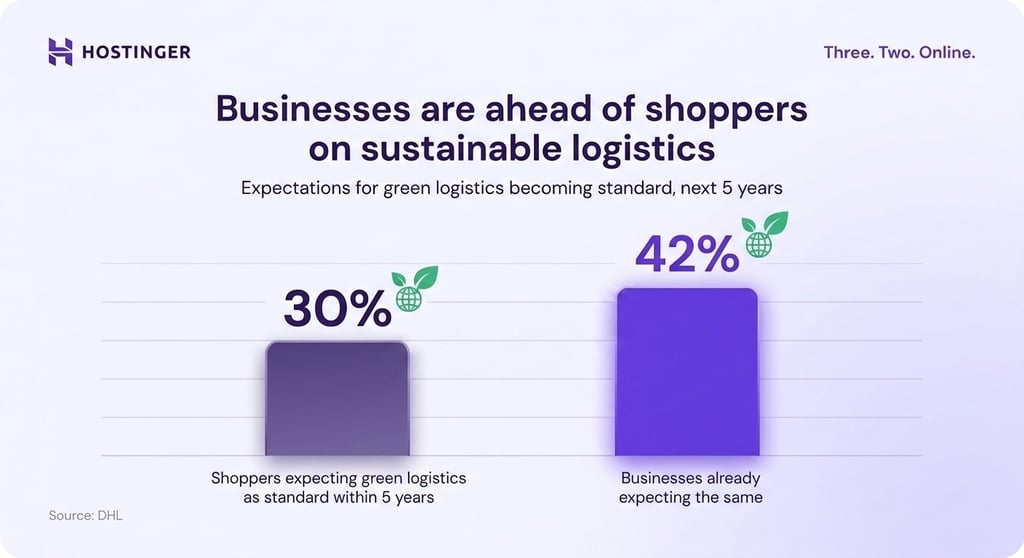
- 30% of shoppers expect green logistics to be standard within five years. 42% of businesses expect the same, putting them ahead of their customers on the timeline – though that lead isn’t yet visible enough to shift purchase behavior (DHL).
What this means for sellers: What this means for sellers: the gap isn’t ambition, it’s visibility. A sustainability commitment that isn’t stated clearly on the product page or at checkout doesn’t register as a reason to buy – and for some shoppers, it becomes a reason to leave.
Retail media is becoming a core revenue line, not an experiment
Retailers are no longer just selling products, they’re selling ad space on top of them, and that business is scaling fast. US retail media ad spend is forecast to reach $71.09 billion in 2026, up nearly 18% from $60.32 billion in 2025, and now represents roughly 30% of all US digital ad spending, up from just 15% in 2022.
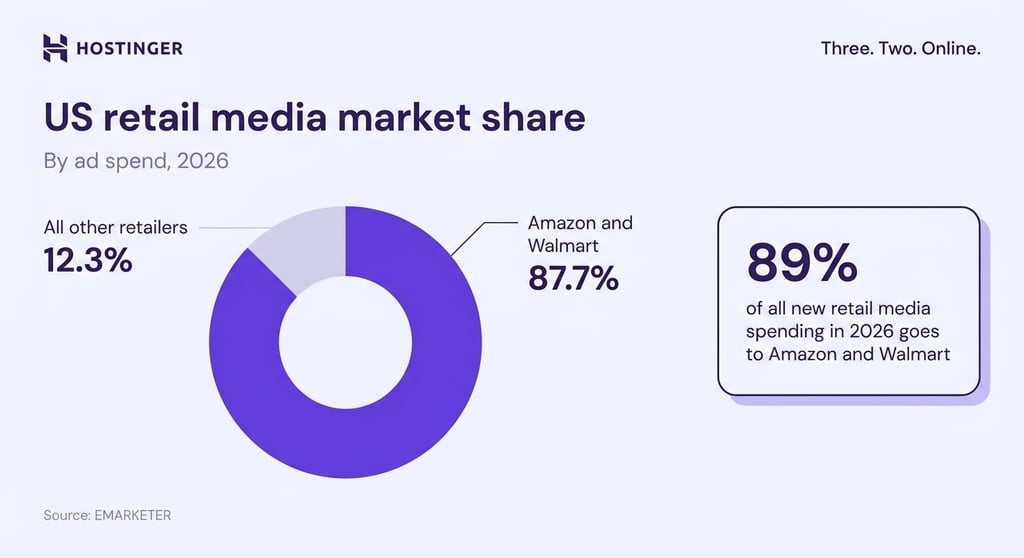
That growth isn’t spreading evenly: Amazon and Walmart already hold 87.7% of US retail media share, and EMARKETER projects they’ll capture 89% of all incremental retail media spending in 2026, about $9.42 billion of the $10.53 billion in new dollars entering the category.
What this means for sellers: retail media is quickly becoming a channel smaller sellers need a strategy for, not just a line item on Amazon and Walmart’s earnings calls. As the biggest platforms absorb most of the new ad spend, the sellers who benefit most will be the ones treating retail media placements as part of their acquisition budget from the start, rather than an afterthought once organic reach stops growing.
The gap to close in 2026
The ten trends above point to one underlying shift: businesses pulling ahead in 2026 are closing the specific gap between what their shoppers expect and what their checkout, delivery, or store actually delivers, rather than adopting every new technology first.
- The AI shift has become measurable this year. Conversion rates from AI-referred traffic flipped from below average to above average in twelve months, which changes where discovery budgets should go next.
- Trust gaps show up more than technology gaps. Payment method mismatches, cross-border localization, social commerce, and sustainability credentials all cost sales for the same reason: shoppers notice friction faster than businesses do.
- Logistics is now a competitive advantage, not just a cost center. Free shipping now outweighs fast shipping as a purchase driver, and delivery subscriptions are shifting from a perk to something a growing share of shoppers expect by default.
That gap narrows or widens at the storefront: whether checkout supports the right payment method, whether delivery options are clear before a shopper commits, whether sustainability credentials are visible.
For businesses still building or rebuilding that foundation, an ecommerce website builder is usually the starting point for making those specific fixes rather than a separate project on top of them.
All of the tutorial content on this website is subject to Hostinger's rigorous editorial standards and values.

Daniela is an Off-Site SEO Specialist with extensive expertise in link building, digital PR, and content optimization. She has led international outreach campaigns across the U.S., Brazil, France, and Spain, securing high-quality backlinks. Follow her on LinkedIn.