Black Friday statistics 2026: Consumer insights and trends
Sep 23, 2026
/
By Ricardo
/
9 min Read

Black Friday 2025 online sales in the US reached a record $11.8 billion, up 9.1% year over year, extending an ecommerce streak that’s now in its fourth consecutive record-setting year.
Mobile devices drove 56.4% of online holiday purchases in 2025 – the first full season mobile has crossed the halfway mark – a shift that keeps reshaping how retailers design their sites and checkout flows.
Black Friday and Cyber Monday have evolved from two separate 24-hour events into an extended shopping season. As of Thanksgiving weekend 2025, 84% of consumers had already begun their holiday shopping, though 53% still had more than half of it left to do.
Hostinger’s 2024 study surveyed 1,000 US consumers about their Black Friday and Cyber Monday shopping preferences, spending habits, and product interests. Although collected in 2024, this data provides historical context that complements the statistics covered throughout this article.
Key Black Friday statistics for 2026
Black Friday has expanded beyond a single day into an extended period that sets the tone for the entire holiday season.
- US online holiday sales reached $257.8 billion for the full 2025 season, up 6.8% year over year and a new ecommerce record.
- A record 202.9 million shoppers turned out over the 2025 Thanksgiving-to-Cyber-Monday weekend.
- Cyber Week online sales hit $44.2 billion, up 7.7% year over year, with Black Friday setting an $11.8 billion single-day record.
- 92% of Gen Z shoppers planned to shop Black Friday or Cyber Monday in 2025, well above the 82% overall shopper participation rate.
- Average spend per shopper over Thanksgiving weekend reached $337.86, up 7% from $315.56 in 2024 and the highest since 2019.
- Buy Now, Pay Later purchases totaled $20 billion across the 2025 season, up 9.8% year over year.
- 22% of shoppers planned to increase their holiday spending despite persistent inflation concerns.
- Affiliates and partners drove 20.4% of full-season online revenue, up 15.9% year over year.
- Traffic to retail sites from generative AI tools grew 693.4% year over year during the 2025 season.
- Consumers planned to spend $622 on average over Black Friday–Cyber Monday weekend, down 4% from 2024, even as overall spending hit records.
Hostinger’s Black Friday study: Key insights
In 2024, Hostinger surveyed US consumers to understand their shopping behaviors during Black Friday. The study revealed key patterns in spending intentions, product preferences, and the influence of marketing channels.
That data predates the numbers below, but it’s a useful baseline for reading this year’s shift.
- 82% of consumers planned to shop during Black Friday. High anticipation for deals confirms Black Friday’s status as a major retail event (Hostinger).
- 31% of US shoppers intended to increase their spending. US consumer optimism was higher compared to 2023 (Hostinger).
- Nearly 30% of respondents shopped exclusively online. Building accessible ecommerce platforms, such as those created with Hostinger Ecommerce, helps businesses reach digital-first consumers effectively (Hostinger).
- 59% of US consumers reported that email marketing influenced their purchasing decisions. It achieves an 8% conversion rate and delivers $36–$50 ROI per dollar spent, outperforming most social channels, making it worth locking in Black Friday email marketing deals before the season ramps up (Hostinger).
- Gen Z and Millennials prioritized fashion and sustainable brands. Baby Boomers focused more on toys and gifts (Hostinger).
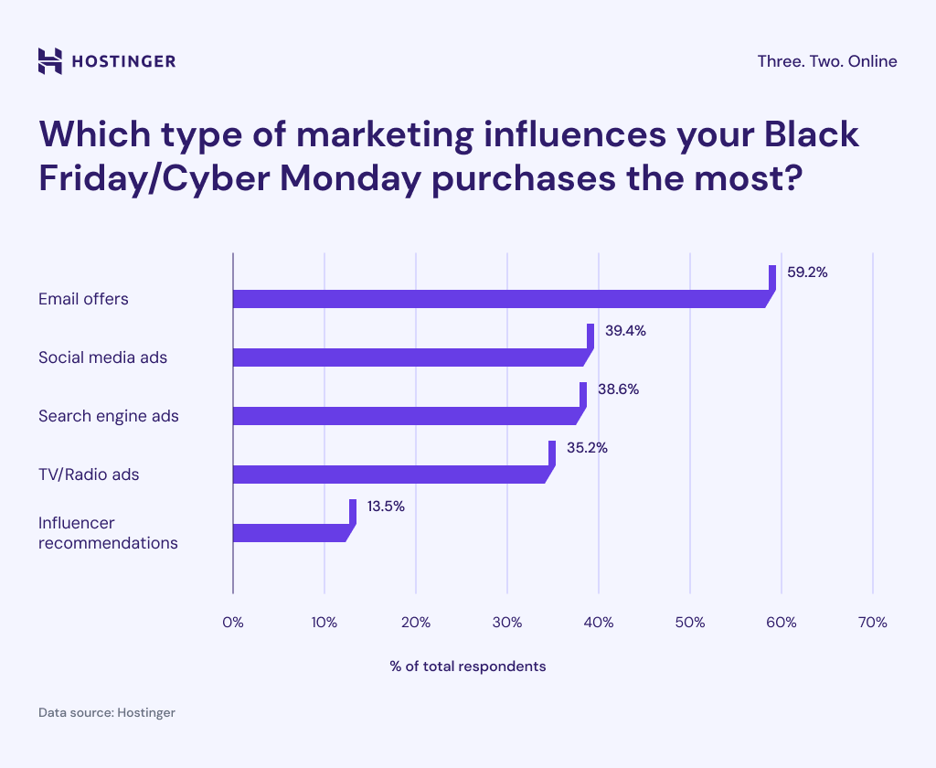
Our 2024 study highlights a meaningful share of shoppers going online-only, even as most still blend online and in-store shopping, alongside the continued effectiveness of email marketing in driving Black Friday sales.
Black Friday spending and sales trends
Black Friday 2025 set new sales records, extending the momentum built in 2024. Spending kept growing steadily, and shoppers stayed engaged even with economic pressures weighing on them.
- Cyber Monday 2025 remained the single biggest online shopping day of the season, at $14.25 billion, a 7.1% increase over 2024. Black Friday’s own growth rate outpaced it, though, climbing 9.1% to $11.8 billion (Adobe).
- Cyber Week 2025 generated $44.2 billion in online sales. The 7.7% year-over-year growth shows just how much weight the extended holiday period now carries (Adobe).
- Consumers planned to spend $1,595 on average across the full holiday season, down 10% from $1,778 in 2024. This is Deloitte’s broadest measure of holiday spending intent, distinct from the narrower BFCM-weekend figure below (Deloitte).
- Only 22% of shoppers planned to spend more this season. This is down from the 31% who planned increased spending in Hostinger’s 2024 study (Experian).
- Average Thanksgiving-weekend spending reached $337.86 per shopper. The 7% increase from 2024’s $315.56 is the highest since 2019, even as planned BFCM-specific spend fell to $622 per shopper (NRF).
- Holiday ecommerce sales are forecast at $305–$310.7 billion. Deloitte projected pre-season growth of 7–9% for online retail. Adobe’s tracked online-only actual came in lower, at $257.8 billion (Deloitte).
- Black Friday is closing the gap on Cyber Monday. Black Friday grew its share of the five-day Cyber 5 window to 26.7% in 2025, while Cyber Monday’s share slipped to 32.2%, its second straight year of decline (Digital Commerce 360).
- Holiday shoppers planned to spend 56% of their retail budget online and 44% in-store. Higher-income shoppers and younger generations were more likely to shop online than others (Deloitte).
Black Friday remains a dominant force in retail sales, and the steady year-over-year growth in online spending means retailers can’t afford to wing it. Strategic pricing, targeted marketing, and product innovation all need to be locked in well before the season starts.
What’s shaping shoppers’ budgets
Behind the headline sales numbers, consumers are working with tighter, more strained budgets than in 2024.
- Consumer confidence hit its lowest point in nearly 30 years. 77% of surveyed shoppers expected higher prices on holiday items, up from 69% in 2024, and 57% expected the US economy to weaken in the next year, the most negative outlook Deloitte has recorded since it began tracking sentiment in 1997 (Deloitte).
- Consumer spending is outpacing income growth. Personal income rose $95.7 billion and personal consumption expenditures rose $129.2 billion in August 2025 alone, a faster pace of growth in spending than income that suggests households are dipping into savings to keep up (US Bureau of Economic Analysis).
- Inflation reaccelerated through the year. After cooling to 2.3% in April 2025, the annual inflation rate climbed back to 3% by September (US Bureau of Labor Statistics).
- Online price deflation is narrowing. Ecommerce prices are still falling year over year, but the drop has slowed considerably, from a low of -5.9% in January 2024 to -2.3% more recently, leaving retailers less room to discount as deeply as before (Adobe Digital Price Index).
- Ecommerce keeps taking share from physical retail. Online sales reached $300 billion in Q1 2025 and $304 billion in Q2, pushing ecommerce’s share of total US retail to 16.3%, its highest point since the 2020 pandemic surge (US Census Bureau).
Expert tip
With inflation squeezing budgets again, we’re seeing shoppers lean on chatbots earlier in their research, comparing prices and checking for a better deal before committing to a purchase. A store that can answer ‘is this really the best price’ instantly has a real edge with a more cautious shopper this year.

Ričardas Kudirka
Product Manager, Chatbots
Black Friday sales keep setting records, but they’re happening against a tighter budget backdrop than in years past. Shoppers still expect a good deal, they’re just being far more selective about which one is worth dipping into savings for.
Black Friday consumer behavior and shopping preferences
Consumer shopping patterns reveal strategic behaviors that combine online research with in-store purchasing. While price remains a primary consideration, early shopping windows and digital tool usage are increasingly influencing consumer decisions.
- 70% of holiday shoppers planned to shop during Thanksgiving week in 2025, up from 68% in 2024. The $100K–$199K income group showed the highest intent to participate, at 77% (Deloitte).
- 68% of shoppers planned to use digital tools, such as social media, generative AI, price comparison sites, or chatbots, to help with holiday shopping decisions. Half also planned to read online reviews before deciding where or what to buy (Deloitte).
- 50% of holiday shoppers planned to spend most of their budget at online retailers or mass merchants, ahead of big-box retailers (39%), digital-first retailers (36%), and specialty retailers (20%) (Deloitte).
- 58% of shoppers considered holiday gift shopping stressful, and 77% said they usually feel frustrated while shopping online. Slow or delayed shipping (37%) and out-of-stock items (36%) were the top frustrations (Deloitte).
- 202.9 million shoppers turned out between Thanksgiving and Cyber Monday in 2025, with online shopping drawing 85.7 million on Black Friday alone, versus 80.3 million in-store (NRF).
- 53% of holiday shopping remained unfinished after Thanksgiving weekend in 2025, similar to the 52% left over in 2024, pointing to strong sales potential through December (NRF).
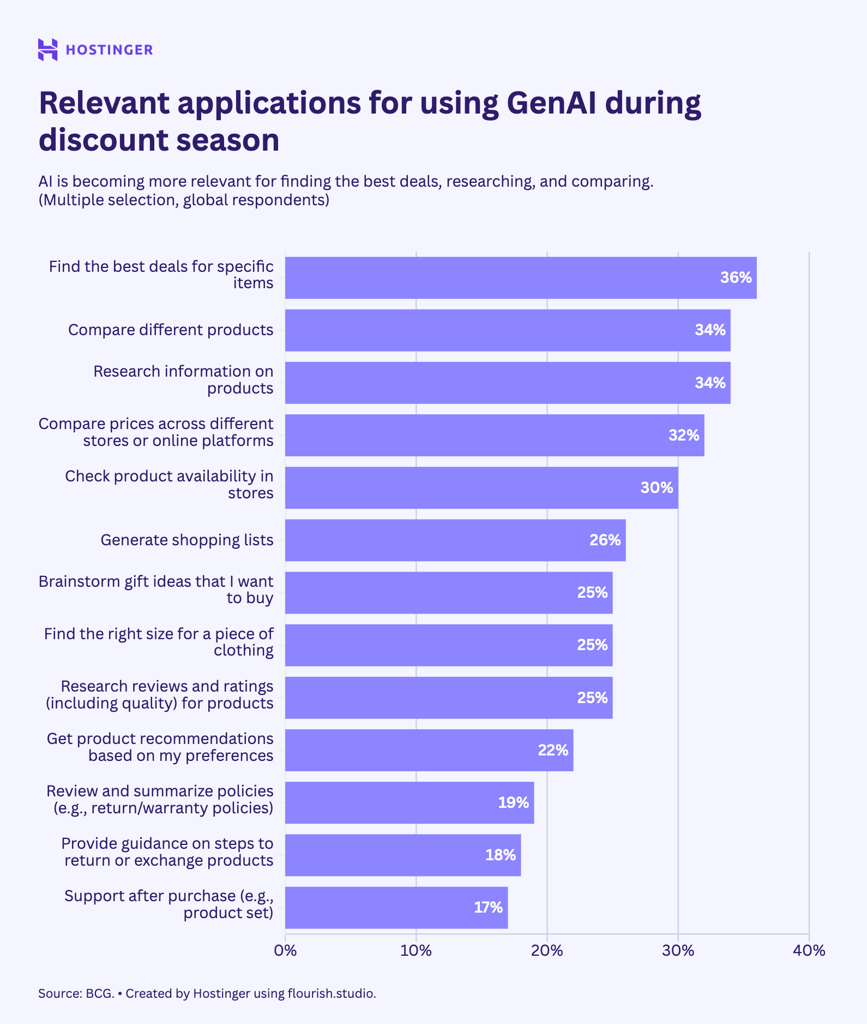
Shoppers want both online convenience and in-store experiences, so a Black Friday and Cyber Monday plan built around just one channel leaves money on the table.
Many are also turning to GenAI tools to hunt down deals and compare prices before they buy, and a majority say online shopping frustrates them.
Retailers who fix friction points like shipping delays and stock visibility, while showing up clearly in those AI-assisted searches, stand to capture sales that would otherwise slip into December.
Black Friday mobile and device usage
Mobile devices have become the primary shopping tool for the majority of online consumers. Smartphones dominate Black Friday browsing, price comparison, and purchasing activities.
- Mobile’s share of online sales climbed to 56.4% for the full 2025 holiday season, up from 54.5% in 2024, the first full season mobile has crossed the halfway mark (Adobe).
- Mobile crossed 60% of daily online sales for the first time on Thanksgiving Day, reaching 61.6%, up from 59.3% in 2024. Mobile peaked at 66.5% on Christmas Day (Adobe).
- Roughly 70% of global Cyber Week orders were placed on mobile devices (Salesforce). For stores that need a scalable backbone to handle that traffic without slowdowns, VPS hosting deals give growing ecommerce sites dedicated resources during peak demand.
- 82.2% of all Buy Now, Pay Later orders this season were placed on mobile, reinforcing that mobile is now the default checkout device for BNPL shoppers specifically (Adobe).
- By 2028, Gen Z mobile payment users are projected to reach 50 million, up from 32.8 million in 2024, representing 37.7% of all mobile proximity-payment users and confirming Gen Z as the first mobile-payments-native generation (EMARKETER).
- 68% of holiday shoppers planned to use digital tools, such as social media, generative AI, or price comparison sites, most of it happening on mobile, underscoring how much of the purchase journey now starts on a phone before a purchase is even made (Deloitte).
Mobile optimization is no longer optional for Black Friday success. With mobile now the default checkout device for the majority of shoppers, businesses that prioritize responsive design, fast load times, and app-quality experiences are better positioned to capture the growing share of mobile sales.
Different demographics require tailored approaches based on platform usage and product preferences. Retailers targeting Gen Z should prioritize TikTok Shop and emphasize sustainability in their branding, while those targeting Millennials should focus on maintaining a strong Facebook presence.
Black Friday demographics and generational differences
Each generation approaches Black Friday with different priorities and spending power. Gen Z shows the highest engagement but also the sharpest pullback in spending, and shopping-day preference splits clearly along generational lines too.
- Gen Z posted the highest generational turnout for Black Friday and Cyber Monday in 2025 at 92%, well above the 82% overall participation rate, but also pulled back hardest on spending, cutting planned budgets by 34% year over year. Millennials cut back a comparatively modest 13% (Deloitte).
- Gen Z favored Black Friday, while Cyber Monday was more popular with Millennials. Shopper participation by event day varied clearly by generation, suggesting a single blanket campaign across the Cyber 5 window is unlikely to reach every group equally (Deloitte).
- 72% of Gen Z planned to shop in-store on Black Friday, compared to 49% of shoppers overall. Despite being digital natives, Gen Z shows a strong pull toward the in-person Black Friday experience specifically (Deloitte).
- 74% of Gen Z relied on social media for holiday shopping inspiration, and 43% planned to use generative AI, both well above the overall shopper averages, reflecting how younger consumers discover and research products differently than older generations (Deloitte).
- Facebook is the preferred platform for 53% of Millennial shoppers. TikTok Shop leads among Gen Z, attracting 40% of users (Hostinger’s social commerce statistics).
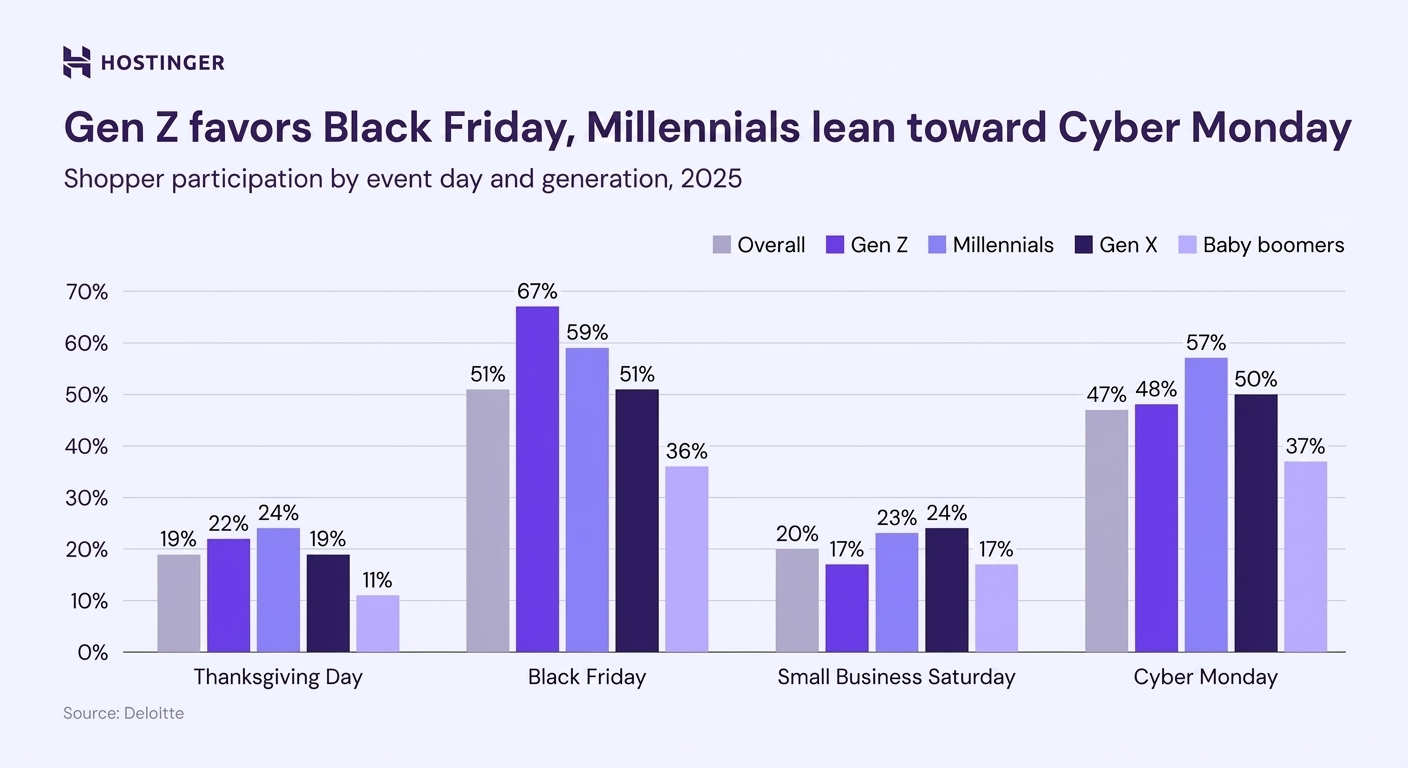
Retailers targeting Gen Z should prioritize social and AI-assisted discovery channels like TikTok Shop, while still preparing for strong in-store turnout on Black Friday itself. Millennials, by contrast, remain more reachable through Facebook and are relatively more likely to shop Cyber Monday specifically.
Black Friday marketing and conversion drivers
Consumer exposure to countless Black Friday offers makes understanding purchase motivators critical. Effective Black Friday marketing begins early and pulls together multiple channels to build momentum.
Preparing your ecommerce store for Black Friday traffic ensures those campaigns don’t outrun your site’s capacity.
- Free shipping, promotions, and positive reviews are top conversion drivers. These incentives effectively convert browsing into purchases (NRF). Impulse purchases accounted for 33% of transactions in Hostinger’s 2024 study, indicating that spontaneous spending remains a significant factor (Hostinger).
- BNPL services generated $1.03 billion in Cyber Monday sales alone in 2025, a 4.2% year-over-year increase and the first time BNPL crossed $1 billion in a single day (Adobe).
- Generative AI traffic to retail sites grew 693.4% year over year across the full 2025 season, reaching 670% specifically on Cyber Monday. This is growth off a much larger base than 2024’s early surge, not a slowdown (Adobe).
- AI-referred shoppers converted 31% higher than non-AI traffic in 2025, nearly double the 2024 gap, with conversions running 54% higher on Thanksgiving and 38% higher on Black Friday specifically (Adobe).
- Affiliates and partners drove 21.8% of Cyber Monday revenue, up 7.4% year over year, and 20.4% of full-season revenue, up 15.9% year over year (Adobe).
- As deals stretch earlier into the week, Black Friday is closing in on Cyber Monday’s longtime title as the season’s biggest single day. (Adobe).
Expert tip
When shoppers are watching every dollar, generic discount messaging doesn’t move the needle anymore. What converts is showing someone the exact bundle or upgrade that solves their specific problem, and email is still the channel where that kind of targeted follow-up feels personal instead of pushy.

Miglė Padelytė
Product Manager, Reach
Successful Black Friday marketing combines multiple channels with strategic incentives. Free shipping and positive reviews drive conversions, while smart bundling and tiered pricing help retailers protect margins as discount depth narrows.
The future of Black Friday
Black Friday continues evolving as a multi-week shopping period with increasing AI integration and diverse customer journeys.
- The shopping season continues to extend earlier into the year. 24% of shoppers’ budgets were already exhausted by the end of October 2025, up from 20% in 2024 and the highest share in five years, as more consumers spread purchases out to manage costs (Deloitte).
- AI agents and agentic commerce influenced 20% of all Cyber Week 2025 purchases globally, worth $67 billion. Retailers building their own AI agents saw sales grow 32% faster than those without (Salesforce).
- Social commerce has moved past being just a discovery tool and turned into a real sales channel. TikTok Shop alone drove over $500 million in US sales across the 2025 Black Friday-to-Cyber-Monday window, with nearly 50% more buyers than the year before (TikTok Newsroom).
Expert tip
AI agents are moving from browsing on a shopper’s behalf to placing real orders during Cyber Week. Retailers who make their product data easy for an agent to read and compare will show up in those transactions. The ones who don’t risk becoming invisible to a growing slice of holiday buyers.

Tomas Rasymas
Head of AI
An extended shopping season and mobile-first customers put real strain on your infrastructure, so it needs to be reliable and able to scale. Hostinger’s Black Friday deals cover the hosting, domains, and tools you need to handle the extra traffic without missing a beat.
All of the tutorial content on this website is subject to Hostinger's rigorous editorial standards and values.

Ricardo is a data journalist and visualization expert with over seven years of experience uncovering insights through data storytelling. His work focuses on data exploration, geospatial analysis, and interactive visualizations, helping audiences understand complex information through compelling narratives. His projects have been featured in Statista, Forbes, La Nación, among others. When he’s not analyzing datasets, Ricardo enjoys brewing specialty coffee, watching sports, and reading fiction. Follow him on LinkedIn or check his Portfolio to see his latest work.