AI agent reasoning: How agents plan and decide
Oct 16, 2026
/
By Alma F.
/
8 min Read
AI agent reasoning, also called agentic reasoning, is the process an AI agent uses to choose actions, evaluate results, and adapt its decisions while working toward a goal. Instead of following a fixed sequence, the agent uses new information, such as tool outputs, errors, or user feedback, to determine what to do next.
This process helps AI agents handle multi-step tasks such as research, coding, customer support, and workflow automation. Common reasoning approaches include ReAct, plan-and-execute, reflection, and Tree of Thoughts, each suited to different types of tasks and decisions.
What is AI agent reasoning?
AI agent reasoning helps an agent decide whether to continue, change its approach, ask for information, or stop as it works toward a goal. These decisions depend on the task, the available tools, and what the agent learns from previous steps.
For example, a small bakery might ask an agent to create an SEO content plan. The AI agent notices that it doesn’t know the bakery’s location or main products, so it asks the bakery for those details. When the bakery says it sells wedding cakes in Chicago, the agent uses that information to decide what research to do next.
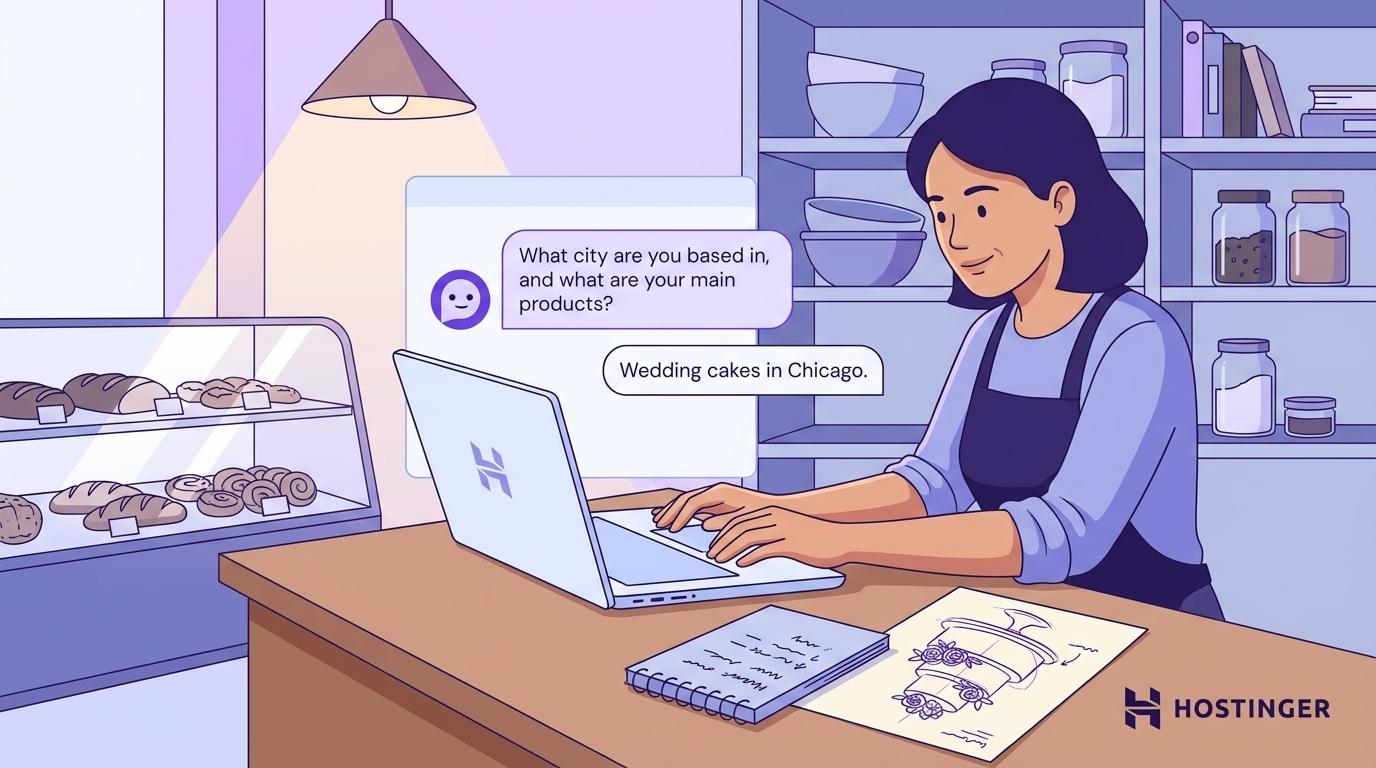
That ability to adapt as new information comes in is what separates agentic reasoning from a one-time AI response.
The reasoning guides the decision. If the agent has access to other software, it can then carry out the next step – for example, by using Google Search to research competitors, Semrush or Ahrefs to check keyword data, Google Sheets to save findings, or Google Docs to build the content plan.
How does AI agent reasoning work?
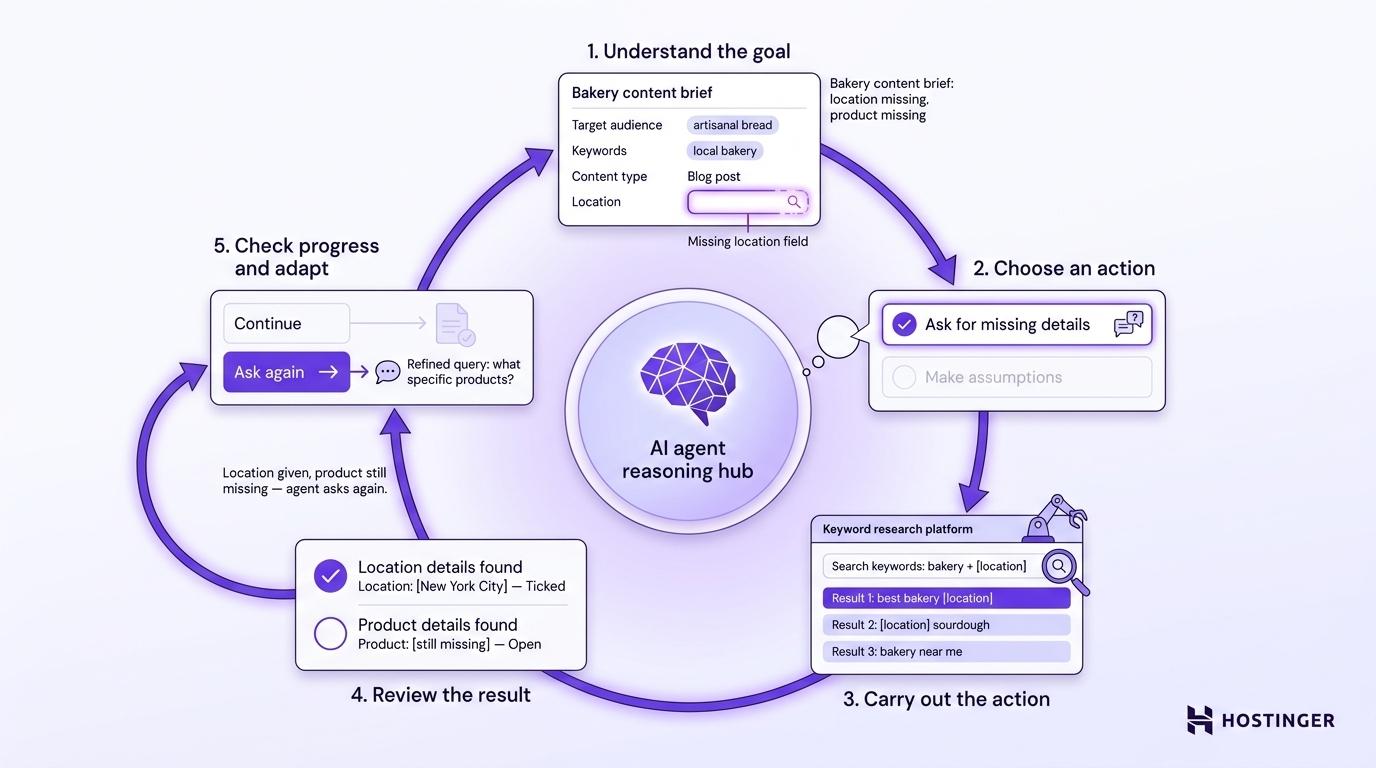
AI agent reasoning works as a five-stage loop in which the agent understands the goal, chooses and performs an action, reviews the result, and uses that result to decide what to do next.
- Understand the goal and make a plan. Identify the desired bakery content plan and note any missing details, such as the location or product focus.
- Choose an action or tool. Ask the bakery for missing details or choose where to research keywords.
- Carry out the action. Use the selected software, such as a search engine or keyword research platform, to complete the step.
- Review the result. Check whether the action worked and whether the result provides enough information to continue.
- Check progress and adapt. Continue, revise the plan, retry a failed step, ask for more information, stop after success, or escalate the task.
Suppose the bakery gives its location but still hasn’t said which products it wants to promote. Before starting keyword research, the agent asks whether the plan should focus on wedding cakes, bread, pastries, or another product.
Behind the scenes, the AI model selects the next action from the set of options it is allowed to use. Software, such as a search engine or a keyword research platform, performs that action and returns the result. The agent then uses the result to decide what happens next.
Workflow rules can also limit what the agent does. For example, they can stop it after three failed searches or require a person to approve a sensitive action.
Main AI agent reasoning patterns
The main AI agent reasoning patterns are ReAct, plan-and-execute, reflection and self-correction, and Tree of Thoughts or other search-based approaches. They differ in when the agent plans, how it responds to new results, and whether it evaluates a single path or multiple paths.
Approach | Best for | How it adapts | Main tradeoff |
ReAct | Open-ended tasks guided by live results | Uses each result to choose the next action | A poor decision can misdirect later steps or create loops |
Plan-and-execute | Longer tasks with a predictable structure | Updates an initial plan when conditions change | A weak initial plan can affect later steps |
Reflection and self-correction | Tasks where the result can be checked | Checks an attempt against feedback or a target, then improves the next attempt | Reviewing its own work without reliable feedback can repeat an error |
Tree of Thoughts and search-based reasoning | Tasks where early choices can lead to dead ends | Compares several possible paths and develops the most promising ones | Exploring more paths increases model calls, cost, and response time |
ReAct
ReAct, which stands for Reasoning and Acting, lets an agent decide what to do next after seeing the result of its previous action.
For example, the bakery agent might run a keyword research query and find that the results are too broad or not relevant to Chicago. It can use that result to narrow the next query by location and product focus before choosing content topics.
This decide-act-observe cycle works well for open-ended tasks where each result affects the next step. However, if the agent misunderstands a result, later actions can move in the wrong direction or repeat the same searches.
Plan-and-execute
Plan-and-execute has the agent create an overall plan first, then complete and revise its steps as new information comes in.
For the bakery, the initial plan might include audience research, keyword research, topic selection, and content scheduling. If the agent later learns that the bakery serves only customers in Chicago rather than shipping nationwide, it can adjust the research and topic stages for that local audience.
This approach works well for longer tasks with a clear structure. However, a poor assumption in the initial plan can affect several later steps before new information reveals the mistake.
Reflection and self-correction
Reflection and self-correction let an agent check an earlier attempt against feedback or a clear target, then improve its next attempt.
For example, the bakery’s content plan might meet the requested format but still fail its goal of increasing local wedding-cake inquiries. If most topics cover general baking tips, the agent can compare the plan with that goal and replace those topics with ideas focused on wedding cakes and the local market.
Tests, reliable sources, tool results, and human feedback give the agent something external to check against. If it judges its work only by reviewing its own earlier answer, it can repeat the same mistake.
Reflection can improve the current task or a later attempt, but it doesn’t automatically update the underlying model or create permanent learning.
Tree of Thoughts and search-based reasoning
Tree of Thoughts lets the model consider several possible ways forward instead of committing to the first one.
In the bakery example, the agent could compare three directions for its content plan: local event searches, product-focused topics, and general baking education. If general baking content has little connection to the bakery’s sales goals, it can drop that option and further develop local and product-focused ideas.
Tree of Thoughts doesn’t inherently require an agent, external software, or feedback from outside the model. An agent can still use the approach when choosing the wrong direction early could waste later work.
This approach works best when several plausible paths could lead to different results. Exploring and revisiting those options requires more model calls, increasing cost and response time.
How does AI agent reasoning differ from reasoning models?
A reasoning model is an AI model designed to handle tasks that require complex, multi-step inference, such as solving problems or comparing options. AI agent reasoning, on the other hand, is the decision-making process within an agentic system that uses model outputs, tool results, and workflow rules to determine the next action to take.
For example, a reasoning model might work out which keywords are relevant to a bakery. An AI agent can go further by running the search, reviewing the results, changing the query if needed, and continuing until the task is complete.
The difference comes from what surrounds the model. Understanding what separates an AI agent from an LLM helps here: the model handles the reasoning, while the agent system adds the software access, saved progress, limits, and rules needed to carry out a task across multiple steps.
That saved progress can include AI agent memory, which lets the agent retain and reuse relevant information from earlier interactions or steps.
Dimension | Reasoning model | AI agent reasoning |
Main job | Works through a difficult question or decision | Uses reasoning to decide what action should happen next |
Taking action | Can ask connected software to perform an action when available | Uses the result of one action to choose the next one |
New information | Can reason over information it receives | Uses new results to change what it does next |
Progress | Doesn’t keep track of a multi-step workflow by itself | Can use saved progress from earlier steps |
Finishing the task | Produces an answer or requests an action | Can continue, retry, stop, or ask for help based on set rules |
What are the practical applications of AI agent reasoning?
AI agent reasoning is useful in research, coding, customer support, sales, marketing, and workflow automation because new information or failed actions can change what the agent should do next. This allows agents to adjust their approach rather than repeat the same instructions when something doesn’t work.
- Research. A research agent can respond to incomplete or outdated results by narrowing a query, changing search terms, checking another source, or asking the user to clarify the research goal.
- Coding. A coding agent can use a failed software test to revise the code or try a different debugging approach before rerunning the test.
- Customer support. A customer support agent can collect missing account information or request details, then use the customer’s response to decide whether to continue or send the case to a person.
- Sales and marketing. A sales or marketing agent can change a follow-up when new customer information changes the situation. If a customer postpones a project, the agent can cancel a scheduled sales message and wait for a more appropriate time to follow up.
- Workflow automation. If the software the agent tries to use returns an error, the agent can retry the step, use an approved alternative, ask for help, or send the task to a person.
These uses aren’t limited to custom-built agent systems. They also appear in ready-to-use products that package these capabilities into guided workflows.
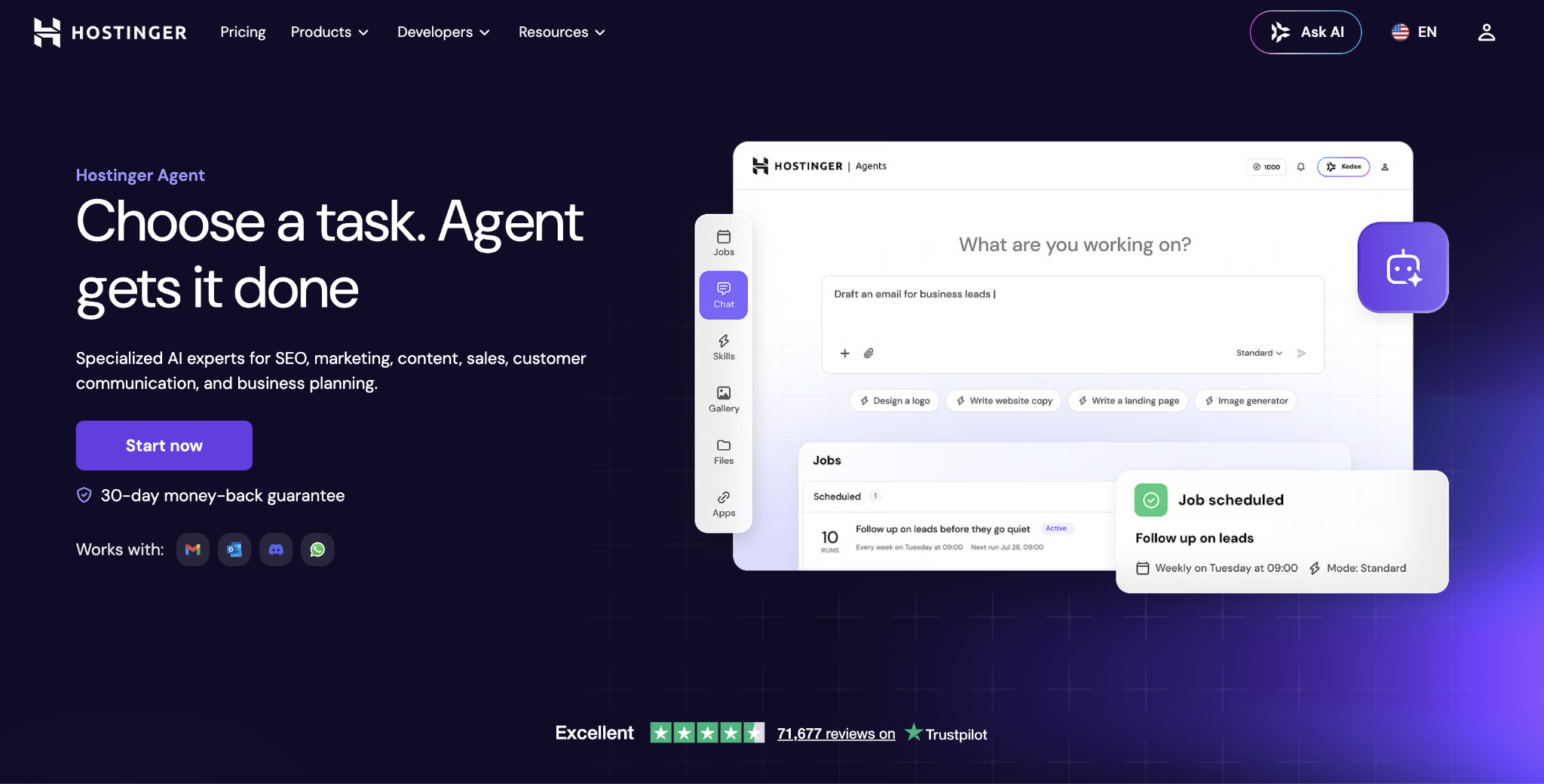
Hostinger Agent is one example, with specialized experts and skills for tasks such as SEO, marketing, sales, content, and customer communication. Its skills break tasks into steps, ask for the information they need, and let users refine the result through follow-up instructions.
Limitations of AI agent reasoning
AI agent reasoning has several limitations and risks: it can make decisions based on incomplete information, carry mistakes into later steps, continue longer than necessary, increase processing costs, and misjudge its own output.
- Incomplete or incorrect information can lead to poor decisions. A sales agent might assume that a customer approved a discount even though the record contains no approval, then prepare an inaccurate offer. Checking important information against reliable records helps catch these mistakes. Limiting what the agent is allowed to change or send also reduces the damage if a wrong assumption gets through.
- Mistakes can spread across later steps. If a planning agent finds an outdated policy and treats it as current, every recommendation based on that policy can also be wrong. Checking important information before the agent continues helps prevent a single error from affecting the rest of the task.
- The agent may not know when to stop. An agent might keep rewriting the same draft because nothing defines when the content is good enough. Clear success criteria, retry limits, and time or cost limits tell it when to stop, try another approach, or send the task to a person.
- More reasoning increases cost and response time. Retrying failed steps, reviewing earlier work, and comparing several options require additional AI processing. Deeper reasoning is most useful when changing the next decision can improve the result.
- Self-checking is not always reliable. If an agent checks a claim only against an earlier answer it produced, it can repeat the same error. Tests, reliable sources, software results, and human feedback give it independent information to check against. For example, a passing software test confirms that the tested condition worked, not that the entire program is correct or secure.
These risks are easier to control when the workflow adds checks around the reasoning process. Use reliable data, set retry and stop limits, restrict sensitive actions, and require human approval when an incorrect decision could have a serious impact.
How to apply AI agent reasoning in agentic workflows
Apply AI agent reasoning by identifying decisions that should change when new information arrives, then use agentic workflow rules to control what the agent can do, when it should stop, and when a person needs to step in.
- Define the decision. Identify where the next action depends on a result. For example, a research workflow might need to decide whether to accept a search result, try another search, or ask for help.
- Decide what information the agent receives. Give it the information needed to make that decision, such as search results, errors, user replies, or test results.
- Set the actions the agent can take. For example, allow it to retry a search, change the query, use another approved source, or send the task to a person.
- Set limits and approval rules. Define what success looks like, how many times the agent can retry a step, what it is allowed to change, and which actions require human approval.
- Test what happens when things go right and wrong. Give the workflow a successful result, an incomplete result, an error, and an unclear response. Check that it stops after success, tries another allowed action when useful, and sends the task to a person when it reaches a limit.
Suppose the agent runs a search and gets no useful results. It can try again with different search terms. The workflow records that this is attempt 2 of 3 and gives the new result back to the agent so it can decide whether to continue.
If the third attempt also fails, the workflow blocks another retry and sends the task, previous results, and error history to a person.
The goal is not to let the AI agent decide everything. Give it room to adapt where new information changes the best next step, while keeping clear rules around what it can do and when a person should take over.
All of the tutorial content on this website is subject to Hostinger's rigorous editorial standards and values.

Alma is an AI Content Editor with 9+ years of experience helping ideas take shape across SEO, marketing, and content. She loves working with words, structure, and strategy to make content both useful and enjoyable to read. Off the clock, she can be found gaming, drawing, or diving into her latest D&D adventure.