Claude watermarks its writing now. Should you worry?

You’ve seen the headlines and heard the panic. Claude now stamps an invisible watermark into the text its latest models generate, and the reaction was instant.
SEO forums lit up with “your rankings are cooked” posts. Watermark removal apps appeared out of nowhere. And someone, somewhere, is already selling a course about it (probably drafted in watermarked Claude).
So let’s take a breath.
Yes, the watermark is real and it’s worth understanding what it actually is and where it does or doesn’t change things for you.
The fears that it’ll sink your rankings or get you flagged as a “cheat”? Somewhat legit depending on what you’re doing, but not enough to panic-delete your life’s work and move to a cabin in the woods.
What actually happened
Anthropic started baking a machine-readable watermark into the text Claude generates. For now that’s the newest Claude models, with older ones being folded in over the coming months, so if you’re on an older model your output might not carry a mark yet.
You can’t see it, it doesn’t change how anything reads, and it travels with the words when you copy and paste them somewhere else.
Here’s how it works.
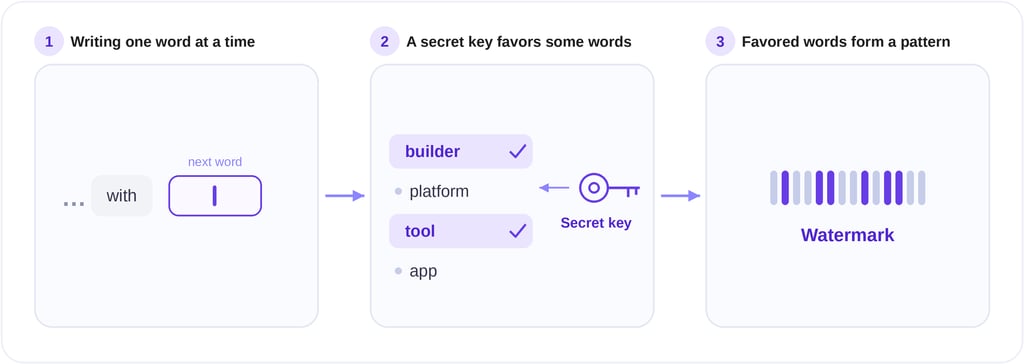
Claude writes one word at a time, choosing from a bunch of words that would all fit perfectly fine. It subtly favors certain ones based on a secret mathematical key.
Any single word by itself is unremarkable but string a few hundred together and a statistical pattern shows up. That pattern is the watermark.
Claude is getting all the attention right now, but all LLMs work the same way. If you want the receipts, it’s adapted from SynthID-Text, the method Google DeepMind published in Nature back in 2024.
The important thing to remember is that nothing gets bolted onto the text. No hidden characters. You can’t scrub it by pasting into a plain text editor (which was my first untrained thought). It lives entirely in the pattern of word choices.
A few ways that plays out:
- Let Claude write it and paste it straight onto your page: the pattern’s all there.
- Retype Claude’s words by hand, letter for letter: still there, because the words were still chosen using the pattern.
- Use Claude to brainstorm, then write the sentences yourself: little to no pattern, because your wording no longer lines up with the key.
- Paste your own draft in and ask Claude to tidy it: mostly your words survive, so not much watermark.
- Have Claude translate something: the ideas can be entirely yours, but Claude picks every single word, so it carries a strong pattern.
Anthropic hasn’t put a number on how much editing it takes to cross the line, but the rule of thumb is simple: the more of Claude’s exact wording that survives, the stronger the mark.
Why they did it
Regulation, of course.
The EU AI Act’s transparency rules came into effect on August 2, and they tell providers of generative AI to mark their output as machine-made.
Anthropic signed the EU’s Code of Practice alongside around 190 other organizations. Google, Meta, Microsoft, and OpenAI all signed the same provider section, which means they’re all heading in the same direction.
There’s no clean way to flip the switch on for European users only, so it’s on everywhere: the apps, the API, the big cloud platforms, all of it.
The law itself is built to fight deception on public interest topics, meaning you only need to disclose that AI was involved when all three of these are true:
- the text informs the public on a matter of public interest (news, political commentary, public health),
- it went out with no human review,
- and nobody took editorial responsibility for it.
Editorial responsibility just means a real person or company reviewed it and stands behind it before publishing, the way an editor signs off on an article.
So does a B2B company’s AI-assisted blog need to disclose? Or a product guide, or your marketing copy?
No, none of that is public interest, so the rule never applies. About the only thing that trips the wire is unreviewed, no-one’s-name-on-it AI text pushed out on serious public topics.
That covers text. For images, audio, and video, it’s stricter: if you use AI to create or alter something that looks like a real person, place, or event, a convincing deepfake, you have to disclose it, and that one isn’t limited to public-interest topics.
Anything that clearly isn’t posing as real (an illustration, a product render, an abstract graphic) isn’t caught by that rule.
It’s got nothing to do with Google
When Anthropic announced the watermarking, most of the SEO panic went like this: my content is watermarked → oh no, now Google knows AI was involved → and now they’re going to penalize me.
But Google has said all along that AI involvement alone doesn’t impact rankings. The only thing they don’t like is using AI (or any other tool) to manipulate rankings.
It’s the same with keyword stuffing, link schemes, cloaking, or any other shortcut people have panicked about over the years.
Google doesn’t care about the technique. They care about whether you’re trying to game the system instead of helping the reader.
Which means helpful content still wins. Is your content genuinely helping people? That’s the benchmark for whether Google recommends your work. Not whether there’s a watermark on it.
So who should actually worry?
You’re in trouble if your whole play is to have AI spit out bulk content, copy-paste without reviewing, and call it a day.
If your product descriptions are just Claude rewriting your competitor’s product descriptions. If your blog is 40 AI-generated listicles a week with no editorial review. If you’re publishing remixed versions of what already exists, adding no original thinking and no real value to the reader.
But that content was on thin ice the day it went live, mark or no mark.
You’ll be fine if you bring your own ideas, your expertise, the opinion you’ll stand behind, and let AI help you wrestle the mess of notes into something readable.
That’s amplifying your thinking, not outsourcing it.
The fear for this group is different: getting branded a cheat for work that’s genuinely yours. And that fear comes from misunderstanding what the mark actually proves.
What the watermark can and can’t tell you (and why trying to remove it is pointless)
The watermark answers exactly one question: was a Claude model involved in producing these words?
That’s it. You could write every word yourself, ask Claude to adjust a clunky paragraph, and walk away with a watermarked document.
Anthropic says outright that the watermark can only determine that Claude was likely involved with the content at some point, and it cannot distinguish “Claude wrote this” from “Claude heavily edited this.”
On the flip side, a clean result doesn’t prove a human writer either. Short passages, plain fact lists, and code barely carry a signal, even if produced entirely by Claude.
So the mark proves a model was part of the production process, and it’s not a verdict on the quality of the work.
Which is exactly why trying to remove it is wasted energy. Within days of Anthropic’s announcement, a wave of “watermark removal” sites appeared.
But not a single one can prove they work since they don’t have the secret key that generates the pattern – only Anthropic does, which means these tools are swinging at something they can’t see.
Switching models doesn’t help either. Every major provider signed the same EU deal and they’re all walking the same direction. There’s nowhere to run to.
And there’s no need to run.
Where you should put your energy is in expressing your ideas in your own words. Use AI to ideate and brainstorm, but own the expression.
Only you can see the world through your eyes. Only you can explain it in your words. Nobody else can do that, certainly not AI.
The “100% human-written” promise just changed
The only area where you need to be more cautious is if you ever promise content is “100% human-written.” That just got harder to keep.
Anthropic does have a detection tool, but right now it’s locked to organizations with EU verification duties, like regulators, fact-checkers, and researchers, not the public.
It’s a clumsy check since all it shows is that a model touched the text somewhere, not where or how much.
Which puts you in a tough spot, because you could do all the thinking and writing yourself, hand the draft to Claude to tighten things up, and the watermark still shows up.
The fix is to stop promising something you can’t prove and describe what you actually do.
“We use AI for research and first drafts, then a human writer shapes it, fact-checks it, and adds original insight” beats “no AI, ever,” and it’s a promise you can keep.
Be upfront about the process and keep a light trail of how each piece came together.
How we handle it at Hostinger
We lean on AI hard and we’re not shy about it. But we point it at very specific things.
Research, digging through thousands of articles to find the right internal link, turning a pile of notes into a first draft that’s structured enough to argue with: that’s where AI earns its keep.
One of our writers even explained handing the tedious parts of her job to AI agents while keeping the parts that actually need a human.
What never gets delegated is the angle, the opinion, which detail earns its place, what you’re meant to take away by the last line.
An agent can hand back ten sources but a person still decides which three belong and what they add up to.
Plenty of what we publish will carry a Claude mark somewhere in its history, because a draft got tidied or a claim got checked with a model in the loop.
We’re not concerned about that because our process is human-driven with AI assistance. If yours is too, you shouldn’t be concerned either.
I even asked our AI team whether they were worried about the watermarks. Crickets.
Where that leaves you
The watermark is a flashlight. It shows that a model was involved somewhere and nothing beyond that.
It stays dark on the only question that decides whether a page is worth reading: is the content actually helpful?
So write the content only you can write. Bring your perspective, your experience, anything that makes a reader glad they found your page instead of someone else’s.
And the mark settles into what it should have been all along: a note on how the work got made, not a verdict on whether it’s any good.

Simon is a dynamic Content Writer who loves helping people transform their creative ideas into thriving businesses. With extensive marketing experience, he constantly strives to connect the right message with the right audience. In his spare time, Simon enjoys long runs, nurturing his chilli plants, and hiking through forests. Follow him on LinkedIn.