Vibe marketing statistics 2026: Emotional branding, Gen Z behavior, and AI adoption

Vibe marketing is an AI-accelerated, emotion-first approach to brand-building that prioritizes aesthetic identity, cultural fluency, and emotional resonance – the feeling a brand creates before a word is read or a price is checked.
Rooted in decades of emotional branding research and accelerated by AI-powered content production, it has emerged as one of the most discussed marketing frameworks in recent years, with growing data across platform performance, consumer behavior, and business outcomes to support it.
Top vibe marketing statistics for 2026
Digital marketing is entering a feeling-first era, where emotional alignment drives more commercial impact than rational messaging alone. The statistics below capture both the macro conditions that made the rise of vibe marketing inevitable and the behavioral data that explains its momentum.
- The global digital marketing market is expected to be worth $1.3 trillion by 2033 at a 13.6% CAGR (Hostinger Digital Marketing Statistics)
- An estimated 95% of purchasing decisions occur in the subconscious mind, where emotion, not rational analysis, drives action.
- Emotional ad campaigns produced nearly 2x the business impact of rational ones: 31% of emotional campaigns reported very large profit growth, compared to 16% of rational campaigns.
- Emotionally connected customers have 306% higher lifetime value and a referral rate four times higher than merely satisfied customers.
- Gen Z global spending power reached $2.7 trillion in 2024 and is on track to hit $12.6 trillion by 2030.
- 73% of global consumers say trust in a brand increases when it authentically reflects today’s culture.
- TikTok’s average engagement rate reached 4.20% in 2025, significantly outperforming Instagram’s 0.48%.
- Lo-fi, unpolished content drives 1.8–2x more comments than campaign-quality posts on TikTok, confirming that authenticity outperforms production value.
- 88% of organizations report regular AI use; 75% of marketers have adopted AI tools.
- Consistent branding drives 10–20% revenue growth for brands that apply it consistently.
What is vibe marketing?
Vibe marketing is an AI-enabled, emotion-first operating model that prioritizes aesthetic identity, cultural resonance, and community feeling over traditional product-led messaging. The term itself emerged in early 2025, extending the logic of “vibe coding” – the practice of building software through intuitive, AI-assisted prompting – into marketing strategy and content creation.
The approach draws on decades of emotional branding research but is defined by its scale and speed: AI tools now allow small teams to produce aesthetically cohesive campaigns in hours, while social platforms distribute cultural signals faster than any traditional media cycle.
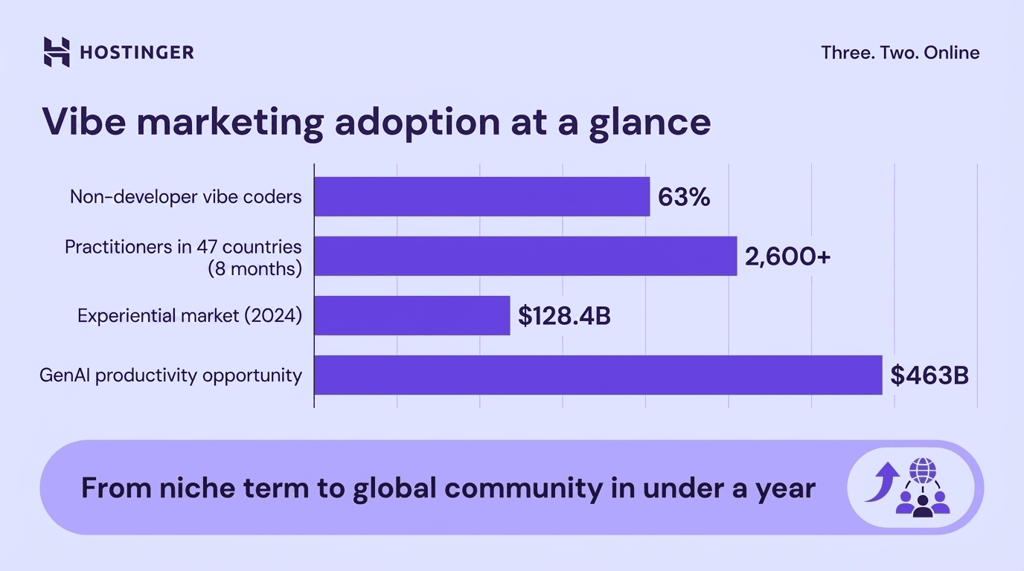
- 63% of vibe coding users are non-developers, showing how the AI-first, prompt-driven approach has spread well beyond engineering teams (Hostinger vibe coding statistics).
- The vibe marketing practitioner community grew to 2,600+ members across 47 countries within eight months of the term being coined, signaling rapid global uptake among early-adopter marketers (TheVibeMarketer.com).
- The global experiential marketing market reached $128.4 billion in 2024, surpassing pre-pandemic levels for the first time, placing vibe marketing within the broader category of experience-led brand investment (PQ Media).
- Gartner forecasts that 40% of new enterprise production software will be built using vibe coding techniques by 2028, illustrating how the prompt-driven, AI-first, intuition-led philosophy is reshaping not just marketing but the entire product-building cycle (Gartner).
- GenAI could boost marketing productivity by 5–15% of total marketing spend, worth approximately $463 billion annually, providing the economic rationale for adopting faster, AI-assisted campaign approaches (McKinsey & Company).
Vibe marketing is best understood as an emerging discipline with a nascent but growing evidence base, built on decades of emotional branding research and now accelerated by AI-powered content production. The term is just over a year old, but the commercial behavior it describes is well-documented across consumer psychology, campaign effectiveness research, and platform data.
Emotional branding statistics
Emotional branding consistently outperforms rational messaging across every major performance metric, from profit growth to customer lifetime value. The science predates vibe marketing by decades, and the data is remarkably consistent.
- An estimated 95% of purchasing decisions occur in the subconscious mind, driven by emotion rather than rational analysis, according to consumer neuroscience research (Harvard Business School).
- Emotional ad campaigns produced nearly twice the profit impact of rational ones, 31% reported very large profit growth vs. 16%, based on analysis of 1,400+ campaigns over three decades (USC Dornsife).
- Ads with above-average emotional response generate a 23% lift in sales volume, while below-average emotional ads produced a 16% decline, a 39-point performance gap, based on EEG testing combined with purchase data across 100 ads and 25 FMCG brands (Nielsen Consumer Neuroscience).
- Digital ads evoking strong emotions are 4x more likely to drive long-term brand equity, compared to ads with weak emotional response (Kantar).
- Emotionally connected customers have 306% higher lifetime value, they stay longer (5.1 years vs. 3.4), refer more (30.2% vs. 7.6%), and are 52% more valuable on average than merely satisfied customers (Harvard Business Review).
- 82% of consumers with high emotional brand engagement always buy from that brand, vs. 38% with low engagement, a 44-point loyalty gap (Capgemini Digital Transformation Institute).
- 80% of executives believe they understand consumer emotions, yet only 15% of consumers agree, revealing a significant perception gap between how brands think they’re connecting and how customers actually feel (Capgemini Digital Transformation Institute).
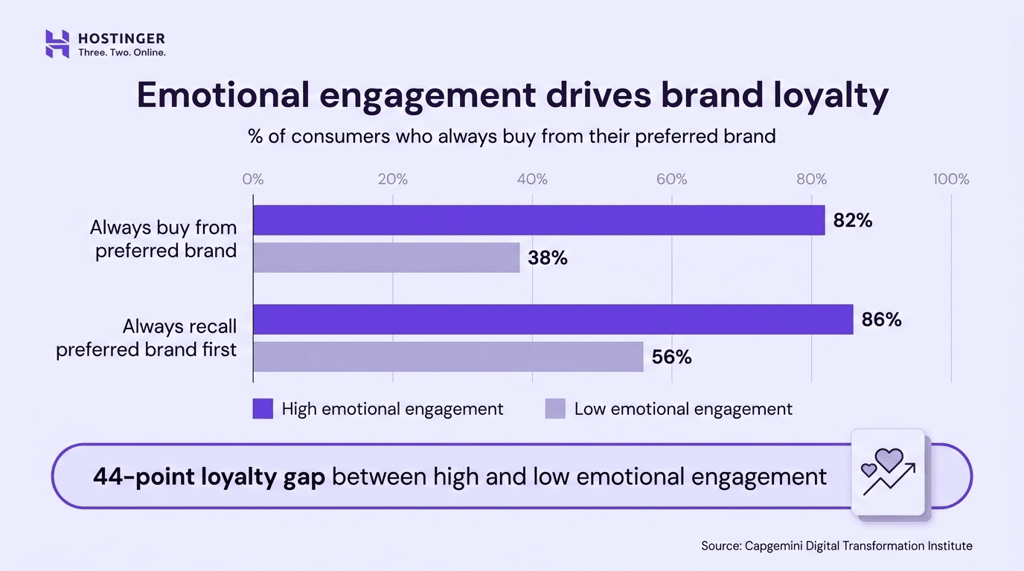
The data collectively shows that emotional resonance is the mechanism through which brand equity, loyalty, and revenue are built. The 80/15 perception gap between executives and consumers is particularly significant: most brands believe they are landing emotionally, but most consumers disagree.
Vibe marketing on social media: platform performance data
TikTok dominates vibe marketing on social media, with engagement rates nearly nine times higher than Instagram’s and lo-fi content consistently outperforming polished campaign posts. Not all platforms perform equally, and the data makes the hierarchy clear.
On Instagram, carousels outperform Reels for depth of engagement (0.55% vs. 0.52%), while Reels still lead on reach, accounting for 46% of total Instagram app time in the US and being reshared 4.5 billion times per day via DMs.
- TikTok’s average engagement rate reached 4.20% in 2025, up 9% year-over-year, significantly outperforming Instagram’s 0.48% in the same period (Socialinsider).
- Lo-fi, unpolished content drives 1.8–2x more comments than campaign-quality posts on TikTok, confirming that authenticity outperforms production value on the platform (ICUC Social Trends Report).
- 63% of consumers say they’d most like to learn about a product via a short video, vs. 12% who prefer text articles, cementing video as the dominant discovery format (Wyzowl).
- Short-form interactive videos boost sales and conversions by up to 80%, and 90% of consumers watch TikTok, YouTube Shorts, or Instagram Reels in their free time (Hostinger Digital Marketing Statistics).
Brands investing in visual content see compounding returns: blogs with relevant images get 94% more views, and companies using custom visual content see 7x higher conversion rates, confirming that aesthetic investment in content, not just copy, drives measurable commercial outcomes.
Expert tip
On TikTok, audiences reward brands that show up as participants in a culture, not broadcasters of a message. The lo-fi content data confirms what practitioners already know: if your content looks like an ad, it performs like one.
The brands getting outsized engagement are the ones willing to be a little imperfect in exchange for being genuinely present.

Gen Z and millennial vibe marketing statistics
Gen Z’s $2.7 trillion spending power and social-first discovery behavior make them the generation that defines vibe marketing’s logic, not just its audience. Their authenticity expectations and community dynamics shape the entire framework.
- Gen Z global spending is projected to grow nearly 5x from $2.7 trillion in 2024 to $12.6 trillion by 2030, with global income expected to hit $36 trillion in the same period, making them the most commercially consequential generation for marketers this decade (Bank of America Institute).
- Social media has overtaken search engines as Gen Z’s top discovery channel, with 41% turning to social platforms first for information, ahead of search engines at 32% (Sprout Social).
- 40% of Gen Z discover products via influencers, vs. 26% of non-Gen Z adults, and 49% follow influencers compared to 29% of older adults. Note: this data reflects US respondents (YouGov Profiles).
- 44% of Gen Z value transparency above all else in brand content, and nearly 1 in 3 actively rejects brands for “trying too hard,” making cultural fluency a prerequisite for engagement (SKIM).
- 43% of Gen Z abandoned a brand because they grew bored with it, and 33% tried a new brand specifically because of creative or culturally relevant marketing content (Britopian Gen Z Report).
- 92% of Gen Z agree that the community surrounding a brand impacts how they feel about it, and 83% say community membership makes them more likely to trust the brand, 19 points above other generations (Sprout Social).
Gen Z’s behavior reveals that vibe marketing is not aesthetics for its own sake. It is the commercial language of a generation that makes purchase decisions through social discovery, community trust, and cultural alignment rather than traditional advertising.
Influencer marketing and creator authenticity statistics
Influencer marketing is the execution engine of vibe marketing, providing the human authenticity that makes emotional branding credible at scale. It only works when the alignment between creator and brand is genuine.
Influencer marketing has moved well beyond experimental spend. Among marketers surveyed, 72.2% expect to increase their influencer budgets by 50% or more in 2026, signaling that creator-led campaigns have become a primary growth lever for brands.
- TikTok is the most selected platform for influencer investment in 2026, chosen by 31% of respondents, with selection incidence more than double Instagram’s, confirming its position as the dominant channel for creator-led campaigns (Influencer Marketing).
- 26% of consumers don’t trust influencer marketing at all, vs. 11% who distrust general advertising. At the same time, 58% have made a purchase based on an influencer recommendation, showing that selective trust still drives real conversion (Lexology).
- One-third of Gen Z and Millennials completely trust influencer product recommendations, vs. 40% of Baby Boomers who report no trust at all, confirming that influencer-driven vibe marketing is a generationally concentrated strategy (Hostinger social commerce study).
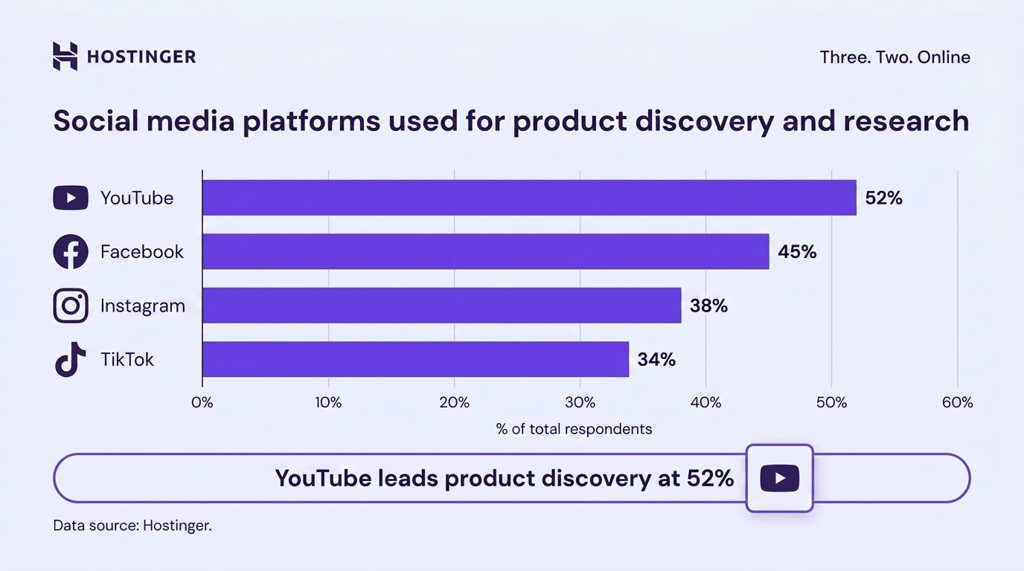
According to Hostinger’s social commerce study, influencer content holds 2.2x higher attention than average digital ads, and 82% of consumers use social media for product discovery and research, with YouTube leading at 52%, followed by Facebook at 45%, Instagram at 38%, and TikTok at 34%.
The 26% distrust figure deserves attention: the reliance of vibe marketing on influencer authenticity creates both its power and its risk. Partnerships that feel forced or misaligned undermine the emotional trust that makes the entire approach work.
Expert tip
Audience size is far less important than audience trust. A creator with 5,000 highly engaged followers in the right niche will outperform a mega-influencer with millions of passive ones every time.
The brands seeing the strongest returns are the ones treating creators as long-term partners, not paid distribution channels.

AI tools in vibe marketing: adoption and usage statistics
Three in four marketers have adopted AI tools, but most are still using them to send generic, one-way campaigns. That gap between adoption and execution is the defining challenge for vibe marketing practitioners right now.
- 51% of companies use generative AI for content creation, customer support, and process automation, making it the most widely adopted AI application among businesses (Hostinger AI statistics).
- 88% of organizations report regular AI use in at least one business function, with AI adoption in marketing and sales more than doubling since 2023. Note: this figure covers all AI, not generative AI specifically (McKinsey).
- 75% of marketers have adopted AI, yet most still use it to send one-way, generic campaigns, signaling a gap between tool adoption and genuine vibe-aligned personalization (Salesforce).
- 85% of marketers use AI for content creation, and those who do are 25%+ more likely to report campaign success (CoSchedule).
- 47–48% of marketers use AI specifically for image generation, making visual content production one of the leading AI use cases in marketing workflows (HubSpot).
- 49% of marketers say AI saves them 1–5 hours per week; 25% save 6–10 hours, equivalent to freeing between half a day and a full working day per week for strategy and ideation (CoSchedule).
- The generative AI in marketing market reached $1.56 billion in 2024, projected to grow to $22.02 billion by 2033 at a 35.1% CAGR (Grand View Research).
The 75% adoption figure paired with the “generic campaigns” caveat is the most revealing data point in this section. Most marketers have the tools; few are using them to deliver the kind of emotionally resonant, culturally specific content that vibe marketing demands.
Brand identity and consistency statistics
Nearly every brand has guidelines, but only one in four actively enforces them – and for vibe marketing, where aesthetic coherence is the product, that gap has a direct cost. Consistent branding is estimated to drive 10–20% revenue growth for brands that do enforce it.
- 95% of organizations have brand guidelines, but only 25% actively enforce them, suggesting most brands underinvest in the consistency that makes vibe marketing effective (Renderforest).
- 73% of global consumers say trust increases when a brand authentically reflects today’s culture, and 84% need to share values with a brand before making a purchase (Edelman Trust Barometer).
- Fostering emotional loyalty could boost annual revenues by 5% for retailers, based on a study of 9,213 consumers across nine countries. Note: this finding applies specifically to retailers (Capgemini Digital Transformation Institute).
- Nearly 40% of brands report that engaged community members are more loyal and tend to spend more over time, with community-building and brand aesthetic alignment compounding retention and lifetime value (Acxiom Fandoms and Communities Research).
- 92% of Gen Z and 78% of all consumers agree that the community surrounding a brand affects how they feel about it, making community-building not just a cultural asset but a measurable component of brand equity that compounds with aesthetic consistency (Sprout Social).
The 95/25 enforcement gap is where most vibe marketing efforts quietly fail. A brand can have a perfectly defined aesthetic identity on paper, but if it isn’t enforced consistently across every content creator, campaign, and channel, the emotional equity built in one touchpoint gets undermined in the next.
For vibe marketing, inconsistency isn’t just a brand management problem – it’s a conversion problem.
Aesthetic trend signals and platform discovery data
Vibe marketing plays out in real cultural micro-niches, not mass-market segments. The following data shows how aesthetic trends form, spread, and convert on social platforms.
- Pinterest Predicts 2026 flagged a new wave of aesthetic niches growing between 50–175% in search, providing brands with reliable early signals for content, product, and campaign planning (Pinterest Predicts).
- 81% of TikTok users say the platform has introduced them to topics or trends they didn’t know they liked, making TikTok the primary discovery engine for aesthetic culture and the starting point for many vibe marketing campaigns (TikTok Marketing Science).
- Sustained TikTok brand presence builds measurable trust: after consistent exposure to brand content, viewers trust the brand 41% more, are 31% more likely to be loyal, and 33% more likely to say the brand fits who they are (TikTok Marketing Science).
- Pinterest trends last nearly 2x longer than trends originating elsewhere on the internet, making Pinterest-sourced aesthetic signals more durable and commercially actionable for brands planning seasonal campaigns (Pinterest Business).
These figures are best treated as trending signals rather than hard market data: TikTok hashtag view counts are platform self-reported and fluctuate, while Pinterest Predicts data carries an 88% historical accuracy track record and is the most defensible source for aesthetic forecasting.
The future of vibe marketing
Vibe marketing is an AI-enabled, emotion-first operating model built for a generation that trusts authenticity over production value. The statistics across every section of this article point to the same conclusion: emotional resonance, cultural fluency, and community alignment are not soft brand values – they are measurable commercial drivers.
The trajectory is upward across every relevant dimension. The creator economy is projected to grow from $205 billion in 2024 to $1.35 trillion by 2033 at a 23.3% CAGR, establishing creator-led marketing as a long-term structural shift.
At the same time, 92% of companies plan to increase AI investments over the next three years, cementing AI-assisted creative production as the engine behind scalable vibe marketing.
The starting point for putting vibe marketing into practice is execution speed. Vibe coding tools like Hostinger AI Builder let you build web experiences through simple prompts, turning your brand’s aesthetic vision into a live product without writing a single line of code – exactly the kind of intuition-led, AI-first workflow that vibe marketing demands.


Daniela is an Off-Site SEO Specialist with extensive expertise in link building, digital PR, and content optimization. She has led international outreach campaigns across the U.S., Brazil, France, and Spain, securing high-quality backlinks. Follow her on LinkedIn.