I used em dashes before it was uncool (or: writing better with AI without the slop)
I might start talking a little about myself.
Before joining Hostinger, I spent six years at a Brazilian tech news website called MacMagazine, and in the newsroom I was known as the wordy one. I was never satisfied with only giving the news: I always added my opinion, a personal angle, a bit of humor… and lots of em dashes to hold it all together in the same sentence. Sometimes em dashes inside em dashes.
The dashes became a running joke among my colleagues, and my editors kept asking me to go easier on them. Bear in mind that was before AI was a thing and, therefore, before em dashes became the signal for “a chatbot wrote this.”
So when AI writing took over the world, I had to let go of my beloved em dash so I wouldn’t sound like a chatbot. I mean, I never did sound like one (I think!), but an untrained eye might have thought so.
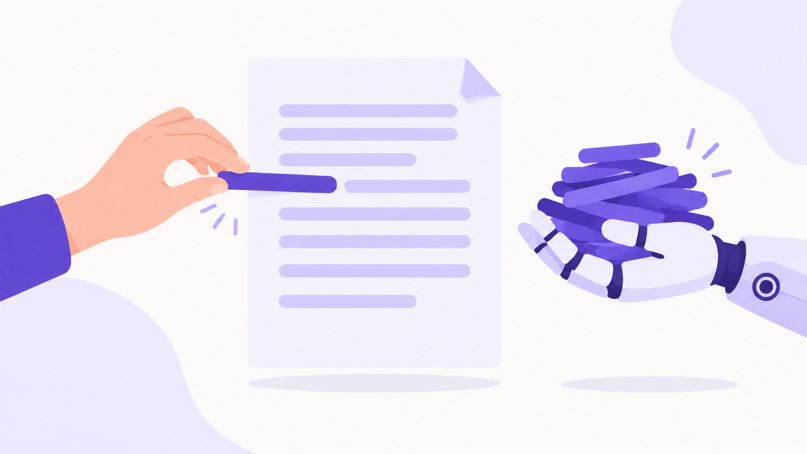
Cut to a few years later. Now I use AI every day to help me write the tutorials and blog posts for Hostinger, and along the way I’ve come to think that much of what we call AI slop started as nothing more than human habits, like my dashes. AI just has all of these habits at once, and none of the reasons behind them. That’s what slop is to me: writing on autopilot, where nobody decides which ones actually belong.
Writing, after all, is thinking before it’s anything else. And as much as AI can help me plan, research, draft, and correct, it shouldn’t replace my thinking; when it does, it shows up on the page.
This very piece you’re reading was written with AI’s help. And I’ll show you exactly where that help lands.
Slop is a habit without a reason
To be clear, my dashes were never the problem per se. I had a reason for each one, even the ones my editors cut. In Portuguese, the em dash, called travessão, is everyday punctuation for dialogue and asides, so mine came with the language.
A habit is a move you keep making because it worked before, long after you’ve stopped checking whether it fits. AI picked up thousands of ours from the writing it learned from, and it reaches for them by default, without asking whether the sentence in front of it needs them. That’s when a habit turns into slop.
Openings are a good example of this lack of judgment. Brazilian journalists have a name for an intro that circles its subject before landing on it: nariz de cera, or wax nose. Folha de S.Paulo, one of Brazil’s most influential newspapers, calls it a sign of wordiness that has no place in journalism. It wasn’t always considered bad writing, though: for decades, it was simply how Brazilian newspapers opened a story, until the lead took its place in the 1950s.
I asked several of my journalism professors why it’s called that, and none of them could fully explain it. The best guess I’ve found since is that a nose made of wax has nothing holding it up, just like a story with no lead.
In my experience, an AI intro written without guidance is a wax nose more often than not: a paragraph on why the topic matters before the topic shows up.
(If you noticed this article’s first line clears its throat a little: guilty. I kept it on purpose, because it’s the one throat-clear in here with a reason. It tells you a person is talking, and a wordy one at that.)
Endings have their own version. When I wrote about the AI to-do assistant our Head of Content built, the AI draft closed on her line about time, then added one more: “And her assistant still hasn’t sent a single message. That’s the point.”
Ana Hercigonja Galić, one of my editors at Hostinger, who reviewed the piece, suggested cutting it, and she was right: the quote had already done the work and had its weight to close the story. The extra line only told readers how to feel about it. A punchline to close a paragraph works in an op-ed, but after a quote that already lands, it’s one line too many.
What AI does better than me
The correction runs the other way, too. AI does three things better than me: keeping things short, polishing my English, and turning a vague idea into a concrete one.
I tend to write more than I need to express my point, and AI is good at suggesting shorter versions that readers can get through quickly. That matters a lot when they come to a tutorial to get something done.
Graciliano Ramos, one of Brazil’s great writers and a newspaperman himself, had a rule for this. “One should write the way the washerwomen of Alagoas do their work,” he said in a 1948 interview. “They wet the clothes, wring them, soap them, and wring them again until not a single drop falls.”
“Words weren’t made to decorate, to shine like fake gold,” he went on. “Words were made to say.” (The translation is mine.) That’s a job AI and I now share: sometimes it wrings out my drafts, and sometimes I wring out its.
The best example of the two working together came from that to-do assistant piece. Our Head of Content’s two AI assistants can’t talk to each other directly, so they pass notes through a shared Google Doc. My draft said something like “colleagues working from very different places.” The AI tightened it to “coworkers who sit on different floors.”
The idea was mine, but AI made it concrete.
This article had an interviewer
I didn’t plan this piece alone. Before writing a word, I asked my AI assistant to interview me about how I write with AI. It asked one question at a time and followed my answers wherever they went, rather than sticking to its list, just like a journalist would.
It was a good interviewer. When I told it about my em dashes at MacMagazine, it answered with three words: “That’s your hook.” It was right. It compared AI drafts of my published pieces with the final versions and asked which changes were mine. When I sent it the slides of a workshop I gave my team in Vilnius last year, it spotted nariz de cera in the transcript, garbled by the transcription tool, and asked me whether that’s what I’d said.
It also got things wrong. It first pitched this article as an editor’s guide to spotting slop. “I’m not an editor, I’m a writer,” I told it. It also dated the term at 70 years old with total confidence. According to media historian Cristiane Costa, the wax nose was already the norm in Brazilian newspapers in the 1920s, so the habit is at least a century old.
Halfway through our interview, I warned it that AI tends to be too literal and not very subtle, and that any idea I gave it would come back a bit too in-your-face. It agreed and suggested leaving the lines that matter most to me. That’s why the first and last lines of this article are completely mine, while the rest is a mix.
Here’s how AI suggested the opening of this article:
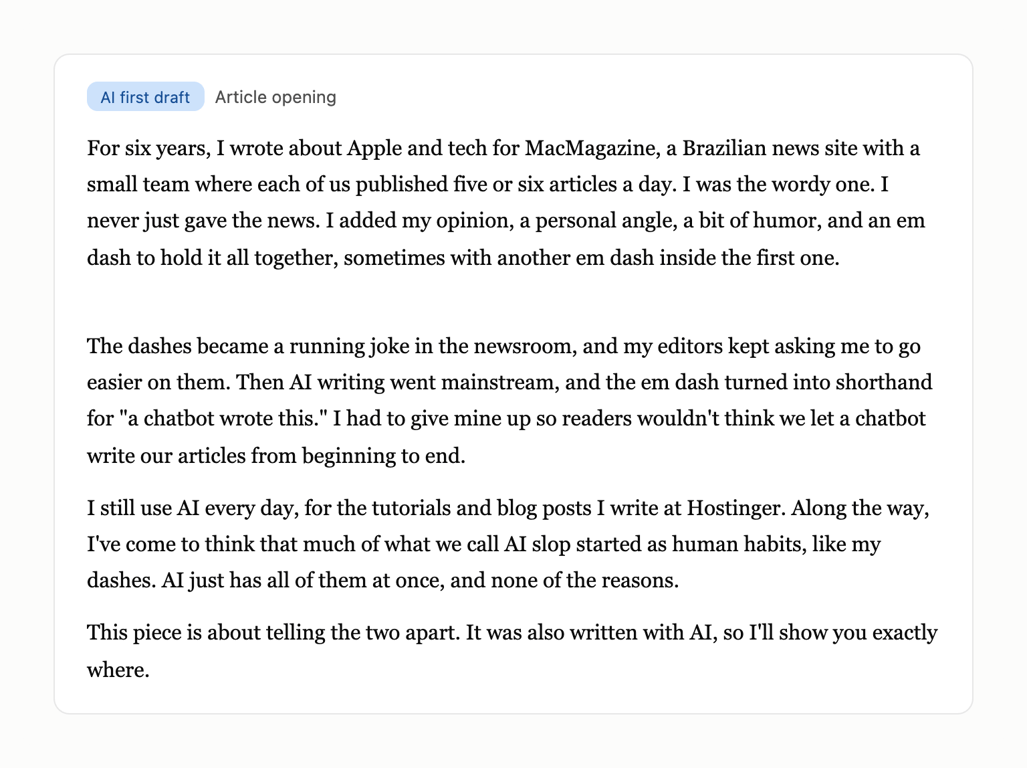
You’ve already read what I did with it: same facts, plus a confessed throat-clear, an “(I think!)” aside, and a screenplay-style “Cut to a few years later.” While the AI wrote a tidy opening, I wanted one that sounded like the wordy guy from the newsroom.
Turning my habits into rules an AI can follow
After the interview, I had a list of everything I usually fix by hand, and I wanted to see whether an AI could keep those reasons from one chat to the next, so I tried it with Hostinger Agent. It lets you save up to 4,000 characters of instructions as a custom skill and use them in any chat.
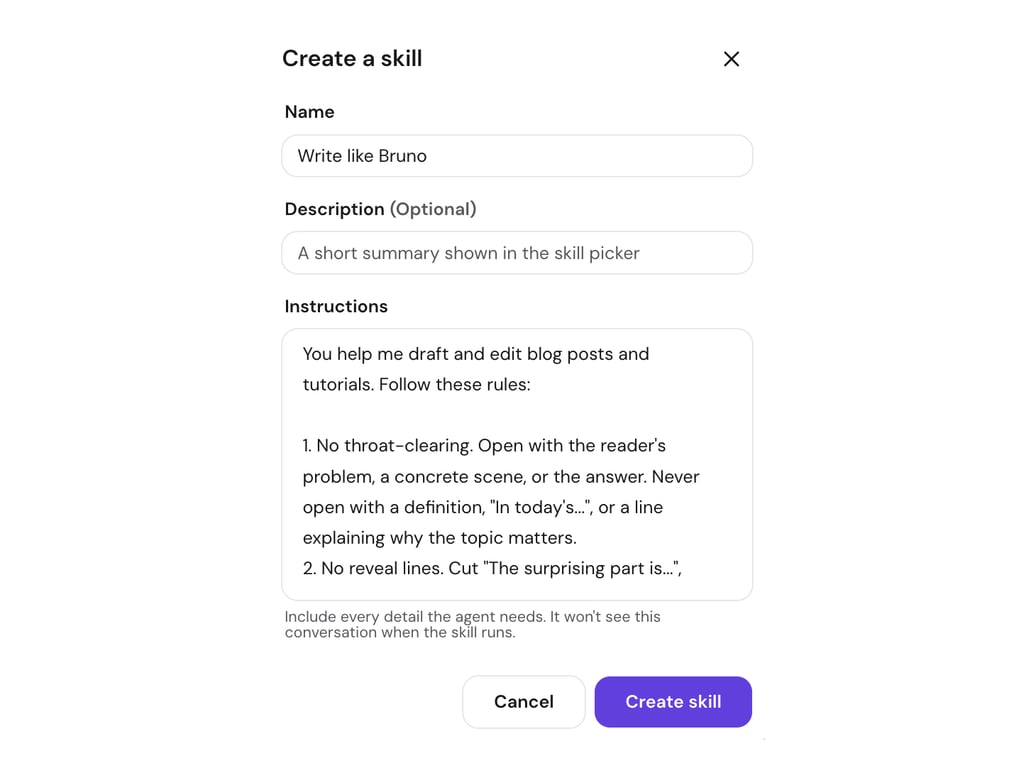
My skill, named “Write like Bruno”, has eight rules, and you’re welcome to steal them:
- No throat-clearing. Open with the reader’s problem, a concrete scene, or the answer. Never open with a definition, “In today’s…”, or a line explaining why the topic matters.
- No reveal lines. Cut “The surprising part is…”, “Here’s the thing”, “The lesson is clear”, and “not X, but Y”.
- No kicker. Don’t add a line after a strong quote or fact. If the material already lands, stop.
- A reason for every step. “Do X” becomes “Do X, because Y”.
- Context for outsiders. Explain anything a reader outside the company wouldn’t know, the first time it appears.
- Short paragraphs. Two to four sentences each, and no em dashes unless the sentence truly needs one.
- Sharper, not safer. When tightening my writing, keep my images, humor, and unusual phrasing. If you’d cut one, ask me first.
- No invented facts. Never invent facts, quotes, or numbers. Mark gaps as [NEEDS SOURCE].
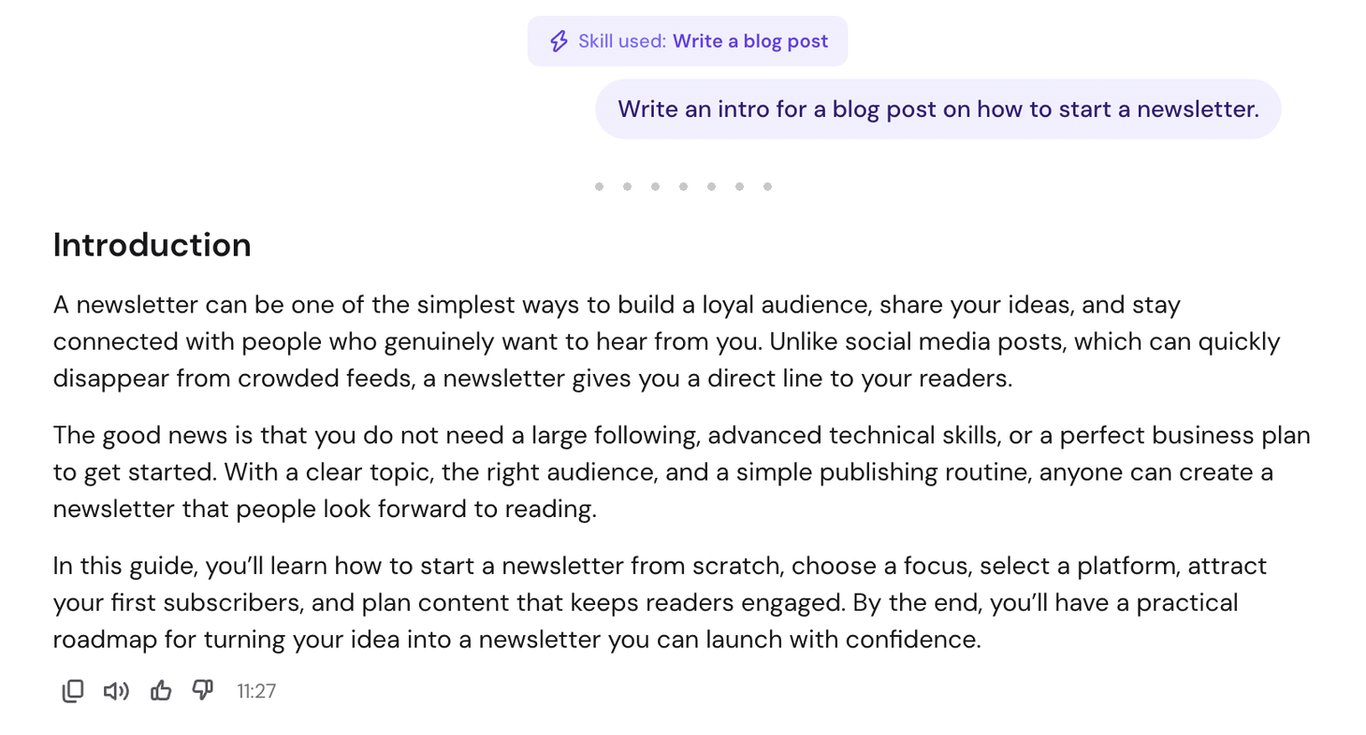
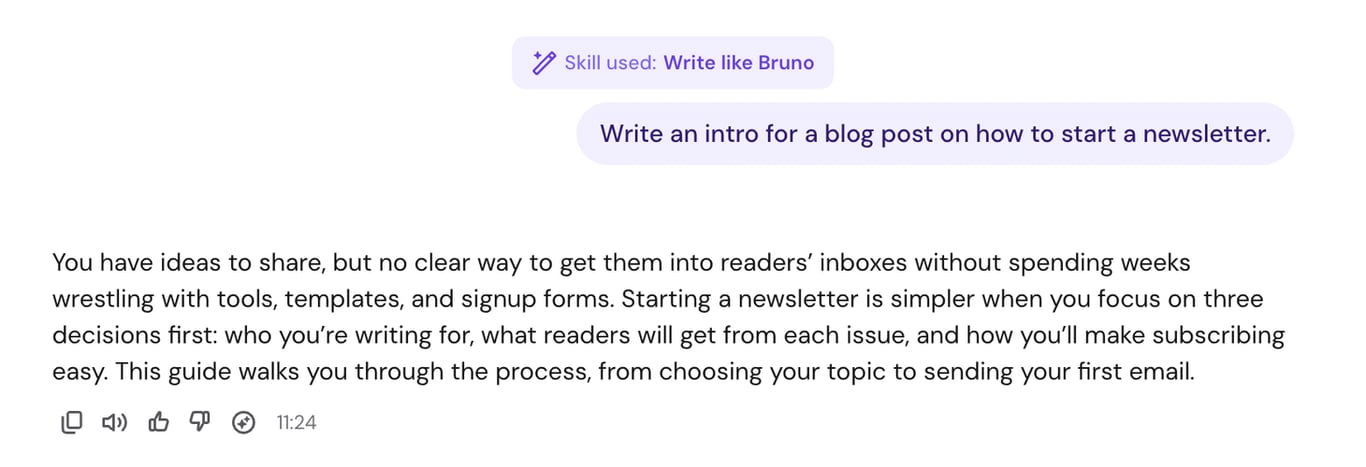
Then I gave the same prompt, “Write an intro for a blog post on how to start a newsletter,” to the built-in Write a blog post skill and to mine. The built-in skill asked three questions about niche, audience, and tone (I skipped them), proposed an outline that opened with “Why newsletters are still valuable,” and wrote a three-paragraph intro that opens by selling the idea of a newsletter.
Mine skipped the questions and opened with the reader: “You have ideas to share, but no clear way to get them into readers’ inboxes without spending weeks wrestling with tools, templates, and signup forms.”
The skill has limits, though. When I asked it to tighten a rough paragraph with that “colleagues working from very different places” comparison, it cleaned up the sentence around it but kept the comparison as vague as it was. So I added a rule telling it to make vague comparisons more concrete and tried again. The paragraph came back cleaner, but the comparison was still just as vague.
So the skill handles the rules it can check, like openings and dashes, but spotting a vague comparison is still on me.
What I actually do with AI now
None of this means writing without AI, but simply deciding which parts it gets and how to make the most of it. This is what that looks like for me:
- Make the plan before the prompt. I decide what a piece argues and who it’s for before AI writes a single paragraph, then shape the outline with it until it’s mine. For this piece, I had the angle and the meta layer in mind before the first outline, and I told the AI not to build one until I said so.
- Let it interview you. Before outlining this article, I had an AI ask me questions one at a time. Answering them brought up stories and examples I’d never have put in a prompt. The MacMagazine story that opens this article came out of a follow-up question about my newsroom days.
- Feed it real material. Transcripts, notes, published pieces, your own examples. A generic topic gets a generic draft back. For this one, I shared AI drafts of two published pieces next to their final versions, and comparing them produced several of the examples you’ve read here.
- Do the last pass in your own space. Once a draft is close, I move it to Google Docs and reread every section, rewriting anything that doesn’t sound like me. This article went through exactly that, and you can compare it with the AI’s version in the interview section.
- Open every source it cites. When I looked up the origin of the name nariz de cera, an AI-generated summary gave me a charming explanation but cited a source that says something else. I also checked Graciliano’s quote against the original Portuguese before trusting our translation.
- Write the lines that matter yourself. The first and last lines are where readers decide what you sound like, so I write mine myself. For the ending, the AI suggested a few angles, and one of them stuck. The line itself is mine.
Which brings me back to punctuation.
The one dash I kept
I still use em dashes, but only when a sentence truly needs one. Midway through my interview with my AI assistant, I used one without even noticing, in an answer about what matters most when I plan an article.
The AI noticed. “You used a dash in that answer, by the way,” it wrote. “It earned its place.”
So if any of my old editors at MacMagazine are reading this, yeah — it’s still me.

Bruno is a Content Writer at Hostinger, focused on creating and optimizing helpful, engaging articles about web development and marketing. With a background in journalism, he combines storytelling with practical insights to make complex topics easier to understand. He has also contributed to publications like MacMagazine and Jornal A Tarde. Outside of work, Bruno enjoys exploring art, cooking, and technology.