Sell it, then build it: a 7-step plan for one-person startups
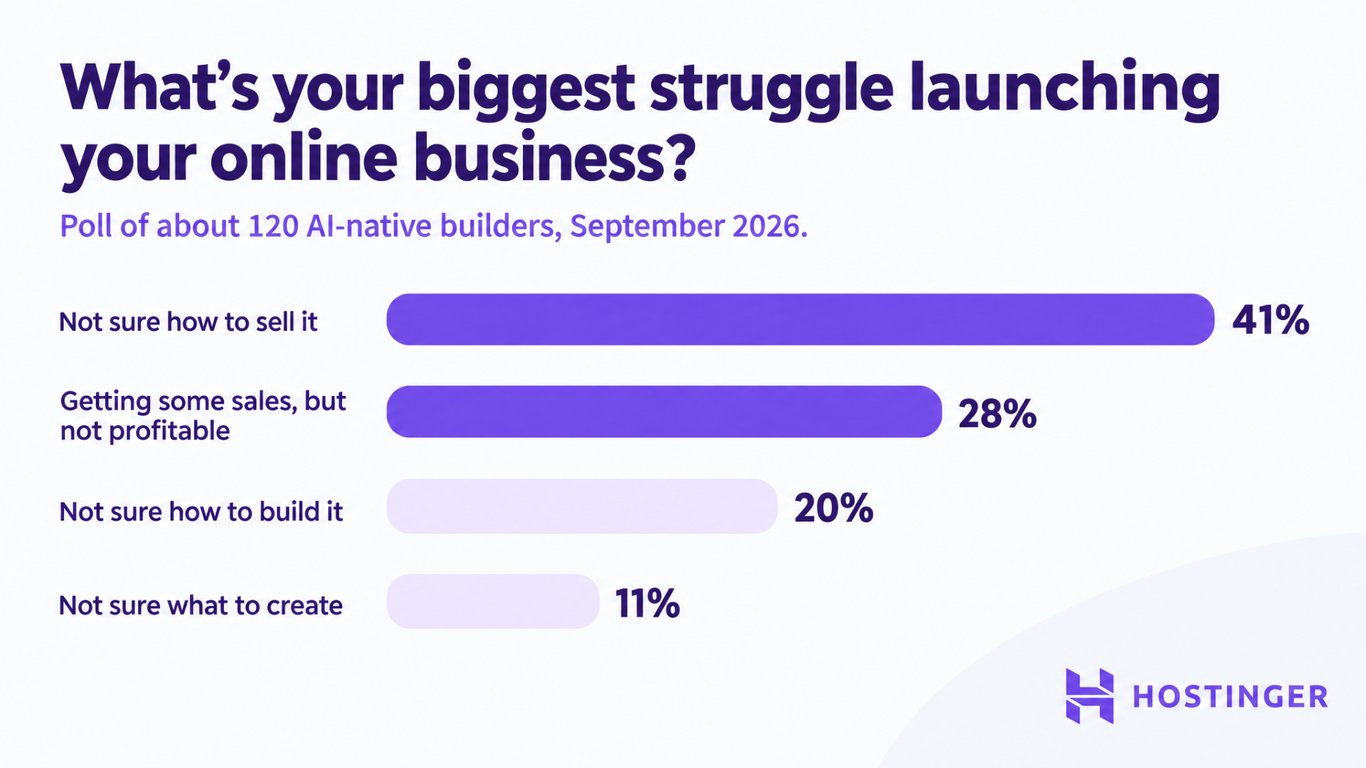
Only 20% of the AI builders we surveyed in September 2026 said building was their biggest struggle. The rest are stuck elsewhere: 41% aren’t sure how to sell their product, 28% make some sales but no profit, and 11% don’t know what to create yet.
We ran the poll at Rethinking the One-Person Startup, a masterclass we hosted with YourStory for VibeCode30, its list of Indian builders who ship working AI products. The sample is one self-selected room, so treat the numbers as a signal from this group, not the whole market.
Emilis Strimaitis, our Head of Product Innovation, who led the session, has a blunt read on that split: AI has made building so cheap that founders who build first can now fail faster than ever.
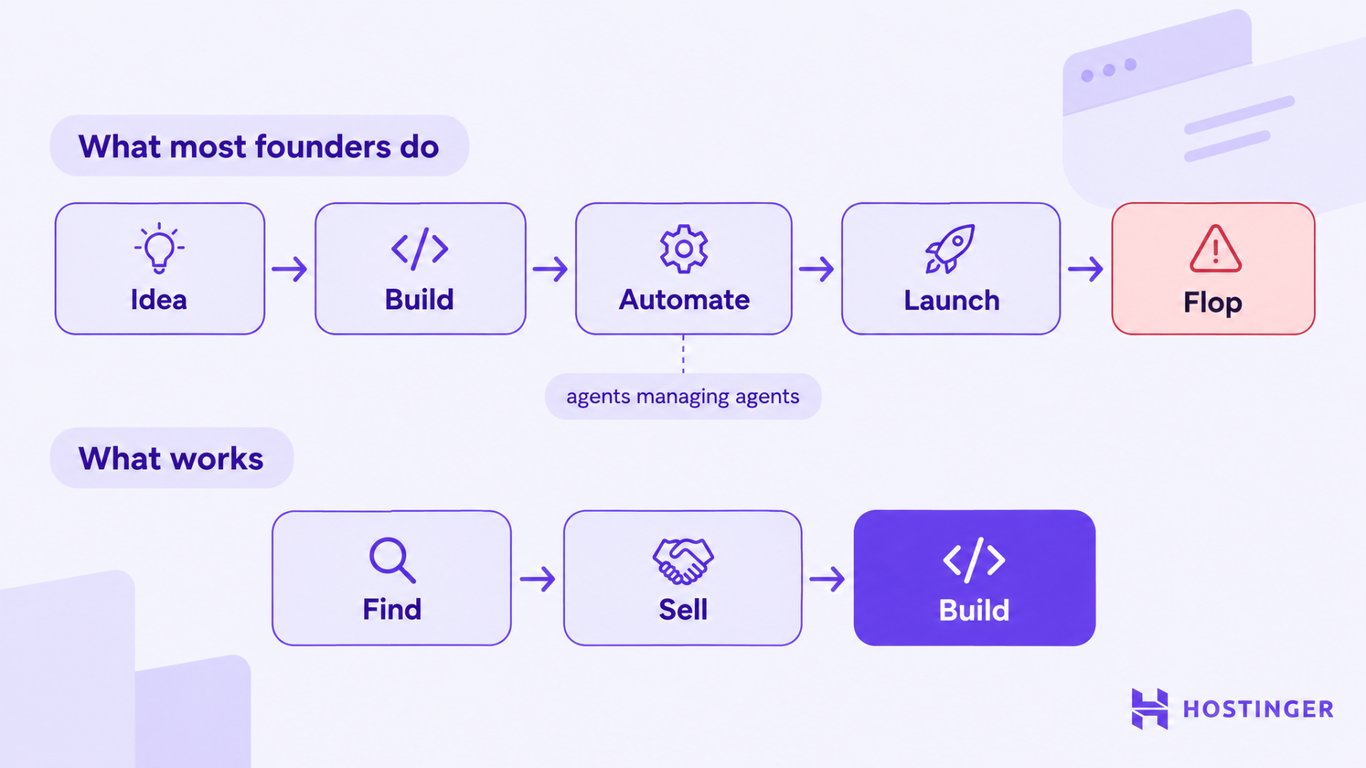
His fix is to change the order: sell first, build second, automate last. He shared his seven steps, two prompts, and a plan for your first week.
The same movie, every decade
In 2019, Emilis spent almost a year working with a developer agency on a shopping app called Swipio. It flopped for the reason behind all his losses: he built it before anyone had asked for it.
Today, vibe coding with a $200/month AI plan could build the same app in a weekend. That speed pays off once you know people want the product. Without that, the app would flop for the same reason, roughly 50 times sooner.
Speed helps your competitors as much as it helps you. “If you can build it in a weekend, so can thousands of people this weekend,” Emilis told the room. “You build something cool on Monday, and by Friday, there are going to be two or three copies. And one of them is going to be free.”
“Your product is now the cheapest part of your business,” he said. Getting it in front of buyers is the expensive part, and it has been for a long time.
He has watched this movie before. When ClickFunnels launched in 2014, as he remembers it, everyone built pages and almost nobody got visitors.
The AI-era version is one he sees every week. Someone builds a product with AI over a weekend, automates it, adds agents to run it, and then adds more agents to manage those agents. “They have zero customers, but it’s fully automatic. What we’re building here is a self-driving car that has no roads to drive on.”
Every win came from selling first
Emilis’ own record shows what the order looks like in practice.

In 2013, he was hand-coding geographically targeted web pages and selling them for $300 each. Clients kept coming back until he couldn’t keep up, which told him they’d pay for a faster, repeatable version.
So he paid a freelancer about $100 to turn the work into a small WordPress plugin. It sold more than $29,000 worth of copies. That same year, he used the money to fund a bigger tool, a $500 build with another freelancer, which made over $200,000 in profit.
Then, in 2014, he skipped the steps: encouraged by the traction, he poured money into a big template-building platform with “a lot of controls.” The development cost over $40,000, and the platform never launched. “It went nowhere because we were building something that nobody asked for.”
That’s the rule he works by now: AI makes every step faster, but it doesn’t let you skip any.
The selling machine: seven steps before one line of code
None of the seven steps involves code. Emilis walked the room through them with one running example, a service that creates and posts Instagram Reels for beauty salons, but your product doesn’t have to be software. The steps work just as well for a service, a PDF guide, a course, a template, or consulting.
1. Pick one group you can reach
A niche is a specific group of people, and it has to pass three checks: you can name them, you can find them online, and they already pay for something related to your idea.
“Small business owners, that’s not a niche,” Emilis said. “That’s probably half of India.” Salon owners who want more clients pass all three checks. It’s a big market, but still one group you can find and talk to.
Going narrow feels limiting at first, but he sees it as a head start: “Once you win one group, the next one is much easier.”
If you’re stuck, look for the overlap of three circles: what you’re good at, what people already pay you for, and what you enjoy or want to learn. In his view, the “I have a great idea” project usually sits outside all three circles.
You don’t have to find the overlap alone. Paste this prompt into Hostinger Agent or any AI assistant you already use:
Interview me to find my niche. Ask one question at a time, max 15: my jobs, what people ask me for help with, what I've fixed for friends, tools I know, what I've paid to learn.

Then give me a shortlist of 10 product ideas for that niche, where what I'm good at meets what people already pay for. For each: who it's for, format, and price.
2. Mine the 1-star reviews for a pattern
Take the first idea on your shortlist and list what your niche already pays for. For salon Reels, that’s booking and marketing apps like Fresha and Zenoti, local agencies and freelancers, and Reels courses and templates made for salons.
Then read the bad reviews. Where you look depends on what they pay for: G2, Capterra, and Google Play for apps, Google Maps and local directories like Justdial for agencies, and Reddit and Facebook groups for owners talking among themselves. To find Reddit threads fast, run a Google search like this:
site:reddit.com [niche] "waste of money"Copy about 50 complaints, word for word. As Emilis’ slide puts it, 1-star reviews are a free business plan.
Then run the idea through three tests:
- Same pain, again and again – If people complain about different things, “that is noise. That is not a pattern.”
- Paying buyers – Check whether the complaints come from paying buyers or from freebie seekers on free plans. Emilis also checks the Meta Ad Library. In his experience, a competitor running ads for more than three months means there’s a paying crowd.
- Room to improve – Look for specifics, like a tool that’s too slow, has too many buttons, or confuses people.
If the idea fails a check, go back to your shortlist and take the next one. If it passes, run the complaints through the second prompt:
You're a product researcher. My idea: [idea] for [niche]. Here are 50 real complaints about what they pay for now: [paste complaints]

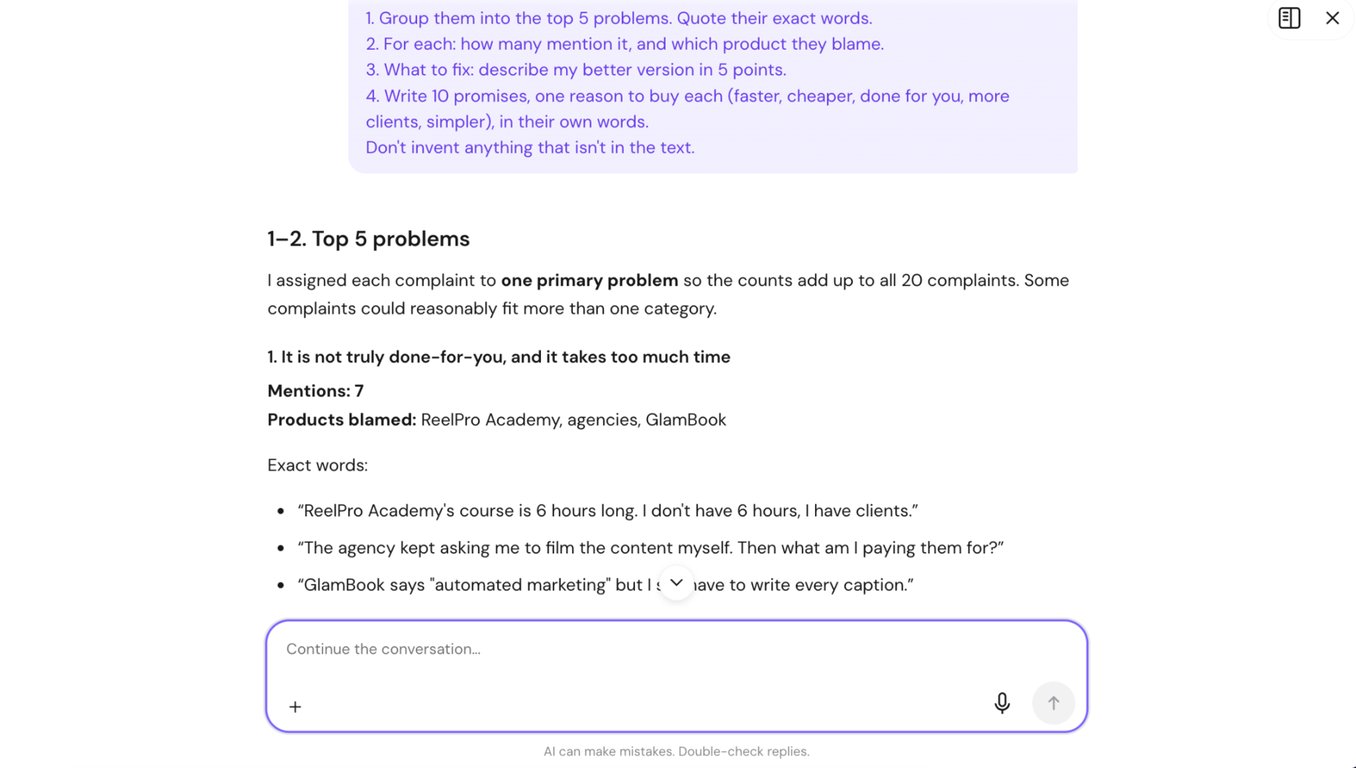
1. Group them into the top 5 problems. Quote their exact words.
2. For each: how many mention it, and which product they blame.
3. What to fix: describe my better version in 5 points.
4. Write 10 promises, one reason to buy each (faster, cheaper, done for you, more clients, simpler), in their own words. Don't invent anything that isn't in the text.
The last instruction reduces the risk of AI filling gaps with guesses. “We’re not allowing AI to invent anything,” Emilis said. “We are allowing users to be our voice.” The output tells you what to fix and gives you the words to sell it.
3. Write 10 promises and build 10 pages
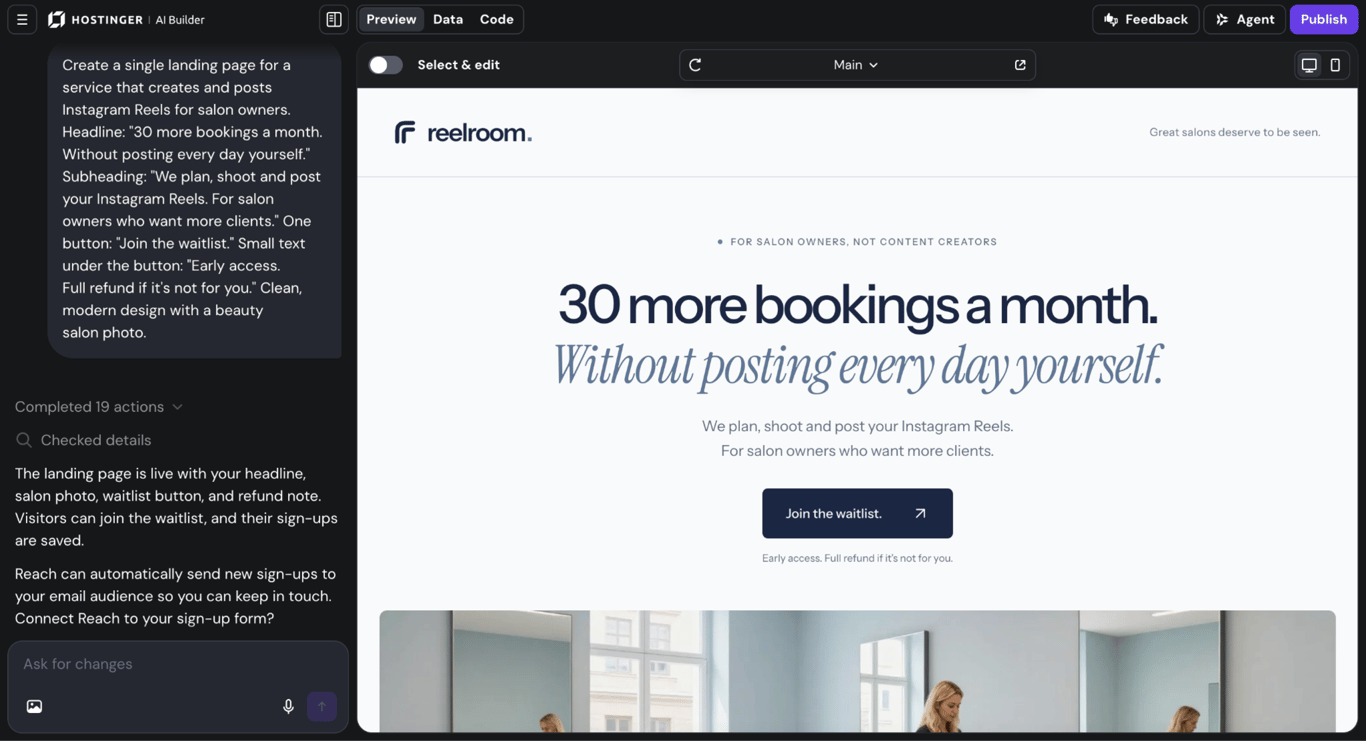
You don’t know yet which promise will land, so test all 10. For salon Reels, Emilis showed five of them:
- Faster – Your first Reel live in 48 hours.
- Cheaper – Half the price of an agency.
- Done for you – We shoot and post. You do the hair.
- More clients – 30 more bookings a month.
- Simpler – One WhatsApp photo a week. That’s it.
Each promise gets its own page with a headline, a short description, and one button. The button can take a pre-order through a payment link or online store, or add people to a waitlist.
Building 10 pages by hand is the slow part. Hostinger AI Builder can draft each one from a short description, so you can focus on the wording.
Emilis’ sample page for the “more clients” promise paired a founding price with early access and a full refund.
Hostinger customer Sola Cosmetics did the same: its founder, Fernanda Ito Toda, checked demand with her Instagram followers before producing a single tube of foot cream, then opened pre-orders two months before launch.
Before you take pre-orders, set clear delivery dates and refund terms, and check your payment provider’s rules and local consumer laws.
4. Post every day for 30 days
You can buy traffic or earn it. Search traffic is worth building, but it won’t show up within 30 days. Social media will, which is why Emilis starts there.
Pick one platform where your audience already spends time: Instagram Reels or YouTube Shorts for consumers, LinkedIn for business audiences, or X for tech. Post every day for 30 days. Each post covers one promise and links to its page, so over the month, each of your 10 promises gets three posts.
Expect a slow start. “Assume that nobody is watching it. Just keep on posting,” Emilis says. You don’t need to film daily, either: record one longer video a week and cut it into clips.
Daily posting moves most of your time from building to promoting. “We don’t want to build something for weeks and promote it once,” says Emilis. “Instead, we want to spend weeks promoting something and build it once.”
Keep the writing human. LinkedIn now limits how far generic AI-written posts travel, and a “Seems like AI slop” flag it launched on July 30 was used by more than a million people in its first two weeks.
5. Move sign-ups into a group you own
When someone signs up or pre-orders, invite them to a group from your thank-you page. Emilis argues that your followers on Instagram, LinkedIn, or X don’t really belong to you: “You’re just renting them. Instagram can change the rules tomorrow, and your posts will start reaching no one.”
WhatsApp is his pick because it’s easy and widely used, but a Telegram, Discord, or Facebook group, or an email list works just as well.
Only invite people who’ve already signed up or pre-ordered. Never add numbers yourself: “That is not cool, that is intrusive.”
Give the group a clear purpose, such as a group just for salon owners, with a name and a welcome message that says what it’s for. Don’t chase size: 10 to 20 of the right people is enough. “You want to have the people in your group that actually want to be there.”
Inside, skip the ads. Share useful tips and behind-the-scenes previews, and personally welcome every new member. In his words, “your group becomes your free research team.”
6. Borrow small audiences
While your own audience is still small, partners can lend you theirs. Look for small creators with 5,000 to 50,000 followers, or admins of groups in your niche, and pick accounts whose posts get real comments on top of likes and views.
Engage before you pitch: like, comment, and get on their radar. Then reach out with something useful, like the message Emilis shared:
Hey, I just love your post about hair and makeup. I help salon owners get more bookings. Can we make something for free for your followers?What you offer can vary: 50% of every sale, a free month for their fans, or a post you make for them. Small creators tend to reply because they get less attention than big names, and in Emilis’ experience, 20 small creators are more powerful than a single big one.
7. Keep the winning promise, cut the rest
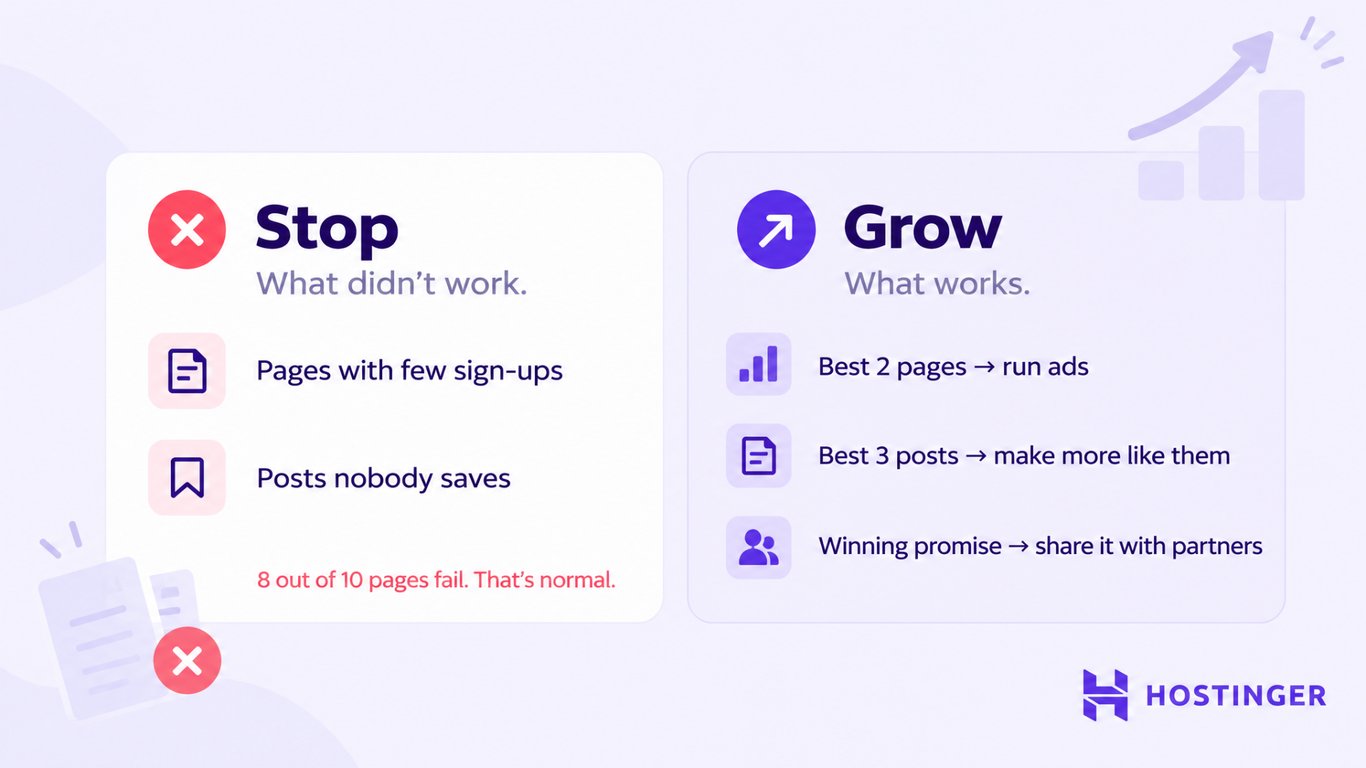
After 30 days, you’ll have data on which pages get sign-ups, which posts people save, and which promises pull. Expect most of them to fail. On Emilis’ slide, eight out of 10 pages failing is normal, which is why you test 10 promises instead of one.
Then act on it:
- Cut what failed – Drop pages with few sign-ups and posts nobody saves.
- Run ads – Send paid traffic to your two best pages. By now, you have data on what converts.
- Make more – Make more posts like your three best ones. “You don’t have to be original.”
- Share the winner – Give your winning promise to your partners so their posts lead with what already works.
Once a winner is clear, fold everything into a single offer with a single promise, and scale it.
Deliver the first 20 orders by hand, then build
Start with anyone who pre-ordered, and deliver by the dates you promised. After that, do each order manually, with no automation. Emilis’ example is a YouTube thumbnail service: sell 10 thumbnails for $29 using AI-made mockups, then make each order by hand with AI image tools and deliver it within 24 hours.
After about 20 orders, you’ll know what customers ask for, which steps repeat, and where the time goes. That’s your spec: build the product from it, then automate the manual steps last.
Your first week
You can run Emilis’ first-week plan with tools you already have: an AI assistant, a simple page builder, a payment or waitlist link, and an account on your chosen platform. “There’s nothing stopping you from using your existing stack,” he said.
Here’s the plan:
- Monday – Pick one niche and run the first prompt for a shortlist of ideas. Then collect 50 complaints and run the second prompt to choose one.
- Tuesday – Write 10 promises and build 10 pages, each with one button for a pre-order or waitlist.
- Wednesday – Start posting every day. Each post covers one promise, and your bio link points to that promise’s page.
- Thursday – Start your WhatsApp group and invite people from the thank-you page.
- Friday – List 20 small partners and start engaging with the best five, so you can pitch them the next week.
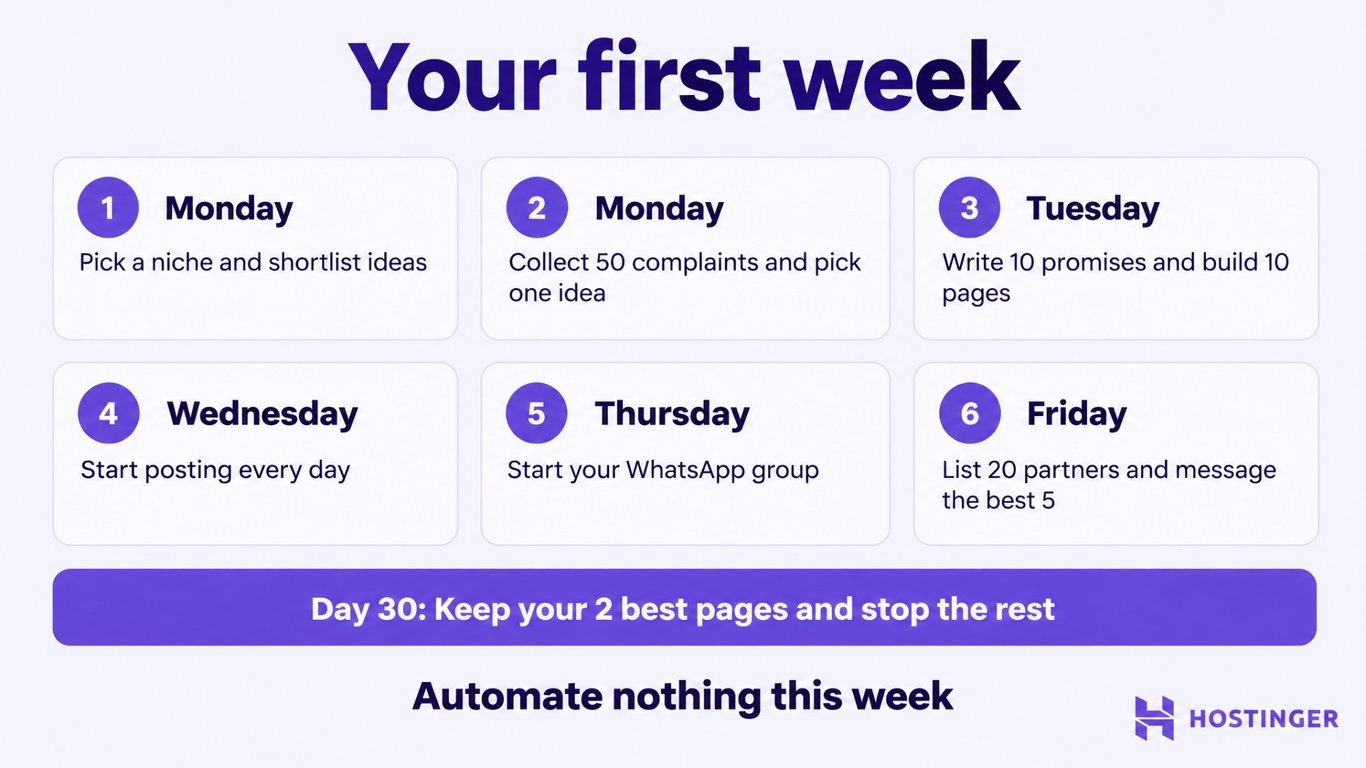
And one rule for the whole week: automate nothing.
Then keep going for weeks two to four: post daily, welcome new members, and track which promises get a response. At day 30, follow step 7.
If you’re one of the 41% who aren’t sure how to sell, this is where to start. By day 30, you’ll know whether there’s a road before you build the car.

Bruno is a Content Writer at Hostinger, focused on creating and optimizing helpful, engaging articles about web development and marketing. With a background in journalism, he combines storytelling with practical insights to make complex topics easier to understand. He has also contributed to publications like MacMagazine and Jornal A Tarde. Outside of work, Bruno enjoys exploring art, cooking, and technology.