Best time to send Black Friday emails in 2026
With 78% of marketers using email as part of their multichannel strategy, it’s no surprise that inboxes are crowded with competing promotions during Cyber Week. Getting your send timing right can help your message get seen and acted on.
That’s why there’s no shortage of advice on when to send.
Send at 6 a.m. Send at 9 a.m. Send on Tuesday. Send before everyone else does.
But much of that advice is based on someone else’s data, and sometimes, it contradicts itself.
So we looked into our own data – Hostinger Reach’s sender base during Black Friday 2025 – to discover the send and engagement patterns across the BFCM (Black Friday and Cyber Monday) week.
One of the most striking findings is also the most counterintuitive: the busiest sending hours were never the best-performing ones, while moderate-traffic windows consistently performed better.
Here’s a closer look at what the data showed and how you can use it to decide when to send your own Black Friday emails.
How we measured the Hostinger Reach data
We analyzed email volume and engagement data from Hostinger Reach during the BFCM week in 2025, examining when emails were delivered and when recipients opened or clicked them.
This let us connect each engagement event to the hour the email was originally delivered, rather than the hour when the open or click happened.
To see how patterns shifted as Cyber Week approached, we compared three periods: a baseline week (November 3–9), a ramp-up period (November 17–23), and Cyber Week itself (November 27–December 1).
All times are recorded in UTC.
Best day to send: Black Friday wasn’t the busiest day
Despite being the day the whole week is named after, Black Friday ranked fourth by send volume in Reach’s data.
Cyber Monday accounted for the largest share of the week’s email volume at 26.6%, followed by Thanksgiving at 23.4% and Sunday at 21.2%.
Black Friday came in fourth at 17.3%, while Small Business Saturday was the quietest day at 11.5%.
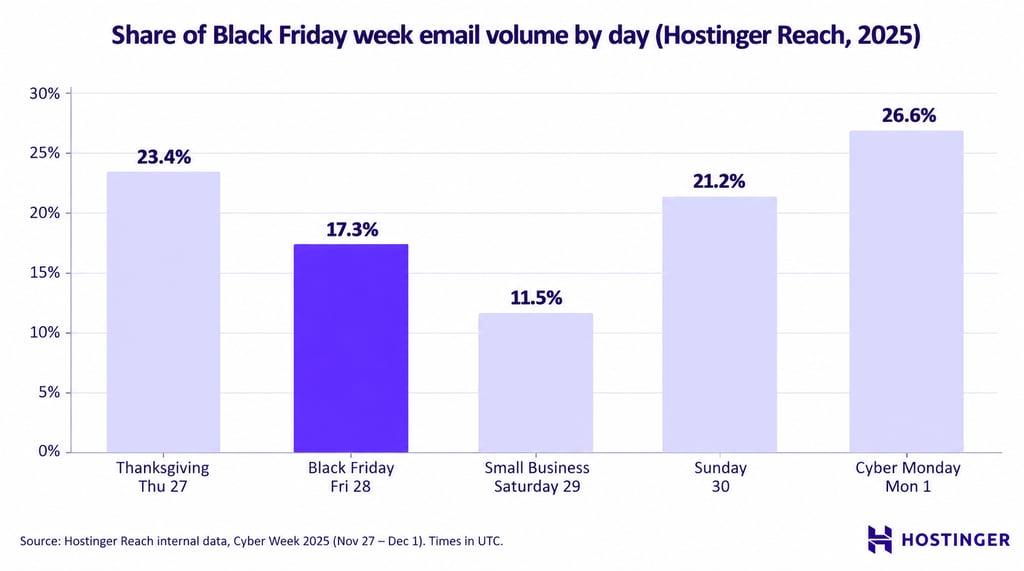
The distribution suggests that many senders spread their campaigns across the week rather than concentrating volume on Black Friday itself. And the inbox was actually more crowded on Cyber Monday.
Best hour to send: The busiest windows were never the best ones
The data shows that the hours when the most emails were sent tended to have the lowest open rates.
The four busiest delivery hours, ranked by volume – 12:00, 07:00, 13:00, and 21:00 UTC – accounted for about 31% of the week’s emails, but none had an open rate above 22%.
The better-performing hours came outside this group. 08:00 UTC had the highest open rate at 32.0%, while 15:00 UTC stood out for both opens and clicks, with a 31.1% open rate and a 2.9% click-through rate.
Additionally, open rates topped 25% at 10:00, 16:00, and 20:00 UTC.
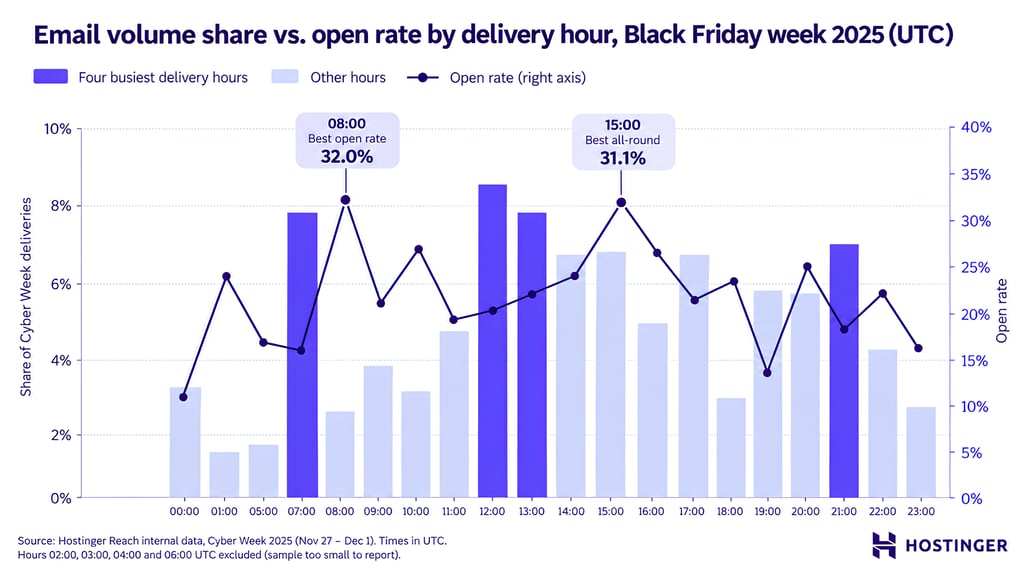
Lower volume wasn’t a guarantee of strong performance – a few quiet hours underperformed, too. But across the busiest hours specifically, none exceeded 22%, which was the clearer and more consistent signal.
The data doesn’t tell us exactly why this pattern occurs. One possible explanation is inbox competition: when fewer senders are sending at the same time, individual emails may have more room to get noticed.
How the best sending hour shifts by day
The strongest sending window didn’t stay fixed across the week. There’s a clear split: midday to mid-afternoon on working days, and morning on weekends.
On weekdays, the pattern was fairly consistent.
Thursday performed best at 12:00 UTC, with a 28.3% open rate and 2.9% CTR, although this specific hour still averaged below 22% for the week overall.
Friday and Cyber Monday both peaked at 15:00 UTC, with a 30.6% open rate on Friday and a 28.1% open rate and 3.4% CTR on Cyber Monday.
The weekend shifted the window earlier. Saturday’s best hour was 09:00 UTC; Sunday’s was 08:00 UTC, with a 27.8% open rate and 3.1% CTR.
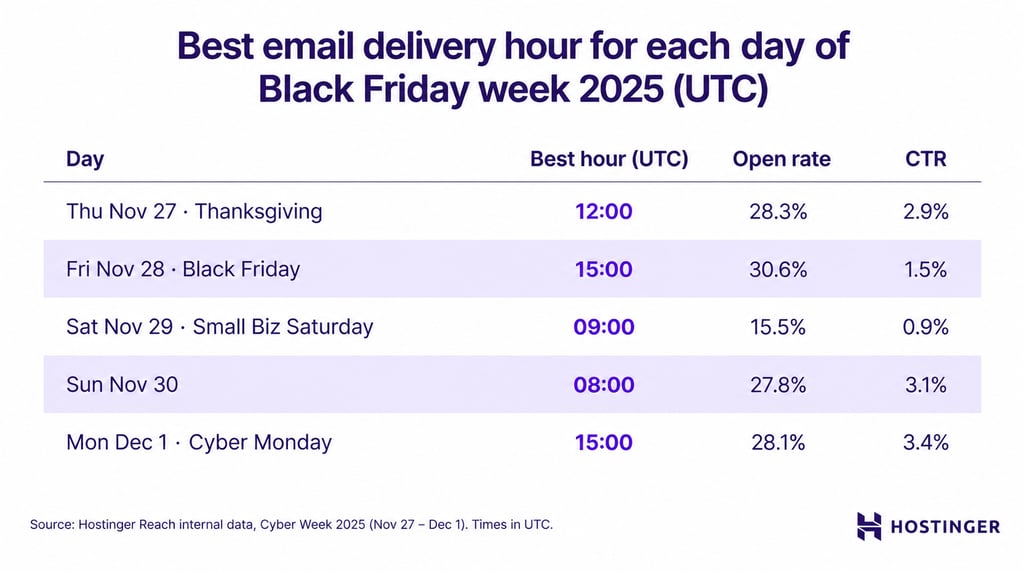
Saturday is worth noting in isolation. It was the lowest-sending day of the week, and even its best hour saw just a 15.5% open rate and 0.9% CTR – roughly half the open rate of the weekday peaks. The data doesn’t suggest that sending more on Saturday would lead to stronger results – it was a quieter day in both volume and performance.
Opens and clicks don’t always peak at the same time
Our data shows that the hour when people are most likely to open the Black Friday emails isn’t necessarily the hour when they’re most likely to take action.
On Black Friday, 15:00 UTC had the highest open rate at 30.6%, but its CTR was just 1.5%. Clicks peaked at 22:00 UTC, with a 4.0% CTR.
In other words, the hour that drove the most opens wasn’t the hour that drove the most clicks.
Attentive’s 2025 BFCM analysis of 2.07 billion email sends from 217 US retail brands found a similar pattern at scale. Its strongest engagement and conversion windows occurred at different times, and both varied from day to day.
That distinction matters when deciding what you want your send to achieve.
If opens are the priority, morning windows may be worth testing. If clicks or conversions matter more, the optimal window may shift – and can vary by day.
How Hostinger Reach’s data findings compare to other sources
Reach’s findings sit within a broader landscape of BFCM timing research, and the variation across sources helps explain why there’s no single universal answer.
Klaviyo’s data from Black Friday 2024 identified 9–10 a.m. ET is the busiest sending hour, with more than 420 million messages sent in that window. Peak order volume followed at noon–1 p.m. ET.
Do note that Klaviyo’s sender base skews more toward the US, while Reach’s skews more toward Europe, so the two reflect different audiences rather than contradicting each other.
Omnisend’s Black Friday-specific guide recommends 6–9 a.m. or 8–10 p.m., noting that these windows tend to outperform midday sends.
SiteGround Academy names Friday mornings before 8 a.m. as the single best time, without citing supporting data. And the familiar advice to send on Tuesday comes from general email marketing benchmarks, not anything specific to Cyber Week.
The variation isn’t surprising, as each dataset reflects a different sender population, time period, and measurement method.
That’s why the most useful insight from these articles isn’t a universal “best time.” Instead, you need to look at how different audiences behave, then use the data closest to your own audience as a starting point.
How to apply these insights to your Black Friday campaign
None of these datasets, Reach’s included, should be treated as a fixed schedule to copy. The more useful approach is to treat the findings as hypotheses to test against your own audience.
Here’s what Hostinger Reach’s data suggests as a starting framework to decide on your best time to send Black Friday emails:
- Skip the crowded hours. The data consistently showed that the busiest sending windows had the weakest engagement. If you’re choosing between a peak hour and one slightly earlier or later, the less crowded option is worth testing first.
- Adjust by day. Reach saw stronger engagement around midday to mid-afternoon on weekdays, and in the morning on weekends. Map that pattern to your audience’s local time zone rather than copying the UTC hours directly.
- Separate your goals. If email open rate matters most to you, the data generally points to morning windows. If clicks and conversions are the priority, look at what happened later in the day – and test accordingly.
- Don’t equate send volume with purchase intent. Cyber Monday led in both email send volume and sales during Cyber Week 2025 – accounting for 32.2% of Cyber Week sales compared to Black Friday’s 26.7% – but the gap is closing year-on-year, according to recent Black Friday statistics. So, spreading your campaign across the week is a safer bet than concentrating everything on one day.
- Use your own data to calibrate. Audience, geography, industry, and campaign type all affect when people engage. Reach’s findings give you a starting hypothesis – your own list gives you the answer.
Ultimately, send timing is one of several inputs. List quality, offer strength, and deliverability all play significant roles in determining whether an email performs, regardless of when it lands.
For the full campaign planning process, see our complete guide to Black Friday email marketing strategy.
Expert tip
During Black Friday week, inboxes get crowded, and email providers pay closer attention to sender behavior. Sudden spikes in sending volume, high complaint rates, and large numbers of unengaged contacts can all hurt deliverability.
That’s why list quality should come before send time. Focus your Black Friday emails on people who have recently opened or clicked, and suppress contacts who haven’t engaged. A well-timed email can only perform if it reaches the inbox in the first place.

Make this Black Friday your dataset
Every timing recommendation you’ll read this season, including the ones in this article, is based on someone else’s audience.
Hostinger Reach’s data is useful because it’s specific and up to date, but its real value is as a starting point, not a schedule to follow blindly.
The best way to find your own answer is to test. Pick one or two windows from the data, use them in your Black Friday campaigns, and look at how opens and clicks vary by hour and day.
By next year, you’ll have something more relevant than any industry benchmark: a pattern of your own audience’s behavior.
If you don’t want to schedule every test manually, Hostinger Reach’s Smart Sending can help by adjusting delivery based on when individual contacts have previously opened emails – and it’s included in our Black Friday deals.
Five days of your own results can tell you more than five hundred pages of benchmarks.
So, what will you test first?

Larassatti Dharma is a content writer with 5+ years of experience in the web hosting industry. She has populated the internet with over 100 YouTube scripts and articles around web hosting, digital marketing, and email marketing. When she's not writing, Laras enjoys solo traveling around the globe or trying new recipes in her kitchen. Follow her on LinkedIn