Top 34 WordPress statistics for 2026: Market trends and insights
Jan 13, 2026
/
By Ricardo
/
10 min Read

WordPress began as a blogging tool and now leads the content management system (CMS) market. As of 2026, this open-source platform powers almost half of all websites, making it the most widely used CMS globally.
There are many reasons why WordPress gained that position, starting with the most significant factor of all: it’s free. It’s also versatile: you can create blogs, portfolios, news sites, and ecommerce stores, to name a few examples.
In addition, there are thousands of plugins and themes available, both free and paid, to help you build and customize your site.
Find out more about this online tool and its ecosystem through the most notable and interesting statistics below.
Top WordPress statistics for 2026
- In total, 43.5% of all websites use WordPress.
- Nearly 9 out of 10 WordPress sites are running on the most recent version 6.
- The average loading time for a WordPress website is 2.5 seconds on desktop and 13.25 seconds on mobile.
- Worldwide searches for WordPress average 16 million per month.
- More than 59,000 free plugins are available in the WordPress directory.
- Ecommerce stores using WooCommerce generate around $25M to $50M in annual revenue.
- On average, hackers attack a WordPress site every 32 minutes.
- More than 4.6 million online stores use WooCommerce as their ecommerce platform.
- Outdated plugins are responsible for 95% of WordPress vulnerability reports.
- The WordPress community has organized WordCamps in more than 71 countries.
WordPress usage statistics
What makes WordPress one of the most popular site-building platforms in the market? This open-source platform allows creators and developers to build simple and complex websites.
1. WordPress is used by approximately 43.5% of all websites
WordPress is the most widely used website-building platform, powering nearly half (43.5%) of all websites. The platform’s market share has increased from 21% in 2014.
Various factors contribute to the CMS’s popularity, including its user-friendly interface, extensive customization options, strong community support, and scalability for different types of websites.
2. WordPress dominates the CMS market with a 61.3% share
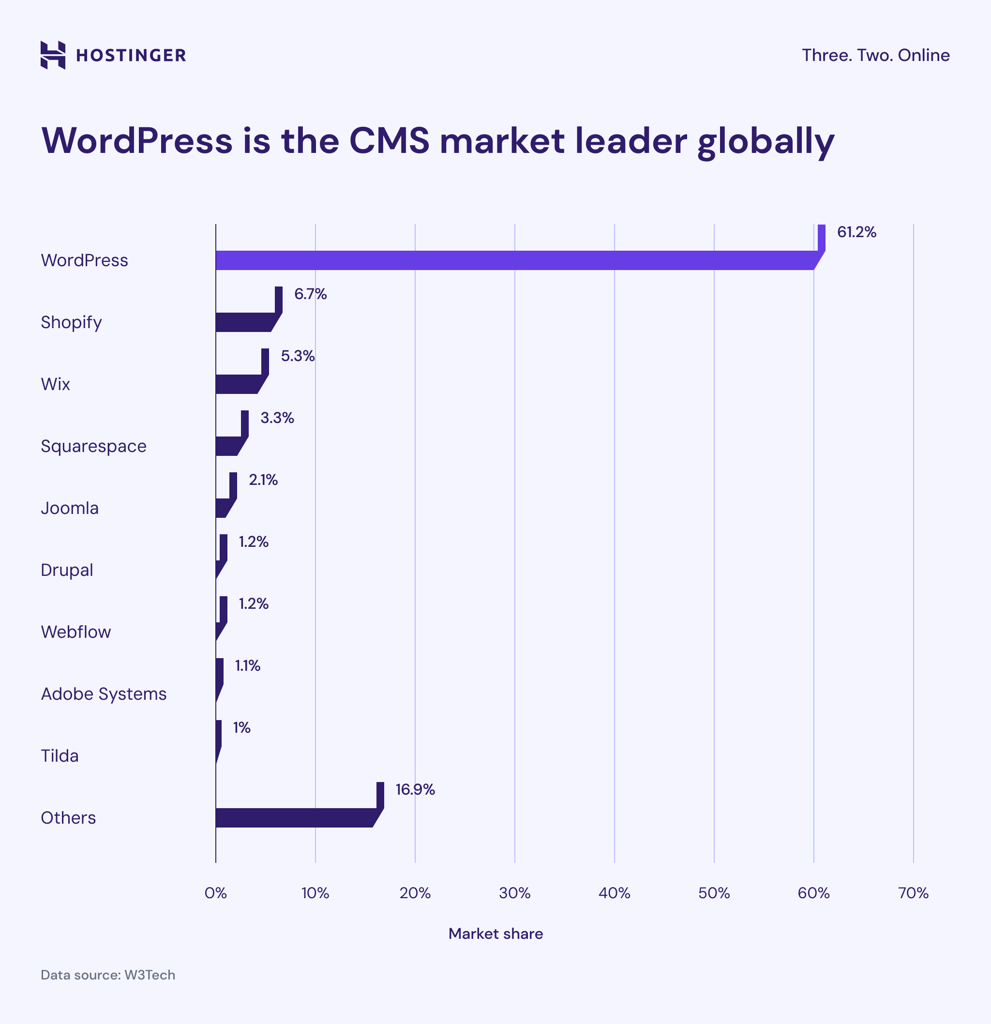
Over the past decade, WordPress has consistently been the fastest-growing CMS. As of 2025, it leads the CMS market share with 61.2%, 9 times higher than Shopify, its closest competitor (6.7%). Other popular site-building tools include Wix (5.2%), Squarespace (3.3%), and Joomla (2.1%).
3. WordPress version 6 is used by 88% of all WordPress websites
The vast majority of WordPress sites (88%) use version 6, while 8.6% and 3.2% run on versions 5 and 4, respectively. Only 0.3% of WordPress websites use version 3.
The latest major update (2025), WordPress 6.8 “Cecil”, introduces user interface improvements that provide a smoother, more secure, and more productive experience.
4. Over 522 million websites use WordPress
According to Netcraft, the total number of websites available will reach 1.2 billion as of 2025. WordPress’s market share (43.5%) means that more than half a billion sites run on this open-source platform.

5. WordPress is the top CMS at Hostinger with over 54% share
As of April 2025, Hostinger hosts more than 9.5 million websites. More than half of them (54%), around 5.2 million, are built with WordPress.
The dynamic and easy-to-use implementation of WordPress for various types of users translates to a rate of creation of 20,000 websites per day, according to Hostinger.
“WordPress continues to be the platform of choice for our users, and it’s no surprise ‒ scalability and flexibility match the needs of everyone from first-time bloggers to enterprise-grade site owners. The consistent growth we see reflects WordPress’s unmatched adaptability in today’s web ecosystem,” explains Marco Chiesi, Head of WordPress at Hostinger.
6. WordPress websites average 2.5 seconds load time on desktop and 13.25 seconds on mobile
WordPress-powered websites load on average in 2.5 seconds on desktop, equal to an average web page. On mobile it takes 13.25 seconds, 4.65 seconds slower than the average. Website loading speed depends on several factors, including the servers used for hosting and their configuration, the CMS version, and the volume of content on the page.
7. WordPress.com is popular for blogging
WordPress.org is a self-hosted platform, while WordPress.com is a fully hosted platform that handles all the technical aspects of site creation.
WordPress.com users publish over 70 million new posts and 77 million new comments monthly. According to the latest blogging statistics, there are more than 600 million blogs on the internet and at least 8.6% (52 million) are built with WordPress.com.
8. WordPress search volume reaches 16 million monthly
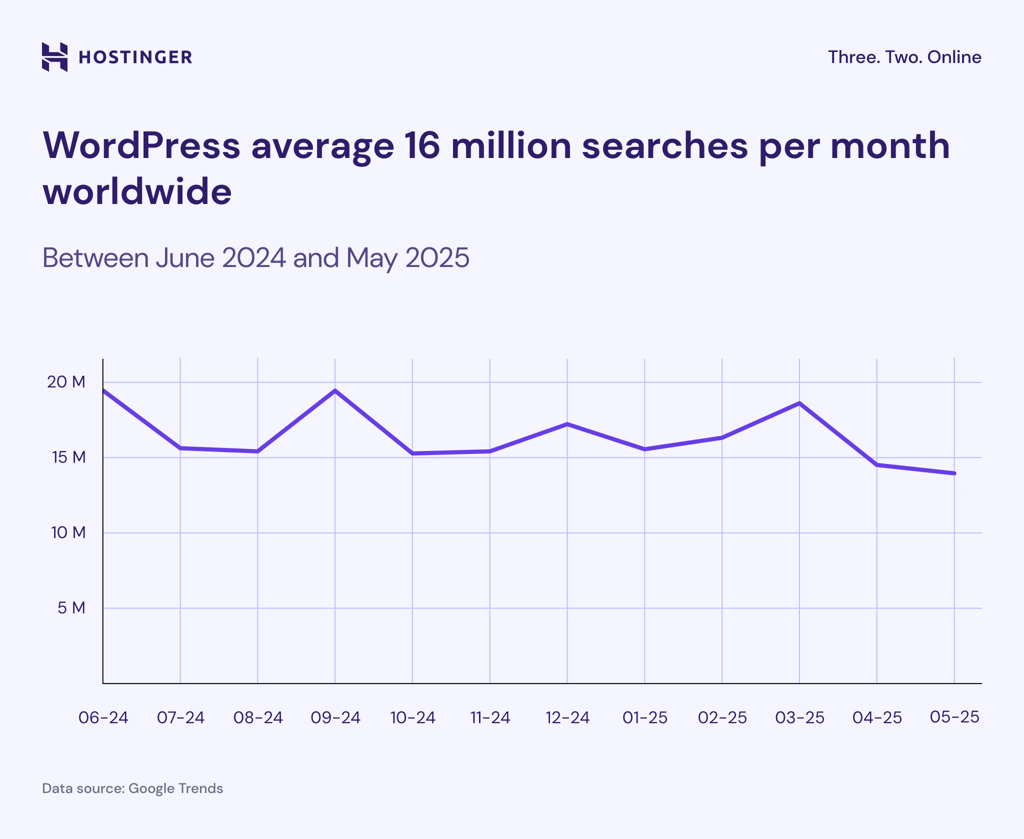
WordPress is one of the first available options for someone who wants to create a blog, launch a business or set up a portfolio of work samples. More than 16 million monthly searches target this CMS, indicating its widespread popularity and relevance.
WordPress plugins and themes statistics
WordPress offers many free plugins and themes for various functions and niches. All items in the WordPress directory are free, including 59,000 plugins and 12,000 themes, but most have paid premium versions as well.
9. There are over 59,000 free plugins in the WordPress directory
The WordPress plugin directory features around 59,600 free plugins. One of WordPress’ market strengths is the immense possibilities these tools offer to fuel creativity and enhance any site’s functionality.
The rich scale of options demands that users constantly monitor plugin use, as too many active plugins may affect site speed or stability.
10. Yoast SEO is the most installed and reviewed WordPress plugin
The Yoast SEO plugin has over 13 million active installations and around 28,000 user reviews, averaging a rating of 4.8 out of 5.
Other plugins – such as Elementor and Contact Form 7, which focus on website creation and user forms – have exceeded the 10-million mark for active installations.
11. Only 62 plugins have over 1 million active installations
While the official directory contains over 59,000 plugins, only 62 of them have surpassed 1 million users.
Those include some of the best WordPress plugins you might be familiar with, such as All in One SEO (AIOSEO), MonsterInsights, LiteSpeed Cache, and Starter Templates for Astra.
12. Over 13,000 free themes are available on WordPress
WordPress makes website design easy, offering around 13,000 free themes you can customize. Users can find web templates for dozens of categories, ensuring multiple options for specific needs.
You can download premium themes from third-party marketplaces like ThemeForest. It offers around 17,000 themes in various categories, and licenses cost anywhere from $5 to $299.
13. Astra is one of the best free WordPress themes
With over 1 million active downloads and more than 5,000 reviews, Astra is one of the most popular free WordPress themes on the market.
Its lightweight nature and compatibility with popular page builders are among the many reasons it has become such a favorite among WordPress users. Plus, Astra has over 100 site templates optimized for search engines, making it easier to attract visitors.
14. Among Hostinger clients, LiteSpeed Cache is the most popular WordPress plugin
Over 4 million Hostinger clients use LiteSpeed Cache on their WordPress websites, underscoring the importance of a fast-loading site. Other popular plugins include Elementor (3.2 million users) and WPForms Lite (1.8 million).
15. Twenty Twenty-Three is the most popular WordPress theme, according to Hostinger
Twenty Twenty-Three, launched in 2022, claimed the spot as the most popular WordPress theme in early 2025. Over 3.4 million Hostinger clients use the template. Twenty Twenty-Four (3.3 million users) and Twenty Twenty-Five (2.5 million) complete the podium of the most used templates.
16. EU mandates Cyber Resilience Act compliance by 2026 for plugin and theme creators
The European Union’s Cyber Resilience Act came into force in December 2024. All WordPress plugin and theme authors must have processes in place to notify authorities and users about all types of vulnerabilities by September 2026.
WooCommerce statistics
WooCommerce, the leading WordPress ecommerce plugin, powers over 4.6 million online stores, according to ecommerce statistics. The following insights highlight WooCommerce’s role in supporting businesses that aim to grow online.
17. WooCommerce stores generate an estimated $25-50 million in average annual revenue
WooCommerce-based websites attract substantial traffic, with data suggesting that stores using the platform generate between $25 million and $50 million in average annual revenue, highlighting its commercial significance.
18. WooCommerce stores make up 9.1% of all ecommerce sites
WooCommerce is by far the most popular ecommerce platform for WordPress. The plugin is used by 20.7% of WordPress sites and 9.1% of all ecommerce stores on the internet.

19. WooCommerce download rate: 50,000 per day
Since its inception in 2017, WooCommerce has been installed by more than 382,754,000 WordPress users, averaging roughly 50,000 downloads per day. By early 2025, the ecommerce plugin exceeded 8 million active installations.
20. WooCommerce leads the ecommerce platform market share
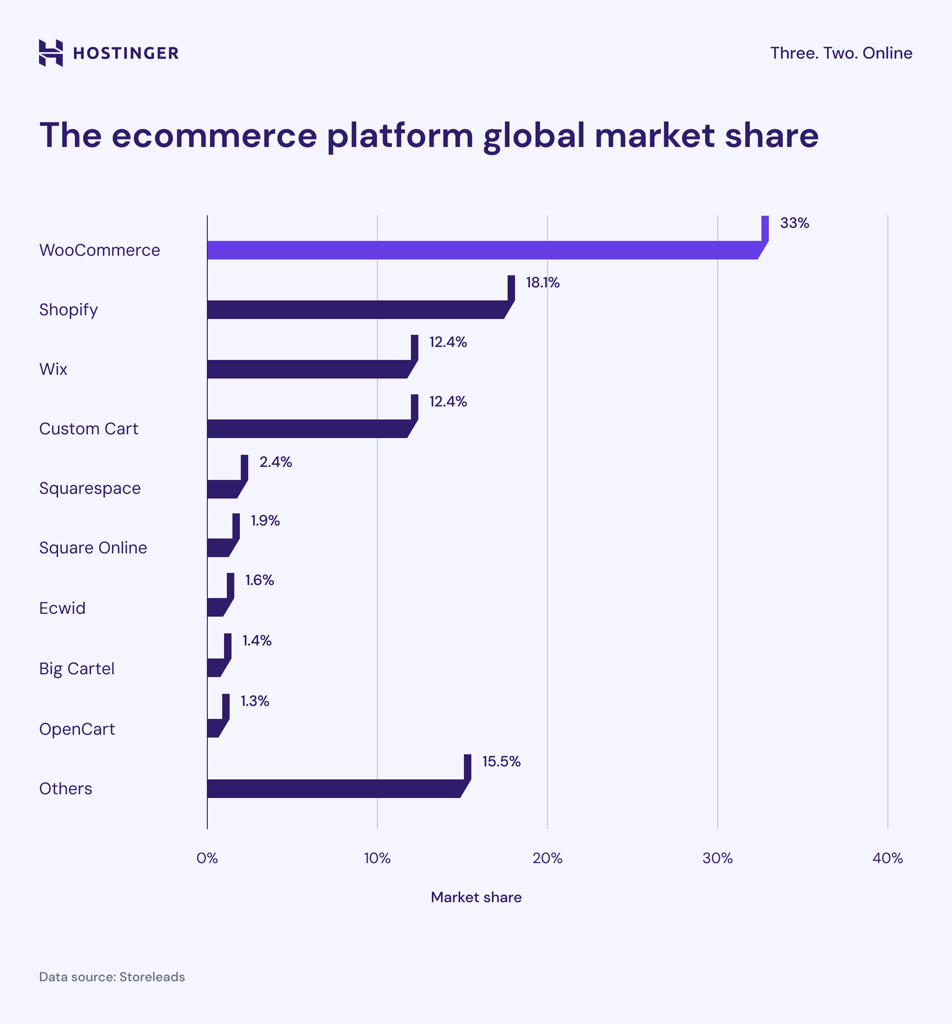
In 2025, WooCommerce established itself as the leading ecommerce software platform, making up 33% of the total market share. Shopify and Wix came second and third, with 18.1% and 12.4%, respectively.
21. Over 4.6 million stores are running on WooCommerce
There’s no doubt that WooCommerce plays a massive role in the online retail sector. In fact, there are 4,650,000 live ecommerce sites built with WooCommerce as of early 2025.
Product-wise, home appliances and apparel lead the way with around 220,000 stores each, followed by business & industrial (171,000) and food & beverage (150,000).
22. WooCommerce plugin usage climbs to 46% at Hostinger
Almost half of the websites hosted by Hostinger employ the WooCommerce plugin. Its widespread adoption among online businesses reflects its usefulness and popularity.
Hostinger’s WooCommerce hosting is a specialized service that provides hosting technology optimized specifically for WooCommerce-based websites.
23. Instagram marketing powers 37.9% of WooCommerce stores
Nearly 4 out of 10 WooCommerce stores leverage Instagram for marketing. The ecommerce software capitalizes on young adult audiences. According to social commerce statistics, 60% of Gen Z and 53% of millennials use Instagram to discover and purchase products.
24. Home and garden products are sold by 5.3% of WooCommerce stores
WooCommerce websites serve a diverse range of products. Home and garden items account for 5.3% of WooCommerce store offerings, the top niche category. The second and third product segments using this ecommerce software are apparel with 4.8%, and business and industrial equipment with 3.7%.
WordPress security statistics
Despite the many security plugins available, WordPress isn’t immune to cyberattacks and vulnerabilities. Identifying weak spots and developing new defense measures against multiple threats is a significant undertaking for its developer community.
25. A WordPress site is attacked every 32 minutes
WordPress sites face frequent security threats, with attacks now occurring on average every 32 minutes. In 2024, it was one attack every 22 minutes. The increase in time highlights that the security measures developed in the community are having an effect.
26. WordPress plugins are responsible for 95% of vulnerability reports
Plugins are the primary source of WordPress security issues, accounting for 95% of reported vulnerabilities within the web ecosystem. Extensions that are outdated or not hosted in the official directory are the primary sources of this susceptibility.
Given WordPress’s emphasis on scalability, working with plugins is crucial. Therefore, website owners must be aware of the current threat landscape and how to mitigate associated risks.
27. Malware is the most common type of hacking method
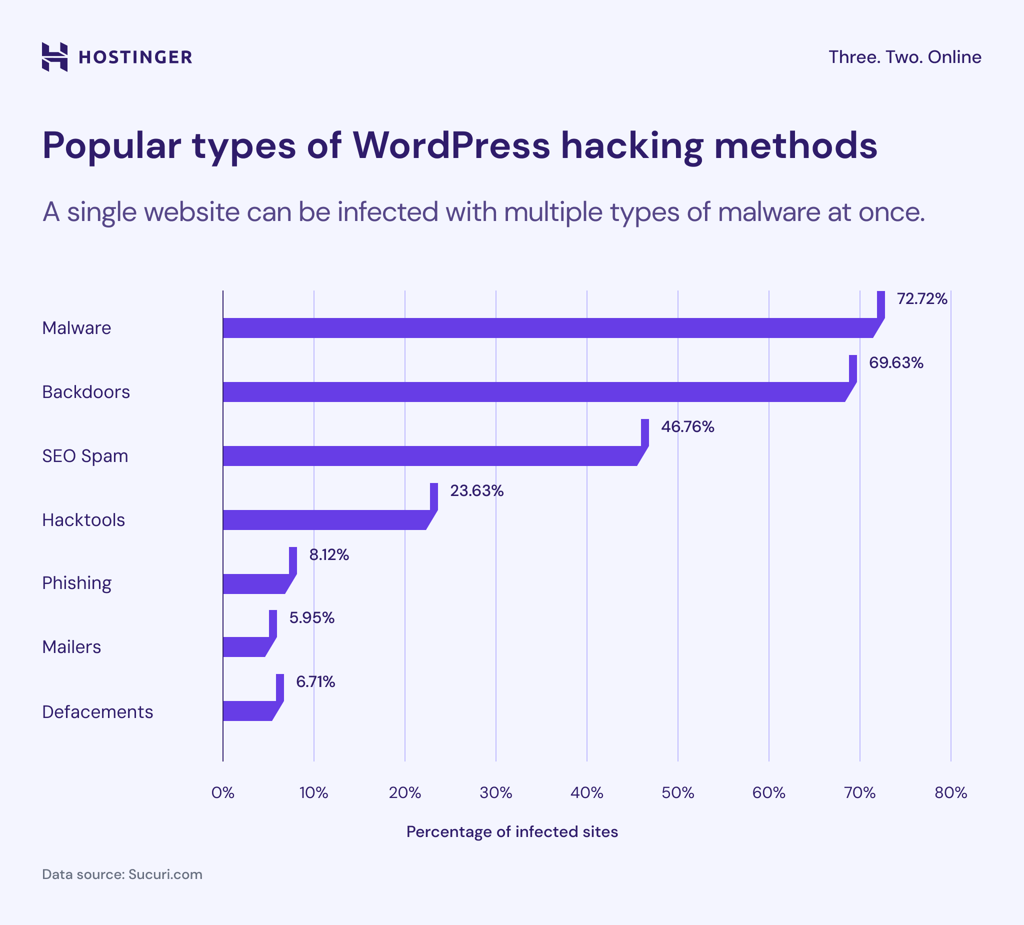
Sucuri, the company that created one of the leading WordPress firewall plugins, found that malware causes 72.7% of site infections. Unauthorized backdoor access and SEO spam followed, accounting for 69.6% and 46.7% of all WordPress hacks, respectively.
Less common hacking methods are phishing (8.1%), defacements (6.7%), mailers (5.9%), and droppers (1%).
28. Wordfence blocks around 120 million attacks every day
Wordfence, a leading WordPress security plugin, blocks approximately 55 million exploit attempts and 65 million brute force attacks per day. An exploit is a piece of code that takes advantage of system flaws, while a brute force attack uses trial and error to crack passwords.
29. Cross-site scripting accounts for 47.7% of WordPress vulnerabilities
Cross-site scripting (XSS) is the most commonly reported WordPress vulnerability. This harmful technique injects malicious scripts into your website, such as redirects, advertisements, and other HTML payloads. Broken access control and cross-site request forgery (CSRF) are the second and third most known vulnerabilities, with 14% and 13% of all cases, respectively.
30. AI emerges as both a cybersecurity risk and a defense tool in the WordPress ecosystem
Artificial intelligence is increasingly employed in breach attempts as well as in WordPress security tech, presenting new risks for exploitation and new opportunities for powering advanced defensive measures. One of the main threats comes from AI-generated code and from using AI to identify vulnerabilities.
WordPress community and events
An open-source product relies on the importance of building a community. WordCamps are tech conferences where participants exchange knowledge, innovate, and connect, creating professional opportunities around WordPress.
31. The first WordCamp was organized in 2006
In 2006, WordPress co-founder Matt Mullenweg held the first-ever WordCamp in San Francisco. Since then, local WordPress communities have organized hundreds of their own events.
32. More than 400 cities in 71 countries have hosted WordCamps
The open-source community is growing with each WordCamp. Until April 2025, WordPress celebrated 1,322 conferences in 407 cities, across 71 countries and 6 continents.
These numbers are set to grow even higher, with more than 20 upcoming WordPress-related events scheduled for the second part of 2025. Notable ones include WordCamp Europe in June, and WordCamp US in August.
“The global WordPress community is what makes the platform truly special. Having contributed to the software and community efforts, I’ve seen how WordCamps create real impact ‒ whether by helping a first-time blogger or connecting developers across continents. It’s more than just events; it’s a movement built on shared knowledge and collaboration.” describes Leonardus Nugraha, Content SEO Specialist and WordPress contributor at Hostinger.
Hostinger has proudly participated in past WordCamps in Asia, Europe, and the US. Sharing our experiences and gaining knowledge from the other participants has been fundamental to Hostinger’s growth.
33. WordPress Meetup Program supports over 630 active groups worldwide
The WordPress Meetup Program fosters a vibrant global community, with more than 630 active groups connecting users, developers, and enthusiasts across multiple regions.
34. WordPress supports a wide range of local languages
WordPress takes content localization seriously as it serves a large global community. It supports over 200 locales but has only been fully translated into 33 local languages, including Arabic, Chinese, Indonesian, Japanese, French, German, and Spanish.
Sources
- WordPress.org
- WordPress.com
- W3Techs
- WordCamp Central
- Statista
- KeyCDN
- Wordfence
- Store Leads
- Sucuri
- Envato Market
- Themeisle
- Google Trends
- Techjury
- Patchstack
- WPScan
- Yoast.com
- WooCommerce
- Similar Web
Conclusion
WordPress is the most popular website-building platform, powering nearly half of all active websites. The open-source CMS’s strength relies on a relentless and creative open-source community with a clear goal: making websites accessible.
WordPress has an immense toolbox of design and functionality options. Users can choose from thousands of plugins and themes. The possibilities are endless for bloggers, business owners, or startup founders who want to publish their content to the world or start an online venture.
Along with new opportunities, threats have grown, too. Cyber security is one of the main concerns and is increasingly dealt with by community developers.
This CMS may have started as a blogging platform, but it is now a consideration for most web-based projects, especially in the ecommerce industry. Popular add-ons like WooCommerce allow millions of users to showcase their products and services. Undoubtedly, WordPress will continue to shape the web as one of the most popular platform for anyone who seeks to build a website.
WordPress Statistics FAQ
What percentage of people use WordPress?
According to W3Techs, 43.5% of all websites use WordPress as the content management system of choice. The percentage is even higher among all sites made with a known CMS: 61.3%.
Is WordPress still growing?
Yes, more than 10,000 new WordPress websites are being published daily on Hostinger’s platform alone. According to Google Trends, WordPress’s search volume surpassed the 16 million mark (average per month) during 2024 and in early 2025.
And with 54 global WordPress-related events scheduled for this year, the WordPress community is expected to continue growing.
Is WordPress secure?
Yes, but as a user or website owner, you have to be aware of vulnerabilities and take precautions accordingly. The average attack on a WordPress website occurred every 22 minutes in 2024, and now occurs every 32 minutes in 2025. The reduction in attacks is due to the added effort now being put in to identify and take action against threats and security weaknesses.
How many websites use WordPress?
More than 522 million websites are using WordPress. This number comes from W3Tech’s latest study, which states that 43.5% of the market runs on this open-source platform, and multiple reports claiming 1.2 billion sites exist on the web.
All of the tutorial content on this website is subject to Hostinger's rigorous editorial standards and values.

Ricardo is a data journalist and visualization expert with over seven years of experience uncovering insights through data storytelling. His work focuses on data exploration, geospatial analysis, and interactive visualizations, helping audiences understand complex information through compelling narratives. His projects have been featured in Statista, Forbes, La Nación, among others. When he’s not analyzing datasets, Ricardo enjoys brewing specialty coffee, watching sports, and reading fiction. Follow him on LinkedIn or check his Portfolio to see his latest work.