Dedicated IP vs shared IP? How dedicated and shared IP addresses work
Apr 07, 2026
/
Ksenija
/
9 min Read
Dedicated IP and shared IP are two common IP address types used in web hosting and internet infrastructure.
A dedicated IP is assigned exclusively to a single website or hosting account, while a shared IP is used by multiple websites hosted on the same server.
Both options play an important role in online services such as web hosting, email marketing, and domain management.
IP addresses allow servers to identify websites and route traffic correctly when visitors access a domain. The choice between a dedicated and shared IP affects how traffic is handled, how IP reputation develops, and how much control a website owner has over the server environment.
The difference between Dedicated IP vs Shared IP involves exclusivity, control, and how responsibility is managed.
Dedicated IPs provide full ownership of the address and isolate reputation to a single website, while shared IPs distribute the same address across multiple users to make hosting infrastructure more efficient and affordable.
Choosing the right option depends on factors such as email usage, security needs, and the type of hosting environment the website runs on.
Dedicated IP and shared IP explained: Key characteristics
A dedicated IP address belongs to a single user or website, while a shared IP address is used by multiple websites on the same server.
A dedicated IP is a unique address assigned to a single hosting account. This exclusivity gives the website owner full control over how the IP is used, including how it handles traffic and sends emails.
Because no other sites share the address, the IP reputation depends entirely on the owner’s activities.
This level of control becomes especially important for email services. Email providers track the behavior of IP addresses sending messages.
When a website sends newsletters or transactional emails from a dedicated IP address, the sender builds a reputation based solely on its own practices. Responsible sending improves email deliverability with IPs, while poor practices affect only that specific address.
A shared IP, in contrast, is assigned to many websites hosted on the same server. This setup allows multiple websites to use one IP address, which is why shared IPs are common in standard hosting plans and often appear when choosing the right web hosting plan.
Shared usage also introduces shared responsibility. The reputation of an IP address depends on the behavior of all websites using it.
If one site sends spam or becomes compromised, the IP may be flagged by email providers or security services. This situation is known as IP reputation spillover, in which actions by one user affect others on the same IP address.
Another common concern is SSL encryption. Earlier internet configurations required a dedicated IP to install an SSL certificate, but this limitation no longer applies.
Modern technologies, such as Server Name Indication (SNI), allow multiple encrypted websites to operate on the same IP address. As a result, most HTTPS websites today run securely on shared IPs without requiring a dedicated address.
Security considerations, however, still differ because of control over the IP environment.
With a dedicated IP, the website owner controls all traffic and services associated with that address. This makes it easier to manage IP reputation, investigate suspicious activity, and respond to abuse reports.
Shared IP environments introduce additional risk because multiple users share the same IP address. The hosting provider manages abuse and security across all accounts, which means individual website owners have limited control over how their IP addresses are used.
Differences between dedicated IP and shared IP
Dedicated IP and shared IP addresses differ primarily in exclusivity, control, and how reputation is managed.
The comparison below summarizes the most important differences.
Characteristic | Dedicated IP | Shared IP |
Ownership | Assigned to a single hosting account | Used by multiple websites on the same server |
Control | Full control over traffic, services, and reputation | Responsibility distributed across multiple users |
Cost | Usually requires an additional hosting fee | Included in most shared hosting plans |
IP reputation | Determined only by your website’s activity | Influenced by all websites using the IP |
Email deliverability | Easier to manage sender reputation | Can be affected by other users’ behavior |
SSL certificates | Fully supported | Fully supported through SNI |
Security exposure | No risk from other websites | Risk of blacklisting if another user abuses the IP |
Management effort | Requires active monitoring of IP reputation | Minimal management handled by the hosting provider |
It is also important to clear up two common misconceptions.
A dedicated IP does not improve search engine rankings. Search engines evaluate website quality based on content, relevance, and authority rather than the type of IP address the server uses.
A dedicated IP also does not make websites load faster. Page speed depends on server performance, caching, and network infrastructure. The IP address itself has no measurable effect on loading time.
How dedicated IP and shared IP work
Dedicated and shared IPs work through the same core mechanism: DNS connects a domain name to an IP address, and the server uses that IP to route incoming traffic to the correct website. The difference lies in how the IP address is assigned and how many websites share it.
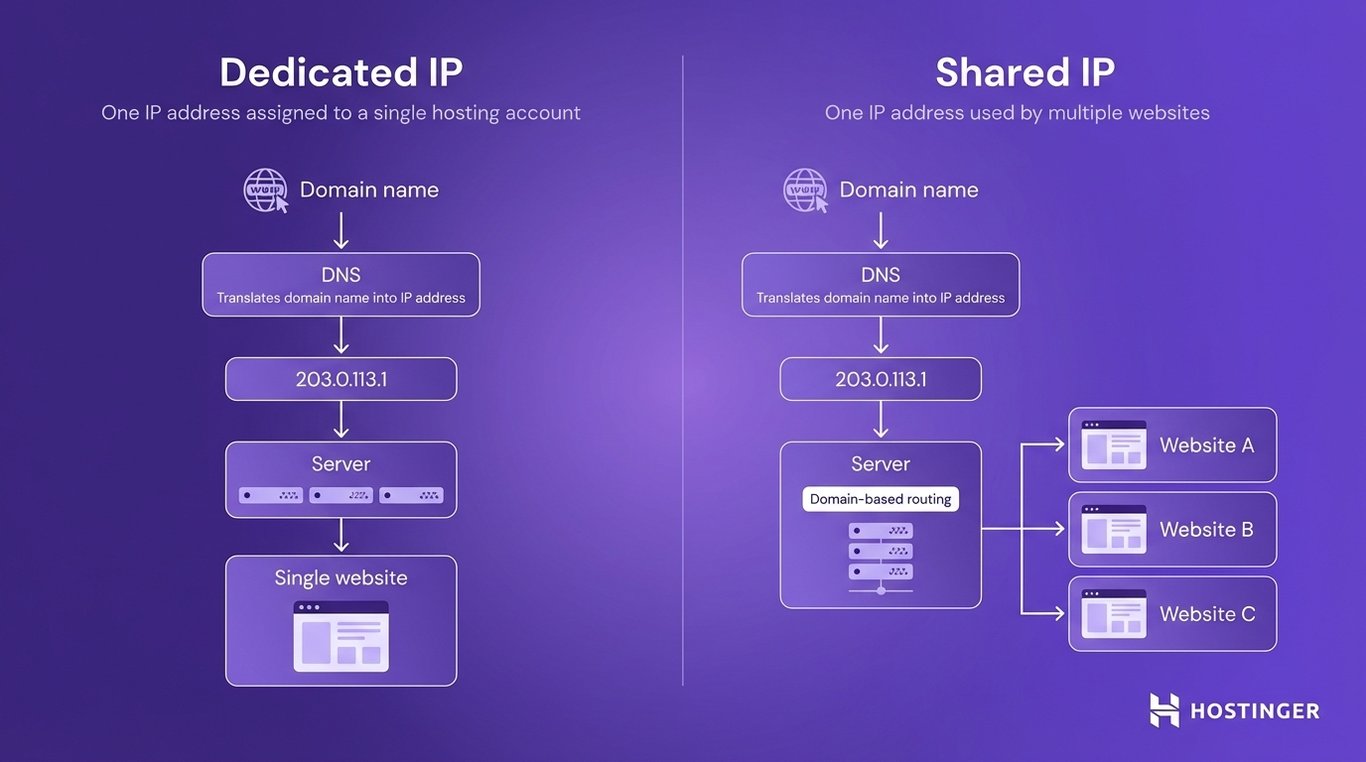
When someone enters a domain name in a browser, the Domain Name System (DNS) translates that domain into an IP address. The browser then sends a request to the server associated with that IP. The server processes the request and returns the website content.
In a dedicated IP setup, one IP address maps directly to a single hosting account. The domain’s DNS records point to that unique IP, and all traffic sent to that address belongs to that specific website or application.
Because the IP is exclusive, the server can route traffic directly to that account without checking which domain requested the content. This model is simple and predictable. Services running on the server, such as web servers or email servers, always associate that IP with the same user.
This approach is useful for applications that rely on a stable and identifiable network address. For example, payment gateways, APIs, or private databases sometimes restrict access to a specific IP address.
A dedicated IP ensures that only the authorized server communicates with those systems.
A shared IP setup works differently. Instead of assigning one IP per website, the hosting server assigns the same IP address to many domains.
When a request arrives at the server, the server examines the domain name included in the HTTP request and determines which website the visitor intended to reach. The server then loads the correct website for that domain.
This process allows hundreds or even thousands of websites to operate on the same IP address without interfering with each other.
The DNS configuration reflects this shared structure. Multiple domains point to the same IP address, but the server distinguishes them using domain-based routing. From a visitor’s perspective, the process remains invisible. Each website still loads normally in the browser.
The practical difference between these two models is control over the IP allocation process.
With a dedicated IP, the hosting provider assigns a unique address to a single account during server configuration.
With a shared IP, the hosting platform assigns the same address to multiple accounts and relies on server software to direct traffic to the correct website.
Type of dedicated and shared IPs
Dedicated and shared IPs can exist in different forms depending on the IP protocol version and the hosting environment in which they are used. The most common variations involve IPv4 and IPv6 addresses for dedicated setups, and different hosting models for shared IP usage.
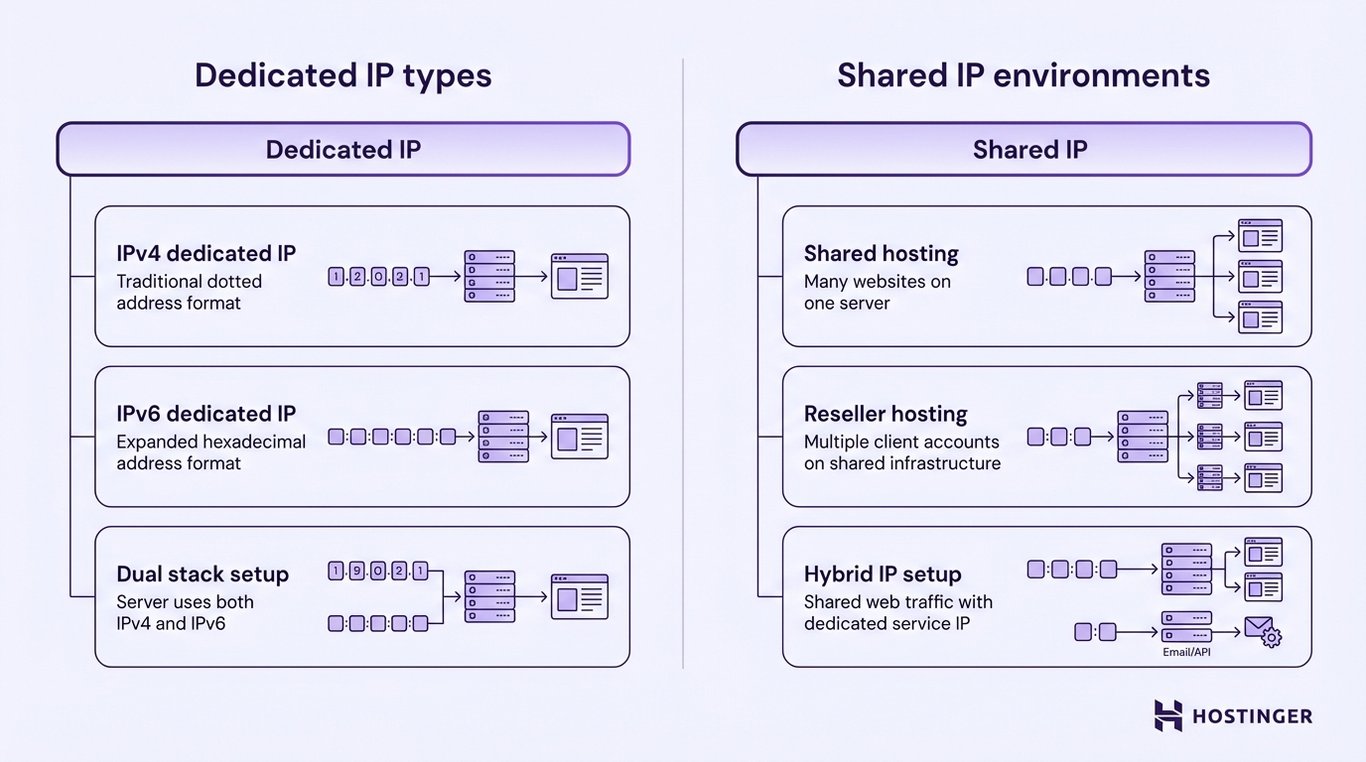
A dedicated IP can be assigned as either an IPv4 or an IPv6 address.
IPv4 addresses are the traditional format used across most hosting platforms. They consist of four numbers separated by dots, such as 192.168.1.1.
Because IPv4 addresses are limited and heavily allocated worldwide, hosting providers often charge an additional fee when assigning a dedicated IPv4 address to a customer.
IPv6 addresses were introduced to solve this limitation. They use a longer hexadecimal format, such as 2001:0db8:85a3::8a2e:0370:7334, and provide a much larger pool of available addresses.
A dedicated IPv6 address works the same way as a dedicated IPv4 address, but allows hosting providers to allocate unique IPs without the scarcity issues associated with IPv4.
Some hosting providers assign both IPv4 and IPv6 dedicated addresses to the same server. In this setup, the website remains reachable through both protocols while still maintaining exclusive ownership of its IP.
Shared IPs appear most often in shared hosting environments, where many customers run websites on the same server.
In this model, the hosting provider assigns one IP address to the server and configures the web server to route incoming requests to the correct website based on the domain name.
Another common scenario appears in reseller hosting environments. In reseller hosting, a provider allows customers to create and manage multiple hosting accounts under their own brand.
These accounts typically operate on shared IP addresses because many client websites run on the same server infrastructure.
Some hosting platforms also implement hybrid IP setups that combine aspects of shared and dedicated IP allocation.
For example, a server may host many websites on a shared IP for regular web traffic while assigning a dedicated IP specifically for email services or API access.
This approach allows websites to maintain a controlled sending reputation while still using the lower-cost infrastructure of shared hosting.
Large hosting companies, cloud providers, and managed hosting platforms commonly offer both models.
A standard hosting plan usually includes a shared IP by default, while dedicated IP addresses are available as optional upgrades for users who require greater control over their network identity.
These variations reflect how hosting providers balance address availability, infrastructure efficiency, and user control when assigning IP addresses to websites and services.
Security considerations for dedicated IP vs shared IP
The main security difference between dedicated and shared IP addresses lies in control over reputation and exposure to other users’ activity.
A dedicated IP isolates your website from other accounts, while a shared IP places multiple websites under the same address and therefore under the same reputation umbrella.
One of the most common security risks with shared IPs is blacklisting. Email providers, spam filters, and security systems monitor IP addresses that send suspicious traffic.
If one website on a shared IP sends spam, distributes malware, or becomes compromised, the IP can be flagged by these systems.
When that happens, other websites using the same IP may experience side effects. Emails sent from that address may land in spam folders, or security filters may temporarily distrust traffic originating from that IP.
A dedicated IP avoids this shared exposure. Because only one hosting account uses the address, any reputation changes result from that website’s own behavior. This isolation makes it easier to diagnose issues and restore trust if problems occur.
Control also plays an important role in how quickly security issues can be addressed. With a dedicated IP address, website owners can investigate suspicious activity, review server logs, and adjust email sending practices without relying on other users on the same server.
Shared IP environments rely more on the hosting provider’s oversight. Providers monitor servers for abuse, suspend compromised accounts, and manage reputation recovery when an IP address is flagged.
While this reduces management responsibility for individual users, it also means that website owners have limited control over how others use the IP address.
Maintaining a strong IP reputation requires consistent security practices regardless of the IP type. Website owners should keep software up to date, secure their hosting accounts, and monitor email-sending behavior.
Running a regular website security audit also helps detect vulnerabilities that could lead to compromised accounts or abuse.
SSL encryption also plays a role in protecting website traffic. Modern hosting environments support SSL certificates on both dedicated and shared IP addresses through technologies such as Server Name Indication (SNI).
This means that encrypted HTTPS connections remain secure regardless of whether the website runs on a dedicated or shared IP address.
In practice, the security trade-off is straightforward. Dedicated IPs offer greater control over reputation and security monitoring, while shared IPs rely on hosting providers to manage risk across multiple accounts.
When to choose dedicated IP or shared IP
Choose between a dedicated IP and a shared IP based on how your website operates, how much email you send, and whether your services require a fixed IP address.
Most websites work perfectly well on shared IPs, while dedicated IPs become useful when you need more control over reputation and network access.
A shared IP is the right choice for most websites, especially during the early stages of a project. This is the setup used in many standard shared hosting products, including Hostinger Web Hosting, where a shared IP keeps costs low while still handling high traffic and loading pages quickly.
If your site is a blog, portfolio, company website, or informational page, you likely send little or no email directly from your hosting server.
In this situation, a shared IP keeps hosting simple and avoids unnecessary costs.
Shared IPs also require less technical management. Your hosting provider monitors the server environment, manages account abuse, and handles IP reputation issues if they arise. If you want a low-maintenance setup, a shared IP is usually the practical option.
You should consider a dedicated IP if your website relies heavily on email communication. For example, ecommerce stores, SaaS platforms, and membership websites often send large volumes of transactional emails such as order confirmations, password resets, and account notifications.
A dedicated IP allows you to build and maintain your own email reputation, which helps improve deliverability.
A dedicated IP also becomes important when external services restrict access by IP address. Some services use IP allowlisting to control access.
For instance, payment platforms such as Stripe and PayPal send webhook notifications from specific IP ranges when payments succeed or fail, and you may whitelist those ranges on your server for added security.
Dedicated IPs matter more when your server needs to connect to a private API, database, or enterprise system that only accepts requests from approved IP addresses.
In these cases, using a dedicated IP ensures your server always connects from the same identifiable address.
Traffic scale can also influence the decision. High-traffic applications and platforms sometimes use dedicated IPs to simplify integrations, monitoring, and infrastructure configuration.
Cost is another factor. Shared IPs are included with most hosting plans, while dedicated IPs are usually offered as a paid add-on. If your website does not rely on email reputation or IP-based access rules, the additional cost often provides little practical benefit.
In practical terms, start with a shared IP unless your project clearly requires dedicated control. If your website grows, begins sending large volumes of email, or integrates with systems that require a fixed IP address, you can upgrade later to a web hosting plan that supports those needs.

All of the tutorial content on this website is subject to Hostinger's rigorous editorial standards and values.

Ksenija is a digital marketing enthusiast with extensive expertise in content creation and website optimization. Specializing in WordPress, she enjoys writing about the platform’s nuances, from design to functionality, and sharing her insights with others. When she’s not perfecting her trade, you’ll find her on the local basketball court or at home enjoying a crime story. Follow her on LinkedIn.