Top 8 best European hosting providers: Key features and pricing
Sep 15, 2026
/
By Alma F.
/
15 min Read

Choosing the best European hosting provider isn’t just about uptime – it’s about where your data is stored and how fast your website loads for visitors across the EU. Hosting on local servers can simplify compliance with the General Data Protection Regulation (GDPR), deliver faster load times for EU visitors, and contribute to better search performance for nearby users.
Many global hosting companies claim to offer European hosting but rely on overseas infrastructure or fail to meet EU privacy standards. The hosts worth your attention are the ones with actual local data centers, solid uptime guarantees, transparent pricing models, and support that operates in European time zones.
Here are our top picks for the best European hosting providers:
- Best overall performance – SiteGround, known for fast servers and excellent European coverage.
- Best for beginners – Hostinger, with easy-to-use interfaces, affordable pricing, and 24/7 support.
- Best budget option – OVHcloud, offering competitive pricing with extensive European data centers.
- Best for advanced users – Hetzner, featuring scalable dedicated servers and transparent pricing.
- Best for developers – Scaleway, offering flexible cloud infrastructure and modern developer tooling.
- Best eco-friendly host – Infomaniak, running 100% renewable energy data centers with strong privacy standards.
1. Hostinger

Hostinger started in Lithuania and has spent over a decade becoming one of the most widely used hosting providers in Europe. Close to five million people have built their sites on it, which tells you something about how well it holds up for real projects, not just test sites.
You get web hosting, cloud, and WordPress hosting options, all managed through Hostinger dashboard – one of the cleanest, most beginner-friendly control panels around. If you’ve ever felt lost inside a hosting dashboard, Hostinger dashboard fixes that. Setup only takes minutes.
There’s also a 30-day money-back guarantee, which takes the pressure off if you’re not 100% sure yet. Test it, build something, see how it feels. If it’s not right, you’re not locked in. For most people, that’s all the reassurance they need to just go for it.
Hostinger pros
- Very competitive pricing – Hostinger consistently offers some of the lowest entry prices in European hosting, making it accessible even on a tight budget.
- Intuitive Hostinger dashboard control panel – Unlike the cluttered dashboards on many legacy hosts, Hostinger dashboard organizes everything logically so you can manage your site, email, and domains without a tutorial.
- Localized data centers in Europe – Hosting your site on a nearby server reduces latency, which means faster load times for your EU visitors and an easier path to GDPR compliance.
- Free SSL and weekly backups included – SSL encrypts your site’s connection (and is required for Google to trust it), while weekly backups mean you always have a recent restore point if something goes wrong.
Hostinger cons
- Fewer advanced features than premium hosts – If you need granular server configuration, staging environments on entry-level plans, or deep developer tooling, you’ll likely hit the ceiling faster than you would with a host like Hetzner or SiteGround.
- No phone support – All support runs through live chat and a ticketing system, which works well for most issues but may feel limiting if you prefer talking to someone directly in a high-stress situation.
Hostinger pricing
Hostinger’s shared hosting plans start at $1.99/month on the 48-month plan, scaling to $2.99/month for Premium and $3.99/month for Business.
If you prefer a shorter commitment, 12-month pricing starts at $2.99/month.
Cloud hosting is also available, with the Startup plan at $9.99/month on a 12-month term, going up to $19.99/month for Professional.
The longer your commitment, the lower your monthly rate, so if you’re confident in your project, locking in a 48-month plan saves you the most over time. For most beginners and small businesses, the Premium Shared Hosting plan hits the best balance: it supports multiple websites and includes a free domain.

2. OVHcloud
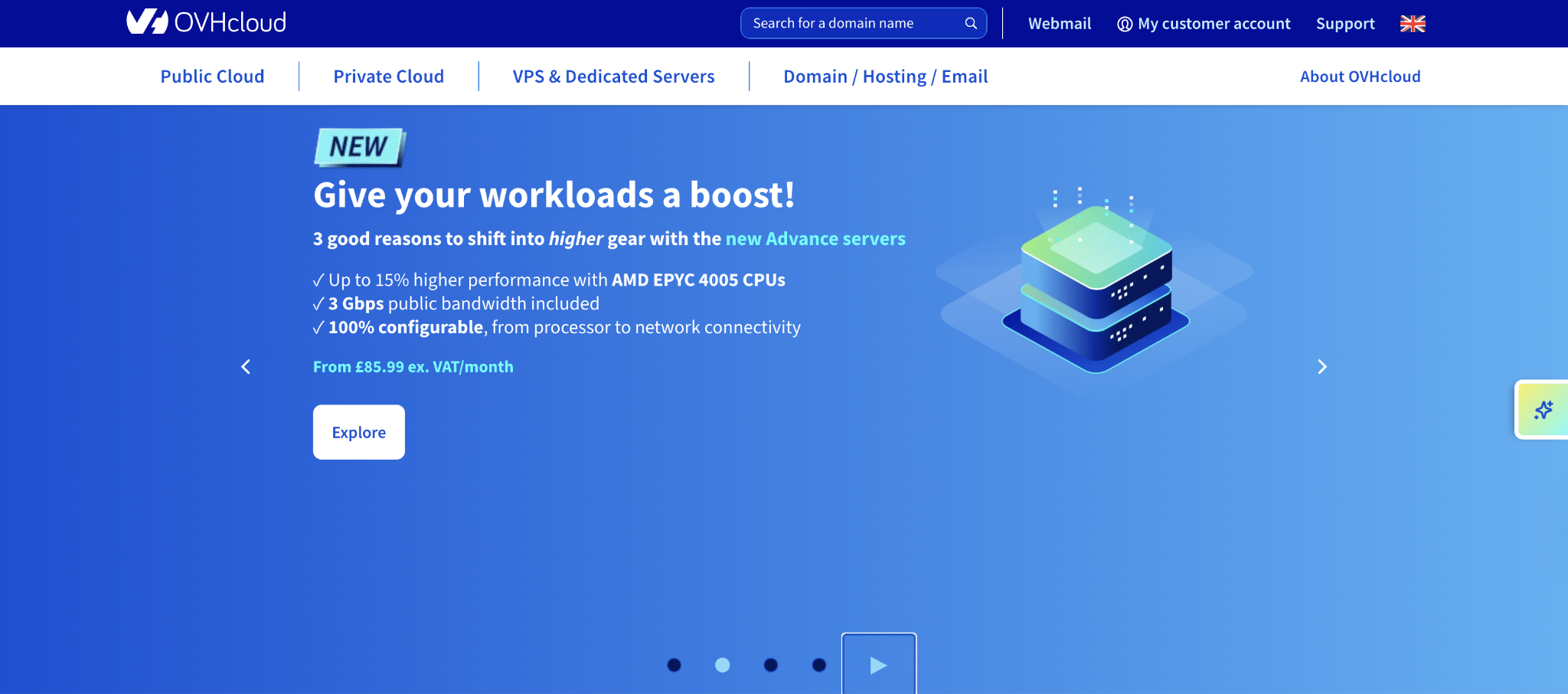
OVHcloud started in 1999 when Octave Klaba, a Polish-French engineering student, set up the first server in his family’s garage in Roubaix, France. It’s since grown into Europe’s largest independent cloud provider, serving 1.6 million customers across more than 140 countries.
The company’s founding philosophy still shapes it today. Unlike the major US cloud platforms, OVHcloud is listed on Euronext Paris and was built on the principle that European businesses should be able to keep their data on the continent without paying a premium to do it.
The trade-off is the learning curve: the interface isn’t as polished as Hostinger’s, and support response times can vary. But if you know what you’re doing – or are willing to learn – the pricing and European server coverage make it a strong pick.
OVHcloud pros
- Wide range of server types – OVHcloud covers everything from entry-level shared hosting to high-performance dedicated servers, so you’re unlikely to outgrow the platform as your needs evolve.
- Competitive pricing, especially on VPS plans – Their VPS options in particular offer strong value for the specs, often undercutting comparable plans from US-based providers by a noticeable margin.
- Strong European presence with multiple data centers – With locations across France, Germany, the UK, and beyond, you can choose where your data lives and optimize for your target audience’s location.
- Full IPv6 support and infrastructure designed to align with European data‑protection laws – IPv6 future-proofs your infrastructure, while built-in compliance with European data protection laws reduces the legal legwork on your end.
OVHcloud cons
- Support can be slower than premium hosts – Response times and resolution quality vary, and if you’re dealing with a critical outage, slower support can be genuinely costly.
- Interface may feel complex if you’re just starting out – The dashboard is functional but not intuitive, and getting familiar with it takes more time than beginner-friendly alternatives like Hostinger.
OVHcloud pricing
Shared and VPS plans start from around €3/month (≈ $3.50/month), making it one of the more affordable entry points among European providers with serious infrastructure. Dedicated servers are available from approximately €50/month (≈ $59/month), which is competitive given the hardware quality.
Cloud products use usage-based pricing, so you only pay for the compute and storage you actually consume – a meaningful advantage if your traffic is variable or unpredictable.
For budget-conscious teams that don’t need hand-holding, OVHcloud’s pricing structure is genuinely difficult to argue with. If you’re choosing between a US-based provider and OVHcloud for a European audience, the combination of local servers and lower cost makes OVHcloud the more logical choice.
3. Scaleway
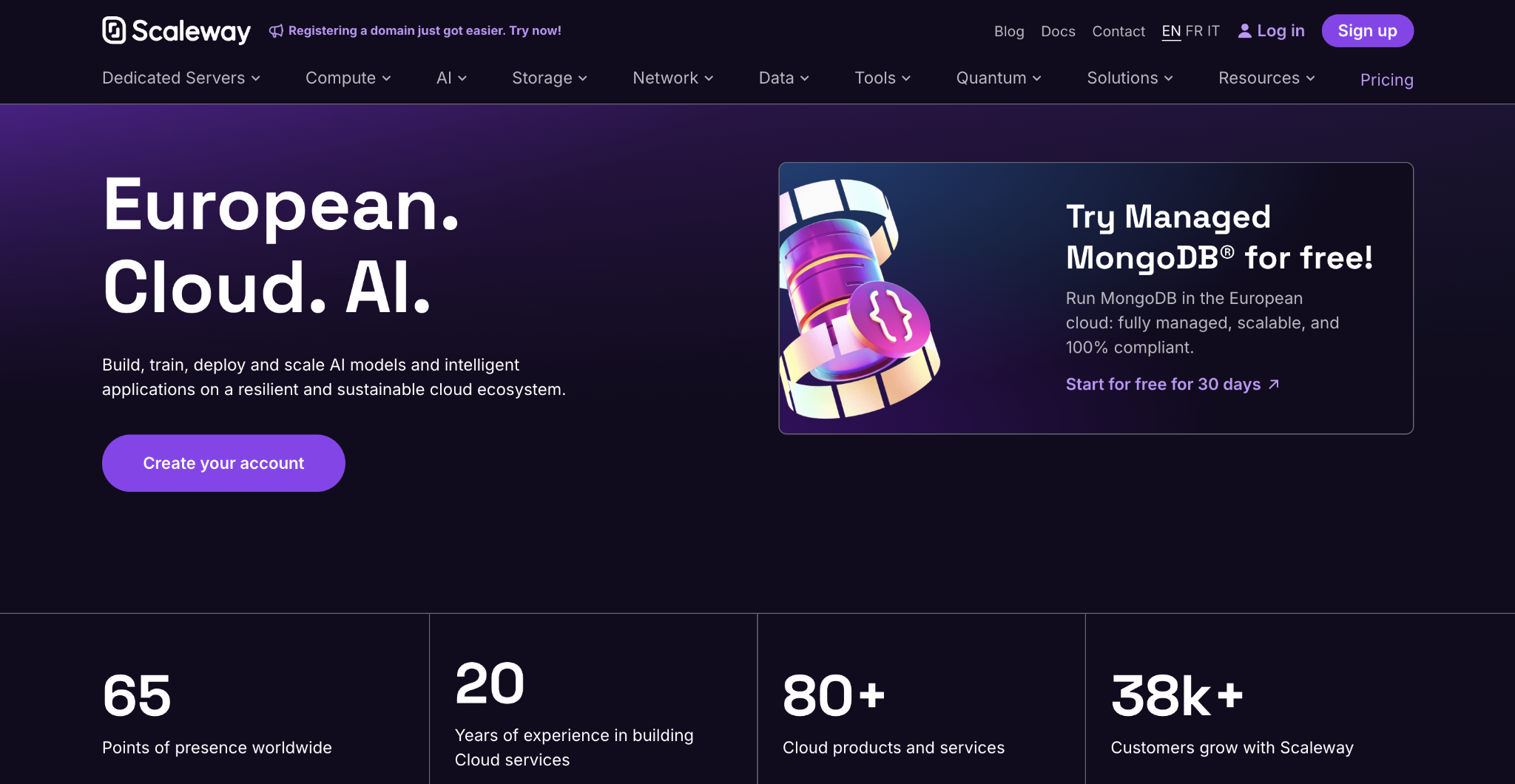
Scaleway is a France-based cloud provider founded in 1999 and a majority-owned subsidiary of the Iliad group. Originally called Online.net, it rebranded as Scaleway in 2017 to reflect a sharp shift toward cloud infrastructure – and it’s been building toward becoming Europe’s answer to AWS and Azure ever since.
Some of Europe’s biggest AI companies build on it. Mistral trained its models on Scaleway’s infrastructure. If you need a cloud platform that stays in Europe, handles demanding workloads, and keeps your data out of US jurisdiction, Scaleway is one of the few providers on the continent that can deliver that.
That said, it’s not for everyone – this is a tool for experienced technical teams who want full control over their infrastructure.
Scaleway pros
- Innovative cloud instances including ARM-based options – ARM architecture offers better energy efficiency and cost-per-performance than traditional x86 servers, particularly for workloads like APIs, microservices, and containerized apps.
- Strong developer tooling and Kubernetes support – Scaleway’s ecosystem is built around modern DevOps workflows, so if your team already works with containers and orchestration, you’ll feel at home quickly.
- Transparent, usage-based billing – You pay for exactly what you use with no surprise charges, which makes cost forecasting straightforward and removes the risk of paying for idle resources.
Scaleway cons
- Requires technical expertise – Without a background in cloud infrastructure, getting a site live on Scaleway takes significantly more effort than on a managed host, and there’s no simplified onboarding to guide you through it.
- Fewer beginner-friendly services – There are no one-click app installs or traditional cPanel-style dashboards, which makes Scaleway a poor fit for non-technical users or small business owners who just need a site up and running.
Scaleway pricing
Scaleway uses usage-based cloud billing, meaning your monthly cost is determined by the compute instances, storage, and bandwidth you consume rather than a fixed plan. There are no long-term contracts required, which keeps things flexible – you can scale up for traffic spikes and back down when things quiet down without penalty.
For developer teams, this model is ideal because it removes the inefficiency of paying for a fixed plan you don’t fully use. It’s a good fit if your traffic goes up and down – you pay more when you need it, less when you don’t.
4. SiteGround
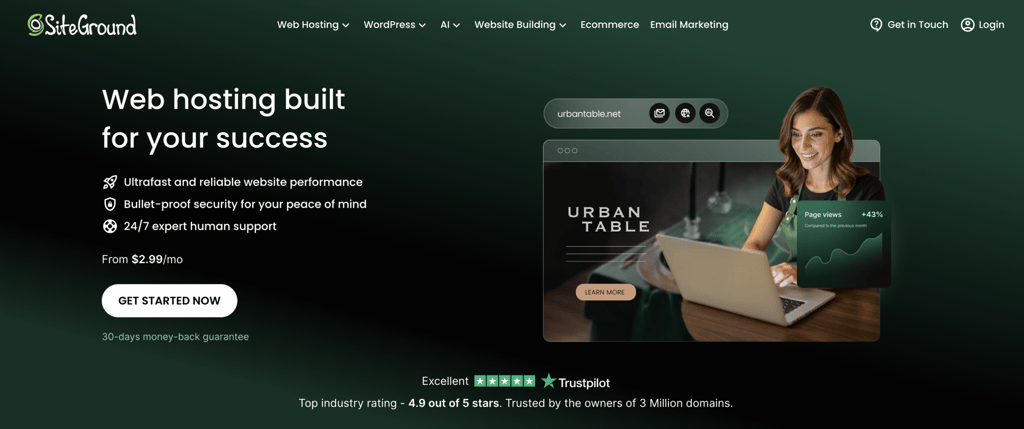
SiteGround was founded in 2004 by a group of university friends in Sofia, Bulgaria. It now hosts over 3 million domains and has never been sold to a larger company, which is uncommon in an industry where most providers eventually get acquired. A business that doesn’t need to sell is one that’s been doing something right for a long time.
Rather than maintaining its own physical servers, SiteGround runs on Google Cloud infrastructure. Your site runs on Google’s European network, with SiteGround’s own caching, security tools, and control panel built on top – enterprise-level reliability without you having to think about any of it. It costs more than budget alternatives, but for sites where downtime or slow load times have a direct business impact, that gap closes quickly.
SiteGround pros
- Fast loading speeds optimized for European visitors – SiteGround’s proprietary caching technology (SuperCacher) and CDN integration work together to serve pages quickly to EU-based users, which directly improves both experience and search rankings.
- Excellent customer support with 24/7 live chat – SiteGround is consistently rated among the best in the industry for support quality – responses are fast and the team is knowledgeable, not just reading from a script.
- Strong security features and automatic daily backups – Daily backups are stored offsite and available for one-click restoration, while proactive security monitoring catches threats before they cause damage.
- GDPR‑aligned infrastructure – Data is stored and processed within EU‑based facilities, and SiteGround provides data‑processing documentation to help you meet your obligations under European privacy law.
SiteGround cons
- Higher price point than budget hosts – SiteGround’s entry-level plan is significantly more expensive at standard rates than providers like Hostinger or OVHcloud.
- Limited storage on entry-level plans – The base plan comes with 10 GB of storage, which is fine for a simple site but gets tight quickly if you’re hosting media-heavy content or multiple sites.
SiteGround pricing
SiteGround’s shared hosting StartUp plan lists at around €15.99/month (≈ $19/month) on a 12‑month term, with frequent promotional discounts that can reduce the initial rate. Managed WordPress plans follow a similar structure. Cloud hosting options are also available for sites that need more power and scalability.
Every plan includes a free SSL certificate and CDN out of the box. SiteGround makes the most sense for small-to-medium businesses and professionals who can’t afford downtime or poor performance – the premium pricing buys you genuine peace of mind, especially on a site that directly generates revenue.
5. Hetzner
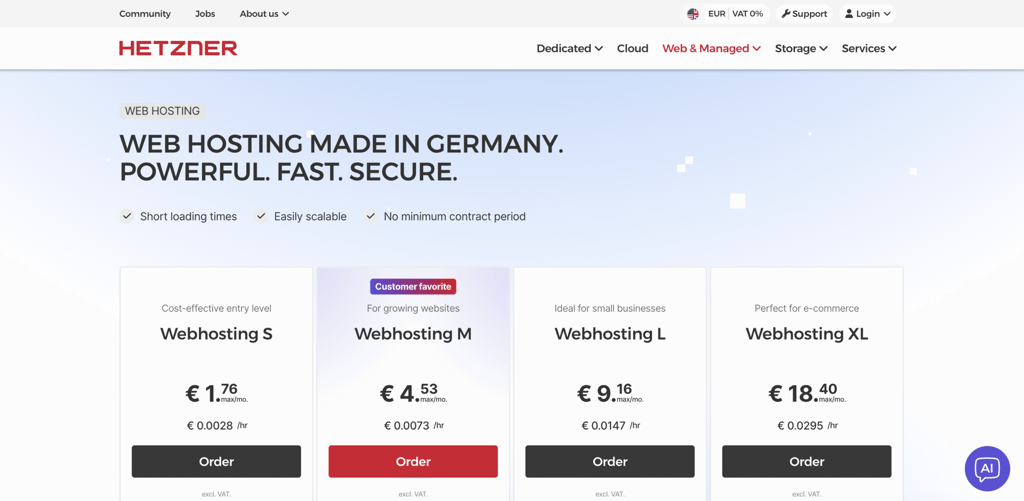
Hetzner is a German hosting company with a strong reputation among developers and technical teams across Europe. If you’ve spent time in hosting forums or asked for server recommendations in a developer community, you’ve likely seen the name come up.
It was founded in 1997 by Martin Hetzner and is still privately owned today. It builds and runs its own data centers in Germany and Finland – no outside investors, no corporate parent, no risk of being acquired mid-contract.
That kind of stability is harder to find than it sounds in this market. The trade-off is that Hetzner isn’t built for beginners. But for technical teams that know what they need, a nearly 30-year-old private company that owns its own hardware is a solid long-term foundation.
Hetzner pros
- Affordable dedicated servers with excellent hardware – Hetzner’s dedicated server pricing is among the lowest in Europe for the specs offered, making it genuinely feasible for smaller teams to run their own infrastructure without breaking the budget.
- Transparent pricing with no hidden fees – What you see in the pricing table is what you pay – no surprise charges for bandwidth, IP addresses, or support tiers that catch you off guard at renewal.
- Strong data protection, compliant with German standards – German data protection law (BDSG) complements GDPR with some stricter national rules, giving you an extra layer of assurance if you’re handling sensitive user data.
- Private networking and customizable hardware options – You can build isolated network environments and configure hardware to your exact specifications, which matters for security-sensitive applications or complex multi-server setups.
Hetzner cons
- Not beginner-friendly – setup requires technical know-how – You won’t find guided wizards or simplified dashboards here; spinning up a server and configuring it properly assumes familiarity with Linux, networking, and server administration.
- Limited customer support compared to managed hosts – Support is available but lean – response times and scope are more limited than you’d get from SiteGround or Hostinger, so you’ll need to be comfortable troubleshooting independently.
Hetzner pricing
Hetzner’s dedicated servers start from around €34/month (≈ $40/month), which is an exceptional value for the hardware on offer. Cloud instances are billed by the hour based on usage, so you can run a small VPS for a few euros a month or scale up to significant compute capacity without committing to a fixed monthly plan.
For technical users, Hetzner is arguably the best value in European hosting. The combination of German-quality infrastructure, transparent pricing, and a wide range of server options makes it the go-to choice for teams that want to control their stack without overpaying for the privilege.
6. Exoscale
Exoscale is a Switzerland-based Infrastructure-as-a-Service (IaaS) provider backed by A1 Telekom Austria Group – one of Central Europe’s largest telecom companies. That backing means you’re not dealing with a startup trying to grow fast. You’re dealing with infrastructure built for organizations that need to stay up and running.
It runs data centers exclusively in Europe – Switzerland, Germany, Austria, and Bulgaria – which makes it well-suited for businesses in Central and Eastern Europe that need infrastructure close to their users. Most providers on this list don’t cover that part of the continent the same way.
Like Scaleway, Exoscale is built for experienced technical teams – there are no shared hosting packages or beginner-friendly tools here.
Exoscale pros
- Enterprise-grade cloud solutions with high-availability zones – High-availability zones mean your infrastructure is distributed across multiple physical locations, so a failure in one zone doesn’t take your entire application offline.
- Strong European compliance standards, including GDPR – Exoscale stores and processes data exclusively in Europe, and its Swiss and EU infrastructure is designed to support strict data‑protection requirements.
- Scalable storage and compute resources – You can expand or contract your resource allocation as your platform grows without migrating to a different provider or rebuilding your architecture.
Exoscale cons
- Primarily targets technical users – The platform assumes a high level of infrastructure knowledge; without a DevOps background, you’ll struggle to configure and maintain your environment effectively.
- No beginner hosting packages – Exoscale doesn’t offer shared hosting or simple WordPress solutions, which makes it a non-starter for individuals or small businesses that just need a website live.
Exoscale pricing
Exoscale operates on a usage-based billing model, charging separately for compute, storage, and bandwidth. This gives enterprises the flexibility to pay precisely for what they consume, with no wasted spend on unused capacity.
For SaaS platforms and regulated industries where data residency and compliance aren’t optional, Exoscale’s pricing model makes sense even at a premium – the compliance guarantees alone can offset high legal and audit costs.
7. Host Europe
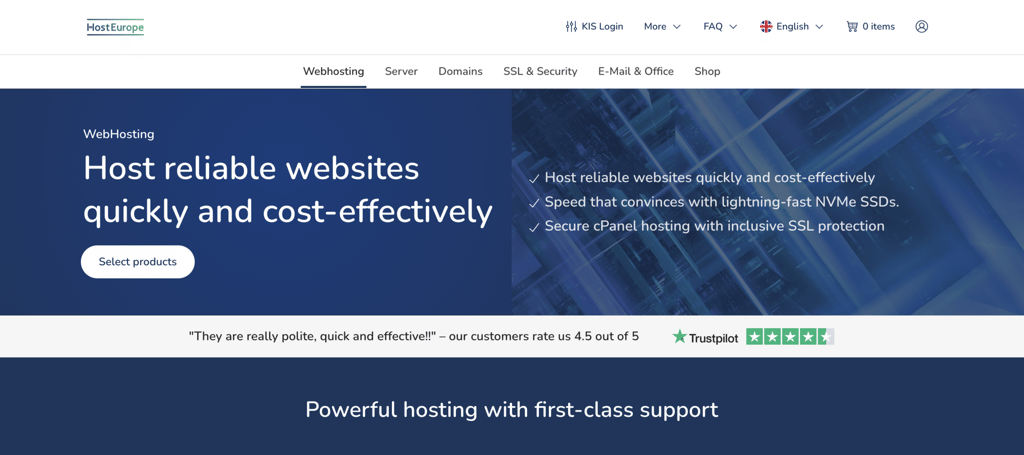
Host Europe has been operating since 1997, making it one of the oldest hosting companies in Europe. It’s particularly well established in Germany, where it has been serving businesses for nearly 30 years.
Its sweet spot is established businesses in Germany, the UK, and the wider DACH region that need a host with a long track record. If continuity matters to your business – the same systems, the same service, year after year – Host Europe is built for exactly that.
The pricing reflects the premium, and the interface feels dated compared to newer platforms. But if localized expertise and regional compliance are priorities for your business, Host Europe delivers where it counts.
Host Europe pros
- Strong focus on European data privacy regulations – Host Europe’s infrastructure is built around GDPR‑aligned data handling, with German data centers that give you control over where your data is stored and processed.
- Multiple data centers in Germany and the UK – Having server options in both locations means you can optimize for your primary audience while maintaining redundancy across two of Europe’s most significant markets.
- Multilingual, customized support options – Support in multiple European languages removes a common friction point for businesses operating across different EU markets, where English-only support can create unnecessary barriers.
Host Europe cons
- Higher price point than budget providers – With shared hosting in the high single‑digit to low double‑digit euros per month, Host Europe is firmly in the mid‑to‑premium range, which may be hard to justify unless localized support is genuinely important to you.
- Interface feels dated compared to newer platforms – The control panel and dashboard lack the polish of modern alternatives like Hostinger dashboard, which can slow down routine tasks for users who’ve grown accustomed to cleaner tools.
Host Europe pricing
Shared hosting is generally priced in the high single‑digit to low double‑digit euros per month (≈ $8–$14/month). The pricing reflects the company’s emphasis on regional expertise, compliance, and support quality rather than competing on raw cost.
Host Europe makes the most sense for established European businesses that prioritize localized service and compliance documentation over low entry prices – particularly in sectors like legal, finance, or healthcare, where data governance requirements are strict.
8. Infomaniak
Infomaniak is a Swiss hosting provider that’s been running for over 30 years with a clear mission: run a hosting company that doesn’t cost the planet. All of their data centers run on 100% renewable energy – making them a natural fit for eco‑conscious businesses, nonprofits, and SMEs.
It’s employee-owned, has never taken outside investment, and is B Corp certified – meaning an independent body has verified that its environmental and ethical claims are real, not just marketing.
Because it has no investors to answer to, Infomaniak makes long-term decisions. That means slower growth, but also more stability. It’s less likely to be acquired, rebranded, or significantly changed in the next few years than most providers on this list.
If you run a small or medium-sized business and want a hosting partner that won’t be restructured any time soon, Infomaniak is one of the more stable long-term options in European hosting.
Infomaniak pros
- 100% renewable energy data centers – All of Infomaniak’s infrastructure runs on clean energy, so choosing them is a concrete way to reduce the environmental footprint of your online presence – not just a marketing claim.
- Strong privacy and data protection standards – Swiss data protection law goes beyond GDPR in several areas, and Infomaniak’s infrastructure reflects that, giving you a higher baseline of privacy than most other European hosts.
- Integrated productivity tools included – Email hosting, collaborative tools, and media platforms come bundled with hosting plans, which reduces the number of separate subscriptions you need to manage and keeps your data under one roof.
Infomaniak cons
- No data center options outside Europe – If your audience spans multiple continents or you need infrastructure closer to users in Asia or North America, Infomaniak’s purely European footprint becomes a limitation.
- Slightly higher entry pricing than budget alternatives – Still reasonable overall, but not as aggressively priced as Hostinger if your main priority is the lowest possible monthly cost.
Infomaniak pricing
Infomaniak’s plans start at approximately €1.95/month (≈ $2.30/month) and scale to around €5.75/month (≈ $6.70/month), depending on the plan and subscription length. A free plan is also available, which is a useful way to test the platform before committing.
For eco-conscious businesses or organizations with strict data sovereignty requirements, Infomaniak’s pricing is fair given what’s included. The productivity tools alone can replace several separate subscriptions, making the overall cost of ownership lower than the headline hosting price suggests.
Factors to consider when choosing a European hosting provider
When choosing a web hosting provider in Europe, the first thing to pin down is where your audience actually is. Server location has a direct impact on page load times – a server in Frankfurt responds faster for a visitor in Berlin than one hosted in Lisbon.
Speed also feeds into SEO: Google factors in page performance, so hosting your site closer to your target audience gives you a real edge in European search rankings.
GDPR compliance is equally important if you’re targeting European users. You need to know where your data is stored, who can access it, and whether your host’s infrastructure supports your legal obligations – especially if you’re handling customer data, payment information, or other sensitive data.
Don’t overlook support quality and language availability either. If your business operates across multiple EU markets, a host that only offers English support can slow you down when something goes wrong.
Finally, look closely at what’s actually included in the price – some hosts advertise cheap rates but charge extra for backups, SSL certificates, or traffic overages that others bundle in by default. Know what you’re comparing before you start comparing.
How to evaluate hosting performance for European websites
Uptime and server response time are the two benchmarks that matter most. Look for hosts that guarantee at least 99.9% uptime – that’s roughly 8 hours of potential downtime per year, and anything below that starts affecting your site’s reliability in ways visitors will notice.
CDN availability is worth checking, too, since a content delivery network distributes your site’s files across multiple locations, keeping load times fast for visitors across Europe.
For speed testing, tools like GTmetrix, Pingdom, and Google PageSpeed Insights let you run tests from European server locations so you can see exactly how your site performs for EU visitors. Run these tests before and after switching hosts to see the real difference.
Scalability is worth thinking about earlier than most people do. A host that handles 1,000 monthly visitors just fine may struggle at 50,000. Look for providers that offer clear upgrade paths – whether that’s moving from shared to cloud hosting or adding resources without migrating your entire site.
European hosting data privacy and compliance essentials
The GDPR applies to any business that collects or processes data from EU residents – regardless of where your business is based. If your site has a contact form, uses cookies, or stores customer information, GDPR applies to you.
Understanding how much website hosting costs in relation to compliance features is a useful exercise – cheap plans sometimes cut corners on the infrastructure that keeps you legally covered.
Hosting providers support compliance in a few key ways: by storing data in EU-based data centers, implementing physical and technical security measures, and offering data processing agreements (DPAs) that formalize the relationship between you and your host under GDPR.
Reputable European hosts generally provide EU‑based data centers, security measures, and DPAs, but you should always confirm a DPA is available and signed before you onboard customer data.
Local data centers matter beyond compliance, too. Keeping your data within EU borders can reduce, though not completely eliminate, the risk of it falling under non‑EU legal jurisdictions – something that matters in sectors like healthcare, finance, and legal services.
Countries like Switzerland and Germany have particularly strict data‑protection laws that complement and, in some areas, add to the protections set out by GDPR, and some hosts aim to exceed these baselines for additional assurance.
How to migrate your website to a European host
Migrating to a European host is more straightforward than most people expect. The process is essentially the same regardless of where your new host is based – most major providers have local teams and standardized tools that make it manageable.
Start by taking a full backup of your site before you do anything else – including your files, databases, and email configurations. Once you’ve confirmed the backup is solid, you’re ready to transfer your web hosting.
If you’d rather not handle it yourself, Hostinger’s website migration service takes care of the heavy lifting.
After the transfer, give DNS propagation time to complete – this typically takes between a few hours and 48 hours, depending on your domain registrar and TTL settings. Use that window to test everything thoroughly on the new host: page loads, forms, email, and any third-party integrations.
A smooth migration isn’t about speed – it’s about confirming everything works before you fully cut over.
Before you migrate, it’s also worth making sure you’re moving to the right web hosting plan. Switching hosts is easy, but switching plans mid-way is an extra step you’d rather avoid. Alternatively you can check out European website builders, many of them include web hosting for free.
All of the tutorial content on this website is subject to Hostinger's rigorous editorial standards and values.

Alma is an AI Content Editor with 9+ years of experience helping ideas take shape across SEO, marketing, and content. She loves working with words, structure, and strategy to make content both useful and enjoyable to read. Off the clock, she can be found gaming, drawing, or diving into her latest D&D adventure.