Most profitable businesses in 2026: Industries, companies, and ideas to start

The most profitable businesses in 2026 share one structural trait: they generate more revenue without proportional increases in cost.
Sole proprietors in professional services average a 41% profit margin. SaaS companies hold 77% gross margins. Semiconductor firms hit 30.45% net margin, the highest of any U.S. industry. And at the company level, Alphabet cleared $132.2 billion in net income in 2025 alone.
The numbers vary by context. Net profit margin is most useful for comparing industries, absolute net income for ranking companies, and owner profit margin (seller’s discretionary earnings divided by revenue) for small business operators.
But the underlying pattern is consistent: the businesses with the best margins have figured out how to scale revenue without scaling costs at the same rate.
Most profitable business statistics for 2026
- Professional, scientific, and technical services sole proprietors report a profit margin of 41.0% on $247.8 billion in receipts, the highest of any U.S. sector.
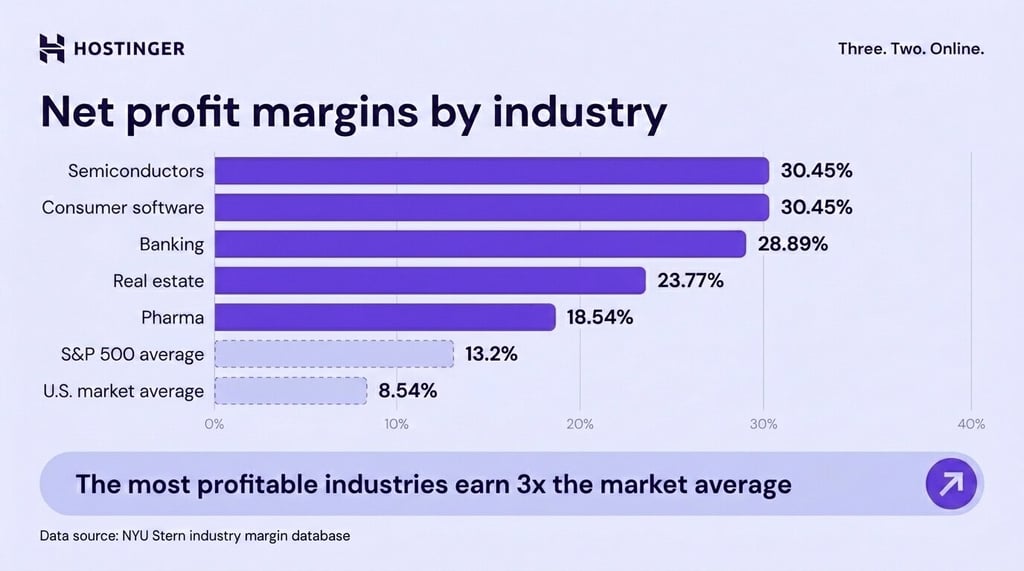
- The semiconductor industry leads all U.S. industries in net profit margin at 30.45%, fueled by IP ownership and AI-driven chip demand.
- The S&P 500 blended net profit margin reached 13.2% in Q4 2025, above the 10-year average of 11.0%.
- Alphabet reported $132.2 billion in net income for full-year 2025, the highest absolute profit of any public company.
- The Fortune Global 500 generated a combined $2.98 trillion in profit in FY2024, the second most profitable year on record.
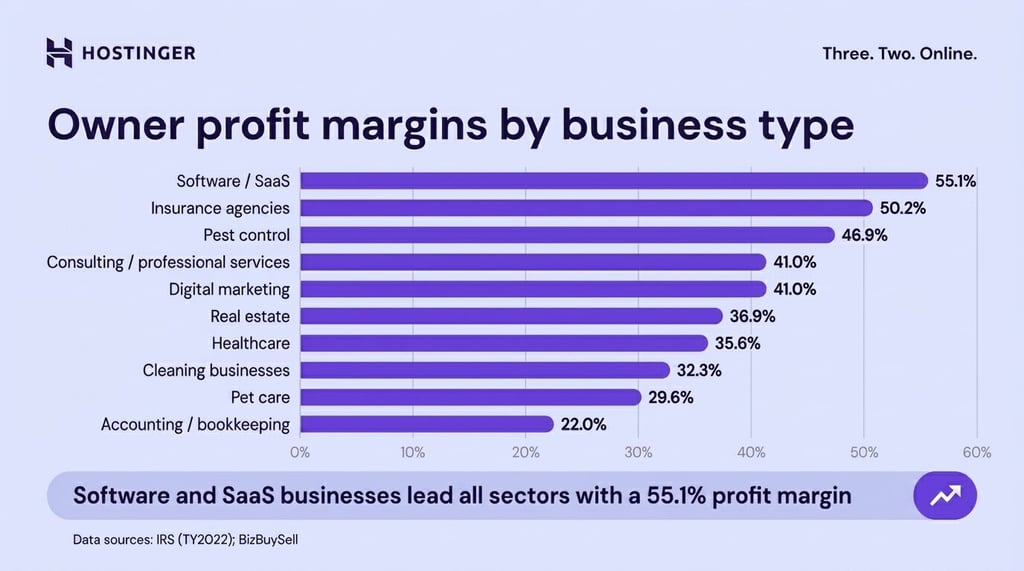
- Insurance agencies report an owner profit margin of 50.2%, making them one of the most lucrative small business categories.
- Amazon private label sellers achieve 30–50% profit margins, the highest of any Amazon selling model.
- Pest control businesses report an owner profit margin of 46.9%, among the highest in the home services sector.
- Americans spend over $150 billion on pets annually, underpinning the recession-resistant economics of the pet care industry.
- Global ecommerce sales are projected to exceed $6.4 trillion by 2029, growing at 9.49% annually.
Most profitable businesses to start
The businesses below cover a range of entry points, from solo service practices to scalable digital products, each with strong margins backed by IRS sole proprietor data and small business transaction records.
If you haven’t landed on a direction yet, online business ideas worth exploring span everything from content creation to niche software.
Software and SaaS businesses
Software-as-a-Service (SaaS) businesses build and sell cloud-based tools on a subscription model. The economics are compelling: near-zero marginal cost per additional user, recurring revenue, and high switching costs once a product is embedded in a customer’s workflow.
Unlike businesses selling physical goods, a SaaS company can serve its thousandth customer at virtually the same cost as its first.
Small software businesses report a 55.1% owner profit margin, one of the highest of any category, and private SaaS companies maintain a 77% median gross margin, reflecting the structural advantage of digital delivery.
This model suits developers, product thinkers, and niche industry experts who can identify a recurring workflow problem. A good place to start is a list of SaaS business ideas spanning everything from productivity tools to niche industry software.
Consulting and professional services
Consulting means selling expertise directly to businesses or individuals in a specific field: management, IT, finance, HR, marketing, legal, and more. Because the primary input is time and knowledge, overhead is near zero. No inventory, no physical space, no production cost beyond the hours you work.
According to IRS data (TY2022), professional, scientific, and technical services sole proprietors report a 41.0% profit margin on $247.8 billion in receipts, the highest of any sector.
This model works best for experienced professionals leaving corporate roles or anyone with deep domain expertise looking for client independence.
The scale of the opportunity is significant: one in four U.S. knowledge workers now freelances, collectively generating $1.5 trillion in earnings, and full-time freelancers report a median income of $85,000, above the $80,000 median for full-time employees.
Accounting, bookkeeping, and financial services
Accounting and bookkeeping businesses provide financial record-keeping, tax preparation, payroll, or advisory services to individuals and businesses.
Clients need these services year-round, which means high retention, predictable recurring revenue, and low overhead for solo operators.
IRS data puts sole proprietors in finance and insurance at a 22.0% profit margin, and while that sits below consulting, the model benefits from near-guaranteed annual demand: as long as businesses exist, they need accurate books and tax filings.
Real estate and property management
Real estate businesses operate through multiple models: buying and managing rental properties, working as a real estate agent, or managing properties on behalf of landlords.
Profitability comes from multiple revenue streams – rent, appreciation, and management fees – alongside leverage that amplifies returns and structural demand driven by population growth and housing supply constraints.
IRS data shows real estate and rental/leasing sole proprietors report a 36.9% profit margin, making it one of the stronger sectors for independent operators with capital to deploy and the people skills that property management demands.
Healthcare and personal care services
Private medical practices, therapy and counseling, dental clinics, specialist services, home care, fitness studios, and nutrition coaching all fall into this category. What they share is inelastic demand: patients pay for healthcare regardless of economic conditions, and an aging population is driving structural growth in many sub-sectors.
IRS data puts sole proprietors in health care and social assistance at a 35.6% profit margin – a figure that holds across a wide range of practice types and service models.
Digital marketing agencies and content businesses
Digital marketing agencies provide SEO, paid media, social media management, content creation, or email marketing services to businesses. Every company needs a digital presence, which creates stable demand, and the model scales well with contractors once a core client base is established.
Because this falls within the professional, scientific, and technical services sector, sole proprietors benefit from the same 41.0% profit margin that makes consulting one of the highest-earning categories in IRS data.
The difference is channel: marketers, writers, and designers with a proven track record can build a retainer-based agency around skills they already use in employment.
Ecommerce and online retail
Ecommerce businesses sell physical or digital products online through their own ecommerce website, Amazon, Etsy, or other platforms. The addressable market is global, premises costs are minimal, and models like dropshipping and private label allow high margins without warehousing.
Among Amazon selling models, private label delivers the strongest returns at 30–50% profit margin, compared to 10–20% for wholesale and 5–15% for online arbitrage. Across all models, 57% of Amazon sellers maintain margins above 10%, and 28% sustain margins above 20%, according to Jungle Scout.
The broader opportunity continues to grow: global ecommerce sales are projected to exceed $6.4 trillion by 2029 at a 9.49% annual growth rate.
Home services (pest control, cleaning, landscaping)
Pest control, house cleaning, lawn care, and HVAC maintenance businesses benefit from non-discretionary spending patterns, recurring contracts, and strong word-of-mouth referrals. Many homeowners and businesses treat these as essential services, making them relatively recession-resistant.
Owner profit margins across the category are strong: pest control leads at 46.9%, followed by commercial laundry at 38.0%, car washes at 37.3%, and cleaning businesses at 32.3%, according to BizBuySell transaction data.
The market is also expanding, with the global cleaning services sector alone projected to grow from $415.93 billion in 2024 to $616.98 billion by 2030, a 48% increase at a CAGR of 6.9%.
This category suits hands-on operators who want to build a team-based business with recurring revenue, and many of these models fit well with franchise structures for those who prefer a proven playbook.
Insurance agencies and financial advisory
Independent insurance agencies sell life, health, property, and casualty products, while financial advisors provide planning and investment services. In both cases, the revenue model relies heavily on renewals and trailing commissions, generating recurring income once a client’s book is built.
Insurance agencies report an owner profit margin of 50.2%, the highest of any small business category in BizBuySell’s transaction data. Investment and asset management firms report an 18.36% net margin according to NYU Stern’s industry database, a lower figure that reflects larger institutional cost structures rather than the economics of an independent practice.
These businesses work best for sales-oriented professionals with an existing network to build from – one where referrals compound over time into a largely self-sustaining book of business.
Pet care businesses
Dog walking, pet sitting, mobile grooming, boarding facilities, veterinary clinics, and pet product retail all benefit from a shared dynamic: pet owners treat animals as family members and spend consistently regardless of economic conditions. This makes pet care one of the more recession-resistant service categories.
It ranks among the top-performing categories within the broader services sector, which carries a 29.6% median owner profit margin. Americans now spend over $150 billion on pets annually, a figure that has climbed steadily for more than two decades.
Low barriers to entry, strong repeat business, and word-of-mouth growth make this a solid starting point for anyone building a service business in a market with durable demand.
Most profitable small businesses: Key context and survival rates
The margins above tell a compelling story, but they come with important context. The U.S. small business landscape is enormous: 36.2 million small businesses represent 99.9% of all U.S. companies, employ approximately 62.3 million people, and account for 88.9% of all net new jobs created. The largest share operates in professional services and real estate, consistent with those sectors topping the IRS profit margin rankings.
Survival, however, remains difficult. Roughly 18% of new firms close within their first year, approximately 50% within five years, and nearly 65% within a decade. The biggest financial pressures are inflation and rising prices (22%) and lack of capital or cash flow (18%).
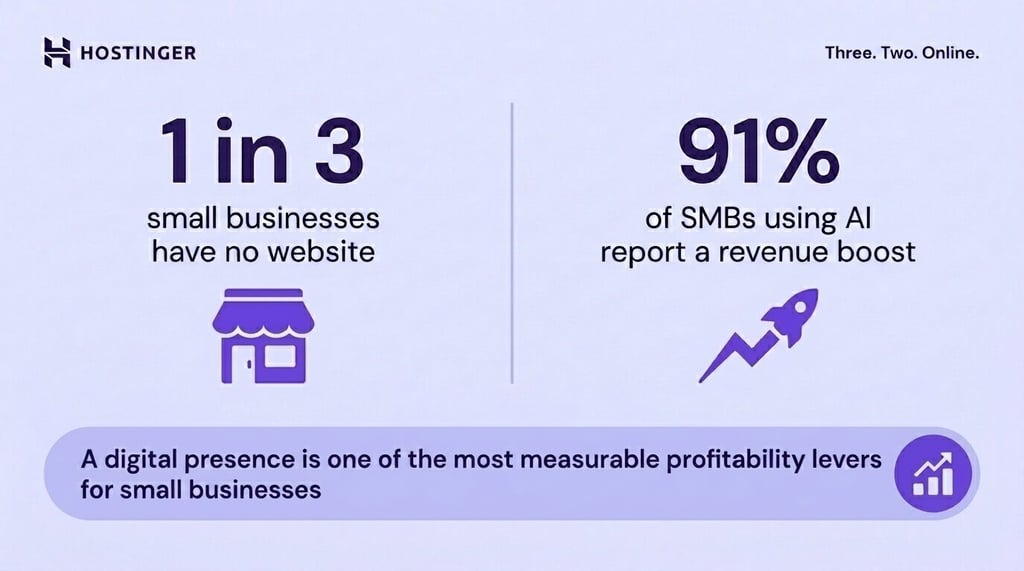
Approximately 1 in 3 small businesses still operate without a website, a gap that carries direct revenue consequences. 91% of SMBs that adopt AI tools report a boost in revenue, and strong web design alone can drive conversion rates by up to 400%, making digital presence one of the most measurable profitability levers available to small business owners.
The businesses with the best survival odds tend to be the same ones with the highest margins. Professional services and real estate benefit from expertise that creates natural barriers to competition, and recurring client relationships reduce acquisition costs over time.
AI is accelerating this advantage: the market for AI tools aimed at small and medium businesses is projected to reach $86.5 billion by 2033, with 57% of small business owners already using AI in their marketing.
What makes a business most profitable?
High margins are rarely accidental. The businesses that consistently generate superior profitability share structural characteristics that separate them from lower-margin competitors.
Understanding these drivers helps identify which models are genuinely worth pursuing and which only appear attractive on the surface.
Low marginal costs are the most powerful profit driver. Software, digital products, and online services can serve additional customers at near-zero incremental cost, which means revenue scales while costs stay flat. This is why SaaS gross margins average 77% and why digital businesses consistently outperform their physical counterparts at scale.
Recurring revenue reduces customer acquisition costs and provides predictable income. Subscriptions and retainer-based models in SaaS, accounting, insurance, and property management compound profitability over time because each retained client requires no additional sales effort to generate ongoing revenue.
Expertise and IP moats allow premium pricing. Professional services, pharmaceutical companies, and semiconductor manufacturers charge rates their competitors cannot easily match because their knowledge base or patents took years and significant capital to build. That creates durable pricing power even in competitive markets.
Inelastic demand keeps margins stable regardless of economic conditions. Healthcare, legal services, and utilities hold their pricing because customers have limited alternatives. A dental patient in pain or a business facing a legal dispute is not comparison-shopping the same way a consumer buying a commodity product is.
Capital efficiency, measured as return on invested capital (ROIC), allows businesses like software companies and financial services firms to compound profits without proportional reinvestment. Tobacco, software, and financial services consistently rank among the highest ROIC industries because each dollar of reinvestment generates outsized returns.
Most profitable industries by net margin
Net profit margin measures what a business actually keeps after all costs, taxes, and expenses, calculated as net income divided by revenue. Industry margins vary dramatically based on capital intensity, regulatory environment, and whether a sector benefits from IP protection, recurring demand, or high switching costs.
The figures below come from NYU Stern’s industry margin database and represent the most current benchmarks available for each sector:
- Tobacco: 37.34% after-tax operating margin and 68.11% ROIC, among the highest returns on invested capital of any U.S. industry, sustained by brand loyalty and minimal capital expenditure.
- Semiconductor industry: 30.45% net margin and 58.97% gross margin, the highest net margin of any U.S. industry, driven by IP ownership and licensing revenue on chips powering AI, smartphones, and data centers.
- Software (entertainment/consumer): 29.93% net margin and 66.45% gross margin, with digital delivery removing physical distribution costs and subscription models providing recurring revenue.
- Banking, money center: 28.89% net margin, as large commercial banks borrow at short-term rates and lend long, amplified by investment banking and wealth management fees.
- Real estate (general/diversified): 23.77% net margin, with the S&P 500 Real Estate sector reporting 33.5% in Q4 2025, the highest of all 11 S&P 500 sectors that quarter.
- Pharmaceutical drugs: 18.54% net margin and 71.73% gross margin across 228 firms, where high gross margins reflect patent-protected pricing and lower net margins reflect R&D intensity.
- S&P 500 blended net profit margin: 13.2% in Q4 2025, above the 10-year average of 11.0%, with full-year 2025 earnings growth estimated at 12.1% year over year.
- U.S. market average: 8.54% net margin across all industries, covering 5,994 firms.
The gap between the 8.54% market average and the 30%-plus margins of software, semiconductors, and banking illustrates how much industry selection matters. A well-run company in a structurally high-margin sector will almost always outperform a well-run company in a structurally low-margin one.
AI adoption is accelerating this divergence, with a record 331 S&P 500 companies citing AI as a current driver of margin expansion on their Q4 2025 earnings calls.
Most profitable companies in the world
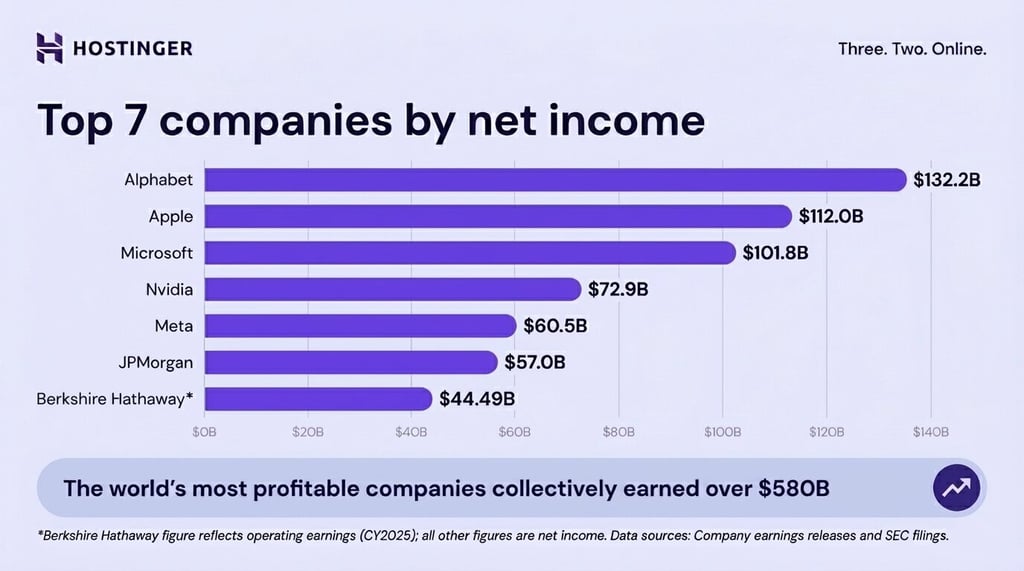
When measuring corporate profitability in absolute terms, the relevant figure is net income, the profit that remains after all expenses, interest, and taxes. The Fortune Global 500 generated a combined $2.98 trillion in profit in FY2024, the second most profitable year on record, while the Forbes Global 2000 recorded $4.9 trillion in combined profit.
The individual figures below come directly from company earnings releases and SEC filings, representing the most recent full fiscal year for each:
- Alphabet (Google): $132.2 billion net income (CY2025), on revenue of $402.8 billion, the first time the company exceeded $400 billion, with a net margin of approximately 32.8%.
- Apple: $112.0 billion net income (FY2025), on revenue of $416.0 billion, up 8% year over year.
- Microsoft: $101.8 billion net income (FY2025), on revenue of $278.2 billion, with a net margin of approximately 36.6%.
- Nvidia: $72.9 billion net income (FY2025), up approximately 145% year over year, fueled by AI accelerator demand.
- Meta Platforms: $60.5 billion net income (CY2025), on revenue of $201.0 billion, up 22% year over year.
- JPMorgan Chase: $57.0 billion net income (CY2025), on revenue of $186 billion, with a return on tangible common equity of 20%.
- Berkshire Hathaway: $44.49 billion in operating earnings (CY2025), down from $47.4 billion in CY2024.
What the top seven have in common is structural: they either benefit from near-zero marginal cost at scale, sit at the center of the AI infrastructure buildout, or earn recurring fee and interest income on enormous balance sheets.
These are not businesses that happened to have a good year; they are built to compound profitability.
The future of profitable businesses: AI and emerging trends
The data points in one clear direction: technology is the primary driver of margin expansion in 2026, and AI is the largest single force within it. A record 331 S&P 500 companies cited AI on their Q4 2025 earnings calls, not as a future aspiration but as a current driver of efficiency, revenue, and competitive positioning. This contributed to full-year 2025 earnings growth of 12.1% year over year.
The AI market for small and medium businesses is projected to reach $86.5 billion by 2033, with adoption already accelerating across marketing, operations, and customer service, with software and semiconductor margins expanding in parallel.
For business owners and entrepreneurs, the implication is practical. The most profitable businesses in the years ahead will be those that use AI to reduce marginal costs, automate repetitive tasks, and deliver personalized experiences at scale.
This applies equally to a solo consultant using AI to increase client capacity, a SaaS company embedding AI features to reduce churn, and a home services business using AI scheduling to improve route efficiency. For anyone ready to build, Hostinger AI Builder lets you launch a product without prior technical experience.
From solo consulting practices to the world’s largest technology companies, the businesses covered here share a common thread: they have found ways to generate more revenue without proportional increases in cost. That principle, more than any particular industry or trend, is what makes a business most profitable.


Daniela is an Off-Site SEO Specialist with extensive expertise in link building, digital PR, and content optimization. She has led international outreach campaigns across the U.S., Brazil, France, and Spain, securing high-quality backlinks. Follow her on LinkedIn.