AI app builder statistics 2026: market size, adoption, and trends

Most people building apps with AI today aren’t developers. Citizen developers already outnumber professional software developers four to one, no-code platforms can cut development time by up to 90%, and the no-code AI platform market is growing from $6.56 billion in 2025 to a projected $75 billion by 2034.
AI app builders are reshaping who builds software, how fast it gets done, and what it costs.
Top 10 AI app builder statistics for 2026
These are the most important data points shaping AI app building in 2026:
- $6.56 billion is the no-code AI platform market size in 2025, projected to reach $75.14 billion by 2034.
- 70% of new enterprise applications will use low-code or no-code tools by 2026, up from less than 25% in 2020.
- 90% of developers regularly use at least one AI tool at work as of January 2026.
- 55% faster completion of coding tasks using AI tools in controlled experiments compared to working without them.
- 63% of vibe coding and AI app builder users are non-developers building without a coding background.
- $2.52 trillion in worldwide AI spending is forecast for 2026, a 44% year-over-year increase.
- 40% of enterprise applications will be integrated with task-specific AI agents by the end of 2026, up from less than 5% in 2025.
- 1.7 billion downloads of generative AI apps were recorded in H1 2025, with in-app purchase revenue nearly doubling to $1.9 billion.
- 1 million users: Hostinger AI Builder reached this milestone in its first year, with users building everything from SaaS dashboards to ecommerce stores.
- 4 to 1: citizen developers already outnumber professional software developers globally, with 100–120 million people building business applications in no-code platforms compared to approximately 27.7 million professional developers worldwide.
The AI app builder market: size, growth, and investment
Few software categories are growing as fast as AI app builders right now. The no-code AI platform market was valued at $6.56 billion in 2025 and is projected to reach $75.14 billion by 2034 at a 31.13% CAGR. That growth sits inside a much larger wave: worldwide AI spending will total $2.52 trillion in 2026, a 44% year-over-year increase, with AI infrastructure alone accounting for $401 billion as technology providers build out their foundations.
The platform-level numbers tell the same story. Lovable hit $400M in ARR in February 2026, valued at $6.6 billion as of its December 2025 Series B, while Replit reached approximately $253 million ARR by October 2025, growing 2,352% year-over-year.
- Generative AI apps were downloaded 1.7 billion times in H1 2025, with in-app purchase revenue nearly doubling to $1.87 billion compared to $932 million in H2 2024, a 67% half-over-half download growth rate, the fastest since the initial AI surge in H1 2023 (TechCrunch).
- C-suite executives report saving an average of $28,249 per developer annually from AI investments, translating to over $750 billion in potential global value when applied across the world’s 27 million developers (GitLab).
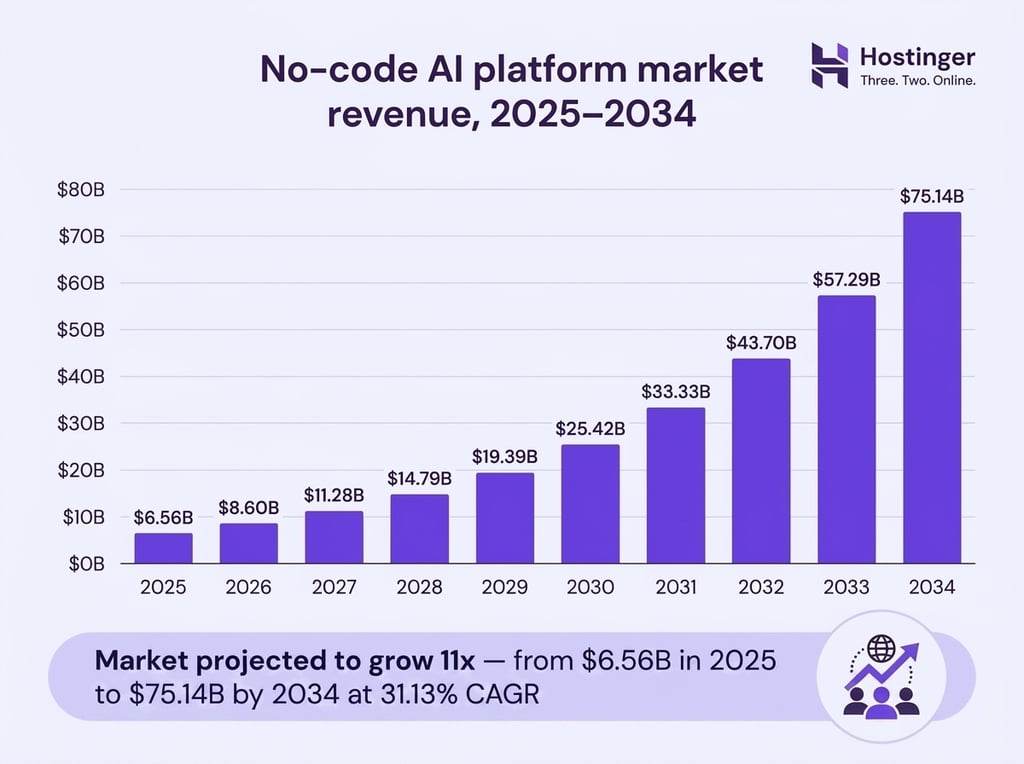
The chart above illustrates the trajectory: a market growing at 31% CAGR doesn’t slow down quietly. And the growth isn’t confined to enterprise. The 1.7 billion generative AI app downloads in a single half-year show the same acceleration playing out at the consumer level.
AI app builder adoption: who is building with AI?
The majority of AI builder users are non-developers, making this a democratization story, not just a developer productivity story.
According to Hostinger’s vibe coding statistics, 63% of vibe coding and AI app builder users have no coding background, meaning these platforms have genuinely expanded software creation beyond the developer community.
Among professional developers, adoption is near-universal: 90% of developers regularly use at least one AI tool at work as of January 2026, up from 85% mid-2025, with 74% already using specialised AI coding tools beyond general chatbots. That figure marks the third consecutive year of growth in developer AI adoption, a trend consistent across multiple industry surveys.
The shift is just as visible outside engineering teams. By 2026, 80% of low-code and no-code users will be outside IT departments, up from 60% in 2021. The people building business applications will increasingly be the same people who need them.
- 91% of C-suite executives say software innovation is now a core business priority, with 89% expecting agentic AI to become the industry standard for software development within 3 years (GitLab).
- 25% of Y Combinator’s Winter 2025 startups had codebases that were 95% or more AI-generated, reflecting how quickly AI app builders have become the default approach for early-stage product development (TechCrunch).
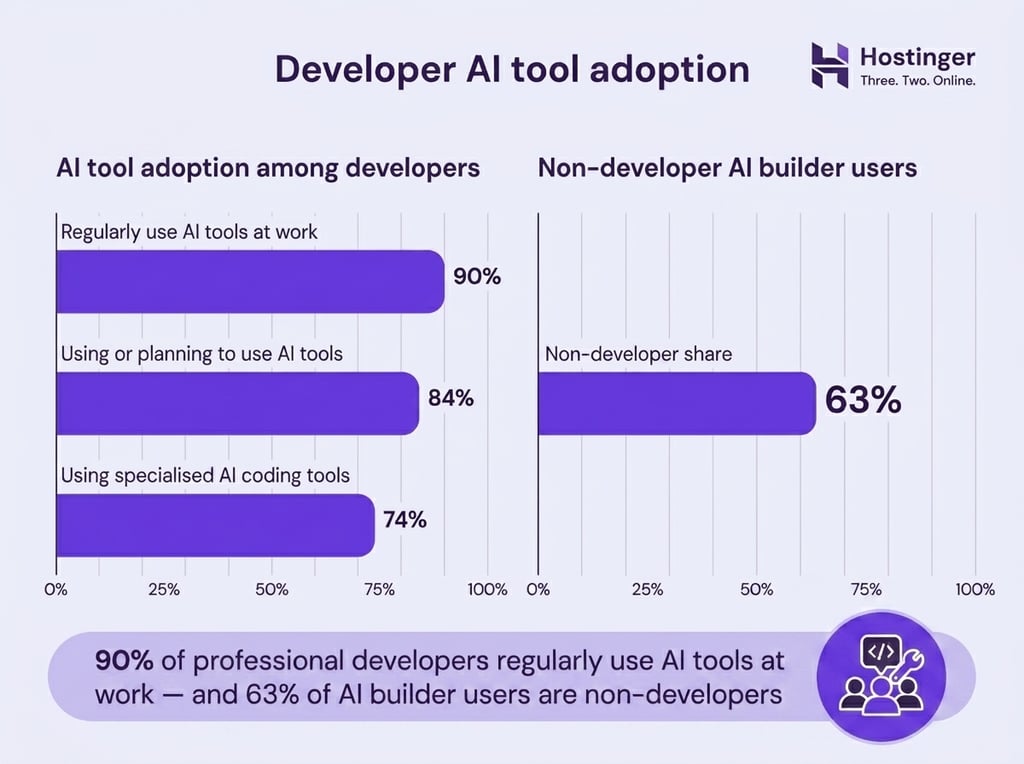
As we saw, the adoption story has two distinct threads. Professional developers are integrating AI into existing workflows, while non-developers are using prompt-to-app platforms to build for the first time.
What are people building with AI app builders?
AI app builders are being used to create real, income-generating projects, not just prototypes and experiments.
- Business and portfolio websites account for 49% of projects built on Hostinger AI Builder, followed by ecommerce stores (10%) and SaaS dashboards and tools (5%) (Hostinger vibe coding statistics).
- Twice as many teams built agentic products in 2025 compared to the year before, as AI-assisted development has moved from simple code completion to autonomous multi-step app creation (Figma).
- 40% of enterprise applications will be integrated with task-specific AI agents by the end of 2026, up from less than 5% in 2025. Gartner describes this as one of the fastest enterprise technology transformations since cloud adoption (Gartner).
- ChatGPT’s use cases have expanded well beyond coding and productivity, with over a third of prompts now related to lifestyle and entertainment. AI apps are becoming part of daily life, not just work tools (TechCrunch).
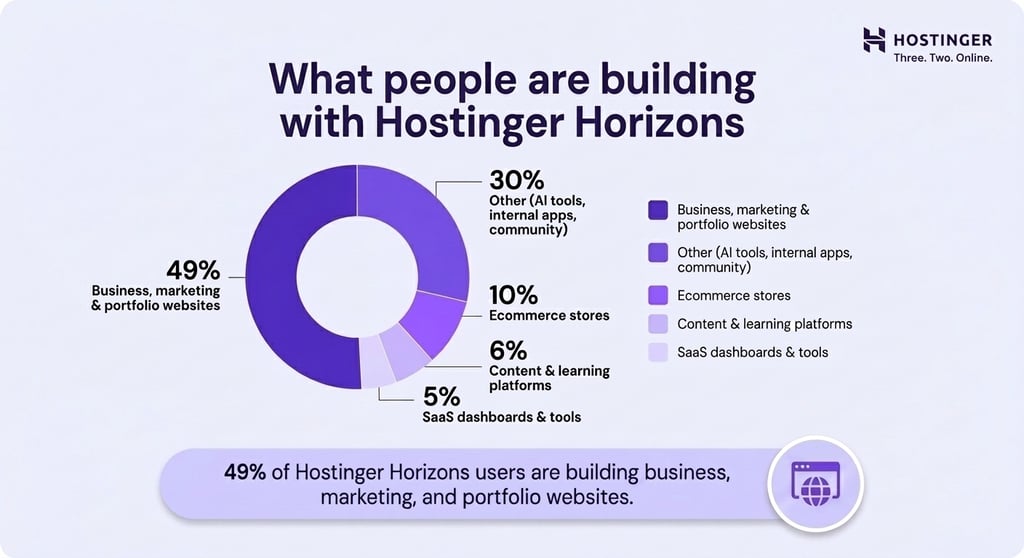
The output data makes one thing clear: people are using AI builders across a wider range of project types than most coverage suggests, from individual creators building portfolio sites to enterprise teams deploying agentic applications at scale.
Expert tip
When we built the AI Builder, the goal was simple: close the gap between having an idea and having a working product. What the data confirms (SaaS dashboards, ecommerce stores, business tools) is that users aren’t experimenting. They’re building things they intend to use and sell. That tells us the platform is doing its job: turning intent into output, no technical expertise required.

How fast and cheap is AI app building vs. traditional development?
Time and cost savings from AI app builders are real, but the gains depend heavily on task type and project complexity.
- Developers complete coding tasks 55% faster using AI tools, finishing the same work in roughly half the time of those working without them (GitHub).
- AI-assisted developers complete 26% more tasks, commit code more frequently, and produce significantly more builds than those working without AI tools (MIT Economics).
- No-code platforms reduce app development time by up to 90%, compressing months of traditional development into days or weeks. Organisations also report average annual savings of $187,000 with 6–12 month payback periods (Integrate.io).
- A simple business website built by a professional developer costs $5,000–$20,000, with timelines of 2 to 6 weeks. AI app builders compress both the cost and timeline significantly, making professional digital products accessible to individuals and small businesses (Space-O Technologies).
- AI-assisted workflows reduce time-to-pull-request by 48–58%, compressing one of the most time-consuming parts of the development cycle (PR Newswire).
- AI-generated pull requests wait 4.6x longer for human review than human-written ones, meaning speed gains at the coding stage are partially absorbed by bottlenecks further down the pipeline (PR Newswire).
- Low-code platforms can make software development 10 times faster than traditional processes, allowing organisations to focus more on design and user experience while business experts lead automation projects instead of waiting for technical teams (Hostinger low-code trends).
The largest gains come from simple, well-scoped tasks on clean requirements. Where complexity increases, such as custom logic, cross-system integrations, or non-standard requirements, human oversight remains essential. The broader pattern is the same: AI accelerates generation but doesn’t eliminate the need for human judgment further down the pipeline.
AI app builder platforms: usage and market share
The market has split into two distinct categories. Developer-facing coding tools accelerate professional workflows, while creator-facing app builders enable non-developers to build from scratch.
Developer-facing AI coding tools
AI coding assistants are no longer optional for most professional developers. The adoption and revenue numbers confirm what most developers already know: these tools have gone from interesting experiment to default infrastructure.
- GitHub Copilot has become the dominant AI coding tool, with 20 million+ users, 75% year-over-year growth, and adoption across 90% of Fortune 100 companies (Microsoft).
- GitHub Copilot now generates 46% of code written by active users, nearly double the 27% rate at launch in 2022, showing how central AI has become to everyday development workflows (GitHub).
- Cursor grew from $0 to $1 billion ARR in roughly three years, making it the fastest B2B scaling on record, with its December 2025 Series D valuing the company at $29.3 billion (Sacra).
- Claude Code reached 18% adoption among developers at work in January 2026, a 6x increase from approximately 3% in April–June 2025 (JetBrains).
AI app builder platforms for non-developers
Creator-facing platforms are producing real output at scale, not just user counts and revenue, but evidence of apps actively being built and used. The line between a website and a web app is dissolving. AI builders now add databases, user authentication, and logic layers to what used to be static sites, and the output data reflects that shift.
- Lovable hit $400M in ARR in February 2026, valued at $6.6 billion, with over 25 million total projects created and 100,000+ new projects launching every day (Sacra).
- Replit reached approximately $253M ARR by October 2025, growing 2,352% year-over-year, as non-technical teams at companies like Coinbase, Zillow, and Mercedes-Benz adopted it for building internal tools (Sacra).
- Hostinger AI Builder reached 1 million users in its first year, with users building business and portfolio websites (49%), ecommerce stores (10%), and SaaS dashboards and tools (5%), demonstrating broad adoption across non-developer use cases (Hostinger AI Builder reached 1 million users).
- 71.7% of new websites are built using a combination of human-edited and AI-generated code, as AI tools assist developers in generating code faster while human expertise handles customisation and quality control (Hostinger web development trends).
A single prompt is now enough to build and deploy a functional web app, no technical background required. The Hostinger AI app builder is built around exactly that idea: describe what you want, and it handles the rest.
Expert tip
When Hostinger’s AI Builder surpassed one million users, what stood out wasn’t the number. It was what people were building. Real businesses, real revenue streams, real products. The platform was designed to make that possible without a technical background, and seeing it happen at scale confirms the vision was right. The opportunity now is to keep raising the ceiling on what anyone can ship.

AI app builder quality, security, and trust
Speed and cost savings are real, but AI-generated code carries genuine quality and security risks that buyers should understand before deploying at scale.
- 46% of developers do not trust the accuracy of AI tool output, a significant increase from 31% in 2024. While adoption keeps rising, trust in output accuracy is moving in the opposite direction (Stack Overflow).
- 66% of developers say debugging AI-generated code is their biggest frustration, with 45% saying it takes more time than writing the code themselves (Stack Overflow).
- By 2028, prompt-to-app approaches by citizen developers will increase software defects by 2,500%, making quality governance one of the most pressing challenges in the industry (Gartner).
- Code quality is the top developer concern about AI tools at 23%, followed by limited understanding of complex logic (18%), privacy and security (13%), negative effect on coding skills (11%), and lack of context awareness (10%) (JetBrains).
- Experienced developers were 19% slower with AI tools when working on mature, large-scale codebases, despite expecting the opposite outcome before starting (METR).
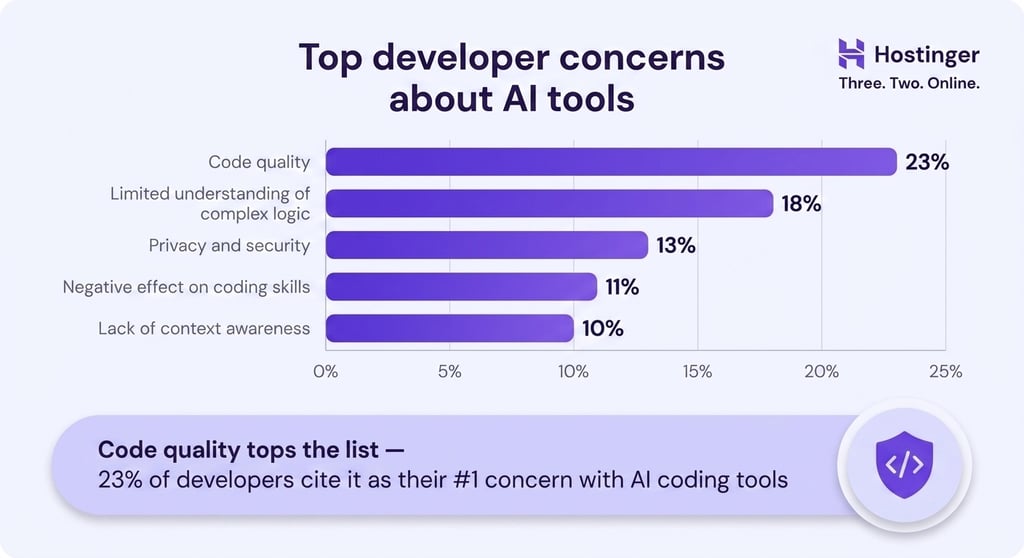
The trust gap is the most significant insight in this data. Nearly half of developers distrust AI output accuracy, and debugging AI-generated code already costs more time than writing it from scratch for 45% of developers.
The review burden is heaviest on complex, mature codebases, which is precisely where the generation gain is smallest. For anyone building with AI tools, the implication is straightforward: the value of AI is front-loaded at the generation stage, and the cost tends to surface later in review and debugging.
The future of AI app builders
The market, the users, and the output data all point to the same conclusion: this is becoming the default way software gets made.
According to Gartner, AI could drive approximately 30% of enterprise application software revenue by 2035, surpassing $450 billion, up from 2% in 2025. By 2029, at least half of knowledge workers are expected to create, govern, and deploy AI agents on demand. Building with AI is becoming as routine as using a spreadsheet.
The developer community itself is shifting. 49% of developers plan to try AI coding agents in the coming year, delegating boilerplate generation, documentation, and test writing while retaining control over architecture and debugging.
Meanwhile, 44% of developers are now turning to AI tools to learn to code, up from 37% the previous year. The next generation of builders may never learn to code the traditional way, and that’s not necessarily a bad thing.
The scale of the citizen developer movement anchors these projections in something concrete. The number of people regularly building business applications in no-code platforms now sits between 100 and 120 million globally, compared to approximately 27.7 million professional software developers worldwide.
Citizen developers already outnumber professional developers by roughly four to one. As AI platforms lower the barrier further, that ratio will only widen.
If you want to see what building without code actually looks like, Hostinger AI Builder lets you go from idea to working app with a single prompt.

Daniela is an Off-Site SEO Specialist with extensive expertise in link building, digital PR, and content optimization. She has led international outreach campaigns across the U.S., Brazil, France, and Spain, securing high-quality backlinks. Follow her on LinkedIn.