Thinking of using an AI agent in your business? Here’s how to get more from it
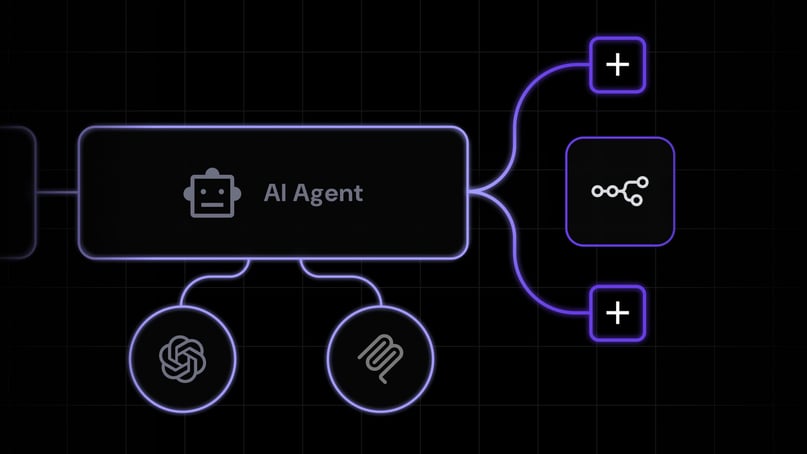
AI agents can fill the awkward gap when your business has more work than you can handle, but not enough revenue to hire another employee. They aren’t quite like the AI tools commonly used today.
You don’t just give an AI agent a prompt and get a descriptive answer. You delegate tasks to it, and it works out the steps needed to get there.
But AI agents aren’t magic extra hands that you can switch on and forget about. If you don’t know what work to hand in, it can create more problems than it solves.
In a five-month study of 20 companies experimenting with AI agents, Abdul Tayyeb Datarwala found that businesses struggled when they automated poorly understood processes, underestimated exceptions, or removed human oversight too soon – not because the technology itself failed.
So what if, instead of thinking about an AI agent as a piece of software you switch on, you thought about it as a teammate you’re hiring?
To make that idea more concrete, let’s imagine we’re building a small creative agency called Milo Studio.
We’re spending hours every week on prospect research, outreach emails, and proposals. We need more help, but we’re not ready to hire another person. So we’re going to approach it as if we were hiring someone to do this work.
Set a clear job description for the agent
Before we start comparing platforms and features for building an AI agent, we need to define the job we want it to do. This makes it easier to determine which capabilities the agent actually needs – and whether an agent is even the right solution.
Some jobs are better suited to simple automation. Others require a system that interprets information and makes decisions along the way. Or both.
For example, if all we need is to send a standard follow-up email three days after a sales call, we don’t need an AI agent. The process is predictable: when X happens, do Y.
But if we want a system to research potential clients, judge whether they’re a good fit, tailor our outreach, and turn interest into a proposal, an AI agent makes more sense.
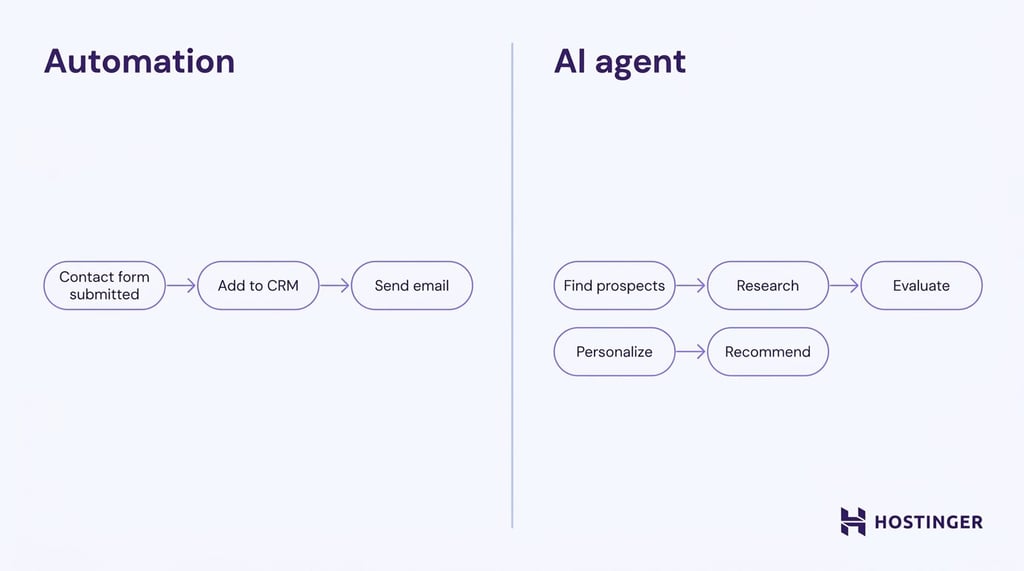
While the line between automation and AI agents isn’t always this clear, our guide on choosing between an AI agent and automation explains how to make the distinction for your own tasks.
For Milo Studio, an agent is the right hire, so we need to make its first job as specific as possible.
“Help with sales” is a vague job description. We need to define what that actually means, what the agent is responsible for, and where its responsibilities stop.
Here’s an example of Milo Studio’s first agent job description:
Every weekday at 9 AM, check Product Hunt for newly launched startups. Look for companies that match our target profile: early-stage technology startups with a consumer-facing product, a small team, and a clear need for branding, website design, or similar creative services.

Research promising prospects using their websites and LinkedIn. For each qualified prospect, include the company name, what they do, their contact person, and why they might need our services. Send me the shortlist for review.
Expert tip
When an AI agent operates without clear context, it tends to ask more clarifying questions, take longer to complete tasks, produce more errors, and return results that are harder to verify and trust.
When building or working with an agent, make its context explicit by providing:
– Clear rules and instructions for its domain, supported by examples
– A clearly defined scope and focused use cases
– Reliable data with a clear source and meaning
– Criteria and methods for evaluating and verifying its outputs
A structured and trustworthy context helps an agent produce useful, consistent, and verifiable results.

Get to know the AI agent candidate better
Once we know which job we’re hiring for, we can start looking for the right platform to build the AI agent. There are plenty of agentic platforms available today, from ready-to-use AI agents to customizable agent builders and automation platforms.
Knowing what the job requires keeps us from overpaying for capabilities we don’t need or choosing a platform that won’t give our agent enough room to do the job.
For Milo Studio, we need an agent that can research prospects. That’s a straightforward goal, so we don’t need to build an agentic sales system from scratch.
A ready-to-use option like Hostinger Agent could be a good fit here, as it includes sales and outreach skills. We’d only need to configure it with a system prompt – the job description we wrote earlier.
After that, let the agent perform some test tasks.
First, we give it a few prospects we’ve already prepared and ask it to identify which ones fit our target profile.
Because we’ve done the work ourselves, we already know what a good result looks like and can compare its output with ours.
Then we make the test harder. We give it a prospect that looks promising but doesn’t actually fit our criteria, or leave out information it would need to make a confident recommendation.
By doing so, we’ll know whether it recognizes the gap, asks for more information, or confidently fills in the blanks. A useful AI agent shouldn’t just know how to complete a task, but it should also know what to do when it can’t complete one.
These tests aren’t simply about deciding whether the agent passes or fails. They help us understand where it performs well, where it needs more context or guidance, and where a human still needs to make the call. If the results aren’t good enough, we can go back, tweak the system prompt, and test again.
And just as with a human hire, we set the hiring bar ourselves. Before we decide whether an agent is good enough for the job, we need to know what good looks like.
That means defining our own benchmark for accuracy, quality, and the level of independence we expect from it.
Put the agent on probation
In its first weeks on the job, we keep our Milo Studio agent’s work behind human review.
We check the prospects it selects. We review its outreach. We compare its proposals against our own pricing and requirements.
Through this process, we learn how it actually performs when the task moves beyond staged test cases into the messiness of real work.
Then we need to track its performance. Over the set probation period, we need to record:
- What did it get right?
- What did it miss?
- What did we have to correct?
- What kinds of situations caused problems?
We can think of this as the agent’s probation file.
Over time, those records give us something better than a feeling that “it seems to be working.” They give us evidence that it can – or can’t – handle the job reliably.
Give it more responsibility when it’s ready
Our Milo Studio agent began with a very specific task: researching prospects.
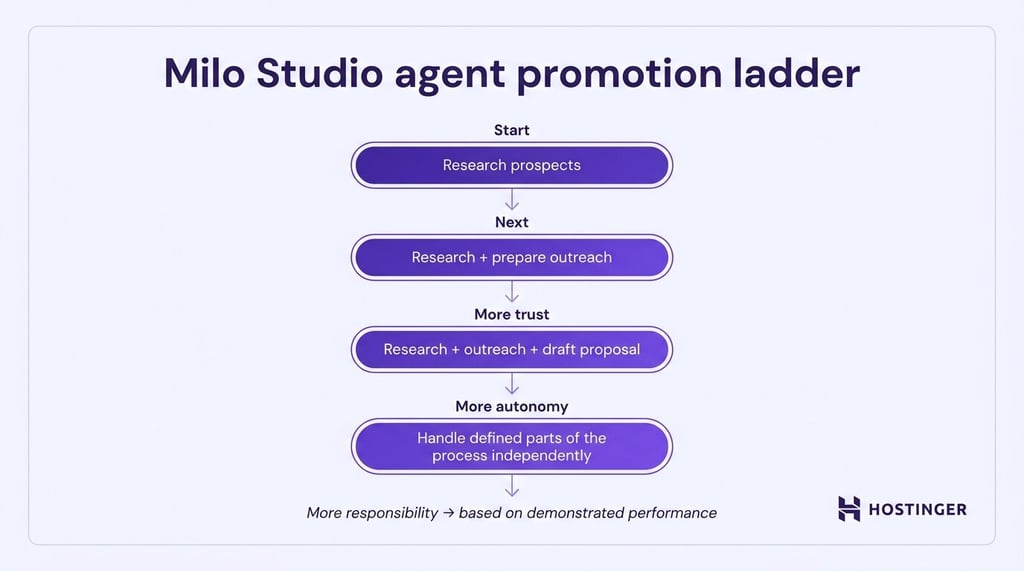
Once we’ve seen it perform reliably, we can gradually increase the task complexity. For instance, we can start delegating cold outreach message drafting or proposal assembling as soon as a prospect meets the criteria we’ve already defined.
We’re increasing its responsibility one step at a time, based on evidence that it can handle the job we’ve already given it. Over time, our feedback and corrections can also give the agent enough context about how we work to handle more of the process independently.
That’s how trust should work – it grows with the job.
If it continues to perform well, we can allow it to handle more of the process independently. But note that we need to define the boundaries clearly too, keeping unusual opportunities, important negotiations, and final approvals with us.
And throughout that process, our feedback matters. When we repeatedly correct mistakes, those corrections can help shape how the agent handles similar situations in the future.
If we never explain what good looks like, review the work, or correct mistakes, we shouldn’t expect the agent to meet our standards.
As AI takes on more work, managing it well matters as much as knowing how to use it.
Decide which responsibilities you’ll never delegate
We’ll always be responsible for what our AI agent does. We can delegate the work, but we can’t delegate accountability for the outcome.
If our agent researches a prospect, drafts a proposal, and includes the wrong pricing, the client isn’t going to ask which AI model made the mistake. They’re going to come to us.
And some decisions are difficult to turn into a job description in the first place.
Our agent might find a promising client and prepare a strong proposal. But it may not know that we’ve worked with a similar client before and decided the relationship wasn’t a good fit.
It can work with the information we’ve given it, but it doesn’t necessarily have the context, relationships, or judgment needed to make every decision for us.
That’s an important distinction, as doing the work and owning the decision aren’t the same thing. Use AI agents for the things they can do well, so you have more room for the things only you can do.
Expert tip
AI has made solving problems cheap. When execution is nearly free, the valuable skill is no longer solving, but finding the problems worth solving, and knowing why they’re worth solving at all. That’s the part you can’t delegate.
And it doesn’t require heroics. Improve by 0.1% a day – question one number, kill one process, hand one task to an agent – and that compounds to over 40% in a year. There were no hero days behind our growth. Just small improvements, every day.

Are you ready to give your first AI agent a job? Learn how to use skills in Hostinger Agent or follow our guide to build a customized agent.

Larassatti Dharma is a content writer with 5+ years of experience in the web hosting industry. She has populated the internet with over 100 YouTube scripts and articles around web hosting, digital marketing, and email marketing. When she's not writing, Laras enjoys solo traveling around the globe or trying new recipes in her kitchen. Follow her on LinkedIn