Is Google still the front door to the internet?
For years, finding a business meant opening Google. Now people also start on TikTok, Instagram, Reddit, YouTube, maps, and AI assistants, depending on their age and what they need. Among Gen Z adults, 19% start a product search on TikTok, more than double the rate of all adults.
But Google is not going anywhere, and neither is the humble business website. A new Hostinger survey of 1,014 US adults found that search is still the most common first stop, most people still circle back to a company’s own site, and a business you cannot find online barely makes the shortlist.
Here is where people actually start, when they wander off to AI and social, and why your website still closes the deal.
Key takeaways
- Nearly 1 in 5 Gen Z (19%) start on TikTok when shopping for products, more than double all adults.
- More than 1 in 10 consumers (12%) chose their most recent business without using Google at any point.
- Nearly 1 in 3 consumers (30%) who used AI instead of Google did so because Google wasn’t helping them find what they needed.
- Even among people who used both Google and AI, Google was the more helpful of the two (38% vs 26%).
- About 2 in 3 Gen Z (66%) trust a business’s Reddit or TikTok reviews more than its website or Google reviews.
- Only 6% would book a business that an AI recommends without checking anything else.
- Over 2 in 5 consumers (44%) would view a business as less trustworthy and would likely choose a competitor if they couldn’t find its website.
Where Americans start looking for a business
Google is the top starting point in seven of eight categories, but Gen Z starts on social for products and travel, and AI is a first stop for healthcare and finance.
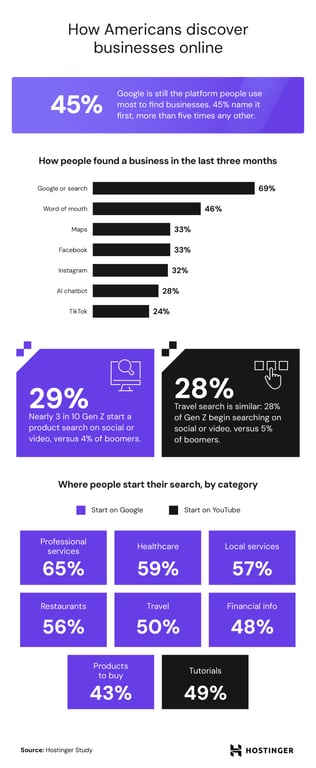
Google was the most common starting point in seven of eight everyday categories, from restaurants to professional services, and when people named the single platform they rely on most, 45% picked Google, more than five times the next choice.
Search has company, though. In the last three months, people also found businesses through word of mouth (46%), maps and Facebook (33% each), Instagram (32%), and AI assistants (28%).
AI assistants are already a real starting point for certain needs. People turn to AI most for healthcare (17%), financial information (16%) and tutorials (14%), which makes it the second most common first stop for health and money questions, behind only Google. For restaurants, just 3% start with AI.
For businesses in those fields, AI search optimization is worth an effort, since it affects whether assistants mention you at all.
And when people wanted a real person’s take, nearly 1 in 4 (24%) went to Reddit first.
The sharpest divide is generational. Gen Z are far more likely to begin on social or video for certain categories: 29% start a product search there, compared with just 4% of boomers, and travel looks much the same (28% versus 5%).
Nearly 1 in 5 Gen Z (19%) start a product hunt on TikTok specifically, more than double the rate of all adults, and that skews heavily female, reaching 38% of Gen Z women.
Older shoppers still default to Google almost everywhere, so the real story is that younger people go social-first for products and travel, while the rest of the map stays search-first.
When people search beyond Google
65% of adults have left Google’s results for Reddit or TikTok, yet 88% still used Google at some point when choosing their most recent business.
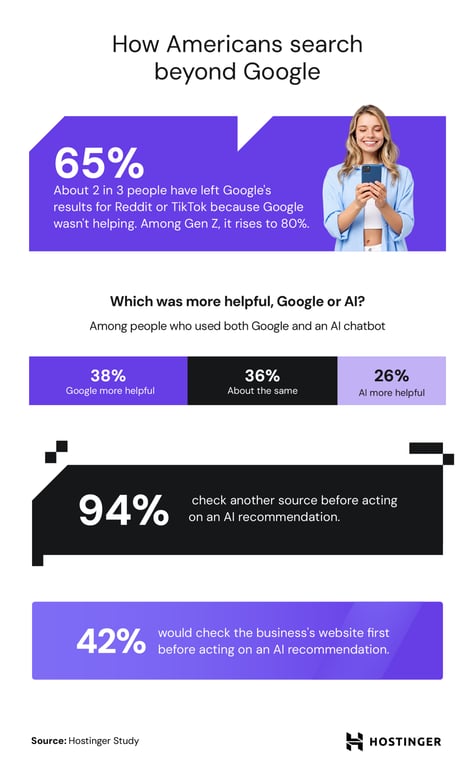
About 2 in 3 (65%) have left Google’s results for Reddit or TikTok because Google wasn’t helping, and among Gen Z that climbs to 4 in 5 (80%). The habit cools with age, from 80% of Gen Z to 72% of millennials, 52% of Gen X and 41% of boomers.
AI assistants have become a normal part of the mix too: 93% of people have gotten a business recommendation from one, and that is just as true for boomers (96%) as for Gen Z (88%).
Among people who used both Google and an AI assistant to choose a business, Google still came out ahead: 38% found it more helpful, versus 26% for the AI, and another 36% found them about the same.
Nearly 1 in 3 (30%) who reached for AI instead of Google did so simply because Google wasn’t surfacing what they needed.
Here is the twist: people fold these tools into their research rather than hand over the decision. Only 6% would do business with a brand based solely on an AI recommendation, without checking anything else. Businesses share that caution, with inaccuracy now the most-cited AI risk in our latest LLM statistics.
Google is still the hub that almost everyone passes through, used by 88% at some stage of choosing their most recent business.
A smaller group skips search entirely, with more than 1 in 10 (12%) choosing their most recent business without ever using Google.
Why your website still closes the deal
When people can’t find a business’s website, 7 in 10 (70%) see it as less legitimate, and 44% would likely choose a competitor.
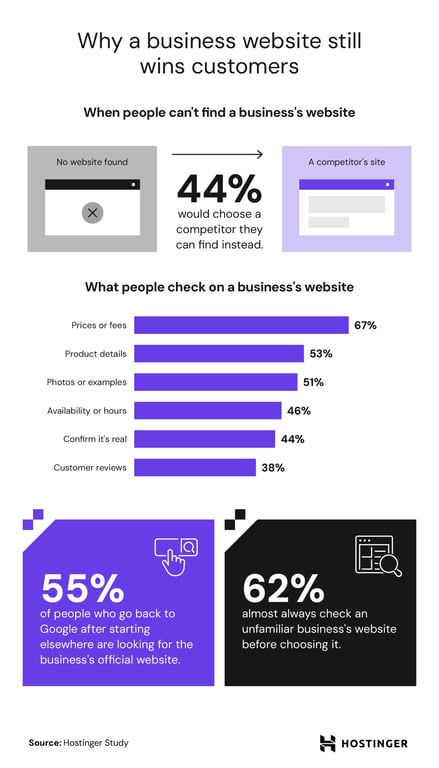
The reaction is strongest among older adults: 64% of boomers would choose a competitor over a business with no findable website, well above the 40%-45% range for younger generations.
About 1 in 3 small businesses still operate without a website, according to Hostinger’s small business statistics.
The website is also what people look for when they double-check something they found on AI or social media. Among those who circle back to Google after starting elsewhere, 55% are looking for the business’s official website.
The site has to deliver once they arrive. When details were missing or didn’t line up, 32% of the 87% who ran into that issue simply chose a different business.
Social proof carries weight too, especially for the young: about 2 in 3 Gen Z (66%) trust a business’s Reddit or TikTok reviews more than its own website or Google reviews, though that trust falls with age, to half of millennials (50%) and about 1 in 3 Gen X (32%) and boomers (31%).
The front door has more doors than ever
People now find businesses through search, social, and AI, but many still check the website before choosing. A business without one risks looking less legitimate, and one with missing or mismatched details risks losing the customer to a competitor.
If you don’t have a website yet, Hostinger AI Builder generates a first version from a description of what you do, which you can further edit, enhance with AI tools, and publish – hosting is included.
Methodology
In October 2026, Hostinger surveyed 1,014 US adults aged 18 and older about where they discover businesses online, where they start their search, and when they visit a business’s website before deciding.
Respondents were grouped by generation using Pew Research Center age bands as of 2026: Gen Z (18 to 29) at 18%, millennials (30 to 45) at 46%, Gen X (46 to 61) at 27%, and baby boomers (62 and older) at 9%. The average age was 42, and 53% were women, 46% men, and under 1% self-described or preferred not to say.
The margin of error for the full sample is about ±3 percentage points at a 95% confidence level. Subgroup results are directional and carry wider margins: about ±5 points for millennials, ±6 for Gen X, ±7 for Gen Z, and ±10 for baby boomers. Results are reported only for groups of at least 5% of the sample.
All figures are self-reported and reflect stated attitudes and recalled behavior, not observed behavior. Percentages may not total 100% due to rounding.
Fair use statement
You’re welcome to share the findings and visuals from this study for noncommercial purposes. Please attribute the research to Hostinger and link back to this page so readers can see the full findings and methodology.

Simon is a dynamic Content Writer who loves helping people transform their creative ideas into thriving businesses. With extensive marketing experience, he constantly strives to connect the right message with the right audience. In his spare time, Simon enjoys long runs, nurturing his chilli plants, and hiking through forests. Follow him on LinkedIn.