Wednesday October 14, 2026
Hostinger P.
Hostinger cuts server response times by up to 35% without expanding infrastructure

Hostinger has reduced server response times by up to 35% after optimizing its in-house content delivery network (CDN). The improvements made the CDN efficient enough to roll it out across all web hosting plans, including Premium and Single, at no additional cost.
“By making our CDN more efficient under the hood, we can now give every customer a faster, more resilient site without asking them to pay for more infrastructure costs. That’s the kind of improvement that should be standard,” said Saulius Lazaravičius, Chief Product Officer at Hostinger.
After completing the CDN optimization, Hostinger automatically migrated existing web hosting customers who met three conditions: they used Hostinger DNS, weren’t already running another CDN, and hadn’t opted out of the rollout. New web hosting customers now have the Hostinger CDN enabled by default.
Following the rollout, early infrastructure-wide data show that average response times fell by 26%, from 965 ms to 714 ms. The performance gains were most prominent on SSD-based web hosting servers, where average response times improved by 35%.
SSD servers had less performance headroom than newer NVMe-based infrastructure, so reducing backend load led to a larger improvement in response times. Although they now make up only a minority of Hostinger’s fleet, SSD-based servers saw the biggest gains from the optimization.
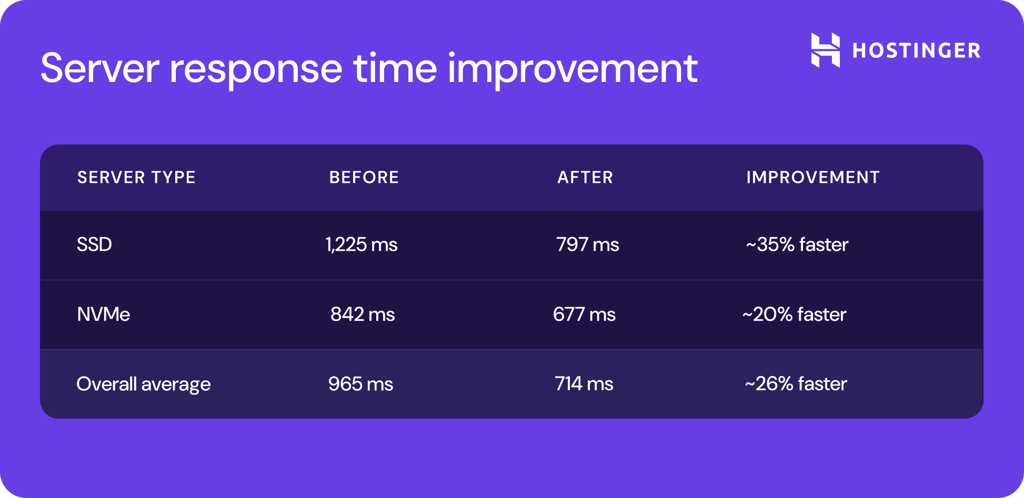
The improvement was driven in part by less pressure on the lower-tier web hosting servers. These servers used to operate at 20–30% above the average load of Hostinger’s Business and Cloud infrastructure. Following the rollout, the trend reversed, with Premium and Single web hosting servers running at 15–20% below that average.
The benefits extended beyond websites that use the Hostinger CDN. By reducing overall server pressure, even websites without the CDN enabled achieved faster response times.
Rather than adding new servers or hardware, the company reduced the computing resources needed to run its CDN by 45–50%.
A key part of that effort was making encrypted connections more efficient. Hostinger migrated SSL certificates from RSA to ECDSA, reducing CPU consumption for SSL-related operations to roughly one-third of its previous level.
The company also adopted kernel Transport Layer Security (kTLS) and improved session resumption, further reducing the resources needed to serve returning visitors.
Another major gain came from Hostinger’s in-house traffic engine. Instead of multiple regions independently fetching and processing the same content, requests can be routed through the edge closest to the website’s origin using warm, pooled connections.
This cut connection setup times from tens of milliseconds to around 3 ms and reduced global CPU usage by approximately 20%. Processing tasks, such as image optimization, can also be reused across the network rather than repeated in multiple locations.
Other smaller engineering improvements contributed to the remaining gains, including eliminating internal lock contention, moving bot fingerprinting into native code, and streamlining storage, logging, request handling, and edge process recovery.
These optimizations made it possible to offer the CDN across all of Hostinger’s web hosting plans rather than reserving it for higher-priced plans as before. The CDN rollout is now completed across all of Hostinger’s web hosting plans at no additional cost.