Inside the two Hostinger inventions that just earned U.S. patents
Most website owners have an email list they haven’t used in months. And their website spends most of the day holding onto resources it isn’t using, at a cost they never see. One problem is theirs; the other is their host’s. Two new Hostinger inventions solve both, and both now hold U.S. patents.
One is for an AI system that produces complete email marketing campaigns from a single conversation. The other is for a way of running servers that starts a website up only when someone visits it.
The two inventions sit at opposite ends of the stack. Reach, the AI-powered email marketing tool, is something a customer opens in a browser and uses in an afternoon.
The server-side work, on the other hand, never appears on a screen at all. It runs underneath thousands of websites, and most of the people who benefit from it will never know it is there.
The two new patents bring Hostinger’s total to four, all from internal R&D by the company’s own engineering teams in Lithuania.
An email campaign from a conversation
Most small business owners already know that email marketing works. Far fewer send campaigns regularly.
The obstacle sits in the gap between knowing and doing: a single campaign is four separate jobs stacked on top of each other. Choosing who to send to. Writing something worth opening. Designing it so it holds up in an inbox. Picking the moment it goes out.
Any one of those is enough reason to close the tab and get back to running the business.
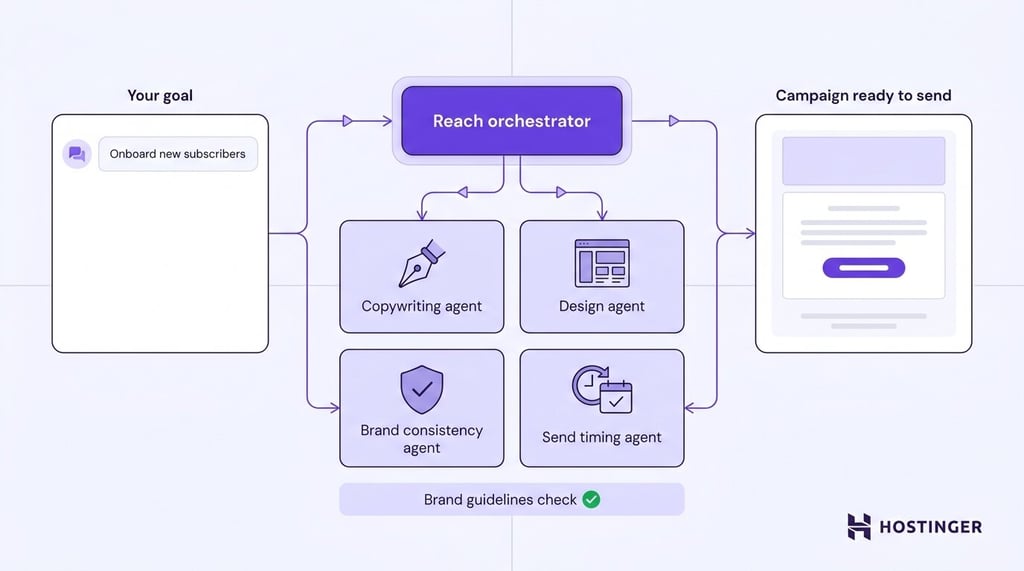
Reach handles all four from one conversation, and it works one of two ways depending on what the customer asks for.
Give it a broad goal, something like onboarding new subscribers, and it first proposes a whole plan: which emails to send, in what order, on what schedule, for the customer to approve before anything is built.
Ask it for one specific email, a Black Friday announcement for example, and it skips the planning and goes straight to building that template.
Either way, the building is done by a set of specialized AI agents, each an expert in a different part of the campaign.
One handles copywriting, one the layout and design, one keeps everything on brand, one translates into other languages, and others weigh the template against what tends to drive opens and clicks.
They work on the same email together, and a separate check compares everything against the customer’s own brand guidelines and flags anything that drifts off tone.


That coordination is what the patent covers. Getting one language model to write a decent marketing email is not the hard part.
Getting a group of specialized agents to work on the same campaign at once, keep it consistent with itself, and hand back something actually ready to send is a different engineering problem.
Filed as Guided Multi-Agent Orchestration For Content Generation And Delivery, the patent is credited to Tomas Rasymas, Miglė Padelytė, and Mantas Lukauskas.
“With a single long prompt, you get something that looks like a campaign. Ask it to change the audience and the copy shifts but the design does not follow, because nothing in the system knows those two things are connected,” said Mantas Lukauskas, AI tech lead.
“Giving each part of the campaign its own agent, and having them work against the same brand and the same brief, was how we kept a campaign consistent with itself.”
The result is a campaign whose four parts already agree with each other on the first pass: an audience, copy written for that audience, a layout built around that copy, and a time to send it. From there, the customer adjusts whatever they want to, by hand or by asking for a change.
Starting a process at the exact moment someone needs it
On a hosting server, every website keeps a process sitting in memory, waiting for a visitor to arrive. Most of those visitors never do.
A site might get a handful of requests an hour, or none at all overnight, and the memory set aside for handling them stays set aside the whole time. Multiply that across thousands of websites on one machine and a large share of a server’s capacity is committed to work that is not happening.
The invention removes the waiting. Rather than keeping a process alive on the chance that someone shows up, the system watches for the exact moment a request arrives, then starts what is needed to handle it.
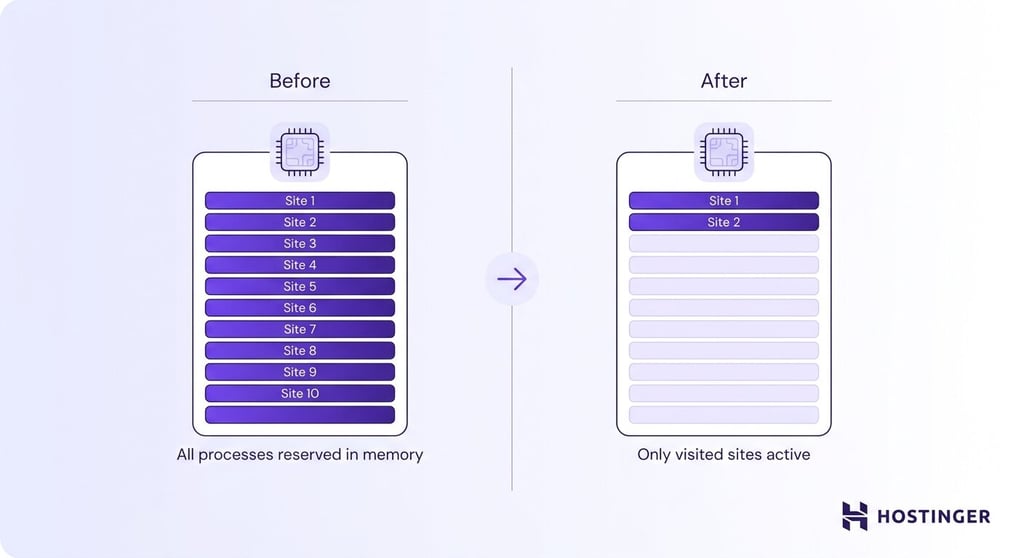
The watching happens with eBPF, a Linux feature that runs small programs safely inside the kernel, the core of the operating system that everything else runs on top of. That’s what makes the detection fast enough that the visitor doesn’t notice anything.
The difference shows up at scale. One website started on demand is a small optimization. Doing it across thousands of websites on the same machine, each one isolated from the others, is what turns it into capacity.
Filed as Kernel-Level Resource Activation For Process Management, the patent is credited to Donatas Abraitis and Antanas Patašius.
“The kernel already knows the moment a connection arrives, before anything above it does,” said Donatas Abraitis, Hosting Principal Systems Engineer.
“It’s the first thing that knows a visitor has arrived. Anywhere else in the system, you find out later, and later is the whole problem.”
For a customer, the effect is that the memory their website needs is there when a visitor arrives, and none of it is tied up while nobody is looking.
On a machine running thousands of sites, that adds up. The memory that used to sit reserved for sleeping websites goes to the ones people are actually looking at.
What both inventions have in common
Both do the same job in different places – they remove work that used to look unavoidable.
Reach takes work away from the customer, who no longer has to make four sets of decisions to send one campaign.
The kernel-level patent takes work away from the server, which no longer reserves memory for visitors who have not arrived.
That is what the teams behind them spend their time looking for: friction, whether it’s a customer stuck on a task that takes longer than it should or a server spending resources on nothing. Then they build something, test it, and then build it again until the friction is gone.
Both patents exist because someone followed a small annoyance further than they had to.
Reach is available to anyone with a Hostinger account today. The kernel-level work is already running on the servers behind those accounts, with nothing for a customer to switch on.
Both teams are hiring, and the open engineering roles are for people who want fix the thing everyone else has learned to put up with.

Simon is a dynamic Content Writer who loves helping people transform their creative ideas into thriving businesses. With extensive marketing experience, he constantly strives to connect the right message with the right audience. In his spare time, Simon enjoys long runs, nurturing his chilli plants, and hiking through forests. Follow him on LinkedIn.