AI website builder statistics 2026: market growth, adoption, and trends

AI website builders have moved from a novelty feature to a core part of the web creation category, enabling anyone to launch a professional site in hours rather than weeks.
In 2026, the data tells a compelling story: the market is growing fast, small business adoption is accelerating, and the tools are reaching first-time builders in markets where professional web development was previously out of reach.
Top AI website builder statistics for 2026
Below are the key AI website builder statistics shaping the landscape in 2026:
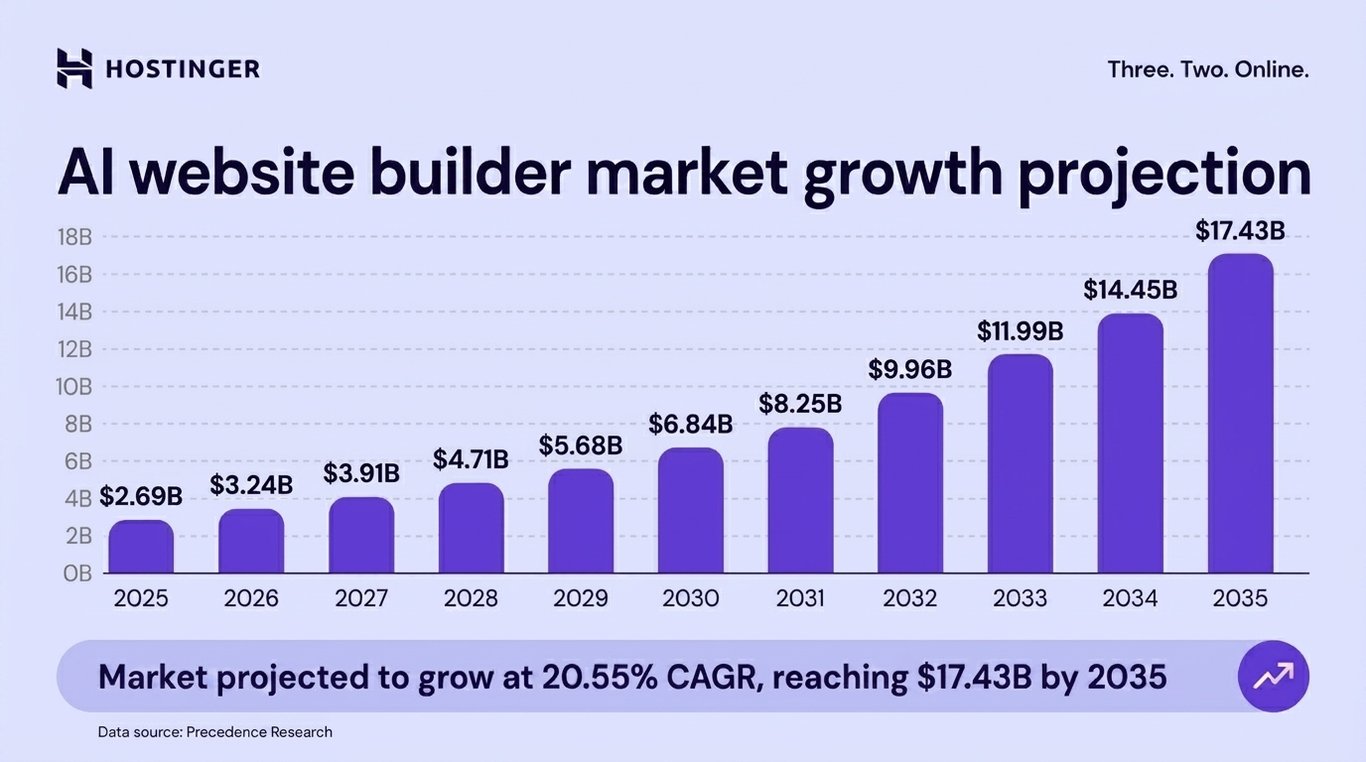
- The global AI website builder market is projected to reach $3.24 billion in 2026, up from $2.69 billion in 2025, and is on track to hit $17.43 billion by 2035.
- Worldwide AI spending will hit $2.52 trillion in 2026, a 44% year-over-year increase, accelerating development of AI-native tools including website builders.
- 58% of small businesses now use generative AI, up from just 23% in 2023, more than doubling in two years.
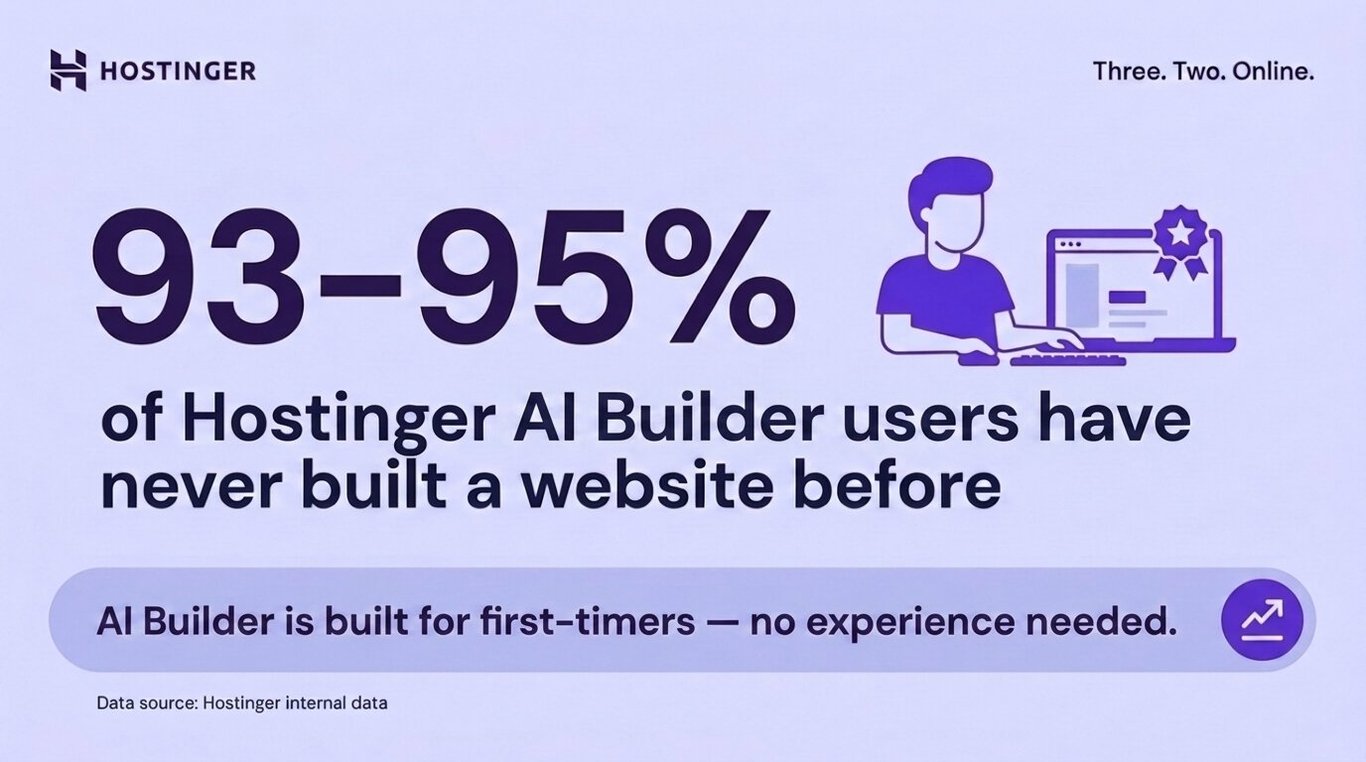
- 93–95% of Hostinger AI Builder users are first-time website builders, with no prior paid web presence.
- 90% of developers say low-code tools help them manage their application backlogs.
- 86% of emerging and semi-professional creators use generative AI in their work.
- 85% of designers and developers say learning to work with AI will be essential to their future success.
- More than one million users have built websites and web apps with Hostinger AI Builder since its launch.
- North America holds approximately 43% of the global AI website builder market share.
- Approximately 1 in 3 small businesses still operate without a website, a gap that AI builders are positioned to close.
AI website builder market size and growth
The global AI website builder market is projected to reach $3.24 billion in 2026, up from $2.69 billion in 2025, and expand to $17.43 billion by 2035 at a compound annual growth rate (CAGR) of 20.55%, according to Precedence Research.
Cloud-based tools dominate the category, accounting for approximately 81% of the market, and small and medium enterprises (SMEs) drive nearly half of all revenue at 49%, confirming that independent businesses are the core adopter segment rather than large enterprises.
- North America holds approximately 43% of the global AI website builder market share, while the Asia Pacific is the fastest-growing region at approximately 18.8% CAGR through 2035 (Precedence Research).
- 78% of companies have adopted AI in at least one business function in 2025, reflecting the broader enterprise shift toward AI that is also driving demand for AI-native website tools (Hostinger AI usage statistics).
- The global low-code market is projected to reach $101.7 billion by 2030, with AI website builders sitting at the intersection of no-code accessibility and AI automation as a key driver of that growth (Hostinger low-code trends).
AI website builders have evolved from novelty features tacked onto traditional drag-and-drop platforms into a standalone market category. The shift is structural: users no longer need to configure layouts, choose color schemes, or write page copy manually.
AI-native tools handle the initial site generation, reducing the decision load that previously made web creation inaccessible to non-technical users. That change in the starting point, from blank canvas to a functional draft in seconds, is what’s driving the adoption and market growth the data reflects.
Small business adoption of AI website builders
Small businesses are both the primary driver of AI website builder demand and the segment with the most room to grow. Despite record AI adoption rates, a significant share of SMBs still operate without any web presence, and AI builders are the most accessible tool available to close that gap.
- Nearly 1 in 3 small businesses still operate without a website, representing a substantial opportunity that AI builders are positioned to address as building costs and technical complexity continue to drop (Hostinger small business statistics).
- 87% of small business owners intend to create a website, signaling that friction, cost, and technical knowledge are the real barriers, all of which AI builders directly address (Hostinger small business statistics).
- 58% of small businesses now use generative AI, up from 40% in 2024, a near-tripling of adoption in two years (U.S. Chamber of Commerce).
- 96% of small business owners plan to adopt emerging technologies, including AI, showing near-universal forward intent even among businesses that have not yet implemented AI tools (U.S. Chamber of Commerce).
- 91% of SMBs using AI say it boosts their revenue, and 87% say it helps them scale operations, making AI adoption a business performance decision rather than just a technology choice (Salesforce).
- 75% of SMBs are at least experimenting with AI, and 83% of fast-growing SMBs have already adopted it, suggesting AI tools, including website builders, are becoming standard in the competitive toolkit for growing businesses (Salesforce).
- 89% of small businesses use AI tools for everyday tasks, showing that AI has moved from a specialized capability to a default operational layer for SMBs (Hostinger’s AI usage statistics).
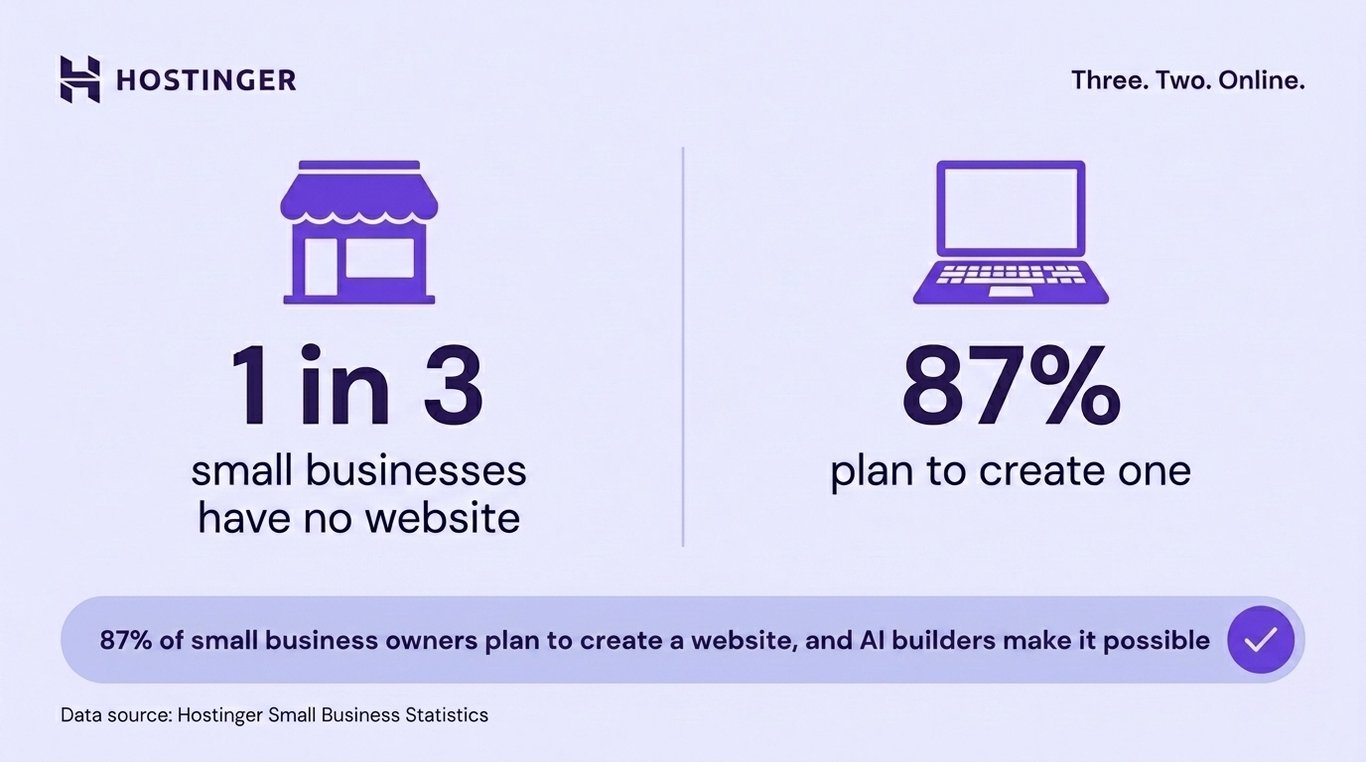
The statistics point to a clear gap between intent and execution. Most small business owners want a website and understand the value of one, but building costs and technical barriers have historically kept that goal out of reach.
AI builders don’t just make the process faster; they remove the need for prior knowledge entirely. For the first time, a business owner can go from zero to a published website in a single session, without hiring a designer, writing a line of code, or learning a drag-and-drop editor.
How AI website builders save time and reduce costs
AI website builders deliver measurable efficiency gains by reducing the time it takes to go from idea to published site. Hostinger’s internal data shows a particularly sharp improvement in time-to-publish, with users of its no-code AI Builder now going from first prompt to live site in under half a day. The proprietary Hostinger data below offers a full breakdown:
- Website development is 90% faster with low-code platforms, and companies can cut development costs by up to 70%, establishing the efficiency ceiling that AI website builders are now approaching for standard use cases (Hostinger low-code trends).
- 90% of developers say low-code helps them manage their application backlogs, reflecting how no-code and AI builder tools are relieving pressure that IT teams alone cannot absorb (Hostinger low-code trends).
- 35% of newly published websites were AI-generated or AI-assisted by mid-2025, up from essentially zero before ChatGPT’s launch in late 2022, with 17.6% created entirely by AI (Fast Company).
The shift in time-to-publish is not a minor product improvement. It represents a fundamental change in who can realistically build a website without outside help.
When the median time from idea to live site drops from weeks to hours, the pool of people who can act on a business idea without a developer or agency expands dramatically. That expansion is what the adoption numbers above reflect.
Expert tip
AI website builders have fundamentally changed the time-to-launch equation for new websites. Hostinger AI Builder’s vibe coding functionality does the heavy lifting on structure and design, so users arrive at a functional starting point immediately rather than facing a blank page. What used to take weeks of back-and-forth with a developer now takes a single focused session.

What Hostinger’s data says about AI website builder usage
Hostinger’s internal research, covering over one million Hostinger AI Builder users between April 2025 and March 2026, reveals who is actually building websites with AI today and how they use it.
User profile and behavior
- 93–95% of Hostinger AI Builder users are first-time website builders, with no prior paid web presence, showing the product is reaching an audience that traditional builders did not.
- Hostinger AI Builder users publish their first website in an average of 0.8 days, down from approximately 2 days in mid-2025, a 2.5x improvement in time-to-publish in under 12 months.
- Hostinger AI Builder users publish 2–3x faster than users of the traditional Website Builder, with the no-code AI builder averaging 0.8 days versus 1.9 days for the drag-and-drop builder.
- The traditional Hostinger Website Builder averaged 1.9 days from creation to first publish, down from 6.6 days in October 2024, a 3.5x speed improvement over 18 months.
- 51% of active Builder websites are company or business sites, making this the dominant use case by a wide margin. Ecommerce collectively accounts for approximately 31%, covering product sales (18%), digital products (7.4%), and appointment-based businesses (6%).
Geography and market reach
- More than one million users have used Hostinger AI Builder since its launch, with Brazil and India alone accounting for over 35% of all users globally.
- Hostinger AI Builder’s top five markets are Brazil, India, the United States, France, and Pakistan, reflecting strong adoption across Latin America and South Asia.
- Six to seven of Hostinger’s top ten markets by customer volume are emerging economies, with India representing 30.95% of the total customer base and Brazil 18.71%, confirming that AI builders are enabling digital access where traditional web development has historically been out of reach.
The AI Builder data reveals something that market projections alone cannot capture: the product is not converting existing website owners or migrating users from competing platforms. It is bringing genuinely new participants onto the web, predominantly in emerging markets, predominantly on their first try.
That pattern reflects what Hostinger AI Builder was built to do, and what separates it from traditional drag-and-drop builders.
How designers and creators are using AI tools
Designers and creative professionals have embraced AI tools at high rates, and the data shows adoption is now standard practice rather than early experimentation. AI website builders represent the consumer-facing version of a shift that is already well underway in professional design workflows.
- 33% of designers use AI to generate design assets, and 22% use AI to create first drafts of interfaces or websites, showing that AI-generated design has moved from experimentation to standard practice (Figma).
- 85% of designers and developers say learning to work with AI will be essential to their future success, a near-consensus that positions AI fluency as a professional baseline rather than an optional skill (Figma).
- 78% of designers say AI significantly enhances the efficiency of their work, though only 32% say they can fully rely on AI output, highlighting that human oversight remains central to AI-assisted design work (Figma).
- 86% of emerging and semi-professional creators report using creative generative AI in their work, and 81% say it helps them produce content they otherwise could not have created. Note: this survey covered emerging and semi-professional creators across eight countries, not full-time creative professionals (Adobe).
- Web design influences 94% of first impressions, making design quality a business-critical variable and strengthening the case for AI tools that deliver professional output without specialist knowledge (Hostinger web design statistics).
- Great UX design can drive conversion rates by up to 400%, underlining the business stakes of design quality and the value of AI builders that apply proven design principles by default (Hostinger web design statistics).
AI tools are no longer a supplementary feature in the design profession; they’re embedded in the core workflow. The distinction that matters is between AI as a drafting assistant, where a human designer uses AI output as a starting point, and AI as a complete builder, where the output is the deliverable.
The statistics show that even professional designers still lean on the former, using AI to accelerate their process rather than replace their judgment. AI website builders give non-designers the same starting point, without requiring the underlying skills.
Expert tip
The data on designer AI adoption reflects something important for anyone evaluating AI website builders: the tools that work best are the ones that create a strong draft and then get out of the way. Designers don’t want AI to make every decision; they want it to handle the repetitive parts so they can focus on the creative ones. The same dynamic applies to small business owners using AI builders. The goal isn’t automation; it’s removing the technical barriers so the person with the idea can execute it.

AI website builder platforms: usage and market share
The AI website builder market has consolidated around a small group of major players, with established builders adding AI features alongside newer AI-native entrants growing their user bases rapidly. The platform data reflects both the scale of the category and the specific growth patterns of the leading tools:
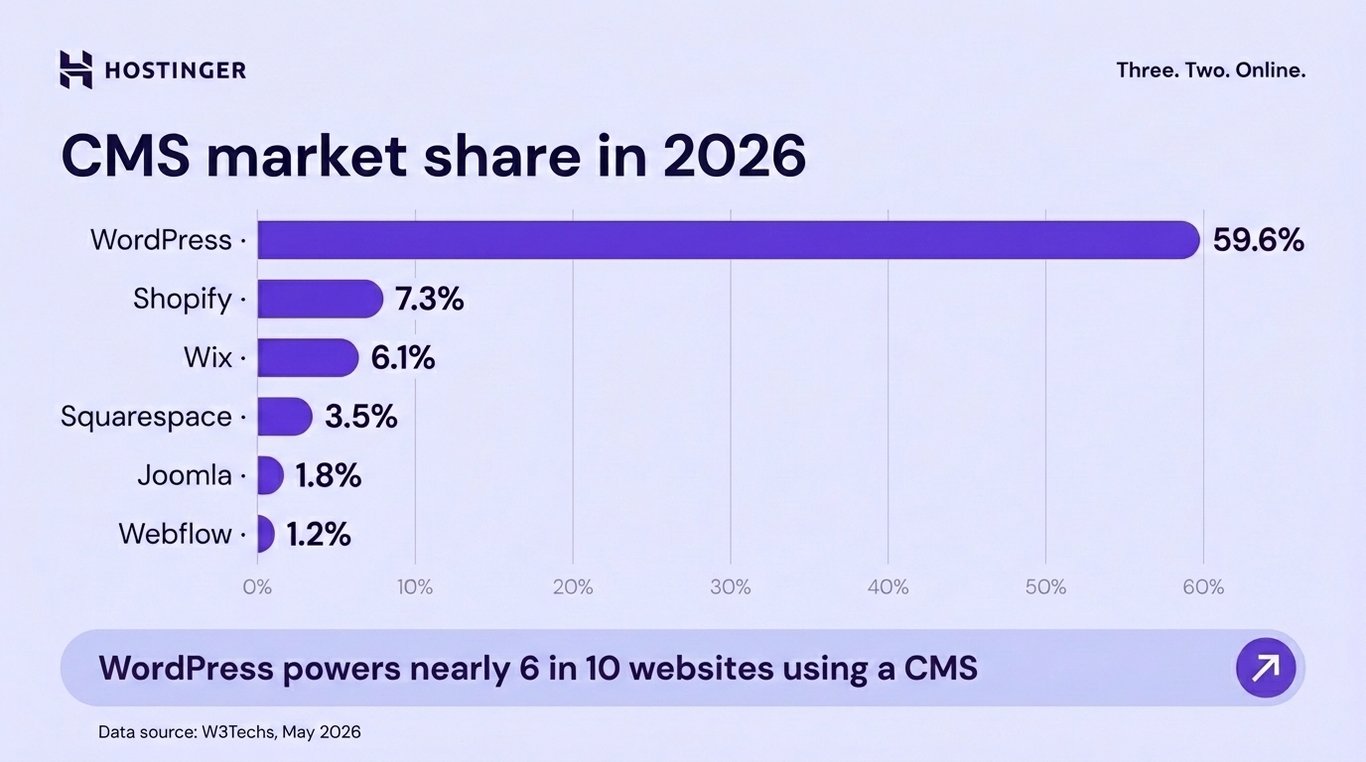
- WordPress holds a 59.6% CMS market share globally, representing the incumbent that AI website builders are positioned to challenge for new site creation, particularly among first-time builders who would historically have defaulted to WordPress (W3Techs)
- Wix powers 4.3% of all websites globally, giving it a 6.1% CMS market share and making it the most widely used dedicated website builder (W3Techs)
- Squarespace powers 2.5% of all websites, representing a 3.5% CMS market share (W3Techs).
- Webflow powers 0.9% of all websites with a 1.2% CMS market share, making it the leading platform among developer-focused visual builders (W3Techs).
- Hostinger holds 4.1% of the global web hosting market and powers 1.43% of the top one million websites worldwide, providing the infrastructure foundation on which its AI website builder products operate (Hostinger web hosting statistics).
The competitive dynamics in this space are still forming. AI-native tools like Hostinger AI Builder is built from the ground up around the prompt-to-site workflow, and the more meaningful signal is where the new users are coming from. Hostinger AI Builder’s profile of first-time builders in emerging markets points to net-new demand rather than migration from existing platforms.
The platforms that serve net-new users rather than fighting for existing ones are the ones positioned to grow the market rather than just redistribute it.
Who is using the AI website builders
AI website builders are primarily reaching first-time builders in emerging markets, people creating business or ecommerce sites without any prior technical background.
- 82% of small businesses using AI grew their workforce over the past year, showing that AI tools, including website builders, drive business growth, countering the concern that AI adoption leads to job displacement (U.S. Chamber of Commerce).
- The AI market for SMBs is expected to grow at a CAGR of 28.6% through 2033, suggesting that the demographic most reliant on AI website builders will continue to increase its AI investment significantly over the next decade (Hostinger small business statistics).
For most of the web’s history, launching a site required technical skills, an agency budget, or significant time to invest. The AI builder data showing that 93–95% of users are first-timers is the clearest evidence that all three of those barriers are now gone
Vibe coding and AI website builders
Vibe coding, building software through natural language prompts rather than manual code, started as a developer technique and has since become a mainstream behavior that extends directly into AI website building. The overlap between the two is significant: 63% of vibe coding users have no coding background, building products, business sites, and ecommerce stores without writing a single line of code. That same non-technical majority is the primary audience for AI website builders.
- 84% of developers use or plan to use AI coding tools, with 50.6% using them daily, establishing AI-assisted creation as the new default across the full web development spectrum (Stack Overflow).
- Non-developers building in no-code platforms now outnumber professional software developers by roughly four to one, with estimates putting the citizen developer population at 100–120 million globally compared to approximately 27.7 million professional developers (Hostinger AI app builder statistics).
- APAC leads global vibe coding adoption at 40.7%, with India alone accounting for 16.7% of global usage, followed by Japan, Pakistan, and Indonesia, a geographic pattern that closely mirrors the emerging-market concentration seen in Hostinger’s own builder data (Hostinger vibe coding statistics).
- 40% of new enterprise applications will feature task-specific AI agents by 2026, signaling that AI-generated builds are becoming a standard approach at scale (Gartner).
- The AI code tools market is projected to reach $22.2 billion by 2030 at a 23.8% CAGR, reflecting the scale of investment flowing into AI-native creation tools across both the developer and non-developer segments (The Business Research Company).
The connection between vibe coding and AI website builders is not just demographic. Both are expressions of the same shift: the assumption that building on the web requires technical skill is disappearing. For the non-technical majority, AI website builders provide the most accessible entry point.
Expert tip
There’s a meaningful difference between what Hostinger AI Builder does and what a traditional AI website builder does. With Hostinger AI Builder, you’re building from scratch and the AI constructs something unique based on your prompt. With a conventional AI website builder, the AI is personalizing a template from existing elements. Both approaches remove the technical barrier, but they serve different needs and produce different results. What matters in both cases is that someone with no technical background ends up with something real they can put out into the world.

The future of AI website builders
The macro investment environment, the convergence of AI generation and vibe coding approaches, and the continued growth of no-code tools all point in the same direction: AI website builders are at the beginning of a sustained growth curve rather than approaching a ceiling.
- Total worldwide AI spending is projected to reach $2.52 trillion in 2026, a 44% increase over 2025, reflecting the macro investment environment accelerating development of AI tools including website builders (Gartner).
- Gartner projects agentic AI could drive 30% of enterprise application software revenue by 2035, surpassing $450 billion, up from 2% in 2025, signaling that AI-native tools including website builders are at the beginning of a decade-long growth curve (Gartner).
- 70% of new enterprise applications are expected to rely on low-code or no-code tools by 2026, a sharp rise from under 25% in 2020, reflecting how AI-assisted building has shifted from a workaround to the default approach across industries (Hostinger AI app builder statistics).
- The global AI in software development market is projected to grow to $15.7 billion by 2033, from $1.37 billion in 2026, a near-12x expansion reflecting the scale of investment flowing into AI-native development tools, the category that AI website builders belong to (Hostinger software development trends).
- 84% of developers use or plan to use AI coding tools, and major tech companies are already generating 30–90% of new code with AI, signaling that AI-native creation tools are becoming standard infrastructure across the full web development stack (Hostinger Vibe Coding Statistics).
- 59% of website development is currently outsourced, representing a large cost base that AI website builders are positioned to displace, particularly for SMBs that currently outsource simple site builds to agencies or freelancers (Hostinger web development trends).
The convergence of AI generation and vibe coding has shifted the definition of what it means to build a website. The audience for this approach is growing across both developer and non-developer segments, and the market projections reflect that. The question for the next few years is not whether AI website builders will become the default starting point for new sites, but how quickly.

Daniela is an Off-Site SEO Specialist with extensive expertise in link building, digital PR, and content optimization. She has led international outreach campaigns across the U.S., Brazil, France, and Spain, securing high-quality backlinks. Follow her on LinkedIn.