We analyzed 213 million AI email actions. Only 2.5% were sends
When people imagine an AI agent with access to their email, they usually picture it sending messages: following up with clients, contacting suppliers, negotiating deals. That’s not what we found.
We looked at data from Agentic Mail, our email service built for AI agents, which launched at the end of May 2026. It lets small businesses, developers, and individuals connect the AI agent of their choice to a mailbox, so the agent can search, read, organize, and send email on their behalf.
Over 14 weeks, these agents performed 213 million actions. Only 2.5% of them were email sends. Most of the rest went to searching and reading messages (the agent opening an email and processing its text). Even by the most conservative estimates, AI agents made about 18 search and read actions for every email they sent.
Agents mostly read email; sending is the exception.
Usage grew 15x in 3 months
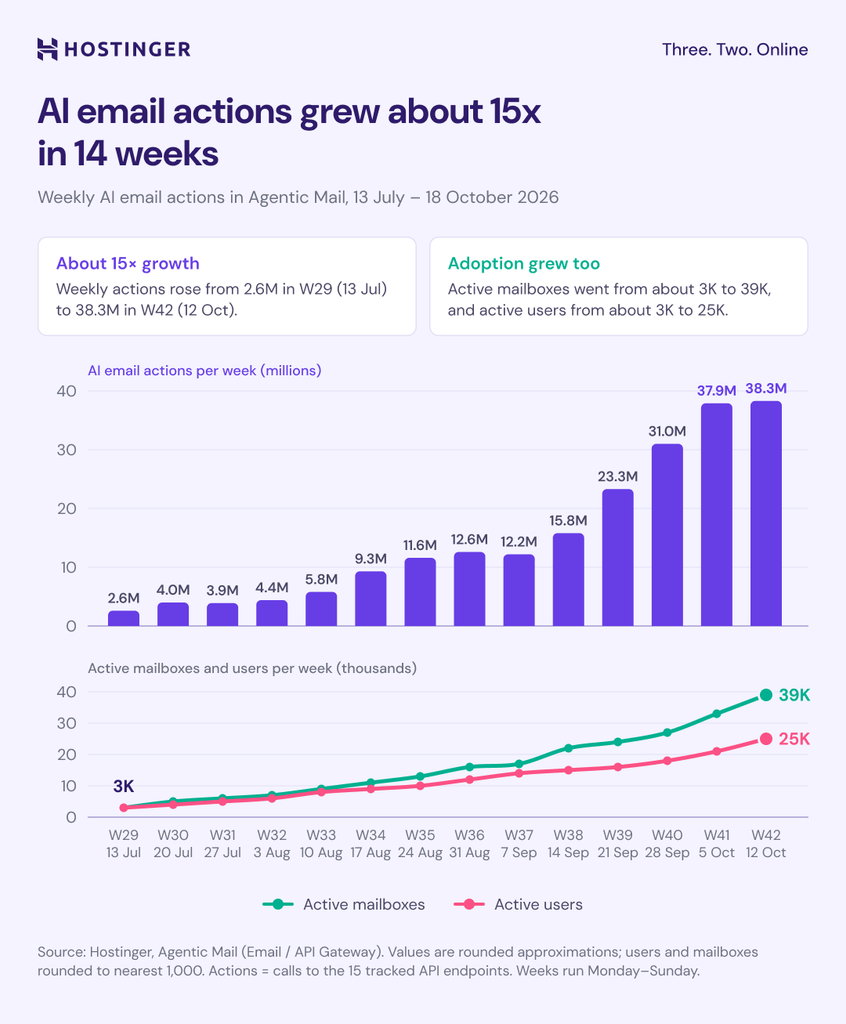
Weekly AI email actions rose from 2.6 million to 38.3 million in fourteen weeks, about 15 times higher. Weekly active users rose from about 3,000 to 25,000 (8x), and active mailboxes from 3,000 to 39,000 (13x).
Users are also connecting more mailboxes. The average rose from about 1 per user to 1.6, which suggests people find it useful enough to hand over more of their email.
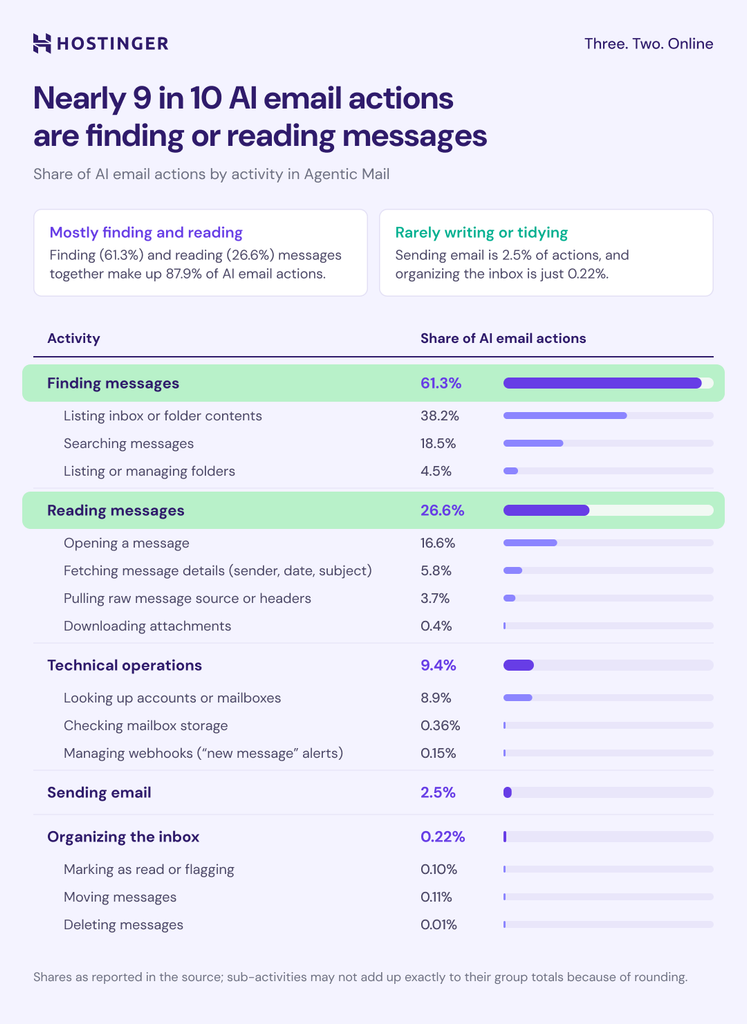
The mix of activity has also shifted over time. In the first four weeks, searching was the main activity with about 38% of actions. But in the last three weeks it fell to about 17%, while inbox listing rose from 25% to about 41% and reading messages increased from 15% to about 25%.
Agents read far more than they send
If we set aside technical operations, about 193 million actions involved working directly with email: searching, reading, sending, or organizing messages.
Some inbox-listing actions come from agents repeatedly checking for new mail, a process called polling. We can’t yet separate these from deliberate browsing actions, so we report a range.
- The conservative figure: If we leave out inbox listing entirely, searching and reading still account for 45% of all actions. That’s about 18 actions to gather information for every email sent.
- The upper figure: If we take all inbox listings as research, the share rises to 83%, or about 33 actions for every email sent.
The real number sits somewhere in between. Either way, the pattern is clear – agents spend most of their effort understanding what’s in the inbox before taking action.
This ratio has been remarkably stable. The conservative figure was about 17 actions per send in the first seven weeks and about 18 in the following seven, even as weekly activity grew roughly 15x.
Meanwhile, weekly sends rose from about 60,000 to about 750,000, but sends made up about 2% of actions in the latest three weeks, down from about 3% earlier.
Agents organize less, and mostly poll
A smaller share of actions went to routine inbox work: flagging, moving, deleting, and filing messages. At 0.22% of all actions, that still adds up to more than 470,000 inbox actions people didn’t have to do themselves.
Deleting is especially rare: about 22,000 delete actions against 5.4 million sends, or roughly one delete for every 250 emails sent.
Some agents are also using webhooks, which alert an agent when a new message arrives, so it doesn’t have to keep checking. They make up a small share of activity so far (0.15% of actions), so most agents still check for new mail by polling.
Roughly 20 years of email work
It’s tempting to multiply 213 million actions by a few seconds each and call it time saved. But that would overstate the result. A single task a person gives an agent, like “reply to the latest message from Peter,” can involve a dozen or more actions. A person doing the same job would just open the inbox and scan it.
The fair comparison is tasks, not actions. There is one task we can count directly: agents sent about 5.4 million emails. If we estimate that each open-read-reply takes about two minutes for a person, that’s roughly 179,000 hours, or about 20 years of non-stop work, for thousands of our customers.
This is an illustrative number, not a measurement. It’s also conservative, because it leaves out read-only tasks like summarizing an inbox or finding a document, which make up most agent activity.
The bigger shift may be that “checking your email” stops being something people do at all.
A note on privacy
This analysis is based only on the type of each action, such as “search” or “send,” which is recorded automatically when an agent uses the service. Hostinger does not read or analyze the content of customers’ emails. We provide the tools that let AI agents work with a mailbox. Customers choose which AI agent or language model to use, and they decide what it does.
Methodology
Hostinger analyzed about 212.8 million AI email actions in Agentic Mail over fourteen consecutive weeks, W29–W42 (July 13 – October 18, 2026). The analysis begins in W29 when full logging was in place.
An AI email action is one API call, the single operation an AI agent performs, such as listing inbox contents, searching, opening an email, or sending one. One task a user gives an agent can involve many actions. Counts cover calls to 15 tracked API endpoints, grouped into the activity categories above.
An active user is a user whose AI agent performed at least one action in Agentic Mail during the week. An active mailbox is a mailbox with at least one action during the week.
Percentages are rounded. User and mailbox counts are rounded to the nearest thousand, so early-week growth figures are approximate. Derived figures, such as ratios, totals, and time estimates, are approximate.

Gediminas is a communications specialist passionate about technologies and their possibilities. His main responsibility is to help people understand Hostinger products and their features. He likes spending his free time bathing in the hot tub, grilling, playing poker, fishing, and other activities.