The Black Friday trap: Despite a boost in traffic, unprepared stores sell less than usual

Getting more site traffic to your online shop during Black Friday is not necessarily the hard part. Turning that attention into sales is.
Hostinger’s analysis of almost 50,000 ecommerce stores shows that stores making no Black Friday preparations, such as product updates, discounts, coupons, or payment-method adjustments, received a traffic lift but still lost orders and sales on average. They were also more vulnerable to steep drops, with half seeing orders fall by more than 20%.
Stores that made at least one such change, by contrast, were better able to turn the extra attention into orders and sales, with the leading group growing orders and sales value by more than a third.
Key data (November 2025 versus the August–October average):
- Unprepared stores saw traffic rise 5.8%, while orders fell 3.5% and total sales value dropped 6.2%.
- Prepared stores’ orders increased by around 16% and sales value by nearly 23%.
- Half of unprepared stores saw orders fall by more than 20%, compared with only 22–27% of prepared stores.
- Stores that prepared 8–21 days ahead saw the strongest relative growth, with traffic increasing by 13.2%, orders jumping by 34.2%, and total sales value by 36.7%.
- Prepared stores stayed above their previous sales baseline through January, while unprepared stores remained below it.
More traffic ≠ more sales
Black Friday brought more website activity even to stores that did not prepare, but that extra traffic did not always translate into more orders.
All three preparation groups studied saw both traffic and orders increase in November. The no-action group was the exception: traffic rose 5.8%, while orders fell 3.5% and total sales value dropped 6.2%.
The strongest contrast came from stores that prepared 8–21 days before Black Friday. Their traffic increased 13.2%, but orders grew much faster, by 34.2%, while sales value rose 36.7%.
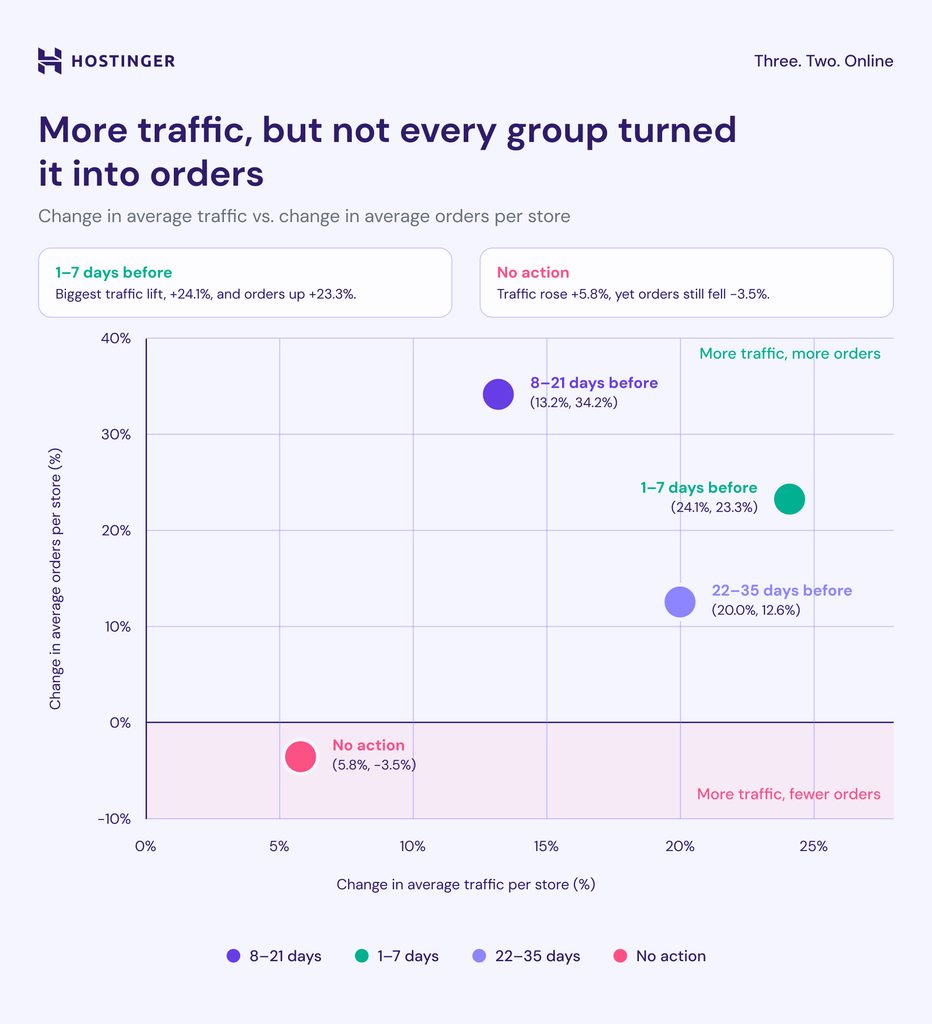
The data does not measure a traditional ecommerce conversion rate, because traffic is based on HTTP requests rather than shopping sessions. Still, it shows a clear gap: more traffic alone was not enough to produce more sales.
Preparation helped stores avoid steep order declines
Average growth can hide what happened to individual stores. The distribution of results gives a clearer picture.
Half of stores that took no preparation action saw their November orders fall by more than 20%. Among stores that prepared, only 22–27% experienced a decline that large.
At the same time, more than half of stores preparing 8–21 days or 1–7 days ahead increased their orders by at least 20%, compared with only 30% of unprepared stores. Among those preparing 22–35 days ahead, 43% saw growth of at least 20%.
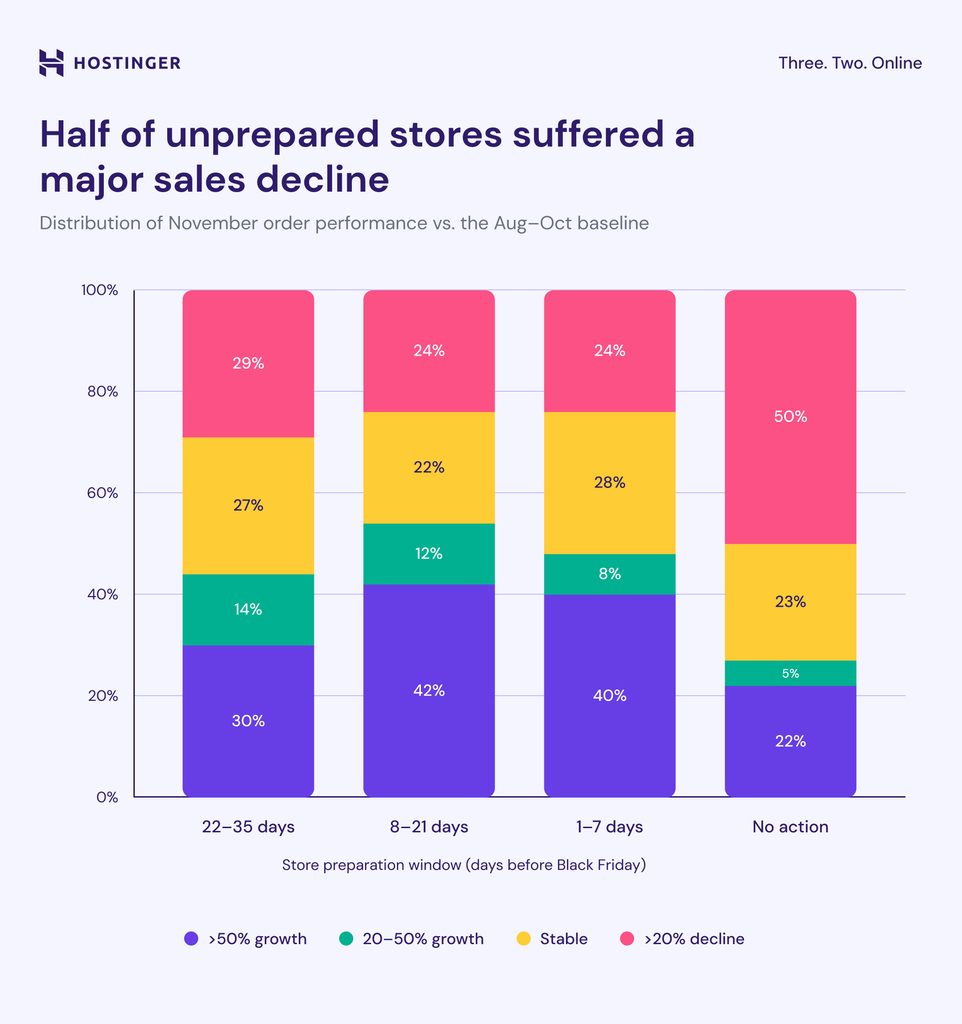
So while preparation did not necessarily guarantee a successful Black Friday, prepared stores were far less likely to see a particularly bad one.
Prepared stores kept orders higher throughout the holiday season
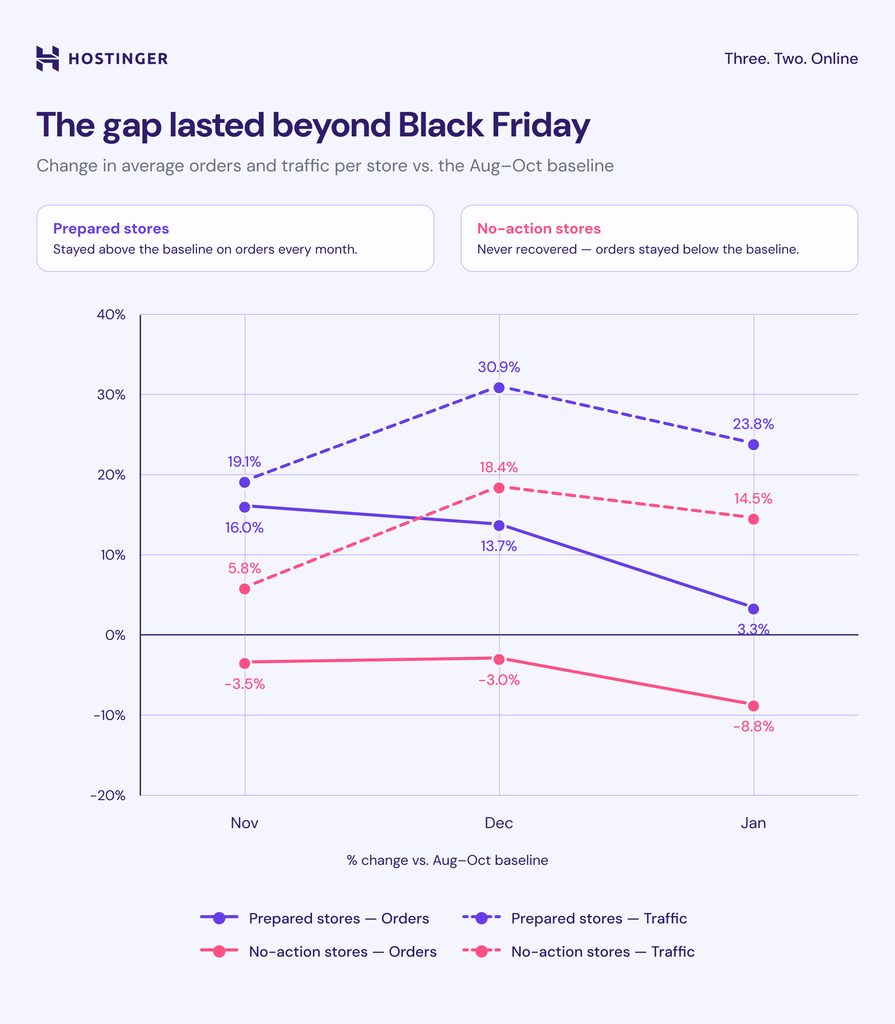
The holiday shopping season likely kept traffic elevated after Black Friday. In December, traffic to prepared stores was about 31% above the August–October baseline and remained 24% above it in January. Unprepared stores also continued to see more traffic, at roughly 18% above baseline in December and 15% in January.
But the sales gap persisted. Prepared stores stayed 13.7% above their order baseline in December and 3.3% above it in January. Unprepared stores remained below baseline in both months, at -3.0% in December and -8.8% in January.
In short, traffic stayed high for both groups, but only prepared stores continued to turn it into more orders.
The pattern differed by market
Preparation did not have exactly the same effect everywhere. However, prepared stores outperformed their local no-action groups in most of the markets analyzed.
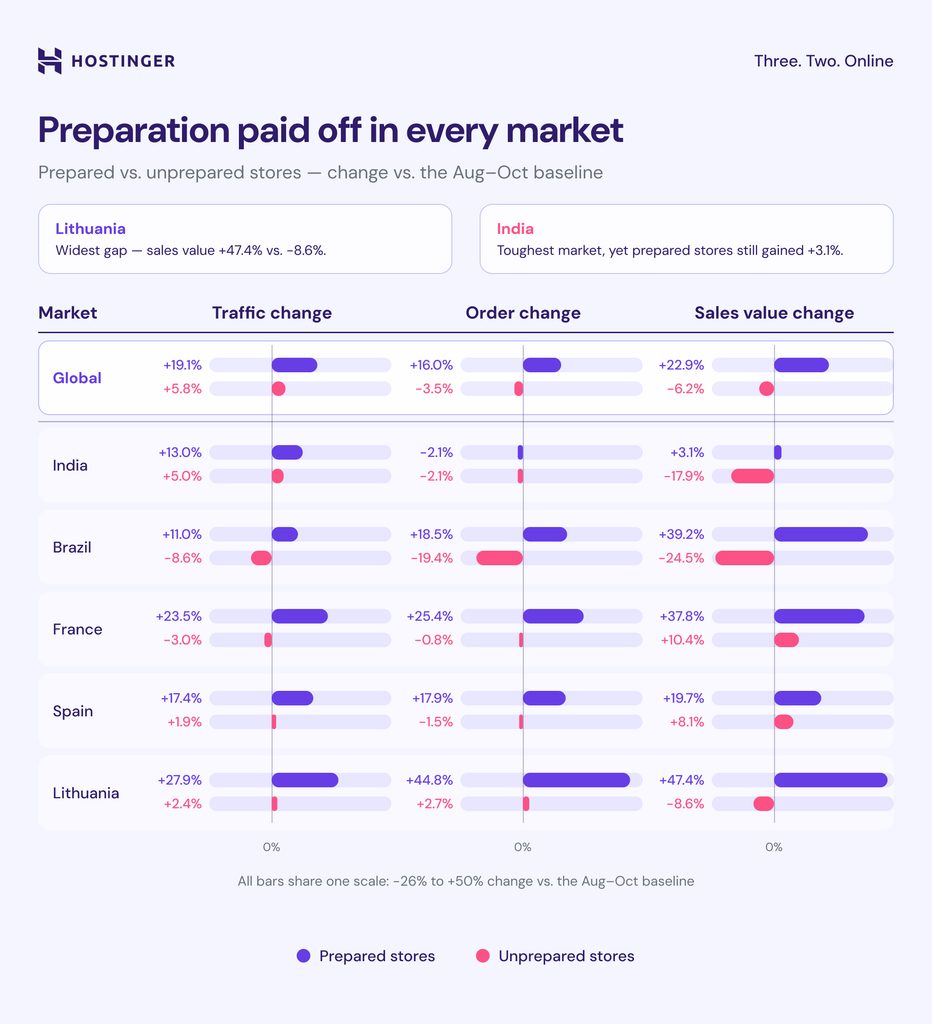
The global traffic trap was particularly visible in Spain, where unprepared stores received more traffic but still sold fewer orders.
Brazil showed the sharpest sales divide: prepared stores increased orders by 18.5%, while unprepared stores fell 19.4%. France showed a similar, although less extreme, split.
Lithuania, Hostinger’s home market, was the main positive exception for unprepared stores. Their orders still grew slightly, but prepared stores increased orders by almost 45%.
India’s Black Friday results were more muted, with average orders declining slightly regardless of preparation. However, the traffic trap was more pronounced around Diwali, India’s major festive shopping season: unprepared stores saw traffic rise 7.4%, while orders fell 13.1%. More than half saw orders drop by over 20%.
Black Friday traffic is only valuable if stores are ready for it
Black Friday should not be treated as a one-day traffic event. It is a test of whether an online store is ready to handle a sudden rise in buying intent and turn it into sustained business.
The data points to a clear divide: prepared stores were not only more likely to grow during Black Friday – they were also less likely to suffer a sharp decline and were still outperforming their earlier sales baseline months later.
For merchants, that makes preparation less about chasing a temporary spike and more about being ready to capitalize when demand increases. Otherwise, the traffic comes, but the sales don’t.
Methodology
The analysis covers 49,318 Hostinger ecommerce stores that met predefined criteria, including minimum annual sales and store activity throughout the year. Stores were grouped according to their earliest Black Friday 2025 preparation action: 22–35 days before, 8–21 days before, 1–7 days before, or no action. November orders, total sales value (gross merchandise value, or GMV), and traffic were compared with the August–October baseline. “Prepared” means the store took at least one defined preparation action: product updates, discount or coupon activity, and payment-method changes. In the sample, 25.8% of stores took a preparation action, while 36,580 did not. Journalists can request additional data at press@hostinger.com.

Gediminas is a communications specialist passionate about technologies and their possibilities. His main responsibility is to help people understand Hostinger products and their features. He likes spending his free time bathing in the hot tub, grilling, playing poker, fishing, and other activities.