The AI domain rush has stalled, but agentic vocabulary keeps spreading
Every idea, business or project online starts with a name, and that means a domain. With 10 million domains now managed by Hostinger, we have a unique view into how those naming choices evolve.
We analyzed 6.2 million Hostinger domain registrations from October 2025 to September 2026 to identify which naming trends are gaining or losing momentum. We then compared our findings with the applications for new domain extensions that ICANN, the nonprofit that coordinates the global domain name system, published on October 7.
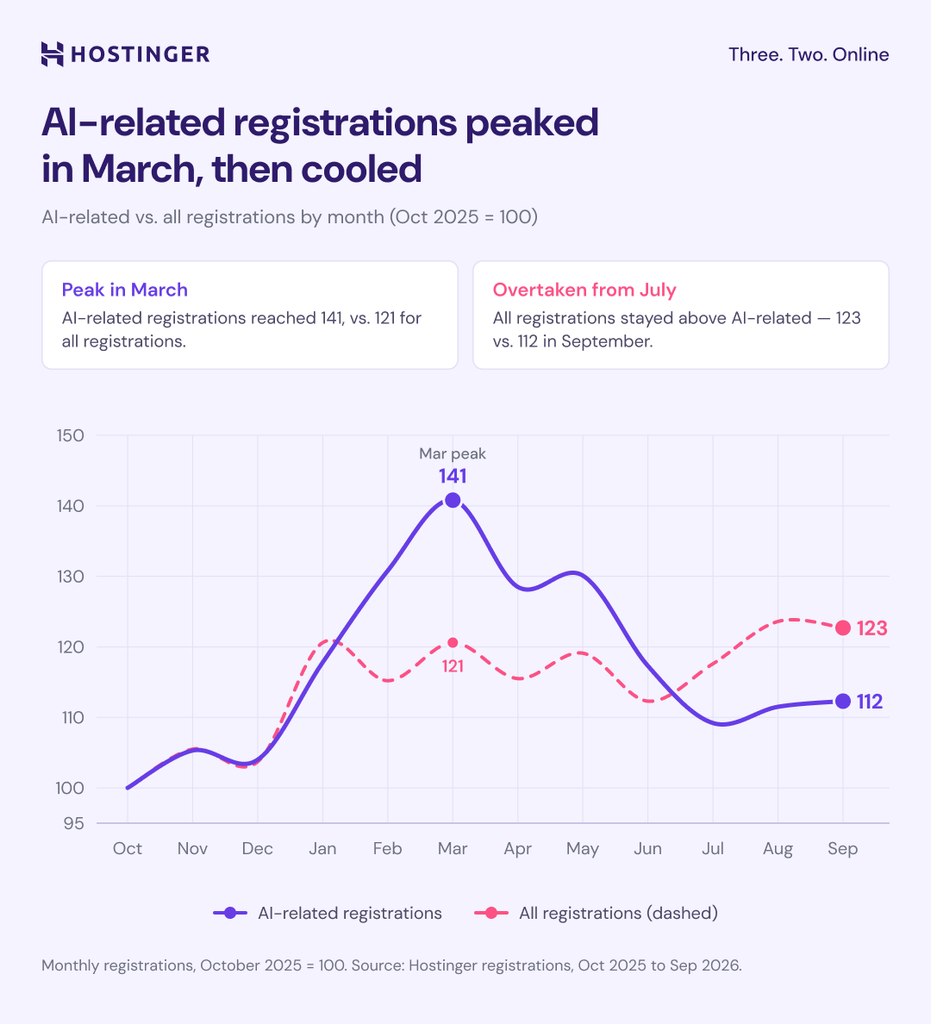
The main finding from Hostinger is that AI-related registrations lagged the market. They grew 1.5% in the second half of the period while total registrations grew 6.7%. That puts AI only 13th out of 20 themes. Because the market grew faster, AI’s slice of it shrank: its share of all registrations peaked at 2.0% in March, up from 1.7% in October, then fell to 1.5% by September.
Still, AI is shaping how people name things. Within the AI theme, agent grew 14.6% and agentic 16.7%. This growing interest is also reflected in ICANN’s newly published applications for domain extensions, where .agent is the most contested extension, attracting 13 applicants. The technology’s vocabulary is spreading even though AI registrations have levelled off.
The growth is going somewhere else, as the practical internet beats the hype: home (+22.5%), energy (+13.6%), and creative (+10.8%) were among the fastest-growing themes, while crypto fell 14.1%.
AI registrations peaked in March, then eased
We grouped Hostinger registrations into 20 themes using keywords in the second-level domain, the part before an extension such as .com or .net. For AI, these include ai, agent, model, brain, and mind. To reduce false positives, “ai” only counts when it starts or ends a name, and known unrelated words such as “dubai” are excluded.
In an illustrative name like brightmodel.com, we would look at “brightmodel” and identify “model” as the keyword. The extension does not affect the category.
AI-related registrations followed a clear arc. By March, they were 41% above their October level, ahead of the market. By September that lead had gone: AI was 12% above October, while total registrations were 23% above.
AI naming is moving east as Europe cools
We compared the first half of the period (October 2025 to March 2026) with the second (April to September 2026). Total registrations grew 6.7%, and AI-related registrations grew in 26 of the 45 countries we could measure. The growth is concentrated in Asia and the Middle East, while Europe is mostly shrinking.
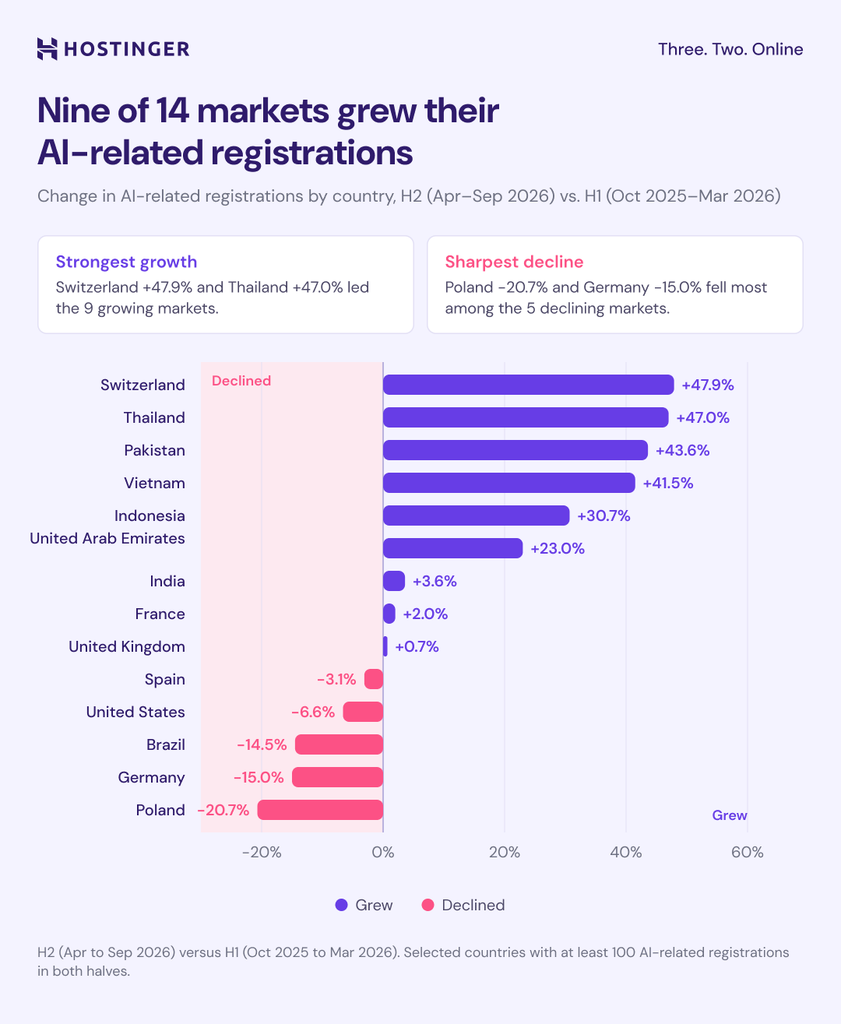
Across 12 Asian markets outside India, AI-related registrations grew 24%, led by Thailand (+47%), Pakistan (+44%), Vietnam (+42%) and Indonesia (+31%). In the Middle East and North Africa they grew 9%, with six of seven countries up.
In Europe they fell 6%, and only three of 14 countries grew: Switzerland (+48%), France (+2%) and the UK (+1%).
The weak global total comes from the biggest markets. India (+3.6%), the US (−6.6%) and Brazil (−14.5%) account for roughly half of all AI-related registrations, and of the three, only India grew. Germany (−15.0%) and Spain (−3.1%) also fell.
Brazil pulls the total down the most, but it isn’t the whole story. It makes up about 19% of all registrations, and its AI-related registrations fell 14.5% while its overall registrations fell 5.2%.
Without Brazil, AI-related registrations grew about 4%, still well behind the 9.6% growth in all registrations.
Where is the growth going instead?
The fastest-growing themes are practical, real-world ones, showing us that people are naming what they’re building, not what they’re betting on.
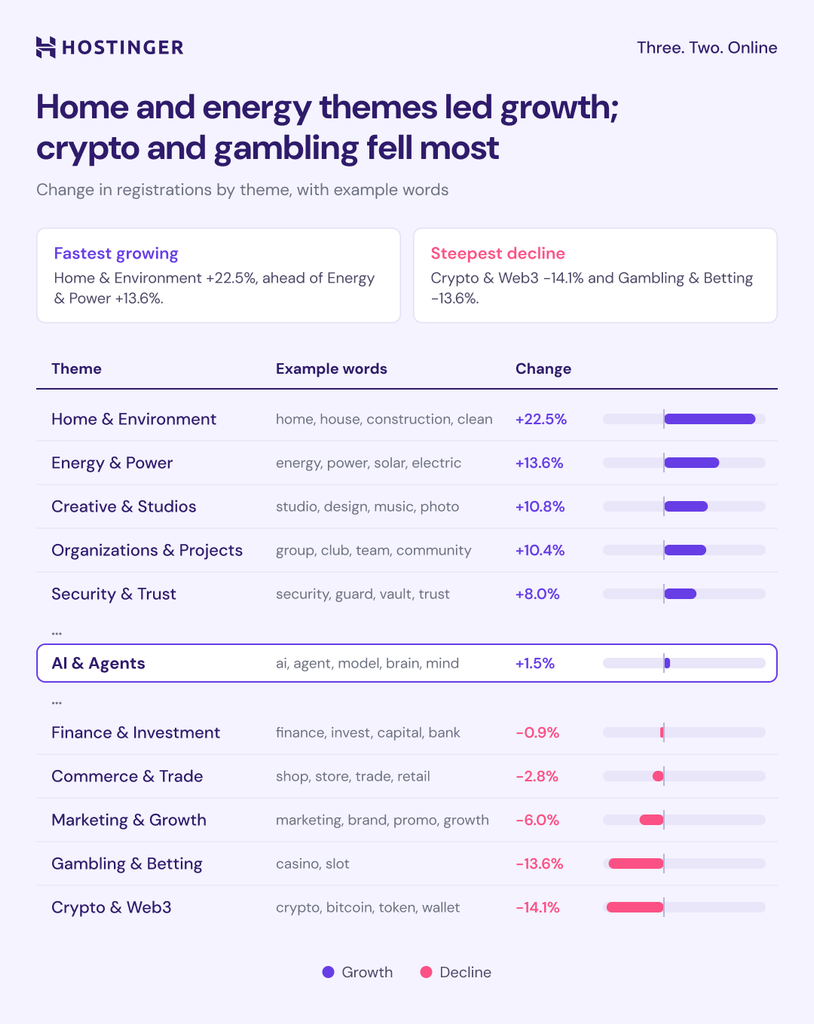
Home grew in 37 of 44 countries, energy in 21 of 25, and creative in 33 of 45. Home was only the sixth-largest theme in the first half, but it was the third-largest in both August and September, ahead of creative. Pakistan supplied about a third of that increase, but without it, home still grew 16.6%. Crypto, by contrast, grew in only 6 of 18 countries.
Which words could become the next domain endings?
Sometimes a single word is enough to increase the demand. In late September, the US government said it would use “super intelligence”, abbreviated SI, instead of “AI”. Slovenia’s country-code ending, .si, happens to match, and domain buyers noticed it fast. Our customers registered almost 35,000 .si domains in just two weeks, making it the second most popular ending, right after .com.
What they registered is just as telling. Only about 3% of those names contain explicit AI terms, while 13% are short names. Most of the demand was for the ending itself, not for AI-themed projects, which suggests the AI hype hasn’t disappeared. It is moving toward new terminology.
The .si surge shows a wider pattern: the words people choose before the dot can offer clues to what comes after it. On October 7, ICANN published the applications for its next round of new domain extensions, which lets us compare what applicants want with what people are actually registering.
The clearest overlap is .agent. It is tied for the most contested string in the round, with 13 applicants, alongside .lab and .labs, which have 13 between them (7 and 6). Our data points the same way: registrations containing agent rose 14.6% in the second half and those containing agentic rose 16.7%, even as the AI theme as a whole grew just 1.5%.
Applicants and registrants do not always agree. Crypto theme is the clearest example: 22 applications were filed for eight crypto words, and every one of those words fell in our registrations, from wallet (−1.6%) to bitcoin (−35.4%). This suggests that companies are investing in new domain extensions that may not reflect what people and businesses are actually interested in registering today.
The table below shows how some of the most contested endings compare with registrations of the same words.
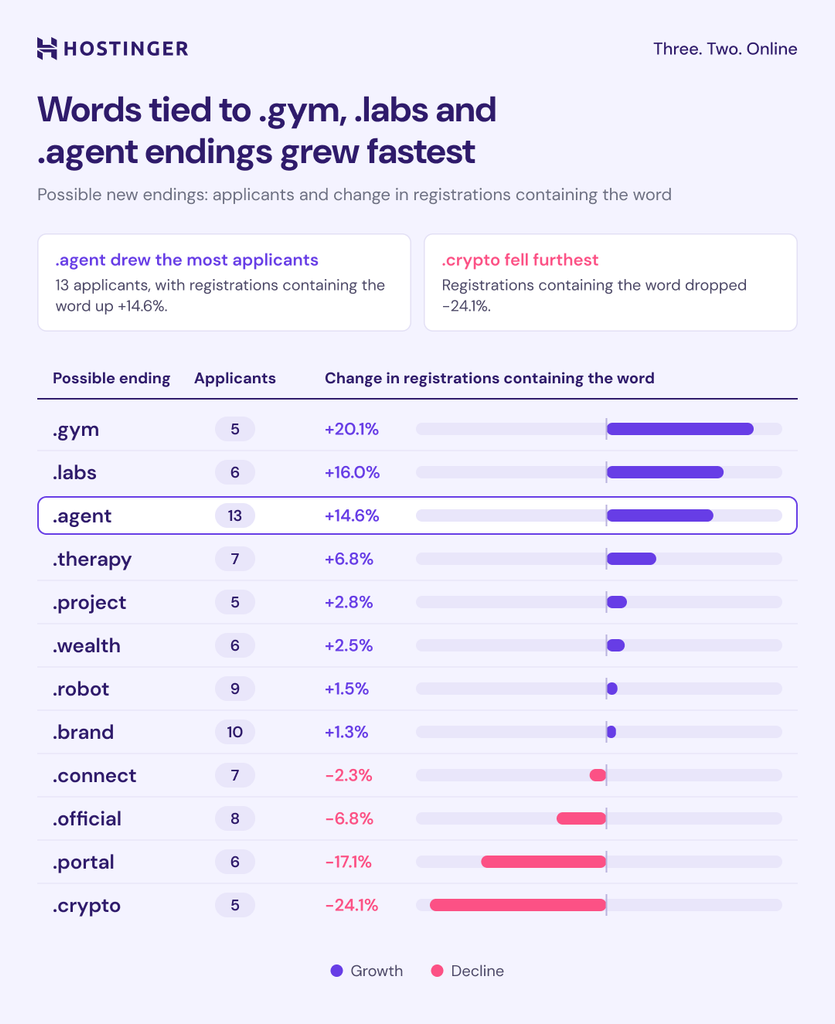
Several practical words are on the list too, and most are growing in our data: power (+11.0%), vault (+26.2%), clean (+12.3%) and electric (+29.7%).
An application is not an approved ending, though. Every string is still in pre-evaluation, and where several applicants want the same string, contention has to be resolved first.
The next naming trend is already taking shape
Domain names do not prove that a business has launched or that an idea related to specific keywords will last. They do show the language people choose when taking an idea online.
Right now, that language is practical, and AI naming is shifting toward Asia and the Middle East without pulling ahead of the market. AI itself may be levelling off, but its vocabulary, from agent to agentic, is becoming part of how people name what they build, and the race for .agent has already begun.
Methodology
Hostinger analyzed new domain registrations between October 2025 and September 2026. The analysis excludes refunded and unregistered domains and transfers, and groups second-level domains into 20 thematic categories using keyword matching. Growth figures compare April–September 2026 with October 2025–March 2026. About 35% of registrations match a keyword group, and country figures cover markets with at least 100 keyword-matched registrations in the theme in both halves. Regions are Hostinger groupings of the countries measured.
Separately, Hostinger compared its keyword data with the list of applications for new top-level domains that ICANN published on October 7, 2026. Applicant counts are the number of distinct applicants with an active application for each string.
Journalists can request additional data at press@hostinger.com.

Gediminas is a communications specialist passionate about technologies and their possibilities. His main responsibility is to help people understand Hostinger products and their features. He likes spending his free time bathing in the hot tub, grilling, playing poker, fishing, and other activities.