Where America wants to work for itself, and where it actually does

The dream of working for yourself is having a moment. Over the past year, search interest related to starting a business or freelancing increased in every state, rising by a median of 31% and by as much as 59% in West Virginia.
But interest doesn’t always translate into action.
We compared how often people in each state search for ways to work for themselves with the share of workers who are already self-employed. The gap between the two was wide and varied depending on where you live.
Key takeaways
- Search interest in working for yourself increased in all 50 states over the past year, with a median increase of 31% and as much as 59% in West Virginia.
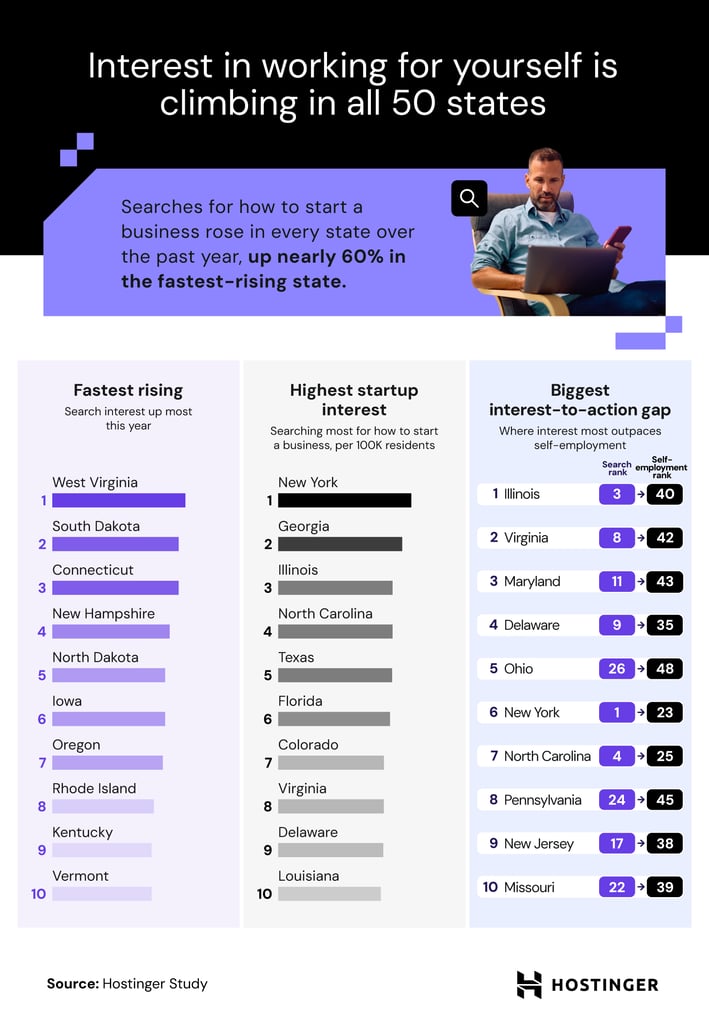
- New York, Georgia, and Illinois have the highest per-capita search interest in starting a business.
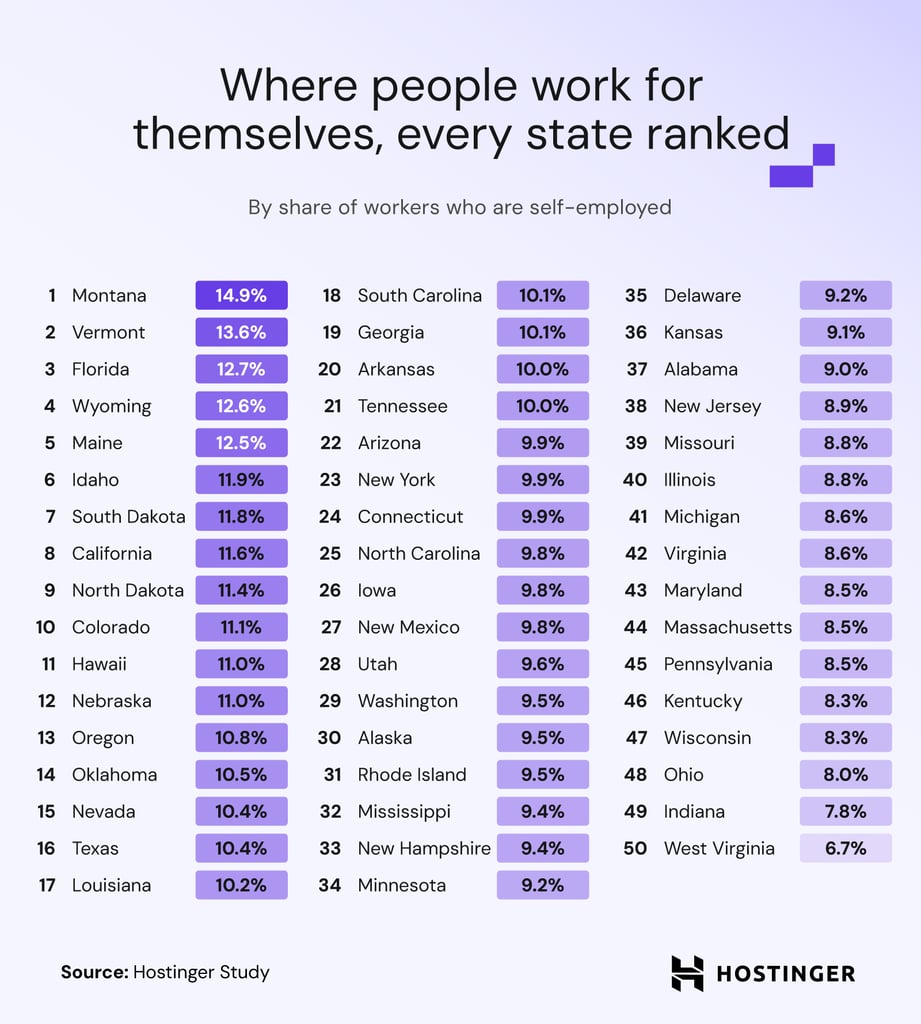
- Montana has the highest self-employment rate in the country, with 14.9% of workers working for themselves.
- Illinois has the widest gap between interest and action, ranking 3rd for search interest but 40th for self-employment.
- Florida and Colorado are the only states that rank in the top 10 for both search interest and actual self-employment.
Where working for yourself is a way of life
Searches can tell us where people are considering self-employment, while state workforce data shows where they’re already doing it. Across the country, the share of workers who work for themselves ranges from about 7% to 15%.
The full 50-state ranking shows just how much self-employment varies across the country. No state comes close to having a majority of workers on their own, but the difference between the top and bottom states is more than eight percentage points.
Here’s what stands out:
- Montana and Vermont lead the country. About 1 in 7 workers in each state is self-employed, with Montana at 14.9% and Vermont at 13.6%.
- Florida, Wyoming, and Maine round out the top 5. Self-employment reaches 12.7% in Florida, 12.6% in Wyoming, and 12.5% in Maine.
- Self-employment is a minority of work in every state. But it’s lowest in West Virginia (6.7%), Indiana (7.8%), and Ohio (8%).
- Several major job markets land closer to the middle or bottom of the ranking. Texas ranks 16th, New York 23rd, and Illinois 40th.
- Only two of the country’s most populous states are in the top 10 for self-employment. Florida is 3rd, and California ranks 8th.
The states dreaming biggest aren’t the ones doing it most
Putting the two rankings side by side reveals where curiosity about working for yourself is already reflected in the workforce, and where people appear to be earlier in the process.
A few things stood out:
- Florida and Colorado pair interest with action. They’re the only two states to rank in the top 10 for both search interest and self-employment.
- High search interest doesn’t always mean high self-employment. New York, Georgia, and Texas all rank among the top 5 in interest, but only about 1 in 10 of their workers are self-employed.
- And some states show much more action than search interest. Maine ranks 5th for self-employment but 46th for search interest.
- Illinois has the widest gap in the country. It ranks 3rd for search interest but 40th for actual self-employment. Nine of the 10 states with the largest gaps are east of the Mississippi River.
- Interest is rising fastest in several smaller states. Searches increased 59% in West Virginia, 56% in South Dakota and Connecticut, and 52% in New Hampshire over the past year.
- West Virginia is an especially interesting case. It has the fastest growth in search interest but ranks 50th for self-employment, suggesting plenty of curiosity even though relatively few workers currently work for themselves.
Methodology
This study compared interest in working for yourself with the share of people already doing so. Measures were standardized per capita, where applicable, so larger states did not receive an automatic advantage.
- Search interest was based on searches for 67 terms related to starting a solo business or freelancing, including “how to start a business” and “become a freelancer.” Search volume was totaled across the terms for each state and measured per 100,000 residents. The year-over-year change compared 2025 with the same period in 2024.
- Self-employment was measured as the share of each state’s workers who are self-employed, using the Census Bureau’s American Community Survey 1-year estimates for 2024 (table B24080). It counts people self-employed in both their own incorporated and unincorporated businesses, as a share of all employed workers. Census Bureau Business Formation Statistics and SBA 7(a) and 504 approval data were also reviewed as supporting indicators.
Rankings include all 50 states. Search activity reflects what people are researching, not whether they ultimately start a business, so it should be interpreted alongside actual self-employment rates.
Fair use statement
You’re welcome to share the findings and visuals from this study for noncommercial purposes. Please attribute the research to Hostinger and link back to this page so readers can see the full findings and methodology.

Ana is a senior editor with 20 years of experience in content marketing, specializing in WordPress, web hosting, and design. She's worked across the full content spectrum – from writing and strategy to editorial quality and B2B storytelling. When she's not untangling passive voice or debating Oxford commas, she's probably reading something she'll insist you read too. She believes a well-placed sentence can do more work than a bullet point ever will.