12 best Mailchimp alternatives for email marketing in 2026
Sep 04, 2026
/
By Simon L.
/
15 min Read
The 12 best Mailchimp alternatives in 2026 are Hostinger Reach, MailerLite, Brevo, GetResponse, Omnisend, Klaviyo, Kit, ActiveCampaign, HubSpot, Moosend, Constant Contact, and Pipedrive. Each platform offers a different advantage over Mailchimp, from lower-cost email sending and simpler campaign creation to ecommerce automation, CRM functionality, and creator-focused tools.
Businesses typically look for a Mailchimp alternative when its pricing increases as their contact list grows or when they need a platform designed for a more specific use case. For example, Hostinger Reach focuses on AI-powered email creation and simple campaign management, Brevo suits businesses with large contact lists, Omnisend and Klaviyo specialize in ecommerce, Kit targets creators, and ActiveCampaign provides more advanced automation.
The right Mailchimp alternative depends on your budget, contact list size, automation requirements, and business model. The comparison below shows where each platform performs best and its main advantage over Mailchimp.
Mailchimp alternatives compared
Use the table below to compare the best email marketing platforms against Mailchimp based on their strengths and the type of user they’re designed for.
| Tool | Best for | Main advantage over Mailchimp | Best-fit user |
| Hostinger Reach | AI-powered email marketing | Generates complete email campaigns with AI and offers a simpler setup | Small businesses, beginners, and Hostinger users |
| MailerLite | Simple newsletter marketing | Easier interface with affordable plans and built-in landing pages | Small businesses, bloggers, and beginners |
| Brevo | High-volume sending | Send-based pricing, built-in CRM, and multichannel marketing | Businesses with large contact lists and B2B companies |
| GetResponse | Email marketing campaign automation | Unlimited email sends and broader built-in marketing tools like funnels and webinars. | Ecommerce and small businesses |
| Omnisend | Ecommerce automation | Built-in email, SMS, and push notifications with ready-made store automations | Shopify, WooCommerce, and BigCommerce stores |
| Klaviyo | Ecommerce personalization | Advanced customer data, predictive analytics, and revenue tracking | Growing and established ecommerce businesses |
| Kit | Creator businesses | Creator-focused newsletters, audience growth, and digital product sales | Creators, bloggers, educators, podcasters, and newsletter publishers |
| ActiveCampaign | Advanced automation | More powerful workflow automation with CRM and lead scoring | B2B companies, SaaS businesses, and sales teams |
| HubSpot | CRM-driven marketing | Email marketing built into a full CRM and sales platform | B2B companies with dedicated marketing and sales teams |
| Moosend | Affordable automation | Advanced automation at a lower starting price | Small businesses, ecommerce businesses, and SaaS companies |
| Constant Contact | Small business support | Guided onboarding, phone support, and event marketing tools | Local businesses, nonprofits, and event organizers |
| Pipedrive | Sales-focused email marketing | CRM-driven campaigns based on deals and pipeline activity | B2B sales teams already using a CRM |
Why look for a Mailchimp alternative?
Businesses look for a Mailchimp alternative to lower email marketing costs, simplify campaign management, or get features better suited to their business model. Mailchimp’s pricing increases as subscriber lists grow. Businesses that mainly send newsletters and basic campaigns may therefore prefer a simpler platform with built-in landing pages, signup forms, and an easier interface to keep their email marketing costs lower.
Your business model also affects which email marketing platform fits your needs. Mailchimp is a general-purpose email marketing platform, while many alternatives specialize in specific use cases. Omnisend and Klaviyo focus on ecommerce, HubSpot and ActiveCampaign prioritize CRM-connected marketing, and Kit is built for creators and newsletter publishers.
The best Mailchimp alternative, therefore, depends on whether you prioritize lower costs, simpler campaign creation, ecommerce features, CRM-connected marketing, or tools designed for a creator business.
1. Hostinger Reach
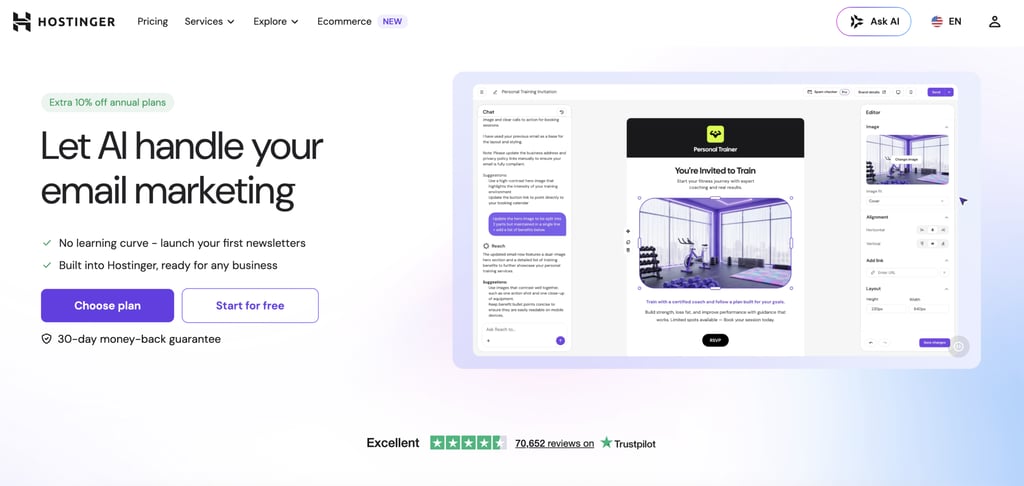
Hostinger Reach is an email marketing platform and Mailchimp alternative for small businesses and beginners who want to create campaigns with less manual work. It supports newsletters and promotional campaigns, as well as automated welcome sequences and ecommerce follow-ups, without requiring the complexity of a broader marketing platform.
When comparing Hostinger Reach with Mailchimp, the main difference is focus. Reach prioritizes AI-assisted campaign creation, simpler setup, and lower pricing for small businesses, while Mailchimp provides a broader marketing platform with more integrations and advanced automation options.
Key features of Hostinger Reach:
- AI email marketing tools. Generate email campaigns, write subject lines and email copy, create branded layouts, suggest weekly campaign ideas, and recommend the best time to send emails.
- Automatic brand styling. Save your logo and brand colors once and apply them across every campaign automatically.
- Hostinger ecosystem integrations. Sync contacts from WordPress, Hostinger Website Builder, AI Builder, and Hostinger Ecommerce, with API support for importing contacts from other tools and platforms.
Limitations of Hostinger Reach:
- Limited native third-party integrations. Reach doesn’t currently offer a large library of native third-party integrations, although you can push contacts from external tools and platforms through its API.
- Smaller automation ecosystem. Reach supports custom workflows, drip campaigns, welcome sequences, and ecommerce automations, but Mailchimp provides more triggers, branching options, and integrations for complex customer journeys.
Hostinger Reach pricing:
Hostinger Reach is free for the first year for up to 100 recipients and 200 emails per month. Paid plans cost $5.99/month with monthly billing, while a 24-month subscription reduces the price to $1.99/month. Paid plans include AI email generation, automations, audience segmentation, analytics, and branded emails.
2. MailerLite
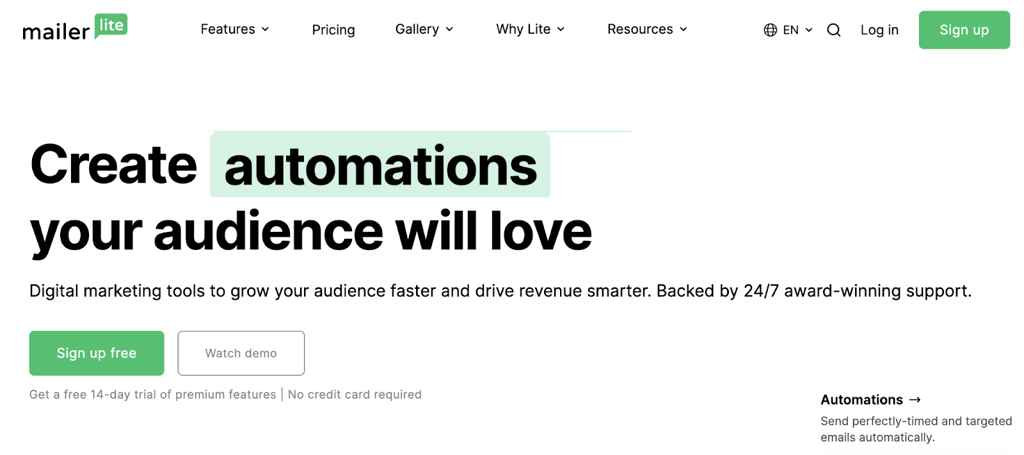
MailerLite is an email marketing platform for small businesses, bloggers, and beginners who want to create newsletters without learning a complex system.
MailerLite strips email marketing back to the essentials, making newsletter creation, landing pages, and list building easier to learn than Mailchimp’s broader platform.
Key features of MailerLite:
- Simple email creation. Drag-and-drop newsletter builder with customizable templates.
- Generous free plan. Includes landing pages, signup forms, and basic email automation for up to 250 subscribers.
- Lead generation tools. Built-in landing pages, popup forms, and embedded signup forms to grow your email list.
Limitations of MailerLite:
- Less advanced automation. MailerLite offers an easy-to-use automation builder, but Mailchimp provides more advanced workflow options, including more triggers, branching logic, and customer journey features on higher-tier plans.
- Fewer reporting and analytics features. MailerLite covers essential email performance metrics, while Mailchimp offers more comprehensive reporting, audience insights, and campaign analytics, particularly on paid plans.
- Weaker ecommerce tools. Ecommerce integrations and automation are available, but Mailchimp includes more built-in features for product recommendations, purchase-based segmentation, and customer retention campaigns.
MailerLite pricing:
MailerLite offers a free plan with up to 250 subscribers and 5,000 emails per month. Paid plans start at $10.80/month and remain more affordable than many Mailchimp plans as your subscriber list grows.
3. Brevo
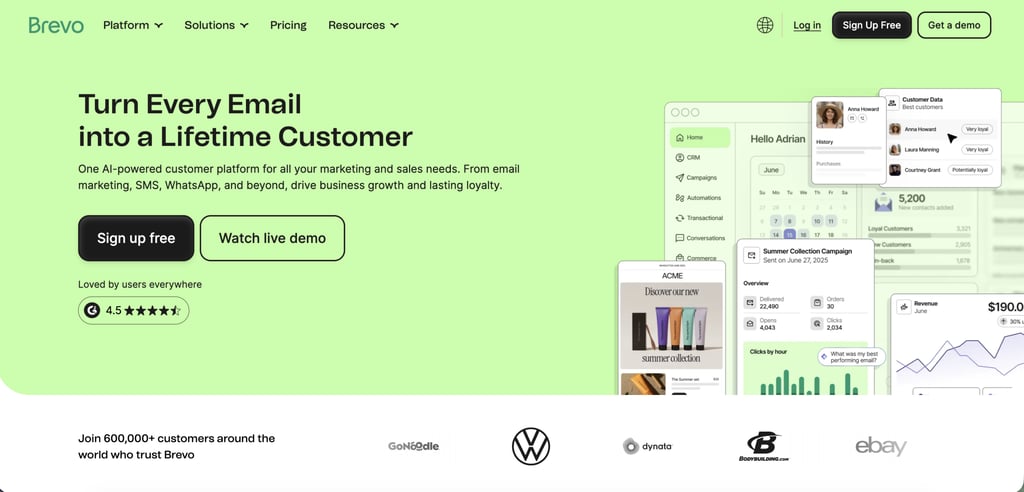
Brevo is an email marketing platform for businesses with large subscriber lists that don’t send campaigns every day.
Brevo charges based on the number of emails you send instead of the number of contacts you store, making it a more cost-effective option for businesses that email subscribers less frequently.
Beyond email marketing, Brevo includes a built-in CRM, SMS marketing, transactional email services, landing pages, and signup forms.
The platform works well for B2B businesses and growing companies that want to manage customer communication from one place without paying separately for multiple tools.
Key features of Brevo:
- Send-based pricing. Costs scale with email volume instead of contact list size, making Brevo a good fit for businesses with large subscriber lists.
- CRM and multichannel marketing. Manage contacts and run email, SMS, and WhatsApp campaigns from one platform.
- Transactional email support. Send receipts, password resets, and other transactional emails through the built-in SMTP service.
- Landing pages and forms. Create landing pages and signup forms to capture leads and grow your email list.
Limitations of Brevo:
- Less advanced automation. The automation builder is not as advanced as ActiveCampaign’s or even Mailchimp’s Standard plan.
- Daily sending limit on the free plan. Free accounts are limited to 300 emails per day.
Brevo pricing:
Brevo offers a free plan, while paid plans start at $9/month, and the Standard plan starts at $18/month.
Comparing Brevo’s pricing with Mailchimp’s Standard plan, which starts at $20/month, Brevo offers a lower entry price and bases pricing on email volume rather than the number of stored contacts.
4. GetResponse
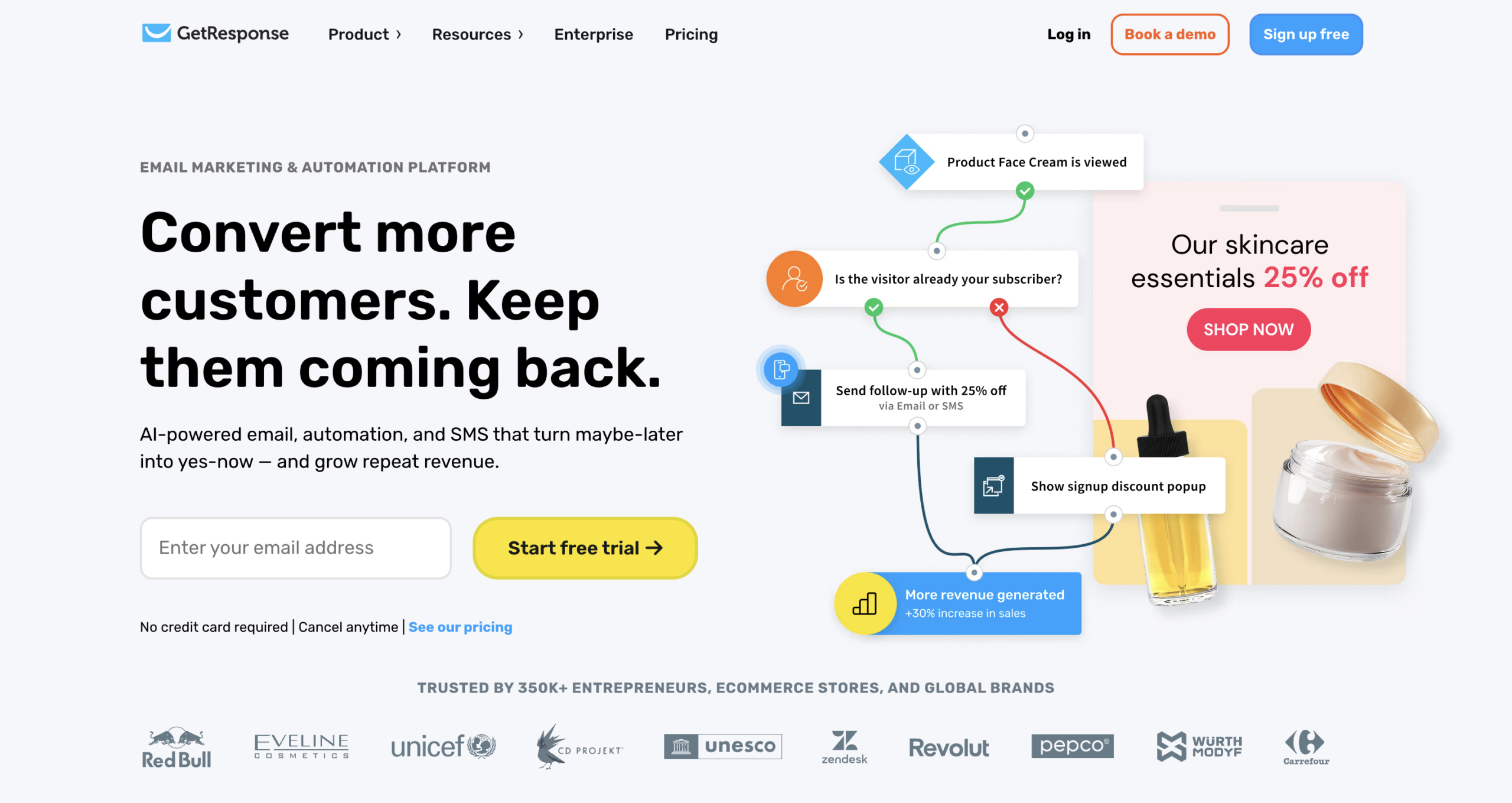
GetResponse is a strong Mailchimp alternative for ecommerce businesses, SMBs, and marketers who want email marketing, automation, segmentation, and conversion tools in a single platform.
It combines newsletter creation, autoresponders, landing pages, forms, popups, and ecommerce-focused automation, making it a practical choice for teams that want to connect email campaigns with sales activity.
Key features of GetResponse:
- Email marketing and autoresponders: Create newsletters, automated emails, and campaigns with a drag-and-drop email creator, AI-powered tools, templates, analytics, and unlimited email sends on paid plans.
- Marketing automation: Build behavior-based workflows using conditions, filters, tags, scoring, and prebuilt automation templates for welcome emails, lead nurturing, abandoned carts, win-back campaigns, and customer retargeting.
- Ecommerce tools: Connect your store, sync customer and product data, send abandoned cart reminders, use promo codes, recommend products, and track sales from email and automation campaigns.
- Lead generation tools: Build landing pages, forms, and pop-ups to collect subscribers and move them into automated campaigns.
- Revenue attribution: Track how newsletters, autoresponders, automation workflows, and ecommerce campaigns contribute to revenue.
Limitations of GetResponse:
- Higher-tier gating: Advanced automation and ecommerce features are mainly available on higher-tier plans.
- Learning curve: The platform offers more tools than a basic newsletter sender, so new users may need time to properly set up lists, workflows, ecommerce tracking, and attribution.
- Plan-dependent features: Webinars and some advanced features depend on the selected plan or account type.
GetResponse pricing:
GetResponse has a free plan and a 14-day free trial for premium features. Paid plans start at $19/month for up to 1,000 contacts with unlimited email sends, and pricing increases with list size.
5. Omnisend
Omnisend is an email marketing platform built for ecommerce stores selling through Shopify, WooCommerce, BigCommerce, and other online store platforms.
Compared with Mailchimp, Omnisend focuses more heavily on ecommerce automation, helping online stores recover abandoned carts, recommend products, and drive repeat purchases across multiple marketing channels.
Key features of Omnisend:
- Omnichannel marketing. Combine email, SMS, and web push notifications in a single automation workflow.
- Ecommerce automation. Build abandoned cart, browse abandonment, welcome, and post-purchase campaigns.
- Store-focused marketing tools. Add product recommendations, discount codes, and product pickers directly to email campaigns.
- Advanced ecommerce segmentation. Target customers based on shopping behavior, purchase history, and product activity.
Limitations of Omnisend:
- Built primarily for ecommerce. Many features provide little value for businesses that don’t sell products online.
- More setup than newsletter tools. Connecting a store and configuring ecommerce automations takes more work than using a basic email marketing platform.
Omnisend pricing:
Omnisend offers a free plan with core email marketing features. Paid plans start at $11.20/month, and pricing is based on reachable contacts rather than your entire contact list, which can be more cost-effective than Mailchimp for ecommerce businesses.
6. Klaviyo
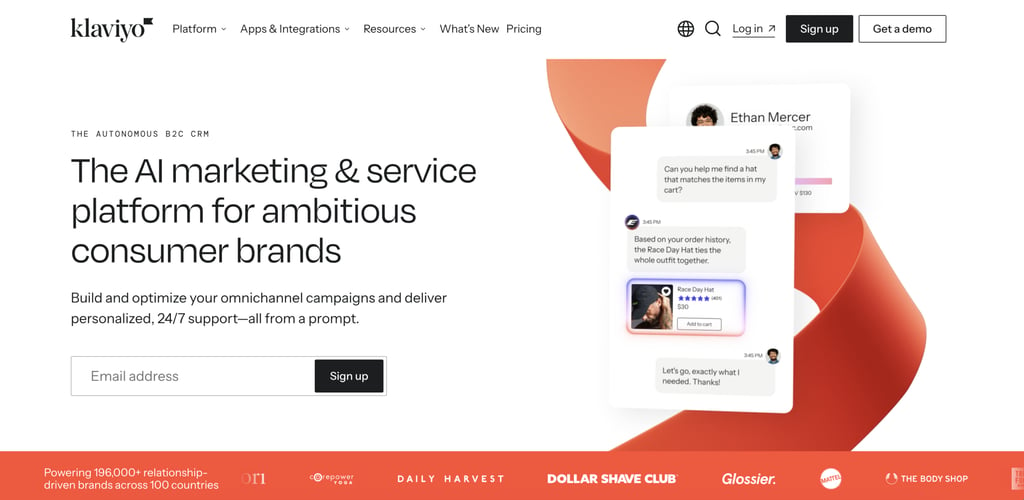
Klaviyo is an email marketing platform for ecommerce businesses that want to turn customer behavior into targeted campaigns.
It works well for stores running abandoned cart, product recommendation, replenishment, and loyalty campaigns.
Deciding between Mailchimp and Klaviyo comes down to the level of ecommerce personalization you need. Klaviyo uses purchase history, predictive analytics, and customer lifetime value to build more targeted campaigns.
Key features of Klaviyo:
- Behavior-based automation. Trigger campaigns based on browsing activity, abandoned carts, purchases, and other customer actions.
- Advanced customer segmentation. Build audiences using purchase history, engagement, predicted customer lifetime value, and other behavioral data.
- Predictive analytics. Estimate metrics such as customer lifetime value, churn risk, and the next expected purchase date.
- Revenue attribution. Measure the revenue generated by campaigns and automations to understand their business impact.
Limitations of Klaviyo:
- Higher pricing. Costs more than many Mailchimp alternatives as your contact list grows.
- Steeper learning curve. Advanced data and automation features take more time to set up.
- Focused mainly on ecommerce. Not the best choice for simple newsletters or businesses that don’t sell products online.
Klaviyo pricing:
Klaviyo offers a free plan for up to 250 active profiles and 500 email sends per month. Paid plans start at $20/month for 251-500 active profiles and scale based on the number of active profiles, making Klaviyo one of the more expensive Mailchimp alternatives as your audience grows.
7. Kit (formerly ConvertKit)
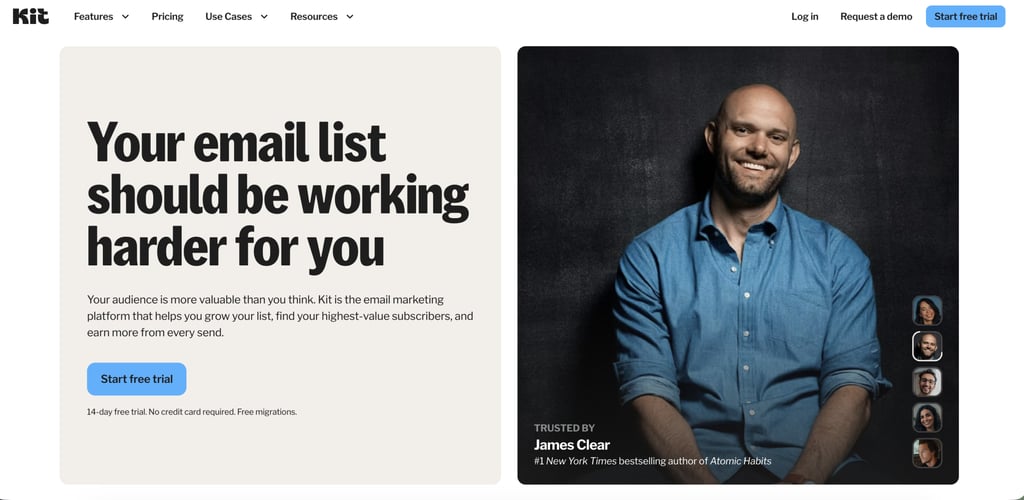
Kit (formerly ConvertKit) is an email marketing platform built for creators who publish newsletters and sell digital products.
Kit is built specifically for creators, while Mailchimp serves a much broader range of businesses.
It works well for bloggers, educators, authors, podcasters, YouTubers, and newsletter publishers.
Key features of Kit:
- Creator-focused email marketing. Publish newsletters, build email sequences, and manage subscribers from a single platform.
- Audience growth tools. Create landing pages, signup forms, and a newsletter website to attract new subscribers.
- Audience tagging and visual automation. Organize subscribers by interests and behavior, then build automated email journeys with a visual workflow builder.
- Monetization features. Sell digital products, paid newsletters, and subscriptions without relying on third-party ecommerce platforms.
Limitations of Kit:
- Less ecommerce-focused than Omnisend or Klaviyo. Kit supports digital products and subscriptions but isn’t designed for product catalogs, deep purchase-based segmentation, or store-driven automations.
- Smaller marketing platform. Doesn’t include the CRM, sales, and broader marketing tools available in HubSpot.
- Simpler email design. Prioritizes creator-focused newsletters over highly visual email templates and advanced design customization.
Kit pricing:
Kit offers a free plan for up to 10,000 subscribers with basic automations. Paid plans start at $33/month for 1,000 subscribers and unlock unlimited visual automations, email sequences, A/B testing, SMS marketing, and integrations.
8. ActiveCampaign
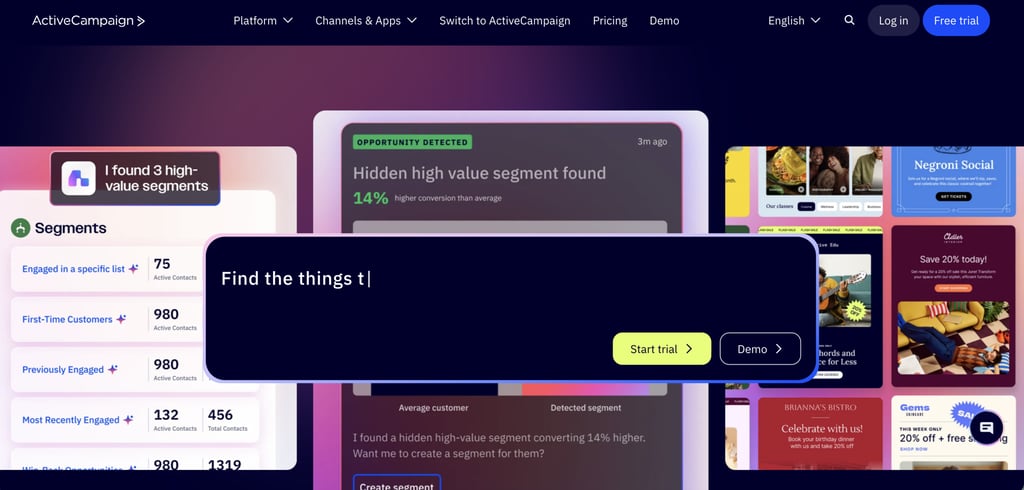
ActiveCampaign is an email marketing and automation platform for businesses that need sophisticated customer journeys, CRM-driven marketing, and sales automation.
ActiveCampaign gives you much more control over how contacts move through campaigns, making it well suited to SaaS companies, agencies, and sales teams with longer buying cycles that rely on a B2B email marketing strategy.
Key features of ActiveCampaign:
- Visual automation builder. Create multi-step workflows with branching logic based on customer actions, conditions, and goals.
- Built-in CRM and lead scoring. Track deals, score leads, and automate sales follow-ups from the same platform.
- Cross-channel automation. Coordinate email, SMS, WhatsApp, and other customer touchpoints from a single workflow.
- Advanced segmentation and integrations. Build targeted campaigns using customer data and connect with more than 1,000 business applications.
Limitations of ActiveCampaign:
- Steeper learning curve. Advanced automation features require more setup and configuration than simpler email marketing tools.
- Higher cost for advanced features. CRM capabilities, unlimited automation actions, and advanced segmentation require higher-tier plans.
ActiveCampaign pricing:
ActiveCampaign offers a 14-day free trial. Paid plans start at $15/month, while the Plus plan starts at $49/month and adds the CRM and more advanced automation features.
ActiveCampaign puts automation at the center of the platform, offering much deeper workflow customization than Mailchimp.
9. HubSpot
HubSpot is an email marketing platform for B2B companies, agencies, SaaS businesses, and service providers that manage leads through a sales pipeline.
HubSpot combines email marketing with a CRM, making it easier for marketing and sales teams to track every interaction from the first form submission to a closed deal.
Key features of HubSpot:
- Built-in CRM. Store contacts, companies, deals, and every customer interaction in a shared database for marketing, sales, and support teams.
- Sales-led marketing. Connect email campaigns with forms, landing pages, live chat, and sales pipelines to nurture leads throughout the buying process.
- Marketing automation. Trigger emails and workflows based on CRM data, customer behavior, and lifecycle stages.
- All-in-one platform. Manage email marketing, landing pages, reporting, and customer data without switching between separate tools.
Limitations of HubSpot:
- High cost. The more advanced plans, which unlock the real automation features, are significantly more expensive than Mailchimp’s.
- Steep learning curve. The platform is massive and can be overwhelming. Mailchimp is far simpler for just sending newsletters.
HubSpot pricing:
HubSpot offers free email marketing and CRM tools. Marketing Hub Starter starts at $7/month per seat, while advanced automation, lead scoring, and personalization require Marketing Hub Professional, which starts at $800/month.
10. Moosend
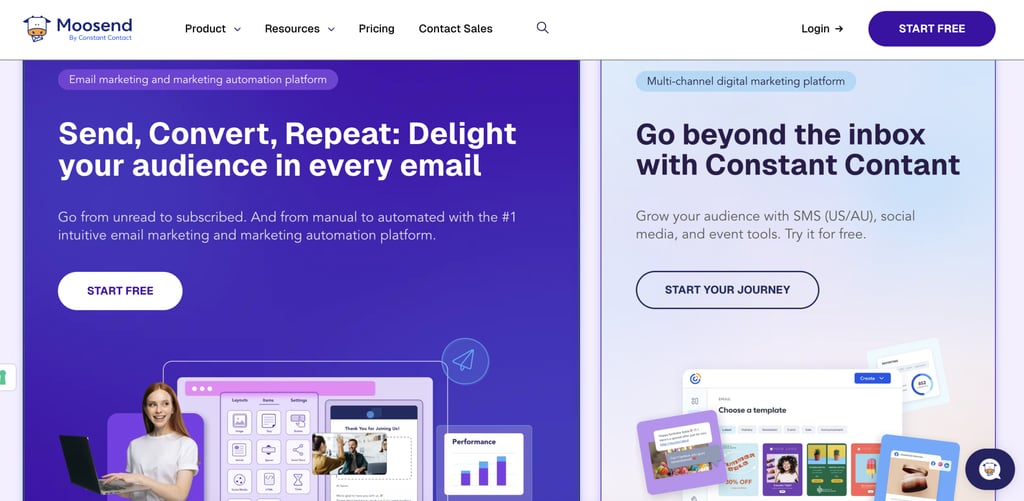
Moosend is an email marketing platform for small ecommerce businesses, SaaS companies, and service providers that want affordable email automation.
Moosend includes advanced automation at a lower starting price, making it a good fit for small businesses that send newsletters, promotional campaigns, and automated customer emails on a budget.
Note that Moosend is owned by Constant Contact but continues to operate as a separate product with its own features and pricing.
Key features of Moosend:
- Marketing automation. Build automated workflows with a visual editor, use pre-built automation templates, and trigger emails based on subscriber activity.
- Campaign creation tools. Design emails with a drag-and-drop editor, customize templates, build landing pages, and create subscription forms to grow your email list.
- Reporting and audience management. Track opens, clicks, heatmaps, geography, devices, and campaign performance while segmenting subscribers with tags and custom fields.
Limitations of Moosend:
- Smaller integration library. Offers fewer native integrations, compared with Mailchimp’s 300+ integrations.
- Less advanced reporting. Provides detailed campaign analytics, but advanced reporting and custom dashboards are more limited than in larger marketing platforms.
Moosend pricing:
Moosend offers a 30-day free trial. Paid plans start at $7/month for up to 500 contacts, making it a lower-cost option than Mailchimp for businesses that want automation without upgrading to higher-priced plans.
11. Constant Contact
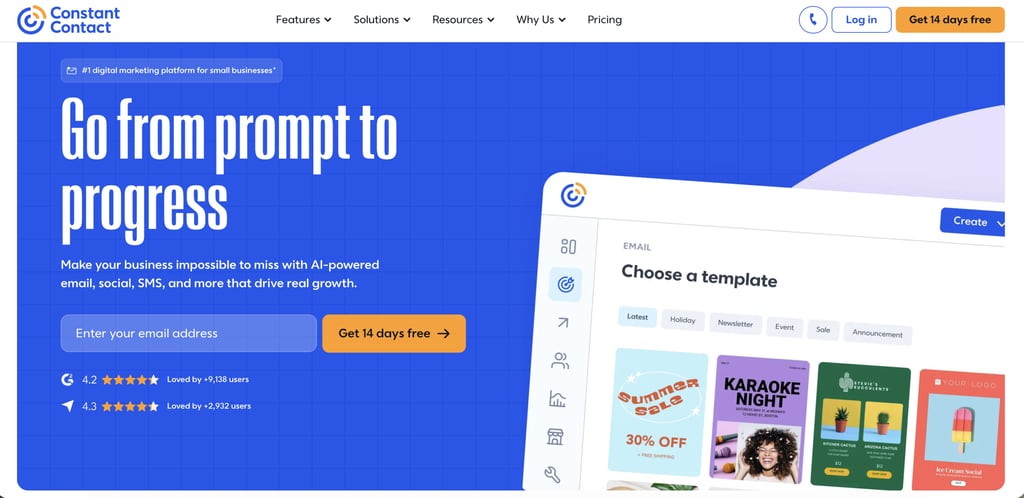
Constant Contact is an email marketing platform for local businesses, nonprofits, associations, and event organizers that want an easy way to create campaigns and stay in touch with their audience.
Constant Contact prioritizes guided onboarding, phone support, and event marketing, while Mailchimp places greater emphasis on automation and marketing features.
Key features of Constant Contact:
- Beginner-friendly campaign creation. Create email campaigns with a drag-and-drop editor, AI copy generation, and ready-made templates.
- Event marketing tools. Create events, sell tickets, collect registrations, and accept payments from the same platform.
- Customer engagement tools. Build signup forms, create surveys, manage contacts, and schedule social media posts alongside email campaigns.
- Live customer support. Access phone and chat support, onboarding assistance, and marketing advisors, unlike many email platforms that primarily rely on self-service documentation.
Limitations of Constant Contact:
- Fewer automation options. Supports basic email automations, but offers fewer workflow branches, conditions, and triggers than ActiveCampaign, HubSpot, or Mailchimp’s higher-tier plans.
- Lower feature value. Comparable pricing includes fewer advanced automation, personalization, and analytics features than many newer competitors.
Constant Contact pricing:
Constant Contact offers a 30-day free trial. Paid plans start at $12/month for Lite, $35/month for Standard, and $80/month for Premium.
Pricing is competitive for beginners, but advanced automation and segmentation features offer less value at similar price points.
12. Pipedrive
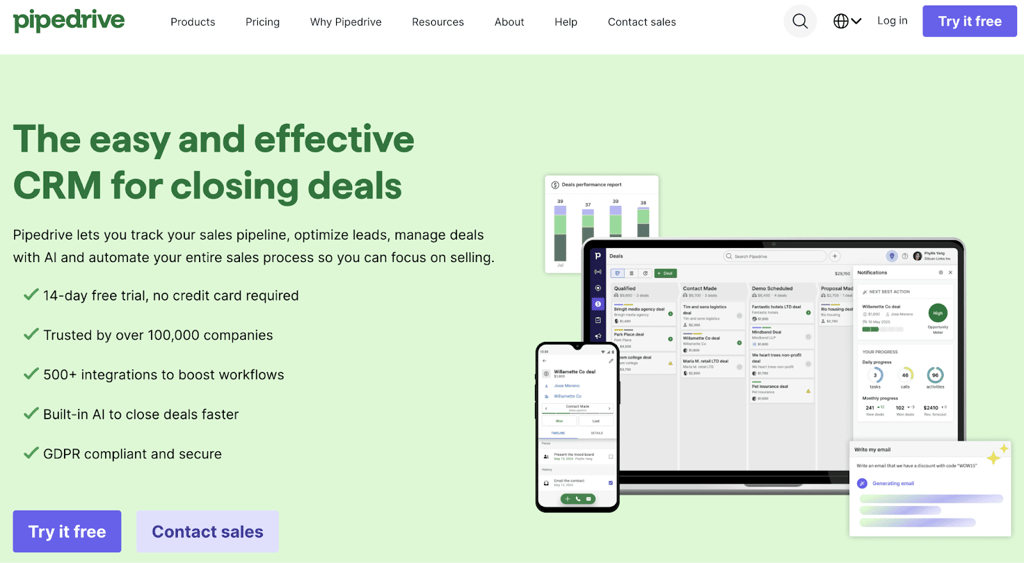
Pipedrive is a CRM with email marketing features for B2B sales teams that manage leads through a sales pipeline.
Pipedrive treats email marketing as an extension of its CRM, while Mailchimp is built primarily as an email marketing platform.
Key features of Pipedrive:
- CRM-driven email marketing. Create email campaigns using CRM contacts, deal stages, and customer data without exporting lists to another platform.
- Sales pipeline targeting. Segment recipients based on pipeline stage, lead status, email engagement, and other CRM data to send more relevant campaigns.
- Campaign reporting. Track opens, clicks, and campaign performance alongside contact activity and sales history to understand how email campaigns influence deals.
Limitations of Pipedrive:
- Not a standalone email marketing platform. Email marketing is available through the Campaigns add-on and is designed to complement Pipedrive’s CRM.
- Built for sales teams. The platform isn’t a good fit for creators, newsletter publishers, or ecommerce stores that need advanced marketing automation and customer journeys.
Pipedrive pricing:
Pipedrive plans start at $14/user/month. Email marketing requires the Campaigns add-on, which starts at $13.33/month.
Pipedrive is the stronger choice for businesses that already use a CRM to manage sales, but a weaker option if email marketing is your primary need.
How to choose the best Mailchimp alternative?
The best Mailchimp alternative depends on how you use email marketing. Before choosing a platform, consider your business model, subscriber list size, sending frequency, automation requirements, ecommerce needs, CRM requirements, and budget.
- Business model. Match the platform to your business. Omnisend and Klaviyo are designed for ecommerce stores, Kit focuses on creators, HubSpot and ActiveCampaign suit B2B sales teams, while Hostinger Reach and MailerLite work well for small businesses sending newsletters.
- List size. Compare pricing based on the number of subscribers you expect to have in six to twelve months, not just today. Some platforms become significantly more expensive as your contact list grows.
- Sending frequency. If you send occasional campaigns to a large audience, look for send-based pricing, such as Brevo’s. If you email subscribers every week, compare monthly plans based on your expected email volume.
- Automation needs. If you plan to personalize campaigns using email list segmentation, lead scoring, and CRM triggers, ActiveCampaign offers more advanced automation. If you mainly need straightforward campaigns and sequences, Hostinger Reach keeps the setup simpler. Compare ActiveCampaign vs Hostinger Reach to see which level of automation better fits your business.
- Ecommerce needs. If you run an online store, choose a platform built for ecommerce. Omnisend is a strong choice for omnichannel marketing and ready-made store automations, while Klaviyo is better suited for stores that rely on advanced customer segmentation, predictive analytics, and personalized campaigns.
- CRM needs. If marketing and sales share the same customer data, choose a platform with built-in CRM capabilities. HubSpot works well for businesses that manage leads across marketing, sales, and support, while ActiveCampaign combines CRM features with advanced marketing automation. Pipedrive is a good fit if your sales team already uses its CRM and wants to add email campaigns.
- Budget. Look beyond the monthly price and compare the features included in each plan. Hostinger Reach and Brevo both offer strong value for small businesses but differ in their pricing models and feature scope, while MailerLite and Moosend are other affordable options. HubSpot and ActiveCampaign justify their higher prices with more advanced CRM and automation features.
What is the best free Mailchimp alternative?
MailerLite is the best free Mailchimp alternative for small businesses and beginners who need newsletters, landing pages, signup forms, and basic email automation.
The free plan includes up to 250 subscribers, 5,000 emails per month, and basic email automation, making it well-suited for growing an email list on a budget.
Brevo is a better fit for businesses with larger contact lists that send campaigns less frequently. The free plan includes 100,000 contacts but limits sending to 300 emails per day.
Built-in CRM features, signup forms, transactional emails, and support for automations such as abandoned cart emails make Brevo a practical option for businesses that plan to expand beyond basic newsletters.
Kit is designed for creators, bloggers, educators, podcasters, and newsletter publishers. The free plan supports up to 10,000 subscribers and includes unlimited email broadcasts, landing pages, forms, audience tagging, and one visual automation.
Kit is a strong choice if your priority is publishing newsletters and growing a creator business.
What is the best Mailchimp alternative for ecommerce?
Omnisend and Klaviyo are the best Mailchimp alternatives for ecommerce, with Omnisend better suited to ready-made store automations and Klaviyo to advanced customer personalization.
Omnisend also makes it easy to add product recommendations, discount codes, and customer segmentation based on shopping behavior.
Native integrations with Shopify, WooCommerce, and BigCommerce simplify setup.
Klaviyo allows you to build detailed customer segments from purchase history, browsing activity, engagement, predicted customer lifetime value, and other behavioral data.
Advanced segmentation, revenue tracking, and predictive analytics help create targeted campaigns, product recommendations, and automations based on purchase behavior.
What is the best Mailchimp alternative for creators?
Kit is the best Mailchimp alternative for creators who want to publish newsletters, grow an audience, and sell digital products. It combines newsletter publishing with landing pages, signup forms, audience tagging, visual automations, and built-in tools for selling digital products, subscriptions, and paid newsletters.
Kit is a good fit if email is your primary channel for growing and monetizing an audience. MailerLite is a better option if you want a simpler, more affordable platform focused on newsletters and list building.
MailerLite includes a drag-and-drop email editor, landing pages, signup forms, and basic automations, making it well-suited to creators who don’t need built-in monetization features or complex workflows.
What is the best Mailchimp alternative for advanced automation?
ActiveCampaign is the best Mailchimp alternative for advanced automation, offering branching logic, behavioral triggers, lead scoring, CRM actions, and multichannel workflows.
ActiveCampaign works well for B2B companies, agencies, SaaS businesses, and sales teams with longer buying cycles.
HubSpot is a better fit if your marketing and sales teams work from the same CRM. Automation workflows use CRM data, lifecycle stages, deal activity, and customer interactions to trigger campaigns, assign leads, and notify sales teams.
The platform fits businesses that manage lead generation and sales from one system.
Omnisend focuses on ecommerce automation instead of CRM-driven workflows.
The platform includes ready-made automations for abandoned carts, browse abandonment, welcome emails, post-purchase follow-ups, and other customer journeys across email, SMS, and web push notifications.
Omnisend is a better choice for online stores than businesses with complex B2B sales processes.
What is the best Mailchimp alternative for large contact lists?
Brevo is the best Mailchimp alternative for large contact lists that send campaigns occasionally, while Moosend is a stronger fit for businesses that email large audiences frequently. Mailchimp pricing is primarily based on the number of stored contacts, while Brevo and Moosend use different pricing models that can be more cost-effective depending on sending frequency.
Brevo charges based on monthly email volume rather than stored contacts. This makes it a better option for businesses with large subscriber lists that send newsletters or promotional campaigns less frequently, because costs don’t increase simply because the audience has grown.
Moosend is better suited to frequent senders. Its pricing is based on the number of contacts, but paid plans include unlimited email sends, which can provide better value for businesses that regularly send newsletters, promotional campaigns, and automated emails.
What else drives email marketing success?
Choosing the right Mailchimp alternative is only the first step. Email marketing success also depends on building a high-quality subscriber list, segmenting your audience, creating relevant messages, and sending them at the right time.
Start by organizing subscribers into meaningful segments based on their interests, purchase history, or engagement. Effective email list segmentation helps you send relevant messages instead of delivering the same campaign to everyone.
Relevant messages also need to be well written and easy to act on. Compelling subject lines encourage subscribers to open your emails, while a clean design and clear calls to action (CTAs) make the next step obvious. Many AI email marketing tools can help create and optimize this content, but the goal remains the same: sending useful and relevant messages to your audience.
Timing is equally important. A well-defined email marketing strategy uses automation to deliver relevant emails throughout the customer journey. Welcome emails, abandoned cart reminders, post-purchase follow-ups, and re-engagement campaigns help maintain consistent communication without requiring every email to be sent manually.
After choosing a Mailchimp alternative, use segmentation, relevant content, and automation together to get more value from the platform and build a more effective email marketing strategy.

Simon is a dynamic Content Writer who loves helping people transform their creative ideas into thriving businesses. With extensive marketing experience, he constantly strives to connect the right message with the right audience. In his spare time, Simon enjoys long runs, nurturing his chilli plants, and hiking through forests. Follow him on LinkedIn.