What is a good domain name and how to evaluate yours
Aug 19, 2026
/
By Justina B.
/
6 min Read
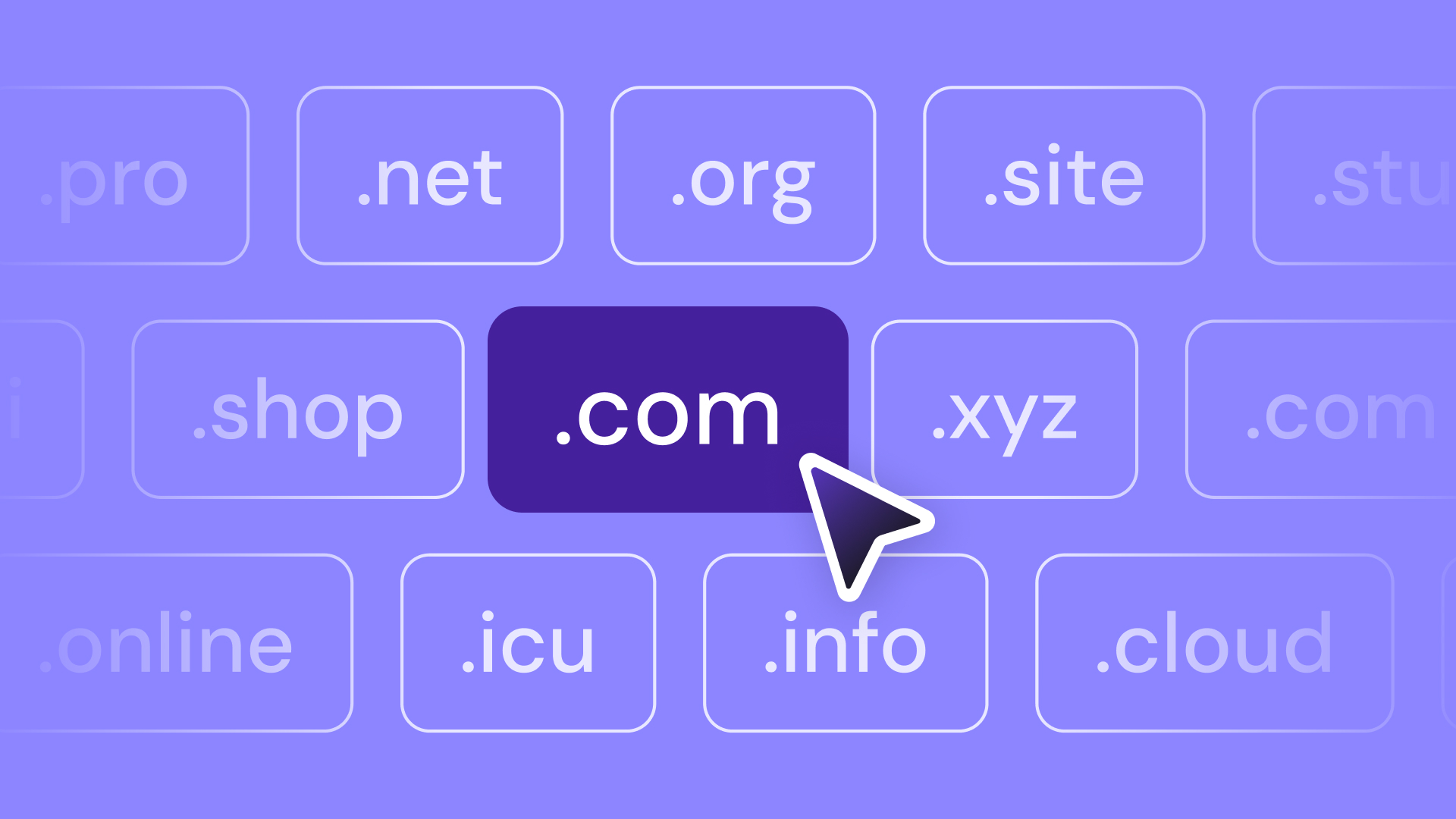
A good domain name is short, easy to spell and pronounce, memorable, and relevant to your brand, including the extension. These qualities help visitors find and trust your website before they see a single page.
It’s tempting to pick a domain name on instinct. But there are specific criteria you can use to test any name before you register it.
Six qualities define a strong domain name:
- Short enough to type from memory.
- Easy to spell on the first try.
- Clear when said out loud.
- Memorable after hearing it once.
- Relevant to your brand or topic.
- Contains the right extension.
Key qualities of a good domain name
A good domain name shares six core qualities that make it easy to find, remember, and trust. These qualities apply whether you’re choosing the right domain name for a personal blog, an online store, or a small business site.
Short length
Aim for 6–14 characters and stick to one or two words when possible. Shorter names are faster to type, easier to share, and less prone to typos.
Easy spelling
Skip unusual letter combinations, double letters, and creative misspellings. If you have to spell your domain out loud for someone, it’s too complicated.
Easy pronunciation
Your domain should sound clear when spoken. If words blend together or create awkward sounds, people will misremember them.
Memorability
A strong domain sticks after one hearing. Rhythmic patterns, alliteration, or distinct word pairings all make a name easier to recall. Creating a memorable, brandable domain comes down to choosing words that are easy to picture and hard to confuse with something else.
Brand relevance
Your domain should connect to your business, topic, or purpose. It doesn’t need to describe everything literally, but it should make sense at a glance. Freshroast.com tells visitors more about what the business does than jkbakes247.com does.
Your domain appears in search results, email addresses, and shared links. Understanding how domain names work shows why relevance matters: your name is often the first thing people notice.
Right extension
.com is the most recognized and trusted extension. .net is the second-most-registered TLD globally and serves as a solid backup. Alternatives like .co, .store, or country-code TLDs are fine when they match your brand or audience.
Beyond these, the right extension depends on your brand and audience. Country-code TLDs like .uk, .de, or .fr signal a local presence, while niche extensions like .tech, .shop, .store, or .cloud tell visitors what your site is about before they click.
Newer options like .one, .diy, and .food are also worth considering if they fit your brand.
Good vs. bad domain name examples
Seeing real examples makes it easier to spot what works and what doesn’t:
| Good example | Why it works | Bad example | Why it fails |
| freshroast.com | Short, descriptive, easy to remember | best-fresh-coffee-roasters-online.com | Too long, hyphens, hard to share verbally |
| pixelcraft.io | Brandable, relevant extension for tech | p1xelcraft.com | Number replacing a letter causes confusion |
| brightnest.com | Two clear words, easy to spell | brightnestserviceshq.com | Filler words dilute the brand |
| brit.co | One word, clean, memorable | bl00m-shop.net | Numbers plus hyphens plus weak extension |
| trailrunner.com | Descriptive, memorable | my–trail-runr.com | Hyphens and misspellings make it nearly impossible to share |
A good domain also avoids numbers and hyphens, which cause spelling confusion and make verbal sharing difficult.
How to evaluate a domain name
Run your domain idea through five tests before you register it. A wrong call here is hard to undo – once it’s yours, you’re stuck with the price you paid and whatever reputation the name already carries.
1. Run the radio test
If someone hears your domain on a podcast or over the phone, can they spell it correctly on the first try?
Say it to five people who haven’t seen it written down and ask them to spell it back. Even one wrong answer means you have a clarity problem.
Most failures come from a short list:
- Homophones like sight vs. site or flour vs. flower.
- Creative spelling, such as kool instead of cool.
- Words with two accepted spellings, like grey vs. gray.
- Double or adjacent letters that blur when spoken fast.
If your audience spans countries, say it in a few accents too. What’s clear in American English can be scrambled in British, Australian, or non-native pronunciation.
2. Check length and simplicity
The ideal domain length is 6–14 characters. Stick to one or two real words when possible.
Short domains fit easily on business cards, social profiles, and email signatures, and they reduce the chance of typos. If you can’t fit the name comfortably in a text message without abbreviating it, it’s probably too long.
Watch for filler words like the, my, best, online, or hq. They add length without adding meaning. Only include them if they’re part of your actual brand name.
3. Make it easy to type
A domain that passes the radio test can still trip people up when they type it.
Type it on a phone keyboard. If autocorrect keeps changing it, your visitors will struggle with it too.
Read it in lowercase as one unbroken string. Word combinations that look fine apart can form something unintended once the spaces disappear, and you won’t catch it just by saying the name out loud.
Skip hyphens and numbers. Both need to be spelled out, like dash or the numeral 3, and both are quickly forgotten.
4. Confirm brand fit and scalability
Your domain should feel like a natural fit for your brand today and still work if the business grows or pivots.
Brand fit means visitors get a sense of what your site is about from the domain alone. A bakery called flourandfire.com tells you more than frbakes18.com.
Scalability means the name doesn’t box you in. A domain like austinplumber.com works for one city, but becomes a problem if the business expands to other cities.
Test how the domain looks in a logo, an email address, and a social media profile. A name might sound fine, but look awkward on screen.
Before committing, search the USPTO database or the WIPO Global Brand Database to confirm the name doesn’t conflict with an existing trademark. A domain name that overlaps with a registered trademark can lead to a legal dispute or forced transfer, even if the domain is available for registration.
Match your domain to social media handles
A good domain should also be available as a username on the social platforms you plan to use.
Consistent naming across your website and social profiles makes it easier for people to find and recognize you. If your domain is flourandfire.com but your Instagram handle is flourandfire_bakery_2024, the branding feels fragmented.
Before you register the domain, check handle availability on Instagram, X, TikTok, LinkedIn, and any other platforms relevant to your audience. Tools like Namechk or KnowEm let you search across dozens of platforms at once instead of checking each one manually.
5. Score your domain idea
Before you register, rate your domain idea on five criteria to see how it stacks up:
| Criteria | Score 1–5 | What a 5 looks like |
| Memorability | _ /5 | You remember it after hearing it once |
| Spelling clarity | _ /5 | Anyone can spell it without help |
| Length | _ /5 | 6–14 characters, one or two words |
| Brand relevance | _ /5 | Visitors understand the site’s purpose from the name |
| Extension fit | _ /5 | .com or a well-matched alternative |
A domain that scores 20 or above out of 25 is strong. Below 15, reconsider the name. Between 15 and 20, look for ways to improve it or test a variation. These numbers are a quick gut check, not a hard rule.
If your score is on the lower end, try running variations through domain name generators to surface available alternatives you might not think of on your own.
Do keywords in a domain name help with SEO?
A keyword in your domain name can add relevance signals, but it won’t move your rankings on its own.
Exact-match domains used to rank well just because they contained the target keyword. Google’s 2012 EMD update reduced that advantage. Today, a keyword-stuffed domain with weak content won’t outrank a brandable domain with strong content behind it.
If a keyword fits naturally and the domain still sounds brandable, use it. freshroast.com works because it’s descriptive and short. buyfreshcoffeeonline.com doesn’t work because it reads like a search query rather than a brand.
Prioritize brandability and clarity over keyword placement. A strong domain paired with good content and solid SEO practices will outperform a keyword domain with nothing behind it.
Check the domain history before buying
Before registering, confirm the domain hasn’t been used for spam. If a previous owner used the domain for spam, thin content, or link schemes, Google’s penalty can carry over – even after you register it clean and start fresh.
Check the Wayback Machine to see past versions of the site, and run a WHOIS lookup to review its ownership history. If the domain shows signs of spam or a string of unrelated past owners, treat that as a warning sign, not a bargain.
Next step – register your domain
Once your domain idea meets the evaluation criteria, check its availability and register it. Hostinger’s domain checker lets you type your idea, see if it’s available, and explore alternative extensions or similar names.
Domain Name Checker
Instantly check domain name availability.
If your first choice is taken, you still have options. Try a different extension, such as .net, .co, or a country-code TLD that fits your audience. Your top-level domain matters too. Pick an extension that’s recognizable in your market and fits your niche.
Before giving up on a name entirely, try small variations that keep the core identity intact:
- Swap the word order. If brightpath.com is taken, pathbright.com might be available.
- Add a short, meaningful word. Think freshroast.co vs. freshroasthq.com. Choose a word that adds context, not filler.
- Try a related synonym. If trailrunner.com is taken, trailhiker.com keeps the same feel without copying the name.
- Shorten it. A two-word domain that’s taken might work as an abbreviation or single-word alternative.
A domain name generator can suggest available combinations you haven’t considered. And if a parked domain is exactly what you need, marketplaces like Sedo or Afternic let you buy it from the current owner, though the price will be higher.
Once you’ve settled on the right name, buying and registering it takes just a few minutes. If you’re still stuck, there are more alternatives worth trying before starting from scratch.
All of the tutorial content on this website is subject to Hostinger's rigorous editorial standards and values.

Justina is a Content Writer passionate about marketing, with a background in social media and customer success management. She also loves reading books, traveling and exploring new places as well as cooking, and trying out new recipes. Follow her on LinkedIn.