Why fitness apps don’t work (and how AI helps)
Jan 23, 2026
/
Ariffud M. & Maria S.
/
6 min Read

There’s a brutal fact in the fitness industry: most New Year’s resolutions don’t survive January.
There’s even a name for it: Quitter’s Day. Strava coined the term after noticing that the second Friday of January is when most fitness resolutions fall apart.
By then, motivation is gone. The gym feels like a chore.
When that happens, we blame ourselves. We tell ourselves we’ve gotten lazy or lack discipline and willpower to stick to a routine. Opening your fitness app feels worse than skipping the workout.
The real problem isn’t you. It’s the system.
Most fitness apps are rigid. They expect your life to follow a clean, predictable schedule. Real life doesn’t work that way.
When you skip workouts, eat poorly for a weekend, or deal with stress, the app doesn’t adapt. It just marks you as “behind” instead of adapting to your circumstances.
That difference matters.
To get past Quitter’s Day, you don’t need another version of MyFitnessPal. You need a system that adapts when things go off track.
That’s where AI changes the game.
Why do most commercial fitness apps fail real humans?
Apps like Fitbod or Freeletics are impressive pieces of software. They offer polished interfaces, large exercise libraries, and tracking that’s far more accurate than a notebook.
Fitbod adjusts weight recommendations based on your training history. If you overworked your lower back doing deadlifts last week, it’ll track muscle recovery scores and respond by reducing the load, decreasing volume, or suggesting alternatives that don’t target those fatigued muscles.
Freeletics modifies workouts based on perceived difficulty. You rate a session as “too easy,” and the next one ramps up. You rate it as “too difficult,” and it scales it back.
Despite these strengths, most commercial fitness apps share the same structural flaw: the broken streak effect.
They try to make consistency feel rewarding by celebrating daily targets and penalizing missed workouts. Skip a session, and the metrics turn red. Your streak resets to zero.
Apps don’t account for your injury history, your medications, a chaotic work schedule, or simply being exhausted.
This design assumes linear progression, as if your body and life operate like a spreadsheet.
In reality, progress includes:
- Deload weeks that turn into deload months
- Accumulated fatigue that changes your rate of perceived exertion (RPE)
- Work travel that destroys routines and non-exercise activity thermogenesis
When these inevitable deviations happen, static apps treat them as failures. That framing creates shame and guilt, two emotions that are poison for long-term consistency.
So you stop opening the app.
This is how fitness apps usually fail. Not through one big setback, but through small broken streaks and accumulated moments of “I’m already behind.”
What we need is software that treats deviations as data, not as personal failure.
Why is an AI system smarter than a standard app?
This is where AI fitness coaching starts to matter. Large language models (LLMs) like Claude or ChatGPT differ from standard fitness apps because they can better understand nuance and context.
Context over calculation
Standard apps rely on generic workout logic, such as total daily energy expenditure (TDEE) formulas, fixed macro splits, and preset progressive overload percentages.
They plug your data into a standardized equation and expect it to hold up. That lack of context is why workout apps don’t work for most people.
AI can process your actual constraints instead. You can tell an AI:
“I’m 31, I work from home, I recently injured my right thumb, and I can only work out for 30 minutes in the morning. Create a monthly routine that works around my injury.”
Once it generates a routine, you can refine it further by adding conditions:
“I’m coming off a minor back tweak, I don’t respond well to high-volume training, and I need to stay functional for a work trip next week.”
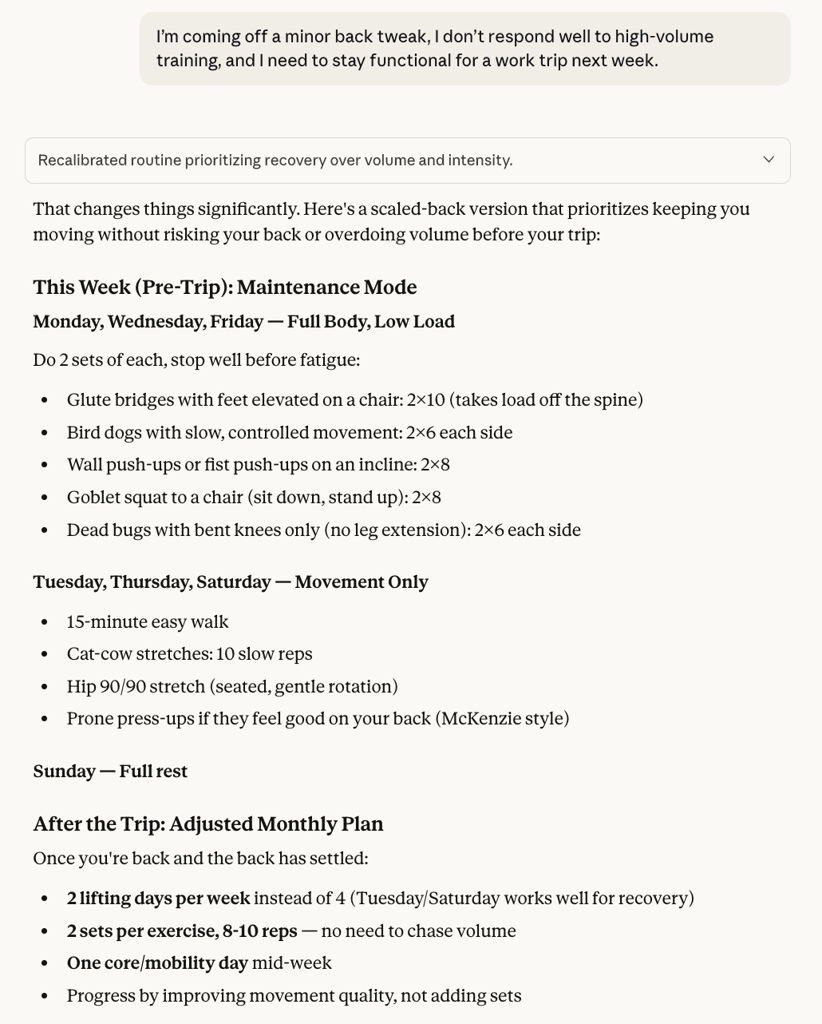
Most apps can’t handle that level of nuance. AI can.
Systems over metrics
Most fitness apps are passive. They log what you’ve already done. AI can be proactive and help you design systems that account for what’s coming next.
Instead of just tracking calories, you can ask for adaptive targets. For example:
“Create a daily calorie target that adjusts based on my activity level, with more calories on workout days and fewer on rest days.”
One approach records setbacks in detail. The other helps you avoid them.
Freedom over friction
There’s also the issue of abandonment. A systematic review in the Journal of Medical Internet Research found that around 71% of users stop using health apps within 90 days.
That drop-off often comes from:
- Too many irrelevant metrics
- Hidden subscriptions
- Privacy concerns
- Tools that don’t match real behavior
Building your own AI workflow lets you strip away all of that. You track only what matters to you, skip the monthly fees, and avoid unnecessary data collection.
How AI systems handle a bad week
To show why traditional fitness apps don’t work in real-world scenarios, let’s run a simple stress test.
The scenario
It’s the second week of January, right in the Quitter’s Day territory. You’ve missed three workouts because of a deadline and ate poorly over the weekend. This is the point where many people give up.
Outcome A: the static app
You open Fitbod. It highlights your missed days. Your weekly volume is down 60%. It suggests completing the workout you missed on Monday, a heavy leg day, on top of your already scheduled sessions.
The implicit message is clear. You’re behind and need to catch up.
The result is predictable. The broken streak effect kicks in. It feels like the week is already lost, so you close the app and plan to “start fresh on Monday.” We both know how that usually ends.
Outcome B: the adaptive AI
You open the previous Claude chat and enter a prompt:
“I missed three days and ate poorly. I’m busy and stressed. Adjust the rest of the month’s plan so I can still hit my goal without burning out.”
The shift is immediate. The system recalculates without judgment and treats the setback as data.
Here’s what it suggests:
- Reduce to two short sessions per week, 10 to 12 minutes each. Consistency beats schedule.
- Off days: a short walk counts. Stretching counts. Doing nothing also counts.
- Don’t overcorrect on food. Just aim for protein at two meals, water before coffee, and one vegetable somewhere.
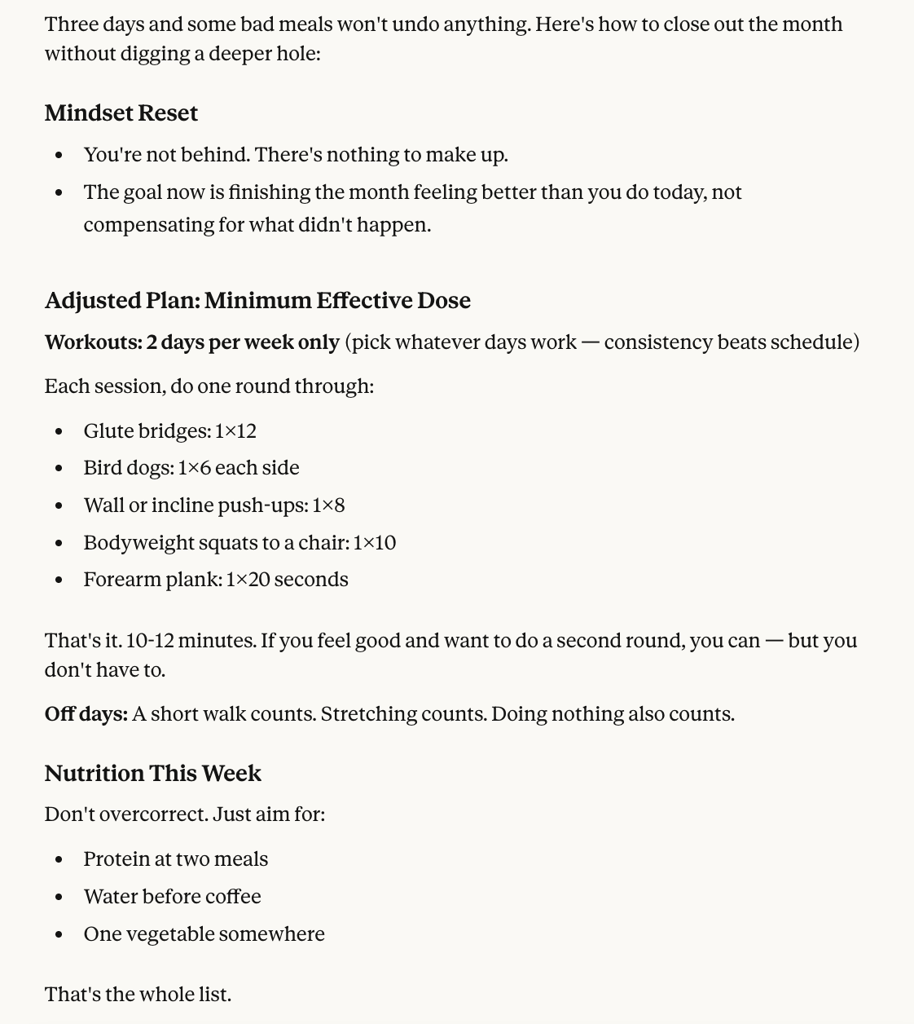
The result is simple. You stay in the game. You maintain the habit, even if you miss a few metrics, and you move past Quitter’s Day without quitting.
Want to see how this works in practice? This Hostinger Academy video walks through the full process.


How to build your own fitness tracker
You don’t need to be a developer, but you need to decide how much effort you want to put in.
The chatbot approach (fastest)
Use ChatGPT or Claude as your coach. Start with the “reality check” prompt. Be honest about your constraints.
“I’m a 31-year-old man, 59 kg, and 1.60 m tall. I work from home and can only exercise for 30 minutes in the morning. I recently injured my right thumb. Create a workout routine. I like walking and swimming.”
This works well for planning, but it’s temporary. You have to scroll through chat history to find your plan, and there’s no dashboard to track progress over time.
The dedicated tool approach (long-term)
If you want something permanent, build your own web app. Hostinger Horizons lets you describe what you want in plain language and generates a working app.
The process is simple. Describe the app you need, for example:
“Create a fitness dashboard to log workouts, track calories, and save meal plans.”
Then refine it through conversation. Our tutorial on creating a fitness web app walks through the technical details if you want to go deeper.
What matters most isn’t the tech – it’s ownership.
If the font is too small to read while you’re sweaty and squinting, you can change it. If you hate tracking macros, you can remove that section and replace it with something you’ll actually use, like a mood tracker or sleep log.
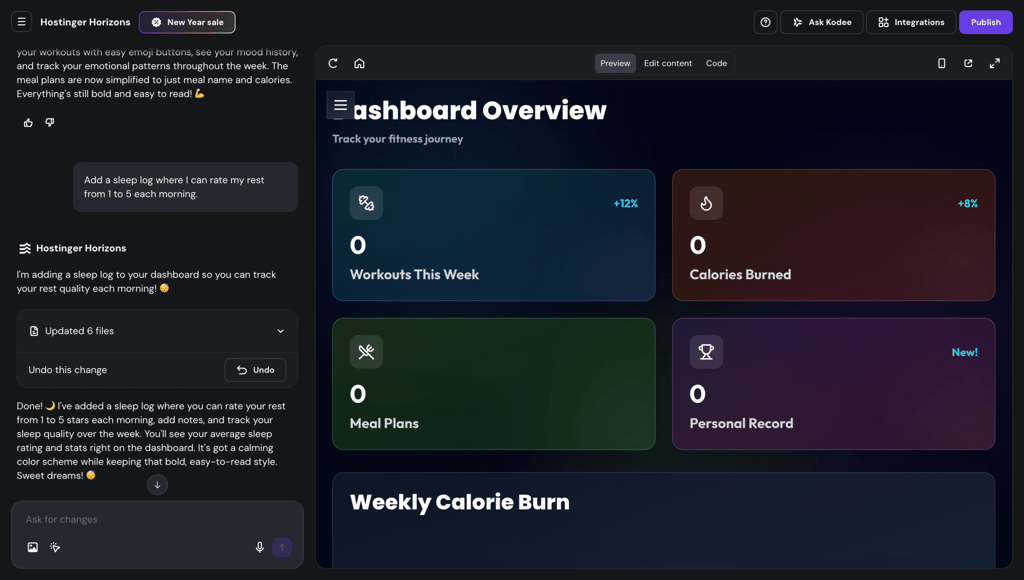
When something isn’t working, you don’t have to wait for a developer in Silicon Valley to ship an update. You can fix it yourself.
That flexibility is the real defense against the Quitter’s Day. It’s a system that bends instead of breaks.
Be the architect of your own consistency
Quitter’s Day isn’t a failure of character. It’s the failure of rigid systems.
Every red notification, broken streak, and “you’re behind” message treats your life like a mistake that needs fixing. Your life isn’t the problem. The app’s assumptions are.
There is no perfect fitness app. It can’t exist, because no developer understands your context better than you.
When you use AI to manage your goals, you don’t have to wait for someone to ship a “sick day” update. You just tell the system what changed, and it adjusts. You’re no longer following a plan. You’re shaping one.
Consistency doesn’t come from being perfect. It comes from having a system that holds up when things get messy. Don’t write off another January. Don’t become a Quitter’s Day statistic.
If you want to apply the same systems thinking to your money, check out our guide on using AI to build smarter financial habits.
All of the tutorial content on this website is subject to Hostinger's rigorous editorial standards and values.


Ariffud is a Technical Content Writer with an educational background in Informatics. He has extensive expertise in Linux and VPS, authoring over 200 articles on server management and web development. Follow him on LinkedIn.

Maria is a scriptwriter for Hostinger Academy. With a background in journalism and content marketing for financial and tech brands, she has experience turning complex topics into visually engaging videos. Follow her on LinkedIn.