B2B email marketing strategy: 8 key tactics for success
May 21, 2026
/
Alma F.
/
9 min Read
A business-to-business (B2B) email marketing strategy is how you reach decision-makers, nurture leads through longer sales cycles, and turn prospects into paying clients. It’s one of the most effective channels for B2B growth, but it works very differently from business-to-consumer (B2C) email.
B2B is a longer game than B2C. You’re writing to buying committees, not individuals. A prospect might read your emails for months before they’re ready to talk. That means your strategy needs to account for multiple stakeholders, longer timelines, and content that builds trust over time rather than pushing for a quick sale.
Follow these eight tactics to create an effective B2B email marketing strategy:
- Identify your target audience so every email speaks to a specific person with a specific problem.
- Set campaign goals tied to each stage of the sales funnel.
- Segment your email list to send the right message to the right group.
- Write personalized and valuable content that addresses real business challenges.
- Prioritize mobile design and accessibility because most professionals check their email on their phones first.
- Use automation and drip campaigns to nurture leads without manual follow-up.
- Test and optimize using open rates, click-through rates, and conversions as your guide.
- Comply with legal regulations like CAN-SPAM and GDPR to protect your reputation.
1. Define your target audience
The first step is knowing exactly who you’re writing to – what problems they face, what role they play in buying decisions, and what would make them stop scrolling.
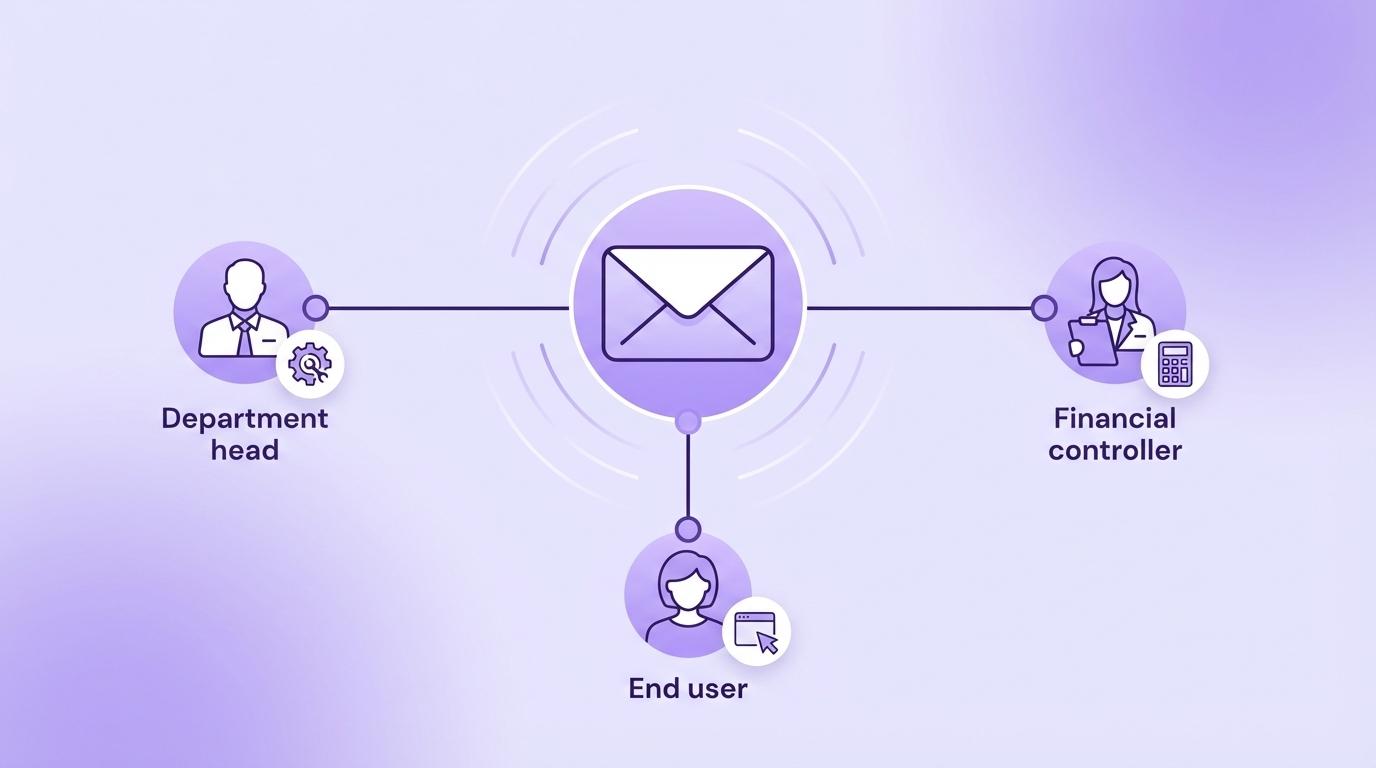
In B2B, you’re rarely selling to one person. A single purchase might involve a department head, a financial controller, and an end user. The department head wants efficiency. The financial controller wants cost justification. The end user wants easy adoption.
Sending the same message to all three won’t work since they all have different wants. This is exactly what makes B2B audience targeting harder than B2C, where you’re usually speaking to one buyer with one motivation. In B2B, effective email marketing starts with understanding these differences.
Build your buyer personas based on real data. Pull insights from your customer relationship management (CRM) tool to see which industries, company sizes, and job titles convert most often. Review past deals for the questions, objections, and content that moved them forward.
It also helps to check industry reports, study what your competitors are doing, and talk to your sales team – they’re on the front lines hearing customer frustrations every day.
Once you know who you’re writing to and what they care about, your emails are more likely to be opened.
2. Set clear campaign goals
You need to know what success looks like before you hit send. Without defined goals, you can’t tell whether a campaign performed well or just felt busy.
The most effective B2B email goals align with specific stages of the sales funnel. What you measure at the top (awareness) looks very different from what you track at the bottom (conversions).
Funnel stage | Goal type | Key metric | Example |
Top | Brand awareness | Open rate, list growth | Newsletter introducing your expertise |
Middle | Lead nurturing | Click-through rate, downloads | Case study or white paper email |
Bottom | Conversion | Demo requests, closed deals | Product walkthrough or free trial offer |
A common mistake is setting goals that are too broad. “Get more leads” isn’t a goal. “Generate 50 marketing-qualified leads from a three-email sequence targeting mid-sized SaaS companies” is. The more specific you are upfront, the easier it is to measure what’s working.
Avoid tying every campaign to bottom-funnel conversions. B2B buying cycles are long, and expecting an immediate sale from a first-touch email sets you up for disappointment. Match your goals to where the recipient is in their journey.Pro Tip
3. Segment your email list effectively
Email segmentation means grouping your contacts so each group gets content that matches their situation. A startup founder and an enterprise procurement manager have very different priorities, even if they’re both looking at your product.
In B2C, segmentation might be as simple as grouping by purchase history or location. B2B segmentation runs deeper because you’re selling to teams, not individuals.
The most useful ways to segment your email list include industry, company size, buyer role, and engagement level. When you group contacts by these traits, your subject lines, offers, and calls to action (CTA) become far more relevant.
Before you can segment, you need to build an email list first. You can use opt-in forms, gated content, and event registrations. Once your list is growing, organize it into meaningful groups. A few examples:
- By role – Decision-maker vs. influencer
- By engagement – Active openers vs. inactive contacts
- By funnel stage – New subscriber vs. returning prospect
From there, you can segment your email list to send targeted campaigns that speak to each group’s needs.
4. Craft personalized and valuable content
Personalization in B2B is more than just adding someone’s first name to the subject line. It means writing email copy that addresses the specific challenges your recipient faces in their role and industry.
Think about what your reader is dealing with on a Tuesday morning. They’re scanning their inbox between meetings, looking for anything useful. Your email needs to earn its place – whether that’s a case study, a white paper with fresh data, or a product demo invite.
This is another area where B2B and B2C differ. A B2C email might highlight a flash sale or trending product. A B2B email needs to show that you understand the reader’s business problem and have a credible solution. That means fewer promotions, more proof.
Keep your tone professional but conversational. B2B doesn’t mean boring. If your email reads like a press release, it’s going in the trash.
Here’s a simple framework for structuring B2B email copy:
- Subject line – Specific and benefit-driven. “How Company X cut churn by 23%” beats “Our latest product update.”
- Opening line – Reference a pain point or trend your reader cares about.
- Body – One clear piece of value – a stat, a tip, or a resource.
- CTA – One focused next step.
The emails that perform best are the ones that make the reader feel understood, not sold to.
5. Design for mobile and accessibility
More than half of professionals check their email on their phones before opening a laptop. If your email looks broken on mobile, then you’ll have wasted a good email copy. Your reader gives you about 10 seconds. Design for that reality.
Mobile-friendly design starts with a single-column layout that stacks cleanly on smaller screens. A few more essentials to keep in mind:
- Keep subject lines under 40 characters so they don’t get cut off.
- Use buttons instead of text links for CTAs – tapping a small hyperlink on a phone is frustrating.
- Keep your email width at 600 pixels or less to avoid horizontal scrolling.
Your email design also needs to work for people using screen readers or limited vision. Use at least 14px for body text, make sure there’s a strong contrast between text and background, and add alt text to every image. Avoid placing key information solely in images, as many email clients block images by default.
Pro Tip
Do a quick mobile test. Send yourself a test email and read it on your phone before launching any campaign. If you have to pinch, zoom, or squint, your recipients will too. A 30-second check saves you from potentially losing half your audience.
Common design mistakes include oversized images without proper image optimization, too much content in a single email, and burying the CTA below several paragraphs.
6. Implement automation and drip campaigns
Email automation lets you send the right message at the right time without manually following up with every lead. For marketers managing dozens of prospects at different stages, this is where real efficiency kicks in. It’s no surprise that 58% of marketers list email automation as a top priority, according to Hostinger’s email marketing statistics.
One of the most common ways to put that automation to work is through drip campaigns – a series of pre-written emails that go out based on triggers you set. Someone downloads your white paper? They get a follow-up three days later with a related case study. They visit your pricing page? A demo invite lands the next morning.
Each email builds on the last, moving the lead closer to a decision. In B2B, where deals take weeks or months to close, that steady contact saves time and keeps your messaging relevant – two things that directly improve return on investment (ROI).
Once your email marketing automation is set up, map your sequences to the buyer journey:
- Early stage – Educational content like guides and industry insights
- Mid stage – Proof points like testimonials and case studies
- Late stage – Direct offers and invites to book a meeting
The key is matching the message to where the person is, not where you want them to be.
An email marketing software like Hostinger Reach makes this setup simple. You can build automated workflows, segment audiences by behavior, and track each email’s results from one dashboard.
There are plenty of email marketing tools on the market, but the right one should handle automation, segmentation, and reporting without forcing you to juggle separate systems.
7. Test and optimize regularly
Even a well-performing campaign has room to improve. The only way to find out where is to test.
A/B testing means sending two slightly different versions of an email to small parts of your list, then sending the better-performing version to everyone else. You can test subject lines, email send times, email length, CTA placement, or even the sender name.
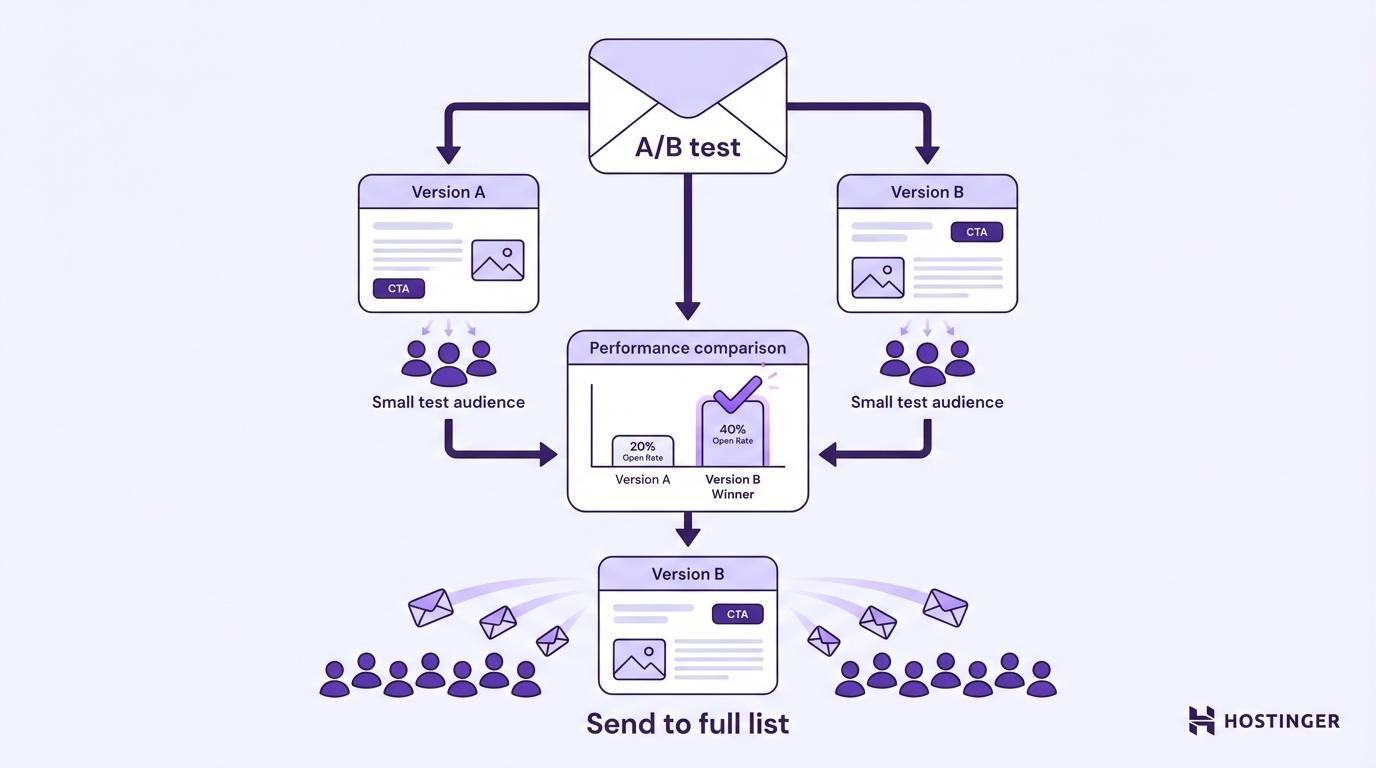
Change only one thing at a time. Otherwise, you won’t know what made the difference.
To decide which version performed better, you need the right metrics. Focus on these three for B2B:
- Open rate. This tells you whether your subject line and sender name are pulling their weight. The average open rate across industries is 35.63%. If you’re consistently below that, test shorter subject lines, try a real person’s name as the sender, or adjust your send time.
- Click-through rate (CTR). This shows whether the content inside your email is strong enough to drive action. If you’re falling below the 2%–3% average, it usually means your email body doesn’t match the subject line’s promise, or that your CTA is buried. Move your CTA higher, tighten the copy, or make the next step clearer.
- Conversion rate. This measures whether the people who clicked actually did what you wanted – like booking a demo or downloading a resource. If clicks are healthy but conversions aren’t, the problem is usually the landing page, not the email. Check that your page matches what the email offered and that the form or next step is simple.
Testing isn’t a one-time project. Test with every campaign, track the results, and apply what you learn to the next one.
8. Ensure compliance with legal regulations
Ignoring email regulations doesn’t just risk fines; it also damages your sender reputation, hurts deliverability, and chips away at the trust you’re trying to build.
There are two main email regulations to consider, depending on your location and where your subscribers are based:
- CAN-SPAM (United States) – The CAN-SPAM Act (Controlling the Assault of Non-Solicited Pornography and Marketing Act of 2003) requires a valid physical address in every email, a clear unsubscribe option, and honest subject lines. You must honor opt-out requests within 10 business days. Penalties can reach $51,744 per violation.
- GDPR (European Union and UK) – The General Data Protection Regulation (GDPR) is the EU’s stringent 2018 law that requires a lawful basis for processing personal data – either consent or legitimate interest. You must explain how you’ll use their data and give recipients easy access to modify or delete it.
Staying compliant means using double opt-in for new subscribers, keeping your unsubscribe process to one click, and regularly cleaning your list to remove bounced or inactive addresses. These steps also improve deliverability, since email providers track how recipients interact with your messages.
Important! Even in B2B, where “legitimate interest” may be a valid lawful basis under GDPR, you still need to document your reasoning and give every recipient a clear way to opt out. Assuming your campaigns are exempt just because they’re business‑related is a common and costly mistake.
Common challenges in B2B email marketing
Even with a solid strategy, B2B email marketers run into common problems. Here’s how to handle the most frequent ones:
- Long and complex sales cycles. B2B buying journeys can stretch over months, with prospects going quiet and coming back at random. The fix isn’t more emails – it’s consistent, well-timed nurturing. Use automation and drip campaigns aligned with each funnel stage to keep your brand visible without overwhelming anyone.
- Multiple decision-makers. A single B2B deal can involve three to seven stakeholders, each with different priorities. The CFO cares about cost. The operations lead cares about rollout. The end user cares about daily usability. Segment contacts by role and tailor your messaging to each persona.
- Low engagement rates. If your opens and clicks are lagging, generic messaging is usually the problem. A subject line that speaks to a specific pain point will always beat one that could apply to anyone. Audit your recent campaigns and ask: Would this feel relevant to the reader?
- Data quality issues. Outdated contacts, missing job titles, and duplicate records quietly drag down your results. Make list cleaning a regular habit. Remove bounced addresses, merge duplicates, and fill in missing company and role data.
- Deliverability challenges. A weak sender reputation or a list full of inactive contacts pushes your emails into spam. Build your list through permission-based methods, monitor engagement trends, and drop unresponsive contacts. Technical authentication records such as SPF, DKIM, and DMARC also help maintain healthy inbox placement.
- Difficulty proving ROI. Connecting email activity to revenue is tough in B2B, where the path from first touch to closed deal is long. Start with clear goals for each campaign. Track metrics for each funnel stage and connect email touchpoints to sales outcomes whenever possible.
How to measure the ROI of your B2B email marketing strategy
Once your B2B email campaigns are running, the next step is figuring out whether they’re paying off. The average ROI for email marketing is $36 for every $1 spent – but reaching that number in B2B takes more careful tracking than in B2C.
In B2C, the path is short. One email can lead directly to a sale. B2B works differently. A prospect might open your newsletter in March, click a case study in May, and book a demo in July. Multiple people from the same company might interact with different emails before anyone signs – because B2B purchases involve bigger budgets, more approvals, and longer decision timelines.
The challenge is tying that entire journey back to the revenue it ultimately generates.
Start by tracking a few core email marketing performance metrics consistently:
- Open rate. Are your subject lines and sender reputation strong enough to get noticed by busy decision-makers?
- CTR. Is the content inside your email strong enough to move a prospect further into the funnel?
- Conversion rate. Are recipients taking the next step – requesting a proposal, booking a demo, or starting a trial?
- Unsubscribe rate. Is your content or send frequency wearing out your audience between touchpoints?
To go deeper, link your email activity to your sales pipeline. Track which campaigns generate qualified leads, which touchpoints appear most often in closed deals, and how long leads take to convert after each sequence.
This means connecting your email platform to your CRM so you can trace revenue back to specific campaigns – not just the last click, but the full path.
The easier it is to see all of this in one place, the faster you can act on it. Hostinger Reach gives you real-time open, click, and delivery insights in one dashboard, so you can see what’s working and what needs reworking without switching between tools.
From there, the process is pretty straightforward: double down on what works, cut what doesn’t, and keep refining. These steady improvements are what turn a basic email marketing strategy into a reliable revenue channel over time.
All of the tutorial content on this website is subject to Hostinger's rigorous editorial standards and values.

Alma is an AI Content Editor with 9+ years of experience helping ideas take shape across SEO, marketing, and content. She loves working with words, structure, and strategy to make content both useful and enjoyable to read. Off the clock, she can be found gaming, drawing, or diving into her latest D&D adventure.