What is a drip campaign? How drip campaigns work
Jul 03, 2026
/
By Alma F.
/
10 min Read

A drip campaign is an automated sequence of emails sent based on a schedule or user actions. Its job is to keep your audience interested over time – so they remember you, trust you, and eventually buy from you.
Many businesses send a single email to their entire list when they have something to share. That works for one-time updates like a promotion, an announcement, or a newsletter. But if you’re bringing in a new user, following up with a potential customer, or reminding someone about items they left in their online shopping cart, one email isn’t enough.
Instead, you send a series of emails over time. For example, a user downloads your free guide on website design and receives a case study about a successful site a few days later, then a comparison of website builders the following week, and then a free trial offer of your website builder after that.
Each message guides the subscriber toward the action you want, such as making a purchase or signing up for a trial. It’s why drip campaigns are a key part of email marketing and marketing automation.
Every drip campaign relies on four core parts:
- Triggers – the actions or timing that start the sequence, like a sign-up or a purchase
- Message sequence – the set of pre-written emails sent in a specific order
- Segmentation – grouping your audience so each person gets content that fits them
- Automation tools – the software that connects everything and sends emails on your behalf
To set up an effective drip campaign, you need to understand what makes them different from regular emails and how to build one step by step. You also need to know which types fit which goals – like welcome sequences, cart reminders, and re-engagement – and the best practices that keep your emails in front of the right people.
What are the key characteristics of drip campaigns?
Three characteristics set drip campaigns apart from other email marketing strategies: they’re automated, so you set them up once, and they send on their own. They’re time-based, meaning emails go out on a schedule you define. And they’re behavior-triggered, so different subscribers receive different emails based on what they do.
Compare that to a one-off broadcast, which is a single email sent to your entire list at once, like a sale announcement or a monthly newsletter.
Feature | One-off broadcast | Drip campaign |
Sending style | One email to your whole list | A sequence of emails over time |
Targeting | Same message for everyone | Personalized based on behavior or data |
Trigger | Typically manual, sent when you hit “send” | Automatic, based on actions or timing |
Goal | Announce something once | Guide people toward a specific action over time |
Two things make drip campaigns feel personal to each subscriber: segmentation and personalization.
Segmentation means splitting your audience into groups based on behavior, interests, or where they are in the buying process. For example, a new subscriber gets a welcome series. Someone who hasn’t opened an email in 60 days gets a re-engagement email to encourage them to interact with your messages.
Then we have personalization, which means changing the content of each email based on what that specific person has done, like what they clicked, browsed, or bought.
Once your campaign is running, three metrics tell you if it’s working:
- Open rate – the percentage of people who open your email. For automated emails, 25–45% is typical across most industries.
- Click-through rate (CTR) – the percentage of people who clicked a link in your email. Automated emails get around 5.5%, compared to roughly 1.7% for broadcasts.
- Conversion rate – the percentage of people who completed a specific action, like buying something or signing up for a free trial.
How to create a drip campaign
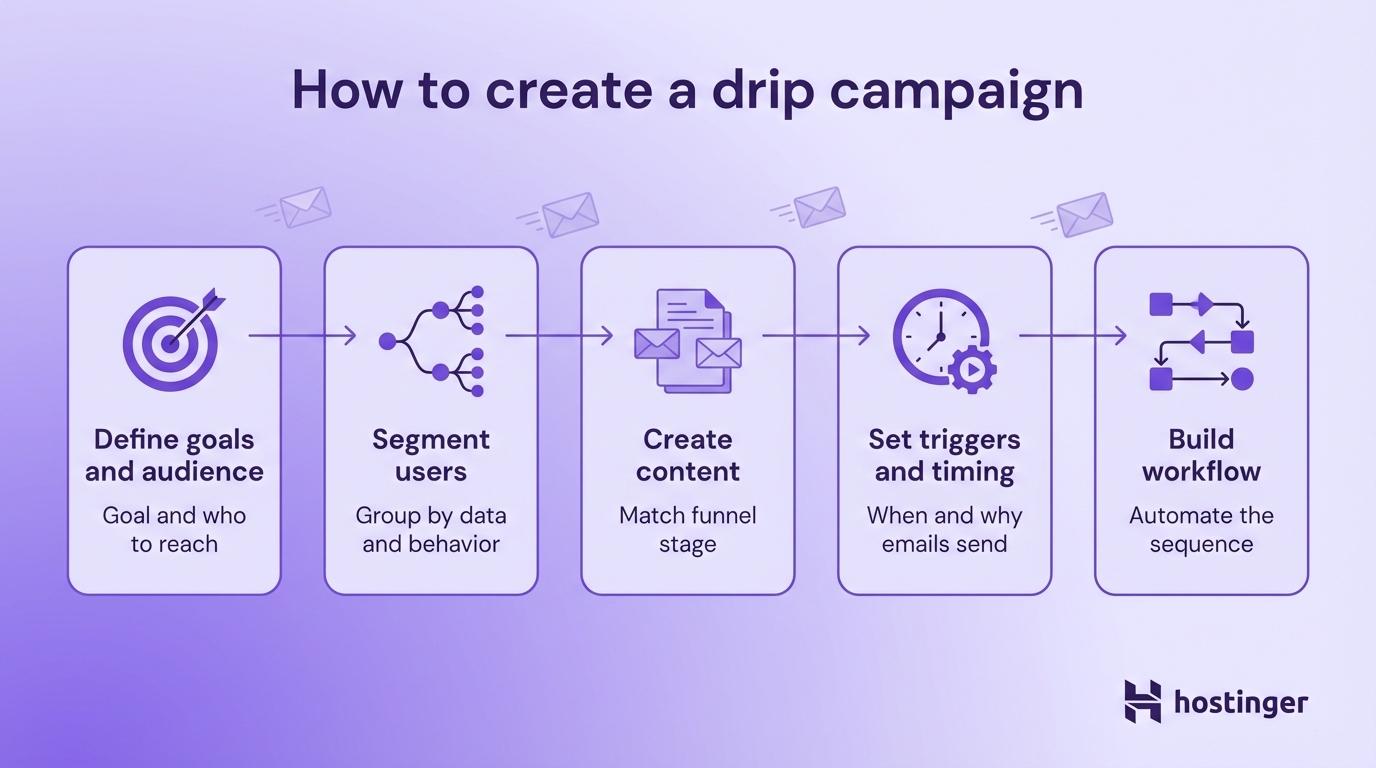
You create a drip campaign by connecting a trigger, a set of emails, and a schedule inside an automation tool.
1. Define goals and audience
Every drip campaign starts with a clear goal – it shapes the content, the timing, and who receives the emails. Common goals include:
- Onboarding new users – helping them get set up and comfortable with your product
- Warming up leads – these are people who’ve shown interest but haven’t bought yet – toward a purchase
- Bringing back inactive subscribers with a reminder or incentive
- Keeping customers engaged after a sale with tips, updates, or related products
Once you have a goal, figure out who should get the emails. New users need different messages than someone who hasn’t logged in for three months. Someone who downloaded your free guide is still researching. Someone who already bought from you is ready for upsells or tips.
2. Segment users based on behavior or data
Next, you segment your email list by splitting your audience into smaller groups so each person gets emails that are relevant to them.
There are several ways to group your subscribers.
- Demographic – who they are, like their age, gender, or job title
- Geographic – where they’re located. A winter sale email makes sense for subscribers in cold climates, not for someone in the tropics
- Behavioral – what they’ve done on your site, like viewing a product page or clicking a link in a previous email
- Engagement-based – how active they are with your emails. Do they open everything, or have they stopped interacting for months?
- Lifecycle stage – where they are in the buying process. A first-time visitor and a repeat customer shouldn’t get the same email
You don’t need complicated groups to start. Even splitting your list into “new subscribers” and “returning customers” leads to higher opens and CTR.
If you’re still growing your contacts, the first step is to build an email list with people who want to hear from you.
3. Create relevant content for each stage
The content in each email should match where that person is in the sales funnel – that’s the path someone takes from first hearing about you to actually buying. Someone who just found your brand needs different emails than someone who’s about to buy.
Sales funnel stage | What the reader needs | What to send |
Early | Understanding their problem | How-to guides, tips, helpful articles |
Mid | Exploring solutions | Case studies, feature comparisons, product demos |
Late | A reason to act now | Free trials, limited-time offers, testimonials |
Don’t try to pack three ideas into a single message. Split them into separate emails, each with one idea and one clear next step, like “Start your free trial” or “read this guide.”
Knowing what to send at each stage is half the work. The other half is writing emails people actually want to read. Your email copywriting – the subject lines, the body text, the calls to action – is what gets people to open, click, and follow through.
4. Set triggers and timing
Triggers control when each email in your sequence gets sent and what causes it to go out. You set them up once, and the system takes care of the rest.
You’ll work with two types of triggers:
- Time-based triggers send emails on a fixed schedule. Example: one day after signup, three days later, then one week after that. Good for welcome sequences where you control the pace.
- Action-based triggers send emails when someone performs a specific action, such as abandoning a cart, clicking a link, or completing a purchase. These feel more personal because they respond to what someone actually did.
The best drip campaigns combine both. You might start with a time-based welcome series, then switch to action-based emails when a subscriber clicks a product link or leaves items in their cart.
Two to five days between emails is a good starting point. Too often, people start tuning you out and might think you’re spamming them. Too much space and they forget about you.
5. Build the workflow in a tool
An email automation tool lets you build your workflow from trigger to final send.
Most platforms have a visual builder that works like a flowchart. You map out the path like this:
“Person signs up → send welcome email → wait 2 days → send tip email → did they click? Yes → send product email. No → send reminder.”
Here are the features you’ll want to build to run effective drip campaigns and maintain a smooth email automation workflow:
- A drag-and-drop workflow builder so you can map out your sequence visually
- Segmentation options so you can send different emails to different groups
- A/B testing, which lets you send two versions of an email to a small group and see which one performs better
- Clear reporting so you can track opens, clicks, and conversions
Many email marketing platforms offer free tiers that handle basic drip campaigns well, so you don’t need a big budget to get started.
Hostinger Reach is a solid choice if you want something beginner-friendly. It’s an AI-powered email marketing tool – you describe your campaign, and it generates a ready-to-send email. You can start for free with email creation and contact management, then upgrade when you’re ready to add automation and performance tracking.
Types of drip campaigns
There are six main types of drip campaigns, each designed for a different goal: welcome, onboarding, lead nurturing, re-engagement, cart abandonment, and educational.
You don’t need to use all of them. Most businesses start with just a welcome or cart abandonment sequence and add more over time.
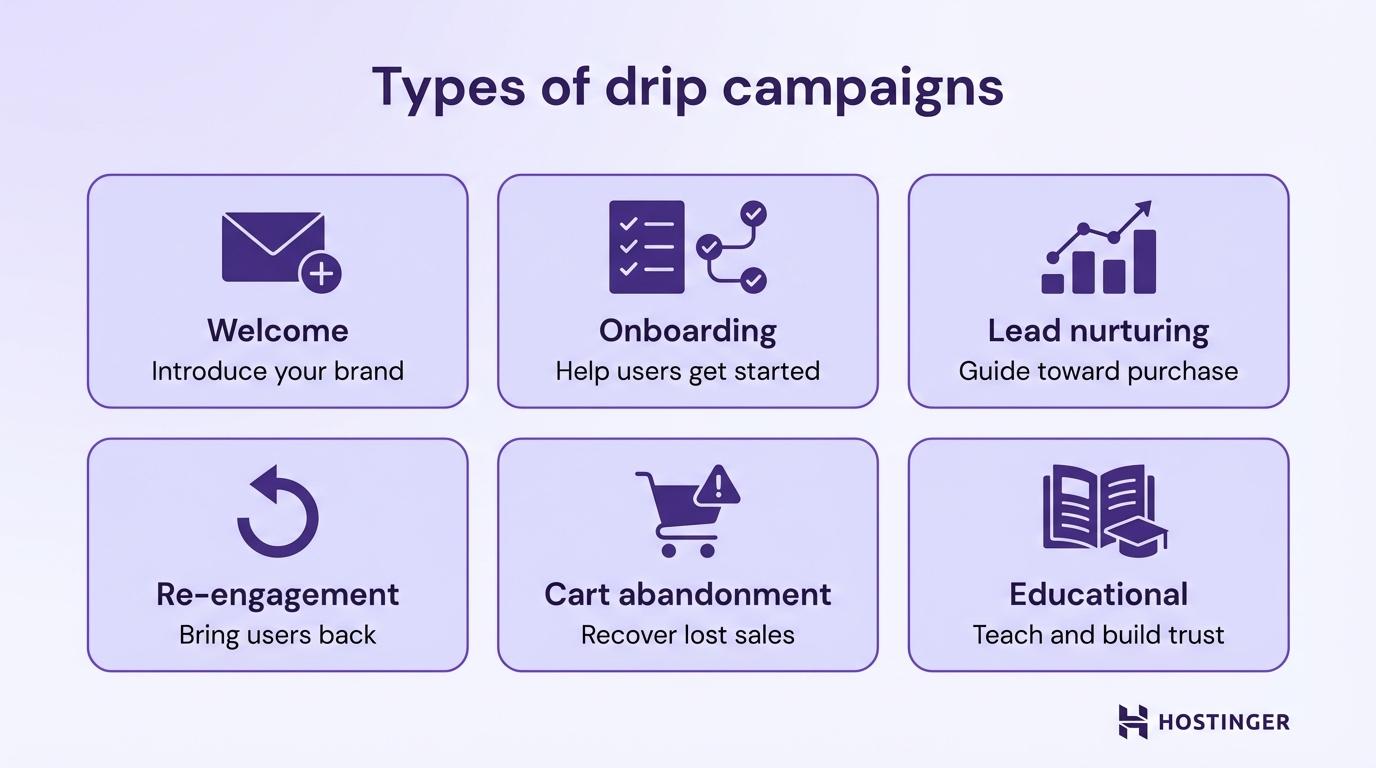
Welcome drip campaign. This goes out the moment someone subscribes or creates an account. You send a thank-you email, introduce your brand, and point them toward a first action, such as exploring a feature or reading a popular post.
A typical sequence looks like this: Day 1, a welcome and thank-you → Day 3, a quick tour of your best content → Day 5, a light suggestion toward a product or feature.
Welcome emails tend to get the highest open rates of any automated email, often above 50%, because the subscriber just signed up and is still paying attention.
Onboarding drip campaign. A welcome series introduces your brand, while an onboarding series teaches people how to use your product. You walk them through setup, point out key features, and share quick tips.
For example: Day 1, a setup guide → Day 3, a tip on a key feature → Day 7, a case study or success story from another user.
The goal is to get them to do something meaningful quickly, like finishing their profile or using a core feature for the first time. People who hit that milestone early tend to keep using your product longer, because they’ve already seen the value.
Lead nurturing drip campaign. Not everyone buys right away. Over days or weeks, you share helpful content, address common concerns, and gradually position your product as the solution.
A simple sequence might be: Week 1, a helpful blog post → Week 2, a comparison guide → Week 3, a free trial offer.
This process is called lead nurturing. People you follow up with over time tend to spend more than those who get no emails at all.
Re-engagement drip campaign. Some subscribers stop opening your emails or logging in. You reach out with a sequence designed to bring them back.
A common flow for this kind of drip campaign is: Email 1, a “we miss you” message → Email 2, a highlight of new features → Email 3, a small incentive like a discount.
If they still don’t respond after three or four emails, it’s usually better to remove them so inactive contacts don’t hurt your open rates or cause your emails to land in spam.
Cart abandonment drip campaign. About 70% of online shoppers abandon their carts before checkout. An abandoned cart email sequence reminds them of what they left behind, sometimes with a small nudge, such as free shipping or a discount.
Here’s what that looks like: 1 hour after abandonment, a reminder email → Day 2, a follow-up with social proof like reviews, ratings, or customer photos → Day 4, a final nudge with a small discount.
These are among the highest-converting automated emails because the shopper already showed interest by adding items to their cart.
Educational drip campaign. Not every drip campaign is about selling. You can teach your audience something useful, like a mini-course, expert tips, or a multi-part guide.
For example, a five-part educational email course might send one lesson per week, each covering a different aspect of a topic your audience cares about. When you teach someone something useful for free, they’re more likely to trust you when you eventually offer something paid.
It works well for businesses with longer buying cycles, because you stay in the reader’s inbox while they’re still deciding whether to buy.
Best practices for drip campaigns
Effective drip campaigns depend on three things: timing, relevance, and testing. Get those right, and your emails drive opens, clicks, and sales.
Space your emails well. As a starting point, two to five days between emails works for most sequences. Welcome series can go faster, even daily, for the first few days. For lead nurturing, five to seven-day gaps work better since the reader needs time to absorb each message.
Pay attention to when your audience opens emails, and adjust your send times accordingly.
Personalize based on what people do. If someone clicked on a product link, the next email should be about that product, not a general update. The closer the match between what someone did and what you send next, the fewer unsubscribes you’ll see.
Give each email one job. One purpose. One call-to-action (CTA) – that’s the button or link you want the reader to click. Emails with a single CTA get much higher CTR than those with several competing links.
Test one thing at a time. Start with subject lines since they affect open rates the most. Then try different email lengths, CTA placements, and send times.
A/B testing means sending two versions of the same email to a small group to see which performs better. It consistently improves your email ROI. ROI stands for return on investment, which is how much revenue your emails generate compared to what you spend on them.
Follow email regulations. Email providers like Gmail and Outlook check whether you follow basic rules, such as including an unsubscribe link, using a real sender address, and only emailing people who gave consent. If you don’t, your emails are more likely to land in spam.
The rules you need to follow depend on where your audience is, not where your business is based. If you email people in the US, follow the CAN-SPAM Act. If any of your subscribers are in the EU, follow GDPR. Canada has CASL.
Use your data to refine the sequence. After your campaign has been running for a few weeks, check which emails get the most opens and clicks, and which ones people ignore.
If email three in your sequence has a 2% open rate, the problem might be the subject line, the timing, or the content. Adjust one thing, watch the numbers, and repeat.
Watch for these three common mistakes:
- Message fatigue – too many emails too fast makes people stop paying attention. If your unsubscribe rate jumps after, say, the fourth or fifth email in a sequence, that’s a sign you’re sending too many.
- Weak segmentation – sending the same sequence to everyone results in most people receiving irrelevant emails. Even basic groupings like new vs. returning, or engaged vs. inactive, help.
- Set-and-forget automation – check your sequences every month or two. Make sure the content still reflects your current product and business.
Go beyond email
Drip campaigns aren't limited to email. You can combine them with SMS messages, push notifications, or social media retargeting. The approach is the same – triggered, sequenced, personalized – but you reach people across more than one channel.
Start your email marketing campaign
Now that you know what a drip campaign is, the different types, and what makes them work, it’s time to set up your first one.
You don’t need a 20-email sequence to start generating opens and clicks. A three-email welcome series or a basic re-engagement campaign is enough. Pick one goal, define your audience, write a few emails, and set your triggers.
To get started, you’ll need a tool that can handle email creation, automation, and managing your contacts. Hostinger Reach does all three on its paid plans.
Once you’re ready, creating an email newsletter is a good first project. It walks you through choosing a platform, writing your content, and sending your first campaign.
All of the tutorial content on this website is subject to Hostinger's rigorous editorial standards and values.

Alma is an AI Content Editor with 9+ years of experience helping ideas take shape across SEO, marketing, and content. She loves working with words, structure, and strategy to make content both useful and enjoyable to read. Off the clock, she can be found gaming, drawing, or diving into her latest D&D adventure.