Do I need a business license to sell online?
Sep 15, 2026
/
By Alma
/
8 min Read

You may need a business license to sell online in the U.S., depending on where your business operates, what it sells, and the rules that apply in your state and locality. There is no single U.S. license required simply because you sell online.
Knowing what applies before you start selling helps you avoid operating without a required license or permit and keeps you from applying for registrations your business doesn’t need. The requirements depend on your location and business activity: federal rules apply to some products and services, state or local rules apply to other businesses, and separate rules cover sales tax and home-based businesses.
Start by identifying where your business operates and what you sell. You’ll also need to distinguish a business license from related tax registrations and business filings, and understand what changes when you sell through an online marketplace or from home.

Do you need a business license to sell online?
It depends. Whether you need a business license to sell online comes down to where your business operates, what you sell, and the rules that apply to your business, not simply on the fact that you sell online.
Federal, state, and local authorities set different requirements based on the activity you’re conducting and where you operate. Check these areas to find out which requirements apply:
- Where your business operates. Licensing requirements vary by jurisdiction, so check the state, county, and city you’re based in. Someone selling handmade jewelry from a home studio in Austin, for example, would check Texas state requirements, Travis County rules, and the City of Austin’s licensing requirements.
- What you sell. Everyday consumer goods like clothing or home decor rarely need special permits. Regulated items such as food, alcohol, firearms, or health products may require federal, state, or local permits. If you’re making and selling baked goods, for instance, your state’s cottage food laws and local health department rules both come into play.
- Whether your work is regulated. Services such as accounting, legal advice, counseling, and real estate may require professional licenses. Check the licensing board for your state and profession.
- Sales tax. If you sell taxable goods and have a sales tax obligation in a state, you may need to register to collect and remit (pass on to the state) the tax. The rules vary by state.
- Whether you work from home. Many cities and counties require a home occupation permit for businesses run from residential addresses. This can come with restrictions on things like inventory storage, signage, and client visits.
One final distinction is important: a business license is separate from your business structure. Forming an LLC or corporation creates a legal business structure, but it doesn’t automatically give you permission to operate in a jurisdiction where a business license is required. You may need both.
Business license vs. seller’s permit and other registrations
A business license, seller’s permit, resale certificate, Employer Identification Number (EIN), and business entity registration serve different purposes. Getting one of these doesn’t mean you also have a required business license or sales tax registration.
Registration | What it does |
Business license | Permission or authorization required by a government authority to conduct certain business activities in a particular jurisdiction |
Seller’s permit/sales tax registration | Registers a business to collect and remit applicable sales tax. The name and requirements vary by state |
Resale certificate | A document used, where allowed, to buy qualifying inventory for resale without paying sales tax at the time of purchase |
EIN (Employer Identification Number) | Identifies a business for federal tax purposes and other federal business matters. It’s issued by the IRS and isn’t a business license |
Business entity registration | Creates or registers a legal business structure, such as an LLC or corporation. It’s separate from licensing |
A common mistake is assuming that forming an LLC or getting an EIN means the business is fully licensed. The LLC creates the legal entity, while the EIN identifies the business for federal tax purposes. You still need to check whether your state or local government requires a separate business license.
A resale certificate is different from a seller’s permit, too. A seller’s permit authorizes you to collect and remit sales tax, while a resale certificate is used to claim a sales-tax exemption when buying qualifying inventory for resale, where permitted by state. Using a resale certificate for personal purchases can result in penalties.
Your EIN is free when you get it directly from the IRS. Avoid third-party services that charge a fee to obtain one for you.
Types of licenses and permits online sellers may need
Online sellers may encounter several types of licenses and permits, depending on their business and location. Not every seller needs all of them.
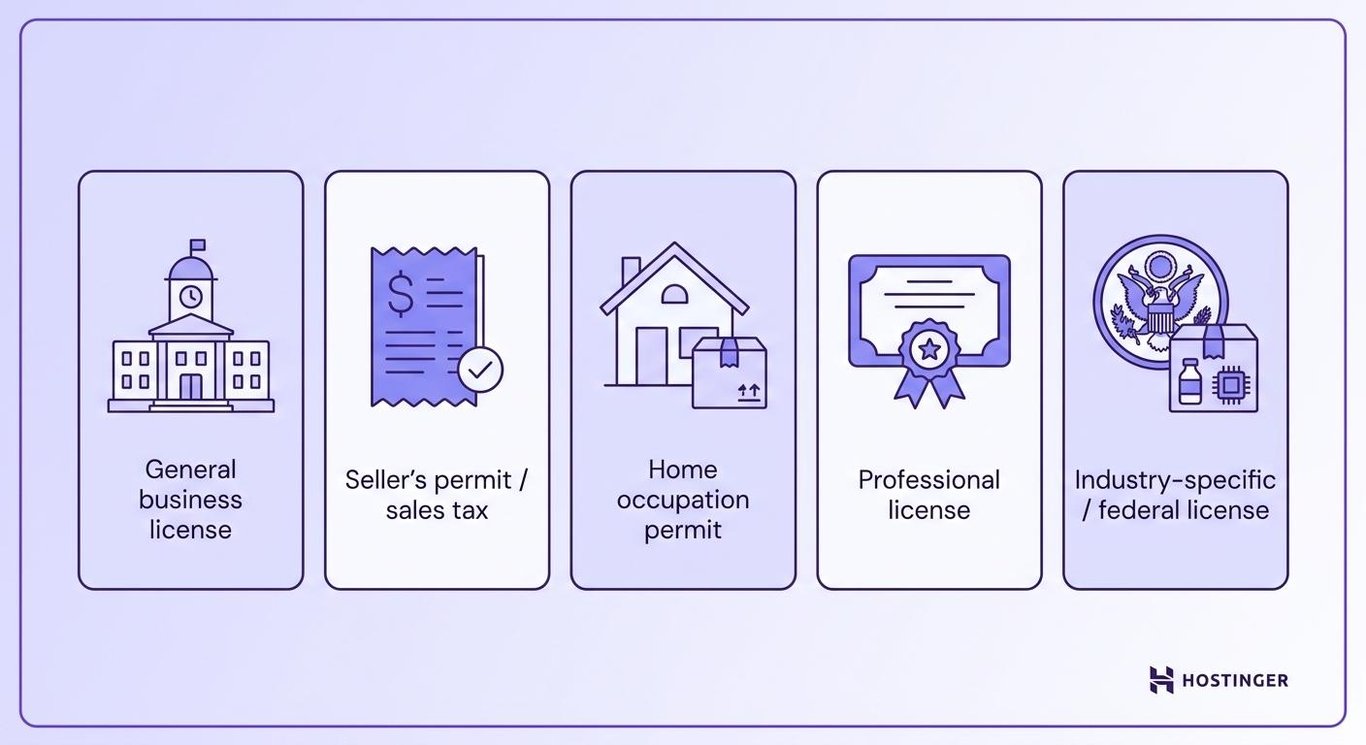
- General or local business license. Your city, county – or, in some states, the state itself – may require one to conduct business in that jurisdiction. A seller shipping custom T-shirts from a home office, for example, would check their city’s business license requirements even though all their sales happen online. Apply through your local government’s website or clerk’s office.
- Seller’s permit or sales tax registration. This applies when you have a sales tax obligation in a state. If you sell taxable physical goods (like clothing, electronics, or handmade crafts), you’ll likely need to register with your state’s department of revenue. The name and process vary by state.
- Home occupation or zoning permit. Many cities and counties require this when you run a business from a residential address to confirm your activity fits the area’s zoning rules. Even a small ecommerce operation packing orders in a spare bedroom can trigger it, with restrictions that commonly cover customer visits, employees on-site, signage, inventory storage, and noise.
- Professional or occupational license. This applies if you offer a regulated service like accounting, legal work, counseling, real estate, cosmetology, or engineering. Your state licensing board issues it regardless of whether you deliver the service online or face-to-face. An online bookkeeper, for instance, needs the same credentials as one working from a traditional office.
- Industry-specific or federal license or permit. Most everyday online businesses don’t need a federal permit, but certain regulated products and activities may require one. Examples include selling alcohol, firearms, or agricultural products across state lines. The U.S. Small Business Administration (SBA) lists every federally regulated activity and the agency responsible for it. Food businesses that prepare, package, or ship products may also need health department permits or FDA registration.
Can you sell online without a business license?
It may be possible to sell online without a business license if no federal, state, or local rule requires one for your business activity. Selling through a website or marketplace doesn’t automatically exempt you from licensing requirements.
The answer also differs depending on the type of activity you’re doing.
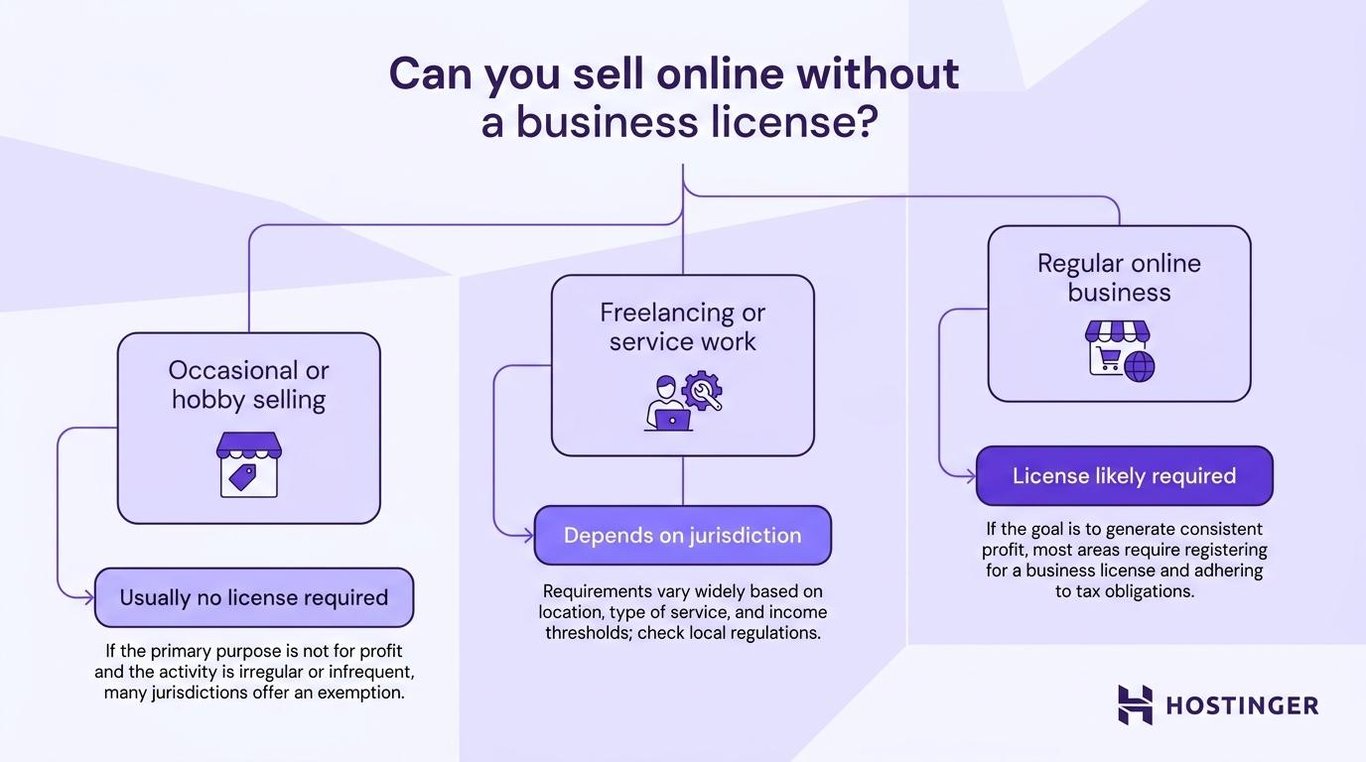
Occasional or hobby selling is one example of an activity where the answer can vary. Clearing out your closet on a resale app a few times a year is different from running a regular online business. For federal tax purposes, whether an activity is treated as a hobby or a business depends on the facts and the applicable tax rules.
For federal tax purposes, the IRS applies a nine-factor test when distinguishing a hobby from a business, covering areas like how you operate the activity, your time and effort, and whether you intend to make a profit.
That tax distinction doesn’t decide whether you need a business license. Your city or state can have its own licensing rules, so check them if occasional selling becomes a regular business.
There’s also freelancing or service work. Freelancers starting an online business around writing, design, or development don’t always need a general business license, but requirements vary by jurisdiction. Regulated services, such as accounting or therapy, may also require a professional license, depending on the service and where you provide it.
Do you need a business license to sell on an online marketplace?
Selling on Amazon, Etsy, eBay, or another online marketplace doesn’t let you skip government licensing. What the platform handles and what the government requires are two separate things.
Marketplaces may collect and remit sales tax on transactions subject to state marketplace-facilitator rules (state laws that shift certain tax-collection duties to marketplaces). They may also verify your identity or business details when you sign up, and restrict or prohibit certain regulated product categories.
None of this means the marketplace has handled every tax or licensing obligation for you. You may still need state or local business licenses, professional licenses, product-specific permits, or business entity registration, depending on your situation.
If you also sell through your own website, social media, or in person, you need to handle sales tax collection on those non-marketplace channels yourself. Check your state’s rules to determine which registrations and permits still apply.
How to get the licenses and permits needed to sell online
Start with your business location, then check the federal, state, and local requirements that apply to your activity.
1. Identify where your business operates
Start with where you’re physically based, because that’s what most licensing rules are tied to.
Write down your business address (even if it’s your home), the city and county it falls in, and the state. If your business is registered in a different state, or you have inventory or employees in more than one location, note those too – you may need to check requirements in each place.
2. Check federal requirements for your products or services
Most online businesses selling ordinary consumer goods don’t need a federal license or permit, but certain regulated products and activities may require one.
Examples include selling alcohol (TTB), firearms (ATF), agricultural products across state lines (USDA), commercial fishing (NOAA), and broadcasting (FCC).
Every federally regulated activity and the agency responsible for it is listed on the SBA website. Scan the list for your product type. If your activity isn’t federally regulated, move on to your state requirements.
3. Check state licensing and tax requirements
Go to your state’s official business portal or department of revenue website. Most states have a “start a business” or “licenses and permits” section that walks you through requirements based on your business type and location. Search for “[your state] business license requirements” or “[your state] licenses and permits” to find the relevant government page.
If your state requires sales tax registration, follow its process for registering to collect and remit sales tax. The registration may be called a seller’s permit, sales tax license, sales and use tax permit, or another name, depending on the state.
If you sell to customers in other states, check whether you have economic nexus, meaning your sales or transactions into that state meet its threshold for a sales tax obligation. Thresholds and calculation methods vary by state.
4. Check city, county, and home-business requirements
Local governments often add their own licensing on top of state rules. Search for “[your city] business license” or visit your city clerk’s website to find out whether your city or county requires a business license or other local permit.
Some cities and counties require a home occupation permit even for online businesses with no customer visits. Check your local zoning and home-business rules to see whether one applies to you. The planning or zoning department handles these, and the application is usually available on the city or county website.
5. Apply for the required licenses, permits, and tax accounts
Fill out the applications and pay any fees once you know what you need. Documentation requirements, costs, and processing times vary by jurisdiction and license type.
If you need an EIN, apply for one free at the IRS website. Corporations, partnerships, and employers generally need one, while some sole proprietors and single-member LLCs do not.
For local business licenses, check whether your city or county takes online applications or requires an in-person visit, and allow time for processing before you plan to launch
6. Track renewals and business changes
Some licenses and permits expire and need periodic renewal. Check the renewal date when you receive each one and set a reminder before it expires.
Check your requirements again whenever your business changes, too. Moving to a new city, selling a new type of product, opening a second location, hiring employees, or expanding into another state can all create new licensing needs.
If your situation involves multiple states, regulated products, or overlapping licenses, check with a local attorney or accountant before you apply.
What happens if you sell online without a required license?
Operating without a required license or permit can lead to penalties, and the seriousness of the consequences depends on your jurisdiction and which requirement you missed.
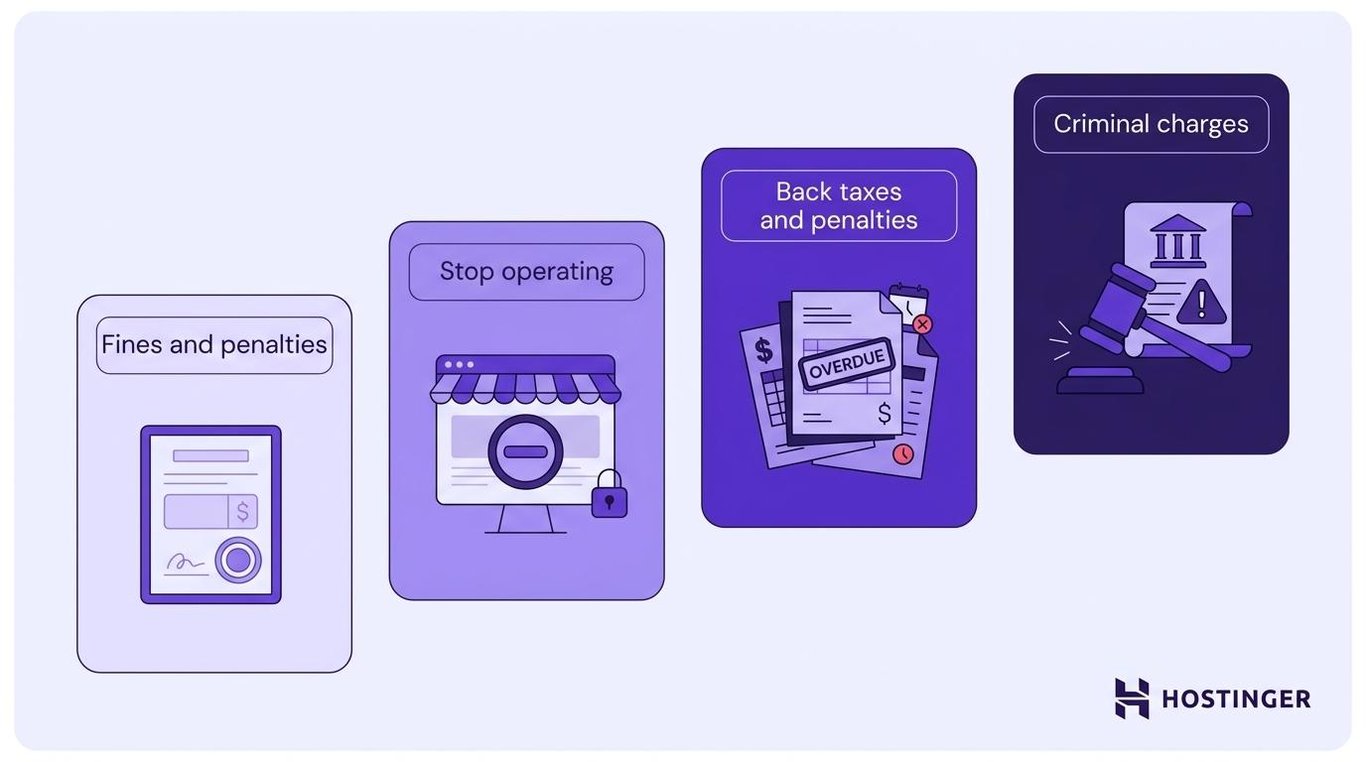
- Fines and penalties. A government agency may charge a fee or impose penalties for operating without a required license or permit. Tax violations can also lead to penalties for the unpaid tax.
- Orders to stop operating. You may have to stop the affected business activity until you become compliant.
- Back taxes and related penalties. If you also failed to register for or collect required sales tax, you may owe unpaid tax, interest, and penalties for the entire period you operated without registration.
- Additional consequences for regulated activities. Violations involving regulated products or professional services can carry more serious penalties, including criminal charges in some cases.
- Renewal problems. Unresolved violations can make it harder to renew existing licenses or obtain new ones later.
Confirm your requirements before launching your store
Before launching, check your requirements at the federal, state, and local levels:
- Federal. Check whether your product or service falls into a federally regulated category.
- State. Check business licensing, professional licensing, and sales tax requirements in your state.
- Local. Check city, county, zoning, and home-business requirements.
Selling through a marketplace may change how sales tax is collected on those transactions, but it doesn’t automatically replace your business licenses or other government requirements.
Once you’ve sorted out the legal side, you’re ready to build the actual store. You can start an online store with a hosting plan, a domain name, and a website builder or a platform like WooCommerce.

Alma is an AI Content Editor with 9+ years of experience helping ideas take shape across SEO, marketing, and content. She loves working with words, structure, and strategy to make content both useful and enjoyable to read. Off the clock, she can be found gaming, drawing, or diving into her latest D&D adventure.