Node.js vs. Flask: Key differences between Node.js and Flask
May 14, 2026
/
Ksenija
/
10 min Read
Node.js is a JavaScript runtime for server-side execution, while Flask is a lightweight Python framework for building web applications and APIs.
Both are used for backend development, but they take different approaches. Node.js focuses on how servers handle requests and scale under load. Flask focuses on how applications are structured and built, especially for simpler or data-driven use cases.
Node.js stands out for its event-driven architecture and non-blocking I/O model. It processes many requests at the same time, which suits real-time applications, APIs, and systems with high traffic.
Flask focuses on simplicity and flexibility. It provides a minimal structure and connects directly to Python’s ecosystem, which works well for APIs, data processing, and machine learning applications.
The table below highlights the key Node.js vs. Flask differences for quick comparison:
Feature | Node.js | Flask |
Type | JavaScript runtime | Python microframework |
Performance | Strong for concurrent and I/O-heavy workloads | Reliable for request-based applications |
Scalability | Handles many simultaneous connections efficiently | Scales with additional processes and infrastructure |
Learning curve | Requires understanding async patterns | Easier to learn with simple syntax |
Flexibility | Full control over architecture and tooling | Flexible, minimal structure |
Ecosystem | Large npm ecosystem across full stack | Python ecosystem, strong in data and ML |
Architecture | Event-driven, non-blocking | Request-response, synchronous by default |
Use cases | APIs, microservices, real-time apps, streaming | APIs, data-driven apps, ML backends, internal tools |
What are the advantages of Node.js over Flask
Advantages of using Node.js over Flask include:
- Non-blocking event loop. An asynchronous, event-driven model allows Node.js to process multiple requests at the same time without waiting for each task to complete. Flask follows a synchronous request model by default, where each request is handled step by step.
- High scalability. A single process can handle thousands of simultaneous connections, making Node.js well-suited for high-traffic systems. Flask can scale, but it usually requires additional setup, such as worker processes and load balancing.
- Full-stack JavaScript. Using JavaScript on both the frontend and backend keeps development consistent and reduces context switching. Flask uses Python on the backend, so teams often work across different languages.
- Strong real-time capabilities. Built-in support for WebSockets and persistent connections makes Node.js a strong fit for chat apps, live dashboards, streaming platforms, and multiplayer systems. Flask can support real-time features, but it depends on extensions and additional infrastructure.
- Large npm ecosystem. Access to npm provides a wide range of packages for APIs, authentication, automation, and integrations. Flask uses Python’s ecosystem, which is strong but more focused on backend services and data-driven applications.
What are the disadvantages of Node.js compared to Flask
This is where Node.js underperforms compared to Flask:
- Callback and async complexity. Managing asynchronous code through callbacks, promises, and async/await increases complexity as applications grow. Flask follows a synchronous model by default, which keeps request handling easier to read and debug.
- Weak for CPU-intensive tasks. A single-threaded architecture handles I/O efficiently but struggles with heavy computations such as data processing or image rendering. Flask can handle CPU-bound tasks more predictably when paired with Python’s ecosystem and multi-process setups.
- Unopinionated structure. The application structure is not enforced, so teams need to define their own code-organizing patterns. Flask encourages a simpler, more consistent structure, making projects easier to maintain.
- Dependency quality issues. The npm ecosystem includes a large number of packages with varying quality and maintenance levels. Flask relies on Python packages, which are generally more curated and stable for backend development.
What are the advantages of Flask over Node.js
Flask offers a simpler, Python-focused development experience compared to Node.js, along with the following advantages:
- Minimal and simple design. A lightweight core keeps setup fast and easy to understand. You start with a small codebase and add only what you need. Node.js projects require selecting and configuring multiple tools before reaching the same baseline.
- Python ecosystem integration. Python’s ecosystem gives Flask-based apps direct access to NumPy, Pandas, and TensorFlow, which handle data processing and machine learning efficiently. Node.js can perform these tasks, but it relies on less established tools, making data-heavy applications harder to build and optimize.
- Gentle learning curve. A clear and readable syntax makes Flask easier to pick up, especially if you already know Python. Node.js requires understanding asynchronous patterns, which adds complexity early on.
- Flexible architecture. You choose how to structure the application and which components to include. Flask stays out of the way and lets you build around your needs. Node.js also allows flexibility, but it involves coordinating multiple libraries and patterns.
- Strong for data-driven apps. Processing datasets, running analytics, and serving machine learning models is easier with Flask thanks to Python libraries like Pandas and TensorFlow. Node.js supports these tasks, but the tooling is less optimized for data-heavy workloads.
What are the disadvantages of Flask compared to Node.js
Flask performs well in many scenarios, but it falls short of Node.js in the following areas:
- Limited scalability for real-time apps. Handling many simultaneous connections becomes harder with Flask’s default request model. Node.js processes thousands of active connections more efficiently, making it well-suited for chat apps, live updates, and streaming systems.
- Lack of built-in tools. In Flask, core features such as authentication, database management, and background jobs require extensions. In Node.js, these features are added through ready-to-use packages that integrate quickly into applications.
- Slower for I/O-heavy tasks. Slower for I/O-heavy tasks by default. Flask 2.0 added async/await support for route handlers, but it requires switching to an ASGI server like Hypercorn – adding setup overhead that Node.js doesn’t need. Node.js handles I/O at the server level without additional configuration.
- Smaller ecosystem. Flask relies on a more focused set of packages within the Python ecosystem. Node.js provides a larger npm ecosystem with a wider range of tools and integrations for different types of applications.
Which is better for performance: Node.js or Flask?
Node.js delivers better performance for I/O-heavy and high-concurrency applications, while Flask performs well in simpler, lower-load scenarios.
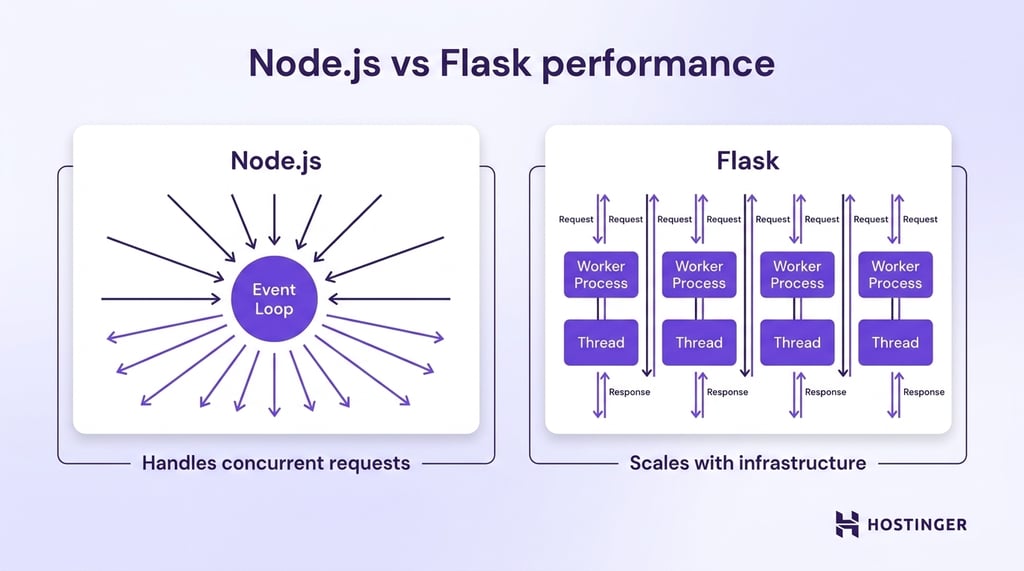
Node.js uses a non-blocking I/O model, allowing it to handle multiple requests simultaneously without waiting for each operation to finish.
When a request involves a database call or a file read, the server proceeds to handle other requests.
Flask follows a synchronous request model by default, though Flask 2.0 added async/await support for route handlers. This allows I/O to be awaited within a single request, but it does not replicate Node.js’s server-wide event loop for handling many simultaneous connections.
APIs that handle frequent database queries, external API calls, or file operations benefit from Node.js, since it keeps the server responsive under load.
Flask handles these tasks in sequence, which can slow down performance as the number of requests increases.
For CPU-bound workloads, such as heavy data processing or calculations, Flask can perform more predictably when combined with Python’s tools and multi-process setups.
Flask still performs well in specific cases. Lightweight APIs, internal tools, and applications with low to moderate traffic run efficiently with minimal setup. In these scenarios, Flask’s simplicity keeps development fast and performance stable.
Verdict: Node.js leads in performance, with more efficient handling of concurrent and I/O-heavy workloads.
Which is better for scalability: Node.js or Flask?
Node.js scales better for applications that need to handle many active connections at once, especially real-time and high-traffic systems.
Its event-driven architecture lets the server keep working while tasks like database queries, file reads, or external API calls finish in the background.
This makes Node.js a strong fit for streaming platforms, chat apps, live dashboards, and services that receive frequent requests from many users.
Flask can scale, but it does so through a different setup. Production Flask apps often use WSGI servers like Gunicorn or uWSGI, multiple worker processes, load balancers, and horizontal scaling across several servers.
This works well for internal tools, admin panels, lightweight APIs, and business applications with predictable request patterns.
Verdict: Node.js is the stronger choice for scalability, especially for high-traffic systems with many active connections.
Which is easier to learn: Node.js or Flask?
Flask is easier to learn, especially for beginners or developers with Python experience.
Flask uses Python, which has a simple and readable syntax. You can build a basic web application with just a few lines of code, and the framework keeps the structure minimal.
This makes it easier to understand how requests, routes, and responses work without dealing with many moving parts.
Node.js has a steeper learning curve due to its asynchronous model. Handling callbacks, promises, and async/await requires understanding how non-blocking code works, adding complexity early on.
The learning experience also depends on your background. Developers familiar with JavaScript may find Node.js more natural, since it extends the same language to the backend. Developers with Python experience can move faster with Flask, since the syntax and concepts stay consistent.
Documentation and community support are strong for both. Flask offers clear, beginner-friendly documentation and a focused ecosystem.
Node.js has a larger community with more tutorials and resources, but the variety of tools and approaches can make it harder to know where to start.
Verdict: Flask is easier to learn, with a simpler syntax and a more straightforward development model.
Which is better for API development: Node.js or Flask?
Node.js is better for building scalable and real-time APIs, while Flask is a strong choice for simple and data-driven APIs.
Node.js supports API development through frameworks like Express, where you define routes and middleware in a modular way. It handles JSON data natively, and request/response handling fits naturally with asynchronous operations.
Flask uses a simpler routing system with decorators, which makes it easy to define endpoints with minimal setup. JSON handling is straightforward in both, though Flask relies on Python data structures and built-in serialization utilities.
The main difference appears in real-time and high-concurrency APIs. Node.js processes many requests at the same time without blocking execution, which suits chat systems, live updates, and streaming APIs.
A real-time notification API or messaging service runs more efficiently in Node.js due to its event-driven model.
Flask handles API requests sequentially by default, which works well for standard request-response patterns but slows down under heavy concurrent traffic.
Flask performs well in data-driven APIs. It integrates directly with Python libraries used for data processing, analytics, and machine learning.
An API that processes datasets, runs models, or returns computed results fits naturally in Flask.
Node.js can build the same APIs, but it requires additional setup and external tools for complex data handling.
Verdict: Node.js is the better choice for API development, especially for scalable and real-time APIs.
Which is better for real-time applications: Node.js or Flask?
Node.js is better for real-time applications due to its event-driven model and built-in support for persistent connections.
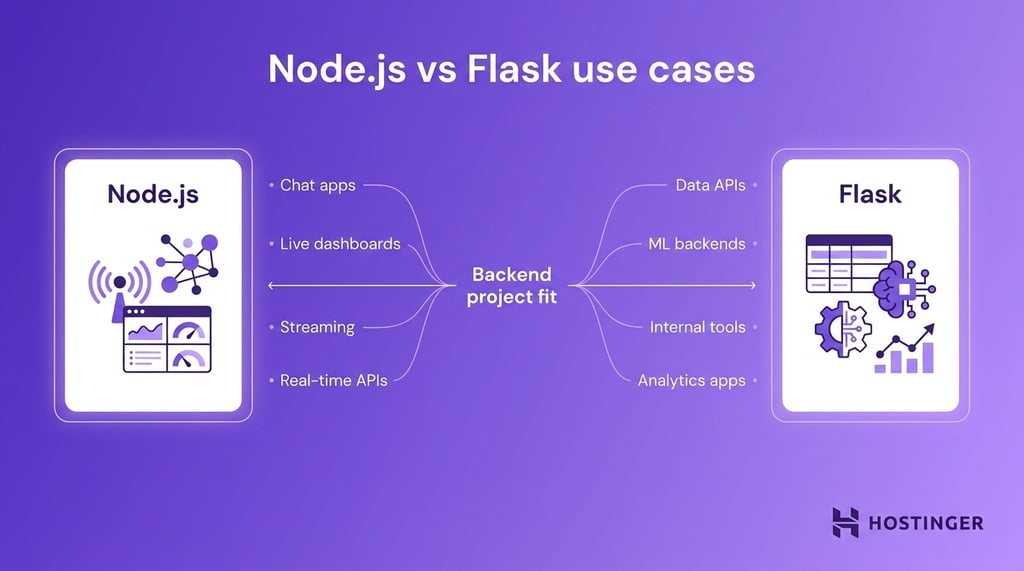
Node.js handles real-time communication through WebSockets, which keep a continuous connection between the client and server. This allows instant data exchange without repeated HTTP requests.
Chat apps, live dashboards, streaming platforms, and multiplayer games rely on this model to deliver updates the moment something changes. A messaging app built with Node.js can push messages to users instantly without polling.
Flask does not provide native support for real-time communication. It follows a request-response model where the client sends a request and waits for a reply.
To build real-time features, you need additional tools such as Flask-SocketIO, message brokers, or background workers. This adds setup complexity and introduces more moving parts into the system.
In Node.js, libraries like Socket.IO integrate directly into the application and handle connection management, broadcasting, and event handling.
In Flask, WebSocket functionality depends on extensions and often requires running a separate server or service alongside the main app.
Verdict: Node.js is the better choice for real-time applications, with direct support for persistent connections and event-driven communication.
Which is better for machine learning integration: Node.js or Flask?
Flask is better for machine learning integration, with direct access to Python’s data science and ML ecosystem.
Flask connects natively to libraries like NumPy, Pandas, scikit-learn, and TensorFlow. These tools handle data processing, model training, and inference efficiently, and they are widely used in production ML systems.
In Node.js, similar tasks rely on wrappers or external services, which adds complexity and limits control over how models run.
The difference shows up in development workflows. In Flask, you can load a trained model, process input data, and return predictions within the same application. This keeps the pipeline simple and reduces integration overhead.
In Node.js, ML workflows often involve calling a separate Python service or using third-party APIs, which introduces extra steps and dependencies.
Flask also fits naturally into model deployment. You can expose a trained model as an API endpoint, handle preprocessing and postprocessing, and return results in a structured format.
Node.js can serve these APIs, but the model itself usually runs outside the application.
Verdict: Flask is the better choice for machine learning integration, with native access to established ML tools and simpler deployment workflows.
Which has a better ecosystem and libraries: Node.js or Flask?
Node.js has a larger and more diverse ecosystem, while Flask benefits from a more focused and mature set of Python libraries.
Node.js uses npm, which includes a vast number of packages covering backend services, frontend tooling, automation, and infrastructure. This makes it easier to find ready-to-use solutions for almost any task, from authentication to real-time communication.
Flask relies on Python packages managed through pip, which offers strong support for web development, data processing, and machine learning, but with a narrower focus compared to npm.
Node.js also stands out in full-stack development. It integrates naturally with frontend frameworks like React, Vue, and Angular, allowing developers to use the same language and share tools across the stack.
Flask focuses on backend development, so frontend integration depends on separate tools and frameworks.
Verdict: Node.js offers a broader ecosystem with more libraries and integrations across the full development stack.
Which is better for deployment: Node.js or Flask?
Node.js is better for modern deployment workflows, while Flask fits more traditional server-based setups.
Node.js applications are commonly deployed using Git-based CI/CD pipelines, Docker containerization, serverless platforms, or modern web app hosting.
A typical workflow connects a Git repository, installs dependencies, runs a build step if needed, and starts the application with a defined command. This approach supports continuous deployment, where each push automatically updates the live app.
Flask applications follow a more traditional deployment model. They usually run behind a WSGI (Web Server Gateway Interface) server such as Gunicorn or uWSGI, combined with a reverse proxy like Nginx.
Deployment involves setting up a Python environment, installing dependencies, configuring the WSGI server, and linking it to the web server. This setup is reliable and widely used for production Python applications.
Node.js runs as a long-lived process, managed by process managers or containers. Flask apps rely on a layered setup, where the application, WSGI server, and reverse proxy work together. This adds more configuration steps and requires more control over the server environment.
Modern hosting platforms significantly simplify Node.js deployment. Platforms that support Node.js web app hosting, such as Hostinger, let you connect a GitHub repository, define build settings once, and deploy automatically on each push, eliminating the need to configure servers, manage processes, or write deployment scripts manually.
Verdict: Node.js is the better choice for deployment, with stronger support for automated workflows, Git-based updates, and modern hosting platforms.

Which should you choose: Node.js or Flask?
Choose Node.js for real-time, high-concurrency applications. Choose Flask for data-driven systems, simple APIs, and Python-based projects.
Start with how your application behaves. If your system needs to handle many simultaneous users, live updates, or constant data exchange, Node.js fits better. It supports chat apps, streaming platforms, real-time dashboards, and scalable APIs where performance under load is critical.
If your application focuses on structured data, backend logic, or machine learning workflows, Flask provides a simpler and more direct path.
Your choice will also depend on whether you’re building a simple app or a more complex system.
Node.js works well for distributed systems, microservices, and applications that grow across multiple services.
Flask suits smaller applications, internal tools, and APIs where clarity and fast development matter more than handling large-scale concurrency.
A big part of the decision is what your team is already familiar with.
A JavaScript-focused team can build faster with Node.js and reuse knowledge across frontend and backend.
A Python-focused team can move more efficiently with Flask, especially when working with data processing or machine learning tools.
You should also consider how your app will scale and evolve. Node.js supports scaling across services and handling high traffic as the application grows.
Flask remains easier to maintain in smaller systems or specialized services, especially when paired with Python’s data ecosystem.
If your use case does not clearly align with either option, it is worth exploring other backend frameworks that may better match your requirements.
All of the tutorial content on this website is subject to Hostinger's rigorous editorial standards and values.

Ksenija is a digital marketing enthusiast with extensive expertise in content creation and website optimization. Specializing in WordPress, she enjoys writing about the platform’s nuances, from design to functionality, and sharing her insights with others. When she’s not perfecting her trade, you’ll find her on the local basketball court or at home enjoying a crime story. Follow her on LinkedIn.