What are ecommerce fulfillment services, and how do they work?
Feb 16, 2026
/
Simon L.
/
18 min Read
Ecommerce fulfillment services are the operational processes that move an online order from checkout to delivery and handle returns.
They cover everything from receiving your inventory and storing it safely to picking the right items when orders come in, packing them properly, creating shipping labels, handing packages to carriers, and processing returns.
It’s important to distinguish fulfillment from logistics: Logistics is the plan; fulfillment is the execution.
If you decide to store inventory in Texas to reach most customers in 2–3 days and negotiate rates with UPS, that’s logistics.
When order #4821 comes in, and a warehouse worker picks two SKUs, packs the box, prints the label, and ships it with tracking, that’s fulfillment.
Who typically uses fulfillment services?
- Direct-to-consumer (DTC) brands selling through their online store.
- Marketplace sellers on Amazon, eBay, and Etsy.
- Subscription box companies shipping recurring orders.
- B2B ecommerce businesses fulfilling bulk orders.
The most common approach is outsourcing to a third-party logistics provider (3PL), which is a company that specializes in storing inventory and shipping orders for multiple clients.
Ecommerce fulfillment services explained
Ecommerce fulfillment services typically include storing your products, processing and packing orders, coordinating shipping with carriers, and handling returns.
In other words, fulfillment services focus on storage and order execution. They don’t handle manufacturing your products, marketing and sales, managing your online store, or customer support—aside from providing tracking and shipment status.
Think of fulfillment services as layers that work together:
- Warehousing. Physical storage space with proper security and organization systems. Your products need a safe home.
- Inventory management. Real-time tracking of stock levels, low-stock alerts, and receiving logs so you know exactly what you have and where it is.
- Order processing. Systems that receive orders from your store, validate them, and route them to the right warehouse for picking.
- Picking and packing. The actual work of finding your products on shelves and putting them in boxes with the right materials.
- Shipping execution. Printing labels, handing packages to carriers, and managing tracking numbers.
- Returns processing. Receiving returned items, inspecting them, restocking what’s sellable, and disposing of what’s not.
- Value-added services. Custom work such as bundling products (kitting), adding inserts, or adding gift notes.
Distributed fulfillment
One powerful feature many 3PLs offer is distributed fulfillment. This is when they store your inventory in multiple warehouses across different regions.
Why does this matter? Shorter distances mean faster delivery and lower shipping costs. Instead of shipping every order from California, you might have inventory in California, Texas, and New Jersey, automatically routing each order to the closest facility.
Common fulfillment terminology
- SKU (Stock Keeping Unit): A unique identifier for each product variant you sell
- Kitting: Assembling multiple items into a single package or bundle
- SLA (Service Level Agreement): Promised performance standards, like "95% of orders ship same-day."
- Cut-off time: The daily deadline for orders to ship that same day
- Dimensional weight: Carrier pricing based on package size, not just weight—this can seriously affect your costs
Ecommerce fulfillment vs ecommerce logistics
People use fulfillment and logistics interchangeably, but they’re different, and knowing the difference helps you understand who’s responsible for what.
Ecommerce logistics is the broader strategy and coordination of moving goods. It includes transportation planning, carrier contract negotiations, network design, demand forecasting, and supply chain optimization.
Logistics is about the “what,” “when,” and “where” decisions. Examples include negotiating shipping rates with DHL and deciding where to locate warehouses based on customer density.
Ecommerce fulfillment is the execution layer. It’s the actual work of receiving, storing, picking, packing, and shipping individual orders.
Fulfillment is the “how” that makes logistics plans real. This involves printing a shipping label for order #4582, picking three products from shelf locations, and packing the box.
Who owns what
- Merchant (you). Product sourcing, pricing, marketing, customer service, and returns policy decisions.
- 3PL provider. Physical warehousing, order picking and packing, shipping execution, inventory counting, and returns inspection.
- Carriers. Physical transportation, tracking updates, delivery confirmation, and claims for lost or damaged packages.
Ecommerce fulfillment services vs Amazon FBA
If you sell on Amazon, you’ve probably heard of Fulfillment by Amazon (FBA). It’s a popular fulfillment option, but it’s not the same as working with an independent 3PL.
Amazon FBA is Amazon’s platform-tied fulfillment service. You send inventory to Amazon’s warehouses, and they pick, pack, and ship orders to customers who buy on Amazon.com.
FBA also makes your products eligible for Prime two-day shipping, which can boost sales.
The catch? FBA is designed for Amazon’s marketplace. If you also sell on Etsy or your own website, FBA doesn’t easily support those channels.
Amazon’s packaging is Amazon-branded, your storage costs follow Amazon’s fee schedule, and you’re subject to storage limits and long-term storage fees if inventory sits too long.
Independent 3PL fulfillment works across all your sales channels, including your online store, Amazon, eBay, and any other channels where you sell.
You get to use branded packaging, set your own customer service standards, and avoid platform-specific storage constraints.
Here are the key decision factors to choose between FBA and 3PL:
- Sales channels. Selling only on Amazon? FBA makes sense. Multi-channel? A 3PL gives you flexibility.
- Branding control. FBA uses Amazon boxes. A 3PL lets you create custom unboxing experiences.
- Storage constraints. Amazon limits storage based on sales velocity. 3PLs offer more predictable terms.
- Returns handling. FBA returns go through Amazon’s process. A 3PL lets you set your own inspection standards.
Want to compare models? Check out our guide on dropshipping vs Amazon FBA.
How ecommerce fulfillment services work
Here’s the fulfillment workflow, from the moment you send inventory to a warehouse until a customer receives their order.
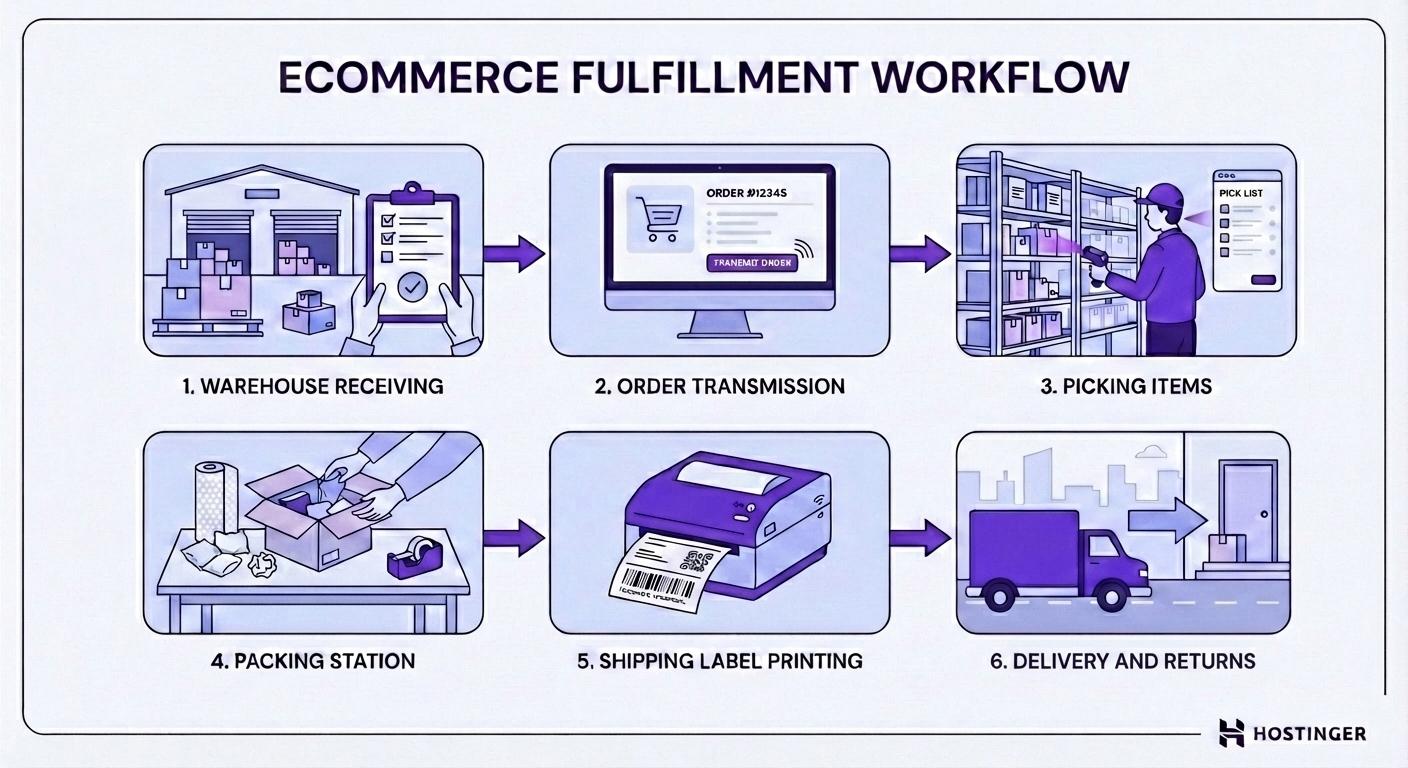
- Inbound receiving and warehousing. You send inventory to the fulfillment center. The warehouse receives it, counts everything, checks for damage, and logs it into their warehouse management system (WMS). Each SKU is assigned to a bin location and stored efficiently, while the WMS tracks exactly how many units are available.
- Order transmission. A customer places an order on your website, and your ecommerce platform sends the order details to the fulfillment center.
- Picking. A picker receives a pick list, walks through the warehouse, grabs each item from its bin, and scans barcodes to confirm accuracy. Good fulfillment centers hit 99.5%+ accuracy rates.
- Packing. Items move to a packing station. A packer selects the right box size, adds cushioning materials, includes any inserts, seals the box, and weighs it. This is where dimensional weight is measured, since inefficient packaging results in higher shipping costs.
- Shipping label creation. The system selects the best carrier and service level, prints a shipping label with a tracking number, and applies it to the box. Many 3PLs have negotiated rates with carriers, passing savings to you.
- Delivery and returns. The carrier picks up packages (usually daily, sometimes multiple times per day), and tracking updates are sent to your store and to the customer. If returned, the warehouse inspects the item and either restocks it, refurbishes it, quarantines it for your review, or disposes of it.
Fulfillment models for ecommerce businesses
There’s no single right way to handle fulfillment. The best model depends on your order volume, product type, margins, and growth trajectory.
Self-fulfillment
You handle everything yourself, including inventory management, order picking, box packing, label printing, and delivering packages to carriers.
Many businesses start by fulfilling orders from home, a garage, or a small office. To get going, you’ll need shelving, packing materials, a shipping scale, a label printer, and carrier accounts.
When self-fulfillment works:
- Shipping fewer than 50 orders per day.
- Simple products with low SKU count.
- Want maximum control over packaging.
- Margins are tight, and you can’t afford 3PL fees yet.
- Still testing product-market fit.
Self-fulfillment is especially common when starting an ecommerce business without funds, since it eliminates the upfront cost of working with a 3PL.
You’re trading your time for money, which makes sense when you’re bootstrapping and need to keep every dollar working for you.
Breaking points that push businesses to 3PL:
- Running out of storage space.
- Spending so much time packing that you can’t work on growth.
- Missing cut-off times for same-day shipping.
- Error rates increase as volume grows.
- Need multi-channel inventory sync, but can’t manage it manually.
Third-party logistics (3PL)
You outsource warehousing and order fulfillment to a specialized company. You send them inventory in bulk, and they handle receiving, storage, picking, packing, and shipping individual customer orders.
Standard services you should expect:
- Warehouse storage with inventory tracking.
- Order receiving and processing.
- Pick and pack operations.
- Shipping label creation and carrier coordination.
- Real-time inventory sync with your store.
- Returns processing.
- Reporting on order accuracy, inventory levels, and costs.
How 3PL pricing typically works:
- Providers charge storage fees per pallet ($15-40/month), per cubic foot ($0.50-2.00/month), or per unit ($0.25-1.00/month).
- Receiving fees run $5-15 per pallet or $0.10-0.50 per unit.
- Pick and pack fees start at $1.50-4.00 for the first item, with $0.25-0.75 per additional item.
- Shipping costs are either actual carrier costs passed through or negotiated rates (usually 10-30% below retail).
- Returns processing costs $2-6 per item.
Service level agreements (SLAs) matter:
Good 3PLs commit to performance standards in writing.
Look for commitments such as 99.5% or higher order accuracy, same-day processing for orders received by the cut-off time, regular cycle counts for inventory accuracy, and clear support response times.
When 3PL makes sense:
- Consistently shipping 50+ orders per day.
- Need multiple warehouse locations for faster delivery.
- Want to focus on growth instead of packing boxes.
- Growing fast and need a scalable infrastructure.
- Selling on multiple channels and need a centralized inventory.
Want help choosing partners? Learn about how to choose vendors for an ecommerce website.
Dropshipping
You don’t hold any inventory. When a customer orders from your store, you forward the order to a supplier, which ships it directly to the customer. You never touch the product.
This completely changes the fulfillment chain:
Traditional fulfillment goes Supplier → Your warehouse → Customer.
Dropshipping goes Supplier → Customer, with you coordinating in the middle.
What you lose control over:
- Packaging (supplier’s packaging, not yours).
- Shipping speed (depends on the supplier’s processes).
- Stock accuracy (you’re trusting the supplier’s inventory data).
- Quality control (can’t inspect before shipping).
When dropshipping fits:
- Testing new products without inventory risk.
- Very limited capital for inventory purchases.
- Okay with longer shipping times.
- Selling commodity products where differentiation isn’t critical.
When dropshipping becomes risky:
- Your brand promises fast shipping, but you can’t deliver.
- Return rates spike because you can’t control product quality.
- Suppliers frequently run out of stock, leaving customers angry.
- You can’t provide accurate tracking or delivery estimates.
If you dropship, be transparent: show realistic delivery windows on product pages (15-30 days, not two to three days), provide tracking info promptly, and set proper expectations about product packaging and return times.
Ready to explore more? Here’s how to start a dropshipping business.
Fourth-party logistics (4PL)
A 4PL doesn’t operate warehouses or ship orders itself – they orchestrate your entire logistics network by managing multiple 3PLs, designing a distribution strategy, and coordinating carriers.
Think of them as a logistics control tower that handles network design, carrier negotiations, technology integration, and performance reporting across all your fulfillment partners.
You’ll know you need one when scaling an ecommerce business to enterprise volume (typically 5+ warehouses, tens of thousands of monthly orders), where coordinating multiple fulfillment partners becomes a full-time job.
Key features to look for in ecommerce fulfillment services
When evaluating fulfillment providers, focus on the practical realities that actually matter in day-to-day operations.
Warehouse locations and coverage
Location determines everything about shipping speed and cost. A package traveling 300 miles costs less and arrives faster than one crossing 1,500 miles.
If most of your customers are in one region and your warehouse is on the opposite side of the country, you’re paying more and delivering slower than you need to.
Common network setups:
- Single region. Works if over 80% of customers are in one region, but limits growth in other regions.
- Bi-regional. Two strategic locations (like opposite coasts) cover most of a large country with ground shipping of one to three days.
- National network (up to five locations). Enables one to two-day ground shipping to most of the country.
- International. Local fulfillment in multiple countries reduces duties, taxes, and shipping times.
Look at your order data from the past three to six months. Where do your customers actually live? If 60% of orders go to California, Texas, and Florida, you want warehouses that cover those markets efficiently.
Questions to ask providers:
- What’s your average delivery time to my top 10 destination ZIP codes?
- What percentage of my orders could ship ground and arrive within 3 days?
- What are your cut-off times at each location?
- Do carriers pick up daily? What about weekends?
Integrations with ecommerce platforms and marketplaces
Manual order entry is a nightmare, so your fulfillment provider needs to communicate directly with your store, and this needs to happen reliably.
Real-time inventory sync prevents selling out-of-stock products, holding back inventory across channels, and making manual inventory adjustments every time you get an order.
Must-have integrations:
- Pre-built connections with your ecommerce platform.
- Real-time inventory sync (not hourly batches).
- Automatic order import (no manual entry).
- Tracking number push-back to your store.
- Exception alerts for failed orders.
To ensure everything runs smoothly, verify that the integration meets your specific needs, especially for complex workflows such as split orders, gift messages, or custom fields.
If you run multiple stores, confirm they can integrate all of them, and ask how often data is updated, as some platforms limit API calls, which can create sync delays.
Questions to ask:
- Do you have a pre-built integration with my platform?
- How often does inventory sync? Real-time or batched?
- What happens if an order fails to import?
- Can you handle orders with custom fields or special instructions?
Shipping options and carrier rate management
Shipping options and carrier rate management determine which carriers you can use, available service levels (ground, express, international), and the rates you’ll pay.
Most 3PLs have negotiated rates below retail carrier costs. They either pass through actual carrier costs with no markup, offer their negotiated volume discounts (usually savings for you), or charge blended rates (flat rates per zone).
Carriers calculate shipping costs based on whichever is higher: the package’s actual weight, its dimensional weight (based on box size), or how far it travels. Using boxes that are larger than necessary increases dimensional weight and raises shipping costs.
For international shipping, you need to clarify who pays duties and taxes, who handles customs documentation, and how international returns are handled.
Questions to ask:
- Do we get your negotiated rates or actual pass-through costs?
- Can you show me rate examples for our typical order profile?
- Do you optimize box sizes to reduce dimensional weight charges?
- What packaging materials do you use, and what do they cost?
Returns processing and quality control
Fast returns processing builds trust, while slow returns processing frustrates customers. But returns aren’t just about customer satisfaction.
They also affect your cash flow, and the faster a return is inspected and restocked, the faster you can resell it or issue a refund.
When a return arrives, the fulfillment center inspects it and decides to:
- Restock if the product is in sellable condition.
- Refurbish if there are minor issues that can be fixed (repackaging, replacing damaged labels).
- Quarantine it for your review or decision.
- Dispose of it if it’s too damaged or unsellable.
You need clear rules about what counts as sellable for your products. A minor scuff might be fine for a $15 phone case, but unacceptable for a $500 luxury item.
Your returns SLA should include inspection turnaround time (within two business days), restock timeframe (inventory updated within 24 hours), and photo documentation for high-value items.
Questions to ask:
- What’s your process when a return arrives?
- How quickly are returns inspected and dispositioned?
- Can you photograph returns before restocking?
- How do we set inspection standards for our products?
- Do you track return reasons so we can identify product issues?
Value-added services
Value-added services (VAS) are services beyond standard pick, pack, and ship.
Common options include kitting (assembling multiple items into a single SKU), subscription box assembly, custom labeling, gift wrapping, inserts (promotional cards, thank-you notes, samples), and FBA prep.
VAS can improve your business by increasing average order value through curated sets, enabling subscription revenue, improving unboxing experience to build brand loyalty, and driving discovery through samples.
On the other hand, VAS introduces operational risk: more touches increase the likelihood of mistakes, complex assembly adds processing time, and complex instructions can be misinterpreted.
If you need VAS, provide detailed documentation including step-by-step instructions with photos, exact packaging specifications, clear quality standards, and physical samples of the finished product.
Questions to ask:
- What value-added services do you offer?
- How do VAS fees work – per hour, per unit, or flat rate?
- How do you handle quality control for complex kitting?
- What’s the turnaround time for VAS work?
Ecommerce fulfillment costs and pricing components
Fulfillment costs depend on order volume, product characteristics, and provider efficiency. The goal is to find the best-value provider rather than the most affordable option.
Cheap fulfillment that ships late or makes mistakes costs more in lost customers than paying for quality.
Typical fee categories
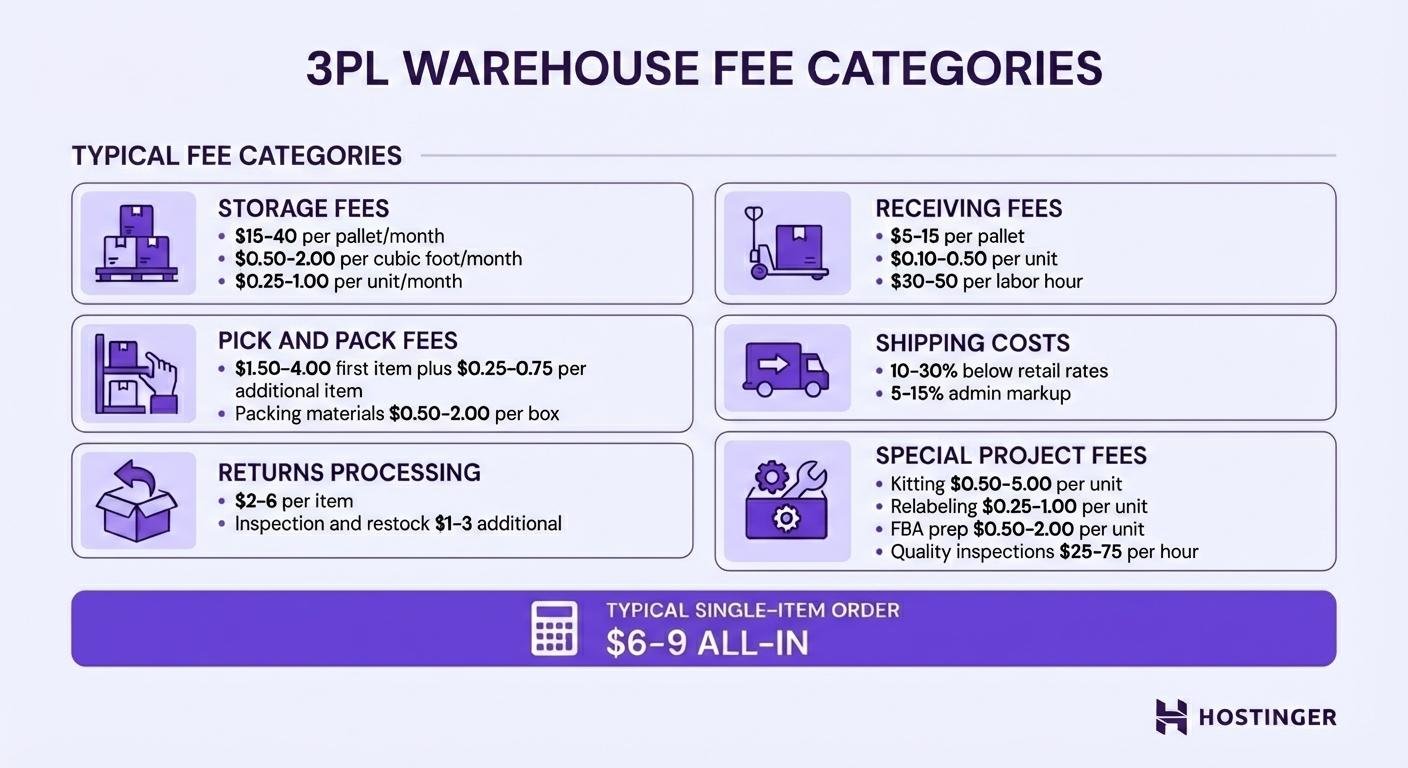
Storage fees: You pay to store inventory in their warehouse. Common methods include $15-40 per pallet per month, $0.50-2.00 per cubic foot per month, or $0.25-1.00 per unit per month. Location, product characteristics (hazmat or temperature control), and how long items sit all influence costs.
Receiving fees: Charged when your inventory arrives, typically $5-15 per pallet, $0.10-0.50 per unit, or $30-50 per labor hour for special handling.
Pick and pack fees: Charged per order shipped, usually $1.50-4.00 for the first item plus $0.25-0.75 per additional item, with packing materials adding $0.50-2.00 per box.
Shipping costs: Either actual carrier costs (transparent) or negotiated rates, usually 10-30% below retail. Most 3PLs add no markup or add 5-15% to cover admin costs.
Returns processing: Receiving and inspecting returns typically costs $2-6 per item, with inspection and restock included or costing $1-3 additional.
Special project fees: Custom work like kitting runs ($0.50-5.00 per unit), relabeling ($0.25-1.00 per unit), FBA prep ($0.50-2.00 per unit), or quality inspections ($25-75 per hour).
What you’ll actually pay
For a typical single-item order with standard packaging shipped ground to a mid-distance destination, expect $6-9 all-in with a good 3PL, including pro-rated storage, pick and pack, and shipping.
Multi-item orders or express shipping will push costs higher, while high-volume accounts often negotiate better rates. The key is understanding your specific order profile rather than optimizing for the lowest per-item fee.
When talking to providers, here are the details you need to have to get accurate quotes:
- Monthly order volume (average and peak).
- SKU count.
- Average units per order.
- Product dimensions and weight.
- Destination mix (percentage domestic vs international).
- Expected return rate.
- Special requirements (for example, kitting or cold storage).
The more accurate your data, the more accurate the quote.
Common hidden costs and contract terms
Monthly minimums: Many 3PLs charge $200-1,000/month regardless of actual volume, or require a minimum number of orders per month. If you’re seasonal or growing slowly, minimums can eat into your margins during slow months.
Long-term commitments: Some contracts require 12-month minimum terms with penalties for early termination, or a 30-90-day cancellation notice. Better contracts offer month-to-month terms or 30-day notice periods.
Seasonal surcharges: Peak season, usually around the holidays, costs more through storage surcharges (20-50% increases September through December), labor surcharges during peak weeks, and carrier surcharges. Ask for peak season pricing upfront so you can budget.
Unexpected billing issues
Beyond these contractual terms, watch for common billing issues that can inflate your costs:
- Inaccurate dimensions (they’ll re-measure and charge you the difference plus fees).
- Minimum box size charges (charged for a medium box even if a small one is used).
- Extra touches (special handling beyond standard pick/pack gets billed separately).
- Label fees (some charge per shipping label printed).
- Surprise carrier surcharges passed through without warning.
Contract checklist before signing
Read the contract carefully and verify these terms before committing:
- All fee categories clearly defined.
- Monthly minimums and duration.
- Cancellation terms (notice period, penalties).
- Peak season pricing in writing.
- What fees can change without notice?
- Sample invoice showing all line items.
- Who pays for damaged inventory?
- Ownership of negotiated shipping rates if you leave.
How to choose ecommerce fulfillment services
Choosing the right fulfillment provider is about finding the one that fits your specific requirements, budget, and growth trajectory.
Here’s a practical framework.
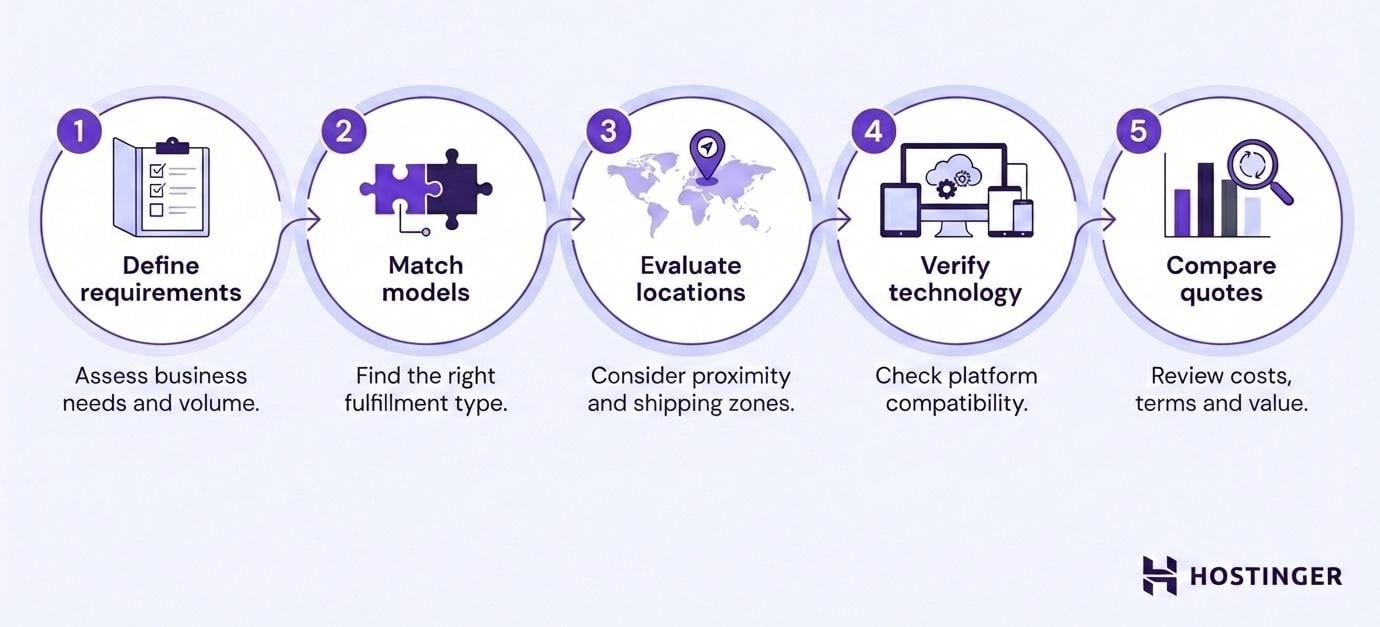
1. Define your fulfillment requirements
Before you talk to any providers, document exactly what you need. Write down your average daily orders (current average and peak day volume) and expected growth.
List your SKU count and product characteristics, such as size, weight, fragility, temperature requirements, or hazmat needs.
Note any special handling requirements, packaging needs, and target ship times (same-day, next-day, or two-day).
Define service requirements:
- Do orders need to ship same-day if received by the cut-off?
- Do you need weekend fulfillment?
- Will you ship internationally?
- How fast do returns need processing?
- What reporting do you need and how often?
Document your channel requirements:
- Which DTC platforms (WooCommerce, Magento, custom)?
- Which marketplaces (Amazon, eBay, Etsy)?
- Do you have B2B orders needing different handling?
- Do you run subscriptions with scheduled shipments?
2. Match the right fulfillment model
Based on your requirements, decide which model fits.
Choose self-fulfillment if you’re shipping fewer than 20-50 orders per day, have storage space and time to pack, need absolute control, or have margins too thin for 3PL fees right now.
Choose 3PL fulfillment if you’re consistently shipping 50+ orders per day, need multiple warehouse locations for speed, want to spend time on growth instead of packing, or sell across multiple channels and need centralized inventory.
Choose dropshipping if you’re testing products, have limited capital, or you’re okay with less control over packaging and quality.
You can also consider hybrid models: best-sellers go with 3PL while testing other products with dropshipping, or self-fulfill for local orders while using 3PL for distant orders.
3. Evaluate warehouse locations and delivery speed
Start by looking at your last three to six months of order data to understand where your customers actually are. Calculate what percentage of orders go to each region or state and identify your top 20 destination ZIP codes.
Next, validate speed claims by giving providers your top destinations and asking them to show transit maps from each warehouse. Calculate what percentage of your orders would arrive in one, two, or three days, then compare that to your shipping promise.
Find out about carrier pickup schedules (daily or multiple times per week) and weekend handling (most don’t process Saturdays or Sundays).
Finally, test their service claims with sample orders. Ask: “If I sent you an order at 10 am on Tuesday to ZIP code 90210, when would it arrive?”
Do this for several important destinations to see real-world performance, not just theoretical transit times.
4. Verify technology, integrations, and reporting
Fulfillment relies on software working smoothly, and if it doesn’t, you’ll spend hours on manual fixes. Before you commit to a provider, ask them to show you their system in action.
Request a demo showing live inventory views in their portal, how an order flows from your store to their system, where you’d see order status and tracking, and how you’d handle exceptions like wrong items shipped.
Ask about the reports you’d receive and how often, how you’d add new products or update SKU data, and what alerts you’d receive for low stock or delays.
If they can’t demo these basics or the system looks clunky, that’s a red flag.
Here are the key systems you need to see:
- Customer portal with real-time visibility.
- Warehouse management system tracking every movement.
- Integration platform connecting your stores.
- API access for custom workflows.
These are the must-have reports:
- Order accuracy rate (percentage shipped correctly).
- On-time shipment rate.
- Inventory accuracy from cycle counts.
- Inventory aging (what’s sitting too long).
- Return reasons.
- Cost per order (fully loaded).
- Exception reports for failed orders or shipping issues.
5. Compare quotes using the same assumptions
You’ll get wildly different quotes if you’re not comparing apples to apples.
Start by creating a standard order profile to use with every provider:
- Order A with 1 item, small box, 14 oz (400g), ships to a nearby region.
- Order B with 3 items, medium box, 2.2 lbs (1kg), ships to a distant region.
Provide identical assumptions to all providers, such as the same monthly order volume, SKU count, storage needs, destination mix, return rate, and special services. This ensures you’re comparing the same scenario across the board.
Don’t just compare pick-and-pack fees in isolation – you need the true total cost per order to make an informed decision. Request “all-in cost per order” that includes storage, receiving costs, pick-and-pack fees, average shipping cost, returns processing, and account fees or minimums.
Once you have the details, score each provider on:
- Cost. All-in cost per order at current and projected volume.
- Speed. Delivery times to your top markets.
- Accuracy. Track record – ask for references.
- Technology. Integration quality and reporting.
- Scalability. Can they grow with you?
- Support. Responsiveness during evaluation predicts ongoing support.
The best choice balances cost, speed, and reliability for your specific needs. Don’t optimize for just one variable, like cost, since cheap fulfillment that ships late costs more in lost customers than paying for quality.
Once you’ve narrowed it to the finalists, get everything in writing: a complete fee schedule with exact rates, contract terms (length, minimums, cancellation), SLAs (order accuracy, same-day ship rate, support response time), peak season pricing, and an escalation process.
Common mistakes when using ecommerce fulfillment services
Even with a great provider, things can go wrong if you don’t manage the relationship well.
Misaligned SLAs and unclear ownership
Without clear ownership, customers email both you and the 3PL, getting conflicting information. Orders ship late, but there’s no clear SLA for on-time delivery, so you can’t hold anyone accountable.
The fix is to document who owns what in writing.
You’re responsible for maintaining accurate SKU data, providing inventory forecasts, handling customer service inquiries, managing return policy decisions, and providing packaging specifications.
Your 3PL is responsible for accurate inventory counts, same-day shipping for orders received by cut-off, 99.5%+ order accuracy, returns inspection within two business days, and providing tracking numbers within one hour.
Create an ownership map document that specifies who is responsible for each scenario, including contact names, response timeframes, and approval thresholds.
Review it quarterly to update contacts, adjust processes based on what’s working, and address any gray areas that have caused confusion.
Poor SKU data and packaging specifications
If you list a product as 8 ounces (225g) when it’s actually 14 ounces (400g), the 3PL uses the wrong box size, pays dimensional weight penalties, and bills you for the difference.
If you wanted branded tissue paper in every box but didn’t specify it, orders go out in plain packaging, and customers notice.
What you need to do is maintain a detailed SKU master file with photos.
For every product, include the SKU code, product name, exact dimensions and weight, fragility level, special handling requirements, case pack quantity, and barcode.
For packaging, specify the box size, required cushioning materials, inserts to include, branded materials, gift options, and any special instructions.
Provide photos of the correct packing configuration, the finished packed box (inside and outside views), and any branded materials. Update this file every time you add a product or change packaging.
Underestimating returns and reverse logistics
Without clear standards, everything gets quarantined, and refunds take weeks because you’re manually reviewing photos.
Or the 3PL restocks everything automatically, and you discover you’ve been reselling damaged products, creating even more returns.
To address this, set clear return rules and inspection standards upfront.
Define your return window (30, 60, or 90 days), condition requirements (unopened, gently used, no restrictions), who pays return shipping, refund timing (immediate or after inspection), and restocking fees.
Create inspection standards:
- Restock if the packaging is unopened or minimally disturbed with no visible damage.
- Refurbish if there’s minor packaging damage or missing cheap accessories.
- Quarantine if there’s moderate damage needing your decision.
- Dispose if there’s severe damage or the refurbishment cost exceeds the value.
Monitor return rate, return reasons, restock rate, days to restock, and cost per return. These numbers reveal patterns that help you spot product quality issues, identify misleading descriptions, catch size chart problems, and understand the true cost of your returns process.
If any metric spikes suddenly, investigate immediately, as it’s usually a signal that something’s wrong upstream.
How to set up a fulfillment plan for your online store
You’ve learned the models, the costs, the evaluation criteria, and the common mistakes. Now let’s turn that into action.
Here’s what your workflow looks like:
- Document your requirements. Write down your average and peak daily orders, list every SKU with dimensions and weights, define target ship times, note which platforms you sell on, and specify any custom services needed, such as kitting or branded packaging.
- Choose your model. Decide between self-fulfillment, 3PL, dropshipping, or hybrid based on your current volume, then set a trigger to transition, like “move to 3PL at 50 orders/day”.
- Shortlist providers. Identify several providers with warehouses in the right locations, check they integrate with your platform, confirm they serve your industry and order profile, read reviews, and ask for references.
- Request quotes. Send identical requirements to each provider, and request a full fee schedule and an all-in cost-per-order estimate. Get contract terms and SLA commitments in writing, and request sample reports and portal access. Then score each on cost, speed, technology, and support.
- Negotiate and select. Narrow to the top two choices, negotiate on onboarding fees, SLA commitments, contract flexibility, and account management inclusions. Choose your provider and sign.
- Onboarding and testing. Set up integrations and test order flow, send initial inventory shipment, document SKU specifications and packaging requirements. Place test orders, verify accuracy, and confirm reporting is working. Don’t launch to real customers until you’ve tested thoroughly.
- Launch and monitor. Go live and watch closely for the first few weeks. Track order accuracy rate, on-time shipment rate, customer complaints about delivery or packaging, and cost per order versus projections. Have weekly check-ins with your account manager for the first month, then move to monthly or as-needed.
Align fulfillment with storefront messaging
If you’re just starting out, learn how to launch an online store to get the basics right first. At every stage of growth, one rule stays constant: your fulfillment capabilities need to align with what you promise customers.
If you promise two-day shipping on your site, make sure your 3PL can actually deliver that. If you can only do three to five days reliably, say so.
If returns take five business days to inspect and restock, don’t promise instant refunds.
If you’re adding international fulfillment, update product pages with delivery estimates and duties info.
Fulfillment isn’t glamorous, but it’s the backbone of customer satisfaction in ecommerce. Get it right, and you’ll build trust, reduce costs, and free yourself to focus on growth.
Get it wrong, and you’ll spend your days apologizing to angry customers. Choose wisely, document everything, and don’t be afraid to change providers if they’re not delivering on their promises.
All of the tutorial content on this website is subject to Hostinger's rigorous editorial standards and values.

Simon is a dynamic Content Writer who loves helping people transform their creative ideas into thriving businesses. With extensive marketing experience, he constantly strives to connect the right message with the right audience. In his spare time, Simon enjoys long runs, nurturing his chilli plants, and hiking through forests. Follow him on LinkedIn.