How to sell courses online: From pricing structure to marketing courses for maximum profit
Mar 10, 2026
/
By Wanda C.
/
17 min Read

With the continuous growth of the online learning industry, selling online courses is a flexible and practical way to make money online.
Such a business model doesn’t require a high upfront cost to get started. There are numerous topics to teach, from fundamental information like personal finances to specific subjects like website creation and programming.
If you’re an entrepreneur, selling online courses can also help you increase brand awareness, build authority, and get more clients.
This tutorial will offer a complete guide on how to sell courses online. We’ll start by covering the essential steps, such as creating online courses, setting a pricing structure, and marketing your course, followed by some helpful tips to increase your course sales.
How to sell online courses – Video tutorial
Wish to watch a video instead? Discover easy-to-follow ways to sell online courses by watching our video tutorial.

1. Create an online course
Before selling online courses, it’s important to understand the basics of creating an online course. Doing so will ensure that the course information is relevant and desirable to your target audience.
Follow these steps to create an online course that sells:
Step 1 – Select a profitable course topic
Here are some factors to consider when choosing an online course topic:
- Target audience. You want to meet the interests and needs of your students. Identify why people should be interested in your course in the first place. Run a search engine query or ask people within your network what they would like to learn.
- Market demand. Examine what other course creators do with the topic, like how much they charge for the courses and their enrollment rate. Look through competitors’ content outlines and identify any information gaps you can fill in. This will help to develop your course’s unique selling point.
- Passion and expertise. Pick a topic you are truly passionate about and confident sharing with others. Consider your area of expertise and industry knowledge. For example, those with a computer science degree can create courses on how to start a side hustle business in the tech industry or simply teach introductory programming courses.
Step 2 – Establish a clear and compelling learning outcome
People join online courses because they’re looking for a solution to address their pain points or reach a specific goal. That’s why providing this information upfront will ensure your audience knows exactly what to expect from your courses.
An effective course-learning model consists of the following components:
- Specific. Explain what students can do or provide practical examples after completing the course.
- Measurable. Determine the success of your course using assessment methods like quizzes, exams, and projects to evaluate student performance and progress.
- Achievable. Avoid setting unrealistic goals beyond the given resources and students’ capabilities.
- Relevant. It should be aligned with the overall goals and objectives of the course.
- Time-bound. Course creators should specify a timeframe for achieving the course objective.
Here are some examples of effective course-learning outcomes:
- By the end of this course, students will be able to analyze and interpret data using statistical software and communicate their findings in a written report.
- Upon completing the course, students can design and implement a marketing campaign for a small business using various digital marketing tools and strategies.
- After completing this course, students can create a basic web application using HTML, CSS, and JavaScript and deploy it to a hosting platform.
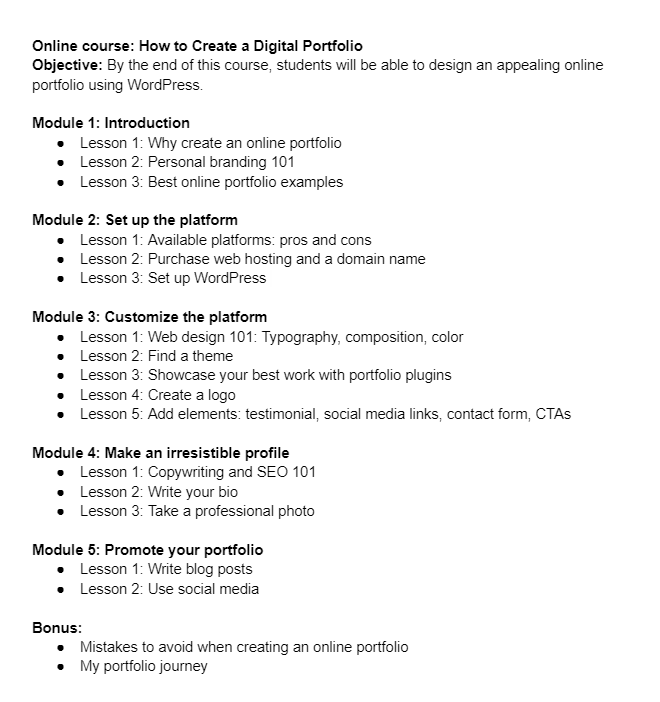
- By the end of this course, students will be able to design an appealing online portfolio using WordPress.
Make a solid course plan
Once your topic and the course learning objectives are determined, it’s time to plan your online course’s structure and presentation.
Here are a few elements to consider:
- Course outline. Having a clear structure from the beginning will ensure that your students can follow along and stay engaged until the end of the course. Identify subtopics within your course subject matter and break them into individual lessons.
- Course length. Ensure the course length covers its objectives and is realistically manageable for the students. Recent research shows that the ideal timespan for online courses typically lasts between 10 and 25 hours, depending on their complexity and depth.
- Course type. Decide which course type is best suited to your audience and course outline. Short courses and masterclasses are great for testing the demand of the course before committing to a full-length course. On the other hand, membership sites are suitable for course creators who want to create a sustainable business model and build a community for their online courses.

Create engaging course material
The final step involves producing course content that provides students with a cohesive and effective learning experience.
Creating effective content requires a strong ability to organize information into digestible learning modules and an engaging format that effectively and compellingly communicates complex topics.
Coming up with course material for your online course can be challenging, but it doesn’t have to be. Start by looking at existing content you’ve created, such as blog posts, articles, and YouTube videos, and turn it into your course material.
Alternatively, look at current popular content within your niche and use that as a starting point for creating your course learning material. Podcasts, webinars, and even interviews with field experts help develop content ideas.
Using the information gathered from previous steps, decide on the delivery and format of your content, such as videos, PDF guides, and audio recordings.
Choose a format that provides the best clarity for students and effectively communicates all the knowledge you will share. Explore and combine all the available formats to increase student engagement and enhance learning opportunities.
To learn more about creating online courses, check out our complete guide on online course creation.
2. Write a captivating course title
The title is one of the most important elements when creating successful online courses.
Considering your course title will be the first thing prospective students come across, it should be captivating and well-written to spark people’s interest and encourage sales.
Here are some tips to keep in mind when writing a course title:
- Keep it clear and concise. An effective title should quickly communicate what your course entails. Avoid using jargon or complex terms that can confuse new students. For simplicity, keep it under 50 characters.
- Make it specific and result-oriented. A title that is too general will be less attractive than one that targets a particular niche and audience. For example, you could use “Web Design Basics: From Concept to Getting Your First Client” instead of “Learn Web Design”.
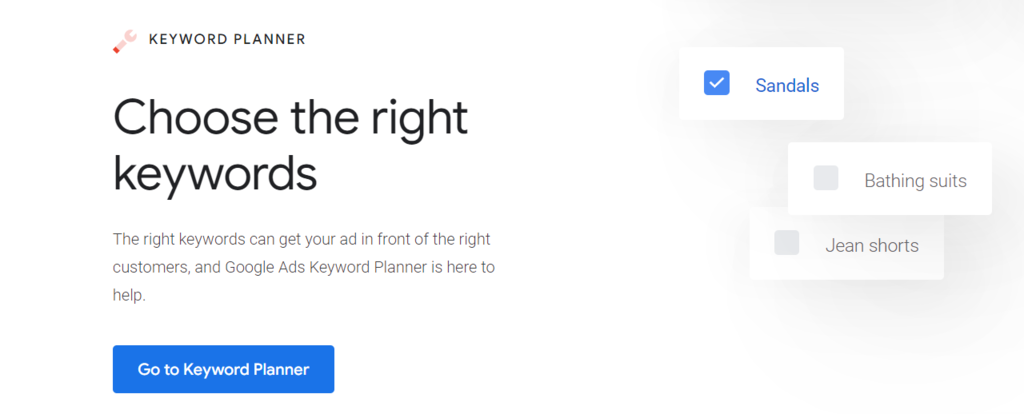
- Add relevant keywords. Use tools like Google Keyword Planner or Ahrefs to discover popular phrases related to your topic and add them to your course title to help make it more visible online.
- Be persuasive. Include strong words in your title to trigger an emotional response in the reader. Some effective words to use are “transform”, “effective”, and “proven”.
3. Choose the right selling platform
A significant aspect of making the online course business profitable is finding the right place to sell it.
By choosing the right platform, you can ensure that students will have access to your content quickly and reliably, allowing them to access your lessons easily.
Additionally, by having a platform tailored specifically to online courses, you can maximize engagement and optimize results by providing an interface designed with great user experience in mind.
When choosing a platform for selling online courses, it is important to consider such factors as cost, hosting options, delivery methods, scalability, and features.
Below are a few options for selling your courses online.
Online course platform
Online course platforms are designed to help course creators and educators build and grow their online course businesses by providing tools and features to support course creation, marketing, and sales.
Below are some of the popular online course platforms available:
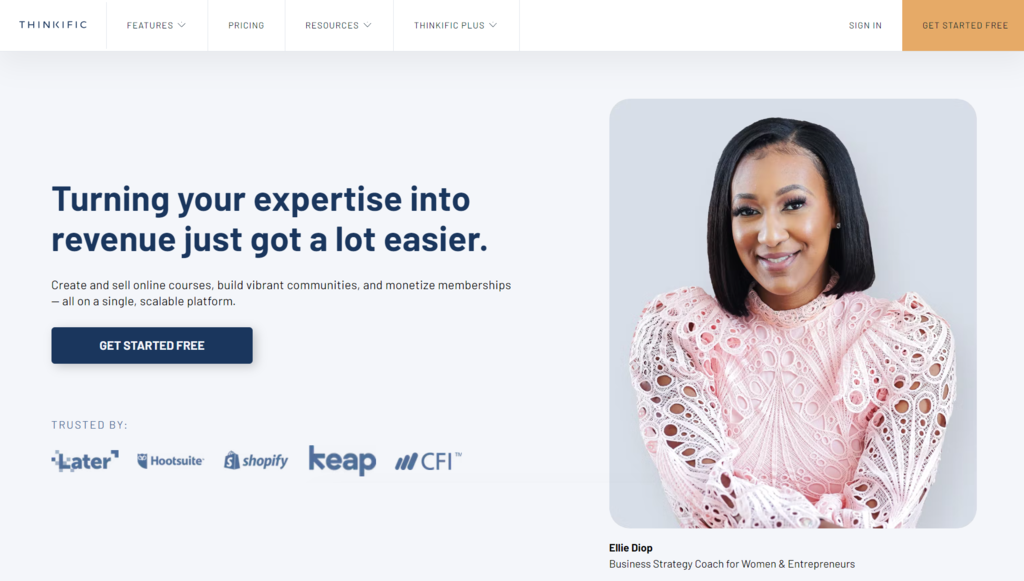
- Thinkific. One of the best platforms to create and sell online courses. Its notable features include a landing page builder, integration with popular marketing tools, and advanced analytics and reporting features.
- Podia. Best all-in-one platform for creating and selling online courses. It boasts a set of course creation features, from marketing tools such as email marketing and affiliate programs to unlimited video hosting.
- Teachable. A platform of choice for beginners who want to create their first online course, as it offers a straightforward setup process and affordable pricing.
- Whop. An all-in-one platform where creators can host courses, manage communities, and sell digital products. You can engage members through built-in chat and livestreams while selling via your own storefront or the Whop marketplace. The pay-as-you-go model makes it a low-risk way to launch and scale a business.
- Kajabi. Using this platform, managing course content, setting prices, and collecting payments is an easy process. The platform is best known for its marketing automation feature that simplifies promoting online courses. It also has an ecommerce functionality that allows creators to sell digital products.
- LearnWorlds. A feature-packed course creation platform for seasoned course creators looking to scale up their businesses. Its notable features include customizable sales pages, advanced built-in analytics tools, and a white-label mobile app builder.
Self-hosted online course website
Using your own personal website is the best option for online course creators wanting to maximize profits and maintain complete control over their course content.
By selling courses directly from the website, creators can keep a larger percentage of the revenue and have full control over the design and delivery of their classes.
In addition, self-hosted websites provide greater flexibility in pricing, course format, and marketing strategies.
One downside is that it can be slightly pricier than other options since you’ll need to purchase a hosting service and get a domain name. Additionally, promoting and marketing your course can be more challenging when you don’t have the benefit of a larger platform.
There are many alternatives for building your online course website. One option is using a popular content management system (CMS) like WordPress, which is ideal for creating a wide range of websites, from online portfolios to large ecommerce sites.
However, using WordPress requires a basic understanding of HTML and CSS, especially when building websites with complex layouts.
If you prefer to build a website for your online course without the use of code, Hostinger Website Builder is an excellent option. It features an intuitive drag-and-drop editor that makes creating and customizing website design easy.
The following are some benefits of Hostinger Website Builder:
- Included in all Hostinger’s hosting plans. It eliminates the need to purchase a separate hosting plan for your website. You can access the website builder by purchasing one of our hosting plans.
- Built-in SEO features. Aside from an SEO-friendly site design, users can easily tweak SEO metadata such as page titles, meta descriptions, hyperlinks, and images’ alt text without installing plugins or third-party extensions.
- Responsive design. Using the website builder, your site content will automatically adapt to any screen size, including desktops and mobile devices. In addition to offering a great user experience, this will drive more traffic to your site.
- Advanced security. It has free unlimited SSL certificates to encrypt connections and Cloudflare nameservers to safeguard user data against hackers, as well as improve website speed and performance.
- All-in-one ecommerce solution. The website builder’s Business plan is specifically designed to help users set up and manage an online store. It offers several customizable templates optimized for ecommerce sites and built-in features such as product reviews, order tracking, and inventory management. All features are available for free at no commission.
- Integrated advertising tools. Hostinger Website Builder packs a range of tools for running paid ads straight from its dashboard. It includes Google Ads app that allow users to easily run and manage Performance Max campaigns, as well as Google Adsense, Facebook Pixel, and others.
If you’re unsure what your online course website should look like, here are some of the best resources to find design inspiration:
- Other courses sites. Check out the websites of popular online course providers, such as Coursera, Udemy, and Skillshare, to see what their websites look like and what features they include.
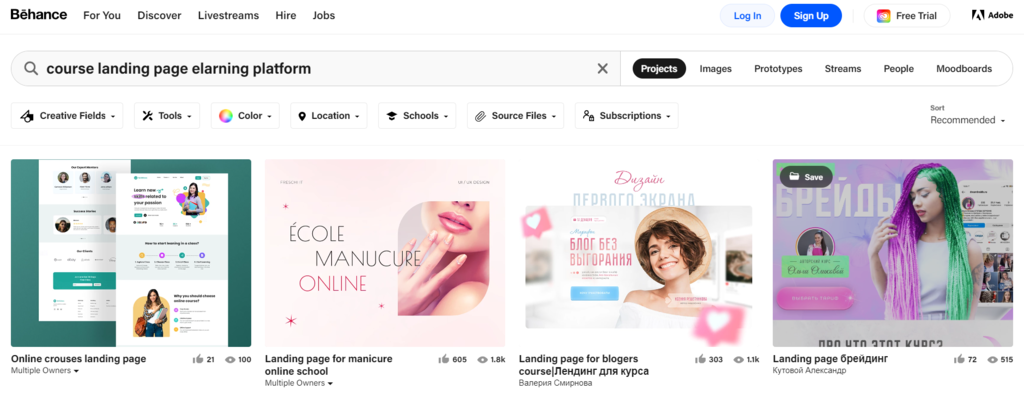
- Creative and portfolio sites. Websites like Behance, Dribbble, and Siteinspire showcase some of the best web designs worldwide. You can browse through different categories and find inspiration for your website.
- Web design blogs. Many web design blogs, such as Webdesigner Depot, Smashing Magazine, and WebdesignTuts+, feature articles, tutorials on web design, and galleries of beautifully-crafted websites.
- Social media platforms. Instagram and Pinterest also can be great sources of inspiration. Search for keywords like “online course design” and “online learning websites” to find designs and layouts that inspire you.
- Online education sites. The design of universities, colleges, or other education centers can also be a great source of inspiration.
Remember that the most important thing when designing a website is to ensure it’s user-friendly, easy to navigate, and visually appealing. This will help you reach wider audiences and deliver your message effectively.
Online course marketplace
Another option is to list your course on online course marketplaces. With minimal marketing effort, these platforms can get your course in front of millions of potential students. Plus, they provide access to feature-rich tools that simplify creating and selling your online courses.
Some of the most popular online course marketplace platforms include Udemy and Skillshare. Both provide everything online course creators need to build and sell their courses, including tools for creating engaging content, processing payments, and handling customer support.
4. Create a pricing structure
In order to sell courses online and earn a profit, it is essential to set a perfect pricing structure. Online courses can sell for different price points, anywhere from $10 to $50 for short courses and up to $100 or $1,000 for a full-length course package.
The key is determining the most attractive pricing type to the prospects while still offering enough value for your efforts.
In this section, we’ll discuss some factors that go into setting a profitable online course price:
- The course’s value. Define the outcome the audience should achieve by taking your course and how much they would be willing to pay for that value. Online courses that help people advance their careers or get a raise typically cost more than one that teaches a single skill.
- Target audience and course topic. Consider who you are trying to reach with your course. High-end clients may be willing to pay a premium price, but if you’re aiming for a mass market, you must set a fair price.
- Course production costs. Calculate the costs associated with the online course production, which include creating, promoting, and hosting your course. Based on these costs, set a price to generate enough gross profit to reach your desired bottom line.
- Competitors. Analyze your competition to validate the demand for your chosen topic and the quality you should aim for.
- Level of authority and trust. How your audience perceives you as an expert influences the course price. If you’re a course creator with a large audience and lots of social proof, feel free to charge a higher fee. However, if it’s your first time selling online courses, it’s best to offer a budget-friendly price, especially if your target audience consists of the younger demographic.
Using pricing models to cater to your audience’s needs and budgets is also a good idea. There are a variety of pricing models to choose from, such as:
Free courses
If you aim to reach a wide audience, offering a free course is a great way to achieve that. It’s an effective lead-generation tool for driving traffic to your lessons.
This model allows students to test the quality of your content before moving on to the paid version. This requires careful planning to ensure the free content is engaging and only gives a glimpse of what’s coming.
One-time payment courses
One-time payment pricing is when people pay a single, up-front fee to access the course materials. This pricing model offers a win-win solution for both course creators and buyers.
For buyers, it allows them to purchase the course without a long-term commitment. Similarly, it gives course creators a predictable revenue stream to invest in new course development or marketing efforts.
Among the disadvantages of one-time payment courses are increasing costs, the burden of customer acquisition, and the difficulty of upselling.
Subscription courses
Another pricing model that works great for selling online courses is the subscription model, also known as the membership model.
This model involves people paying for an annual or monthly subscription in exchange for your course content. Online learning platforms, educational websites, and digital course providers often rely on subscriptions.
They provide a steady income stream while offering an opportunity to build relationships with students.
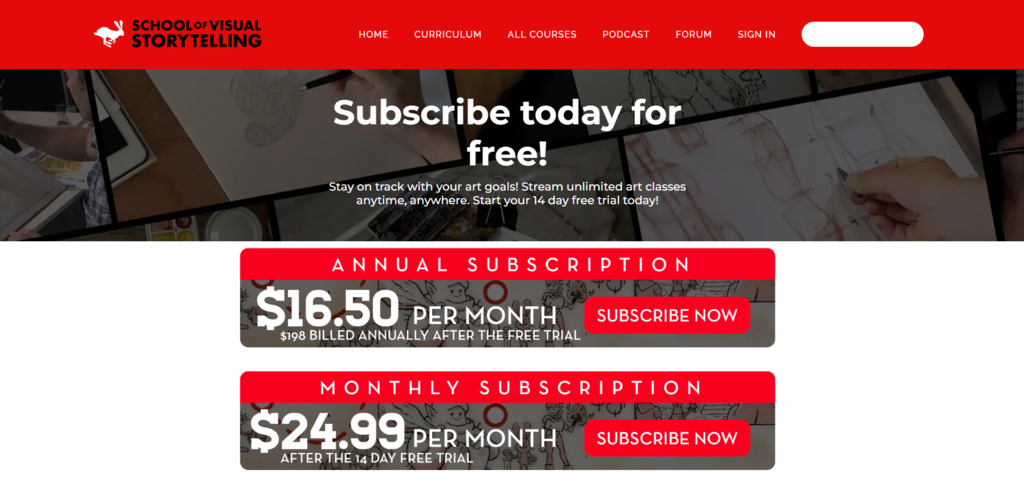
Moreover, creating a membership site allows course creators to build a sense of loyalty and community with their customers and upsell them on additional products or services.
One of the major downsides of this pricing model is the need to produce fresh content regularly to keep subscribers engaged, and customers may cancel their subscriptions anytime.
Ultimately, there’s no one-size-fits-all solution for online courses, and the best pricing model will vary depending on the type of course and your goals.
For instance, the one-time payment model may be the best choice to generate revenue quickly. However, subscription models may be more effective in establishing a long-term relationship with your students.
Pro Tip
Use pricing that ends in odd numbers, such as $9.99 or $97, to make the course seem more affordable or valuable.
5. Increase the value of the courses
Gain more profit with your online courses by applying these different strategies:
- Create a limited-time offer. Use time-specific offers and emphasize the benefits of your course to create a sense of urgency and motivate new and existing customers to purchase. For example, you can give new students a discount code or take advantage of special or seasonal events like Black Friday deals.
- Provide premium content. Provide access to exclusive content like bonus lectures, downloadable resources, exclusive one-on-one coaching, or live Q&A sessions. Doing this will increase student engagement and satisfaction, leading to more positive reviews and referrals for your course.
- Make a course bundle. Offer a content bundle of related courses at a discounted rate to encourage customers to purchase multiple classes at once.
- Implement three-tiered pricing. Offer three different tiers for your online course, with the first tier at a normal price and the other two offering enhanced versions of the course at higher prices. This way, the cheaper options will be perceived as a better deal.
6. Market the courses
Once you have a solid pricing structure, it’s time to market your course. Promoting the course is the key to achieving your sales goals.
Marketing plays an essential role in getting people interested in buying your course. However, it can take time to determine which methods are best for reaching potential clients.
Luckily, several strategies have been proven effective for promoting courses online. Experiment with different tactics until you find the best one and generate the highest return on investment (ROI).
Sales funnel
Selling online courses requires an effective sales funnel to help you sell more online courses. A sales funnel is a series of steps that leads potential students from initial awareness of your course to eventually making a purchase.
By carefully crafting each step in the funnel, you can increase the likelihood that prospective customers will take the desired action.
The first step in creating a sales funnel is to generate awareness of your course. This can be done through various marketing channels, such as social media, email marketing, or paid advertising.
Once you have captured people’s attention, the next step is getting them interested in your course. This can be done by providing more information about the course content and outlining its benefits.
The next step is to get prospective customers to take action and sign up for your course. Finally, once they have completed the course, you can encourage them to leave a review or take another lesson.
Lead magnets
A lead magnet is a free tool or resource you can offer potential customers in exchange for their contact details. It comes in many forms, from eBooks and checklists to webinars or free templates.
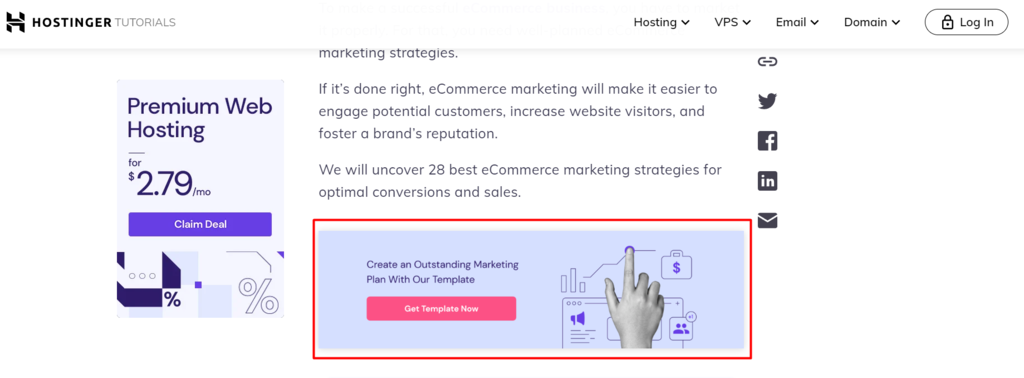
The key is offering something prospective clients will find valuable and relevant to the course content. For example, your free eBook called “Speed Up Your Website”. Offer free information but encourage prospects to buy your online course for more in-depth knowledge.
There are some ways to use lead magnets for promoting online courses. One option is to offer it as an incentive for people to subscribe to your email list or use it direct traffic to your course sales page.
You can also use lead magnets as part of an affiliate marketing campaign, offering them to other businesses in exchange for promoting your courses.
Sales page
A course sales page is designed to convince potential students to sign up for the course. This is where you will encourage the audience to complete different actions, such as signing up for your classes or subscribing to your newsletter.
When creating a course sales page, certain elements are essential to give your page the best chance of conversion, such as:
- Banner. Consists of your course name, a sub-headline, a hero image, and a strong call to action (CTA) to convert site visitors into students.
- Course description. Showcase your course’s value proposition and the full curriculum so people can preview the chapters and lessons of your classes.
- An instructor bio. A brief overview of your credentials as an instructor.
- Social proof. Add additional information, such as an FAQ section, testimonials, or a money-back guarantee to incentivize potential customers to invest in the course.
There are several ways to build a sales page for online courses. Some online platforms like Teachable and Thinkific have built-in sales page templates and a drag-and-drop editor for the hassle-free creation of sales pages.
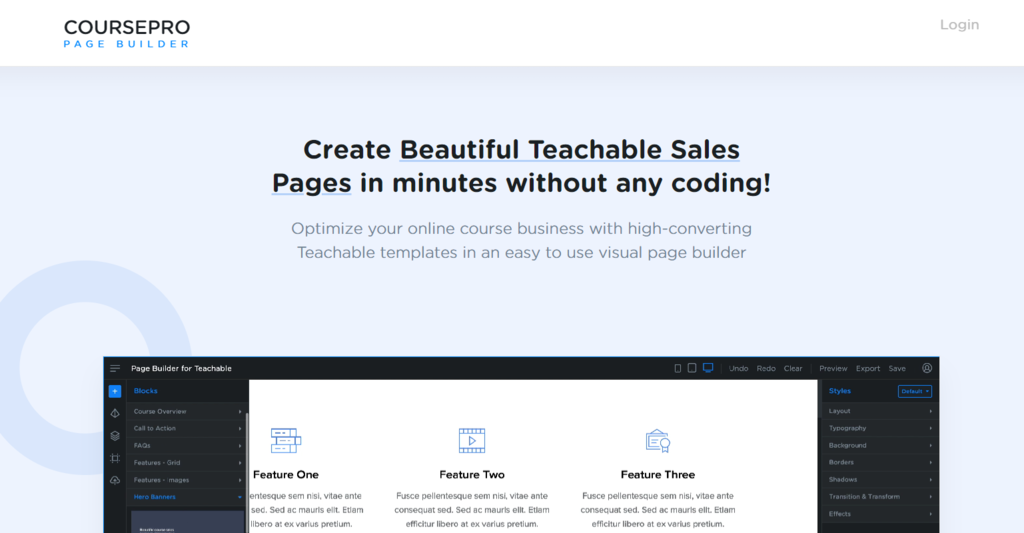
However, remember that all the pages created with such platforms will have a similar design, which can obscure your brand’s visibility.
If you want more control of your page visuals and branding, we suggest building your course sales page and linking it to your website.
For example, if you have already built your course website with WordPress, you can use page builder plugins like Beaver Builder and Divi to quickly create and integrate a course sales page into the main website.
Search Engine Optimization (SEO)
Focusing on SEO is essential as it allows you to be discovered by prospective students online.
Luckily, you can take a few simple steps to ensure your course is well-optimized for search engines.
First, ensure that your website is SEO-friendly. This involves using keyword-rich titles and descriptions and including relevant keywords throughout the copy of your site.
In addition, your website should be easy to navigate and mobile-friendly since most internet users use smartphones to access web content.
Next, create high-quality content for your course. This includes video lessons, blog posts, infographics, and anything else to help students learn the material.
More importantly, your content should be original and engaging, as no one wants to read a boring textbook or watch a dull lecture.
Additionally, promote your content across social media and other online channels.
Following these simple tips ensures your online course is visible to those searching for it.
Pro Tip
When creating your first online course, it's best to target long-tail keywords. Besides having low competition, they can help target specific searches and reach potential students more effectively.
Content marketing
Content marketing involves creating and sharing valuable content focused on your course topic and target audience.
Start a blog that features engaging and informative content about your course topic and emphasizes the course benefits. For example, if you’re selling an SEO beginner course, write blog posts on keyword research or link building, and include links to your course’s page.
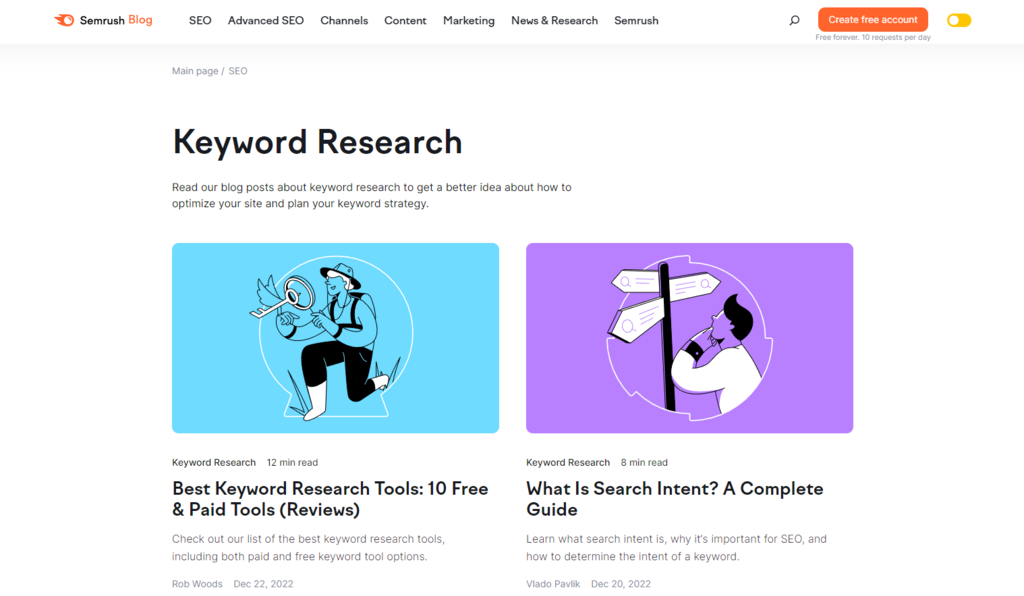
Consider sharing on social media channels to reach more potential customers. Keep in mind that although content marketing is low in cost, it may take time as it involves a creative approach to content making and optimization.
Paid ads
Another option is to place paid ads on search engines, social media, or other niche-related websites. This strategy provides a quick way to attract traffic to your online course.
Paid ads can be more cost-effective than other marketing tools because they can target specific customers most likely to be interested in your class.
It’s also possible to track the ads’ performance and change their targeting if necessary. Aside from that, several different types of advertising platforms are available:
- Search engine advertising. Involves bidding on certain keywords to appear higher in the search engine results pages (SERP). For example, pay-per-click (PPC) and cost-per-click (CPC) are popular search engine ads.
- Social media advertising. Let course creators run highly targeted ad campaigns through popular social media channels like Facebook, Instagram, and Tik Tok. It’s a perfect option for targeting the younger demographic.

- Display advertising. These ads are typically shown on web pages, apps, and other digital platforms as banners or pop-ups. Design banners with catchy headlines and eye-catching visuals to grab people’s attention and get them to take action.
- Native advertising. Unlike traditional display ads, native ads are not intrusive and blend in with the page’s content.
Email marketing
By building a list of interested subscribers, you can reach a large audience with your marketing efforts. For example, you can create email campaigns to promote new courses, remind students of upcoming deadlines, or offer special deals and discounts.
For course creators looking to streamline their email marketing efforts, Hostinger Reach offers an AI-powered solution that eliminates the guesswork from campaign creation.
Simply describe your goal (like “promote my new [x] photography course with a 20% early bird discount” or “remind students about tomorrow’s [y] live Q&A session”) and Reach automatically creates compelling email content, suggests the best layout, and ensures mobile-friendly design. The platform integrates seamlessly with your course website, automatically syncing your student list so you can focus on teaching while Reach handles the marketing complexity.
Follow these tips when building your online course email list:
- Send personalized emails. Personalize the email’s subject line to make it more relevant and interesting to the recipient.
- Sort your list by segment. Group your email list based on past course enrollments or interests. This allows you to send more targeted and relevant emails.
- Test and optimize. Use the A/B testing method to see what subject lines, email designs, and call-to-actions work best for your audience, optimizing your campaigns accordingly.
- Track and analyze results. Use marketing automation software to track your open, click-through, and conversion rates, and use this data to improve your campaigns over time.
Tips for successfully selling online courses
Follow these tips to get on the right track when creating and selling online courses:
Build trust
Trust is key in convincing potential students to invest in your course. It also helps establish credibility and creates a sense of student loyalty. Here are some ways to do it:
- Be transparent. Provide a clear value proposition describing the course’s purpose and how it will benefit your students.
- Use social proof. For someone who has already sold a few courses can leverage social proof by sharing reviews, testimonials, and ratings from previous students.
- Share your credentials. Establish a strong personal brand and position yourself as an expert within your course niche. Build authority on social media channels by actively engaging students and offering solutions.
Make the courses easily accessible for purchase
Another important thing to consider when selling online courses is making your lessons easily accessible for people to enroll in and purchase.
Such marketplace sites as Udemy or SkillShare will cover your payment processing for you.
However, if you want to sell online courses on your website, it is imperative to clearly explain the course content and make the checkout process as convenient and quick as possible.
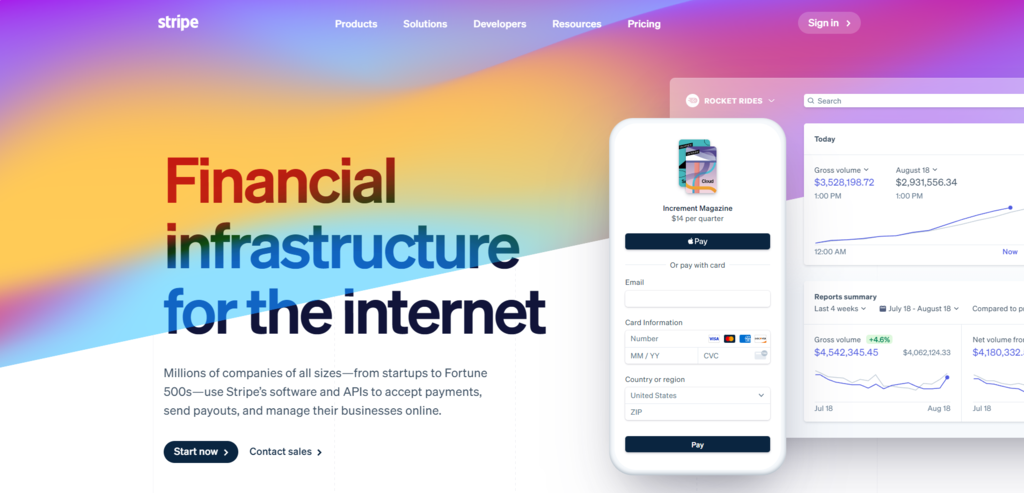
For example, most course creators use a two-step checkout process that requires account setup before entering payment details. Connect to payment gateway services like PayPal or Stripe to collect payment. These platforms allow you to accept different billing options to increase customer satisfaction and conversions.
Gather feedback
A key to creating a successful online course is identifying what customers are looking for and how to better serve their needs.
Collecting feedback is one way to gain valuable insights into how customers feel about your course and their overall experience, as you can identify what customers are looking for and how to better serve their needs.
Here are some effective methods for gathering feedback on online courses:
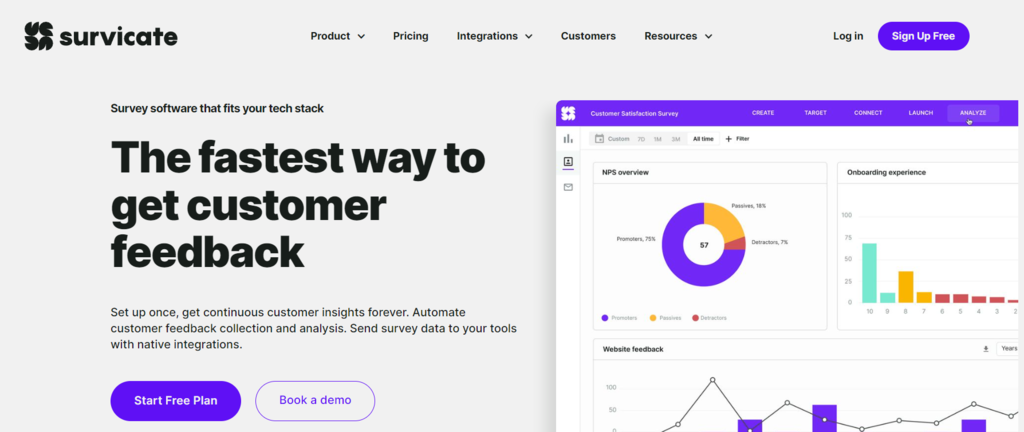
- Surveys. Send out an NPS (Net Promoter Score) survey to students at the end of or periodically throughout the course. The survey can include questions about the content, delivery, and overall satisfaction with the course. Use an online survey tool like SurveyMonkey or Survicate for easy and efficient data collection.
- Discussion boards. Set up a discussion forum for students to share their thoughts and feedback on the course. This will help foster a sense of community and engagement among students.
- One-on-one interviews. Contact students individually for a phone or in-person interview to gather more detailed and personal feedback.
- Email or chat support. Set up an email or chat support system for students to reach out with any questions or feedback.
- Reviews. Encourage students to leave reviews on your website or third-party review sites.
Conclusion
Selling courses can be a cost-effective, scalable, and convenient way to reach a global audience, provide valuable education to new students and create a steady income stream alongside.
Let’s recap the six essential steps for selling your online course successfully:
- Create a profitable online course.
- Pick an enticing course title.
- Choose the right selling platform.
- Set reasonable pricing.
- Increase the value of your online course.
- Plan a strong marketing strategy to increase course sales.
You need a strong personal brand to build trust and sell your online courses successfully. Moreover, it’s important to ensure your classes are easily accessible and offer a clear purchase flow. Remember to always take student feedback into account to improve the quality of your lessons.
We hope this article has helped you know how to sell courses online effectively and scale your online course business. Good luck on your online journey!

Wanda enjoys helping people become more successful online by sharing her expertise in digital marketing and website development. In her free time, she loves reading mystery books, thrifting for vintage clothes, and exploring aesthetic cafes.


Comments
0 responses