How to sell shoes online
Mar 10, 2026
/
Emman Z.
/
10 min Read

To get started selling shoes online, you need to identify your niche, research the market, and choose the right shoes that will attract your target audience. From there, sourcing your products, setting up an online store, and creating an effective marketing strategy will all be essential steps in driving traffic and boosting sales.
In this article, we’ll discuss how to choose the right shoes to sell, where to sell them, and how to promote your store effectively. We’ll also share proven tips on pricing, customer acquisition, and scaling your business so you can start selling shoes with confidence.
Understanding the online shoe market
The online footwear industry is vast and constantly evolving, shaped by shifting customer preferences and new trends. To succeed, you need to know the types of shoes that sell well, what buyers are looking for, and how to position your brand effectively.
Here’s how you can get a grasp of the market.
What are the best shoes to sell online?
The best shoes to sell online will depend largely on the type of audience you’re targeting and current market demands. Having a solid understanding of what’s trending and what customers are actively seeking can help you choose products that will sell well.
Below are some popular categories that consistently perform well in the online shoe market:
- Sneakers and athletic shoes. With the athleisure and casual wear market projected to reach $920 billion by 2034, sneakers remain one of the most in-demand categories. From fitness enthusiasts to everyday wearers, their versatility offering both comfort and style makes them appealing to a wide range of shoppers.
- Sustainable and eco-friendly shoes. As consumers become more environmentally conscious, there’s a growing demand for footwear made with ethical practices and sustainable materials. Shoes crafted from recycled fabrics, biodegradable soles, or natural fibers are becoming increasingly attractive to eco-minded buyers.
- Comfort-oriented footwear. Footwear designed with comfort in mind, such as orthopedic shoes, memory foam soles, and arch-supporting designs, appeals to a growing market of older adults, people with foot health needs, and anyone prioritizing comfort over fashion.
- Luxury and designer shoes. From designer heels to upscale boots and dress shoes, these products continue to attract loyal customers worldwide. In 2025, the luxury footwear market is projected to generate US$34.7 billion in revenue, with an expected annual growth rate of 1.63%. This steady demand creates opportunities for new brands to enter and grow in the space.
To choose the right inventory, align your product offerings with real-time trends and evolving customer interests. One of the best ways to stay ahead is by tracking trending products in the ecommerce space. This helps you not only identify top-selling items but also discover emerging sub-niches within footwear.
Identifying your niche and target audience
You can’t sell to everyone, and you shouldn’t try to. Zero in on a niche that excites you and speaks to a specific group of people.
Having a well-defined niche will help with product selection, branding, and marketing strategies so that you connect with the right customers.
Start with the basics:
- Demographics. Are you focusing on young adults who love streetwear and trendy sneakers, or older individuals seeking comfort and support in their footwear? Knowing your customer’s age, gender, location, and income level is the first step in narrowing down your niche.
- Psychographics. What do they care about? For instance, if they’re eco-friendly, your marketing efforts should highlight your shoes’ sustainable materials. If they prefer luxury, focus on exclusivity, premium materials, and brand prestige. Understanding these traits helps you refine your product range and attract the right customers.
- Behavioral segmentation. Do they wait for sales or buy new drops the second they launch? Are they loyal to particular brands? Understanding your customers’ behavior helps you refine your sales strategy and tailor your promotions accordingly.
Pro Tip
Join niche-specific online communities like sneakerhead forums, sustainable fashion groups, or comfort footwear subreddits. These spaces are goldmines for discovering what your target customers actually care about, what brands they love or dislike, and which gaps exist in the market that your store could fill. Listening in can be just as powerful as traditional market research.
Start selling shoes online: essential steps
Once you’ve found your niche and know your customer, it’s go time. Here’s your step-by-step game plan:
1. Source your shoes
The way you source your shoes will depend on your business model and how much control you want over product quality, branding, and inventory. You’ve got three main options:
- Wholesale. Buying shoes in bulk at discounted rates offers higher profit margins but requires upfront investment and inventory storage.
- Dropshipping. Work with a supplier like AliExpress, Spocket, and Modalyst who ships directly to your customers. You don’t need to hold inventory, but you have less control over product quality and shipping speed. When starting a dropshipping business, it’s important to research the advantages and disadvantages thoroughly.
- Private label or custom manufacturing. Design your own shoes and have them manufactured under your brand. This approach offers complete control over your product but requires higher startup costs and lead times.
Regardless of the sourcing model you choose, always test product samples first. Order a few pairs for yourself to check the quality, fit, and packaging before committing to larger orders. This will help you avoid potential issues with returns and customer satisfaction.
2. Choose where to sell your shoes online
You have a few options when it comes to selling online:
- Your own ecommerce store
- Third-party marketplaces
- Social media platforms
Each option has its advantages and challenges, so it’s important to pick the one that aligns with your goals.
If you want full control over your branding and customer experience, building your own website with Hostinger’s ecommerce website builder is the best option.
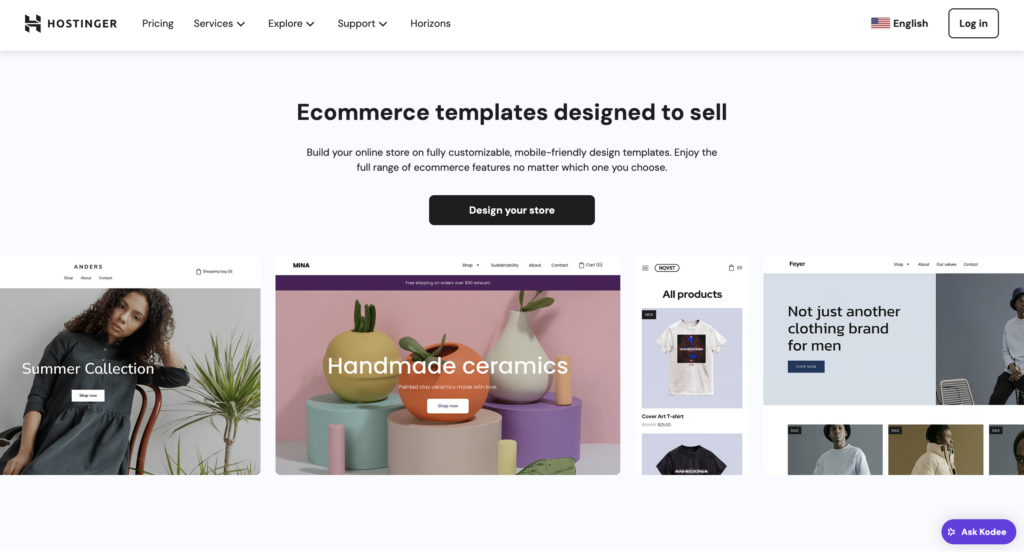
Customize your store, showcase your products, and build long-term relationships with customers. Plus, Hostinger’s built-in AI tools help you generate product descriptions, optimize SEO, and even create a custom logo, so you can launch faster and sell smarter.

Want to tap into existing traffic and start selling right away? Try marketplaces like Amazon, eBay, or Etsy.. These marketplaces are great for fast exposure but come with fees and branding limitations.
Platforms like Instagram and Facebook Marketplace also provide an easy way to sell shoes directly to consumers, especially for products with strong visual appeal.
For many, a multichannel approach works best: selling on both your own website and through marketplaces to maximize exposure and sales.
Here’s a quick comparison of popular selling platforms:
| Platform | Pros | Cons |
| Hostinger ecommerce website builder | Complete control over branding, pricing, and customer experience. No marketplace fees, better SEO, and long-term growth. | Requires setup and active promotion. |
| WooCommerce | Fully customizable, integrates with WordPress. Easy to add new features and grow your store. | Requires some technical setup and may need regular maintenance. |
| Amazon | Massive customer base. Fulfillment options like FBA (Fulfilled by Amazon) make shipping easier. | High competition, marketplace fees, limited branding and customer experience. |
| eBay | Wide range of customers looking for new, used, or niche products. | Seller fees, competition with other sellers, less control over customer interactions. |
| Etsy | Great for handmade, vintage, or custom shoes. Strong community focus. | Limited audience for mass-market products. Fees for listings and transactions. |
| Facebook Marketplace / Instagram Shops | Direct access to buyers. Easy to set up and promote visually appealing products. | High competition, less control over the sales process, dependent on social media engagement. |
If you’re ready to launch your own store, Hostinger’s ecommerce website builder makes it easy to get started at just $3.99/month. You’ll also get a free domain and business email included, so you can start selling with a professional setup from day one.
📚 Suggested Reading
To explore the best platforms for your store in detail, check out our guide to the best ecommerce platforms.
3. Price your shoes
Pricing isn’t just math, it’s psychology.
Factors like perceived value, competitor pricing, and what your customers are willing to pay all influence how to price a product effectively.
If your prices are too low, customers may question the quality of your shoes, and if they’re too high, you risk losing potential buyers. The key is to find the sweet spot that balances your costs and your customer’s willingness to pay.
Your pricing strategy also depends on the type of footwear you’re selling. If you’re selling affordable casual wear, customers expect competitive pricing. If you’re offering designer shoes, your pricing should reflect premium positioning.
Start by calculating the total cost of each pair of shoes. This includes:
- Product cost (including shipping and taxes)
- Packaging and branding materials
- Platform or transaction fees
- Marketing and advertising spend
Once you have a clear understanding of your costs, you can set a markup based on the profit you want to make. A markup is the amount added to your total costs to ensure you earn a profit on each sale. A common strategy is cost-plus pricing, where you add a fixed markup to the cost of the product. For example, if your total cost for a pair of shoes is $25 and you want to make $25 profit per pair, you’d set a markup of $25, making the selling price $50.
If you’re selling high-end designer or luxury shoes, value-based pricing is an effective strategy. This pricing method sets the price based on what customers are willing to pay, not just on the cost of production.
For instance, luxury shoes with high-quality materials or a strong brand reputation can be priced higher because your target audience is willing to pay more for exclusivity and the status that comes with owning a prestigious product.
Remember:
Don’t undervalue your products just to compete on price. Constantly undercutting your competitors can damage your brand’s perceived value and make it difficult to maintain healthy profit margins. Instead, focus on delivering quality, highlight what makes your shoes unique, and use limited-time offers or seasonal discounts to drive sales when needed.
4. Market and promote your online shoe store
No one can buy from you if they don’t know you exist.
Luckily, there are numerous strategies that don’t require a large budget to get started.
Here are the key channels you should focus on:
- Social media marketing. Use Instagram, Pinterest, and TikTok to showcase your shoes in real-life settings. Reels and user-generated content can build trust and engagement. For example, a streetwear shoe brand might run Instagram ads showing customers unboxing and styling their shoes.
- Influencer partnerships: Reach out to micro-influencers who already speak to your audience. A few well-placed mentions can generate immediate interest and sales.
- Email marketing: Build your list with sign-up offers, then send targeted campaigns with product launches, promotions, and tips.
- SEO: Learn how to optimize your store for search engines to rank higher in search results. For instance, if you’re selling “vegan running shoes,” include long-tail keywords like “breathable vegan running shoes for women” to attract more specific search traffic.
- Paid advertising: Once you validate your product and audience, scale with paid ads on Google Shopping or Facebook Ads. Start with a small budget and refine it based on performance.
Pro Tip
For paid ads, start with a small budget to target specific demographics and see what works best. Once you’ve identified the winning ad sets, you can increase your budget and refine your targeting for better results.
Setting up your online shoe store
To set up your online shoes store, you’ll first need to choose a reliable and intuitive ecommerce platform to launch your store.
Hostinger’s ecommerce website builder offers a user-friendly interface, customizable design options, and secure payment integration, making it the perfect choice for entrepreneurs looking to create a seamless shopping experience for their customers.
Here’s how to make your store welcoming and trustworthy:
- Choose a theme that aligns with the feel of your business, whether it’s sleek and modern, casual, or sophisticated.
- Make sure your website is mobile-responsive, as many customers will be shopping on their smartphones.
- Add high-quality product images, along with clear, detailed descriptions for each pair of shoes.
- Integrate reliable options like PayPal, Stripe, and credit card processing to offer a variety of payment methods.
- A secure, smooth checkout process is key to preventing cart abandonment, so make sure customers can easily complete their purchase without confusion or delay.
- Decide whether to offer free shipping, flat-rate fees, or tiered pricing based on order size or destination and clearly state your shipping policies on your website so customers know exactly what to expect at checkout.
📚 Suggested Reading
If you’re unsure about how to set everything up, we’ve made the process easy for you. Check out our comprehensive guide on how to start an online store, which walks you through the steps to launch a successful ecommerce business from scratch.
Offer upsell and cross-sell products
One of the best ways to increase your revenue without acquiring new customers is through upselling and cross-selling.
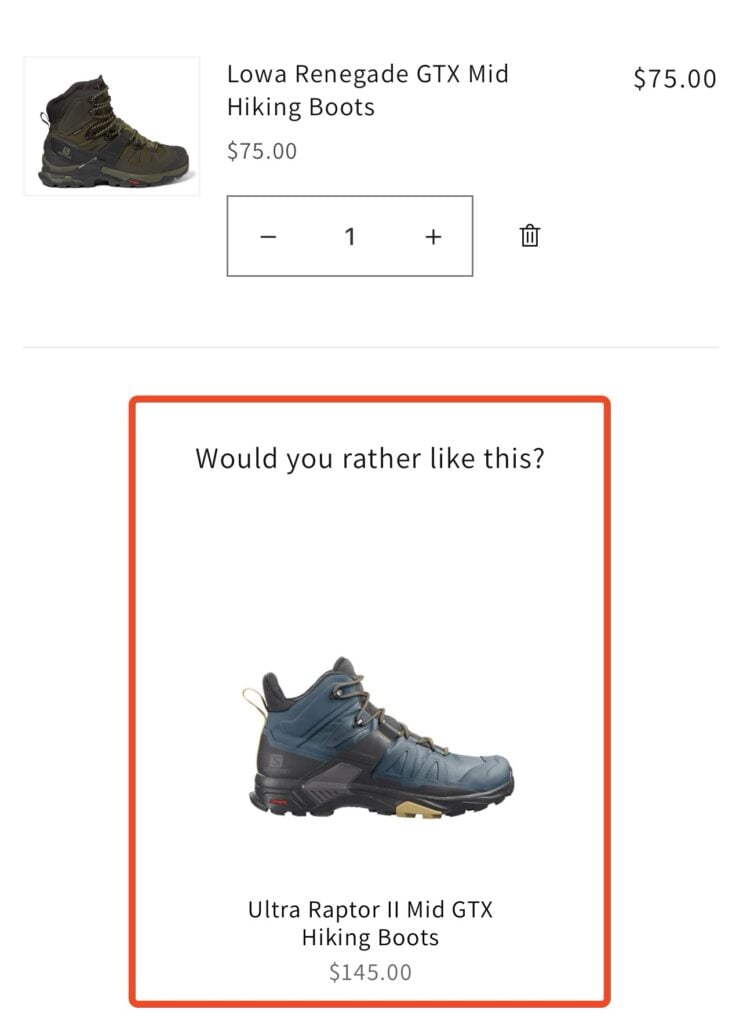
Upselling involves offering a higher-end version of the product your customer is already considering.
For example, if a customer is looking at a standard pair of hiking boots, you can upsell by suggesting a more expensive version with additional features, such as extra cushioning or waterproofing. This tactic works because it highlights the value the customer will get from a more expensive product.
Cross-selling, on the other hand, recommends complementary products that pair well with what the customer is already purchasing.
For instance, when someone buys a pair of running shoes on Adidas’s website, the site offer related products such as running socks, shorts, or a water bottle. These recommendations are targeted and relevant, as they complement the customer’s initial purchase.
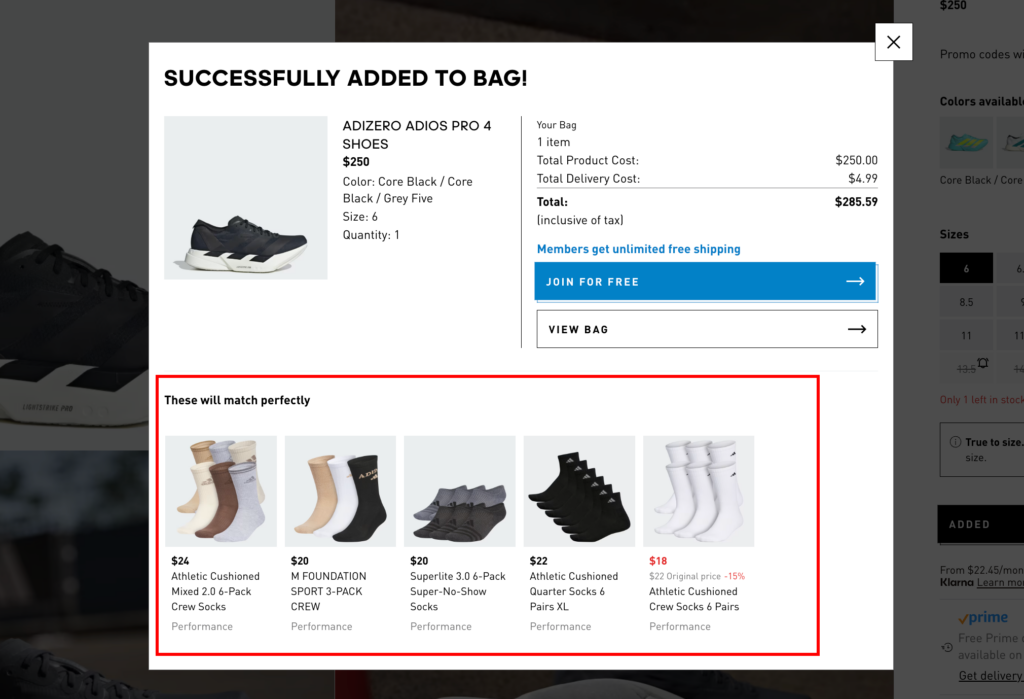
Both strategies work best when they are presented at the right moment. You can offer upsell or cross-sell recommendations during the checkout process or on the product pages themselves.
How to be successful selling shoes online
Success in selling shoes online requires a combination of strategic planning, strong branding, and consistent customer engagement. To build a successful shoe business, focus on developing a clear brand identity and delivering a smooth shopping experience that keeps customers coming back.
Offer excellent customer service
Respond quickly to inquiries, handle returns efficiently, and ship orders on time. Trust is a key driver of repeat purchases, so offering high-quality products along with great customer service can go a long way in building loyalty.
Engage your customer
For long-term success, keep your audience engaged through personalized email campaigns, special offers, and updates on new arrivals or limited-edition drops.
Make marketing an ongoing effort
Invest in SEO to boost your store’s visibility in search results, and use social media to grow a community around your brand. Regularly post content that adds value, such as styling tips or user-generated content, and consider partnering with influencers to expand your reach.
You can even use tools like Google Analytics to monitor your performance, understand customer behavior, and fine-tune your marketing strategies for better results over time.
Tips for making money selling shoes online
If you’re wondering how to make money online by selling shoes, you need to go beyond just listing products. Below, we’ll share some innovative strategies to help you maximize revenue and profit. By using these strategies, you’ll learn how to sell shoes online and make money more efficiently:
Sell digital products related to shoes
In addition to physical shoes, consider selling digital products that complement your business. This could include downloadable shoe care guides, style ebooks, or even design templates for custom shoes. Digital products have a high-profit margin since they don’t require inventory or shipping.
Offer shoe customization services
Shoe customization is a popular trend, especially in the sneaker and fashion industries, and it not only increases your revenue per customer but also sets your store apart from mass-market sellers. Offering personalized shoes, such as custom paint, embroidery, or monogramming, can add a premium value to your offerings.
Create a referral program
Word-of-mouth is one of the most powerful tools for any business. Encourage your existing customers to refer friends or family by offering incentives, such as discounts, free products, or store credit.
A referral program helps you leverage your current customer base to generate new sales without needing to spend on ads. This organic growth model can boost your revenue and bring in highly targeted traffic that’s more likely to convert.
Host online events or launches
Live events, virtual product launches, or online fashion shows are an excellent opportunity to showcase new arrivals, run limited-time discounts, and interact directly with potential customers. If done right, these events can drive immediate sales and create a sense of community around your brand.
Use affiliate sales for shoe accessories
In addition to selling shoes, you can boost your income by promoting complementary products through affiliate marketing. For example, offer shoe-related accessories like cleaning kits, shoe polish, or socks as affiliate products on your site.
You can earn commissions by linking to these products through affiliate programs. This strategy provides a passive income stream while offering customers a full shopping experience related to their shoe purchases.
Start your online shoe selling journey
You’ve now learned how to sell shoes online and make money by combining smart strategies and creative approaches. Whether it’s through offering exclusive products, using upselling/cross-selling techniques, or expanding into new sales channels, there are countless ways to build a successful online shoe business.
There’s never been a better time to start selling shoes online. With the global footwear market expected to exceed $570 billion by 2030, now is the perfect time to get started.
So whether you’re launching a side hustle or building your empire, remember this: the world needs your style, your story, and your spin on footwear. Put yourself out there and start walking the walk. If you’re just getting started, check out our guide on how to sell clothes online for best practices on listings and fulfillment. When you’re ready to scale and boost revenue, our articles on how to scale an ecommerce business and how to increase sales online are full of actionable strategies.

Emman is a Content Writer at Hostinger where she helps simplify complex topics for readers around the world. With over 5 years of experience in crafting SEO content, she’s passionate about making tech topics easy to understand. In her free time, Emman enjoys traveling and watching Formula 1 races. Follow her on LinkedIn.