How many emails are sent per day? Key statistics and trends
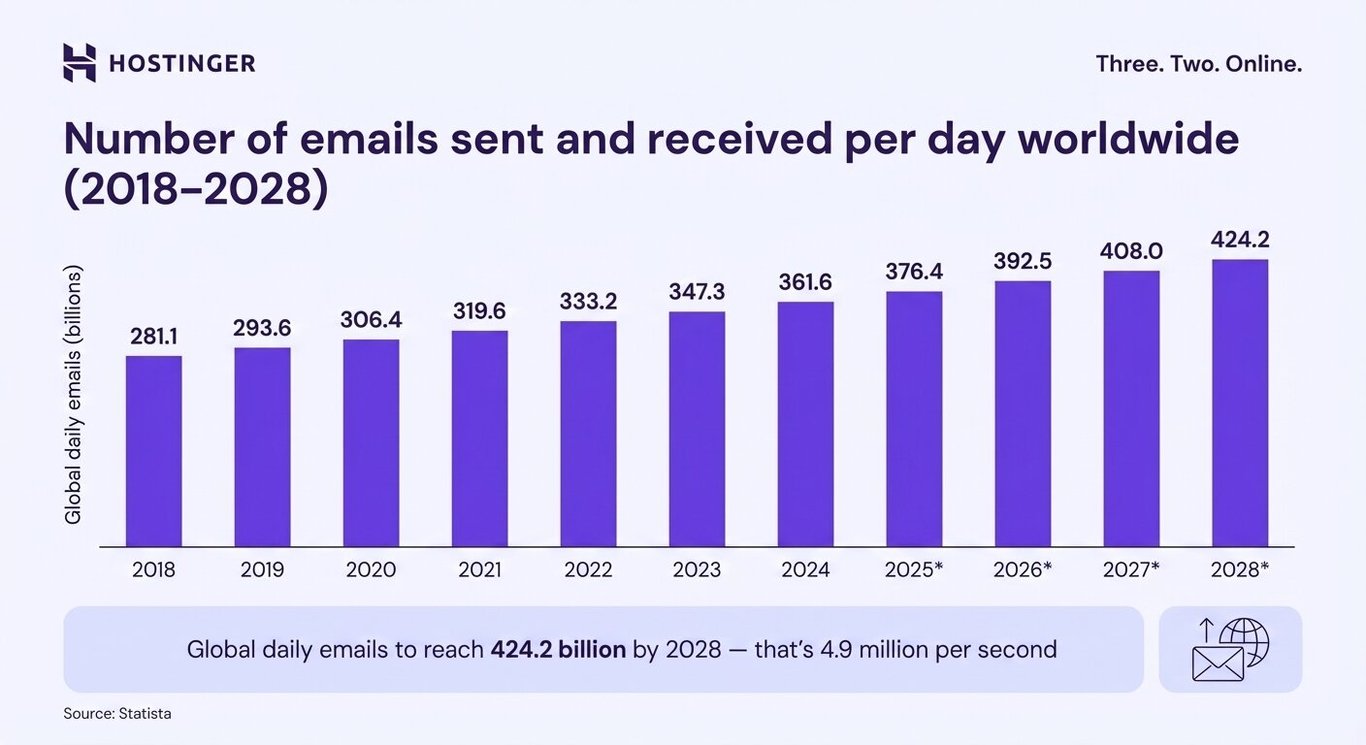
In 2026, approximately 392.5 billion emails are expected to be sent and received worldwide every day. That number is growing at 4.2% annually and is on track to hit 424.2 billion by 2028.
Over 4.55 billion people use email globally, nearly half of all emails never reach an inbox, and more than 160 billion of the ones sent daily are spam.
Email is not slowing down. It remains one of the most widely used communication channels on the planet.
Top 10 email statistics for 2026
These are the most important data points shaping email usage in 2026:
- Approximately 392.5 billion emails are expected to be sent and received every day worldwide in 2026.
- By 2028, daily email volume will reach 424.2 billion, roughly 4.9 million emails per second.
- There are 4.55 billion email users globally in 2025, projected to grow to 4.97 billion by 2028.
- The United States sends the most emails of any country, at approximately 9.8 billion per day.
- The average office worker receives 121 business emails daily while sending around 40.
- Around 75% of users delete emails that are not optimized for mobile viewing.
- Over 160 billion spam emails are sent every day, representing nearly 45.6% of all global email traffic.
- 93% of people use email daily, and 58% check their inbox first thing in the morning.
- Only 43.9% of all emails sent globally actually reach an inbox.
- Global email marketing is projected to reach $36.3 billion by 2033.
How many emails are sent per day worldwide?
Approximately 392.5 billion emails are expected to be sent and received every day in 2026, up from 376.4 billion in 2025.
According to Statista, that growth isn’t slowing down. By 2028, daily volume is expected to hit 424.2 billion, or roughly 4.9 million emails every second. The compound annual growth rate from 2018 to 2028 is 4.2%, showing that email’s expansion has been steady and predictable, not a spike driven by any single trend.
That volume covers everything: marketing newsletters, password resets, customer support replies, order confirmations, and everyday personal messages. Every one of them counts toward the daily total.
What actually happens to emails after they’re sent?
Knowing how many emails are sent each day only tells part of the story. To understand what the global inbox really looks like, Hostinger analyzed 1 billion emails processed through its platform in January 2026, examining delivery outcomes, sender types, and the reasons messages are blocked.
The analysis is based on anonymized technical metadata, including sender domains, authentication results, reputation signals, and delivery outcomes. No message content was read. The findings paint a very different picture from the raw volume numbers.
How many emails actually reach the inbox?
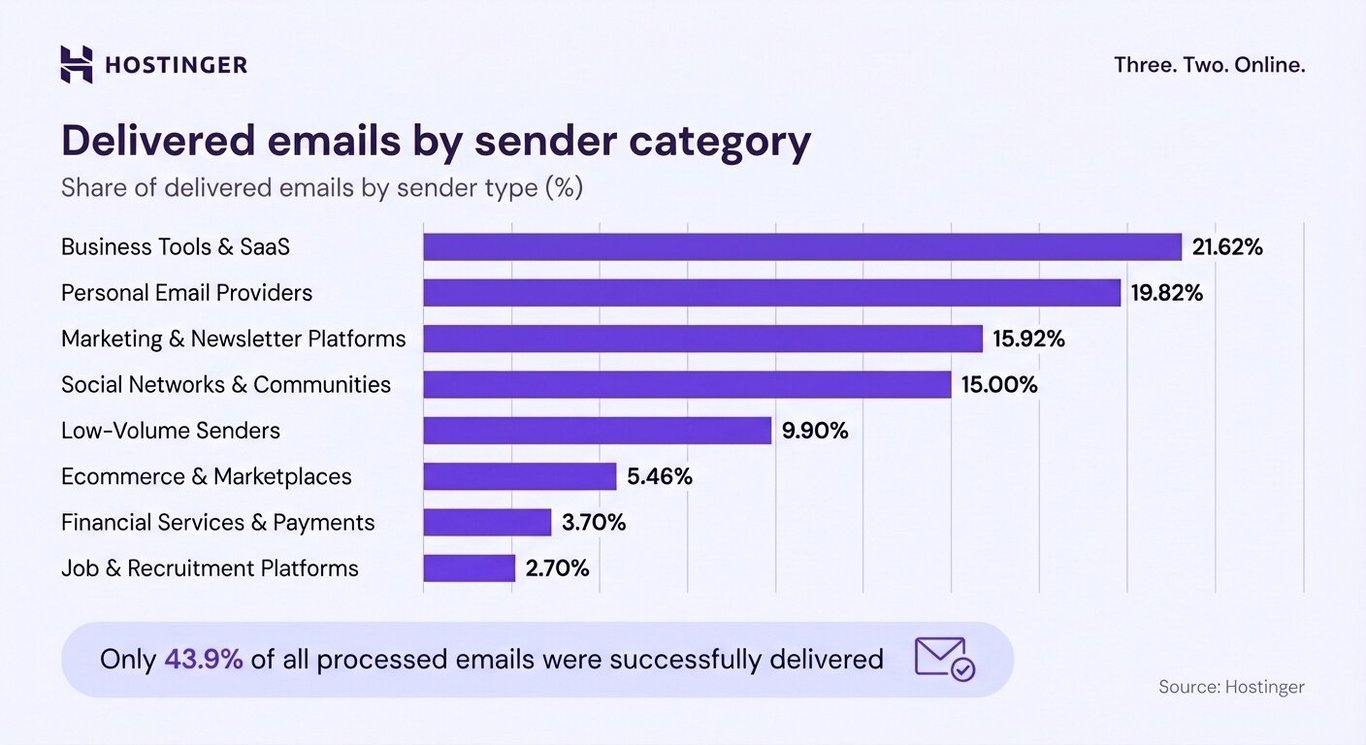
Less than half of all emails sent globally reach a recipient’s inbox. Hostinger’s analysis found that only 43.9% of all processed emails were successfully delivered, while the remaining 56.1% was blocked by spam and virus filters before reaching any inbox.
Of the emails that do get through, business tools and SaaS platforms make up the largest share at 21.62%, covering CRMs, project management tools, and workflow automation. These are the most common legitimate emails most people receive at work.
Personal email providers (Gmail, Outlook, Yahoo, and similar services) account for 19.82%, while marketing and newsletter platforms account for 15.92%, covering campaigns sent through tools like Amazon SES, SendGrid, and HubSpot.
Social network notifications from platforms like Facebook, Instagram, and LinkedIn make up 15%, and ecommerce and marketplace emails (order confirmations, shipping updates, account alerts) account for 5.46%.
Only two of these categories, personal email providers and low-volume senders, typically involve a real person writing a message. Together, they account for less than 30% of received mail, or about 13% of all email traffic. Nearly everything else is automated.
Why do so many emails get blocked?
56.1% of emails that never reach an inbox are blocked for a range of reasons, and a single email can be flagged for more than one reason. The percentages below reflect how often each factor contributes to a rejection:
- Phishing, scams, malware, and botnets account for 33.87% of blocked mail, making this the single largest category of rejected email. These messages typically rely on fast-changing domains and automated systems designed to evade detection.
- Poor sender reputation accounts for 33.9% of all rejected mail, driven by sending to outdated lists, generating high bounce rates, or accumulating spam complaints over time.
- Aggressive spam and suspicious marketing campaigns account for 21.94% of blocked mail, often sent in bulk to scraped mailing lists from low-reputation domains.
- Invalid recipient addresses cause 17.29% of rejections. Repeatedly hitting nonexistent inboxes signals to providers that a sender is emailing blindly, which can damage reputation fast.
- Misconfigured sending infrastructure is responsible for 10.82% of blocked email. Legitimate messages are often rejected not because of their content but because the sending server lacks SPF or DKIM records or shows unusual authentication patterns.
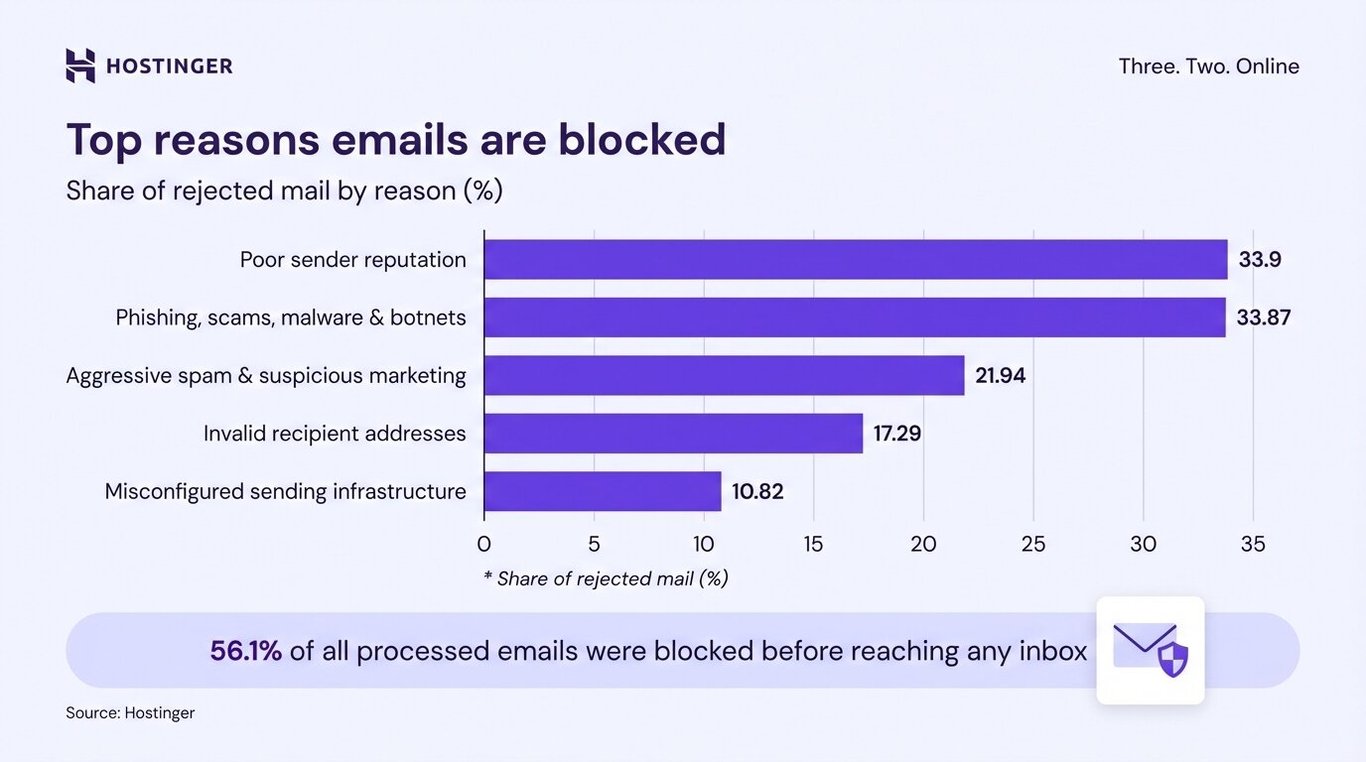
The takeaway for businesses is practical: most delivery failures come from fixable problems. Keeping mailing lists clean, setting up proper authentication records, and monitoring sender reputation are the three highest-impact steps any sender can take to improve inbox placement.
Number of emails sent per day by country
Email usage varies significantly by country, shaped by population size, internet penetration, business infrastructure, and digital adoption rates. The top 10 countries account for a substantial share of global daily email volume, with the United States and several European nations leading the rankings.
- The United States sends approximately 9.8 billion emails per day, the highest of any country globally, reflecting its large internet user base and highly active business email culture (Statista)
- Germany sends around 8.5 billion emails per day, ranking second worldwide (Statista)
- India, Ireland, France, and the United Kingdom each send 8.3 billion emails per day, sharing third place. This tie reflects comparable levels of business and consumer email activity across these markets (Statista)
- The Netherlands sends 8.2 billion emails per day (Statista)
- Belgium and Japan each send 8.1 billion emails per day (Statista)
- Czechia sends 7.9 billion emails per day, the lowest among the top 10 countries (Statista)
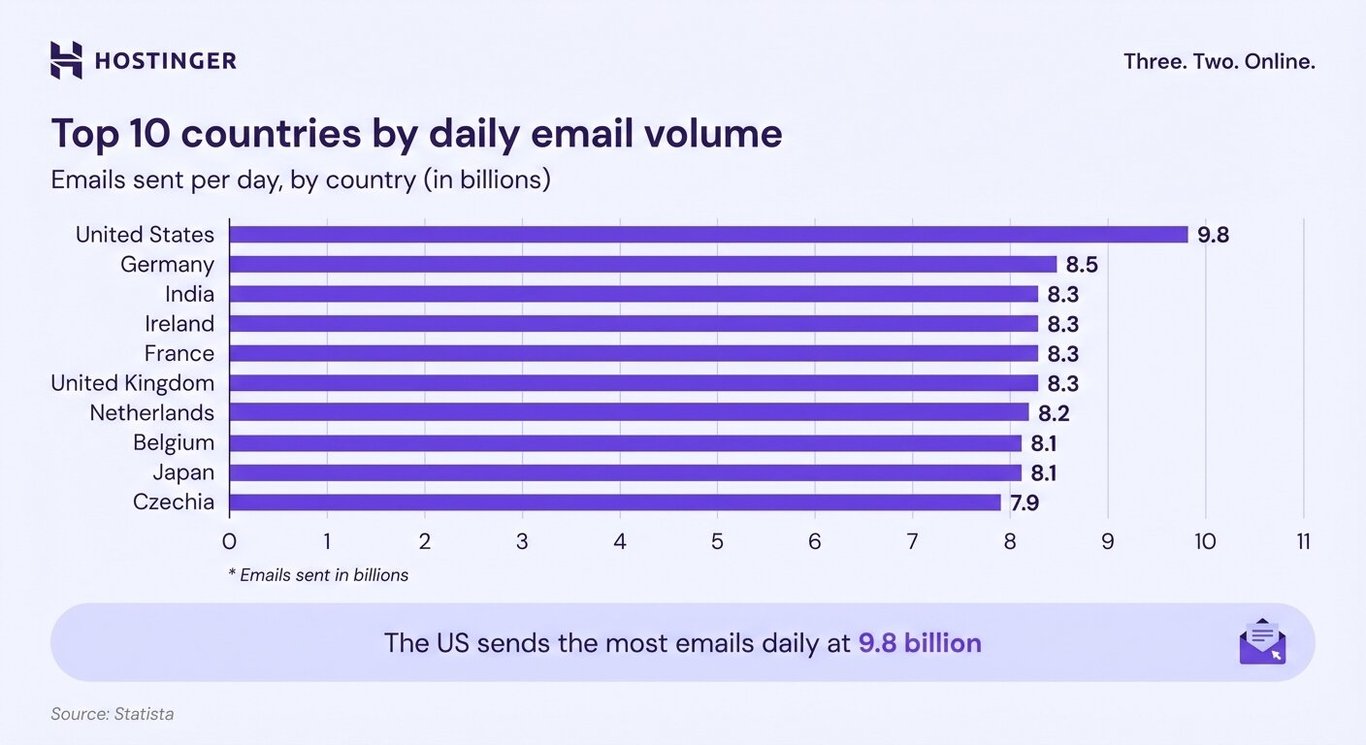
The top 10 countries show a notably tight range, from 9.8 billion for the U.S. to 7.9 billion for Czechia, suggesting a broad and relatively uniform level of email activity across developed economies. Europe is notably well represented, with six of the top 10 spots held by European nations.
How many email users are there globally?
The global email user base is large and continues to grow. Email remains one of the most universal digital tools available, cutting across age groups, industries, and regions in a way that few other channels can match.
- There are 4.55 billion people who use email globally in 2025, representing 56% of the world’s population and 82% of all internet users (Statista)
- The email user base is growing by approximately 383,000 new users every day, reflecting steady and ongoing expansion (Statista)
- 4.97 billion email users are expected by 2028, an increase of 420 million users from 2025, a 9.2% rise over three years (Statista)
- Global email marketing revenue is projected to reach $36.3 billion by 2033, underlining how commercially significant the email channel remains (Hostinger Email Marketing Statistics)
- 93% of people access or use email daily, and 58% check their inbox first thing in the morning, making email one of the most consistently engaged digital habits worldwide (EmailTooltester)
With more than half the world’s population using email and adoption still climbing, the channel shows no sign of being replaced. Growing internet infrastructure in underserved regions will continue to bring new users online and into the inbox in the years ahead.
How many emails does the average person receive per day?
For most people, especially in professional settings, the inbox is one of the busiest places they visit each day. Email volume at the individual level varies by industry and role, but the numbers consistently point to high activity and a measurable impact on time and focus.
According to Clean Email’s report, the average user receives between 82 and 120 emails per day – roughly one email every 12 minutes during waking hours, or about 45,990 per year.
For office workers specifically, the numbers are more intense:
- The typical office worker receives 121 business emails daily while sending around 40, a sending-to-receiving ratio that highlights just how much inbound volume most professionals manage.
- Office workers spend between 5 and 15.5 hours per week on email.
- 70% of professionals cite email as their top workplace stress source, and 42% describe their inbox as “out of control”.
The gap between emails received and emails sent reveals a core challenge for modern workers: most people are on the receiving end of far more communication than they generate. Tools that help prioritize, filter, and automate email responses are increasingly essential for maintaining productivity.
Expert tip
Most people don’t realize how much of their inbox is noise rather than genuine communication. Automated notifications, marketing emails, and social alerts now make up the majority of what lands in your inbox. The best thing you can do is set up filters, unsubscribe aggressively, and use a professional email address with clear folder rules.
AI-powered tools can also help by automatically categorizing messages, surfacing what’s important, and drafting quick replies, making inbox management even more effortless. A well-organized inbox isn’t just about productivity – it’s about being able to focus on what actually matters.

What devices do people use to check email?
Mobile devices have become the dominant tool for email access. Smartphones allow users to stay connected around the clock, which has fundamentally changed when and how people read and respond to messages, raising the bar for how emails need to be designed.
- 54–85% of people access their email on a mobile device, making mobile the most common way people interact with their inbox (Clean Email)
- Around 1.7 billion people use mobile phones to send and receive emails (EmailTooltester)
- 81% of total email users prefer reading emails on their smartphones (EmailTooltester)
- 75% of users delete emails that are not optimized for mobile viewing, making responsive design a non-negotiable element of any effective email strategy (Clean Email)
- Responsive email design increases unique mobile clicks by 15%, a direct performance gain from ensuring emails render well on smaller screens (Hostinger Email Marketing Statistics)
- 63% of all web traffic comes from mobile devices, reinforcing the mobile-first reality that applies across email and beyond (Hostinger’s key internet growth statistics)
Mobile preference also varies by generation:
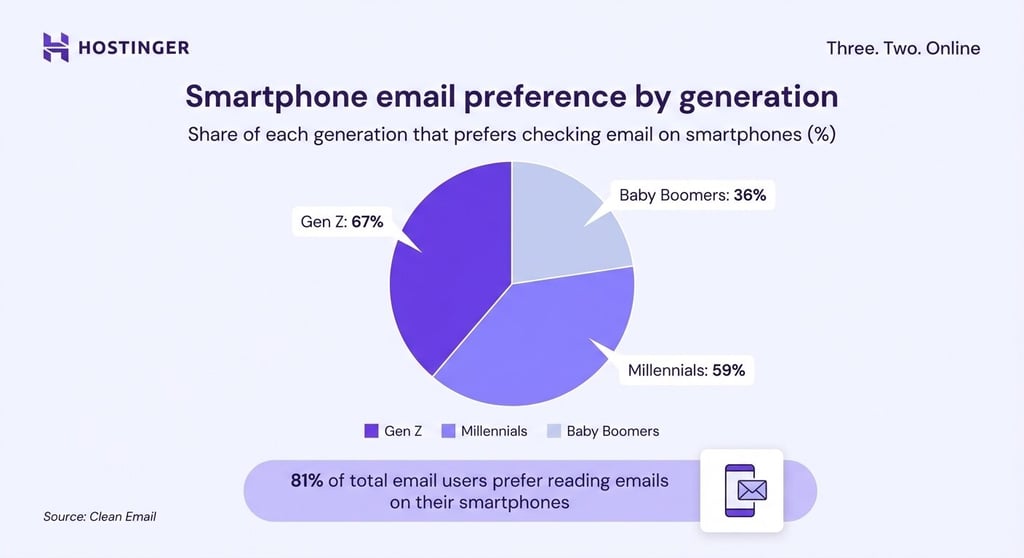
Younger generations show the strongest preference for mobile email, but the trend cuts across every age group. For businesses and marketers, the message is clear: if an email does not work on a phone, it is likely to be deleted before it is read.
How many spam emails are sent per day?
Spam represents a significant portion of all email traffic worldwide. Beyond simple annoyance, unsolicited emails carry real security risks, from phishing attempts to malware, and have a measurable effect on user trust and inbox deliverability for legitimate senders.
- Over 160 billion spam emails are sent every day, accounting for nearly 45.6% of all global email traffic (EmailTooltester, Statista)
- Over 38 million phishing attacks were detected worldwide in 2024, highlighting how spam is increasingly used as a vehicle for targeted cybercrime, not just bulk promotions (Statista)
- China and the United States lead global spam output, each sending around 7.8 billion spam emails per day, by far the highest volumes of any country (Statista)
- 96.8% of people report receiving spam messages of some kind, whether by email, text, or phone call (Clean Email)
- 80% of users say they mark an email as spam if it looks like spam, meaning poor design, misleading subject lines, or unfamiliar senders are enough to trigger a spam report (ZeroBounce)
- 47% of people report an email as spam if they did not give explicit permission to receive it, a clear signal that consent-based email practices are not just a best practice but an expectation (ZeroBounce)
Expert tip
When nearly half of all email traffic is spam, email deliverability becomes a competitive advantage. Most senders focus on subject lines and send times, but the real filter happens before any of that — at the domain level.
If your SPF, DKIM, and DMARC records aren’t configured correctly, you’re asking inbox providers to trust you on your word. They won’t.

Inbox placement for legitimate senders is harder to earn and easier to lose. Maintaining a clean sender reputation, using proper email authentication, and sending only to engaged, opted-in audiences are the most effective ways to avoid the spam folder.
The future of email: trends and business email solutions
The data makes one thing clear: email is not declining. With nearly 400 billion messages sent daily and a user base approaching 5 billion people, email remains one of the most actively used communication channels in the world, and its commercial value is still growing.
Despite the rise of social media platforms and messaging apps, email continues to hold its ground precisely because it is direct, personal, and measurable. Businesses rely on it for customer acquisition, retention, transactional communication, and brand building. For consumers, it remains the primary channel for formal and commercial communication.
Several trends are shaping email’s next phase. AI is the biggest one: 89% of marketing experts expect up to 75% of email strategy operations to be fully AI-driven by 2026, according to Litmus.
That means automated personalization, smarter send-time optimization, and AI-generated content at scale – capabilities that tools like Hostinger Reach are already bringing to businesses of any size, without requiring a dedicated marketing team.
Expert tip
Email is still one of the highest-ROI channels available, but the gap between senders who use it well and those who don’t is widening.
AI tools are making it easier to personalize at scale, time campaigns intelligently, and create professional-looking emails without a design team. The businesses that will get the most out of email in the next few years are the ones treating it as a strategic channel, not just a broadcast tool.

At the same time, email authentication standards are becoming more important as spam and phishing volumes rise, making protocols like SPF, DKIM, and DMARC essential for any brand that wants its messages to reliably reach the inbox.
As inbox providers tighten filtering and users become quicker to mark emails as spam, the quality of a sender’s list, the relevance of their content, and the technical setup behind their domain all matter more than ever. A professional business email address is now a baseline requirement, not just for appearances, but for trust and inbox placement.
Email has grown from a simple messaging tool into a core commercial infrastructure. The volume numbers reflect that: nearly 400 billion messages per day, growing at 4.2% annually, with no slowdown in sight.

Daniela is an Off-Site SEO Specialist with extensive expertise in link building, digital PR, and content optimization. She has led international outreach campaigns across the U.S., Brazil, France, and Spain, securing high-quality backlinks. Follow her on LinkedIn.