Fazenda Bonanza: A fourth-generation coffee family finally puts their name on the bag

In early March 2020, Talles Carvalho was on the other side of the world. He was working in marketing on a world cruise aboard the MSC Magnifica when COVID began closing ports and grounding flights.
Back home in Brazil, his wife, Aila, was heavily pregnant with their first child, Lucca. Talles had arranged leave to be there for the birth, but the company could no longer promise he would make it home in time.
So he resigned and got off the ship in Sydney, making his own way back through borders that were closing one by one.
He landed in Minas Gerais, at his family’s farm in the mountains where, as Talles describes it, “there’s always good hot coffee and pão de queijo waiting for you.” The farm had been growing coffee for 65 years.
For most of that time, the family sold their beans the same way every other commodity producer in the region did: shipped abroad in unlabeled bags, with no brand attached. They kept the worst of what they grew for themselves.
Today, Fazenda Bonanza is a specialty coffee brand. The coffee carries the family’s name and their colors, and reaches customers through a mix of online and on-the-ground channels.
All of this happened in the last five years.
Years abroad, then home


Before he came home, Talles had been gone a long time. In 2012, he left Brazil on an Erasmus exchange to Porto, Portugal, where he stayed two years and finished a degree in journalism and graphic design at the Faculty of Fine Arts.
The rest of that decade went to marketing for cruise lines: Norwegian Cruise Line, then Royal Caribbean, and finally MSC, the Italian company.
The job carried him through ports across Europe, Asia, and the Americas. He produced destination videos and, on paper, built a life that was hard to leave.
The salary was in euros. His managers wanted him to stay. But something was always missing.
“I had a feeling that I needed to go back to my hometown,” Talles said. “I think everyone has a bit of this feeling.”
The return in 2020 was not a soft landing. His mother, Marcia, a schoolteacher of 30 years who had recently retired to help on the farm, had been diagnosed with cancer.
The first stretch back was hard. His savings were running out, the farm couldn’t yet support him, his son was a newborn, and his mother was in treatment.
“My money was just disappearing,” Talles said. “We didn’t see that it would be possible to have a successful business as we have right now.”
It took three to four years before the business could actually pay him a salary. The work in that period was less about the coffee itself and more about everything around it: rebuilding the main house on the farm, investing in roasting and processing equipment, and getting the brand off the ground.
“Now I see that it was the best decision,” Talles said.
A family that sold the best coffee and drank the worst
The family had been growing coffee at the same farm for 65 years. Talles’ great-grandfather started it, his grandfather kept it going, and his father runs the production today.
Talles is the fourth generation.
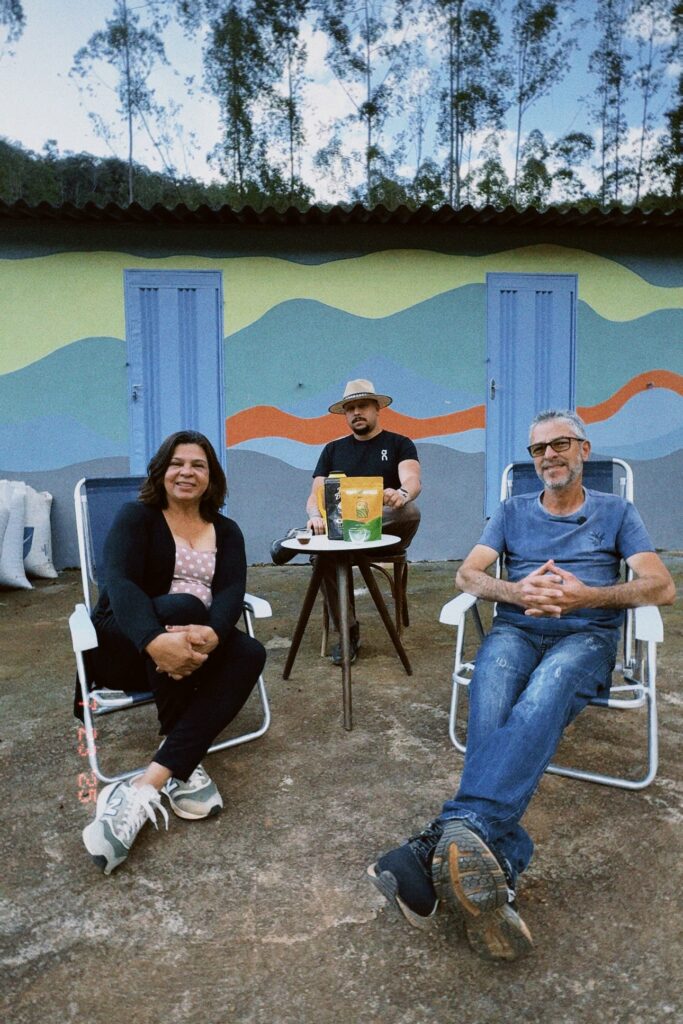
For most of that time, the model was simple. The family grew Arabica coffee, processed it into green beans, and sold it unroasted.
The work itself was anything but simple. The farm sits in a mountainous stretch of Minas Gerais near Serra do Brigadeiro, with around 110,000 coffee trees picked by hand at altitudes up to 920 meters.
The coffee left the farm anonymous, even though every step of producing it required skilled, hands-on work.
“For more than 20 years, we always sold coffee as a commodity, as something that we put in a bag,” Talles said. “No label, no identity.”
And the family didn’t even sell abroad directly. A middleman bought the green beans and passed them on to markets in Europe, Asia, and the Americas, one more layer between the farm and anyone who valued the coffee.
Coffee is a global commodity. The producer doesn’t set the price; the market does.
For decades, the market told Minas Gerais coffee growers that their region wasn’t worth much. The reputation went back over a century. The region’s coffee even had its own denomination, Rio Zona, the bottom of Brazil’s cup-quality scale.
Beans from the region were known to spoil during transport to the ports. What no one realized at the time was that the coffee wasn’t actually bad.
It was being mishandled. By the time it reached the buyers, the damage was done.
What they drank at home was a separate problem. The family sold the best of the harvest and kept the worst for themselves. Those leftover beans were rough.
People roasted them dark and added sugar to cover the taste. That harsh, sweet cup became the local idea of good coffee.
“I always found it absurd that we drank the worst of our production,” Talles said. “It’s like you take the trash and the ashes, and you drink it.”
That has changed, region by region. The south of the state embraced specialty coffee years earlier. Their corner of Minas Gerais caught up only in the last five years.
The market started treating coffee more like wine. Origin, scoring, and small-batch production all started to matter.
The region that was once written off as a producer of bad beans now produces some of the best coffee in Brazil. Bonanza’s own coffee scores between 80 and 86 points on the specialty grading scale, with maximum points in sweetness. Anything 80 or above qualifies as specialty grade.
Talles wanted his family to participate in that shift, not just supply it. That meant keeping the best of what they grew, putting it in their own bags, and selling it with their name attached.
“If the coffee is special, why not the package?”
The packaging of Bonanza’s coffee wasn’t an afterthought. It was a central piece of how the family rebuilt the business once Talles came home.
“If the coffee is special, why not the packaging?” he said. “And also the communication and the website? Everything around it should be treated the same way the coffee is treated.”
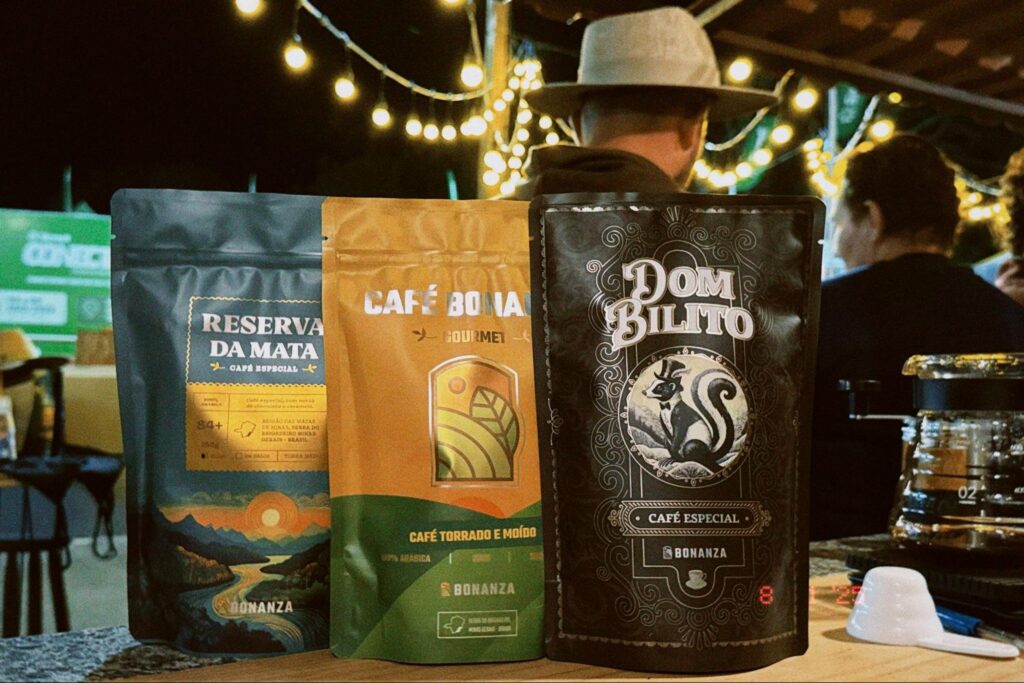
The design of every bag is rooted in the actual farm. The main yellow package reflects the landscape and the sunset visible from the farmhouse, with the Bonanza Valley and Pico do Soares in the distance.
The logo is the shape of the main door of the farm, a reference to the family’s tradition of welcoming visitors. “We want to communicate that our doors are always open,” Talles said.
The pink package, reserved for their best annual microlot, gets a new design each year, built around the season’s flavor profile.
Talles runs a marketing agency alongside the coffee business, and that’s where the design work happens. He provides the art direction, and a designer he has worked with for three years brings it to life.
For Talles, all of this comes back to a bigger idea about what the brand is offering.
“We don’t just have a brand,” he said. “We have a moment, and coffee is that moment.”
In early 2026, the marketing agency brought Bonanza into a deal it hadn’t seen before. A major supermarket chain in Minas Gerais, which had been an agency client for years, agreed to launch its first private-label coffee line.
The chain wasn’t buying the Bonanza name. They were buying the coffee itself, already specialty-grade and distinctively sweet.
The agency proposed the concept. Bonanza filled the bags. The deal became Bonanza’s biggest single sale to date, sold exclusively across the chain’s 10 stores.
“That was the time when we realized, okay, this is something that is working,” Talles said.
The website came first, the office came later
Bonanza had a website before it had a physical office in town. The farm, the team, and the production setup had been there for years.
Talles built the site himself, around mid-2023, during the harvest season at the farmhouse. He had bought the domain through Hostinger and noticed the website builder came with it.
So he gave it a shot.
“I had some good coffee, and it was a nice morning,” Talles said. “I started doing it, and I never stopped.”
He has no programming background. His training is in journalism and design, not development.
The builder was visual enough that he could work without writing code, and the result was something he could shape to match the brand he had built.
The yellow background on the homepage matches the yellow on the main coffee bag. It’s also the color of the farmhouse itself.
The fonts, the logo placement, and the photography all pull from the look the family had been refining since Talles came home.
“I was able to put my brand on that,” Talles said. “It belonged to the same brand as the packages, the coffee, and the actual farm.”
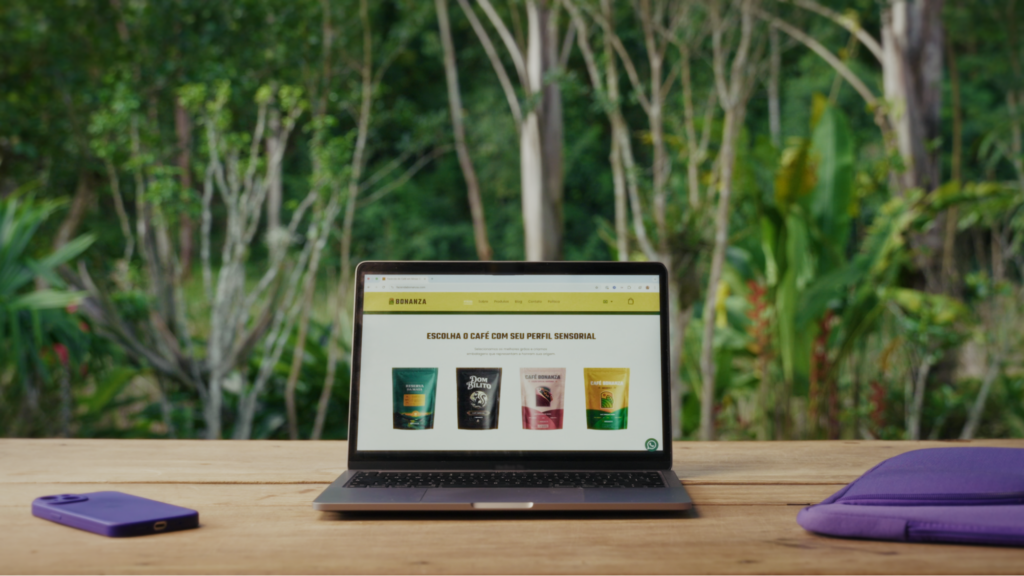
The site is also a shop. Customers can choose ground or whole-bean coffee, pick a microlot, leave reviews, and check out without much fuss.
The price mattered too. Margins on a small specialty coffee business are tight, and a professional designer or developer would have been hard to justify at that stage.
“It has a nice price, which is important,” Talles said.
“Everything we do to run our coffee business is hard work,” Talles said. “The website is the easy part. And it’s true.”
Not the main channel, but the most important one
Most of Bonanza’s sales don’t come from the website. They come from supermarkets in the region, events, salespeople, Amazon (a good fit for the long distances of Brazilian shipping), and a network of influencers who share discount coupons with their followers.
But Talles ranks the website as the most important channel for the business. It earns that ranking not for what it sells but for what it confirms.
“If I were to rank it, the website is number one for credibility,” he said. “People feel that the company exists if you have it on a website. On Instagram, you can attract more views and more people, but for people who are highly intent on buying or who are looking to do business with you, the website works better.”
The clearest proof of that came in early 2026. ApexBrasil, the country’s trade and investment promotion agency, reached out to Bonanza after finding them through Instagram and following the link to the website.
That conversation led to Bonanza enrolling in a coffee export program, which is now opening doors in markets they couldn’t easily access from Minas Gerais on their own.
“They found us through the site,” Talles said. “The website helps with that institutional communication. It’s how people understand that the company actually exists.”
Talles calls the farm side of the business “pretty rustic and crafty work.” The fields, the hand-picking, and the sorting at altitude all happen the way they have happened for decades.
The website is what connects that side to the modern markets that want to buy from it.
From a farmhouse in Minas Gerais to the world
What comes next for Fazenda Bonanza, according to Talles, is the rest of the world.
He has already started work on an English version of the website. The plan after that is to add more languages, including Spanish, so that international customers can place orders the same way Brazilian customers do today.
“Our goal is to go global,” he said. “Being available for everyone to just click and have the coffee.”
Some of that expansion is already moving on its own. The ApexBrasil program is putting them in front of international buyers, and the supermarket private-label deal is generating cash they can put back into equipment, new products, and new markets.
The fifth generation is already part of the picture. Lucca tags along to tastings, to events, and around the farm. He’s growing up in the family business.
Marcia is back working with the family, the bridge between the production side his father runs and the brand side Talles built. The cancer that hit her in 2020 is no longer a part of the story she leads with.
“Just as my father passed this legacy on to me,” Talles said, “I want my children to continue this same work and grow up on the Bonanza farm.”


Ariffud is a Technical Content Writer with an educational background in Informatics. He has extensive expertise in Linux and VPS, authoring over 200 articles on server management and web development. Follow him on LinkedIn.