Guide to Black Friday in AI search
Sep 25, 2026
/
By Ksenija
/
16 min Read

To prepare your ecommerce store for Black Friday in AI search, improve the product information so AI systems can interpret it and optimize the shopping experience so customers can evaluate and buy products.
This matters because shoppers use AI-powered search and assistants to compare products, summarize reviews, find deals, and narrow down their choices before visiting your store.
Provide clear product titles, descriptions, specifications, prices, and stock information so your products are easier to understand and compare.
Once shoppers reach your store, accurate discounts, delivery estimates, return conditions, and customer reviews help them verify the offer and decide whether to purchase.
These changes do not guarantee that an AI system will mention or recommend your products. However, they give AI systems more reliable information to interpret while strengthening the store experience needed to convert product discovery into a sale.
Guide to Black Friday in AI search: 11 tactics to build Black Friday AI search readiness into your ecommerce strategy:
- Give AI systems complete and consistent product data.
- Answer the questions shoppers ask when comparing products.
- Help shoppers narrow their options within product categories.
- Target seasonal shopping needs with deal pages and gift guides.
- Make product differences easier to evaluate.
- Support buying decisions with reviews and transparent policies.
- Keep offer details clear and up to date.
- Expand product visibility across relevant third-party sources.
- Make products easier to evaluate on mobile.
- Remove inventory and checkout barriers to purchase.
- Track AI visibility and respond to changes throughout the sale.
1. Clean up your product data
To clean up your product data, review the core information that identifies each product and distinguishes it from similar options, including its name, category, variants, specifications, identifiers, brand, and other relevant attributes.
AI-powered search and shopping assistants can use information from product pages, structured product feeds submitted to shopping platforms, category pages, and other connected sources to identify and compare products.
Missing attributes give these systems less information to work with, while conflicting specifications or identifiers can make it harder to determine which details describe the product accurately.
Focus on the attributes shoppers actually use to distinguish one product from another.
Describing a laptop as high-performance, for example, provides little concrete information. Listing its processor, RAM, storage, display size, battery life, and operating system makes the model and its capabilities much easier to understand.
If your ecommerce platform supports it, add Product structured data to your product pages. This standardized, machine-readable markup identifies important information about the product and helps search engines interpret it more reliably.
Include identifiers and attributes such as:
- Brand – the manufacturer or brand associated with the product.
- Product variants – differences such as size, color, material, or configuration that distinguish one version from another.
- SKU – your store’s internal identifier for a specific product or variant.
- GTIN – the product’s global identifier, such as a UPC, EAN, or ISBN, when one exists.
- Product specifications – attributes relevant to the category, such as dimensions, material, capacity, processor, storage, or compatibility.
If you sell through Google, submit and maintain a product feed in Google Merchant Center. Before Black Friday, check for missing identifiers, incomplete attributes, disapproved products, and differences between the product details in your feed and on your website.
Cleaning up product data should be one of the first ecommerce strategies for Black Friday because product descriptions, category pages, comparisons, gift guides, and other shopping content all depend on accurate information about what you’re selling.
2. Rewrite product descriptions around buying questions
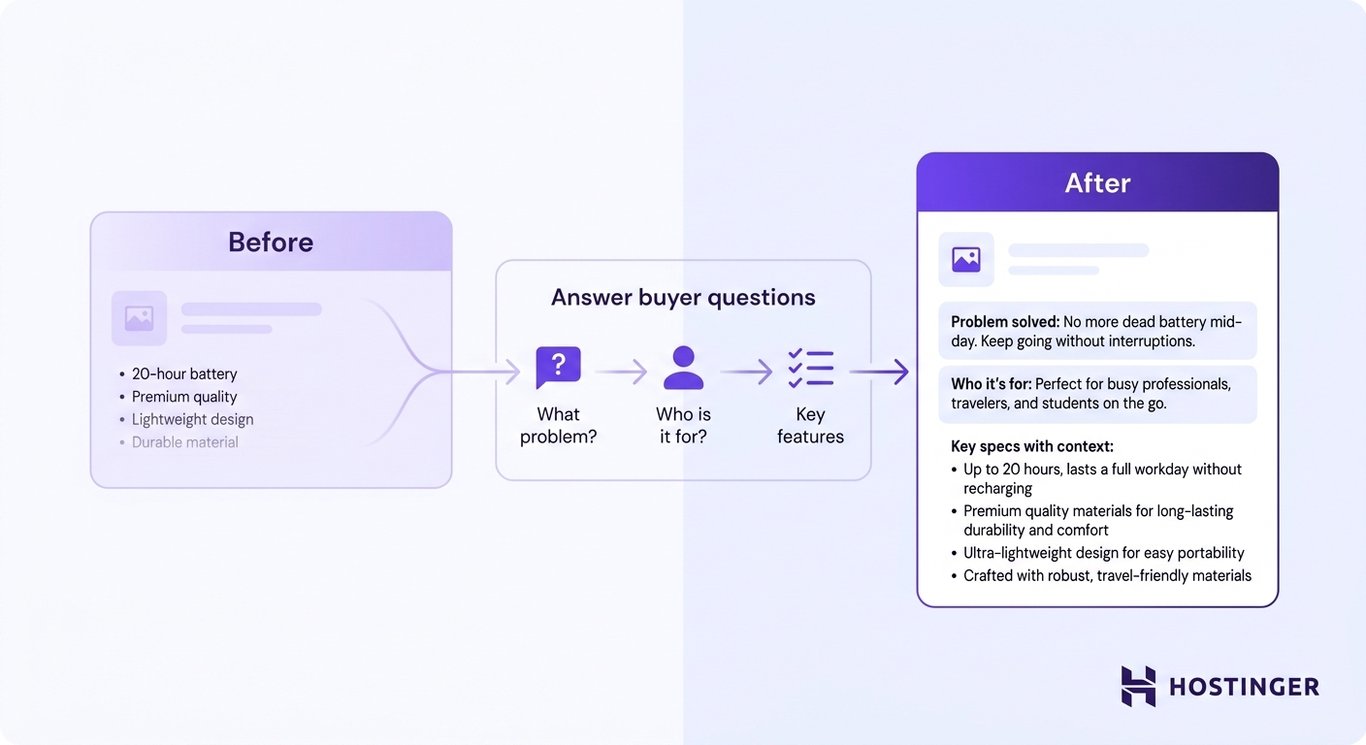
Rewrite product descriptions to answer the questions AI-powered search and shopping assistants are most likely to summarize for potential buyers.
Start by identifying the questions customers repeatedly ask before buying. Product reviews, support requests, and product Q&A sections often reveal the information missing from your descriptions.
If the same question keeps coming up, don’t leave the answer buried in a help article or customer support inbox; add it to the product page.
If a product page clearly explains what the product is, who it’s for, and why someone would choose it, AI systems are more likely to surface accurate information when helping shoppers compare products.
Before writing a product description, answer questions such as:
- What problem does this product solve?
- Who is it designed for?
- What are its defining features?
- Which specifications influence the buying decision?
- What sizes, dimensions, or compatibility requirements should customers know about?
- Are there any limitations or situations where another product would be a better fit?
- What makes this product different from similar alternatives?
Those answers help shoppers make decisions, but they also give AI systems enough context to compare products and explain why one option may be more suitable than another.
Focus on providing context, not just facts. A specification tells readers what a product has. Context explains why that specification matters.
Compare these examples:
Instead of: 20-hour battery life.
Write: Up to 20 hours of battery life, designed to last through a full workday without charging.
The second version doesn’t exaggerate or add marketing language. It simply connects the specification to a real-world use case, making the product easier for both shoppers and AI systems to interpret.
Avoid generic claims such as perfect for everyone, best-in-class, or unmatched performance.
3. Strengthen category pages for comparison shopping
Strengthen category pages by adding the context shoppers need to compare products and narrow their options.
This is particularly useful for broad searches such as best gaming laptops or Black Friday running shoe deals, where the shopper knows the product category but has not chosen a specific model.
A strong category page should provide more than a product grid. Add:
- A clear category description. Explain what products belong in the category and, when helpful, what falls outside it. This helps shoppers confirm that they are browsing the right products.
- Differences between product types. Describe the features, benefits, and tradeoffs that distinguish the main options. For example, explain how earbuds, on-ear headphones, and over-ear headphones differ in portability, comfort, battery life, and noise isolation.
- Filters based on buying criteria. Let shoppers filter products using the attributes that affect their decisions. A laptop category could include processor, RAM, storage, display size, operating system, and price.
- Guidance on who each option suits. Connect product types or features to specific needs. For example, earbuds may suit commuters, while over-ear headphones may be better for long journeys or focused listening.
- Links to comparisons and buying guides. Direct shoppers to content that answers common questions, explains technical differences, or compares popular options in more detail.
Category pages that explain buying criteria, product differences, and intended use give AI systems richer information to summarize while helping shoppers move from a general idea to a shortlist of products that match their needs.
4. Create dedicated Black Friday deal pages and gift guides
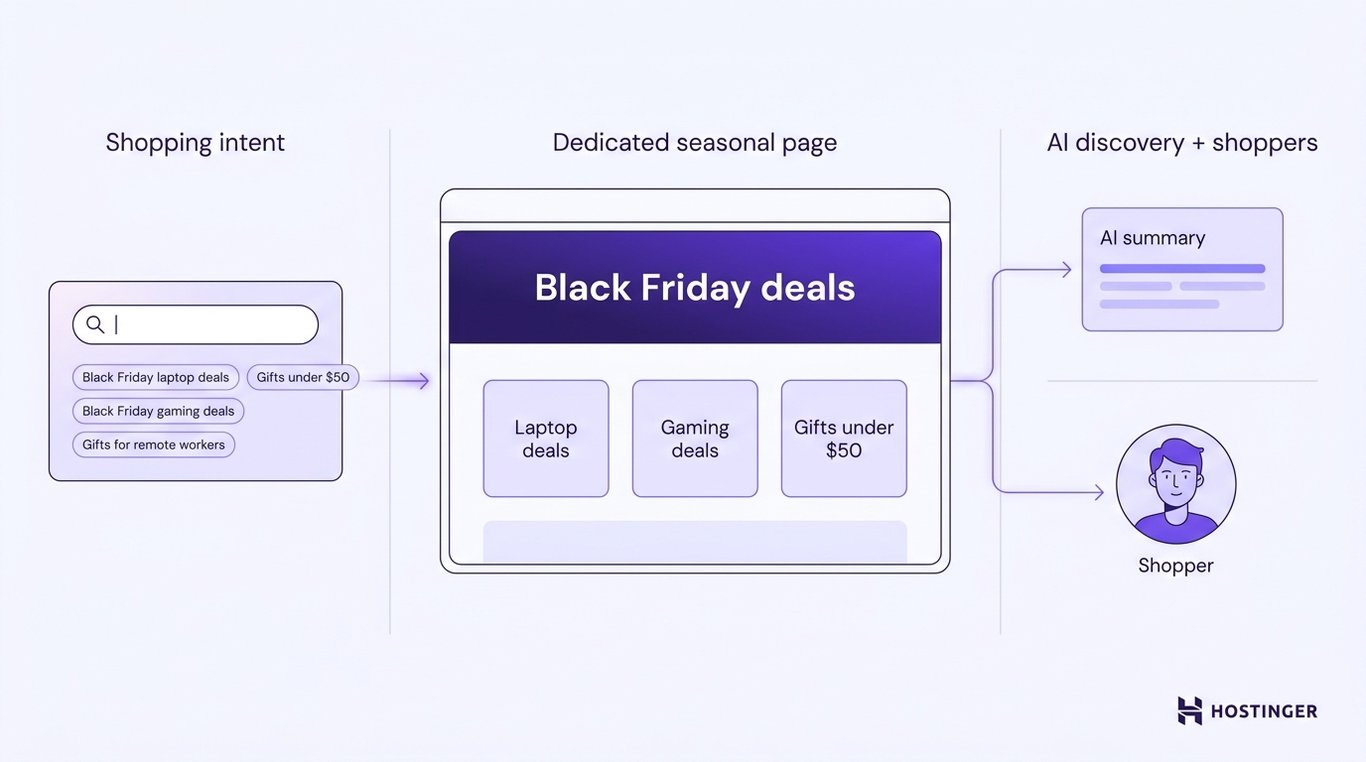
Build separate seasonal pages around the ways shoppers narrow down Black Friday purchases, such as product category, budget, recipient, or interest.
Use these criteria to decide which deal pages and gift guides to create instead of putting every promotion on one general Black Friday page.
For shoppers looking for a particular type of deal, create focused pages such as Black Friday laptop deals, Black Friday gaming deals, Black Friday deals under $100, or Black Friday deals for students. For example, Hostinger Black Friday deals bring seasonal offers for hosting and other website services together on a dedicated deal page.
Include only products that match the page theme and provide the details shoppers need to compare them, such as the original and discounted price, key features, availability, and promotion terms.
Keep this information updated throughout the sale so the page reflects the offers that are actually available.
Use gift guides when shoppers need help deciding what to buy, rather than simply finding a discount.
Choose guide themes based on who the gift is for, what they’re interested in, or how much the shopper wants to spend, such as:
- Black Friday gifts for gamers
- Tech gifts under $50
- Gifts for remote workers
- Black Friday gifts for college students
Select products that genuinely fit each guide and briefly explain why each recommendation suits that recipient, interest, or budget.
You can also group products by price range, use case, or product type when this makes the choices easier to compare.
Dedicated pages also give AI-powered search and shopping assistants a focused source for matching products to specific shopping queries.
This is particularly useful during Black Friday, when shoppers are searching across many products and promotions in a short period.
5. Publish useful product comparisons
Publish product comparisons that help shoppers evaluate options against the criteria that matter to their decision.
This content directly answers questions they may ask AI tools, such as Laptop A vs. Laptop B, Which wireless earbuds are better for travel?, or What is the difference between these coffee machines?
Compare products using concrete criteria rather than broad claims. Depending on the category, these may include:
- Price
- Specifications
- Size or dimensions
- Compatibility
- Included features and accessories
- Intended use
- Ongoing ownership costs
- Strengths and tradeoffs
Use a comparison table to present the main differences in a consistent, scannable format. For example:
Feature | Laptop A | Laptop B | Laptop C |
Price | $899 | $999 | $1,199 |
Processor | Intel Core i5 | Intel Core i7 | AMD Ryzen 9 |
Graphic | Integrated | Integrated | Dedicated |
RAM | 16 GB | 16 GB | 32 GB |
Storage | 512 GB SSD | 1 TB SSD | 1 TB SSD |
Best suited for | Everyday work | Creative projects | Gaming and demanding workloads |
Pro tip
If your platform supports it, add structured data markup (such as schema.org/Product) to your comparison pages. This helps AI-powered search systems read and verify product attributes directly from your page, rather than inferring them from unstructured text.
Don’t stop at the table. Explain what those differences mean in practice, so neither shoppers nor AI systems have to infer why one product is a better fit than another.
- Choose Laptop A if you want the lowest price for everyday work, browsing, and productivity tasks.
- Choose Laptop B if you regularly edit photos or videos and need more processing power without moving into a premium price range.
- Choose Laptop C if you run demanding software or play modern games where additional memory and graphics performance justify the higher cost.
Avoid declaring every product the “best.” AI-powered search aims to match products to specific requirements, not identify a universal winner.
6. Build stronger review and trust signals
Build trust by collecting genuine customer reviews and making essential purchase information easy to find. Reviews provide evidence about real customer experiences that product descriptions cannot establish on their own.
Start collecting reviews before Black Friday rather than waiting for seasonal traffic to arrive. Ask customers to describe how they used the product, what worked well, and what limitations they encountered.
A review explaining that a backpack remained comfortable during a week-long hiking trip is more useful than a five-star rating without any context.
Display enough information for shoppers to evaluate the feedback properly, including:
- The product’s rating and number of reviews
- Written feedback from customers
- Verified-purchase status, where supported
- Recurring strengths or problems
- Merchant responses to relevant questions or complaints
Do not remove reasonable criticism simply to improve the overall rating. A mix of positive and negative experiences can make the reviews more credible while helping customers decide whether a product suits their needs.
Displaying certification badges or award logos without linking to the original source can reduce credibility rather than build it. Shoppers and AI systems may treat unverified claims with the same skepticism as marketing copy. Always link directly to the certifying body, test report, or award page.
Reviews and transparent policies do not guarantee that AI systems will cite or recommend your products. Their primary purpose is to help shoppers assess the product, understand the purchase conditions, and decide whether they trust your business.
7. Make pricing, discounts, shipping, and returns explicit
Display the key terms for each Black Friday offer directly on the product page, near the price and purchase options.
Make each detail specific rather than relying on generic sales messaging or requiring shoppers to search elsewhere for information.
Support a reliable ecommerce customer experience by making the following information easy to find:
- Current and original price
- Discount amount and any conditions
- Stock status
- Availability for each variant
- Estimated delivery dates
- Shipping costs
- Return conditions
Be specific about discounts. Instead of showing “up to 70% off” on an individual product that receives a much smaller discount, state the actual discount and sale price for that product.
If the offer requires a coupon, a minimum purchase, a membership, or another condition, display that alongside the price.
Make sure you give shoppers clear delivery estimates, costs, and any Black Friday-specific return conditions before they reach checkout.
AI-powered shopping tools may use these details to determine whether a product matches a shopper’s request.
If someone is looking for a laptop under $1,000 that can arrive before the weekend, the current price and delivery estimate all affect whether the product is a suitable recommendation.
Keep this information updated as Black Friday offers change. An expired price, an unavailable variant, or an outdated delivery estimate can leave AI systems working with information that no longer reflects what the shopper can actually buy.
8. Build mentions beyond your own website
Build relevant third-party mentions by making accurate product information available on the platforms shoppers already use to research purchases.
AI-powered search draws on multiple sources, so your product pages are not the only places where shoppers or AI systems may encounter your brand.
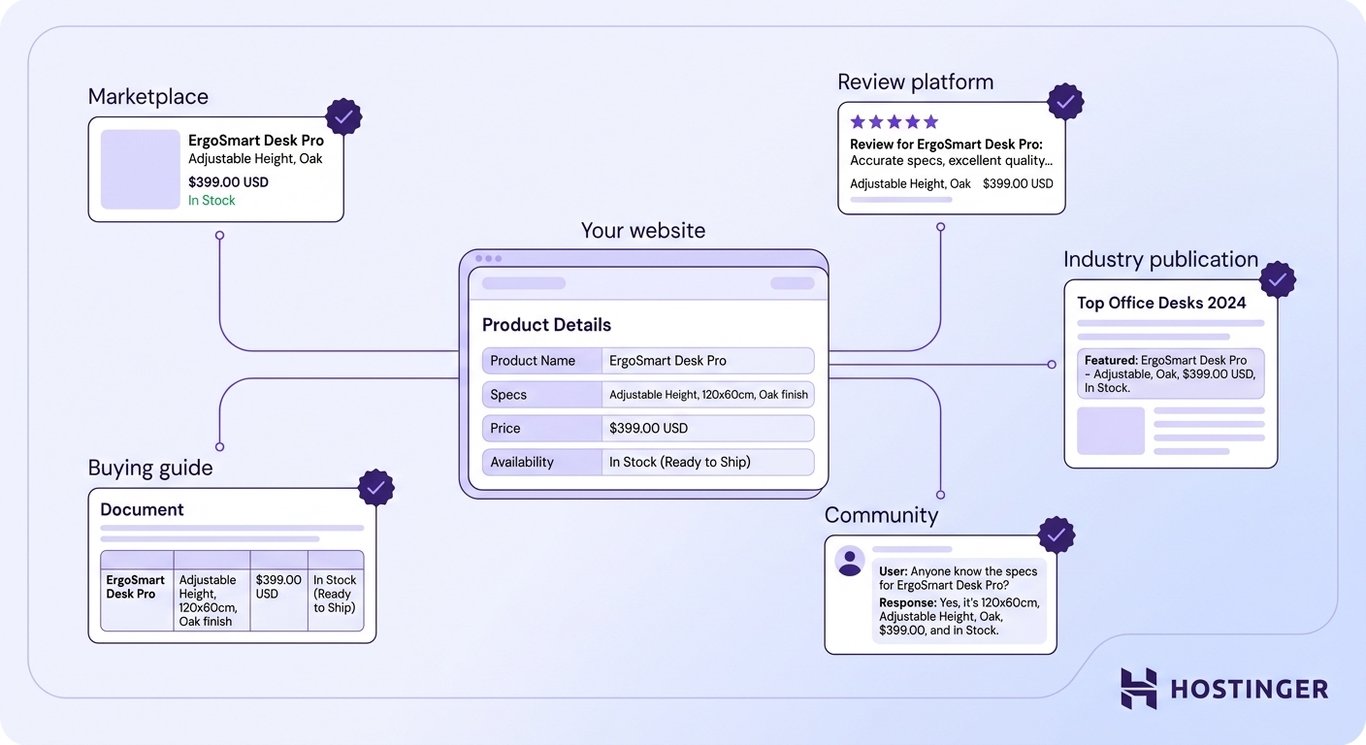
Start by identifying external sources that already influence buying decisions in your product category.
Depending on what you sell, these might include:
- Online marketplaces that list comparable products
- Specialist review sites and industry publications
- Black Friday roundups and buying guides
- Reputable product directories
- Communities where shoppers discuss your product category
- Social platforms where genuine product reviews and recommendations appear
Prioritize relevance over the number of mentions. A running shoe brand, for example, is better served by coverage from an established running publication or specialist gear reviewer than by listings on unrelated directories.
Then look at how products earn inclusion on those platforms. Some publications accept products for editorial review, marketplaces allow merchants to submit listings, and directories have formal submission processes.
Communities require a different approach. Don’t create accounts simply to post promotional links. Instead, participate where you can genuinely answer questions or clarify product information, and follow each community’s rules on commercial participation.
Once your products appear on external platforms, check the information periodically. Product names and specifications should be accurate, and time-sensitive details such as Black Friday pricing or availability shouldn’t contradict information you control elsewhere.
Third-party mentions can give AI systems more sources for discovering and evaluating your products, but they don’t guarantee that your products will appear in AI-generated answers.
9. Improve product images and the mobile shopping experience
Improve product images and mobile usability so shoppers can quickly verify and evaluate products they discover during Black Friday research.
AI search may narrow dozens of options to a shortlist, but the shopper still needs to confirm details such as appearance, size, variants, price, and availability on the product page before buying.
Start with images that answer questions the product data can’t. Show the complete product, multiple angles, available variants, and close-ups of details that affect the buying decision.
Add scale or dimensions where size is difficult to judge from a standard product photo. For products where use matters, include an image showing the item in context.
Then test the same product page on a smartphone. Don’t just check whether the page technically fits the screen.
Try to complete the tasks a Black Friday shopper is likely to perform quickly:
- Swipe through the product gallery
- Zoom in on important details
- Select a size, color, or other variant
- Find the sale price and stock status
- Open shipping or return information
- Add the product to the cart
Watch for slow-loading images, controls that are difficult to tap, variant selectors that hide unavailable options poorly, and promotional pop-ups that cover important product information.
10. Prepare inventory, payments, and checkout for demand
Prepare your inventory, payment setup, and checkout before Black Friday so shoppers can complete purchases without encountering outdated information or avoidable friction. AI-driven discovery has little commercial value if a product is sold out, its discount does not apply, or the checkout fails.
Start with inventory. Check the available quantity for each product and variant included in your Black Friday promotions, especially for products sold through multiple storefronts or sales channels.
Stock can change quickly during the event, so the availability shown on your store and any product feeds you control should reflect what customers can actually order.
Decide how you’ll handle products that sell out, too. Check what customers see when a product or a specific variant becomes unavailable, and confirm that they can no longer purchase it.
If you replenish popular products during the promotion, update inventory promptly wherever you control the product information.
Leaving stale availability online increases the chance that shoppers or the systems helping them research products encounter an offer that no longer exists.
Next, review your payment and shipping setup. Confirm that every payment method you plan to offer is active and correctly configured.
Check shipping rules as well, particularly if rates depend on location, order value, or delivery method.
A shopper who has already narrowed down a product through AI-assisted research may arrive with a specific price or delivery requirement in mind, so unexpected costs at checkout can undermine the information that brought them there.
If you’re still creating an ecommerce website or preparing your store for its first major sales event, choose an ecommerce setup that lets you manage those operations centrally.
With Hostinger Ecommerce, you can manage products, orders, payments, shipping, and sales channels through a central Store Manager.
You can set up checkout and payment methods, manage inventory across your store, and use AI to generate or improve product descriptions.
Quick Links give you another way to sell individual products by creating shareable purchase links that you can add to social media, messages, or other channels without sending shoppers through your main storefront.
Before Black Friday, test the entire purchase process rather than assuming a configured checkout is ready for a surge in orders.
Hostinger Ecommerce provides a test payment method, so you can place test orders without processing real transactions.
Check that checkout loads quickly and works smoothly on mobile, payments and shipping options appear correctly, orders reach the Store Manager, and inventory updates after a purchase, so customers aren’t able to buy products that are no longer available.
Before Black Friday, place a test order and check that:
- Checkout loads and completes without errors.
- The correct product and variant appear in the order.
- Payment works as expected.
- Shipping options and costs are calculated correctly.
- Black Friday discount codes apply to eligible orders.
- Discounts don’t apply to excluded products or ineligible orders.
- The completed order appears in your store manager.
- The customer receives the expected confirmation.
AI search can influence which products make a shopper’s shortlist, but your store determines whether that buying intent becomes a completed order. This is why the checkout experience is one of the most important parts of ecommerce conversion rate optimization strategies.
11. Monitor AI visibility and refresh content throughout Black Friday
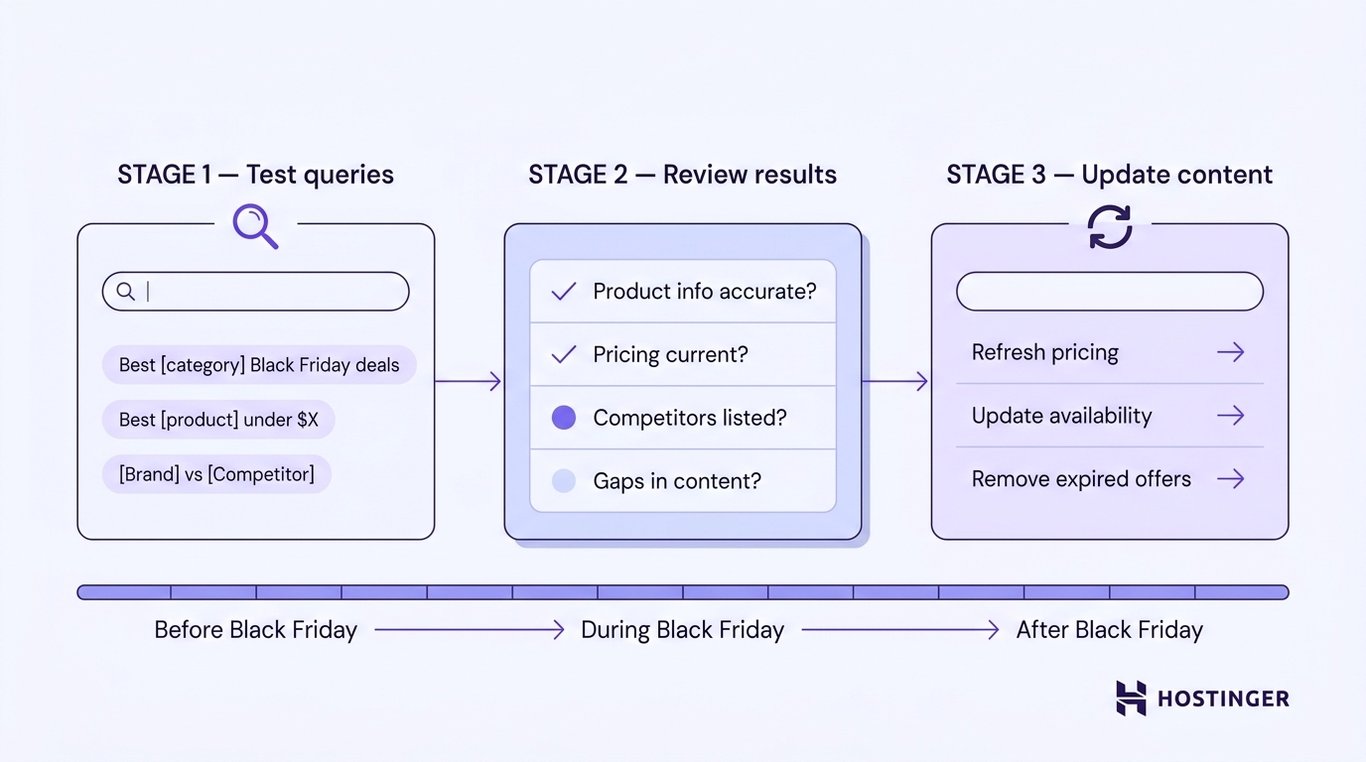
To monitor how your products appear in AI search throughout Black Friday, start by testing representative shopping queries in the AI search tools your customers are most likely to use.
For example, search for:
- Best [category] Black Friday deals
- Best [product] under $X
- [Brand] vs [Competitor]
- Best [product] for [use case]
For each query, record:
- Whether your brand or products appear
- Whether the product information is accurate
- Which competitors appear
- Which sources are referenced
- Whether expired prices or promotions surface
- Which questions your existing content does not answer clearly
Treat these manual checks as directional observations rather than a complete measure of AI visibility.
Results can vary between queries, tools, users, locations, and sessions. A product appearing once does not establish consistent visibility, while one missing result does not prove that the product never appears.
Before Black Friday
Update the content that AI systems and shoppers may use during their research. Review evergreen product information, comparison pages, category content, gift guides, and planned deal pages. Confirm that prices, product specifications, shipping terms, and promotional claims agree across the sources you control.
During Black Friday
Keep prices, availability, discount terms, and shipping estimates current. If a product sells out or an offer changes, update the relevant product feeds, landing pages, and sales channels promptly. Continue checking representative queries for outdated information or questions your content does not answer well.
After Black Friday
Remove expired claims and update deal pages so they no longer advertise unavailable offers. Preserve useful comparisons, gift guides, and other evergreen content, but revise time-sensitive language so shoppers do not encounter misleading promotions after the event.
How is AI search changing Black Friday shopping?
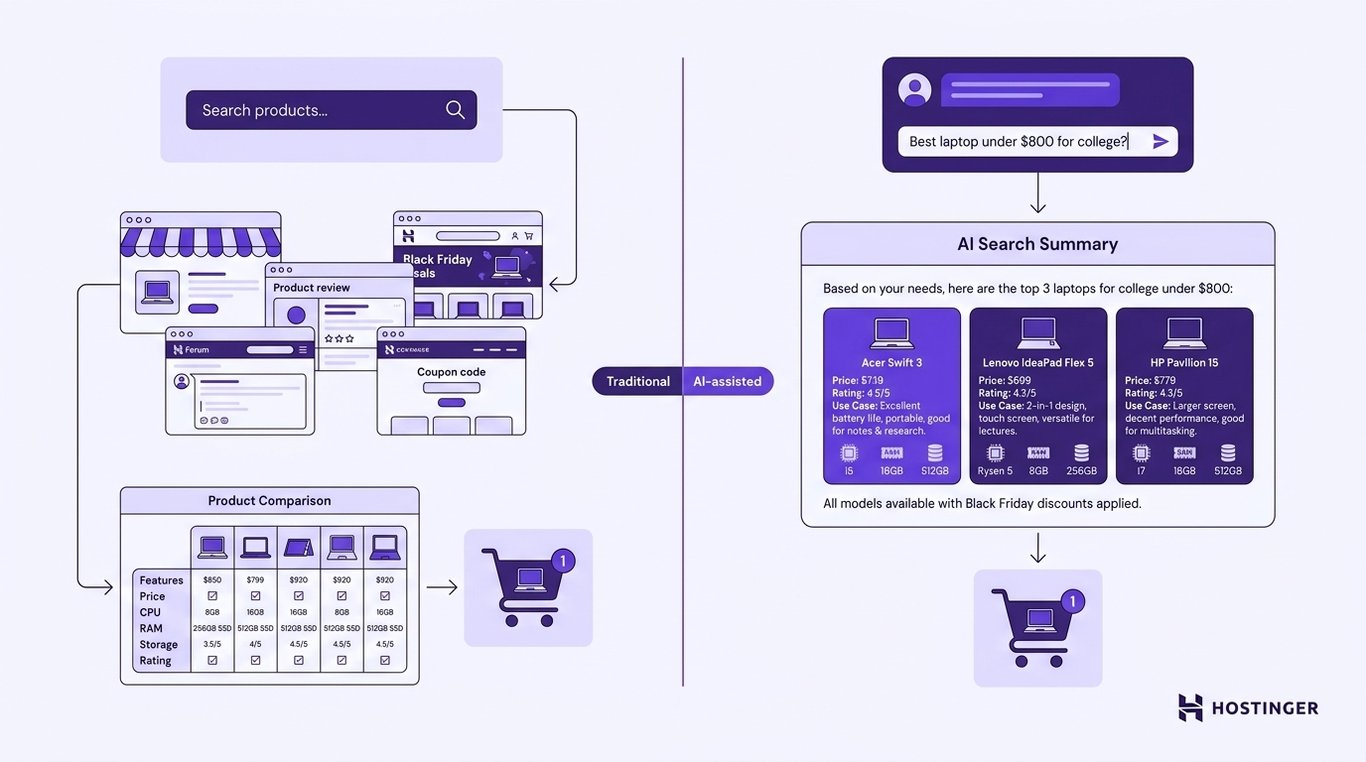
AI search shortens the Black Friday research process by helping shoppers compare products, summarize information, and narrow their options without having to manually open every search result.
A traditional Black Friday shopping journey looked like this:
Search → browse search results → open several online stores → compare products → make a purchase
With AI-assisted shopping, the process changed to this:
Ask a detailed question → receive a summarized answer → refine your requirements → investigate a shortlist of products → make a purchase
Instead of opening several product pages individually, a shopper might ask an AI tool to:
- compare three laptops within a specific budget
- summarize the differences between two products
- find Black Friday deals for a particular category
- recommend a gift for someone with specific interests
- identify the best option for a particular use case
This matters during Black Friday because shoppers often have strong purchase intent but limited time. They want clear comparisons, accurate prices, current availability, reliable delivery estimates, and straightforward return terms. If that information is incomplete or contradictory, an AI-generated answer may misrepresent the offer, or the shopper may abandon the purchase after reaching the store.
AI agents are systems that can perform tasks on a user’s behalf with varying levels of autonomy. In ecommerce, some emerging shopping agents can move beyond product research by tracking prices, adding items to a cart, or helping shoppers complete supported purchases.
Google’s Universal Cart illustrates this shift. It works across merchants and Google services, allowing shoppers to add products while using Search or Gemini and then move toward checkout through supported purchase flows.
However, Universal Cart, agentic checkout, and similar capabilities are not available to every merchant, shopper, market, or product category. Google is still expanding these features and onboarding supported retailers. Merchants should not assume that their products can automatically participate.
The practical priority is to prepare your ecommerce store for AI agents by maintaining accurate product information and a reliable path to purchase.
Whether a shopper arrives from a traditional search result, an AI-generated comparison, or an agentic shopping feature, the product page, price, stock status, shipping terms, and checkout still need to support the decision.
AI search optimization vs. traditional ecommerce SEO
Traditional ecommerce SEO helps product and category pages appear in search results, while AI search can use information from multiple sources to summarize, compare, and surface products directly within an answer.
Instead of clicking through a list of links to research products, shoppers may receive a synthesized response before deciding which stores or products to investigate further.
Here are the main differences between AI search and traditional ecommerce SEO:
Traditional ecommerce search | AI-assisted search |
Search starts with keywords. | Queries can describe detailed needs or buying scenarios. |
Results commonly appear as links or product listings. | Results can include generated comparisons, summaries, and recommendations. |
Shoppers compare multiple pages manually. | AI can summarize differences before the shopper visits a website. |
Individual page relevance is central. | Clear facts, context, comparisons, and supporting information become especially valuable. |
A click often begins the research process. | A click may happen after products have already been narrowed down. |
AI-assisted search doesn’t replace ecommerce SEO. Search engines and AI systems still rely on accessible, accurate, and understandable information to interpret your products.
Technical SEO, well-structured product data, logical site architecture, and useful content remain essential for helping both traditional search engines and AI-powered experiences understand your store.
The difference becomes clearer at the product level. A traditional search result for running shoes might lead shoppers to several product pages, where they compare qualities such as cushioning, weight, terrain, and intended use.
With AI-assisted search, some of that comparison can happen before the shopper visits a store. A query such as “lightweight road running shoes with moderate cushioning for daily 10K runs” gives the AI system several criteria to consider at once. It can use available product information to identify options that fit those requirements and explain the differences between them in its response.
This changes where product evaluation can happen in the shopping journey. Traditional ecommerce search primarily helps shoppers find relevant pages, while AI-assisted search can help interpret requirements, narrow options, and compare products before a click occurs.
Black Friday AI search mistakes to avoid
The biggest Black Friday AI search mistakes come from incomplete information, inconsistent offers, weak buying guidance, and updating your store too late.
Avoid these common missteps before seasonal traffic begins:
- Thin product descriptions. Generic copy gives shoppers little concrete information for comparing products.
- Unclear discounts. Shoppers should be able to identify the current price, discount, promotion period, and relevant conditions.
- Outdated stock information. Promoting unavailable products wastes high-intent traffic and creates conflicting information across sales channels.
- Weak shipping and return information. Missing delivery costs, estimates, and return terms create uncertainty before purchase.
- Missing customer reviews. Shoppers lose an important source of real-world evidence about product quality and suitability.
- Slow or difficult mobile pages. Product discovery has little value if poor mobile usability causes shoppers to abandon the purchase.
- Generic gift guides. A product list without selection criteria does little to help shoppers choose the right gift.
- Inconsistent information across channels. Conflicting prices, specifications, or availability make products harder to evaluate and trust.
- Waiting until Black Friday week. Late updates leave little time for shoppers, search systems, and external sources to encounter the new information.
Improve evergreen product pages, comparisons, category content, and gift guides well before Black Friday. As the event approaches and begins, shift your attention to time-sensitive information such as prices, promotion terms, inventory, and shipping estimates.
How to measure Black Friday performance in AI search
Measure Black Friday performance in AI search by combining manual checks in AI search tools with your ecommerce analytics.
Use the following metrics to measure how shoppers progress from AI-assisted discovery to purchase completion.
Metric | How to measure it |
AI visibility | Brand or product appearances for tracked AI queries, accuracy of surfaced information, competitors shown, and sources referenced |
Search discovery | Review Google Search Console to monitor organic impressions, clicks, and changes in branded search demand. |
Product engagement | Use Google Analytics 4 or your ecommerce analytics platform to track product page traffic, Black Friday landing page visits, and add-to-cart rate. |
Checkout performance | Monitor checkout completion and cart abandonment in your ecommerce platform or analytics dashboard. |
Sales performance | Review conversion rate, average order value, and revenue from Black Friday landing pages in your ecommerce reports. |
Use a consistent set of representative shopping questions when checking AI visibility. Record whether your products appear, whether the information is accurate, and how the results change during the promotion.
Treat these checks as directional, as AI-generated responses can vary across tools, queries, users, locations, and sessions.
Attribution from AI search is still imperfect. Analytics platforms may identify some referral traffic from AI tools, but merchants cannot universally track every visit or purchase influenced by an AI-generated comparison or recommendation.
The more useful approach is to interpret several signals together. For example, greater visibility across tracked AI and organic searches, followed by increased product traffic, stronger add-to-cart activity, and higher Black Friday revenue, provides more meaningful evidence than a single appearance for one AI query.
This article is a localized version of Guide to Black Friday in AI search, originally published in English.

Ksenija is a digital marketing enthusiast with extensive expertise in content creation and website optimization. Specializing in WordPress, she enjoys writing about the platform’s nuances, from design to functionality, and sharing her insights with others. When she’s not perfecting her trade, you’ll find her on the local basketball court or at home enjoying a crime story. Follow her on LinkedIn.