Replit vs. Lovable: Key differences in features and use cases
Sep 18, 2026
/
By Ariffud M.
/
14 min Read

Replit is a browser-based, AI-first development platform built around a full-code IDE that supports 50+ programming languages, while Lovable is a guided AI web app builder that generates React applications from natural language prompts with a frontend-first approach.
When comparing Replit vs. Lovable, you’re choosing between a code-first AI development platform and a guided no-code or low-code product builder. This choice affects how much control you have over your app, how quickly you can ship, and how far your project can scale.
If you want AI-powered app creation with built-in hosting, scalability, and simpler long-term management, Hostinger AI Builder offers a third option worth considering.
| Feature | Replit | Lovable | Hostinger AI Builder |
| Customization | Full-code access with 50+ languages and custom backends | Dev Mode for code editing, visual style editor, Supabase schema control | WYSIWYG editor for text and images (no credits used), code editor and ZIP export on Hobbyist and above |
| Learning curve | Moderate to steep. Best for users with development experience | Low. Guided AI handles most architectural decisions | Lowest. Conversational AI with a planning agent and prompt optimization |
| Hosting | Yes. Built into the platform, deducted from credits | Yes. lovable.app subdomains, custom domains on Pro and above | Yes. Hosting, SSL, CDN, and domain included at no extra cost |
| Deployment | One-click deploy with static, autoscale, and reserved VM options | One-click deploy to Lovable subdomains or custom domains | One-click publish to a custom domain with a sandbox testing environment |
| Pricing | Free tier, Core at $17/month, Pro at $95/month, custom Enterprise pricing. All prices reflect annual billing | Free tier, Pro at $21/month, Business at $42/month, custom Enterprise pricing. All prices reflect annual billing | Free trial, paid plans from $9.99/month (Explorer) to $99.99/month (Hustler). All prices reflect annual billing |
| Best for | Full-stack apps, custom backends, production-grade projects, mobile apps | Rapid prototyping, MVPs, frontend-first apps, product validation | Business websites, online stores, web apps, and MVPs with built-in hosting |
What are the advantages of Lovable over Replit?
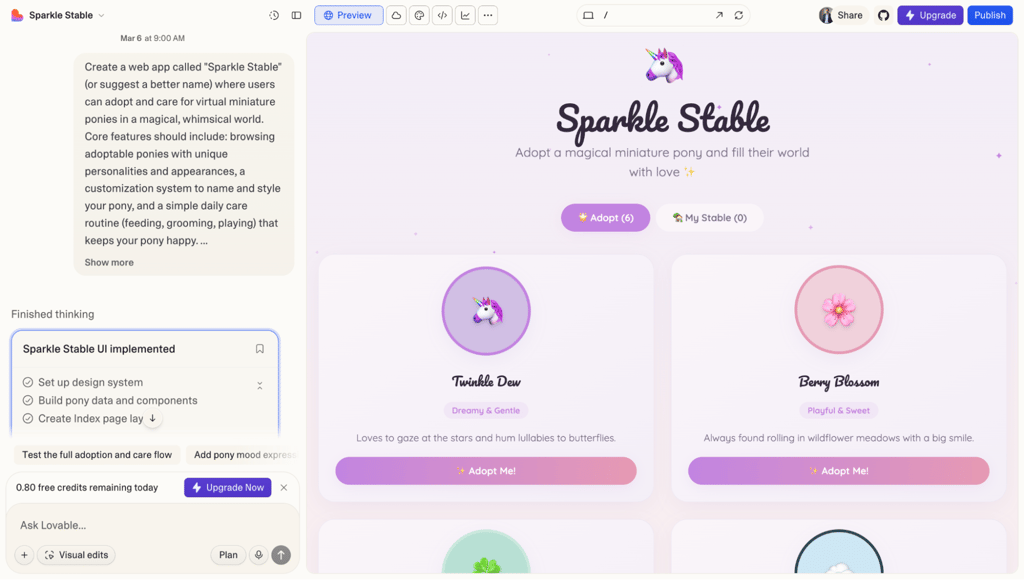
Lovable offers a faster, more guided path from idea to a working prototype with fewer technical decisions than Replit.
- Fast app creation from a single prompt. Lovable can generate a complete, structured web app from a natural language description in minutes. Founders and nontechnical users can describe a product idea, and the guided AI builder handles the architecture, component structure, and styling. Replit’s Agent can also build from prompts, but it runs inside a full IDE where users often need to review and guide the AI’s technical decisions.
- Fewer decisions for nontechnical users. Lovable’s conversational interface manages the build process without exposing users to terminal commands, file trees, or configuration files. This approach makes it a better fit for designers, product managers, and founders who want to validate an idea without learning development workflows. Replit provides a full coding environment, which assumes some familiarity with how software projects are structured.
- Cleaner, more consistent visual output. Lovable generates polished, well-structured frontend code that often looks production-ready from the first prompt. For early-stage product validation, this means you can create a demo or MVP that looks professional enough to show investors or test with users right away. Replit’s output quality can vary depending on the framework and stack you choose, and improving UI polish often requires additional iteration.
- Built-in backend for common product needs. Lovable integrates natively with Supabase to support user authentication, databases, and basic backend logic without manual setup. Founders building a login-based SaaS prototype or a data-driven MVP can get backend functionality running without writing server-side code. Replit also includes a built-in database and authentication tools, but configuring backend logic requires more hands-on development experience.
- Beginner-friendly AI tools for iteration. Lovable includes a visual style editor for design changes, a Chat Mode agent for debugging and planning, and two-way GitHub sync for version control. These features let nontechnical users refine their apps without touching code, while still enabling technical collaborators to contribute through GitHub. Replit’s tooling is more powerful overall, but most features assume a higher baseline of development knowledge.
What are the disadvantages of Lovable compared to Replit?
Lovable is a capable AI app builder for rapid frontend prototyping, but compared to Replit, it has clear limitations in backend flexibility, deep customization, and long-term scalability.
- Limited backend depth. Lovable relies on Supabase for backend functionality, which covers authentication, databases, and basic server logic. However, custom server-side workflows, complex API integrations, and multistep business logic are harder to implement. Tools like Replit provide a full-stack environment with built-in PostgreSQL, object storage, and support for writing custom backend code in any supported language.
- Customization limits from a single tech stack. Lovable generates only React + Tailwind CSS apps. If your project requires server-rendered pages, a different UI framework, or native mobile code, you’ll need to work around those constraints or build outside the platform. This also means your team’s frontend and backend choices are tied to Lovable’s defaults, limiting how much you can customize the architecture as requirements change.
- Unpredictable credit consumption. Users often report that Lovable’s 100 monthly credits on the Pro plan run out faster than expected on complex projects. Credits are charged dynamically based on message complexity, which makes costs harder to predict upfront.
- Scalability constraints beyond MVP. Lovable excels at quickly launching a working prototype, but teams building production-grade apps may outgrow the platform. Complex state management, performance optimization, and advanced integrations can push against its limits. At that stage, many teams start exploring alternatives to Lovable and move to a full-code development environment.
- Limited collaboration on lower tiers. Lovable’s free plan allows only one editor per project, and the Pro plan supports up to three editors. While Replit’s free tier also supports only one editor, its Core plan allows up to five collaborators.
What are the advantages of Hostinger AI Builder over Replit and Lovable?
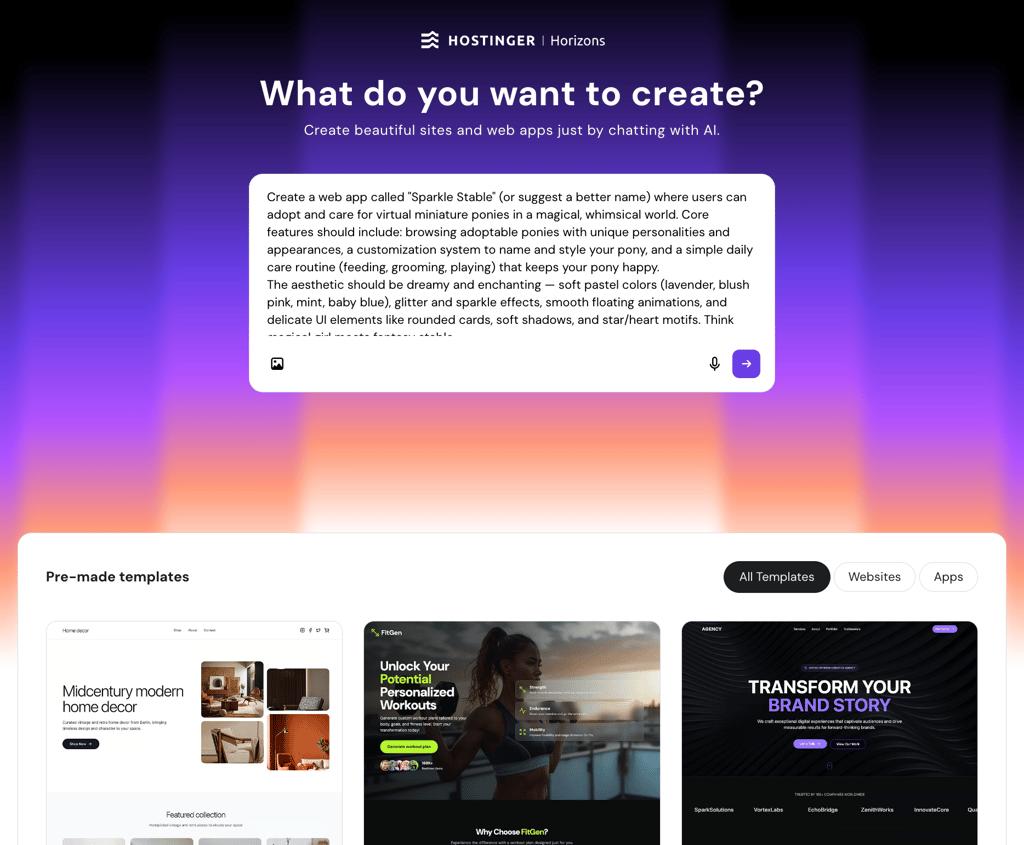
Hostinger AI Builder is an AI-powered, no-code web app builder with built-in hosting infrastructure, offering clear advantages in simplicity, cost predictability, and long-term maintenance compared to developer-focused tools like Replit and Lovable.
- Built-in hosting and infrastructure by default.Hostinger AI Builder no-code platform includes hosting, an SSL certificate, a Cloudflare CDN, and a free domain on the Starter plan and above. It also provides an integrated backend with authentication, data storage, and automated emails. Replit deducts hosting and deployment costs from your monthly credits, potentially reducing your AI usage budget. Lovable relies on Supabase for its backend functionality, which requires creating a separate account – a key difference between Hostinger AI Builder and Lovable.
- Guided AI workflows without unnecessary credit usage. The planning agent asks clarifying questions to refine your prompts before the AI generates code, so you spend credits only on actual code changes. The WYSIWYG editor on selected plans lets you edit text and images without using credits. Replit and Lovable charge dynamically based on message complexity, so even a clarifying or corrective prompt can consume credits.
- Lower long-term maintenance overhead. Published apps on Hostinger AI Builder run on managed hosting with SSL, CDN, DDoS protection, and automatic security updates handled by the platform. You don’t need to manage deployment infrastructure, monitor resource usage, or budget separate credits to keep your app running. Compared to Hostinger, Replit requires ongoing credit allocation for deployments, databases, and bandwidth, whereas Lovable relies on Supabase’s uptime for backend reliability.
- Balance between ease of use and long-term growth. Hostinger AI Builder lets nontechnical users build and launch a web app from a single conversation. As projects grow, you can expand with ecommerce features, including up to 600 products and more than 100 payment methods on the Starter plan and above, collaboration tools, and a built-in code editor on higher-tier plans. Code export (ZIP) also provides a clear migration path if your project outgrows the platform.
What are the advantages of Replit over Lovable?
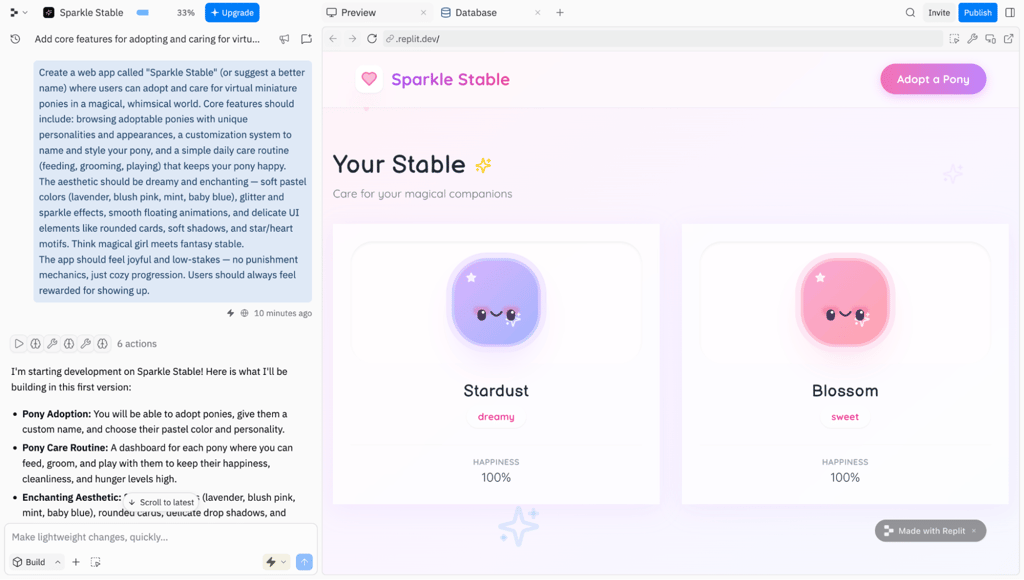
Replit is generally better than Lovable for full-stack development of complex, production-grade apps, offering deeper technical control, a complete AI coding environment, and stronger collaboration features.
- Full-code access with a complete IDE. Replit provides a browser-based development environment with syntax highlighting, an integrated terminal, file management, and SSH connectivity. Developers and technical teams can write, debug, and deploy a wide range of apps from a single interface. Lovable’s Dev Mode allows code visibility and editing, but it still operates within the constraints of its tech stack.
- Support for 50+ programming languages and frameworks. Replit supports Python, JavaScript, TypeScript, Java, C/C++, Go, Ruby, Rust, PHP, React Native, and many more. This flexibility lets developers build almost any type of app, from web apps and APIs to data pipelines and mobile apps. Lovable supports only React and Tailwind CSS with Supabase, limiting the types of projects technical teams can build.
- Autonomous AI Agent for complex builds. Replit’s Agent can build, test, debug, and deploy apps from natural language prompts. It can work independently for up to 200 minutes per session. The Agent runs in three modes: Economy (cost optimized), Power (for complex tasks), and Turbo (maximum speed, Pro plan only). Lovable also generates structured code from prompts, but it works more as a guided builder than an autonomous development agent.
- Built-in full-stack infrastructure. Every Replit project includes a production-grade PostgreSQL database, object storage, built-in authentication (Replit Auth), and one-click Stripe payment integration. Lovable’s Supabase-based backend covers common needs but requires managing an external service.
- Real-time collaborative development. Replit supports real-time multiuser editing. The Core plan allows up to five collaborators, while Pro supports up to 15 builders with pooled credits and no per-seat fees. For growing development teams, Replit’s collaboration model can scale more efficiently than Lovable’s.
- Mobile app development. Replit supports full-stack React Native and Expo development with backend support, AI integrations, and database access. Lovable doesn’t support native mobile app generation and focuses on mobile-responsive web apps instead.
What are the disadvantages of Replit compared to Lovable?
Replit is generally less beginner-friendly and slower to produce polished visual results than Lovable.
- The IDE can overwhelm first-time builders. Replit presents a full IDE with a terminal, file tree, package manager, and deployment configuration. A nontechnical founder who wants to test a product idea may spend their first session navigating the environment settings rather than building. Lovable removes that friction by handling setup decisions behind a conversational interface.
- Simple projects carry unnecessary setup overhead. Building a simple landing page or frontend MVP on Replit still requires choosing a framework, configuring the project structure, and managing dependencies. For projects that don’t need backend logic or custom infrastructure, this overhead adds time without adding value.
- Effort-based billing can create cost unpredictability. Prompts that seem simple can trigger complex Agent behavior, leading to unexpectedly high charges. Usage-Based Billing (UBB) charges are non-refundable under Replit’s terms of service, and users have reported the Agent entering recursive loops that consume credits without producing useful output.
- UI polish requires more iteration. Replit’s Agent can build functional interfaces from a prompt, but reaching the same level of visual refinement that Lovable delivers on the first pass usually takes several rounds of iteration. For projects where design quality matters early, like investor demos or user testing, this adds cycles.
- Deployed apps consume credits continuously. Hosting, database operations, and bandwidth draw from the same credit pool as AI usage, even when you’re not actively building. If credits run out, pay-as-you-go billing is automatically activated. This means a deployed app creates ongoing costs that reduce your development budget.
Which one is more beginner-friendly: Replit or Lovable?
Lovable is generally more beginner-friendly for nontechnical users who want to build a functional web app without prior coding experience.
On Lovable, a new user describes their app idea in a chat prompt and sees a structured, styled application generated in minutes. On Replit, a new user lands in an IDE with a file tree, terminal panel, and deployment settings visible before any code runs.
The difference is about how quickly each platform delivers a visible result that motivates the next step.
When a first-time builder adds user authentication to their app, Lovable handles the Supabase connection, auth flow, and component structure automatically.
On Replit, a beginner would need to understand how authentication works at the code level, choose between Replit Auth and a custom solution, and manually connect the pieces.
Replit works best for users with some development experience. Its full-stack environment supports almost any type of project.
Features like Plan Mode, which helps scope work before spending credits, and Design Mode, which generates UI layouts, give experienced users more control than Lovable’s guided workflow.
Replit’s learning curve is steeper, but it also offers a much higher ceiling for capability.
Is Hostinger AI Builder easier to learn than Replit and Lovable?
Yes, Hostinger AI Builder is generally easier to learn than both Replit and Lovable, especially for absolute beginners.
Since it’s designed as a no-code, all-in-one AI builder platform, you describe what you want in plain language, and the AI generates a fully functional web application in real time.
The onboarding experience looks like this:
A new user types a description like “I need a portfolio site with a contact form and project gallery.” The planning agent responds with clarifying questions, such as layout preferences and the number of portfolio items, before generating code.
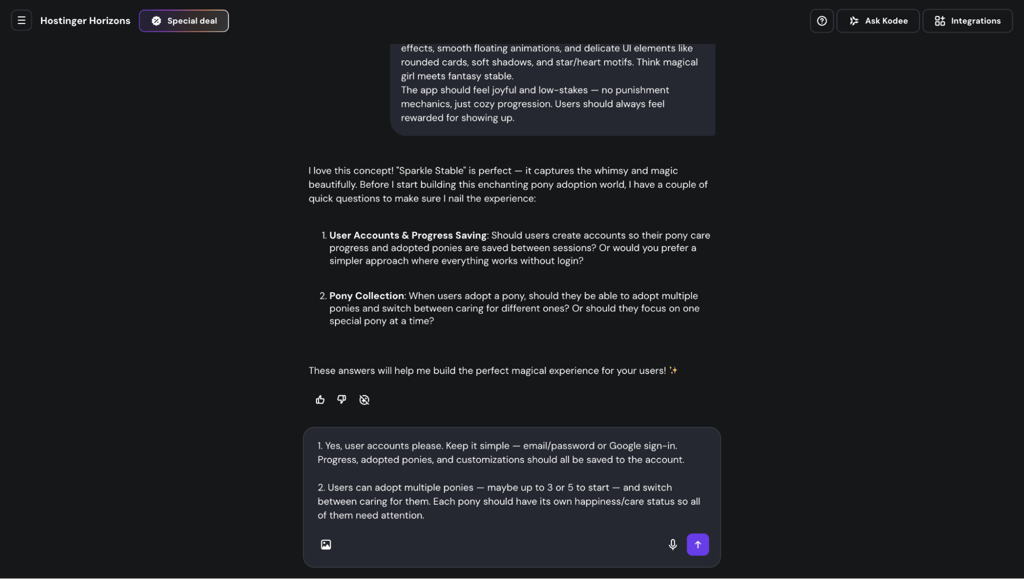
This back-and-forth costs zero AI credits because only the final code generation counts.
After the app is built, text and image edits happen in the WYSIWYG editor, also without credits. This workflow means a beginner can experiment freely before committing credits to structural changes.
Which is more flexible: Replit or Lovable?
Replit is more flexible overall. It functions as a full-featured IDE that supports more than 50 programming languages and gives developers full control over frontend code, backend logic, database architecture, and deployment infrastructure.
For UI control, Replit lets you build and style interfaces with any framework you choose. Lovable limits design customization to its visual style editor and direct code edits within its React + Tailwind stack.
For logic customization, Replit supports custom server-side code, complex API endpoints, and advanced state management in many languages. Lovable handles backend logic via Supabase, limiting what you can build beyond standard patterns.
For workflow freedom, Replit provides a full terminal, a package manager, multiple deployment types, and SSH connectivity. Lovable follows a guided conversational workflow where the AI makes most architectural decisions for you.
The trade-off comes down to priorities. Replit sacrifices some simplicity to give developers full control over branding, features, and infrastructure. Lovable reduces complexity to help users produce working apps faster and with a lower barrier to entry.
How does Hostinger AI Builder compare with Replit and Lovable in terms of customization?
Hostinger AI Builder focuses on AI-guided customization without requiring full code ownership, Lovable emphasizes AI-driven frontend refinement within its React stack, and Replit provides the most control through manual coding across its broad language and framework support.
Hostinger AI Builder sits in the middle. The Hobbyist plan and above include a built-in code editor for viewing and editing source code directly, as well as ZIP export for full code ownership.
You can start by prompting the AI in natural language, then switch to manual code edits when you need more precise control.
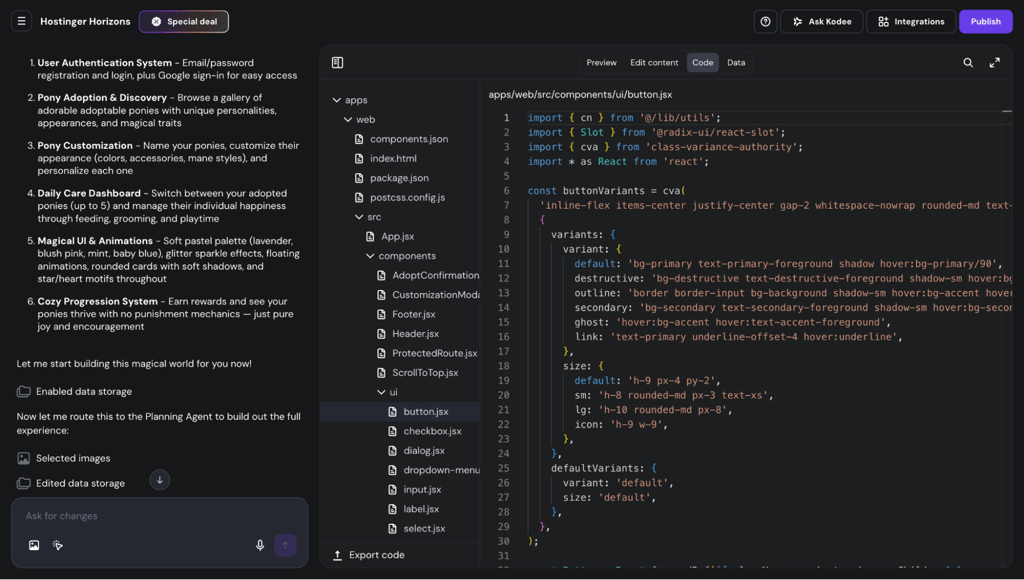
For real-world business use cases such as landing pages, online stores, or web apps with user authentication, Hostinger AI Builder provides enough customization depth to meet most requirements.
The WYSIWYG editor handles routine content changes, the AI manages structural updates, and the code editor covers edge cases.
Which is better for scalability: Replit or Lovable?
Replit is generally better for long-term development scalability and production-ready applications. Lovable works better for speed and rapid prototyping in the early stages of a project.
From a performance perspective, Replit runs on configurable infrastructure on the Google Cloud Platform, with autoscaling deployments that adjust to traffic. As you allocate more resources, your app can handle higher demand and maintain performance.
Lovable’s web app performance depends on Supabase’s managed database scaling and the efficiency of the generated React code. This setup works well at a moderate scale, but it offers fewer tuning options when traffic grows.
Replit apps scale through infrastructure you control directly, including autoscaling for variable traffic and reserved VM deployments for always-on availability.
Lovable apps scale through Supabase’s managed backend and structured React component patterns. Custom server-side processing, complex data pipelines, or infrastructure-level optimization usually require moving beyond Lovable.
For prototypes, Lovable is often the stronger choice because it produces a polished app in minutes with minimal setup.
For MVPs that need backend functionality such as user authentication or data storage, both platforms can work, though Lovable helps you launch faster while Replit gives you more backend control.
For production-ready apps with real users, growing data, and complex business logic, Replit is usually the better option because its full-stack environment supports the optimization and architectural control that production systems require.
How does Hostinger AI Builder compare with Replit and Lovable in terms of scalability?
Hostinger AI Builder provides built-in scalability for small to medium web applications through its bundled hosting infrastructure. Compared to Replit and Lovable, Hostinger AI Builder requires the least configuration to handle moderate traffic growth.
Hostinger AI Builder includes a Cloudflare CDN with WebP optimization enabled by default, along with SSL, DDoS protection, and unlimited bandwidth on all plans.
The integrated backend supports up to 5 GB of data storage per project and up to 500 automated emails per day. This covers the backend needs of most small to medium web applications.
If a project outgrows these limits, the code export option lets you migrate to a dedicated hosting environment. This creates a clear upgrade path.
You can build and validate with Hostinger AI Builder, then export and scale independently if the application requires it.
Which one is cheaper: Replit vs Lovable?
Replit and Lovable both offer entry-level AI-focused plans in the $17 to $21/month range. However, their pricing models work differently, and the total cost depends on how you build.
Both platforms charge dynamically based on the complexity of the prompt. Replit’s effort-based model triggers automatic pay-as-you-go billing once your monthly credits run out. Lovable caps usage at your available credit balance and does not charge automatic overages.
Replit’s Core plan includes $20 in credits that cover AI usage, deployments, databases, storage, and bandwidth from the same pool. Lovable’s Pro plan includes 100 dedicated AI credits and five daily bonus credits that roll over for one billing period.
Replit offers Core at $17/month (annual billing) and Pro at $95/month (annual billing) for teams of up to 15. Lovable offers Pro at $21/month (annual billing) and Business at $42/month (annual billing) for teams of up to 20.
Lovable’s credits go entirely toward building and refining your app, so you can often iterate faster per credit spent. However, complex projects can quickly use up 100 credits.
Replit’s credits cover the cost of keeping your app running after deployment. This means a deployed app consumes credits continuously, and long-term hosting costs can reduce your development budget.
For nontechnical founders validating an idea quickly, Lovable’s focused credit system usually offers more predictable costs and faster iteration.
For developers building complex applications that require custom backend logic and long-term infrastructure, Replit’s full-stack environment can provide more value despite higher cost variability.
How does Hostinger AI Builder compare to Replit and Lovable in terms of pricing?
Hostinger AI Builder offers a lower entry point than both Lovable and Replit. Its plans start at $9.99/month (annual billing), compared with Replit’s $17/month and Lovable’s $21/month entry-level plans.
The Starter plan at $19.99/month is the closest comparison to Replit Core and Lovable Pro. It includes 70 AI credits, ecommerce features, visitor analytics, WYSIWYG editing with no credit cost, collaboration tools, and a free domain for one year.
Because Hostinger AI Builder bundles infrastructure into the subscription, there are no separate charges for hosting, SSL, CDN, or custom domains on the Starter plan and above.
This makes the total cost of ownership more predictable than platforms where infrastructure costs are variable or drawn from the same credit pool as AI usage.
Which platform makes it easier to deploy to production: Replit or Lovable?
Lovable is generally easier to deploy to production, especially for rapid MVP launches. Its automated deployment workflow and preconfigured Supabase backend make the process simple.
On Lovable, publishing takes a single click that automatically handles hosting, SSL, and domain configuration. Replit requires you to choose from four deployment types (static, autoscale, scheduled, or reserved VM) before your app goes live.
You describe what you want, the AI builds it, and clicking deploy makes the app live on a Lovable subdomain with no additional configuration. Custom domains are available on the Pro plan and above. There are no external hosting requirements.
Replit gives you control over scaling rules, scheduled tasks, and always-on availability, but you need to understand each deployment type and its cost implications.
Deployment costs are deducted from your monthly credits, and autoscale deployments can incur unpredictable charges during traffic spikes. If credits run out, pay-as-you-go billing is automatically activated.
For teams that want an MVP live with minimal technical effort, Lovable is usually the faster path. For teams that need detailed deployment control for production-grade applications, Replit offers stronger tooling.
How does Hostinger AI Builder compare with Replit and Lovable for deployment and production readiness?
Hostinger AI Builder handles deployment, hosting, and infrastructure by default with zero configuration required, Lovable offers one-click deployment with automatic hosting on its subdomains, and Replit provides the most deployment flexibility with multiple deployment types for different infrastructure needs.
On Hostinger AI Builder, clicking Publish makes your application live immediately under a custom domain with the platform’s full hosting stack already configured. A sandbox testing environment also lets you test changes before they affect the live version.
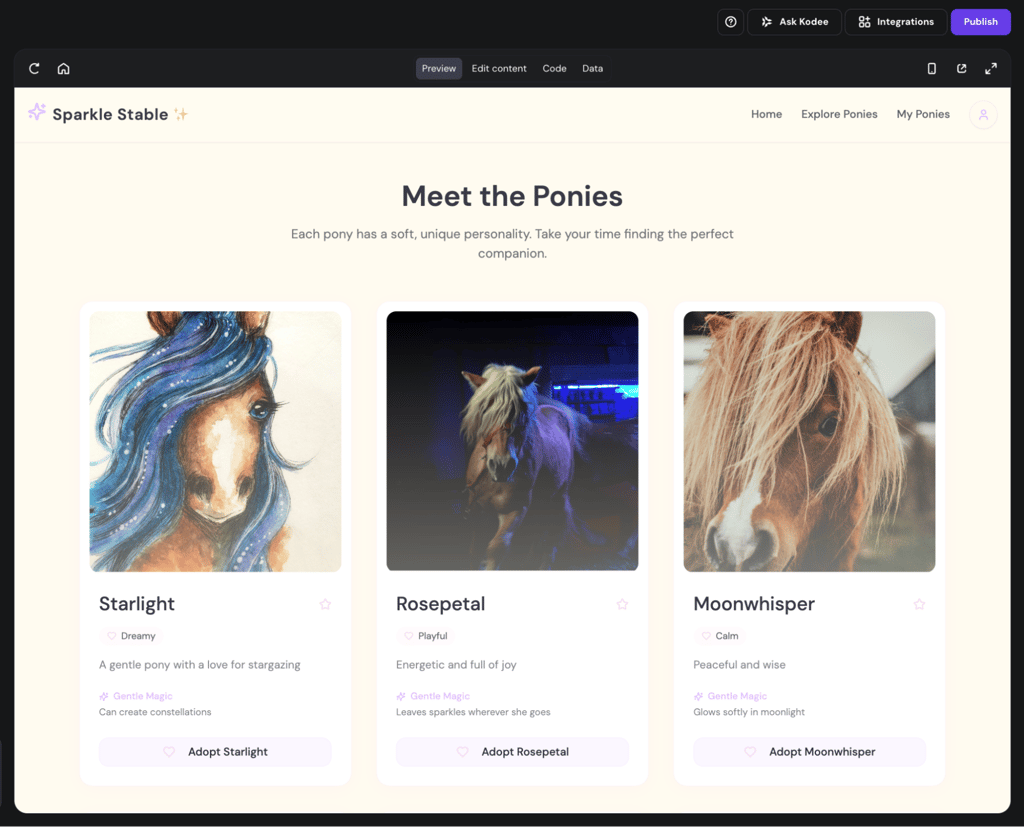
This approach removes the operational overhead that the other two platforms still carry. Replit needs ongoing credit management for deployments and infrastructure. Lovable requires a paid plan for custom domains and a separate Supabase configuration for backend reliability.
Among the three platforms, Hostinger AI Builder requires the least technical effort and the fewest external dependencies to move from building to running a live application.
Which platform should you choose to build with AI: Replit, Lovable, or Hostinger AI Builder?
Choose Lovable for fast, guided AI prototyping with clean frontend output, Hostinger AI Builder for the easiest all-in-one building and launching experience, or Replit for full-stack, code-first AI app development with maximum control.
The right platform depends on three questions:
- How technical are you? Replit works best for developers who want full control over the stack. Lovable suits users who can describe what they want but prefer the AI to make architectural decisions. Hostinger AI Builder targets users who want to build entirely through natural language, with a built-in code editor available on higher-tier plans for more precise adjustments.
- How far will this project go? For prototypes and MVPs, Lovable and Hostinger AI Builder both deliver fast results. Lovable is stronger for frontend-heavy MVPs, while Hostinger AI Builder is a better fit when you need a live product with backend functionality, ecommerce, or a custom domain. For production-grade apps with complex business logic, Replit’s full-stack environment offers the most room to grow.
- How much operational overhead will you accept? Hostinger AI Builder bundles hosting, SSL, CDN, and backend into the subscription, so there’s minimal maintenance. Lovable requires a subscription to keep apps live and may require separate Supabase management. Replit demands the most operational attention, with credits covering both AI usage and infrastructure.
Here’s who each AI-powered platform is best for:
- Replit. Best for code-centric AI development. Developers, technical teams, and startups building complex, production-grade applications benefit most from Replit’s full IDE, autonomous Agent, and built-in infrastructure. If your project involves custom backends, mobile apps, or multi-language architectures, Replit is usually the right fit.
- Lovable. Best for guided, fast AI app creation. Nontechnical founders, designers, and product teams validating ideas benefit from Lovable’s speed, visual quality, and structured workflow. If you need a working React prototype in hours instead of days, Lovable offers one of the fastest paths from concept to clickable product.
- Hostinger AI Builder. Best for building, launching, and scaling with minimal overhead. Solopreneurs, small business owners, and creators who want to move from idea to a live web app without managing separate hosting, domains, or backend services benefit most from Hostinger AI Builder’ all-in-one approach. The bundled infrastructure, predictable credit system, and low entry price make it one of the most accessible AI product creation platforms.
The best platform is the one that matches how you plan to build with AI today and how far you expect your project to grow.
If you’re exploring app development through vibe coding, start by evaluating your technical comfort level, your project’s complexity, and the level of ongoing maintenance you’re willing to handle.
All of the tutorial content on this website is subject to Hostinger's rigorous editorial standards and values.

Ariffud is a Technical Content Writer with an educational background in Informatics. He has extensive expertise in Linux and VPS, authoring over 200 articles on server management and web development. Follow him on LinkedIn.