30 profitable craft ideas to sell in 2026
Jul 27, 2026
/
By Simon L.
/
19 min Read

The best craft ideas to sell combine three traits – low material costs, short production time, and a selling price higher than their cost to make. Together, these determine whether a handmade product is genuinely profitable or simply breaks even.
The 30 most profitable craft ideas to sell include personalized products, digital goods, textile crafts, home decor, wellness products, DIY kits, and seasonal items. They range from low-cost impulse buys to premium custom products.
Pricing starts by calculating the total cost of making one item. The right sales channel depends on the product: digital and lightweight goods are ideal for online stores and marketplaces, while large or fragile pieces sell better locally.
Craft idea | Product examples | Approximate startup cost | Skill level | Personalization potential | Best sales channel |
Personalized drinkware | Mugs, tumblers, water bottles | $500–1,500 (printer, heat press, and blanks) | Intermediate | High | Etsy, own store, corporate orders |
Handmade jewelry | Initial necklaces, charm bracelets, earrings | $50–200 (tools and starter materials) | Beginner to intermediate | High | Etsy, own store, craft fairs |
Printables and digital products | Planners, wall art, templates | $0–150 per year (design software) | Beginner | Medium | Etsy, own store |
Hand-poured candles | Soy container candles, wooden-wick candles | $100–500 (supplies for a first batch) | Beginner | Medium | Own store, markets, wholesale |
Bath and body products | Soap, scrubs, lip balms, bath bombs | $50–200 (ingredients, molds, and packaging) | Beginner to intermediate | Medium | Markets, own store |
DIY craft kits | Embroidery, candle-making, and painting kits | $150–500 (bulk components and packaging) | Intermediate | Medium | Own store, Etsy |
Custom pet accessories | Collars, bandanas, ID tags | $150–400 (sewing machine, fabric, and hardware) | Beginner to intermediate | High | Etsy, own store, pet events |
Christmas ornaments | Personalized, wooden, and photo ornaments | $50–150 (materials, varies by medium) | Beginner | High | Etsy, markets, own store |
These costs assume a small home-based setup. Your actual costs will depend on your supplier, location, and order volume.
What makes a craft profitable to sell?
A craft is profitable to sell when its price covers materials, production time, packaging, and selling fees, and still leaves a margin worth your effort. Nine factors decide that margin:
- Material cost. Cheaper inputs leave more room for profit, as long as quality meets customer expectations.
- Production time. Every hour of labor has to be paid by the final price.
- Perceived value. Buyers pay for design, usefulness, meaning and finish, not raw materials.
- Personalization potential. Custom details justify higher prices and increase buyer interest.
- Repeat-purchase potential. Consumable products bring customers back.
- Batch-production potential. Making multiple items at once cuts the cost and time per item.
- Storage and shipping. Small, lightweight, and durable products cost less to store and send.
- Marketplace demand. Products with existing buyer interest are easier to sell.
- Competition level. Crowded niches can make it harder to stand out and maintain profitable prices.
High demand alone doesn’t guarantee profit. A product that requires excessive labor, expensive equipment, or fragile oversized shipping consumes its own margin.
Before turning your craft idea into a business, match it to your existing skills, available tools, startup budget, and intended sales channel.
Digital and lightweight products have lower ongoing costs than large handmade goods. A printable can be sold repeatedly without making a new item each time, while a custom wood sign requires new material, finishing, packaging, and shipping for every order.
Personalized and giftable craft ideas to sell
Personalization increases a product’s perceived value by turning a generic item into something made for one person. That’s why personalized crafts are especially popular for gifting, milestone, and event-related purchases, from weddings to work anniversaries.
1. Personalized drinkware
Personalized drinkware covers mugs, tumblers, water bottles, travel cups, and insulated flasks customized with names, dates, logos, or themed designs. Common methods include sublimation printing, laser engraving, adhesive vinyl, and UV printing.
One blank serves two markets: individual gift buyers and bulk orders for weddings, clubs, company merchandise, and group events.
The margin logic is simple: blank tumblers and mugs cost a few dollars each in bulk, while personalization sells them at gift prices. Getting started requires an entry-level sublimation printer and heat press, around $500–900.
Selling tips:
- Build template designs for common occasions so custom orders only need a name swap.
- Offer tiered bulk pricing to attract wedding parties and small businesses.
- Photograph products in real settings, such as on a desk or in a gym bag, rather than against a plain background.
Best sales channels: Etsy, your own online store, and local events.
2. Handmade jewelry
Handmade jewelry sells year-round because pieces are small, light, and cheap to ship. Prices are often driven more by design and perceived value than by material cost alone. Popular formats include charm bracelets, initial necklaces, birth-flower pendants, birthstone jewelry, earrings, and resin jewelry.
Personalization increases profit potential: an initial necklace uses the same material as a plain one but sells for a higher price because it feels made for the wearer. To sell jewelry online at premium prices, invest in material quality, controlled production time, branded packaging, and sharp product photography.
Selling tips:
- Anchor your shop to one recognizable style instead of a bit of everything.
- Photograph every piece both worn and on a plain background.
Best sales channels: Etsy, your own online store, and craft fairs.
3. Custom apparel and accessories
Custom apparel and accessories include personalized T-shirts, embroidered hats, aprons, patches, sweatshirts, and small fabric accessories made for niche audiences: events, clubs, small businesses, and local organizations.
You can produce items directly, which means buying blank apparel upfront and carrying the inventory risk if designs don’t sell, or use a print-on-demand business, where a supplier prints and ships each order, allowing you to avoid holding stock.
Direct production earns more per item but requires upfront investment and inventory management. Print on demand reduces financial risk because you only pay for products after a customer places an order, though the profit per sale is typically lower.
Selling tips:
- Target one niche audience per collection instead of designing for everyone.
- Test new designs with print-on-demand before buying blank apparel in bulk.
Best sales channels: your own online store, Etsy, and local organizations.
4. Custom pet accessories
Custom pet accessories turn a pet’s name, breed, or personality into products owners buy on emotion: collars, bandanas, ID tags, pet portraits, treat pouches, and matching owner-and-pet accessories.
Niche targeting makes these profitable. A generic bandana competes with mass retail; a bandana embroidered with the dog’s name doesn’t. Most items are lightweight, which keeps shipping cheap and makes them easy to display at markets and pet events.
Selling tips:
- Bundle matching items, such as a collar and bandana set, to raise the average order value.
- Offer breed-specific and size-specific fits that big brands skip.
- Add a personalization preview so buyers approve the names, spellings, or other custom details before you make the item.
Best sales channels: Etsy, your own online store, and pet events.
5. Personalized signs and plaques
Personalized signs and plaques cover family-name signs, house-number plaques, nursery signs, wedding signs, business signs, and milestone boards, made from wood, acrylic, slate, metal, or layered combinations.
Size, material, customization, and finishing determine the production cost. A small engraved slate costs a fraction of what a layered wood-and-acrylic wedding sign costs, and finishing time increases with every added element. Larger pieces are more expensive to ship, so offer local pickup for oversized orders.
Selling tips:
- Price by size and material tiers so quotes stay predictable.
- Market to weddings, housewarmings, nurseries, and small businesses, where personalized signs commemorate important occasions.
Best sales channels: Etsy, local pickup orders, and wedding vendors.
Easy and low-cost crafts to make and sell
Low-cost crafts reduce your financial risk: if a design flops, you lose a few dollars in materials rather than an equipment budget. They also work well as impulse purchases, add-ons to bigger orders, or digital products that require no inventory.
“Easy” refers to production complexity here: a product that’s simple to make in volume still requires skill and thoughtful design.
6. Printables and digital products
Printables and digital products include planners, invitations, wall art, worksheets, checklists, templates, labels, and printable craft patterns that customers download and print themselves.
You create the file once and sell it indefinitely, with no inventory or shipping. The costs lie elsewhere: design time, software subscriptions, marketplace fees, and customer support when a buyer can’t open or use a file.
Selling digital products online works best when each file solves one specific problem, such as a budget tracker for freelancers rather than a generic planner. Editable templates, bundles, and seasonal collections can increase order value without adding production work.
Selling tips:
- Niche down each collection to one audience and one occasion.
- Bundle related files to lift the average order value.
Best sales channels: Etsy and your own online store.
Every font, graphic, template, and clip-art element in a product you sell must be original or covered by a commercial license. Free-for-personal-use assets don’t qualify, and marketplaces remove listings over licensing complaints. This applies to printables, stickers, greeting cards, and any other design-based product.
7. Stickers and labels
Stickers and labels include planner stickers, decorative sheets, product labels, packaging seals, and personalized name labels. Production ranges from fully handmade to home-printed with a cutting machine, to outsourced printing, where you only handle the design.
Small size and minimal shipping weight make stickers one of the cheapest products to sell online. Themed sheets, bundles, and subscriptions turn a $4 impulse buy into repeat revenue, while business buyers order labels and packaging seals in bulk.
Selling tips:
- Use waterproof vinyl for anything destined for bottles, laptops, or outdoor use.
- Release themed collections monthly to give subscribers a reason to stay.
Best sales channels: Etsy, your own online store, and sticker subscriptions.
8. Greeting cards and paper goods
Greeting cards and paper goods cover greeting cards, postcards, gift tags, invitations, note cards, and small stationery sets. Batch production is the key to profitability: printing or assembling 50 cards in one session reduces the production time per card to just a few minutes.
Seasonal collections concentrate demand around birthdays, weddings, holidays, and thank-you occasions, while business stationery can bring recurring orders. Matching sets, such as a card with coordinated gift tags, raise order value with very little extra work.
Selling tips:
- Plan holiday collections at least one season ahead.
- Sell singles for impulse buyers and boxed sets for gift buyers.
Best sales channels: craft fairs, Etsy, and local boutiques.
9. Fabric bookmarks
Fabric bookmarks include designs in fabric, felt, embroidery, quilting, and tassels, usually sewn from scraps left over from larger projects. That’s the appeal: low material cost and a size that fits inside a standard envelope.
Themed bundles for readers, students, teachers, and gift buyers sell better than singles, and bookmarks pair naturally with journals, book sleeves, or reading gift boxes. At markets, they serve as low-priced impulse items that turn browsers into first-time customers.
Selling tips:
- Bundle three to five coordinated designs per set.
- Pair bookmarks with higher-priced reading accessories to raise order value.
Best sales channels: craft fairs, Etsy, and book-themed markets.
10. Keychains and bag charms
Keychains and bag charms come in acrylic, resin, fabric, leather, wooden, beaded, and engraved versions. Low production costs combined with personalization create the opportunity for strong margins: a $2 base item with a name or profession sells as a $10–15 gift.
Niche themes drive sales for this product. Initials, professions, hobbies, pets, and local landmarks all give buyers a reason to pick yours over a generic charm, and multipacks or matching accessory sets push orders past the single-item purchase.
Selling tips:
- Test attachment hardware before listing, since a failed clasp means refunds and bad reviews.
- Build collections around local landmarks for market and tourist sales.
Best sales channels: Etsy, craft fairs, and local gift shops.
Textile and wearable craft ideas to sell
Textile crafts combine everyday practicality with personalization and distinctive materials, making them easy to scale into repeatable product collections. A buyer who loves one hand-dyed cushion cover usually wants the matching set.
11. Crochet items
Crochet items sell best in small and medium formats: coasters, hats, bags, plushies, plant holders, keychains, and baby accessories. If you plan to launch a crochet business, those formats keep production time manageable, making it easier to price each item high enough to cover both materials and labor.
Large blankets and garments can command high prices but may take 20 hours or more to complete, which is why so many makers underprice them. Track production time per piece and set profitable prices for handmade crochet before listing anything. Themed collections and matching sets, such as a beach set with a bag and hat, encourage multi-item orders.
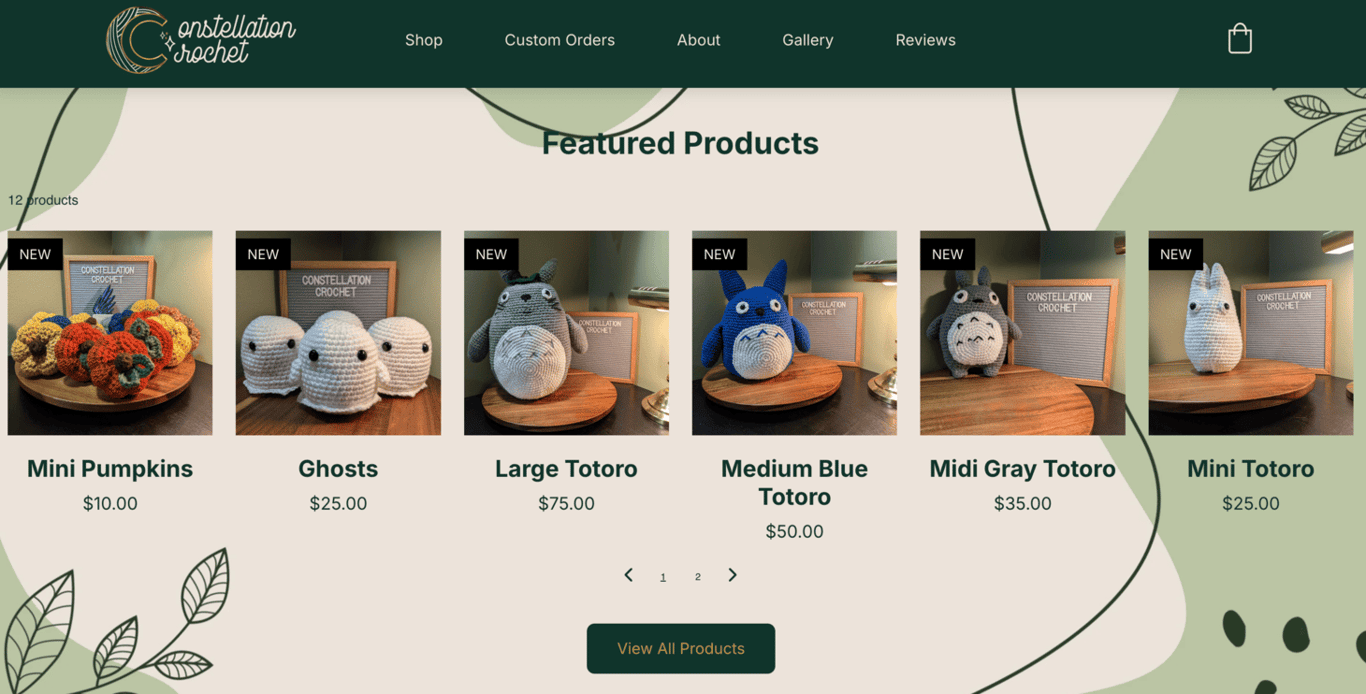
Constellation Crochet demonstrates this approach with plushies: seasonal designs at $10–25 attract new buyers, while larger custom pieces at $50–75 serve customers willing to pay for the extra production time and craftsmanship.
Selling tips:
- Standardize a few repeatable patterns instead of one-off designs.
- Photograph plushies and accessories in use, not flat.
Best sales channels: Etsy, craft fairs, and your own online store.
12. Handmade tote bags
Handmade tote bags range from fully sewn designs to decorated blanks, reusable shopping bags, laptop totes, and niche-purpose bags for gym gear or market hauls. Added features such as pockets, lining, zip closures, padding, and custom prints justify prices a plain canvas bag can’t reach.
Personalized, event, and business orders add volume, since totes double as wedding favors, corporate gifts and branded merchandise. If you use organic cotton or repurposed deadstock fabric, highlight it on the listing. The claim works only when the material backs it.
Selling tips:
- Add one practical feature per design, such as a phone pocket or a key clip.
- Offer bulk pricing for events and small businesses.
Best sales channels: your own online store, Etsy, and local markets.
13. Embroidery and cross-stitch products
Embroidery and cross-stitch products include framed pieces, patches, clothing personalization, ornaments, bookmarks, and custom portraits. Custom work drives value: initials, dates, and family or pet portraits sell for several times the price of a ready-made design.
Detailed commissions take hours, so factor production time into every price. Selling your patterns as digital downloads creates a second revenue stream with no additional production time per sale.
Selling tips:
- Publish a clear commission price list with estimated completion times.
- Convert best-selling designs into downloadable patterns.
Best sales channels: commissions through social media, Etsy, and marketplaces.
14. Textile-dyed goods
Textile-dyed goods include dyed clothing, scarves, table linens, cushion covers, wall hangings, and coordinated fabric sets, produced using techniques such as tie-dye, ice dyeing, shibori, and natural dyeing.
Limited-edition patterns are the commercial advantage: no two dye batches match exactly, so each drop sells as a one-time collection. Test colorfastness before selling, include washing instructions with every order, and keep base fabrics consistent so coordinated sets match properly. Make sustainability claims only when your fabrics and dyes support it.
Selling tips:
- Release small, numbered collections instead of a permanent catalog.
- Sell matching sets, such as table linens with coordinated napkins.
Best sales channels: your own online store, markets, and Etsy.
15. Resin accessories and small decor
Resin accessories and small decor include coasters, jewelry dishes, trays, bookmarks, decorative objects, and desk accessories. Silicone molds make resin a batch-friendly product: one pour can fill multiple molds, reducing cost and time per item as production scales.
Customization increases perceived value: colors, dried flowers, names, and embedded objects turn a plain coaster into a wedding favor or a memorial keepsake.
Selling tips:
- Make multiple pieces at once to spread setup and drying time across more items.
- Offer a customization menu with fixed options to keep orders predictable.
Best sales channels: Etsy, craft fairs, and your own online store.
Liquid resin releases fumes and irritates skin. Work in a ventilated space, wear gloves and a respirator rated for organic vapors, and let every piece cure fully before packing it.
Home decor and wood crafts to sell
Home decor crafts combine everyday use with personalization and a higher perceived value, since buyers treat them as part of their space rather than as a disposable purchase. The trade-off is logistics: large or fragile pieces raise packaging and shipping costs, so keep both in mind when pricing before you list.
16. 3D-printed home decor
3D-printed home decor includes vases, organizers, plant pots, wall decor, lampshades, and desk accessories. The production cost goes beyond the printer itself: filament, electricity, failed prints, maintenance, and paid design licenses all add to the per-item price.
Customization by color, size, name, and intended use helps your products stand out from mass-produced alternatives. Print only the designs you created yourself or have permission to sell commercially, since many free models are limited to personal use. Biodegradable filament like PLA requires industrial composting, so present it accurately rather than labeling every print as sustainable.
Selling tips:
- Track failed-print rates per design and price accordingly.
- Offer size variations of best-sellers, since creating different dimensions from an existing design requires little additional design work.
Best sales channels: Etsy, your own online store, and niche hobby communities.
17. Clay planters and trinket dishes
Clay planters and trinket dishes cover planters, ring holders, incense holders, spoon rests, and small trays.
The type of clay shapes the business model: air-dry clay requires minimal equipment, polymer clay cures in a home oven, and kiln-fired ceramics demand equipment or paid kiln access but sell at higher prices.
Fragility is the hidden cost. Budget for protective packaging on every order and price shipping honestly, since one cracked planter can erase the profit from several sales.
Selling tips:
- Sell themed sets, such as a trio of planters in graduated sizes.
- Offer personalized details, like initials pressed into the base.
Best sales channels: craft fairs, Etsy, and local boutiques.
18. Canvas and pressed-flower art
Canvas and pressed-flower art includes small canvases, textured pieces, pressed-flower frames, custom illustrations, miniature paintings, and mixed-media work.
Repeatable formats create steady income: a signature style produced in a fixed size can sell consistently, while one-off commissions add higher-priced sales.
Size, materials, originality, and customization set the price. A miniature original can outsell a large print because buyers value a one-of-a-kind work. The fastest way to turn original art into an online business is to pair a repeatable collection with a monthly commission-slot system.
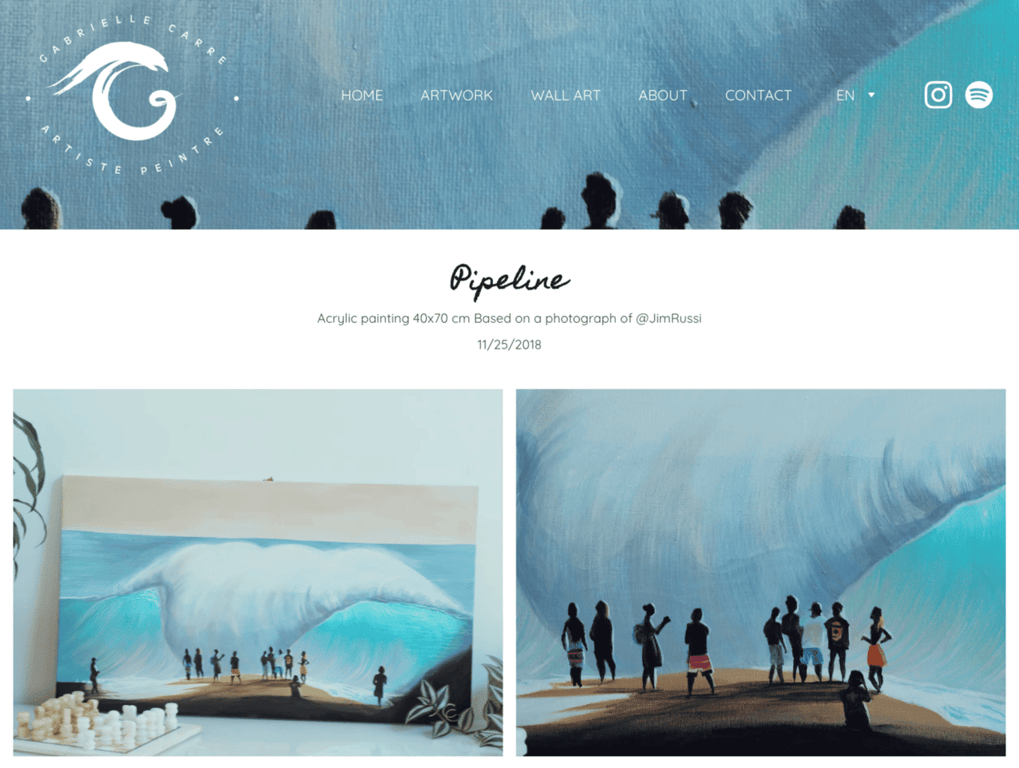
Gabrielle Carre demonstrates this approach: each painting on her site lists the medium, dimensions, and reference source, positioning every piece as a unique, documented original.
Selling tips:
- Fix two or three standard sizes to simplify framing and shipping.
- Open limited commission slots each month to control your workload.
Best sales channels: online commissions, markets, and local boutiques.
19. Wooden desk and home accessories
Wooden desk and home accessories combine function with warmth: picture frames, phone stands, laptop stands, monitor risers, cable organizers, charging docks, shelves, and device covers, plus garden pieces like birdhouses as a product variation.
Practical use and custom sizing raise perceived value, since a stand made for a buyer’s exact setup offers something mass-produced products often cannot. Wood type, finishing, hardware, production time, and shipping weight all affect profit margins.
Hardwood and hand-finishing sell higher, but slow production down. Avoid adding integrated electronics, such as built-in lighting or wireless charging, unless the components meet the safety certifications required by your market.
Selling tips:
- Publish exact dimensions and offer custom sizing at a premium.
- Batch-cut standard models and reserve custom work for higher prices.
Best sales channels: Etsy, your own online store, and local markets.
20. Wooden toys
Wooden toys include stacking toys, blocks, puzzles, pull toys, balance toys, and pretend-play sets. Parents often buy them as durable, plastic-free alternatives, and their longevity can support higher prices.
Design for the age group first: rounded edges, non-toxic finishes, and parts too large to swallow. Personalization, such as a painted name, works only when it doesn’t affect safety, so skip small glued-on letters or loose decorations.
Selling tips:
- Publish the finish and materials on every listing, since safety-conscious parents look for these details.
- Design toy sets that adapt as children grow to encourage repeat purchases.
Best sales channels: Etsy, your own online store, and children’s boutiques.
Children's products are strictly regulated in most countries. In the US, toys must comply with CPSIA requirements and the ASTM F963 safety standard, including third-party testing and a Children's Product Certificate; in the EU, toys need EN 71 compliance and CE marking. Research the rules for every market you ship to before selling.
Wellness, home fragrance, and DIY craft ideas
Consumable products change the sales model: a candle or a soap bar gets used up, so a happy customer can reorder instead of making a one-time purchase. DIY kits work differently: they sell a curated activity and the satisfaction of learning a skill, not just materials.
21. Hand-poured candles
Hand-poured candles cover soy candles, beeswax candles, container candles, sculptural candles, wooden-wick candles, and rotating seasonal scents.
Calculate the full cost before pricing: wax, fragrance oil, wicks, vessels, labels, burn testing, and packaging all need to be included in the cost of each candle.
Repeat purchases are the business advantage. Candles burn out, so a customer who loves one scent reorders it, joins a subscription, or buys gift sets, and wholesale accounts with cafes and boutiques can also add volume.
Personalized labels for weddings and events are one option among many, not the entire product line. To turn candle making into a business, establish two or three signature scents before expanding the catalog.
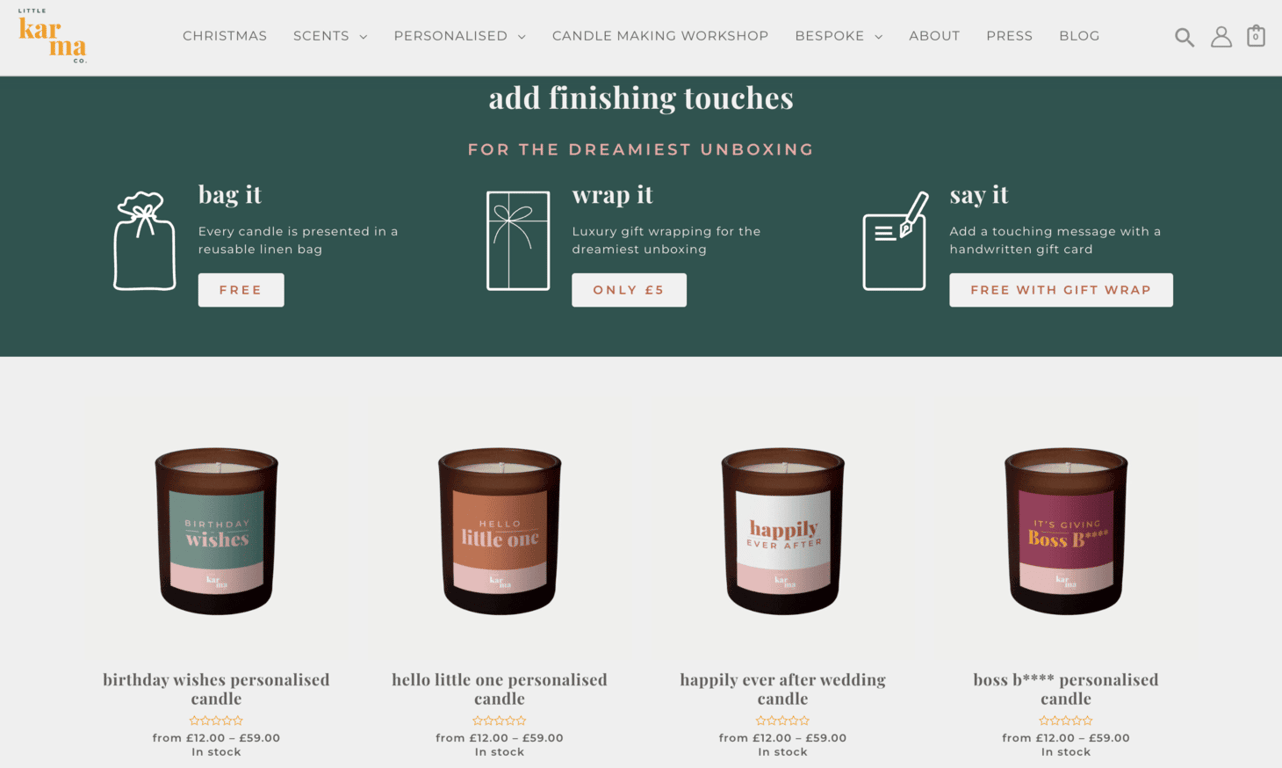
Little Karma Co. extends the value beyond the candle itself: free linen bags, optional gift wrapping, and a handwritten card lift the gift experience and support its £12 to £59 price range.
Selling tips:
- Burn-test every wax, wick, and vessel combination before selling it.
- Launch seasonal scents on a schedule so customers anticipate the drops.
Best sales channels: your own online store, markets, and wholesale accounts.
22. Wax melts and home fragrance products
Wax melts and home fragrance products include scented sachets and drawer fresheners, offering flame-free options for buyers who avoid candles. Batch production drives profitability: one pour fills dozens of clamshell molds, so the labor cost per unit stays low.
Scent collections and refill purchases drive repeat orders, and bundles move slower scents alongside best-sellers. Test fragrance strength and melting point for your climate, and package melts so they hold up during summer transit. Skip therapeutic and health-related claims entirely; sell the scent, not a promised effect.
Selling tips:
- Sell sample packs so customers can test scents cheaply before committing.
- Offer subscription refills for the strongest repeat revenue.
Best sales channels: Etsy, your own online store, and markets.
23. Bath bombs and shower steamers
Bath bombs and shower steamers sell year-round instead of being limited to Valentine’s Day, and the same ingredients also make bath salts and gift sets, so one supply order builds a full product line. Ingredient cost per unit is low, but moisture control isn’t optional: humidity can trigger the fizz reaction early, ruining stock.
Shelf life, airtight packaging, and correct ingredient labeling decide whether the product survives storage and complies with the cosmetics rules in your market. Seasonal scents and event bundles, such as exam-recovery or new-parent sets, concentrate demand without new recipes. Avoid medical or aromatherapy claims you can’t prove.
Selling tips:
- Shrink-wrap every unit and store stock with desiccant packs to control moisture.
- Build gift sets around occasions instead of single products.
Best sales channels: markets, Etsy, and your own online store.
24. Handmade soap and body care products
Handmade soap and body care products include artisan soap, sugar scrubs, lip balms, body butters, and solid lotion bars. Formulation is the foundation of the product: ingredient sourcing, testing, shelf life, packaging, and labeling affect both your costs and your legal requirements.
The repeat-purchase economics mirror the candle business model: soap gets used up, and a customer who trusts your formula reorders on a cycle. Gift bundles built around scents or skin types raise order value, and consistent branding across the line encourages customers to try the next product.
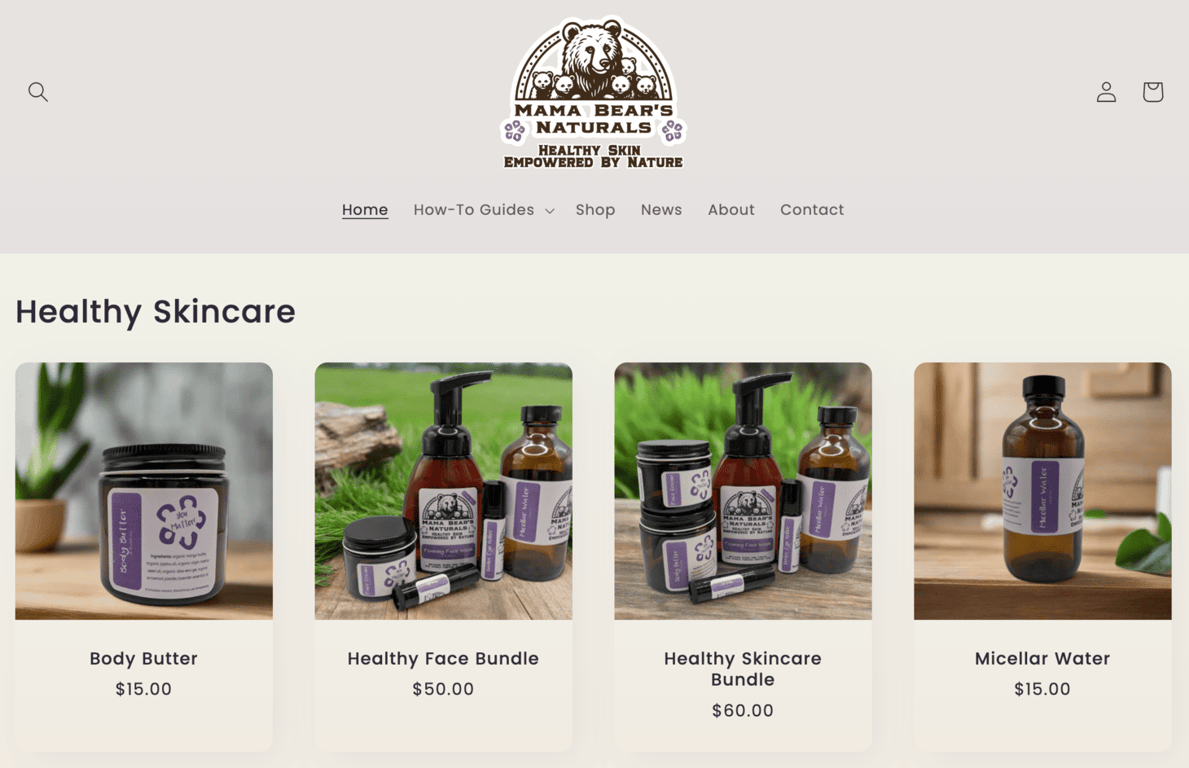
Mama Bear’s Naturals shows the bundle gap in practice: individual products start at $15, while bundled skincare sets reach $50–60, lifting the average order without adding new formulations.
Selling tips:
- Batch-test every recipe for shelf life before scaling production.
- Label every ingredient exactly as your market’s regulations require.
Best sales channels: markets, your own online store, and boutiques.
Cosmetics are regulated products. In the US, handmade soap and body care fall under FDA labeling rules, and the Modernization of Cosmetics Regulation Act (MoCRA) added registration and safety requirements, with some small-business exemptions. Verify the cosmetic rules in every market you sell to before launching.
25. DIY craft kits
DIY craft kits package materials, instructions, and the experience of making something: embroidery, painting, candle-making, miniature, crochet starter sets, and seasonal project boxes.
Buyers pay for curation, so the product is the whole box: beginner-friendly written instructions, a QR code linking to a video walkthrough, gift-ready packaging, and refill packs that turn one sale into a series.
Calculate the cost of every component and your assembly time per kit, since a $30 kit with $18 in parts and 25 minutes of packing can leave less profit than it appears. Include safety instructions whenever a kit contains tools, heat, chemicals, or small parts.
Selling tips:
- Film the project once and reuse the video across every kit sold.
- Sell refill packs so finished customers come back for the next project.
Best sales channels: your own online store, Etsy, and gift retailers.
Seasonal and occasion-based crafts to sell
Seasonal and occasion-based crafts create concentrated demand: a short window where buyers actively search and pay full price, followed by silence. Unsold stock may sit in storage until the next season, so take preorders, produce in small batches, and start marketing at least one season early.
26. Wedding and party favors
Wedding and party favors include personalized candles, keychains, mini soaps, place cards, magnets, favor boxes, and small keepsakes ordered in bulk for one event. The business depends on volume and coordination: one client, 100 units, a matching theme, and a hard deadline.
Set minimum order quantities that cover your setup time, and build production deadlines into every quote, since a favor delivered after the wedding is worthless. Coordinated personalization across the whole set is what clients pay for.
Selling tips:
- Publish clear minimums, lead times, and bulk price tiers.
- Send sample packs to event planners and venues for repeat referrals.
Best sales channels: direct orders, event planners, and local partnerships.
27. Christmas ornaments
Christmas ornaments include personalized, wooden, ceramic, fabric, engraved, photo, and upcycled designs. Personal details drive sales: names, dates, pets, family milestones, and locations turn a low material cost into a keepsake gift that buyers repurchase as their families grow.
Timing decides the season’s revenue. Start production by late summer and marketing by October, because search demand peaks well before December and shipping shortens the selling window.
Sets, family collections, and annual designs give collectors a reason to return every year. Keep designs reproducible: an ornament you can’t remake 50 times in November doesn’t belong in the catalog.
Selling tips:
- Launch a dated annual design to build a collector habit.
- Offer family sets with a matching design per member.
Best sales channels: Etsy, markets, and your own online store.
28. Holiday wreaths and garlands
Holiday wreaths and garlands cover Christmas, autumn, and spring wreaths, door hangings, table garlands, and reusable seasonal decorations. Materials, storage space, size, and shipping are the main challenges: wreaths are bulky, crush easily, and require more expensive protective packaging.
Local pickup solves most of that for larger pieces. Reusable bases with interchangeable seasonal elements extend one product across the whole year and give customers a reason to come back each season. Avoid flammable materials for anything likely to hang near candles or heat sources.
Selling tips:
- Sell interchangeable element sets that refresh one base wreath per season.
- Offer local pickup or delivery for oversized designs.
Best sales channels: local markets, pickup orders, and Etsy.
29. Halloween decorations
Halloween decorations include signs, wreaths, fabric decorations, garlands, tabletop pieces, and reusable props. Batch-friendly designs perform best here: the selling window is only around six weeks, so products you can produce in batches of 30 often outperform elaborate one-offs.
Storage and seasonality shape the economics, since unsold stock waits 11 months before the next selling opportunity. Themed sets and personalized family decorations, such as a name-painted trick-or-treat sign, add margin without complicating production.
Skip unsafe lighting, flammable materials, and complex outdoor installations.
Selling tips:
- Design collections around one theme per year to simplify batching.
- Start listing by early September, before search demand peaks.
Best sales channels: markets, Etsy, and local shops.
30. Memory books and legacy journals
Memory books and legacy journals turn milestones and family history into guided products: baby journals, wedding books, family-recipe books, travel journals, guided legacy books, and couple journals.
They sell well as gifts for holidays, anniversaries, weddings, births, and retirements – occasions when buyers want meaning over utility.
Offer the format in three ways: physical books, printable PDFs, and editable digital versions, each priced separately. Personalization through names, dates, custom prompts, covers, and page layouts moves the product from simple stationery to keepsake.
Selling tips:
- Write prompts for one specific relationship per edition, such as a grandparent-to-grandchild relationship.
- Sell the printable version as a low-cost entry to the physical book.
Best sales channels: Etsy, your own online store, and gift markets.
How to choose the right craft idea
The right craft idea matches your existing skills, available tools, startup budget, production space, time per item, shipping requirements, and sales channel with a product people already buy.
Start from your constraints, not from the highest-priced idea. A $150 wedding sign means little if you lack the tools, space, or patience to finish one per week. Depending on where you live and what you make, also check whether your business needs a license before your first sale.
If you have… | Start with… |
A tight budget | Printables, stickers, fabric bookmarks |
Sewing skills | Tote bags, pet accessories, bookmarks |
Woodworking tools | Signs, desk accessories, wooden toys |
Limited space or production time | Jewelry, keychains, greeting cards |
A goal of repeat customers | Candles, wax melts, soap, and body care |
Local buyers, rather than online reach | Wreaths, signs, party favors |
Test one or two products before launching several unrelated categories. A small, focused catalog reveals what sells and keeps quality consistent, and the best choice is rarely the idea with the highest selling price; it’s the one you can produce repeatedly at a cost that leaves room for profit.
How to price crafts for profit
To price crafts for profit, add up every cost of producing and selling one item, then set a price that leaves room for your target profit margin. The cost side includes materials, labor, packaging, equipment allocation, overhead, marketplace fees, payment-processing fees, and any shipping costs you cover.
Labor counts even when you make everything yourself. An unpaid hour is a cost you’re absorbing, not a saving.
Three numbers get confused constantly. Revenue is what the buyer pays, markup is what you add above your cost, and profit is what’s left after all business costs are paid.
Let’s use a hand-poured candle as an example: materials cost $4.50, packaging adds $0.50, and 15 minutes of labor at $20 per hour adds $5, creating a $10 base cost. A selling price of $22 gives you $22 in revenue and a 120% markup.
If you sell it on a marketplace that charges a 6.5% transaction fee, a $0.20 listing fee, and 3% + $0.25 for payment processing, then about $2.54 in fees comes out of the sale. That leaves roughly $9.46 in profit per candle before overhead like electricity and equipment wear.
Personalization and bundles raise prices without increasing costs at the same rate. Wholesale and bulk discounts reduce the per-unit price, but they also remove marketplace fees and make production more efficient through larger batches.
Margin-based formulas cover the rest: to price a product for profit, divide the total cost by one minus your target margin.
pro tip
Time a full production batch once, from setup to cleanup, and divide by the number of items. Makers who guess their labor time usually underestimate it by half.
Where to sell homemade crafts
You can sell homemade crafts through your own online store, handmade marketplaces, social-commerce platforms, local craft fairs, and wholesale partners. Most sellers combine two or three channels.
Your own online store is the only channel you control, with branding, pricing, customer data, and no marketplace commission.
It isn’t free, though: you still pay for hosting or a website builder plan, payment processing, and your own marketing, so treat it as a lower-fee channel rather than a no-fee one.

Marketplaces work the other way: you trade per-sale fees for built-in traffic and a faster start. Fees and features vary widely across platforms for selling products online, so match the channel to your product before committing.
Sales channel | Best for | Main advantage | Main limitation |
Own online store | Building a brand with repeat customers | Full control and no marketplace commission | You generate all the traffic yourself |
Handmade marketplaces (Etsy, Amazon Handmade, Folksy) | Reaching buyers already searching for handmade goods | Built-in demand and buyer trust | Per-sale fees and heavy competition |
Social-commerce platforms (Instagram, Facebook Marketplace) | Visual products and local sales | Free discovery through content | Reach depends on the algorithm |
Local craft fairs and markets | Fragile, bulky, or sensory products | Direct feedback and no shipping | Booth fees and limited selling hours |
Boutiques and wholesale partners | Steady volume without direct marketing | Predictable bulk orders | Wholesale prices cut the per-unit margin |
According to Etsy’s fees and payments policy, sellers pay a $0.20 listing fee, a 6.5% transaction fee on the order total, and a 3% + $0.25 payment processing fee in the US.
Amazon Handmade deducts a 15% referral fee (minimum $0.30 per item) and waives the $39.99/month Professional plan fee for approved sellers after the first month. Folksy, a UK-only marketplace, charges 15p + VAT per listing on its basic plan or £7.50/month for unlimited listings, plus a 6% + VAT commission on the item price.
Match the product to the channel: digital goods and lightweight items like jewelry, stickers, and printables are well-suited to marketplaces and your own store. Fragile or bulky pieces like wreaths, planters, and large signs sell better at fairs and through local pickup, while giftable consumables like candles and soap can perform across multiple channels and open wholesale doors.
Selling crafts also stacks with other ways to generate income online, from digital patterns to teaching your craft.
Start with one product, one channel, and a price that already includes your labor. Reinvest the first profits into better materials and photography, then expand the catalog once the numbers prove themselves.
All of the tutorial content on this website is subject to Hostinger's rigorous editorial standards and values.

Simon is a dynamic Content Writer who loves helping people transform their creative ideas into thriving businesses. With extensive marketing experience, he constantly strives to connect the right message with the right audience. In his spare time, Simon enjoys long runs, nurturing his chilli plants, and hiking through forests. Follow him on LinkedIn.