Agentic ecommerce is online shopping and store management where AI agents can independently complete several steps of a task for you, such as comparing products, building a cart, updating prices, or preparing a promotion.
Instead of giving a single answer and stopping, the AI agent checks current store information, works through the decisions needed to complete the task, and uses the store tools it has permission to access.
For shoppers, that can mean getting help from product discovery through checkout. For merchants, it can mean handing off parts of store management, such as catalog updates, promotions, inventory checks, and order handling.
What separates agentic ecommerce from traditional automation is that the agent can change its approach when new information appears instead of following one fixed sequence. That flexibility also makes accurate data, reliable checkout, and clear limits on what the agent can do more important.
What makes ecommerce agentic?
Ecommerce becomes agentic when AI can work toward a goal using current store data, decide what to do next, and take permitted actions in the store.
The agent doesn’t need unrestricted control to do that. It needs enough information and access to move the task forward within the limits set by the shopper or merchant:
- A clear goal. A shopper might ask for running shoes under $120 with arch support in their size. Those requirements give the agent a specific result to work toward.
- Current store information. The agent checks live prices, stock, shipping options, and product details so its decisions reflect what the store can offer now.
- A way to plan and adjust. Instead of merely returning one answer or applying a fixed rule, agentic AI can choose the next tool or action based on what it has learned, subject to its instructions and permissions.
- Access to store tools. The agent can search products, prepare a cart, update a listing, or perform another store action it has permission to take.
How does agentic ecommerce differ from other AI in ecommerce?
Agentic ecommerce is one type of AI in ecommerce. Unlike many other ecommerce AI tools that handle one defined task, an ecommerce agent can use the result of one step to decide what to do next and continue working toward the same shopping or store-management goal.
A fraud-detection system, for example, assesses a payment’s risk, while a recommendation system suggests products based on shopper data. Those are useful AI capabilities, but neither alone is an agent that can plan and act across a larger commerce task.
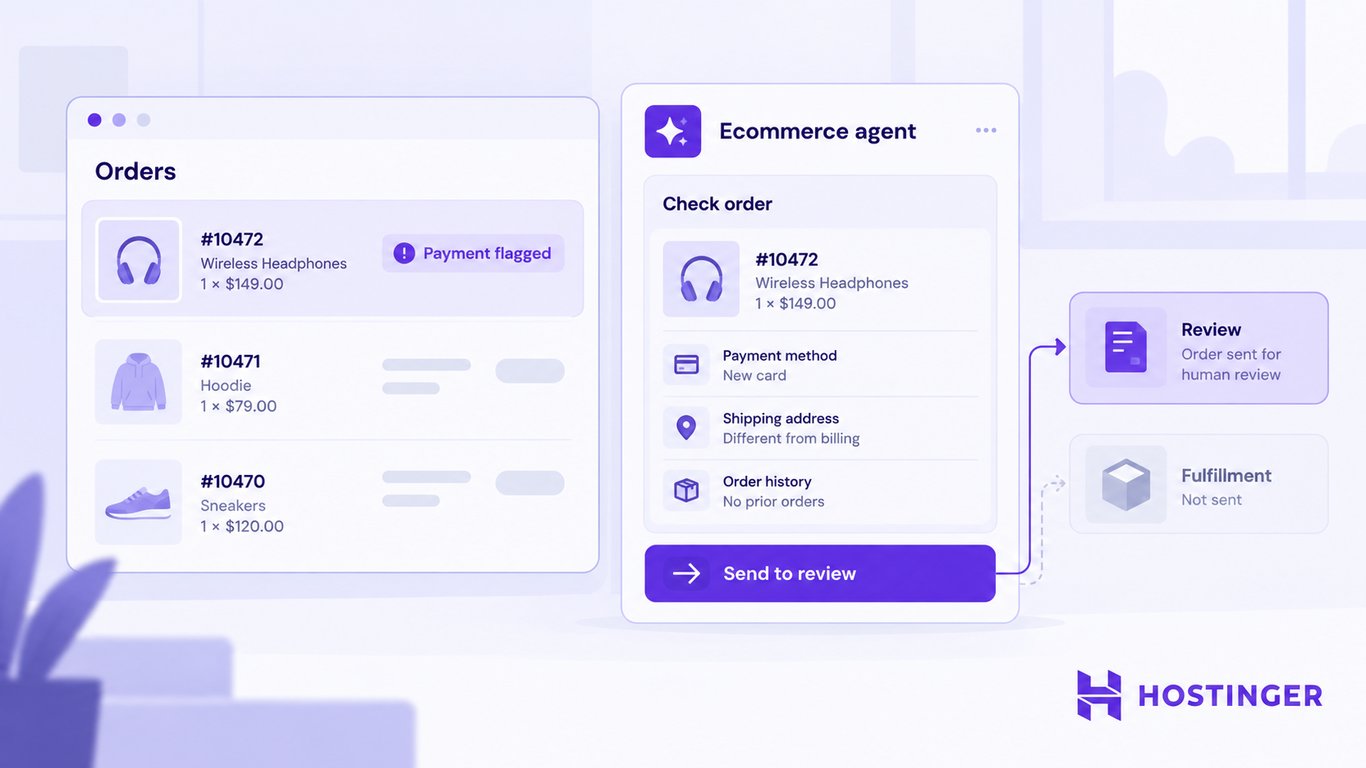
An ecommerce agent can use those results as part of a longer task. For example, the agent could check the order details and send the order for review instead of continuing with fulfillment if a payment is flagged.
Agentic ecommerce vs. traditional ecommerce automation
Traditional ecommerce automation follows rules you set in advance, while agentic ecommerce can adjust its actions based on the information it finds.
A normal automation might send an email 24 hours after someone abandons a cart or send a restock alert when inventory falls below 10 units. You decide what triggers the workflow, which action follows, and what happens next.
An agent can start with a broader goal, such as “recover abandoned-cart sales.” It could check whether the products are still in stock, review the cart value, and decide whether to prepare a discount or contact the shopper. The agent can adjust without you defining every possible path in advance if something changes during the task.
Traditional automation | Agentic ecommerce | |
Starting point | A trigger and rules you define | A goal to work toward |
Next action | Set by the workflow | Chosen using current information |
When conditions change | Follows another rule you created beforehand | Reassesses the situation and chooses from the actions it is allowed to take |
Best fit | Tasks that should run the same way each time | Tasks where the right action depends on what happens during the process |
Buyer-side vs. merchant-side ecommerce agents
Ecommerce agents can help shoppers make purchases or help merchants run their stores.
The difference comes down to who assigns the task and which store information and tools the agent has permission to access.
Buyer-side agents
Buyer-side agents help shoppers find, compare, and buy products. A shopper might use one through a retailer’s website, a marketplace, or an AI shopping service.
For example, a shopper could ask:
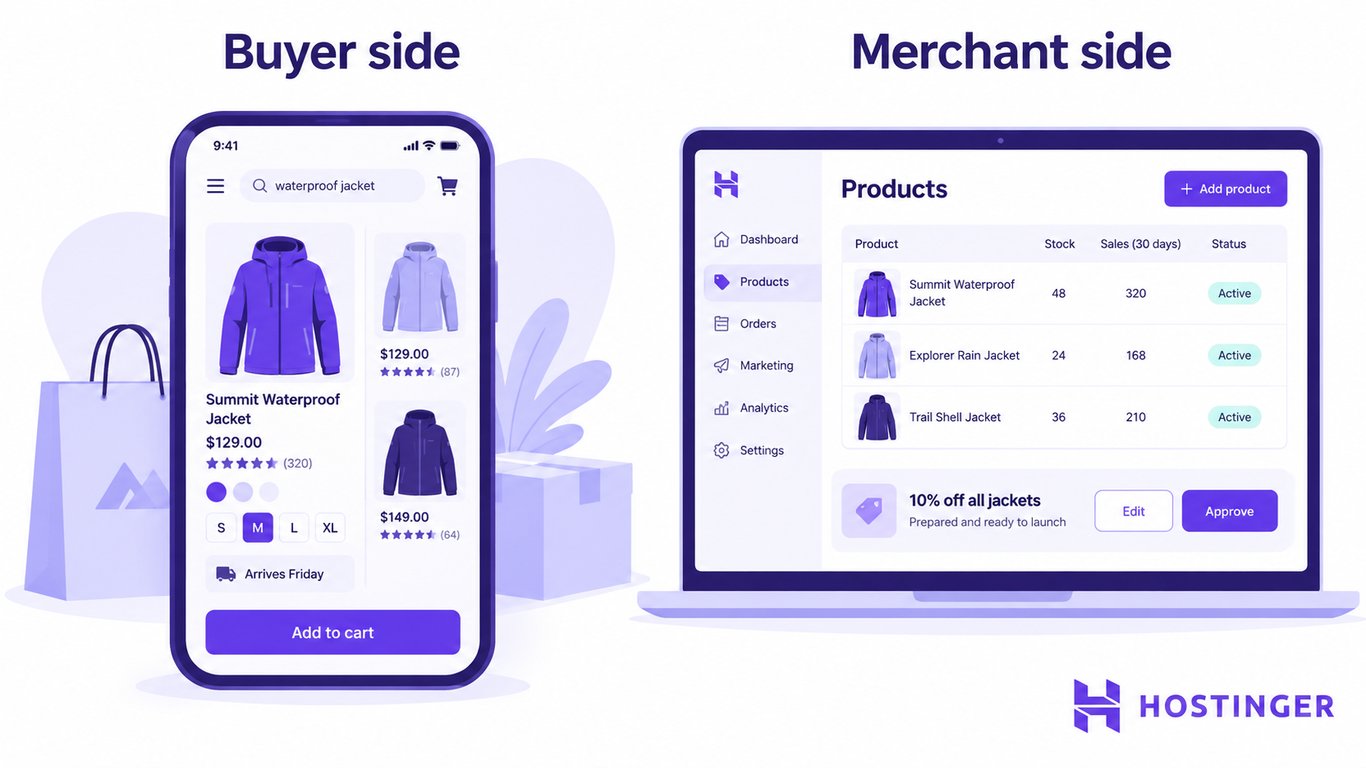
“Find a waterproof jacket under $150 in size M that arrives by Friday.”
The agent could search available products, compare prices and features, check which jackets are in stock in size M, and remove any that would arrive too late.
With cart access from the retailer or shopping service, the agent could add the shopper’s chosen jacket. Where checkout is supported, and the shopper has authorized the purchase, it could also complete the order within the approved product, delivery, and spending limits
The agent can’t simply do anything it wants on the store. What happens after the product search depends on the access the retailer and payment system provide.
Merchant-side agents
Merchant-side agents help businesses manage their stores. The merchant might use one inside the ecommerce dashboard or through another AI tool connected to the store.
Imagine the same store sells several waterproof jackets. The merchant could ask:
“Find waterproof jackets with high stock and no sales in the last 60 days, then prepare a 10% promotion for the ones that still have enough margin.”
The agent could check sales, inventory, and pricing data, identify the jackets that meet those conditions, and prepare the promotion.
The merchant decides how much control the agent gets. It might be allowed to update product details and prepare discounts but require approval before changing prices or publishing a promotion.
How agentic ecommerce works
Agentic ecommerce works by allowing an AI agent to use store information and permitted tools across connected ecommerce systems to complete a shopper or merchant task across multiple steps.
The request starts in the AI tool the person is using. That could be a shopping assistant on a retailer’s website, an AI shopping service, or a merchant tool connected to the store dashboard.
The exact task can vary, but the same agentic workflow applies. Here’s what it could look like when a shopper uses an AI shopping assistant:
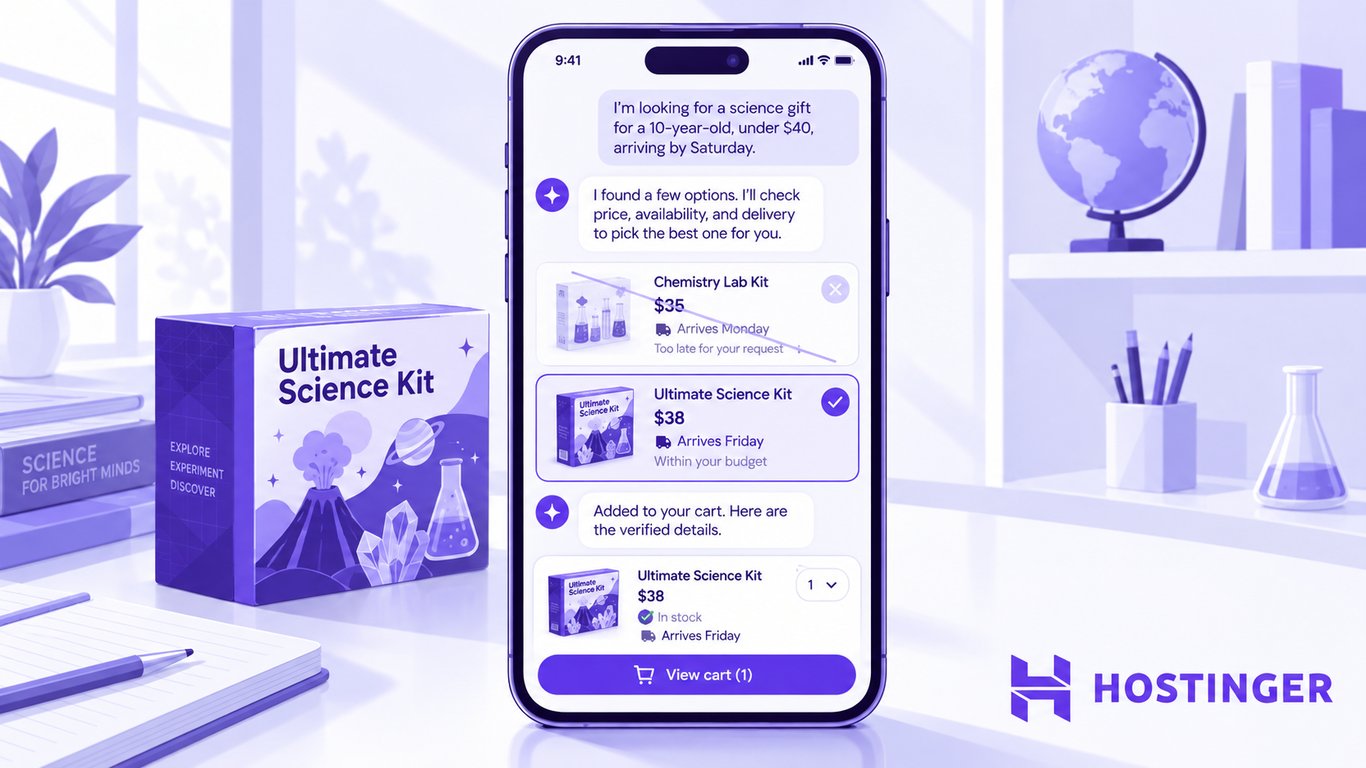
- The agent receives the goal. A shopper enters: “Find a science gift for a 10-year-old under $40 that arrives by Saturday.” The agent uses the age, budget, interest, and delivery date as conditions for the search.
- The agent checks current information. It compares suitable products using current prices, stock, age recommendations, and delivery dates. A $35 chemistry set won’t arrive until Monday, so the agent removes it from the options and continues searching.
- The agent requests an action. It finds a $38 science kit that is in stock and can arrive by Friday, then asks the store to add it to the shopper’s cart. The ecommerce platform creates the cart and calculates the current checkout details.
- The agent checks the result. It confirms that the product is still available at the expected price and delivery date. If something has changed, such as the item selling out, it can return to the remaining options and choose another product.
Agentic ecommerce use cases
Agentic ecommerce use cases include helping shoppers discover and compare products, build carts and complete purchases, track orders and get support, and helping merchants manage inventory, product listings, and promotions.
Product discovery, comparison, cart building, and selected merchant operations already work in deployed tools. Checkout and automated reordering are available in certain supported services and markets; cross-store autonomous purchasing, refunds, and broad merchant integrations remain more limited. Not every store or AI service supports these actions.
Product discovery and comparison
AI shopping tools can compare a shopper’s requirements with current product information and narrow down suitable choices.
A shopper searching for a dishwasher might ask for one under $600 that runs quietly and has a quick-wash cycle.
The agent can turn those needs into specific criteria, compare suitable products, and check current prices and stock before returning the matches that still fit.
Current shopping assistants already support parts of this process. Google’s AI shopping features help shoppers discover and compare products, while Amazon’s Alexa for Shopping can help customers research products and narrow down choices.
For merchants, accurate product details give these tools enough information to understand when a product matches what the shopper is asking for.
Cart and checkout
Agent-assisted checkout goes further because the system must know exactly what the shopper has approved and how the payment should be handled.
Google’sUniversal Cart began rolling out in the U.S. across Search and the Gemini app in October 2026. It saves products from multiple retailers and offers checkout through the Universal Commerce Protocol (UCP) with participating merchants, or transfers items to the merchant’s cart. The shopper still completes the checkout steps.
These systems work through supported shopping and payment flows. They don’t give an AI open permission to buy anything from any website.
That distinction matters for merchants: product discovery can work from accessible product data, while purchasing requires much tighter connections between the agent, merchant, customer account, and payment system.
Fulfillment and customer support
Agents can handle order and support questions when they have access to the information needed to answer them.
A shopper asking “Where is my order?” doesn’t need a support agent to find and copy a tracking number. An ecommerce agent with access to the order can return the latest shipping status directly.
The same approach works for checking whether an order is still within its return period or whether it can be canceled.
Issuing a refund is different because it moves money and may be irreversible. The agent should verify the order, refund eligibility, amount, and customer identity, then request explicit approval unless the merchant has granted a narrowly scoped, auditable refund policy.
Merchant operations
Merchant-side agents can handle jobs that normally require checking several parts of the store.
A merchant could ask:
“Find products with more than 90 days of inventory, check their margins, and prepare a promotion for the slowest sellers.”
With access to inventory, sales history, product costs, and pricing, the agent could identify suitable products and draft the promotion. It should flag missing cost data rather than guess whether the discount leaves enough margin.
This can save the merchant from checking each system separately, while the store still controls which changes the agent is allowed to make.
What infrastructure does agentic ecommerce need?
Agentic ecommerce depends on accurate store data, reliable software connections, working checkout and payments, clear business rules, and controls over what an agent can access or change.
Product information needs to be stored in a form that software can understand. For example, instead of mentioning “waterproof” only in a jacket description, the store can save “waterproofing” as its own product field. This is called structured product data.
Infrastructure area | What the agent needs | What goes wrong without it |
Product information | Clear fields for size, color, material, specifications, and product codes | The agent misses suitable products or compares them incorrectly |
Current prices and stock | Prices, discounts, and availability that match what the store can actually sell | The shopper sees a price or product that isn’t available at checkout |
Store connections | A reliable way for software to check products, carts, and orders or request changes | The agent can’t get the information or perform the action it needs |
Checkout and payments | Correct totals, shopper authorization, and a supported secure payment flow | The agent finds the right product, but the purchase fails |
Store policies | Clear shipping, return, cancellation, and refund rules | The agent gives the wrong answer about what a shopper can do |
Access limits and records | Enforced permissions, approval for sensitive actions, a record of changes | A mistake can affect parts of the store the agent never needed to touch |
The store also needs a controlled way to share that information and allow specific actions. AI agent integrations provide those connections and determine what the AI can read or change. One integration might allow stock checks without inventory edits, for example, while another could allow order updates.
One common way to create this connection is an application programming interface (API). An API lets one system ask another for information or request an action, such as “Is size 9 in stock?” or “Create this cart.”
Different stores and AI platforms also need to agree on how those requests are structured. A commerce protocol provides shared rules for those interactions.
Shared protocols can reduce the need for separate integrations with each AI platform. The Universal Commerce Protocol (UCP) supports catalog search, carts, checkout, and order management. OpenAI and Stripe’s Agentic Commerce Protocol (ACP) provide another approach to connecting agents with merchant checkout systems.
The specific standards will continue to develop. The practical requirement for merchants stays the same: outside software needs a dependable and controlled way to read store data and request supported actions.
Benefits of agentic ecommerce for merchants
Agentic ecommerce helps merchants reach shoppers through AI tools, spend less time on routine store tasks, and manage work across connected systems. Agents can also adjust their actions when store information changes.
- Reach shoppers through AI tools. Customers can discover and compare products through AI services without visiting your store first. Accurate product descriptions, prices, and stock information help these tools recommend relevant products. This is part of broader ecommerce trends changing how people shop online.
- Spend less time on repetitive tasks. Agents can check stock before a promotion or update multiple product listings, saving you from making the same checks and changes manually.
- Work across different store tools. Instead of checking inventory, sales, and orders separately, you can have an agent use information from connected systems to complete a task.
- Adapt when things change. When a product sells out or a price changes, an agent can use the new information to decide what to do next. Traditional automation relies on rules defined in advance.
For straightforward tasks with predictable steps, traditional automation is still the simpler choice.
Limitations of agentic ecommerce
The main limitations of agentic ecommerce are its reliance on accurate store data, the need for clear purchase approvals and access restrictions, and reduced merchant control when customers shop through third-party AI services.
Without proper safeguards, agents can recommend unavailable products, make purchases shoppers didn’t approve, or change store settings beyond their assigned tasks.
- Inaccurate product data leads to unreliable decisions. AI agents rely on product details, prices, and inventory information from retailers or connected services. Outdated data can lead to incorrect recommendations, misleading prices, or failed purchases.
- Unclear approval rules can lead to unwanted purchases. Shopping agents need limits on what they can buy, how much they can spend, and when they must request confirmation. Without these rules, shoppers risk paying more than expected or receiving items they didn’t intend to purchase.
- Excessive access increases the risk of mistakes and attacks. Agents with more permissions than their tasks require can make unintended changes to prices, refunds, or other store settings. Attackers can also exploit those permissions through prompt injection, which uses malicious instructions hidden in content the agent reads.
- Third-party shopping can reduce brand control. External AI platforms may influence which products appear, how features and prices are summarized, and when shoppers reach a merchant’s own site. Merchants should monitor product-feed accuracy and ensure critical product and policy details remain consistent across channels.
How to make an ecommerce store agent-ready
Make your ecommerce store agent-ready by checking product and inventory data, testing store integrations and checkout, reviewing store policies, and limiting what AI agents can access or change.
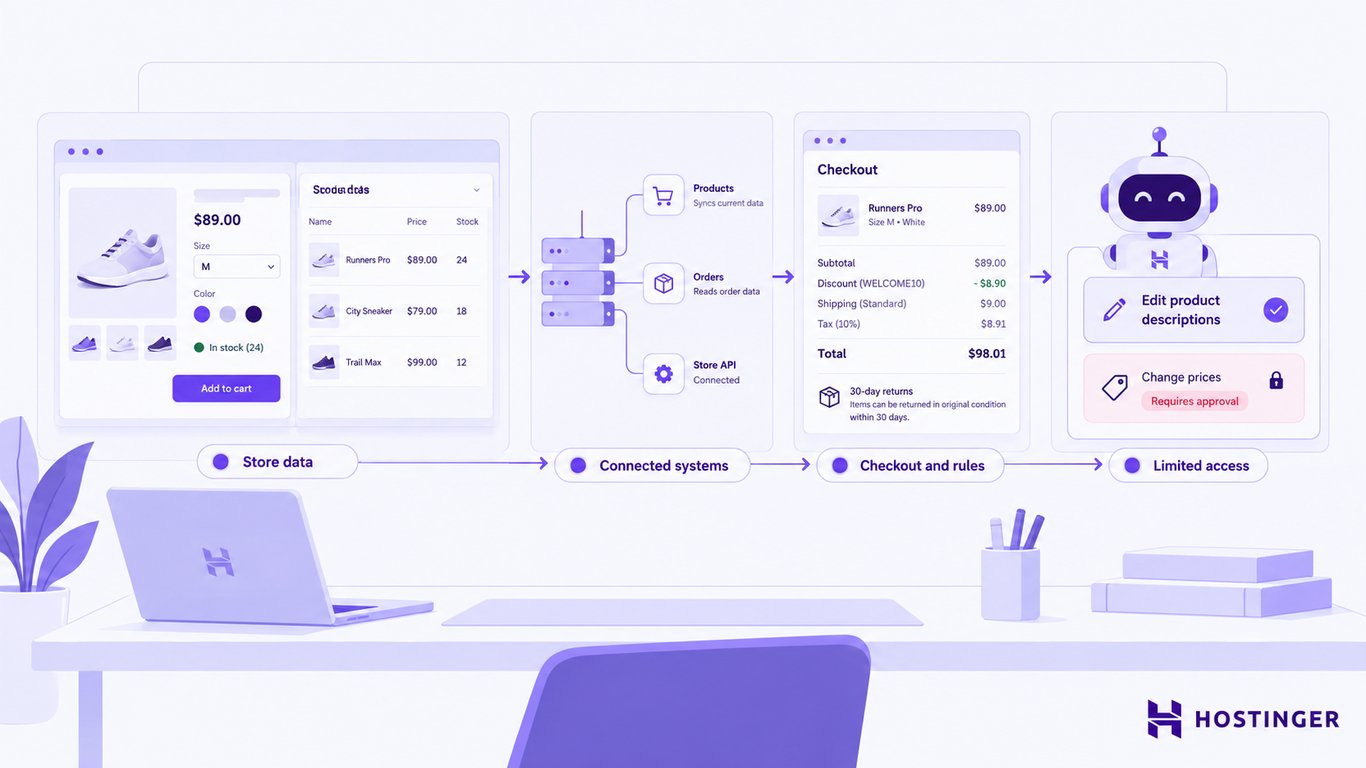
1. Check product, pricing, and inventory data
Check that your product details, prices, and inventory records are accurate, starting with products that have variants, discounts, or frequently changing stock.
Make sure details such as size, color, material, dimensions, product codes, price, and availability are stored in the correct fields rather than buried only inside descriptions.
Then compare the information shown on the product page with the record in your store dashboard. The variant, price, promotion, and stock status should match.
Pay particular attention to values that make sense to a person but not necessarily to software. If a color is listed as “Midnight,” for example, add a standard color such as navy where your store supports it.
2. Test how other systems reach your store data
Test whether your store’s API or other integration returns accurate data by retrieving one product variant. Use approved test credentials to check a test order separately, and confirm that only the authorized customer or merchant can access its details.
The values should match. Differences mean an agent could make decisions using outdated or incomplete information.
Merchants who don’t work with APIs directly can ask their developer or integration provider to run this check.
Hostinger Ecommerce maintains products, stock, carts, orders, payment settlements, and connected sales channels in a centralized Store Manager. Its Custom sales channel and Ecommerce API can give supported integrations a consistent commerce backend.
3. Test checkout and store rules
Test checkout and store rules using sample orders, with a test payment method or sandbox checkout where available to avoid charging a real customer.
Check that the price, discount, shipping charge, tax, availability, and final order stay consistent throughout the process. If the agent sees one price and checkout calculates another, the workflow isn’t reliable enough yet.
Test store policies the same way. Pick one order that qualifies for a return and another that doesn’t. Your written return, refund, cancellation, and shipping rules should make the correct outcome clear in both cases.
4. Limit access and start with a reversible task
Limit the agent’s access to what its first task requires, and choose a task that’s easy to review and undo.
Updating a small group of product descriptions is easier to review and reverse than issuing refunds or changing prices across the whole catalog.
Test the limits as well. Ask the agent to perform an action outside its permissions, such as changing a price when it only has content access. It should refuse the request or require the approval your workflow specifies.
Once the agent handles the narrow task reliably, expand its access one function at a time.
How does Hostinger support agent-ready commerce?
Hostinger supports agent-ready commerce by combining store data and operations in Hostinger Ecommerce with tools for AI-assisted management and custom sales channels.
Merchants can use Hostinger Agent for supported tasks inside Hostinger, while developers can connect compatible AI coding assistants through Hostinger Connector or build custom storefronts using the Public Sales Channel API.
These tools don’t automatically enable purchases through third-party AI shopping assistants, which require a separate, compatible checkout integration.
Hostinger tool or capability | What you’d use it for | How to get started | Best for |
Hostinger Ecommerce | Running the store itself, including products, inventory, orders, payments, shipping, and sales channels | Open Ecommerce in the Hostinger dashboard and set up the parts your store needs | Merchants who want to manage their store operations in one place |
Hostinger Agent | Getting AI help inside Hostinger with Ecommerce tasks available to your account, such as setting up payments or shipping | Open Agent in the dashboard sidebar or select Ask AI | Merchants who want help with store setup or account tasks without building anything |
Hostinger Connector | Letting an AI coding assistant work with Hostinger. For Ecommerce, documented uses include working with products, inventory, and orders | Install Connector for a compatible AI coding tool, sign in to Hostinger, and approve the connection | Developers or technical merchants building and managing their store with an AI coding assistant |
Public Sales Channel API | Building a custom storefront while keeping its catalog, orders, and checkout connected to Hostinger Ecommerce | Add a Custom sales channel, then connect through the API directly or build it with help from Hostinger Connector | Developers creating a custom storefront or another place where customers can shop |

Where should merchants start with agentic ecommerce?
Start with a dependable store setup rather than trying to connect every new AI shopping tool. Your product details, prices, stock, and checkout information need to match across the places you sell. Good ecommerce inventory management helps keep availability accurate as orders come in.
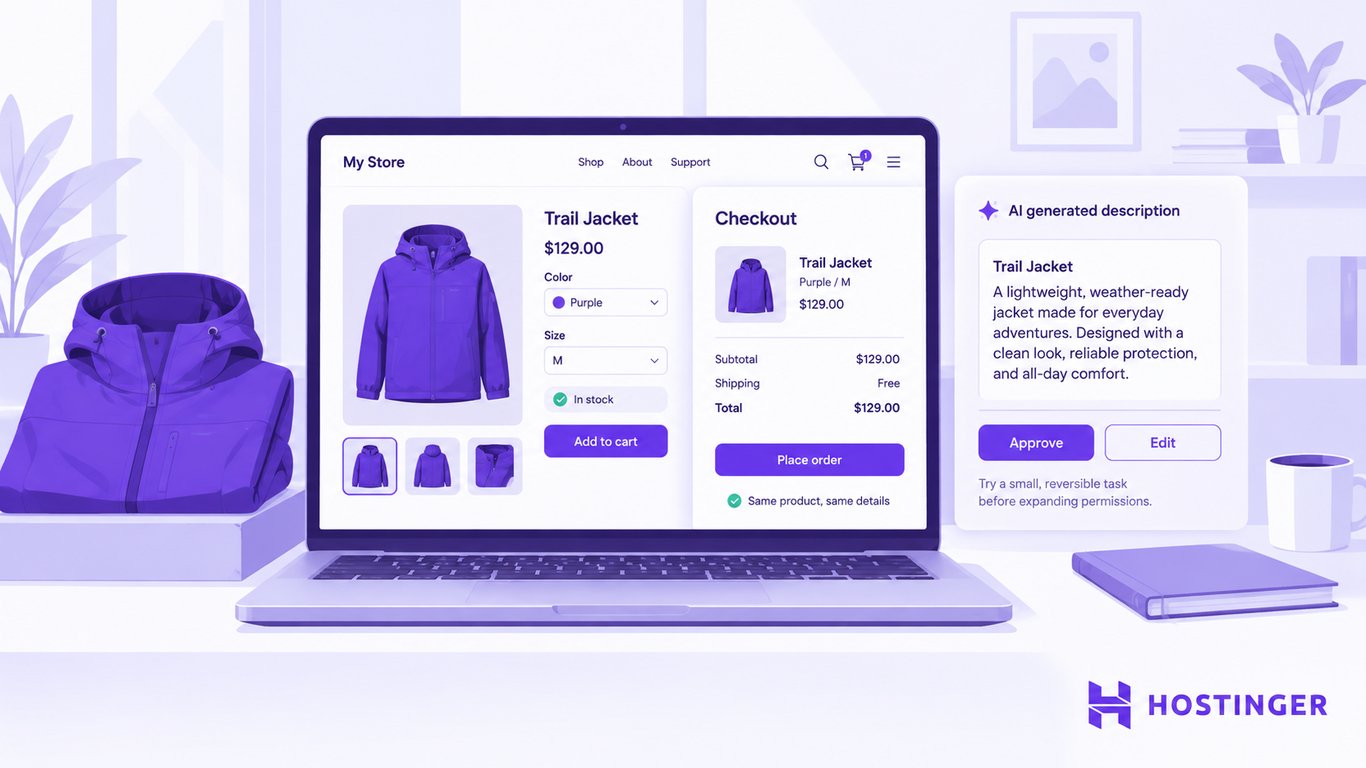
Once that foundation is reliable, give an agent one small task you can review, such as preparing updates for a few product listings. Use the checklist to prepare for agentic commerce, then verify that changes are accurate, unauthorized actions are blocked, and you can stop the agent before giving it more responsibility.
This article is a localized version of What is agentic ecommerce?, originally published in English.
All of the tutorial content on this website is subject to Hostinger's rigorous editorial standards and values.

Alma is an AI Content Editor with 9+ years of experience helping ideas take shape across SEO, marketing, and content. She loves working with words, structure, and strategy to make content both useful and enjoyable to read. Off the clock, she can be found gaming, drawing, or diving into her latest D&D adventure.